POTD: Spot the famous photojournalism reference

_N5_DSC1804bw copy
Nomos Tangomat GMT-12 Prototype in Auckland. Bonus points for those of you who can spot the famous photojournalism reference here – hint: think Prague. Sony NEX-5, 18-55 kit lens.

On assignment this weekend, so I apologize in advance if it’s a little quiet here or on flickr. I will still be using the D800 for most things as it won’t involve much, if any, wide-angle work; there’s a D3x in case it does, though. MT
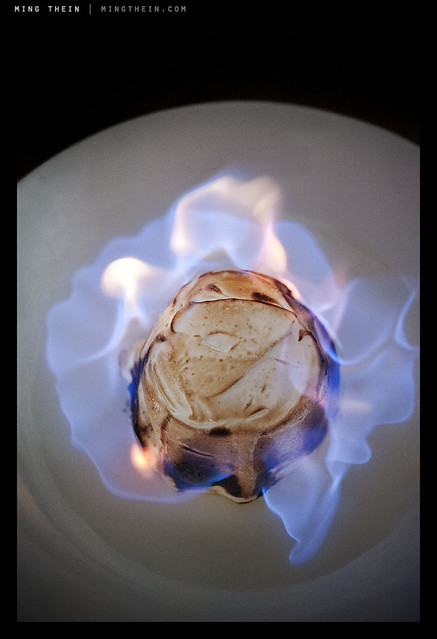
POTD: Flambé

_7060984 copy
Baked Alaska. Nikon D700, AFS 60/2.8 G Micro

Flames are a funny thing – they don’t photograph well. Simply, yellow flame is bright because it contains a lot of incandescent little particles; usually, it’s too bright to photograph well relative to surroundings – you land up losing detail in the flame if you have context, or losing context if you have detail in the flame. Blue flame is almost impossible to photograph because most of its energy is heat – there isn’t much in the way of light-emitting incandescent particles. Flames are also very random in an interesting fractal kind of way; photographically that means you’ve got to do many, many takes – four Alaskas, in the case of this shot. And dozens of frames until we got just the right flame.

The problem for food photography – specifically baked Alaskas – is that the lit brandy you pour over the dessert burns blue, which isn’t so great to shoot. Sure, you could composite flames in after, but it would both look unnatural and just be dishonest. So what do we do? Simple: add a little something to the alcohol that makes it burn brighter, and a little yellower.

Interestingly, this is where the high ISO capabilities of the D700 become useful: ISO 6400 with a good amount of remaining dynamic range and very low noise. I don’t think this shot would have worked as well with the D800. MT

Sushi, and the philosophy of photography

_PM07501 copy
Seared Wagyu beef with momeji oroshii.

Sushi is a universe in itself – there are so few components that if you get any one of them slightly wrong, the taste will be horrible. But if you get every one of them right, the experience can be magical. Specifically, your fish must be fresh and in season; precisely the right amount of soy sauce should be brushed on to the top, with a little dab of wasabi hiding between the rice and the fish. The fish itself is cut slightly concave so it drapes perfectly over the rice, itself measured to precisely the right quantity to make a mouthful and shaped by hand, not too tightly packed and not too loose, either.

_PM07411 copy
Katsuo (bonito) with ginger.

And then there’s the seasoning that accompanies the rice – a mix of mirin and rice vinegar – which must offer the right degree of tartness and sweetness to provide a counterpoint to the fish and soy sauce, but not so much that it overpowers or tastes sour. And this is before we even talk about more complicated creations that involve multiple types of fish, or searing, or additional condiments and seasoning.

_PM07492 copy
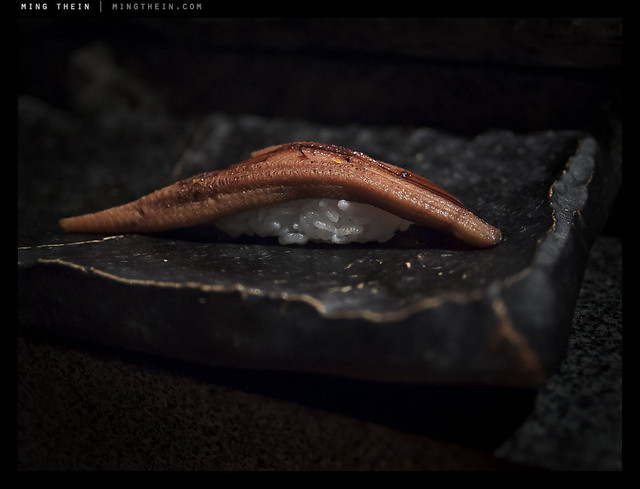
Broiled anago (freshwater conger eel).

There’s a parallel between sushi and photography (and sushi and many other things, actually) – aside from the obvious that it’s art, sushi making requires both technical skill and creativity. There are constraints, but you can work around them. It can be learned, it can be honed by experience, but there’s definitely an element of talent and intuition involved which all great sushi chefs possess. Photographs and sushi both come in small, bite-sized increments – they require little time to create if all the elements come together, and can be enjoyed in moments or contemplated for hours – I’ve eaten sushi dinners with 20+ different varieties served over many hours; I suppose that would be like going through the Magnum annual. Neither photography nor sushi is cheap, either; and mastery can take years.

_PM07485 copy
Torigai clam.

There’s even an anticipative element to it – the feeling of curiosity before you go to eat (wondering what is in season and came from Tsukiji today) is much like the feeling I get before a shoot; you’re all excited and ready to go. It’s also entirely possible that it’s just me.

_PM07471 copy
Seared katsuo

The best sushi I’ve ever eaten – so far – comes from a local chef in Kuala Lumpur at a restaurant called Hanare; Kenny Yew is an absolute genius when it comes to creating new things – for instance, seared wagyu with momeji oroshii chili – as a sushi. I need to go at least once a month or I get withdrawal symptoms and the DTs, because I just can’t eat sushi anywhere else now. The few lucky friends I’ve taken there feel the same way. It really is art – some of the pieces make me tingly and others nearly bring me to tears. I’ve eaten things there I never would have though edible, let alone ordered – and loved them. That’s much like how certain exhibitions, art or equipment inspire me to try photographic experiments that work out a lot better than expected.

_PM07446 copy
Seared hama-tai (sea bream)

And best of all, you can mix the two. The lighting conditions at that restaurant are pretty horrible, but they save me a seat at the counter which happens to have a halogen spot over it; I position my sushi carefully to be well-lit. This set might appear the same, but that’s because I wanted a consistent point of view; (and comparison)
they were also shot during the same meal. I discovered one other thing that night: the best color I’ve yet managed to achieve is delivered by a combination of Zeiss glass and Olympus cameras.

_PM07395 copy
Oo-toro. (Fatty yellowfin tuna belly)

I had the ZF.2 2/28 Distagon on the Pen Mini via an adaptor, and was utterly floored by the color when I opened up the raw files on my computer – the sushi literally looked like it had in real life. Every bit of the color, texture, iridescence and freshness was captured. I’m guessing it’s a combination of the fortuitous lighting, the great color and micro contrast of Zeiss lenses in general, and the pleasing color palette of Olympus cameras. Whatever it is, I think I’ve found my perfect sushi-camera.

_PM07426 copy
Red snapper.

My parting advice is that if you do get a chance to eat sushi made by a master, do as you would do at an exhibition of photographs by a great photographer: put away your preconceptions, go in with an open mind, and enjoy. You’ll probably be surprised. MT

_PM07424 copy
Kamburi (giant yellowtail).

A couple more Nikon D800 images, and some commentary

_8001029 copy

Shadows. Nikon D800, 28-300VR

One of the big questions that’s been running around the internet is whether the D800 can replace medium format – the answer isn’t quite as simple as you might think. Firstly, the resolution is definitely there to compete with the lower pixel count options – and even more so once the D800E joins the fray. However, a very large part of the medium format ‘look’ is a product of the interaction between lenses, sensor size (i.e. angle of view) and tonal response of the sensor. Remember that almost all medium format sensors are CCDs, which have a very different – and less linear – tonal response to CMOS sensors. For comparison at the 35mm/FX size, the D700 and D800 both have a different tonal palette to the CCD-based Leica M9. Undoubtedly the look is different already due to no other factors.

However, once you consider the angle of view vs DOF equation, then things look different again – it’s similar to the difference between APSC and full frame – for a given angle of view and aperture, you’re going to have ever decreasing depth of field (and quicker transitions between in-focus and out of focus areas) with the larger sensors.

Some of the other things which have been of concern to shooters – like having enough light and decent support – are nothing new in the medium format world, especially to users of very high resolution backs like the IQ180 or H4D-MS; this is perhaps why a lot of people are crying ‘so what?’. Even so, good support pays off for both medium and smaller formats – even compact shooters have something to gain. The tradeoff is always weight and flexibility.

A quick note on color reproduction: the D800 has the most accurate color I’ve ever seen. This seems to be corroborated by the recent batch of DXOMark tests, which rank the D800 first (!). Most cameras have trouble accurately reproducing the blue-green-cyan tone of glass reflections (due to UV transmission/ reflection issues) – but the D800 required only minimal corrections. Furthermore, the very fine repeating patterns between the squares on the textured floor panels do not show visible moire, but plenty of detail. It’s also worth noting that nothing is blown out, and I crushed the shadows for the visual effect – there weren’t any blocked up blacks, either.

_8001224 copy
The look. Nikon D800, 28-300VR

Again, I was very pleased with the quarter tone reproduction quality here. I’m actually finding that for a lot of images – especially those with less contrast – you need to apply a curve with a very long, shallow shadow tail in order to get the right ‘look’. This is undoubtedly due to the D800’s huge dynamic range at low ISOs. As for detail, you can see the weave in the man’s shirt and my reflection in his glasses.

_8001190bw copy
Bike traffic. Nikon D800, 28-300VR

This shot was a test in many ways – extreme highlights and shadows; lots of fine detail; tonality of B&W conversions. The short answer is, the camera passes. The image (which looks much better on a large monitor at full size, by the way) retains good detail even into the extreme corners, despite being shot with the weakest end of the 28-300VR, and has nice rich quarter and half tones, which make for a good B&W image.

_8000812bw copy
The reader and the thinker. Nikon D800, 28-300VR

This portrait is a little deceptive, because there was a lot less light than it appears – 1/125s at ISO 1800, f5.6 and 150mm. Yet the camera held on to shadow details well – with remarkably little noise, I might add – and I can read the text in the newspaper at full size. I don’t think the files make as outright punch B&W conversions as say the Leica M9-P, but black and white conversions from the D800 seem to have a unique signature of their own – perhaps best characterized by subtle tonal gradations and deep shadow detail. In short, I like what I’m seeing, but I’m going to need to adapt the processing style a little to get the most out of it. MT

Photoessay: Cigars

One of my other passions is to have a good cigar now and again. Although I mostly prefer Cubans, there are also some very good things coming out of the Dominican Republic such as the Fuente Opus X and Padron brands. Needless to say, a camera usually accompanies me to these outings; partially because it’s attached to me like an extra limb, and partially because I write the occasional review and video for My Cigar Blog. MT

This series shot with a whole load of different equipment.

_M9P1_L1001196 copy

_7050217 copy

_7050126 copy

_7048354 copy

_7041334 copy

_7041315 copy

_220_IMG_0162bw copy

POTD: Sunset clouds over the sea

_M9P1_L1013197 copy
Sunset clouds over the sea. Over Hat Yai, Gulf of Thailand. Leica M9-P, 35/1.4 ASPH FLE

Photoessay: Mount Yotei

Mt. Yotei overlooks the Niseko area in Hokkaido, northern Japan, and is itself a popular skiing destination. In many ways, it’s the archetypical ‘perfect’ mountain, being symmetrically conical – much like the iconic Mt. Fuji. It also happens to provide a perfect backdrop to a golf course. Shot during the summer off season, when everything is green and not covered in snow. MT

Series shot with the Nikon D700, Zeiss 2/28, 2/35 and 2/100 lenses.

_7013841 copy

_7013875 copy

_7013195 copy

_7013429 copy

_7014255 copy

_7014399bw copy It’s everywhere, even in town!

Photoessay: The Shipbuilders

Here they build the super-tugs that maneuver and tend to offshore oil drilling rigs and production platforms. Series shot at the Jaya Shipyards in Singapore with the Panasonic TZ3 and Ricoh GR-Digital I. MT

P1030651b copy.jpg

P1030386b copy.jpg

_1002147bw copy.jpg

_1002116bw copy.jpg

P1030546bw copy.jpg

P1030402bw copy.jpg

_1002121b copy.jpg

P1030541bw copy.jpg

P1030674b copy.jpg

Photoessay: The Ford GT40

This car is a bit of a legend – the weapon that Ford used to beat Ferrari at their own game at Le Mans in the late 60s and early 70s. I was lucky to find an original, still-raced example locally, and even luckier to get the chance to photograph it. MT

Series shot with the Fuji Finepix X100.

_DSF1793 copy

_DSF1783 copy

_DSF1886 copy

_DSF1874 copy

_DSF1860bw copy

_DSF1806 copy

_DSF1891bw copy
Every special race car comes with a cute grid girl in a short skirt.

Photoessay: Nagarkot

Nagarkot is a popular tourist destination at the foothills of the Himalayas in Nepal; you aren’t really there, but you do get a spectacular view of the mountains if the weather cooperates – it did to some extent on the one day and one night we were there. Kathmandu is situated in a valley that tends to trap smog, pollution and every other kind of nasty; less than two hours outside (probably more like half an hour if the roads were maintained properly) and you’re breathing clear mountain air. Feeling ambitious, we undertook a 9km round trip hike; we underestimated the heat and altitude, and landed up flagging somewhat on the way back down – it might have had something to do with the rather disappointing view from the ‘lookout tower’ that was both not that much of a tower, and extremely difficult to climb because the ladder inexplicably started six feet off the ground. MT

Series shot with a Nikon D700, AFS 24/1.4 G and AFS 85/1.4 G lenses.

_7030232 copy
Everest by aeroplane

_7037602 copy
Incredible night view; not really visible to the naked eye, but that’s why we have cameras with 30s exposures and f1.4 lenses.

_7037720 copy
Before sunrise. What appears to be a cloud bank turns out to be a solid unbroken mountain range.

_7037739 copy
Breaking dawn

_7037774 copy
Watching the view

_7037832 copy
Commando training – center left.