I’ve always found the Atlantic coastlines to be a little melancholy: there’s the beauty of nature, but often something heavy in the sky and a bite to the wind that makes you glad you brought your coat and hat. People still go because they’re attracted to the sea and presumably wondering what’s over the horizon; in this case, we’re at one of the westernmost points of the European continental mainland, and there’s pretty much nothing until you hit the coast of America. This series of images was shot in the space of a couple of hours. Porto’s old town proper had proven rather depressing, and the weather hadn’t helped; we took a chance and headed to the coast with the hopes of one last hurrah before returning to Lisbon. I’m glad we did, because I think it paid off – even if it meant using a lot of damp towels later to carefully dissolve the dried salt off our equipment. Despite the huge amount of moisture in the air and seawater splashing everywhere, the Hasselblad didn’t miss a beat – though curiously there was a lot more dust on the sensor than normal, perhaps sticking as a consequence of humidity.
Off topic: thoughts on turning 30, or – the trouble with choice

The barrier: mental, physical, or simply too much confusion?
How many careers will the average 30 year old have by the time they retire – if they can even afford to retire? My guess is anywhere north of five. This is a stark contrast with my parents’ generation, where working with the same company for life wasn’t unheard of – and 20+ year stints were pretty common. A move after anything less than five years was seen as ‘unstable’. When I began my career 14 years ago, that timetable was down to three; these days, a year is just fine. Are we learning faster? Probably not. Are we getting more impatient? Definitely. Tomorrow, I’ll turn 30. I am aware that this is probably a bit younger than most in the audience, if the workshop demographics are anything to go by, but I’m both here and I’m not; having graduated and started work at 16, I’m now on my second career and the vast majority of my friends and peers are in their 40s and 50s – which puts me in a rather unique observatory position (or eternal no-mans’ land, depending on how you look at it). If you’ll permit me the digression – I promise we will talk photography at some point later in the piece – I’d like to share some thoughts.
Formats and creative intent
The term ‘format’ has come to represent two things in photographic parlance – firstly, the aspect ratio of the capture area or composition (e.g. 3:2, square, 16:9) and also the physical size of the recording medium (compact, APS-C, M4/3, ‘full frame’ etc.) – to the point that we have somewhat generic terms like ‘medium format’ and ‘large format’. How medium is medium? Is that 44×33, or 6x9cm? How large is large – 4×5″, or 20×24″? Capture medium choices are more of a continuum than anything, and all other things being equal, to see a significant difference a good rule of thumb is that you’re going to have to double the linear dimensions – i.e. 4x overall area. But what does all of this have to do with the actual making of images, and is it possible that larger isn’t necessarily better for some things? Absolutely.
One place left final 2016 Masterclass: Prague (September)
There are still a couple of places One last slot is available for my final workshop of 2016 – the Prague Masterclass (5-10 September). Click on  for the details, or send me an email to book. This is likely to be the last workshop for some time…
Photoessay: Tokyo street monochromes III
I actually prefer to think of these as little stories, or vignettes – I suppose that should really be the objective of street photography; to capture an transient and narrative element of life in a documentary way. That little slice of time might not be significant to anybody other than the main players, but it’s no excuse for a lack of story. I’m going to complete my version of the story by adding titles…even if audience preferences may differ 🙂 Enjoy! MT
This series was shot with a Nikon D5500, 55-200/4-5.6 DX VR, Sony A7RII, Zeiss 2.8/21 Loxia, Zeiss 1.8/85 Batis, and Contax Zeiss 2.8/85 Sonnar and post processed with the Monochrome Masterclass workflow. You can also get your weekly dose of PS right here…
The principles of Philippe Halsman

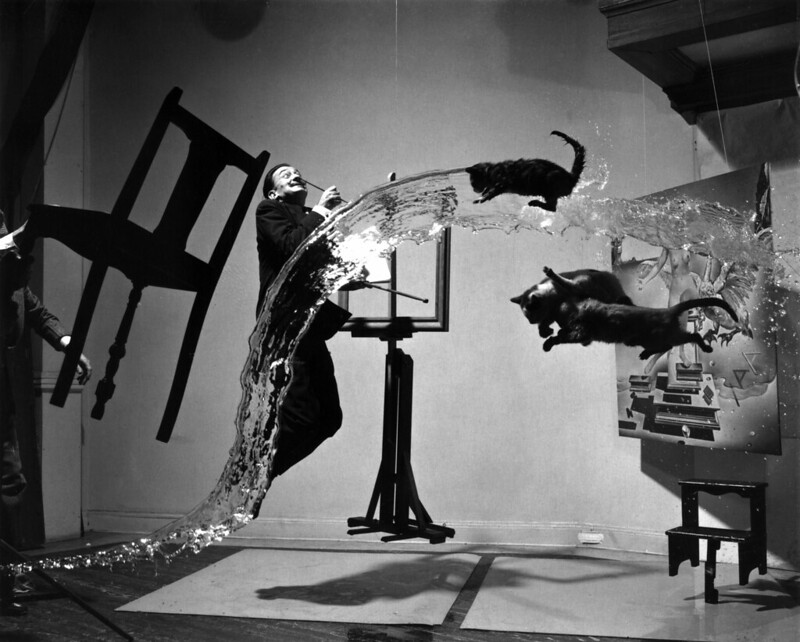
Dali ‘Atomicus’, unretouched. Source: Wikipedia, used under the terms of the Creative Commons
One of the less commonly cited photographic greats, Philippe Halsman is perhaps best known for his Atomicus portrait of Salvador Dali, above. He also photographed a number of other personalities of the time for Life and other magazines; I personally get the feeling his work is about as close as you can get to a constructed biography in a single frame. I had a discussion with one of my students recently about his six rules for the creation of photographic ideas – and the execution of that portrait. There was no Photoshop in 1948, and retouching was limited to painting over things – in this case, the removal of some of the supports for the various elements in the frame. The final image was take number twenty eight: by that point, the cats had probably had enough. The salient points of Halsman’s life and career are better summed up by Wikipedia, here. Today’s article is a few thoughts on that portrait and his principles in general.
Hasselblad X1D: Very early shooting impressions (with full size samples)
Firstly, Selamat Hari Raya to my local readers! Secondly, and perhaps of more importance to the global audience, about 36 hours ago, the X1D arrived – plus both lenses and the system bag. I’m currently in the middle of a masterclass in Singapore and have had about four hours in total to shoot with it. Regular readers will know that normally, I wouldn’t post anything this early on in my usage of the camera for several reasons – firstly, firmware is not final, so not all functionality has been implemented and there are a lot of thing which will be improved before retail release. A large part of my responsibilities also include debugging and finding as many of those glitches as possible. Secondly, you really need to use it under a wide range of conditions to make a useful and comprehensive assessment of its capabilities. However, my inbox has been overflowing from the number of questions and requests for information, plus there’s been so much speculation over image quality, it’s more efficient for me to address this here. I also have clearance from Hasselblad to post full size images, linked in the article – I think they are also the first full size samples available anywhere. They are of sufficient technical standard but I’ll be the first to admit, it’s early days and I’ve not had as much time to shoot with it as usual – so the subject matter is somewhat limited. I have attempted to assess several things with these tests, though – quality of bokeh, edge sharpness, flare resistance, dynamic range, lateral CA etc. You may print or download them for your own use, but not commercial redistribution. For early impressions, read on. For full size files, click the images. I will attempt to answer questions left in comments HOWEVER please note that I am on the road for the next couple of days, so internet access will be limited. (Update: links to full size fixed; please let me know if they still don’t work.)
Important note: this is NOT final hardware, and subject to significant changes: and these changes will be only be improvements.
Artists, creatives and critics
Almost everybody falls into one of two categories: creator or consumer. Do you spend more time making content or material, derivative or otherwise, than consuming it? Do you prefer to make or view images? Of the creators, there are positive, derivative and negative. The positives try to advance art, science and and knowledge by providing a point of view or product or device or service that hasn’t existed previously, whilst maybe or maybe not benefitting personally from the provision of said novelty. The line between positive and derivative is a blurry one, and perhaps doesn’t cleanly exist – in my mind, it’s down to whether the creator tries to add some element of originality or not; there’s no such thing as 100% uniqueness or 100% invention from nothing. We cannot create without some base of precedent or inspiration, no matter how remote or seemingly unrelated. But the more remote the connections that are made in the creation of something, the more the creator contributes by joining the dots, making the logical conclusions and helping the rest of us see what we might have missed.
Photoessay: Motion in Tokyo/ The Idea of Man II
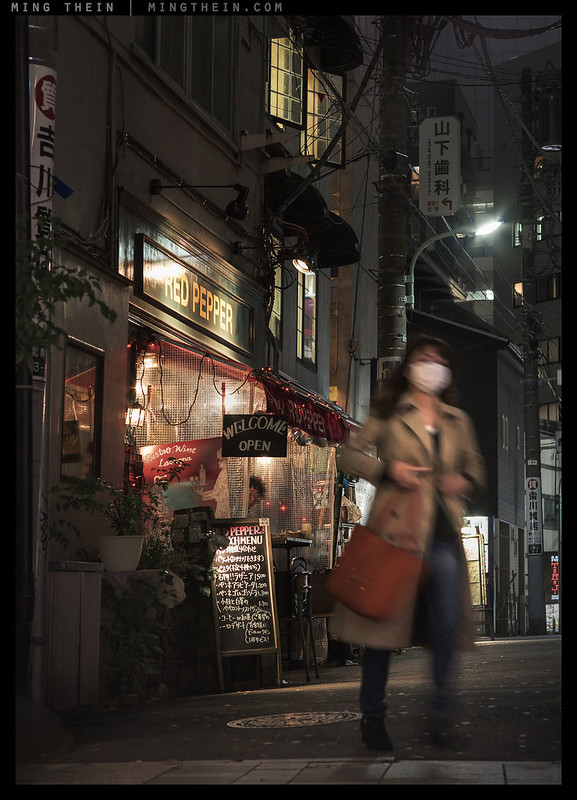
I view The Idea of Man project as mostly complete; the story is tight and stylistically consistent. But I’ve been thinking a lot about its sequel in the time since the exhibition; to begin with – is there one at all? Where does one go from the story of the individual finding their place in the world? The answer came to me after some long exposure urban landscape: it’s in community, in groups, in the flow and interaction of individuals. And that idea will be at the core of The Idea of Man II.