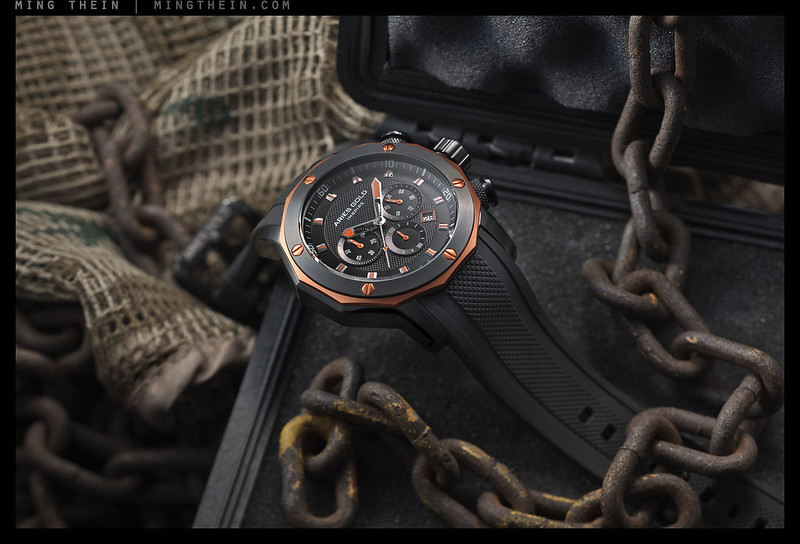
Today’s photoessay-on-assignment-report hybrid comes courtesy of a regular client who both makes their own and OEM watches for other companies. They’re not a big name – you’ve probably never seen the brand outside Asia, if at all – and they’re certainly not competing at the high end, but they do have mass-market volume; it’s a very different sort of assignment to the kind I normally undertake in Switzerland. It doesn’t require much skill to make an exceptional watch made with no consideration for price look exceptional; the challenge there is making it look extraordinary – otherwise your photography has not added any value or even done the object justice. My job here is very different: how does one make a $200-retail watch look like a $2,000++ one?
On Assignment: Retouching, and the difference between amateurs and pros…

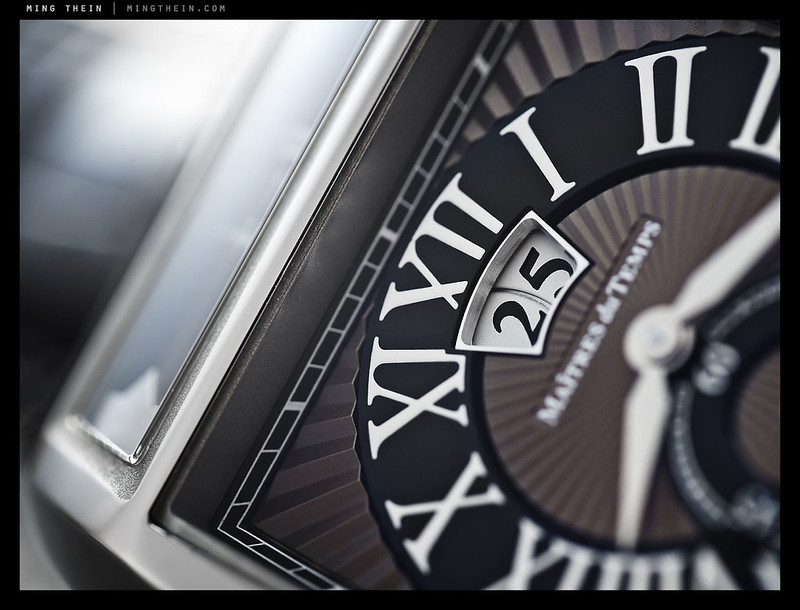
Maitres du Temps Chapter Three in white gold. (Larger version) There are panels at 6 and 12 that drop down into the dial and retract to uncover day/night and second time zone indicators; there’s a moonphase indicator at 4.30, date at 2 and small seconds at 8. Like all watches designed and made by famous independent ACHI members – this one is the offspring of Kari Voutilainen and Andreas Strehler – if you have to ask the price…
An image like this requires a surprising amount of work: I’ve already talked about the mechanics of lighting horological images in this three-part series (beginning here). To be honest, I originally intended to photograph the set up and other b-roll for another on-assignment post, but the simple reality is that I’m usually so busy on the shoot that I just don’t have the time. Instead, I’m going to talk about the amount of work that goes in behind the scenes.
Off topic: hobbies and photographers
It seems that a lot of my other photographically-inclined friends and students share the same few passions – watches/ horology, cars, cigars, food/ wine, travel, and to some extent, hi-fi. It could be because serious photographers tend to be mostly male (no sexism intended, but 90% of my reader demographic and students are male) and these are male pursuits; however, the funny thing is that a good number of the ladies in the 10% share these interests, too. I’m not counting casual or passing fancies here – I’m only including people serious enough to devote a meaningful chunk of time and income towards these hobbies. Even so, the numbers are overwhelmingly in favor of just a few pursuits*.
*My point of view could however be biased by the demographic of my readers; I suppose if I surveyed those who lived in countries with strong anti-smoking laws, expensive car operating costs, and reasonable public transport – sounds like the UK – we’d find that cigars and cars drop off the list.
Film diaries: Watches and a Hasselblad

Digital contact sheet of the negs.
I’ll admit that deep down, from the day I decided to buy the Hasselblad, I’d harboured a deep, masochistic desire to do this. During previous evaluations of medium format for my main commercial subjects, it didn’t really fit the bill: too difficult to achieve the degree of magnification required for watches, and digital medium format wouldn’t give me the width I needed for architectural work. It’d also be overkill for food photography in this country, given the current state of affairs*.
*I recently had a large corporate client ask for a portfolio and quote, then turn around and give the job to another photographer who quoted less and said ‘here, copy’. The results were crude because of harsh lighting and repetitively boring subject placement, but I suppose if they can’t tell the difference…perhaps I’m the one who’s got unrealistic expectations?
But hey, on film, for fun and in the spirit of creative experimentation, why not?
Watch photography with the Olympus OM-D, and thoughts on its use as a backup system

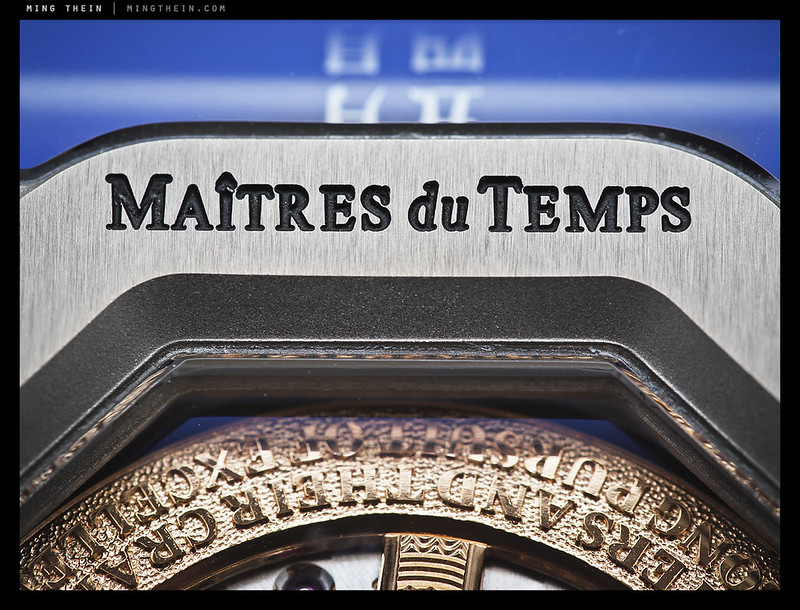
The Maitres du Temps Chapter Two Tonneau China special edition.
For a system to be able to serve as backup, it must fulfill one important function: the ability for me to continue working with it and delivering images if my main system should fail for any reason. And it should be able to cover all genres of what I shoot, without too many workarounds or compromises. The obvious choice would of course be to buy two of the same camera, but a) where’s the fun in that, and b) sometimes it’s also useful to have a different camera system to give you other shooting options not available from your primary.
For the past couple of months, I’ve been shooting with the Olympus OM-D for most jobs which do not require special purpose lenses (e.g. tilt shifts) or huge resolution; the Nikon D800E of course covers everything else. What I’ve found so far is that from a usability and image quality point of view, the camera has no problems delivering the goods consistently; the only exception being a peculiar lockup problem that only happens if you use the Fn1 button to zoom into an image after shooting, then hit the protect button if you’re in the screen with the zoom toggle slider on one side. Unfortunately that does seem to be part of my workflow, but I’m learning to avoid it.
The biggest question, in my mind, was whether the system was a viable alternative to the D800E for doing watch work – rather important, given that this is the majority of what I do commercially. I acquired a Panasonic-Leica 45/2.8 Macro Elmarit (yes, a review is in the works) for this purpose. Suffice to say – the lens isn’t the limiting factor at all, it’s pretty darned awesome (and one of the better macro lenses I’ve used, actually).
Although Olympus does have a wireless flash system (FL36R, FL50R and FL500R) which is IR-triggered like Nikon and Canon’s systems, I wasn’t about to buy another set of speedlights, and certainly not about to carry them around along with the primary system, too. Fortunately the Nikon SB900s I use have a SU4 optical slave trigger mode – with manual flash power, of course. I used this and manually set the output levels. Yes, it’s much slower than using iTTL and dialing in adjustments directly through the camera, but it works.
All in all, as you can see from the images here, I think the results are pretty darned good – my client didn’t say anything about the file quality, or lack of it; the OM-D’s files interpolated very cleanly to 25MP and their required resolution.
Depending on what I shoot, I’ll carry the OM-D body and 12mm and 45mm macro lenses, or just the 45; the 20/1.7 rides along as a body cap. One nice thing is its ability to use the Zeiss ZF glass I’ll normally carry for my D800E via an adaptor, so I don’t even have to carry the 45 and 20mms if I’ve got the 50/2 Makro-Planar and 21/2.8 Distagon.
One note of caution – during my recent Hong Kong workshop, the camera decided to stop working in a very humid environment (light rain, probably 90-95% humidity) and didn’t come back to life again until being dried out in air conditioning and with a few blasts from a hair dryer for good measure – so they’re probably not as well weather sealed as they claim. It continued to work intermittently for a few days afterwards, with menus self-navigating (as though one of the buttons was shorted out) before working normally thereafter. Odd. MT
The Olympus OM-D in various configurations is available here from B&H and Amazon.
____________
Visit our Teaching Store to up your photographic game – including Photoshop Workflow DVDs and customized Email School of Photography; or go mobile with the Photography Compendium for iPad. You can also get your gear from B&H and Amazon. Prices are the same as normal, however a small portion of your purchase value is referred back to me. Thanks!
Don’t forget to like us on Facebook and join the reader Flickr group!
Images and content copyright Ming Thein | mingthein.com 2012 onwards. All rights reserved
Photoessay: Some Hublots (and, how to shoot watches on location with available light…)
I was recently at a Hublot event – both covering the new Basel 2012 watches for fratellowatches.com as well as meeting the CEO and marketing people (it never hurts to network in this industry). I didn’t want to bring the lighting equipment, and the photos were for a blog – not commercial use – so I figured that I could get away with a lightweight rig. I used the Olympus OM-D and Panasonic Leica 45/2.8 Macro, and available light. Most of the images were shot at ISO 1600 or above; even at larger sizes, they hold up pretty well. Needless to say, for web use, they’re fine.
But I digress – all I had was whatever lights were set into the roof of the showroom, and a dark watch display tray for use as a background. By tilting the tray and camera to look for the right lighting angles – sometimes to avoid reflections, sometimes to enhance them – I managed to produce a set I was pretty happy with, but yet manages to have a very different feel to what I normally produce in the studio. (They also have zero dust retouching, which you fortunately can’t see at this size – cleaning cloths are your friend!) Enjoy! MT
____________
The inaugural mingthein.com photography contest closes 31 July 2012 – the more people entering, the larger the cash prize! Enter here
If you enjoyed this post, please consider supporting the site via Paypal (mingthein2@gmail.com) or via Ming Thein’s Email School of Photography – learn exactly what you want to learn, when you want to learn it. You can also get your gear from Amazon.com via this referral link. Prices are the same as normal, however a small portion of your purchase value is referred back to me. Thanks!
Don’t forget to like us on Facebook!
Extended photoessay: A visit to manufacture Jaeger-LeCoultre
For most horological afficionados, visiting their favorite manufacture is a necessary pilgrimage along the path. I’ve had the privilege to visit a few in my time, however living halfway around the world makes this a bit more of an expedition than is convenient. However, on my last assignment to Switzerland, I happened to have a free day, and the folks at Jaeger LeCoultre were extremely accommodating…
Enjoy the photoessay – it’s more of a story of how a watch is made, and a slight deviation from normal programming, but I think you’ll find it interesting all the same.
Images shot with an Olympus OM-D and Panasonic 20/1.7 and 45/2.8 macro lenses. Each image can be clicked on for a larger version.
I was given this and a lab coat, presumably to keep out street dust (or perhaps add to the authenticity of the experience for some). Sadly, they didn’t issue me with any tools – perhaps for my own good.
That pass, gets you into here:
Once past the obligatory heavy Eastern Europeans (presumably there to ensure you don’t leave with any watches you didn’t come in with), one is greeted by this sculpture a little further down the hall; signed by all of the thousand employees who work at the Manufacture.
The old Manufacture, now the reception area and offices.
Views from this place are incredible. It’s like working in a postcard.
Life of a watch starts in the prototype and R&D department; for understandable reasons, I wasn’t allowed to take photos in here – or even go in, for that matter. From a production standpoint, things begin here – in the parts fabrication department, where things are cut, stamped, shaped, machined, CNC’d, bent…
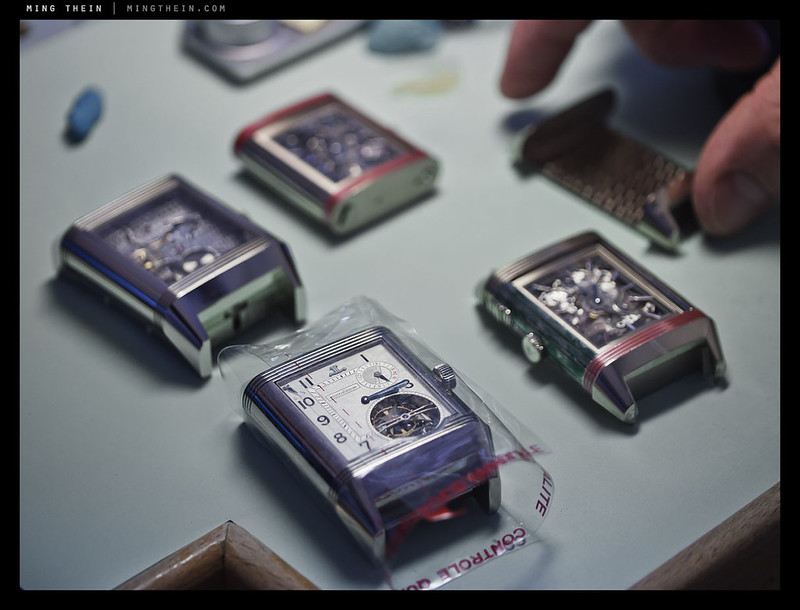
The output of which can be seen here – Reverso case blanks, thousands upon thousands of tiny, perfect blued screws, and a whole bunch of spare gears (I believe these are offcuts that didn’t pass QC).
Those cases marked in red (along with other parts) are then sent to the QC department, where a laser alignment rig checks that the parts are within extremely fine (think micron level) tolerances. You can see that rig at work here:
Next up is finishing – parts are polished, grinded, striped, anglaged, perlaged, engraved, plated, and generally prettied up in yet another department. Two things surprised me: stripes and perlage are surprisingly fast to apply; polishing a Reverso case is not – in fact, it takes a lot longer than I would have imagined.
Anglage.
Rotor engraving.
Setting microscopically small jewels; that pile of what looks like dust off to the top right is actually a pile of unset ruby bearing stones. Needless to say, it takes a microscope and hands of stone.
Anchor setting room.
Up some stairs, with a quick pause (note scenery) and through an attic doorway…
…takes us to the haute horologie department.
Don’t forget your protection. And those wrapped things at bottom left aren’t sweets, they’re earplugs.
On a tray for visitors to enjoy as you enter. Sadly, no ‘Please Take One’ sign was to be seen anywhere.
This part of the workshop is an incredibly quiet, calm environment; you get the feeling you’re in a high precision lab rather than a manufactory – which I suppose is pretty much what it is. You’ll notice that most of the employees are plugged into their iPods; the music and isolation help concentration.
Assembling a Spherotourbillon.
Ta-da! Look what I made earlier. This is possibly the only photograph to date with five of them in one place…
Beginning to case up inside a negative pressure cabinet, so dust gets sucked out.
Moving over to another bench, we find:
The red and blue plastic is a protective layer to prevent scratches as the watches are cased, assembled, and final adjustments made.
There’s also a Repetition Minutes a Rideau present – but not just any one, a blue one!
It sounded great. I suspect the double case (the movement is actually based on the earlier limited edition series of 500 in pink gold) improves the tonal qualities of the chime significantly. It also looks absolutely stunning, though I’d gladly forgo the outer slide mechanism and just have the inner watch – apparently the inner case is about the same size as a regular Reverso GT, which isn’t very big at all.
On the way out, we pass a Gyrotourbillon in final stages of regulation. The dial on the left (which actually looks complete) is a work dial, used for adjustment only. I’m told that it takes one watchmaker between 1.5 and 3 months to assemble one of these; the huge time difference is if after assembly, it doesn’t run to spec, then the whole thing has to be taken apart and the cage re-balance and re-adjusted.
The gemsetting atelier is next.
I’m not a huge fan of gem set pieces (they showed me bracelet links for a Master Tourbillon, which when completed, would retail for around one million Euros – the entire thing was covered in diamonds, including the dial); however, this particular piece was pretty intriguing – it’s called a ‘chaotic’ setting, and you actually can’t see where the setting ends and the stones begin. They use around 200-240 diamonds of various sizes to cover a ladies’ Reverso case.
We appear to have found the Atmos division.
I actually found this portion quite fascinating, as you seldom see so many of these in one place – and more interestingly, so many vintages; there were clocks here dating from easily fifty years go. I suppose it’s one of the few products whose fundamental parts have changed very little over time. Interestingly, they still cure the balance suspension wire; except these days, it’s done with weights and electric current rather than horse urine and time.
Oh look, a Klimt! In all seriousness, this was an incredibly stunning piece which I think few have been lucky enough to see in person.
View from the employee canteen.
I did also visit the museum, but wasn’t allowed to take any photos. Suffice to say there are some incredibly rare and very interesting pieces in there. And while all the Atmoses are running, charmingly none of them show the exactly same time 🙂 MT
I would like to say a personal thank you to Marina Shvedova, Janek Deleskiewicz, Cecile Tichant, Alexis Delaporte, Reena Tan, and all the patient employees whom patiently answered my endless barrage of questions.
____________
Visit our Teaching Store to up your photographic game – including Photoshop Workflow DVDs and customized Email School of Photography; or go mobile with the Photography Compendium for iPad. You can also get your gear from B&H and Amazon. Prices are the same as normal, however a small portion of your purchase value is referred back to me. Thanks!
Don’t forget to like us on Facebook and join the reader Flickr group!
Images and content copyright Ming Thein | mingthein.com 2012 onwards. All rights reserved
Photoessay: The Jaeger Le-Coultre Master Ultra Thin Moon
From the horological files. MT
Set shot with a Nikon D800E, several SB900s, the AFS 60/2.8 G Micro, and one shot with a Leica 35/1.4 ASPH FLE via adaptor – see if you can spot which one!
____________
Visit our Teaching Store to up your photographic game – including Photoshop Workflow DVDs and customized Email School of Photography; or go mobile with the Photography Compendium for iPad. You can also get your gear from B&H and Amazon. Prices are the same as normal, however a small portion of your purchase value is referred back to me. Thanks!
Don’t forget to like us on Facebook and join the reader Flickr group!
Images and content copyright Ming Thein | mingthein.com 2012 onwards. All rights reserved
On Assignment: The contents of my bag
I thought you may all be curious to see what I’m bringing to Switzerland for my current assignment. Let’s just say there’s a hell of a lot of stuff here:
Primary system:
– Nikon D800E
– AFS 28/1.8G
– AFS 60/2.8 G Micro
– PCE 85/2.8 Micro
– ZM 28/2.8 plus Leica M to Nikon F adaptor
Backup system:
– Olympus OM-D with HLD-6 grip – I plan to do some walking around too, and I don’t want to carry the D800E.
– Olympus ZD 12/2
– Olympus 45/1.8
– Panasonic 20/1.7 G
– Panasonic Leica 45/2.8 Macro
– That little clip on flash thingy to trigger the SB900s in SU4 mode
– Nikon G to M4/3 adaptor
Lighting:
– Nikon SB900 x3
– Custom made perspex diffuser and case, various cards, papers and laminates for backdrops and diffusion.
– Manfrotto 5001B compact light stands plus heads and flash stands x3
Support
– Gitzo GT1542T Traveller 6X carbon fiber tripod
– Manfrotto 468RC0 Hydrostat ball head
– Manfrotto micro positioning rail
IT
– Apple MacBook Air 11″
– Apple iPhone 4
– Western Digital MyPassport 1TB 2.5″ USB drive for backups
– Sandisk Extreme SD/CF USB card reader
– Chargers and universal adaptors
Other accessories:
– Spare batteries and chargers for both cameras
– 8 sets of Sanyo Eneloop AA batteries for the SB9000s
– Two sets of Kenko Pro DG extension tubes
– Adaptor plugs and multi strip
– SD cards; Sandisk Extreme HD 32 GB x4
– MAHA C801D fast AA charger
– Nikon SC-31IR flash deflector panel for D800E built in
– Rocket air blower
– Soft white cloths
– Blu tack
– Duct tape
– Magic tape (for removing dust)
– WhiBal cards
– Small lens pouches
Bags
– Think Tank Airport International v1
– Billingham Hadley Pro, without the internal dividers but with some small lens pouches and a camera wrap, packed into my check-in luggage
– Manfrotto MBAG80P for light stands and tripod
Here’s most of it packed in. What you don’t see is the diffuser case, which is quite enormous and wouldn’t fit into the picture…
____________
Visit our Teaching Store to up your photographic game – including Photoshop Workflow DVDs and customized Email School of Photography; or go mobile with the Photography Compendium for iPad. You can also get your gear from B&H and Amazon. Prices are the same as normal, however a small portion of your purchase value is referred back to me. Thanks!
Don’t forget to like us on Facebook and join the reader Flickr group!
Images and content copyright Ming Thein | mingthein.com 2012 onwards. All rights reserved
POTD: If you thought one watch was bad…
…try dealing with the reflections off two!

Sarpaneva Korona K3 Northern Stars. Nikon D700, AFS 60/2.8 G Micro
Photographs involving multiple watches require extremely good lighting control, assuming you are not going to be compositing images (and sometimes, you have no choice). What looks great on one watch may not look so good on the other, and vice versa. You also need to be very, very careful with positioning your subject – not least because they may scratch each other! I use a small bit of tape or paper to act as a buffer, tucked neatly out of sight. MT