Photoessay: Dawn over Kuala Lumpur

Although not technically aerial shots, the 421-m tall platform (plus hill) afforded by Menara Kuala Lumpur (KL tower) is a great place to get some interesting images of the city downtown at dawn or dusk – though it usually rains in the evening, so morning is a better bet. MT

Series shot with a Nikon D700 and 28-300VR.

_7049662 copy

_7049646 copy

_7049526 copy

_7049524 copy

_7049521 copy

POTD: Flambé

_7060984 copy
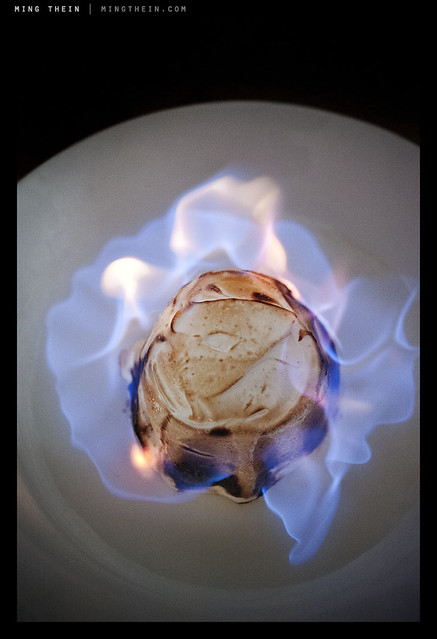
Baked Alaska. Nikon D700, AFS 60/2.8 G Micro

Flames are a funny thing – they don’t photograph well. Simply, yellow flame is bright because it contains a lot of incandescent little particles; usually, it’s too bright to photograph well relative to surroundings – you land up losing detail in the flame if you have context, or losing context if you have detail in the flame. Blue flame is almost impossible to photograph because most of its energy is heat – there isn’t much in the way of light-emitting incandescent particles. Flames are also very random in an interesting fractal kind of way; photographically that means you’ve got to do many, many takes – four Alaskas, in the case of this shot. And dozens of frames until we got just the right flame.

The problem for food photography – specifically baked Alaskas – is that the lit brandy you pour over the dessert burns blue, which isn’t so great to shoot. Sure, you could composite flames in after, but it would both look unnatural and just be dishonest. So what do we do? Simple: add a little something to the alcohol that makes it burn brighter, and a little yellower.

Interestingly, this is where the high ISO capabilities of the D700 become useful: ISO 6400 with a good amount of remaining dynamic range and very low noise. I don’t think this shot would have worked as well with the D800. MT

Sushi, and the philosophy of photography

_PM07501 copy
Seared Wagyu beef with momeji oroshii.

Sushi is a universe in itself – there are so few components that if you get any one of them slightly wrong, the taste will be horrible. But if you get every one of them right, the experience can be magical. Specifically, your fish must be fresh and in season; precisely the right amount of soy sauce should be brushed on to the top, with a little dab of wasabi hiding between the rice and the fish. The fish itself is cut slightly concave so it drapes perfectly over the rice, itself measured to precisely the right quantity to make a mouthful and shaped by hand, not too tightly packed and not too loose, either.

_PM07411 copy
Katsuo (bonito) with ginger.

And then there’s the seasoning that accompanies the rice – a mix of mirin and rice vinegar – which must offer the right degree of tartness and sweetness to provide a counterpoint to the fish and soy sauce, but not so much that it overpowers or tastes sour. And this is before we even talk about more complicated creations that involve multiple types of fish, or searing, or additional condiments and seasoning.

_PM07492 copy
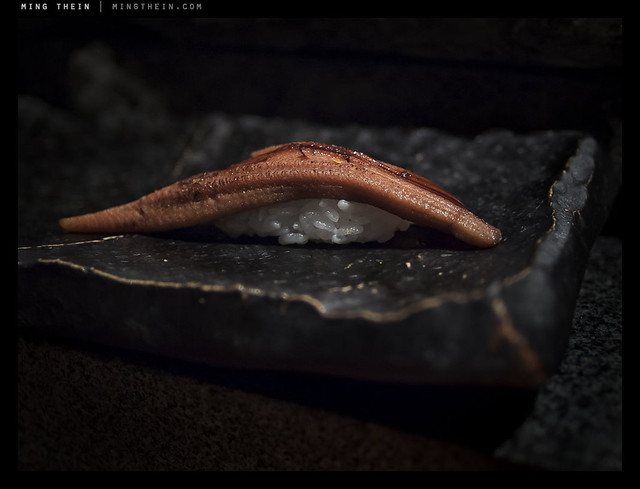
Broiled anago (freshwater conger eel).

There’s a parallel between sushi and photography (and sushi and many other things, actually) – aside from the obvious that it’s art, sushi making requires both technical skill and creativity. There are constraints, but you can work around them. It can be learned, it can be honed by experience, but there’s definitely an element of talent and intuition involved which all great sushi chefs possess. Photographs and sushi both come in small, bite-sized increments – they require little time to create if all the elements come together, and can be enjoyed in moments or contemplated for hours – I’ve eaten sushi dinners with 20+ different varieties served over many hours; I suppose that would be like going through the Magnum annual. Neither photography nor sushi is cheap, either; and mastery can take years.

_PM07485 copy
Torigai clam.

There’s even an anticipative element to it – the feeling of curiosity before you go to eat (wondering what is in season and came from Tsukiji today) is much like the feeling I get before a shoot; you’re all excited and ready to go. It’s also entirely possible that it’s just me.

_PM07471 copy
Seared katsuo

The best sushi I’ve ever eaten – so far – comes from a local chef in Kuala Lumpur at a restaurant called Hanare; Kenny Yew is an absolute genius when it comes to creating new things – for instance, seared wagyu with momeji oroshii chili – as a sushi. I need to go at least once a month or I get withdrawal symptoms and the DTs, because I just can’t eat sushi anywhere else now. The few lucky friends I’ve taken there feel the same way. It really is art – some of the pieces make me tingly and others nearly bring me to tears. I’ve eaten things there I never would have though edible, let alone ordered – and loved them. That’s much like how certain exhibitions, art or equipment inspire me to try photographic experiments that work out a lot better than expected.

_PM07446 copy
Seared hama-tai (sea bream)

And best of all, you can mix the two. The lighting conditions at that restaurant are pretty horrible, but they save me a seat at the counter which happens to have a halogen spot over it; I position my sushi carefully to be well-lit. This set might appear the same, but that’s because I wanted a consistent point of view; (and comparison)
they were also shot during the same meal. I discovered one other thing that night: the best color I’ve yet managed to achieve is delivered by a combination of Zeiss glass and Olympus cameras.

_PM07395 copy
Oo-toro. (Fatty yellowfin tuna belly)

I had the ZF.2 2/28 Distagon on the Pen Mini via an adaptor, and was utterly floored by the color when I opened up the raw files on my computer – the sushi literally looked like it had in real life. Every bit of the color, texture, iridescence and freshness was captured. I’m guessing it’s a combination of the fortuitous lighting, the great color and micro contrast of Zeiss lenses in general, and the pleasing color palette of Olympus cameras. Whatever it is, I think I’ve found my perfect sushi-camera.

_PM07426 copy
Red snapper.

My parting advice is that if you do get a chance to eat sushi made by a master, do as you would do at an exhibition of photographs by a great photographer: put away your preconceptions, go in with an open mind, and enjoy. You’ll probably be surprised. MT

_PM07424 copy
Kamburi (giant yellowtail).

POTD: One of those strange inexplicable things that happens from time to time

_M9P1_L1009159 copy
A windfall for a small gorilla. Leica M9-P, Zeiss ZM 2.8/28 Biogon

I just remembered I hadn’t posted an image today. This image has been sitting in the upload queue for some time – it reminds me that sometimes, you don’t need technical perfection for something to work; a sense of fun and whimsy can do wonders, too. MT

The confusion between T-stops and f-stops

f-stop – we all know what that is, right? The size of the hole in the lens that lets light through. The faster the better, and the faster the more expensive. The faster it is, the easier it is to shoot in low light. An f0.95 Leica Noctilux is easily ten times more expensive than an f2.5 Leica Summarit, yet it’s only three stops faster.

That’s all. Right?

Not quite.

_5100_DSC1518 copy
Zeiss ZF.2 2/28 Distagon. Notice how the front few elements almost disappear – that’s because they’re not reflecting anything. This despite a huge diffuse light source – it’s the mark of excellent coatings, and promises a T-stop close to the f-stop.

f-stop is the relationship between the physical aperture of the lens – the effective optical diameter, usually limited by the diaphragm – and the focal length. Specifically, focal length over physical aperture equals f-stop. So a 50mm f2.0 will have an effective physical aperture of 25mm. This affects one property, and one property only of the lens: the minimum depth of field. All f1.4 lenses of a given focal length will have the same depth of field. However, they may appear to have different depths of field because the speed of transition between in focus and out of focus differs depending on the optical formula of the lens. As does the quality of the bokeh. (See my other article ‘A word (or ten) on bokeh’ for more information).

_7052666 copy
The legendary Leica Noctilux.

T-stop (curiously, always written with a capital T) is a number measuring the effective transmission aperture of the lens – in other words, the physical aperture might be f2.0, but how well does the light actually transfer light to the image plane? Why would it even differ from the f-stop in the first place? Lenses are actually black holes: they absorb or reflect or refract light in directions other than the imaging plane. It could be due to poor coatings, or internal polished elements, or simply having many elements – at every air/glass or glass/glass interface, 100% transmission is impossible. There will always be some reflections which decrease the effective transmission factor of a lens.

_5100_DSC1488 copy
The famous Zeiss T* coating.

Modern coatings go a very long way towards ensuring that all light entering the lens makes it to the image plane, with flare reduction and increased contrast as a bonus. However, as lens design gets more complex – take those 18-270mm super zooms for instance – the number of elements required to correct aberrations across all focal lengths covered increases, and so does the complexity of the lens design. Remember, more surfaces means less light transmission.

_D90_DSC7216 copy
Leica 21/1.4 Summilux-M ASPH. Again, note how the front few elements disappear thanks to the coating. Interestingly, this is a very complex design for a Leica lens – 10 elements in 8 groups.

Practically, this means that prime lenses will generally give you a higher shutter speed for a set aperture; it might be a small difference, or a noticeable one. Your f5.6 super zooms probably have a T-stop closer to f8 or f10. Conversely, a good prime lens with few elements and excellent coatings will give a T-stop very close to the actual f-stop.

Example 1: the older Nikon 85/1.4 D has a T stop closer to T-2; the Zeiss ZF 85/1.4 Planar yields almost double the shutter speed for the same exposure, with all other variables constant. The T-stop is around T1.47.

_1KD_MG_0064 copy
Old Nikon 85/1.4 D – note visible reflections off every single element. That’s light that isn’t going to reach the sensor anymore.

Example 2: ignoring the minor difference in focal length, consider the Nikon 105/2.8 VR macro and the Leica 90/4 Elmarit-M macro. The Leica has only four elements. The Nikon, 14 elements in 12 groups. What do you think their T stops are? Unsurprisingly, not very different.

Not all lenses are made equal. And don’t think because there are fewer elements, the lens design isn’t as good. It’s very difficult to design a well-corrected lens with few elements – designs such as the Cooke Triplet and Double Gauss are pretty much as simple as they get. MT

____________

Visit our Teaching Store to up your photographic game – including Photoshop Workflow DVDs and customized Email School of Photography; or go mobile with the Photography Compendium for iPad. You can also get your gear from B&H and Amazon. Prices are the same as normal, however a small portion of your purchase value is referred back to me. Thanks!

Don’t forget to like us on Facebook and join the reader Flickr group!

appstorebadge

Images and content copyright Ming Thein | mingthein.com 2012 onwards. All rights reserved

POTD: New car obsession

_8001335 copy
New car obsession. Nikon D800, 28-300VR

On a photographic note: the T stop of the 28-300 is much lower than the f stops would suggest, requiring higher ISO. If you want to know the difference between the two, I suggest you come back later for today’s article 🙂 What you can’t see art this size is that this was shot at ISO 1400 – yes, there’s some fine grain if you look at 100%, but guess what – it could have been ISO 50 for all intents and purposes on the web. Downsizing large images (even if noisy at the pixel level) averages out the luminance noise and leaves you with a much cleaner print than you might think.

A mark of today’s blind consumer society: I was attending the launch for the new BMW 3 series locally; overheard was a conversation between two other customers:

Person 1: “It’s so huge inside!”
Person 2: “Really? Doesn’t seem much bigger than the old one to me.”
Person 1: “But it must be, the salesman said so!”

There’s a moral to this story: firstly, don’t believe everything you read or hear: go and verify it with your own eyes, especially if you’re going to be spending your own hard earned money on it – more so these days, since inflation seems to have had a very visible effect on the pricing of goods. Or maybe it’s the aspiring middle class, or both. If something is fit for your purpose, then go ahead and disregard what others – especially those with a clear bias, like salespeople – are trying to tell you. That’s the whole benefit of choice! Remember: this applies equally to anything, be it luxury cars or cameras. 🙂 MT

Passion and frustration

I’ll begin by saying that this is a difficult post for me to write for many reasons. Over the course of the last month or so, you – my valued readers – have hopefully seen some of my work and passion, and even more hopefully learned something from the articles and how-to’s.

I started this site for several reasons. Firstly, I wanted to share my knowledge; secondly, I want my work to reach a greater audience – although every true artist would (and often does) work without pay or acknowledgement, sometimes the egotistical part of us does value recognition. Thirdly, there are sites aimed at amateurs, at professionals, at particular user groups…but I find the level of content not really that advanced, or too equipment-focused, or not balanced between pure image sharing, learning and techniques/ equipment. Photography is all of these things. Finally, I want to figure out a way to spend more time doing photography-related things, and less time in the corporate world.

The reality of commercial photography these days is that there are plenty of talented people out there; more so now that people have discovered skills thanks to the ever-lowering barriers to accessibility. This is further compounded by the effects of social media (yes, I know I’m benefitting too). Curiously though, although the overall standard for images has raised thanks to the proliferation of photographers, the business community attaches less and less value to it – meaning to say bluntly that there really isn’t any money in the business (with a few very rare exceptions) because corporate buyers are both spoiled for choice and frankly can’t tell the difference most of the time. Those that can are served by long-standing relationships with existing photographers.

What does this mean? ‘Professionals’ are usually scratching a living and unable to have the freedom to develop and improve because that requires time and money; they’re short of the former because they need to do more jobs to get enough of the latter. ‘Amateurs’ have all of the equipment, for the most part act outwardly like professionals, but when the crunch hits, usually can’t quite deliver. The people who are truly pushing are either those aforementioned professionals with long-standing commercial relationships – think Annie Leibowitz and the like – or serious amateurs whose living costs are supported by a day job. I know for a fact that almost all of my professional photography friends do not make a living from selling pictures or photo work. Think about this for a minute: if professional photographers aren’t valued, who’s going to drive the image creation of the future? How are companies going to find the ever-better visual content demanded but not support the people they rely on to create it? I don’t think they’ve given any thought to that; bottom lines are all that matters.

I’m not complaining; far from it. The shift in photography market dynamics has opened up other opportunities that would have been previously unsustainable or commercially unworkable. But the reality for me is that I have to choose between my passion and my day job – which is both mutually exclusive, and nowhere near a fair contest.

Maintaining this blog – creating articles, photographing and keeping myself up to date and pushing the envelope to deliver content that you’d want to read – takes time. A lot of it. Somewhere in the region of 20-30 hours per week, actually – that’s almost a full time job in itself. Actually, it is a full time job if you think about how much more productive you are when you both don’t have to take breaks and can produce everything by yourself – and the topic is something you’re an expert on.

At some point, I’m going to have to decide which path I take going forward – I no longer have the time or ability to maintain both. It’s a tough choice, though – because one path is nothing but uncertainty (except perhaps certain poverty) and the other is the diametric opposite of anything creative. I suppose everybody who is intensely passionate about something, and that something is not their day job, faces this dilemma eventually. What I wonder is how many people regret not trying – and how many people try, but never manage to make it work and just give up eventually. Society likes to talk about determination leading to success – but we also call people fools who try repeatedly but never succeed.

So I’m going to do three things now:

1. Ask for your opinions and thoughts – please leave a comment on this post

2. Ask you to share – use the social media buttons; email links to articles you like; link my blog. (It’s still ad free, and in order to keep it that way I need to traffic to try out some of the other exciting ideas I have planned – which can only work if I have a big enough readership).

3. Shamelessly, if you’ve enjoyed reading or viewing or have learned something, please consider a donation via PayPal ([email protected]) – however large or small, it does help me to continue providing content and art for you all to enjoy. It’s not just the time cost; there are hosting costs, equipment costs, travel costs…the list goes on. The more resources I have, the better content I can create.

Finally – thank you all for your continued support! MT

POTD: Weekend worshippers at the temple of retail

_PM01826 copy
Weekend worshippers at the temple of retail.
Olympus E-PM1 Pen Mini, 45/1.8

Who says the economy is bad? Our (already high as a per capita basis) shopping malls are always packed to the gills on weekends, and still they open more. Note red shirted queue at top right – the malls are such crowd-pullers that Canon stages an annual one-day photography competition set solely in the mall itself. There were at least a thousand people running around with probably $1-2k of gear each – says quite a lot about the state of the photography industry, really. Never has it been so consumer-centric – which is a great thing for variety of equipment, but a disaster for working pros unless you’re well entrenched at the highest end of the spectrum. MT

Photoessay: Cigars

One of my other passions is to have a good cigar now and again. Although I mostly prefer Cubans, there are also some very good things coming out of the Dominican Republic such as the Fuente Opus X and Padron brands. Needless to say, a camera usually accompanies me to these outings; partially because it’s attached to me like an extra limb, and partially because I write the occasional review and video for My Cigar Blog. MT

This series shot with a whole load of different equipment.

_M9P1_L1001196 copy

_7050217 copy

_7050126 copy

_7048354 copy

_7041334 copy

_7041315 copy

_220_IMG_0162bw copy

POTD: Sunset clouds over the sea

_M9P1_L1013197 copy
Sunset clouds over the sea. Over Hat Yai, Gulf of Thailand. Leica M9-P, 35/1.4 ASPH FLE