Finding inspiration, or the lack of it

We’re all familiar with the feeling: sometimes you go to a place or an event and there’s just no end to the photographic opportunities you see. At other times, life is an artistic desert: there’s just nothing inspiring you to shoot at all, and all subjects are too familiar, too uninteresting, or just plain flat and boring.

_M9P1_L1012712 copy
Shadow crossing. Leica M9-P, 35/1.4 ASPH FLE

I thought of the idea for this article on a recent business trip to Bangkok (last month). Ostensibly, I was there for a conference but did have some down time between sessions, some of which was spent socializing with my group, some of which was spent trying to shoot.

_M9P1_L1012732 copy
Untitled. Leica M9-P, 35/1.4 ASPH FLE

Bangkok is familiar ground for me. I worked there (in something non-photographic) for just over a year in 2006, right up until the first round of protests against the government. The photojournalist in me wishes I’d been stationed there during the action, but the rest of me is happy that I didn’t have to do my day job with everything severely disrupted. During that year, I did find things to shoot, but looking back I realize that most of it was social – there was very little documentary photography or travel photojournalism going on.

_M9P1_L1012673 copy
More traffic. Leica M9-P, 35/1.4 ASPH FLE

I put that down to two things: it really isn’t a city made for walking; it’s too big, for one; the climate is too hot to spend much time outdoors, for two; and the public spaces are predominantly malls and shopping complexes, with the exception of the 500 various temples and shrines that dot the city. It’s also a concrete jungle, with overpasses and highways and monorail lines arcing high overhead even downtown. Unlike Tokyo, where there’s plenty of money left over for beautification, there is nothing of the sort in Bangkok – anything new becomes grey and grimy and coated with a layer of urban dust after not much time at all.

_M9P1_L1013094bw copy
Concrete jungle. Leica M9-P, 35/1.4 ASPH FLE

The upshot of all this is that when walking, you feel like you’re in some sort of canyon – everybody who can afford to, drives. And there’s not really a lot of things you can do with people in cars, or trying to shoot from cars – except perhaps traffic.

_M9P1_L1012658 copy
Interesting light, and yet more traffic. Leica M9-P, 35/1.4 ASPH FLE

There is of course the adult entertainment industry, which does advertise on the streets (even if the transactions take place behind closed doors) – but that’s not something advisable to shoot casually, or without a local guide. I was told by a reliable source that there are a lot of underworld figures involved, and they don’t take too kindly to the seedier aspects of their business being documented. It is not something that interests me, in any case.

_M9P1_L1012660 copy
The relentless pace of progress. Leica M9-P, 35/1.4 ASPH FLE

So we return to the initial point of this article: there will be times when you’re stuck in a photographic or inspirational desert; it happens. But what can you do to get out of it?

_MT87548 copy.jpg
The monk. I was in Chinatown for this one; off my normal circuit but good enough to get something different. 2006. Nikon D2H, 80-200/2.8

1. The obvious thing to do would be to change location.

2. If you can’t do that, look specifically for things within your location that do interest you – I landed up doing a lot of abstract geometry and architecture – Bangkok does really have some nice buildings.

3. Change something in the mechanics of how you shoot: in other words, run an experiment. Reality is that something different will increase your chances of wanting to get out and shoot – it could be forcing yourself to work with maximal or minimal depth of field; getting a new piece of equipment, or using one that’s been neglected for a while; or simply trying to replicate a different style or trying a new idea. It’s because it forces you to change the way you perceive the world (or the world through the viewfinder) – which in turn makes you have to consciously focus on looking for shots or adjusting your composition to make it work; you can’t just run on autopilot anymore.

_M80_DSC3030 copy.jpg
Zap. Through the office windows, long exposure. 2006. Nikon D80, 17-55/2.8

And this is where a modicum of self-reflection and assessment is useful: I didn’t change anything, but in hindsight I realized I should have, which is the genesis of this article. I did initially go with only one lens in an unfamiliar and un-intuitive – to me, anyway – focal length of 35mm; but I don’t think it was different enough to force the creativity out. I should have tried shooting with only my iPhone or something. Or perhaps painting the camera pink, just to disarm the public to provoke some interesting reactions from street photography subjects.
_1_DSC0620 copy.jpg
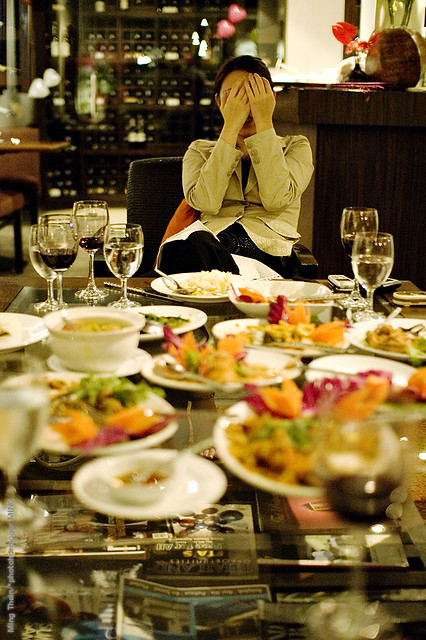
The embarrassment of gluttony. 2006. Nikon D50, Sigma 30/1.4

By the opposite logic, it’s also worth making conscious observation of what does inspire you – what do your favorite subjects or images have in common? It might be one simple thing – I’m drawn to the mechanical intricacy of watches, for instance – or something much more complex; like the juxtaposition between man and environment; dramatic lighting; harmonious geometry – or a mix of all three.

_MT92533 copy.jpg
Seafood seller. 2006. Nikon D2H, Sigma 30/1.4

The underlying moral of the story is action: don’t wait until afterwards to change things, it might be too late. I’ll never know what shots I’ll have missed, but you can bet next time I won’t wait to find out. MT

Bonus points to those who noticed the difference between the first set of images in this series – shot this year with an M9-P – and the second set, from my first long stint in Bangkok, shot with various other equipment? Why is this? Many things have changed: location (different parts of the city), equipment, most of all, experience, and the benefit of a lot more experimentation in the intervening years.

POTD and Off Topic: Test drive notes of a different sort

_8001318 copy
Eyes, part one. New F30 BMW 328i Sport. Nikon D800, 28-300VR.

_7025483 copy
Eyes, part two. Outgoing E90 LCI BMW 320d M. Nikon D700, 28-300VR.

Perhaps I should have called this post ‘a parable in headlights’. I am a BMW fan, which isn’t to say I don’t like other makes; the lower vehicle is my daily car, and serves me well in a versatile manner for everything from grocery shopping to ferrying the wife around to the occasional spot of sideways driving along my favorite piece of road on Sunday morning. It also has a remarkable engine that puts out somewhere in the region of 210bhp and 450Nm after a little ECU tweaking – oh, whilst managing a consistent 35mpg in our abysmal traffic. (I’ve seen it go as high as 58mpg for long distance cruising, and it’ll do 0-62mph in about seven seconds). I’d say this is much like the car equivalent of the D700: you can do pretty much anything with it, and it does a very competent job and doesn’t get in your way. Even the standard non-M sport base 320i petrol version is a nice drive, and the only difference between the two is body roll, power and suspension stiffness. Otherwise, they handle much the same – think of one as moving along at five-tenths, and the other as eight-tenths.


The new model – codename F30 for BMW geeks – is a bit of a different beast. I test drove two versions – the normal, base, bog-standard 320d with no frills or options; and the ‘sport’ package 328i with (optional) adaptive suspension, active steering and BMW’s new masterpiece turbocharged 2-litre petrol that puts out about 250bhp and 350Nm. The 328i was one of the most nimble, responsive cars I’ve ever driven. It was just so easy to drive; I felt confident straight away and able to push the car to perhaps 90% of its limits (or at least the limits to which I feel comfortable driving on public roads). Even the new electric power steering system, whilst oddly and irregularly weighted at low speeds – the sensation of the rack ratio changing while maneuvering at 5mph feels like the front wheels are losing traction, but you’re most certainly not – becomes perfectly weighted and direct (if a little less communicative than I’m used to) at speed. The paddle shifters, combined with the new 8-speed ZF gearbox, make firing off a gear change fast and easy. And that engine…oh boy. It’s got power and torque everywhere in the rev range, and just feels more eager to rev than the 2 litre turbo diesel I’m driving now, even though the car I drove only had 40km on the odometer. The only thing I didn’t like about the car (apart from the increased price tag, nearly 10%!) was the odd-feeling steering at low speeds. Would I buy this? Hell yes, if I could find some spare organs I didn’t need, or perhaps a hidden hoard of diamonds under my floorboards.

The base 320d (F30) on the other hand, was utterly horrid. I hated it. I didn’t feel confident in the car at all; the suspension wallowed and rolled; the steering was equally odd at low speeds, but strangely disconnected and uncommunicative at high speeds; even the interior materials felt a step down from the other car – even though they were supposedly built at the same plant. Even though the engine was a supposedly updated version of the one in my car, it felt tight and underpowered, lacking the midrange punch between 1800 and 2800rpm that I’m used to. Would I buy this one? No.

I felt that this odd duality gave the new 3 series a similar personality to the D800: a specific tool, which if configured (optioned?) correctly, would do a peerless job; but was also capable of being entirely inappropriate in some situations compared to the old model.

Conclusion: newer isn’t always better, often the refinements mean that what you’re going to use it with (i.e. the engine and options, in this case) is almost equally as important as how you’re going to use it. As a consumer, don’t always get fooled into thinking that you need to change something. Just because a new model is out doesn’t in any way reduce the capability of the existing model you own: yes, it might be better for some things, but if those things aren’t important to you, then why spend more money? You’d be surprised at the number of emails I’ve been getting in the last few days asking ‘D800 or D700?’ when clearly the person using the camera has no need for large file sizes, but every need for speed or higher ISO. Know what you need your tools to do first before you buy them. MT

Photoessay: St. Vitus Cathedral, Prague

A fantastic piece of gothic architecture, St. Vitus is arguably the centerpiece of Prague Castle – itself at the northern part of the old Malastranska district and overlooking the rest of the city itself. I’ve been inside a number of famous cathedrals – St. Paul’s, Canterbury, Notre Dame, St. Vitus, the Sagrada Familia, and Stefansdom – and the one thing that always amazes me is that we humans could build such structures as early as nine hundred years ago, when the majority of people were living in shacks and huts without sanitation or any other modern infrastructure. Even more amazing is the degree of architectural finesse involved in building these structures in stone – remember, there were no structural members that could take tensile loads, let alone pre formed or pre stressed panels. Everything was reliant on gravity to stay in place. Construction took generations; even with modern building techniques, the Sagrada Familia began in 1882 and isn’t expected to be complete until 2026 – that’s <em>144 years</em>. Frankly, it doesn’t look very different today than when I first visited in 2003. Glass <em>had</em> to be made with lead frames holding together small pieces, simply because there was no way to make big sheets. But the craftsmen of the day found a way to make that beautiful, creating the incredible stained-glass mosaics that survive to this day; a lasting testament to their devotion to their faith. MT

Series shot with the Leica M9-P, 28/2.8 ASPH and 50/1.4 ASPH

_M9P1_L1006136 copy

_m9p1_l1006504 copy

_M9P1_L1006161 copy

_M9P1_L1006470 copy

_M9P1_L1006548 copy

_M9P1_L1006458 copy

POTD x3: Food photography with the Nikon D800

_8005414 copy

Goldeneye steamed in miso and ginger

_8005366 copy

Seared tai (seabream) with momeji oroshii chili.

_8005295 copy
Iso-bagai snail, I believe poached in mirin and soy.

This series shot with a Nikon D800, PC-E 85/2.8 D Micro, and two LED light panels. Chef – Kenny Yew at Hanare

Two of the toughest things to get right color-wise (in my experience, at any rate) are people and food. There’s something about the way organic materials reflect light – probably due to the fact that they are both reflective, transmissive, and have odd properties in the infrared and ultraviolet regions (think: flowers, or cat’s eyes) which is just a huge challenge for most cameras.

Up to this point, I was fairly convinced that the Olympus Pen Mini plus Zeiss lenses (usually ZF.2 2/28 via adaptor) delivered hands down the best color; perhaps not the most accurate, but certainly the most pleasing. The Olympus sensor’s color bias would take care of global saturation and hue, and the Zeiss glass would ensure great micro contrast and accurate color transmission. Similarly, for landscapes – anything with skies, especially – the Leica M8/M9s excelled; I still can’t match the blue with any other camera. To my eyes, the Leicas (with Leica lenses) deliver the best sky blue bar none; and a decent skin tone (with Zeiss lenses – yes, there is a difference in color transmission; it’s subtle but I’ve always felt the Zeisses are slightly warmer.) The Nikons…well, I learned to correct them, but frankly, they weren’t that accurate (thought the D700/D3/D3s was the best of the bunch to date). I think it has something to do with the way Nikon designs lenses for global contrast rather than micro contrast, which affects the transmission of subtle tonal variations. Color improves markedly with Zeiss glass, which is designed to optimize micro contrast.

After this shoot, however, I think I’ve stumbled upon the best of both worlds. The D800’s sensor delivers the best color I’ve ever seen – accurate and highly pleasing, which is an achievement (and I believe DXOMark found the same thing). Paired with the Zeiss 2/28 Distagon, it’s pretty incredible. But what if it could get better? What if you could have accuracy, saturation, micro contrast, macro contrast and everything in between? Apparently, you can. The PC-E Micro-Nikkors now take the cake for me as the best lenses to use with the D800; resolving power is there even wide open; color transmission and micro contrast are on par with the Zeisses; edge performance isn’t an issue because they were designed with enormous image circles to support the tilt shift movements; and finally, you solve the DOF vs diffraction issue through tilts or swings.

My only complaint is that focusing ring feel is rather inconsistent, for some inexplicable reason. The 24 PCE is silky smooth; the 85 PCE is so stiff and dry that it’s very difficult to move in small increments. And sadly, Nikon has changed some components internally so that moving the tilt and shift axes to be parallel now requires new internal PCBs and about $400, instead of just removing some screws. This begs the obvious question: why the hell didn’t they design it that way in the first place, since a) clearly, enough people want the lens that way that they designed a separate PCB for such cases; b) almost all of the lenses I’ve seen on ebay have been modified and c) it doesn’t make any sense photographically unless you want to do a horizontal pano! For architectural work, macro work, and everything else, you need to have tilt and rise/ fall, not tilt and shift or swing and rise/ fall. Makes you wonder if anybody is actually a photographer on the lens design team.

All of that aside, being able to shoot at wide open or nearly wide open and still have sufficient DoF is a joy. It makes small LED light panels useable as your primary light source at ISO 100, handheld even. This is great, because studio strobes and speedlights will make the food wilt in double time, and anything raw will start to look slightly parboiled under the heat if you don’t work fast. On that note, enjoy the sushi. MT

Photoessay: Piccadilly Circus by night

If this isn’t one of the most recognizable urban spaces on the planet, I’m not sure what is. Piccadilly Circus, London, is a gathering point for both locals and tourists, and all levels of the social stratum. The upscale thoroughfares of Regent Street, St. James and Piccadilly flow into a public square-cum-tube-station-cum-bus-stop-cum-traffic-junction, and mingle with the Theatre District and Chinatown in Shaftesbury Avenue, and the movie hub of Leicester Square.

I didn’t intend to shoot on this trip; I was based in Kuala Lumpur at the time and visiting London for work – to get some very confidential prospectuses securely printed, of all things – and only had a compact camera on me. Still, there are some places where you are compelled to break out a camera – of any sort – and shoot; this is one of them. And having a compact is not a bad thing in security-paranoid London; it just makes you like another tourist. Even better if it’s dusk, and your camera is black and nondescript. Not so good with the small sensor, but hey, there are compromises everywhere. MT

Series shot with a Ricoh GR-Digital III

_0011022 copy

_0011141 copy

_0011016 copy

_0011073 copy

_0011069bw copy

_0011148bw copy

_0011029bw copy

POTD: Abstract stairs

DSCF1968bw copy
KLCC Convention Center. Fuji FinePix F10

One from the archives – 2005, to be precise.

I’m in the middle of retouching a huge batch of product images for a client – 36MP also means 3x more retouching time, unfortunately – so today will be pretty quiet. I’m still planning to get the reader critiques up later today (thank you to all of you who submitted – there are far more than I expected, so I’m afraid I won’t be able to do everybody). MT

Photoessay: The mosque by the sea

A little while ago, I was on a company trip to Melaka/ Malacca – happened to attend Friday prayers at one of the more pleasant mosques I’ve been to, on the outskirts of the historical city of Melaka/ Malacca. The open, airy architecture made the most of its location by the sea, oriented well to allow cool breezes to flow through and keeping the internal temperature pleasant. I got some images before and after the main prayer session.

Series shot with a Sony NEX-5 and 18-55 kit lens.

_N5_DSC0111 copy

_N5_DSC0100 copy

_N5_DSC0112bw copy

_N5_DSC0103 copy

_N5_DSC0107 copy

_N5_DSC0097bw copy

_N5_DSC0114 copy

Perspectives, revisited

The two images below demonstrate the difference between choosing your perspective before you shoot and then composing around it, against choosing your angle of view then just picking whichever focal length happens to match where you are standing:

_3027115 copy
2008. (Yurakucho, Tokyo; Nikon D3, 24-70)

Being self-critical, I was trying to ensure that all parts of the frame were filled; shooting with 24mm on full frame was a new experience for me, and the one mistake I continually made was not putting the subjects close enough to the foreground to be identifiable. Whilst a visually appealing image with nice lighting and geometry, there’s no real focus; the man should be in the gap closer to the traffic light to balance out that space. The most important thing to note here is that I wanted to get the whole scene in the frame to give it context – but failed to put a subject in.

_M9P1_L1003753 copy
Late 2011. (Vienna U-Bahn, Leica M9-P, 50/1.4 ASPH)

Note how the diagonals converge onto the center of the image, precisely where it’s focused; there’s symmetry in the arrangement of the people to the left and right of the pillar, which balances the composition. I was shooting with a normal lens this time, and still managed to get some perspective in the frame. The red frame further focuses your eye onto the subject, which (in a large print) would be clear – the sign. The image is a metaphor for choices – left, right, back, forward – everybody is different, so everybody makes the choice that suits them best, which is why there are people on both sides of the platform. I’m pleased with this image now, but I have no doubt that I’ll find something to improve on if I look at it another five years down the road.

Metaphors and stories in an image aren’t so easy to capture, especially when you only have a very short amount of time to get the shot – most of the time it’s instinctive, if you happen to capture anything of deeper meaning at all. If you don’t, try again and practice until it does actually become intuitive. I’ll be the first to admit that I don’t manage this consistently, and it’s something I need to work on. MT

POTD: Seeing the wood from the trees

_MT39637bw copy
Fog. La Tania, Les Trois Vallees, France.

As ever, there’s a moral to this story. Look at the above image.

Suppose I tagged it ‘shot with the first preproduction Leica M10’ – there would be soaring traffic, minute discussion, questions over grain and image quality, people wondering why I didn’t upload a full size image, others gushing over the lens sharpness…etc.

Now suppose I left it as is, i.e. with caption only and no camera info – it would be seen as an image only, and merits judged accordingly – commensurate to the subject, composition and technique. (I like the image very much, but then again I clearly suffer from personal bias.)

Consider a third scenario. The truth: the image was shot in 2005, with a Nikon D2H – a camera that was already perceived as being under-specced noisy technology at the time of its release, with a mere 4MP and ISO 1600 that had to be used with extreme caution. Does it make it any less of an image? I should think not; if anything, the fact that it was possible to capture this tough scene – it was dark, extremely foggy and low in contrast – the camera focused cleanly on the trees at f2, with one of Nikon’s sharp but frequently miscalibrated DC lenses (in the days before AF fine tune) – should say something. The tonal range was also pretty challenging; frankly, at the time I remember being amazed that there was anything there at all, other than a white mess. If I reshot this today with a D800, would it be better? Better technically, yes. Better compositionally, I doubt it. The camera doesn’t influence that part of the image making process.

Forget what other people think: what would you think of the image in each one of those three scenarios?

Moral of the story: it really doesn’t matter what camera you use. Get over the gear lust: cameras are tools; some work better than others for a given purpose – know your tools, select the right ones, and that should be the end of equipment masturbation. Ultimately, it’s the sack of meat behind the viewfinder that makes the difference, not the metal. MT

Print announcement

Starting today, all of the current and past POTD images will be available as a limited edition (maximum 20) 13×19″ numbered and signed fine art print at US$300 delivered by courier anywhere in the world; please contact me for details.

Photoessay: Those magnificent men in their flying machines

There’s a magical whimsy about hot air ballooning. It’s always appealed to me because of the silence, grace and intimate connection with your environment that you can’t get from other forms of flying; unfortunately there’s also the issue of complete lack of control over navigation, and the fact that your sole protection from the elements is a wicker basket, and the only thing keeping you from crashing is a thin bag full of gas. But still, I do enjoy watching them fly and very occasionally going up in one myself. MT

Images from a variety of events.

_7013522 copy
Fire. Nikon D700, Zeiss ZF.2 2/28 Distagon

_M8_L1000112 copy
Unhappy at being left behind. Leica M8, 35/2 ASPH

_M8_L1140590 copy
Rising. Leica M8, 35/2 ASPH

_7027148 copy
Watching the show. Nikon D700, 24/1.4

_3100_DSC2009 copy
Evening glow. Nikon D3100, 85/1.4 G

_7027432 copy
High priest saluting the power of fire. Nikon D700, 24/1.4