Sadly, it doesn’t seem to address the AF issue yet (if it is at all addressable via firmware) – but those of you who’ve been having problems with the camera freezing in playback mode, or wireless transmitter use, or D lighting shadows – here’s your fix. D800 and D800E
May 10, Part 3: Bayer vs. non-Bayer: Leica M-Monochrom vs. Nikon D800E
May 27, 2012 by

Nadiah. Leica M-Monochrom, 50/2 APO
The final part in this triptych aims at examining the differences between Bayer and non-Bayer sensors. Part one was the review of the M-Monochrom; part two, the APO-Summicron 50/2 ASPH.
Note: I’ve been informed by Leica that both camera and lens are prototypes, and there may be changes between now and the final release product.
Operational and system differences aside, the aim of this portion is solely to look at how the sensors render images in black and white, and to examine pixel-level files and resolution advantages of the non-Bayer sensor. It’s frequently claimed that the Bayer matrix removes between 30-50% of the real resolving power of the sensor – i.e. a non-Bayer sensor of the same pixel count will have somewhere between 1.5x and 2x the resolving power. Since the M-Monochrom’s sensor is 18 MP and full frame, what better to compare it against the 36MP (2x) also full frame Nikon D800E? Both cameras have no antialiasing filter, which evens out the playing field somewhat. I’ll also go on later to look at noise, tonal rendition, and ultimate image potential, which is to say, what I can do with those files in the conversion.
A note on testing methodology: for the direct A-B comparisons, both cameras were shot in lossless compressed RAW and converted via ACR 6.7 final release. The D800E files were converted to black and white with a straight desaturation in ACR, and the M-Monochrom files upsized via bicubic smoother to match the output resolution of the D800E for the real image comparisons, and the D800E downsized for one set of the noise/ resolution comparisons to see if the comparison holds both ways. If sharpening was applied, it was applied consistently to both sets of images (and very minimally at that). The lens used on the MM was the 50/2 APO-Summicron-M ASPH (50 AA), the best lens that Leica currently makes; I didn’t have anything comparable to use on the Nikon (a Zeiss 2/50 Makro-Planar would have been perfect) – the closest thing I had was the Nikon 45/2.8 AI-P pancake, which is actually a fairly competent lens. The 45P resolves well at the focal plane, but lacks the flat-field and cross-frame consistency of the 50 AA – for all but the portrait comparisons, both lenses were shots at f5.6 or f8 to achieve maximum resolution. The D800E was focused with live view and magnification, and where possible, the camera moved to match framing (obviously impossible for the distant shots).
As usual, go by what I say; do not make any conclusions from the actual images (which are there for illustration purposes only) – I’ve been looking at many full size, uncompressed images on a calibrated monitor.
Resolution and pixel acuity

Full test scene. Leica MM, 50/2 APO

Center crop. Full size

Corner crop. Full size
It’s pretty clear that the MM is very much holding its own against the D800E; or perhaps that should be the D800E is holding its own against the MM – at least in the center. The corners tell a very different story; this is more a testament to the resolving power and cross-frame consistency of the 50 AA than anything. Even at f8, the 45P lacks the bite and crispness of the 50 AA; note especially definition of the crane cables. Slight magnification differences aside, I’d say the M9/ 50 AA combination is resolving ever so slightly more than the D800E and 45P; look closely at the antenna sticking out of the roof box. It may be a different story if I’d had a better lens, but I doubt we’re going to get much more center resolution out of any combination on the D800E – I certainly haven’t seen it with any of my other lenses, including the 85/2.8 PCE.

Second scene, full image. Leica MM and 50/2 APO

Center crop. Full size
The second scene appears to be much closer in terms of resolution; it was shot at f5.6 on both lenses. The 50 AA actually has a slight advantage here as the lens is now three stops down from maximum, but the 45P is only two stops down. Both cameras resolve the foliage well, and texture in the pavement and road is retained – just. If you take a close look at the motorcycle’s wheel spokes and license plate, it seems like the MM is once again resolving a hair more detail, but there’s really not a lot in it – in fact, it could well be false detail due to aliasing at this point. I wouldn’t pick one combination over the other at this point.
I did a number of other comparisons of various scenes, and could only conclude that the MM resolves at least as well as the current state of the art 36MP Bayer sensor. But for the most part, there’s not a lot in it – I would not pick one camera over the other on the basis of resolution alone.
Noise

First set of noise crops. MM enlarged to match D800E native resolution. Full size. I didn’t bother with ISO 320 because they both looked almost identical to the ISO 640 crops, which is to say essentially noise-free. Highlight and shadow recovery were both set to 10/10 for each camera.
It’s hard to say which way this comparison should go – one one hand, the MM has a much higher native ISO than the D800E (320 vs 100), and no added noise from the de-Bayering; on the other hand, it does use a CCD rather than CMOS sensor, which is known for having a higher noise floor to begin with. Once again, resolution appears to be a toss-up between the two cameras; the D800E clearly retains more useable resolution at higher ISOs.
At the pixel level, the D800E begins pulling away from ISO 1250; the MM is probably a stop behind by ISO 2500, and nearly two stops behind by the time we get to ISO 5000. I’d put ISO 5000 as being okay on the D800E, with ISO 10k being useable for emergencies. This lowers by a stop on the MM. It’s interesting to note that despite the MM exposure being slightly brighter – the exposure settings for both cameras were identical – the noise affects not just the shadows (as with the D800E) but also clearly encroaches on the midtones, too. Lowering the exposure a fraction on the MM may have helped, but it wouldn’t reduce the amplitude of the noise – there are clearly noisy pixels that have been amped far enough that they are affecting the fine detail structure of the image.

Low ISO crops. Full size

High ISO crops. Full size
For the second set of noise tests, the D800E’s files have been reduced to match the size of the MM. I’m also looking at the highlight portion of the image. I’d say there’s no difference in noise or resolution to ISO 1250; the D800E’s files downsize reasonably well, but you can see some stairstep artifacts on the fine detail of the label – this is more likely a Photoshop artifact than a reflection on the resolving power of the camera. The story for high ISO is once again similar to before: the D800E has less noise, by 1.5-2 stops again. Curiously, the downsizing (bicubic smoother) has also reduced acuity of the D800E slightly.
Intermediate conclusion: downsize or upsize files to match, it won’t make any difference.
Dynamic range, tonality and a quick word on bokeh

Reference bears again, full size image from the above crops.

Leica MM and 50/2 APO

Crops; full size
Although there is a huge amount of subjectivity introduced by the B&W conversion method, it’s safe to say that in general, a straight desaturation results in the lowest contrast image. Yet the MM images always land up being less contrasty than the D800E’s; it doesn’t appear that this results in there being more dynamic range – in fact, I’d say there’s if anything slightly less useable dynamic range (look at the noise in the lens barrel that isn’t there on the D800E image). What I’m seeing is a different tonal response curve that’s more shadow-biased; it’s probably something to do with the inherent differences in sensor architecture more than anything else. Is one better than the other? Only you can answer that, because it depends very much on your intended output.
I don’t want to talk too much about bokeh, because that’s a property of the lens, not the camera, but in the crops, both lenses are delivering a pleasing out of focus rendition.
Output potential
And now is a very good time to talk about output potential: what can the cameras actually do, when the files are processed properly, in a real-world scenario? The portraits were lit by a 1000-LED daylight balanced panel (not that it matters for B&W conversions), with brightness adjusted to give a reasonable exposure to simulate daylight or indoor lighting – 1/90th at f2.8 ISO 640 or thereabouts. I’ve put a fair amount of work into the output of both cameras – basically, enough to the point that I’d be happy with the finished image.
Leica MM and 50/2 APO

Nikon D800E and 45/2.8P
No matter what I did to the D800E’s images, they were always slightly contrastier – especially in the skin tone highlights, which required quite a lot of tweaking to avoid borderline harshness. The MM’s files just feel tonally smoother – look at the frame contents in the bottom left corner of the image, and the model’s dress. (Clicking on any image will bring you to a the Flickr landing page, from which you can view a larger version.)

Leica MM and 50/2 APO

Nikon D800E and 45/2.8P
The tonal difference mentioned above – manifested as a sort of ‘lightness’ if you will – is again apparent here. I personally find the MM’s rendition a bit more pleasing to the eye, but there really isn’t much in it. Full size crops of the image follow below (you will need a screen with more than 1200 pixels across to view them); take your pick for resolution – I can’t say that one has more than the other. Microcontrast is slightly better on the MM/ 50 AA image, though.

Leica MM and 50/2 APO

Nikon D800E and 45/2.8P
Conclusion
Often when we are writing reviews, comparing gear, or reading reviews, it’s very easy to get carried away and land up making a huge deal out of small differences. It’s pretty clear – to me, at any rate – that both cameras are capable of producing outstanding image quality, minor differences aside. Yes, the D800E does offer a stop more useable ISO, but then the MM makes up for it with lower shutter vibration and an easier method of focusing (if you’re using manual focus lenses on the D800E) – these somewhat cancel out when you’re handholding. The biggest difference again is going to be in the method of working – I’ve continuously found the D800E requires a bit more care to get the most out of it – it doesn’t really feel like a casual, fluid camera in the same way as the Leica Ms do. However, even though it’s more fiddly to focus, it’s also a lot easier to determine whether the image is in focus or not – using both back to back really reinforces how poor the MM’s screen is. And as mentioned in the MM review – you’re going to have to recalibrate your internal vision to see luminance values rather than contrasting colors and perceptual luminance. The MM does not see in the same way as you are used to with traditional B&W conversions, which take into account some of the color information when performing the conversion.
Tonal rendition is a subjective thing; some may prefer the D800E and others the MM; personally, I feel the MM’s files have a bit more luminosity to them – it’s difficult to describe, and it could very well be a lens thing; this is definitely an endearing trait. If you do a lot of black and white work, I’d seriously consider adding the MM to your arsenal; just make sure you also have the right lenses to do it justice. For the rest of us who are content to make conversions from our conventional Bayer cameras – with the channel mixing flexibility that enables – I’ll be posting an article on black and white conversion options in the near future. Stay tuned! MT
Coda: There have been a huge number of people asking why I chose to use the ‘inferior’ 45P against the 50 AA. I want to clarify this logic here, and I continue to stand by the results of this test.
1. Aside from the single corner crop included out of curiosity, the center performance of both lenses at f5.6 or f8 at the pixel level is as good as I’ve seen out of any lens.
2. This is a sensor comparison. So we look at the center resolution of the sensor, which is the same as the edge resolution. We look at noise, dynamic range, tonal response etc – note I did not include color or microcontrast (those are also influenced by the lens). The former three properties aren’t.
3. Yes, I could have used a worse lens on the MM or a better lens on the D800E. But the reality is that nobody pays me to write these things, so I wasn’t about to go out and buy a lens I didn’t need for the sake of one test.
4. Finally, it’s a real world comparison. If I did have the MM and 50 AA, I probably would look into the camera cabinet and try to decide between that and the D800E/ 45P combination if I wanted that focal length. In the end I would select on a) noise, if I needed low light performance, b) if I needed color and c) weight. Both combinations are capable of stunning images. Both are also capable of utter rubbish. The biggest difference is the photographer, not the camera.
The M-Monochrom is available here from B&H, and the D800E is here from B&H and Amazon.
____________
Visit our Teaching Store to up your photographic game – including Photoshop Workflow DVDs and customized Email School of Photography; or go mobile with the Photography Compendium for iPad. You can also get your gear from B&H and Amazon. Prices are the same as normal, however a small portion of your purchase value is referred back to me. Thanks!
Don’t forget to like us on Facebook and join the reader Flickr group!

Images and content copyright Ming Thein | mingthein.com 2012 onwards. All rights reserved
Nikon D700 firmware update…
May 22, 2012 by
…v1.03 is now online for download here. It’s supposed to solve an extreme underexposure problem (which I’ve never, ever seen in >100,000 frames with three cameras) – but I suspect there may be some additional minor tweaks in there somewhere. Nice to see that Nikon’s still supporting it despite the age of the camera and it’s recent replacement by the D800…MT
Photoessay: This little piggy
May 20, 2012 by
At Chinese weddings all over the world, the groom traditionally has to bring an offering of a roast suckling pig to the house of his bride-to-be on the morning of the tea ceremony, after which the couple is considered officially married by the community. I recently attended the wedding of one of my cousins – how could one not bring a camera (or two)?
This series shot with a Nikon D700, D3x, 24/1.4 G and 85/1.4 G lenses. You’re probably wondering why I didn’t use the D800; I didn’t have an AF solution at this point, and it isn’t really suited to being a photojournalism camera. The D3x had the 24/1.4 on it and the 85 was on the D700. MT


POTD: Primary colors
May 20, 2012 by

Primary colors. Nikon D700, 28-300VR.
Here’s a good example of an image that wouldn’t work at all in black and white…to be the subject of an upcoming article! MT
Balancing content and technical perfection
May 15, 2012 by

Base jumping off the KL Tower. There are no do-overs for either the shot or the participants. Nikon D200, AI-P 500/4
Suppose you had one opportunity to get the shot: what do you do? The obvious answer is go for broke; who cares if it’s slightly overexposed, out of focus or the framing is a little off. Maradona is probably only going to use the ‘hand of god’ once; the millennium is only going to roll around once in your lifetime. Bigfoot will probably only appear once, and only in out of focus or foggy areas*.
That’s one end of the spectrum: it’s all about the content rather than the execution.

Benzinger Skeleton. Full control of everything, full repeatability. The second, third, fourth and fifth shots would look exactly the same.
The opposite end would be fine art still life: any one of the aforementioned photographic sloppinesses would probably get you thrown out of the gallery, unless perhaps you were very, very good at explaining why out of focus images represent the current zeitgeist of society, how rushing around and achieving complete form and ‘just getting it done’ rather than doing it well – quantity over quality – are also paradigms of modern corporate living.

What’s this? A situation in the middle: you can anticipate what’s going to happen and be prepared, but you don’t get a do-over. You should be able to get a perfect result with practice.
Enough sarcasm. Basically, if you’re going to create a still life, you’d better damn well be in control of the elements, or it just makes you look sloppy and incompetent as a photographer. There’s no way you can excuse compositional errors, slanted horizons, overexposure or things intruding into the edges of the frame. Studio commercial photography also falls into this category; it’s 100% controlled, and if you can’t get your image right when there isn’t anything left to chance – and the shot is repeatable – then you should probably hang up your camera.

It wouldn’t have worked without the man. Schonbrunn Palace, Vienna. Leica M9-P, 28/2.8 ASPH
And that’s where the dilemma comes in: for photography that isn’t clearly at one end of the spectrum or the other, where do you draw the line of acceptability? If there is no expectation to create perfection, is there any necessity? In fact, if the expectation is of something slightly imperfect – to capture the chaos of reality – then perhaps perfection would actually weaken the impact of the overall image.

I like the lyricism and movement in this image; in fact, nothing is perfect. It was underexposed because the meter gets fooled by backlit situations so I went manual and got the exposure slightly wrong; then the limitations of my equipment meant motion blur in the subject was a certainty, so I decided to work with it; finally, none of the verticals are straight – it bothers the perfectionist in me, but I bet you it wasn’t the first thing you noticed about the image. Malastranska, Prague. Leica M9-P, 28/2.8 ASPH
That last point isn’t immediately obvious. In fact, it’s quite counterintuitive; I was only made aware of it because I personally tend to drift towards the technical perfection end of the spectrum, and various clients have commented that my images look a little too perfect in some ways, especially for photojournalistic work. For studio photography, on the other hand, my clients love the attention to detail.

If This Looks Too Perfect, That’s Because It Was Staged. Artfully constructed scene for a promotional video. Nikon D700, Zeiss ZF 1.4/85 Planar
A year or two ago, I would have thought that the ideal combination would be to nail content, composition and the technical aspects of the exposure to produce a perfect image; however, this is not only nearly impossible to do, but somehow also results in slightly lifeless images. The soul is missing – or perhaps it’s not so much soul per se as humanity represented by the slight imperfections which impart the character of the photographer onto his or her image.

More lyricism. Malastranska, Prague. Leica M9-P, 28/2.8 ASPH
Perhaps I’m just confusing myself with the philosophy now, because this is my current photographic worldview:
1. We strive for perfect images.
2. Technical perfection isn’t perfection per se, because that slight bit of imperfection humanizes an image and gives it personality.
3. This means that we must have skill and ability to achieve technical and compositional perfection, even under spontaneous circumstances.
4. However, we need to have even more control than that, because we need to have the ability to add imperfection at will.
5. Go out and create, with this brief of perfect imperfection in mind.

Just your average slice of life. Olympus E-PM1 Pen Mini, Panasonic 20/1.7 G
I hear questions from the back of the room. Does this apply to every situation? More importantly, how much imperfection should we apply?
The answer to the first is obviously not; if you can do this in a situation where you have little or no control over the subject – think war zone photojournalism, for instance – that probably makes you one step removed from God, and a clear notch above the great PJs like Capa, HC-B et. al. Remember from the Magnum Contact Sheets book, even they had to work the scene a bit to get the final composition they wanted.

The foot. The one aberration in this abstract urbanscape is actually to me what makes the image. Nikon D800, AFS 24/1.4 G
The answer to the second is nowhere near as clear cut. And frankly, I have no idea how much is too little, how much is enough, and how much is too much. The only way to determine the answer to this conclusively is to experiment, and get your work out there and opined-upon. Modern Japanese photographers tend to be at the very haphazard end of the spectrum – some of their work seems almost random, albeit very carefully constructed random – and the other end I suppose are the environmental portraitists who bring lights and modifiers and everything else with them even into the middle of conflict areas.
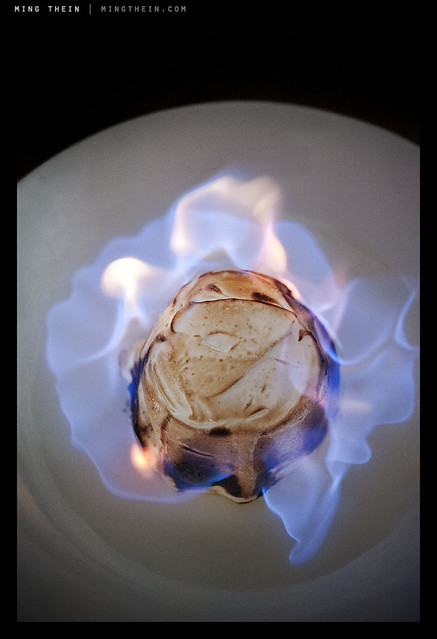
Flambe. Repeatable, but not controllable. You can set up the shot and do it again, but you can’t control what the flames are going to do. And this is the interesting thing that gives a little variation and makes each shot different. Seascapes are another good example. Nikon D700, AFS 60/2.8 G Micro
Personally, I’m going for something in the middle; but before I even get there, I need to shoot more – to have full intuitive control over my camera so that whatever adjustments I make come to me as second nature. And at this point something has to be said about good cameras, bad cameras, and too many cameras; good cameras are intuitive to use and require little training or practice to master. They do what you want them to, nothing more and nothing less. Bad cameras are ones that you never feel fully in control of, no matter how much practice you have. And too many cameras is just that: if you have too many cameras, you’re bound to eventually forget which button does what. And that could cost you at the most critical moment. This is why I’ll continue to use my D700 for reportage assignments until I’m fully comfortable with the D800; I know exactly habit will do under every situation, born of seventy thousand frames of experimentation – not counting the fifty thousand I shot with the D3, which is pretty much the same camera. MT
*Did anybody get the Futurama reference?

Would the burger be as appetizing without that juicy pickled onion marmalade peeking out? Probably not. Nikon D700, AFS 60/2.8 G Micro
____________
Visit our Teaching Store to up your photographic game – including Photoshop Workflow DVDs and customized Email School of Photography; or go mobile with the Photography Compendium for iPad. You can also get your gear from B&H and Amazon. Prices are the same as normal, however a small portion of your purchase value is referred back to me. Thanks!
Don’t forget to like us on Facebook and join the reader Flickr group!
Images and content copyright Ming Thein | mingthein.com 2012 onwards. All rights reserved
Lens review: The Nikon AF-S 85/1.4 G
May 7, 2012 by

Untitled still life. Nikon D700, AF 85/1.4 D with extension tubes.
Let me start by giving you a bit of my fast 85mm history. I never saw the big deal about this focal length until I went full frame; and even then, not til I got a D700 and the f1.4 D version in late 2009. Up til that point, it was just another forlorn intermediate marking on the barrel of my 70-200 or 70-300mm lenses.

Tea plantation, Cameron Highlands. Nikon D700, AF 85/1.4 D
After The First Leica Period, I had to find a lens to satisfy my bokeh addiction – it would spiritually replace the Leica 50/1.4 ASPH and Voigtlander 50/1.1; since all of the Nikon mount fast 50s were frankly pretty weak, and after the M8’s 1.3x crop factor, 50mm becomes 75mm, 85mm was the natural choice. I went for the Nikon AF-D 85/1.4 – the screwdriver focus version – and had a love/ hate relationship with it. On one hand, it delivered amazing bokeh, and great sharpness and separation of planes; use it at f2 and smaller apertures for optimal performance.

Ticketed. Nikon D90, AF 85/1.4 D
But what I didn’t like was that it missed focus frequently owing to the backlash in the focusing system, and often wouldn’t be able to move the elements enough to take care of small changes in distance. And then there was the edge softness, and CA…which was perhaps the worst I’ve ever seen in a modern lens design. Wide open, on a high contrast edge, you’d get a good 2-3 pixels PLUS some sort of interesting ‘bloom’ that would span anywhere up to a further 5 pixels – on a 12MP FX body, which is already fairly forgiving of lenses.

On set. Nikon D700, Zeiss ZF 1.4/85 Planar
Enter the Zeiss ZF 1.4/85 Planar. Not only did it have minimal CA, and somehow deliver 2/3rds of a stop more shutter speed for a given aperture setting (no doubt the T* coating had something to do with the hugely increased T stop) – it also delivered micro contrast and color transmission that was absolutely out of this world. In fact, the ability to reproduce fine structures went far beyond anything that I’d seen from Nikon glass – and I was pleasingly reminded of the 2/28 Distagon I also owned.

Construction, Putrajaya. Nikon D700, Zeiss ZF 1.4/85 Planar
There is, of course, one catch: it wasn’t easy to focus. There was definitely some focus shift on stopping down; I solved that problem by shooting it wide open all the time – and with bokeh like that, I can’t think why anybody would want to stop it down in the first place. But more than that, depth of field – as expected – was about the thickness of two sheets of paper. Maybe two and a half, if you had a more distant subject.

Arches. Perbadanan Putrajaya. Nikon D700, Zeiss ZF 1.4/85 Planar

The Nikon AF-S 85mm f1.4 G ED IF N SWM (full name). Image from Nikon USA.
When Nikon released the updated AF-S 85/1.4 G in late 2010, I jumped. I didn’t intend to, but a brief test drive at my dealer purveyor of addictive substances confirmed my worst fears: it was not only on par optically with the Zeiss (at least on the D700), it also focused by itself, and was able to do so with precision, thanks to the AFS motor.

Left out. Nikon D5100, AFS 85/1.4 G
On the D700, 12MP and 16MP FX bodies, I still think it’s an amazing piece of glass. You get all of the good properties of the Zeiss – high transmission, smooth bokeh, great micro contrast, broad spectral transmission, that 3D look, almost no CA – lateral or longitudinal – but with precise, fast autofocus. It’s also slightly sharper in the edges and corners than the Zeiss was.

Pipe man, Nikon D5100, AFS 85/1.4 G
There really isn’t a lot to say beyond that it’s a) almost perfect on these bodies and b) eye-wateringly expensive. It was, and still is, my favorite lens for the D700 – fully 7% of all the images on my flickr stream were shot with it (which is amazing when you consider the number of cameras I use, and the number of lenses I’ve got.)

Rickshaw man, Kathmandu. Nikon D700, AFS 85/1.4 G
Which is why my subsequent experience with it on the D800 is very, very confusing indeed. It doesn’t focus accurately or quickly; in fact, it tends to hunt more than a little, and doesn’t snap to focus with the certainty of the D700. (Although this could be my body, with it’s AF sensor misalignment and other peculiarities – I’ll report back again once I’ve had a chance to do extensive testing with the replacement D800E). It also isn’t that sharp, even on center. Before you ask, it isn’t an AF fine tune issue – even focusing in live view yields similar ‘best case’ optical results. It gets better – or perhaps worse – there’s also now very visible longitudinal chromatic aberration, something I’ve never seen with this lens on the D700; this color shifting also causes reduction in contrast and visible degradation of sharpness.

Failure to launch. Nikon D700, AFS 85/1.4 G
To top everything off, I find that if I calibrate the lens for close distances, then it’s off at infinity. And vice versa. Again – not behavior I’ve ever seen with any other body I’ve used this lens on. To be sure, I tested three samples, and several D800 bodies – they were all the same. I think it’s one of those unfortunate cases where the optical design doesn’t play nice with the new low pass filter or whatever other optical elements happen to be sitting in front of the new sensor.

No trekking today. Kathmandu. Nikon D700, AFS 85/1.4 G
If you stop down to f2, most of the oddness goes away. By f2.8, the lens becomes its perfect self again – but we didn’t pay for the extra stop to use it at f2.8; perplexingly, the (optically) much simpler AF-S 85/1.8G (no nano coating, no aspherical elements, no ED glass, no RF or IF even) is perfect at f1.8, and stays that way – the f1.4G needs to stop down to f2.8 to match it. Of course, you do loose about 2/3 stop of transmission between the two lenses, so something has to be said for the value of the fancy coatings and optics in the f1.4G.
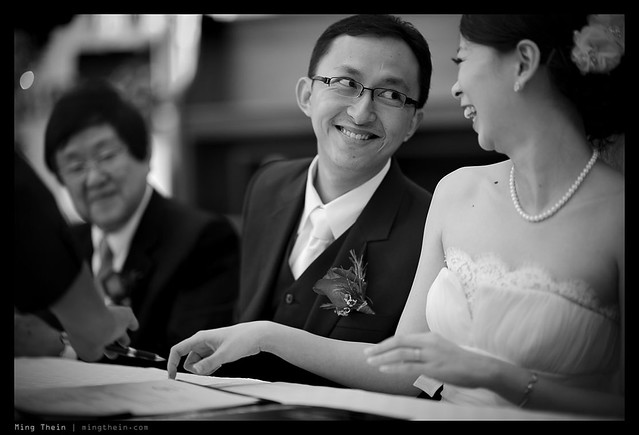
A great lens for ‘sniping cinematic moments’. Nikon D700, AFS 85/1.4 G
Still. Surprising, no?
It’s a pity, because I really, really wanted to use this lens on the D800 – the sensor’s ability to reproduce very fine tonal gradations and subtle color nuances goes beyond anything else I’ve used; that combined with the 85/1.4 G’s resolving power and optical qualities (seen on the D700 at any rate) would have made a formidable combination for cinematic photography. Alas, it looks like I’m going to either have to buy the 85/1.8G to use on the D800, or stick with the D700/85/1.4G combo for now.

Stall chefs. Nikon D800, AFS 85/1.4 G
Can I recommend the lens? For D800 users, honestly, no. You’re better served by the 85/1.8G; use the balance of funds for other glass, or buy one of my prints with some of the money you’ve saved (shameless plug). It simply lacks the crispness I’ve seen with other bodies. For D700, D3, D3s and DX users: absolutely yes, it’s a stunning piece of glass, and has become my go-to lens together with the 24/1.4. I don’t know why it isn’t the case on the D800 since it has similar pixel density to the D7000, with which the lens does an excellent job – but it just isn’t. Now, what might be an interesting combination is D800 + Zeiss 1.4/85 Planar; I’d rather not find out in case I have to buy something. Having three 85mm lenses would be utterly ridiculous, wouldn’t it? 🙂 MT

Kathmandu. Not just a portrait lens; it’s great for reproducing the fine detail in landscapes, too. Nikon D700, AFS 85/1.4 G
The Nikon AFS 85/1.4 G is available here from B&H and Amazon.
____________
Visit our Teaching Store to up your photographic game – including Photoshop Workflow DVDs and customized Email School of Photography; or go mobile with the Photography Compendium for iPad. You can also get your gear from B&H and Amazon. Prices are the same as normal, however a small portion of your purchase value is referred back to me. Thanks!
Don’t forget to like us on Facebook and join the reader Flickr group!
Images and content copyright Ming Thein | mingthein.com 2012 onwards. All rights reserved
An unfair fight? 35mm vs Medium Format: Nikon D800E and the Leica S2-P
May 5, 2012 by

I want to say upfront that until I did the test, I had no idea how the result was going to turn out. What I suspected wasn’t quite the outcome that occurred; but you’re going to have to read on to find that out 🙂 I apologize in advance, because what was supposed to be a quick A-B image comparison has turned into a 3,500 word dissertation. There are a lot of things that must be said, clarified and put into context when dealing with these cameras.
The best conceived test is completely useless if the methodology isn’t sound; likewise, a seemingly unfair fight can be actually relevant if properly executed. Both cameras are in the high 30MP range; 36.3MP for the Nikon D800E, and 37.5MP for the Leica S2. Close enough to make as near as no difference. (Also, the S2-P is the same camera as the S2 except for the sapphire cover over the screen and professional service.) Everything was shot at base ISO on a sturdy tripod (a heavy Manfrotto 444 Carbon One with Hydrostat head) and mirror lockup. Lossless compressed RAW for both, with files processed via ACR 6.7 final release with equal sharpening, zero noise reduction, and equal shadow/highlight recovery slider settings. Images were then saved as quality 12 jpegs – the full frame shots you see are reference for color only, not resolution of course – and the 100% crops are also quality 12 jpegs. There is some minor quality degradation but not a lot. The first cityscape had both cameras set to the same Kelvin temperature for white balance, however subsequent shots were point balanced in ACR to the same location as this was more representative of real-life workflow.
In addition to outdoor subjects – the dynamic range torture test – I also shot a number of indoor subjects to test both front and back bokeh, sharpness, high ISO performance, lens performance in the macro range, and a trial run for something I’d use both cameras for – watch photography.*
Similarly, I matched lenses as closely as possible; we chose the best for each system. Not difficult with the S2 – all of the lenses are incredible, and nearly flawless. It is simply one of the highlights of the system; there are no lenses worse than excellent. And each lens has its own calibration firmware embedded at the factory, to ensure perfect focus on every camera body – why other manufacturers don’t do this is beyond me. I certainly wouldn’t have had the D800 AF issue if this was the case. I used the Leica 35/2.8 Summarit-S and 120/2.5 APO-Macro-Summarit-S on the S2, and the Zeiss ZF.2 2/28 Distagon and Nikon 85/2.8 PCE Micro-Nikkor on the D800E – both lenses I consider to be the best of their focal length in F mount.
Focusing was done either via the AF system (and results checked via live view or manually bracketed) to achieve optimum sharpness. Everything was shot within minutes of each other, so there should be minimal differences in lighting. There will be some differences in the final watch shot as I couldn’t get the tripod to hold in that overhead position with the weight of the S2; the shot was handheld and there are some minor differences in lighting due to watch positioning and reflections.
*I shot part of an architectural assignment recently with the S2, 30mm and 70mm lenses; see an upcoming On Assignment for the rest of that article.
Part one: Cityscape – dynamic range and resolution test. Zeiss 2/28 and Leica 30/2.5

The full D800E + Zeiss ZF.2 2/28 Distagon frame

The full Leica S2 + 35/2.5 Summarit-S frame
The first obvious thing is that the color response of both sensors is hugely different, despite both being set to the same color temperature; I’m guessing it has to do with many factors, including a) CMOS vs CCD architecture; b) the nature of the Bayer algorithm used and the color filter array layout; c) internal signal processing and ‘company color profile’; d) ACR’s interpretation of the files.
The D800E’s file looks quite natural but is a touch too warm; the S2 is very blue-green biased and would make for great landscapes, however it doesn’t get the color right either. Both cameras could be corrected to accurate (as their sensors’ tonal response is broad enough) however neither gets it right out of the box. The S2 has slightly better dynamic range – perhaps half a stop or so – but there isn’t a lot in it. Neither camera has blown areas or blocked up shadows.

D800E 100% center crop, at f2.5

D800E 100% center crop, at f8.

S2 100% center crop, at f2.5

S2 100% center crop, at f8
In the center, the Zeiss/D800E combination is already excellent at f2.5 (set to match the S2) and barely improves at f8. The Leica, however, is even better at f2.5 (wide open!) and seems to soften a bit at f8. I repeated this test several times with the same result – the lens is best used wide open, it seems.

D800E 100% edge crop, at f8

S2 100% edge crop, at f8
The corners tell a very different story; the Zeiss/D800E is very good, but the Leica is outstanding. The former has clear softening due to CA at high contrast edges (note white building) due to field curvature; the Leica shows none of this whatsoever and is sharp enough to show minor evidence of color moire (!). This is best seen in the air conditioning condensers in the windows of the white building.
Note – shadow noise here is high because I’ve run a 50/50 setting for the shadow/highlight slider to maximize dynamic range.
Part two: Indoors, wide-angle bokeh test and flare test

D800E + Zeiss ZF.2 2/28 Distagon full frame

S2 + 35/2.5 Summarit-S full frame
There’s really not a lot in this one – both images look great. Color is accurate, and bokeh is pleasant – though I’d give the edge to the S2 because the highlight rolloff is a little smoother; which no doubt has much to do with the dynamic range of the sensor. What is noticeable here is vignetting on the D800E/ Zeiss combination; almost a stop. I guess it’s one of the factors that contributes to the cinematic look of the Zeiss. The Leica has zero vignetting, despite being shot wide open. Depth of field is about the same; the D800E/ Zeiss was shot at f2, and the Leica at f2.5.

D800E 100% center crop, at f2

S2 100% center crop, at f2.5
Both lenses are commendable in the way they handle the strong backlight with almost no flare; the coatings on both are superb and you see very little of the first few elements. However, on closer inspection at 100%, we see the Zeiss has a definite purple fringe, and the Leica appears almost completely apochromatic. I’d say resolution here is a tie.
Part three: telephoto bokeh and flare test

D800E + 85/2.8 PCE full frame

S2 + 120/2.5 APO full frame
We’ve now switched lenses to the short tele macros; the 85/2.8 PCE on the D800E, and the 120/2.5 APO-Macro-Summarit on the S2. The tripod was moved between shots to try to match the angle as the Leica 120 is about 95mm equivalent; I don’t have the AFS 105/2.8 VR handy, and besides, I think the 85/2.8 PCE is a better lens anyway – the micro contrast structure is a lot more refined, and LoCA is lower.
The D800E seems to have a slight dynamic range advantage here, though it could be due to exposure. Bokeh from the S2 is definitely better, as would be expected from a lens that’s both faster and longer. Both lens/ camera combinations deliver a very 3D feel, and pleasant foreground bokeh – something that’s frequently ignored by photographers, but contributes heavily to a workable defocused foreground as part of the composition or not.

D800E 100% center crop at f4

S2 100% center crop at f4
On closer inspection, we see both lenses are easily capable of matching the resolving power of the sensor; if forced to choose, I’d give a hair to the Leica, but there’s almost nothing in it. Where there is a difference is in longitudinal chromatic aberration (‘bokeh fringing’) which is very obvious on the Nikon crop, but almost completely absent from the Leica – the 120mm is an APO lens, after all. This may contribute to the overall impression of the Leica being slightly sharper. Interestingly, the micro contrast structure and color transmission between the two lenses is very similar indeed, which is to say very neutral.
Part four: high ISO test

D800E full frame, ISO 1250

S2 full frame, ISO 1250
The same scene, again – however, this time at ISO 1250, which is the upper limit for the S2. The D800E can of course go a lot higher – to 25,600 – but I wouldn’t touch this with a barge pole. Notice the reduction in dynamic range for both cameras – more so on the S2, as expected from its CCD sensor architecture. Color transmission is commendably consistent between the two. In case you’re not convinced it’s dark, exposure time was 1/40s at f4 ISO 1250 for both cameras. Although this isn’t pushing the limits of the Nikon with it’s CMOS sensor, it is pretty much forbidden territory for most medium format systems.

D800E 100% center crop, ISO 1250 f4

S2 100% center crop, ISO 1250 f4
THe S2 displays a similar noise profile to the M9 at the pixel level; this of course isn’t surprising because they share the same base sensor architecture from Kodak. It is clear that both cameras are showing noise (there is zero NR applied here; it could be much improved by judicious use of the noise reduction tools in ACR). The D800E’s noise pattern is very fine grained luminance noise only; there’s a hint of chroma noise in the S2, but it’s still mostly luminance. I’d put it at being 1.5-2 stops behind the D800E. This is clearly not an available light camera; frankly, neither one is; I’d pick a D3s or D4. Detail retention for both cameras is still excellent, with the edge again going to the Leica – more clearly this time – perhaps the Nikon is applying some noise reduction on its raw files (though I switched this option off in camera.)
Part five: practical applications

D800E + 85/2.8 PCE full frame

S2 + 120/2.5 APO full frame
What you see here is a processed (but un-retouched – that would take too long) final photo achieved with multiple Nikon flashes – triggered via CLS on the D800, or via an optical SU4 trigger on the S2 – which is representative of the kind of shoot I’d use either camera for. Of course, this doesn’t take into account the minimum practical frame size on the D800E being about 10x7mm, vs 60x90mm for the S2.
The S2 image pops more – it could be due to a slight change in camera position for reasons mentioned earlier – but I suspect it may be due to the Leica 120mm having slightly higher overall contrast than the Nikon PCE. Both cameras have done outstandingly well; I like both images very much. Color is commendably accurate after adjustment.

D800E 100% center crop, f5.6

S2 100% center crop, f5.6
Close up, there’s there’s a bite to the S2 image that’s lacking from the D800E; somehow the finest structures aren’t being completely transmitted by the lens; it seems the S2 lenses have more micro contrast. Once again, both images were shot at the same aperture, but somehow the S2 appears to have a hair more resolution and acuity.
Part six: specific comments on the Leica S2
There are a lot of things I like about this camera. It’s the first Leica system designed from the ground up in a long time, and it shows. There’s DNA from the R9 ‘Hunchback of Solms’ about the way the shoulders of the camera slope, the gigantic shutter dial, and the almost vertical shutter release (which is a great design choice, by the way – squeezing the grip greatly reduces camera shake compared to a vertical plane release). Even the power switch positioning is reminiscent of that lever on the R9 whose function I’d never been able to figure out. In fact, it’s pretty amazing that they managed to fit such an enormous viewfinder inside that prism hump – it’s not much bigger than the D800E’s hump, in fact (though the latter also contains a pop up flash).
Despite the legacy DNA, the control system is well thought out and remarkably simple – four hot keys around the LCD have soft functions; selections and scrolling are taken care of by the thumb wheel, which also clicks in to select or change exposure mode. It’s a very elegant and easy to use system. The camera and lenses are also fully weather sealed, with elaborately precise flanged gaskets that make the Nikon look positively crude by comparison. (Strangely, I was also told that it was probably not a good idea to shoot with the camera in the local monsoon rain). Build quality is excellent; it feels like a solid block of metal (and weighs about the same too, but a lot of this is attributable to the lenses), and there are very few external screws except on the base, which is rubberized; I’d say it’s a level above even the D4. The mirror mechanism is remarkably well damped, and for such a large mirror, blackout time is negligible. The one thing I don’t like about the ergonomics is the hand grip; that odd finger cut just doesn’t seem like it was made for Asian hands.
The viewfinder is enormous – as expected for medium format – and hugely addictive, being both of high magnification and high eye point. In fact, magnification is about 100% with the 70mm, which means you can comfortably shoot with both eyes open. I never thought I’d say this, but it makes the D800E’s finder feel like a dark tunnel. And there’s no comparison when it comes to ease of manual focus – though the D800E does of course have live view. Battery life is excellent, too – in my time shooting with the S2, I’ve never been able to make the charge indicator move more than a small fraction even during a heavy day of shooting with several hundred images. I’d estimate you’d get at least a thousand, possibly even two thousand, images off one charge.
The crown jewel of the system, however, has to be the lenses. The S system lenses are hands down the most impressive optics I’ve ever used; they’re almost flawless wide open, even in the corners, and even more perfect than the best M system lenses. And they focus themselves! Sadly they’re also enormous and heavy – which I suppose is the price paid for perfection. The 120 macro is almost the size of a 70-200 VR.
It’s not all roses, though. The S2 doesn’t work well as an available light camera; it’s very difficult to nail critical focus, stop camera or subject motion, and still stay within the good quality ISO range. I’d go to ISO 640 with reservations, and 1250 in emergencies. But then again, it was never supposed to be. The LCD could be improved, and some parts of the menu just look crude. The reverse-turning (at least relative to Nikon) aperture dial is also immensely confusing; I wish they put an option in the menu to allow users to reverse the direction. Autofocus is precise, but by no means fast; with the 120 APO-Macro it might take a while as the focusing helicoid nearly runs a full 360 degree turn of the barrel.
Part seven: specific comments on the Nikon D800E
You can find plenty of my thoughts on the nearly identical D800’s detailed first impressions review.
After a month of using the sibling of this camera in various ways, my opinion still hasn’t changed: it’s a game changer as far as image quality in the small format goes. There isn’t anything that can touch it, and the D800E stretches that bar even further. I thought the image quality of the M8 was good, but this is like having two M8 sensors welded together side by side – that’s a noticeable increase in resolution.
The D800E does require care with regards to moire; I’ve seen it several times already during my very short time with the camera. Both luminance and chrominance moire are possible; watch carefully with high frequency repeating patterns such as architectural detail or fabrics.
It’s a shame, however, that most of Nikon’s lenses don’t seem up to the task. They have built a monster of a camera body capable of incredible resolution and color that seems to have outstripped the rest of the system somewhat – very, very few Nikkors can do the sensor justice. The PCEs are a safe bet, as are most of the Zeiss lenses; of the AF glass, be careful with the primes. Yes, there were focusing problems, yes, they’re being repaired, and yes, my D800E is much better than the D800 – though still affected to a very slight degree. Enough that I’ll be careful, but not a deal breaker as most of my work with the D800E will be done under controlled studio circumstances with longer lenses.
Conclusion
What I find interesting is that we’re at a convergence point: my complaints of the S2 are because I’m treating it like a normal SLR; on the opposite hand, I’m expecting medium format quality from the D800E. This says a lot: both cameras have achieved and surpassed their design objectives. The Leica S2 was designed to make medium format easy and convenient; it does – to the point where we forget that we’re shooting with medium format. The D800E was supposed to raise 35mm-format DSLRs into the medium format realm; it does. I don’t think I’ll ever take the D800E with me on holiday; I’d certainly pack something lighter, smaller and less demanding to shoot. But I can offer my clients a new level of quality, but without the limitations of medium format (wireless TTL flash, magnification, focal length selection). By the same token, I’m quite happy walking around with the S2 and 70/2.5 (which is my favorite lens for the S system) and treating it as I would my M9-P. Both have a place in the photographer’s arsenal; however, you probably shouldn’t buy either unless you know you’re going to use the resolution – and in that case, the S2 wins on the quality its lens system.
You’ve probably read all the way to the end of this review hoping I’ll pronounce one better than the other; the reality isn’t that clear cut. The Leica S2 wins on lens quality (by a large margin), resolution (by a hair), dynamic range (though this may be debatable) and build; the D800E wins on color, practical usability (ISO 6,400 at medium format resolutions, anybody?), lens selection, speed and portability.
I honestly like both cameras and systems very much; I don’t think I could pick between the two if money weren’t an issue. The reality is that unless you’re going to torture your files and print them at enormous sizes, the D800E does deliver much better value for money. However, you’re going to have to spend a lot of money on lenses to do the sensor justice – that is if you can even find anything suitable; this lens selection is very, very small; and it’s also not cheap. I’d give the edge overall to the S2; because of the matched lenses, it feels like a more complete system, but you’ve got to climb a steep diminishing returns slope to get there. However, with the ever rising pixel densities of lower end cameras – 24MP APS-C, for instance – I’d be surprised if there wasn’t an even higher resolution D4x in the future, and given the undoubtedly huge investment for Leica, this is just the beginning of the S system. MT
Note: I don’t think I’ll be doing a direct comparison with the regular D800 as I no longer have one handy; however what I will do is try to dig out some similar files and do an approximate comparison that way. What I see from the D800E definitely has higher acuity at the pixel level, though I’ve also seen clear evidence of color and luminance moire – much in line with expectations.
____________
Visit our Teaching Store to up your photographic game – including Photoshop Workflow DVDs and customized Email School of Photography; or go mobile with the Photography Compendium for iPad. You can also get your gear from B&H and Amazon. Prices are the same as normal, however a small portion of your purchase value is referred back to me. Thanks!
Don’t forget to like us on Facebook and join the reader Flickr group!
Images and content copyright Ming Thein | mingthein.com 2012 onwards. All rights reserved
POTD: I’m working on it.
May 4, 2012 by

The mother of all DSLR comparisons is coming soon. Give me until Sunday!
Just arrived: Nikon D800E
May 3, 2012 by

The D800 went back, so I won’t be able to do a direct A-B comparison, but what I will do is post an update as I shoot with it more. I’ll also try to find a matched image to shoot (both under ideal conditions) so we can take a look at the differences.
Initial impressions: acuity is better, but ever so slightly. It seems to remove that ‘layer of fog’ from some lenses, though. Annoyingly, you can’t save settings on a D800 then transfer them to a D800E; apparently the firmware is different, too. Everything else is the same.
The question you’ve been wondering about is AF: yes, it’s a hell of a lot better. Not 100% perfect on the left side, but close enough to LV that I’m now wondering if my copy of the 24 is a bit off and the other bodies just weren’t high enough resolution to notice it. The 85/1.4G is noticeably better than on the D800; no explanation why. I haven’t used the other lenses yet, so I can’t comment. But I do have a watch shoot coming up for which I’ll use the 85 PCE, so that should be interesting.
This month looks like there’ll be a lot of gear reviews – I’ve got an OM-D incoming, and I was told to clear my schedule for a couple of days after May 10. Please don’t ask me what for, I don’t know either. MT
Quick update at 8pm: I forgot to mention earlier that I also had a chance to play with the new AFS 28/1.8 G at Nikon; it was a prototype so they didn’t let me take it away for a more extensive evaluation, and I wasn’t allowed to keep any images. First impressions are positive; it’s sharp wide open, bitingly so by f2.8, consistent across the frame, focuses fast and positively, and is surprisingly light. However, the problem for me is that it simply lacks character; I can’t put my finger on why but I suspect it’s to do with Nikon’s preference for macro contrast over micro-contrast. The Zeiss 2/28 Distagon may not be as perfect on a test chart, but it certainly has much more personality – and remains my preference in this focal length. I suspect also that it has a much higher T stop than the Nikon.