Review: The Nikon AFS 28/1.8 G

_8015822 copy

Due to a risky mixture of popular request and a slight but gnawing dissatisfaction with my the performance of my 24/1.4 G on the D800E, I recently acquired the Nikon AFS 28mm f1.8 G to review. (Hereafter referred to as the 28G) The 28G was released earlier this year, and is now available with relative ease. It’s a 11/9 design with a near focus limit of just 25cm, and magnification of 0.22x.

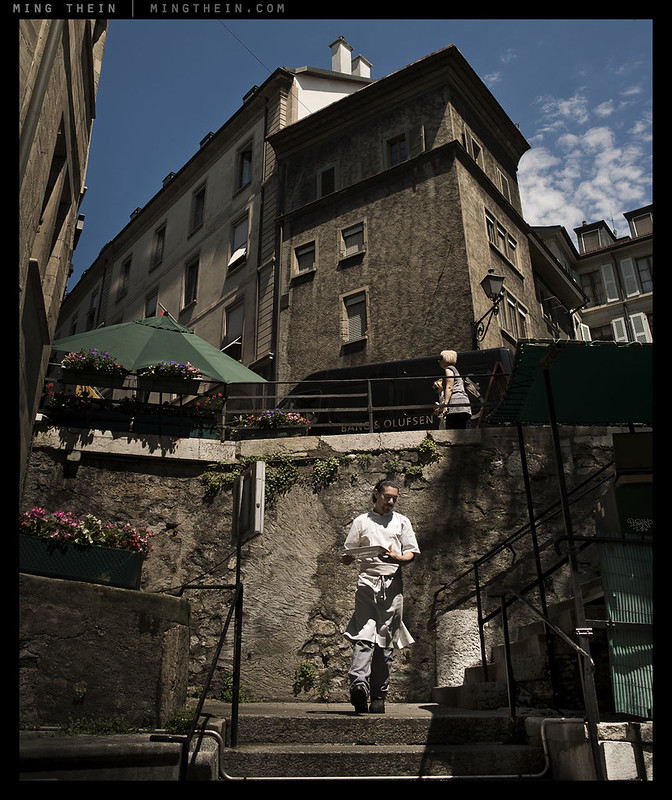
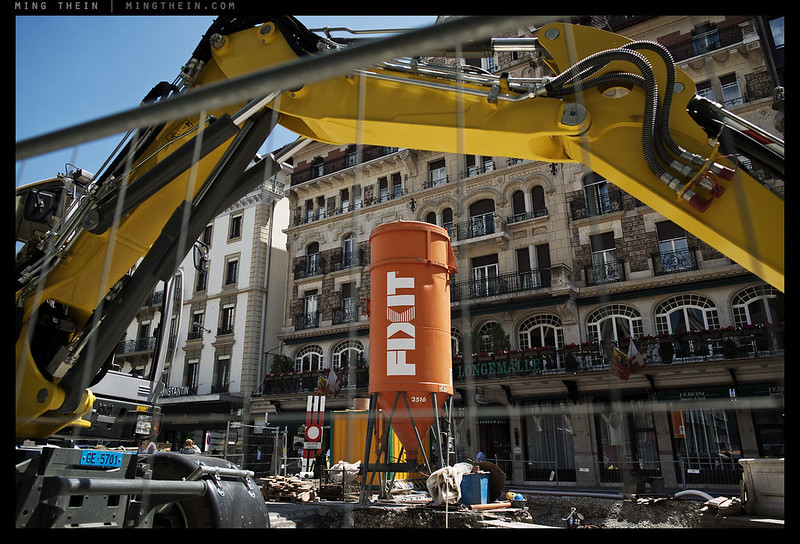
All images in this review may be clicked on for larger versions. Photographs from this review were shot with a Nikon D800E on my last assignment to Geneva.

A note on testing methodology: I’m not a lab reviewer, but I do try and make my testing as scientific as possible. It’s part of getting to know the limitations of you gear, so you can make the most out of it on assignment and in the field. This means that if I see some odd behavior, I’ll do my best to replicate it before reporting it’s an issue. Please go by what I say, not by the images – it’s impossible to judge optical characteristics on web-sized jpegs; I’ve been looking at hundreds of D800E raw files.

_8015800 copy

The lens is both light in the hand, and fortunately also light on the wallet. At a street price of around US$650 (in Malaysia, at least) – it represents excellent value for money compared to both the AFS 24/1.4 G, and the notoriously difficult to find AF 28/1.4 D. Being a huge fan of the 28mm focal length, I find myself with few options – 24 and 35 are much more popular, and have everything from f1.4 options to macros and tilt-shifts. (To the best of my knowledge, the only perspective-control 28mm made was an early Nikon 28/3.5, which only allowed shift and no tilt.) Until now, my go-to lens at 28mm has been the Zeiss ZF.2 2/28 Distagon T* – to be the subject of a future review – which has some pretty unique optical qualities, not least its hugely pronounced field curvature.
_8015090 copy

Although the 28G carries the gold front ring signifying contents of ED glass and professional level construction, it definitely doesn’t feel like it. This is one of the lightest lenses for its size I’ve ever handled; similar in weight and size to the 18-135 DX kit lens, actually. The shell is entirely polycarbonate, and the only metal to be found anywhere is on the mount and screws. Looking at the edges of the back element, I suspect there’s a moulded aspherical element or two in there also. Still, build quality seems decent enough, with no creaks, rattles or clunking, and the focusing ring is both easy to turn and without any free play. The lens also has a rear gasket and is weather sealed.

_8015136 copy

This is a proper AF-S lens, which means that there’s full time focus override, no hard stops at either end of the focusing scale (though the resistance increases noticeably) and reasonably fast and accurate focus. It acquires focus at about the same speed or slightly faster than the 24/1.4, actually. Most of the time, the lens snaps into focus quickly and positively. I’ve had a couple of occasional ‘near misses’ where the camera thought the lens was in focus but it was just out of critical sharpness range – near enough – but only when shooting at f1.8. I don’t know if this is an issue with the lens or the D800E (and its focusing issues). Some further investigation is in order, I think. The lens is somewhat prone to the left-side AF issue of the D800/D800E, though only for the extreme most points (the column of three) – all of the other points focus as expected, at least on my D800E body.

_8014986 copy

_8014986 crop
100% crop of above

Optically, the 28G does a great job in the center – it’s sharp from wide open even on the D800E, however you need to stop down a bit to reach maximum microcontrast. Optimal sharpness in the center comes at about f5.6. There’s almost no CA or flare, even when shooting high contrast subjects; a testament to Nikon’s Nano-Crystal Coating doing the job it was designed for. There is, however, some uncorrected speherochromatism and longitudinal chromatic aberration – the latter which appears as both bloom and red/green fringing when shot wide open. The lens makes nice sunstars, too – with minimal ghosting.

_8014939 copy

_8014939 crop
100% crop of the above image, shot through glass (hence the fringing)

The corners, are a different story – they’re not sharp til about f8, and noticeably vignetted. However, it seems that the 28G also suffers from pronounced field curvature – much like the Zeiss Distagon – because there is a sharp plane of focus, curved in front of the subject and back towards the camera. It isn’t quite as pronounce as the Zeiss, but it’s definitely there. Technical shooters will hate this because it isn’t a flat-field lens, but personally I think it’s great for environmental portraiture and reportage – placing your subject somewhere in the central region means that the lens actually helps you to achieve better separation by relatively defocusing the background further. Speaking of technical shooters, there’s a hint of pincushion distortion, but nothing that isn’t easily fixable with the profiles available in Photoshop/ ACR.
_8015140 copy

Let’s talk a bit about bokeh – it’s best described as neutral to good. There are some bright edges on circular OOF highlights, but nothing too bad; there’s also a hint of texturing inside the same circles, which points to the use of a moulded aspherical element or two somewhere inside. I can’t help but think a circular 9-bladed diaphragm, similar to that used in the f1.4 G lenses, would have improved things a bit – the pennies had to be saved somewhere, and we have to make do with a 7-bladed and slightly angular iris.

_8015087 copy

If you’ve got enough distance between subject and background, the lens renders the scene with rather nice ‘pop’ – subjects are well separated from the background. Although the 28G has a maximum aperture of f1.8, it has about the same isolating power as the 24/1.4 due to the slightly longer focal length. I still wouldn’t use it for close up portraits though, the wide angle perspective distortion is definitely not flattering.

_8014954 copy

In what must be a first for any Nikon lens, the 28G seems to out-transmit its Zeiss counterpart, aperture-for aperture. The 28G has a T stop that’s about 1/3 stop greater than the 28 Distagon; a rather surprising result. (The Zeiss 85 Planar is nearly a whole T stop faster than the 85/1.4 D, and about a third of a stop faster than the 85/1.4 G.) The front elements have the same nearly-invisible look as those of the Distagon. More importantly, transmission throughout the color range is pleasingly neutral; scenes are rendered with clarity and natural saturation – though not quite with the same microcontrast punch and overall saturation of the Zeiss

_8015154 copy
Oops, missed the sensor dust.

If at this point it seems that the review has somewhat turned into a comparison between the Zeiss ZF.2 28 Distagon and the 28G, you’d be right – in my mind, these are natural competitors (at least they are in my lens cupboard, at any rate). It’s very difficult to choose between the two – the Zeiss does have a certain hard-to-define quality about its microcontrast structure and bokeh that just makes images shot with it slightly more vivid and three-dimensional; however, you lose very little with the Nikon, and gain much convenience by way of autofocus.

_8014991 copy

I am a 28mm junkie (at the last count, I’ve got nine ways to get there on four different sensor sizes) so you might want to take this conclusion in context – I can see reasons for having both. If I was shooting something for which I had time to be deliberate in the setup and craft the scene – I’d pick the Zeiss. However, if I was doing documentary work, or travel, or anything which might possibly have a hint of run-and-gun to it – I’d mount the Nikon. MT

The Nikon AFS 28/1.8 G is available here from B&H or Amazon.

____________

Visit our Teaching Store to up your photographic game – including Photoshop Workflow DVDs and customized Email School of Photography; or go mobile with the Photography Compendium for iPad. You can also get your gear from B&H and Amazon. Prices are the same as normal, however a small portion of your purchase value is referred back to me. Thanks!

Don’t forget to like us on Facebook and join the reader Flickr group!

appstorebadge

Images and content copyright Ming Thein | mingthein.com 2012 onwards. All rights reserved

_8014927 copy

_8014996 copy

_8015069 copy

Update: My 28 stopped working yesterday; up til this point it hasn’t had any issues, but suddenly none of my cameras would recognize the lens. Nikon service says it’ll be three weeks to get replacement parts (AF motor, PCB, some connectors) – which frankly is pretty unacceptable for a lens that’s only three weeks old! To make it worse, there aren’t any loan units or similar lenses other than a slow zoom or two.

To their credit though, they arranged a replacement through my usual dealer within about half an hour. With the number of problems with Nikon’s recent products, I’m starting to think that QC has suffered quite a bit following the tsunami – or it could just be because the lens is made in China.

How to tell if your D800/ D800E/ D4 has the ‘left focusing problem’

I’ve been asked this question more times in the last few days than I can remember: ‘does my D800/ D800E/ D4 have the left side focusing problem?’

Here’s how you can tell.

1. Pick the widest, fastest lens you own. A 24/1.4 is ideal.
2. Shoot it wide open, with the camera on a tripod, AF set to AFS single point.
3. Shoot a set of images at extreme left, center and extreme right, defocusing the lens manually between shots. Use viewfinder AF. Pick a subject about 2m away.
4. Without moving the camera, do the same but in live view. (This is so the camera focuses exactly on the sensor).

5a. If there is no difference in sharpness in AF and LV modes between the points across the frame, then you’re fine and don’t have a problem. (But you might of course find the edges worse than the center; that’s normal. LV and AF focused shots at each point should look exactly the same in a correctly calibrated camera.)

5b. If LV is sharper than AF for all frames, then you need to use AF fine tune and try the process again.

5c. If the LV shots look sharper for only some, but not all, of the points, (e.g. right and center points look the same for AF and LV, but your left point is much sharper in LV than AF) – then you have the asymmetric focusing problem and your camera has to go back to Nikon.

You might also find this article useful on how to use AF fine tune.

And with that, I’m off to send my camera in for the fix. Will report back later (or tomorrow, whenever it’s done)…MT

____________

Visit our Teaching Store to up your photographic game – including Photoshop Workflow DVDs and customized Email School of Photography; or go mobile with the Photography Compendium for iPad. You can also get your gear from B&H and Amazon. Prices are the same as normal, however a small portion of your purchase value is referred back to me. Thanks!

Don’t forget to like us on Facebook and join the reader Flickr group!

appstorebadge

Images and content copyright Ming Thein | mingthein.com 2012 onwards. All rights reserved

Photoessay: Polo time, part 1

From an afternoon spent at the Royal Selangor Polo Club as a guest of one of the players – one of the very few times I’ve shot sport, believe it or not. I once again come to the conclusion that I’ve got an insufficient number of millimeters, and you need rather high shutter speeds to get any sort of useable and sharp images out. Now that I’ve got a Panasonic 100-300 for my OM-D, I’ll have to try and get myself invited back again…MT

This series shot with the Nikon D700, D3100 and 28-300VR.

_7021220bw copy

_3100_DSC0166 copy

_7021334bw copy

_7020966 copy

_7021206 copy

_7020910 copy

_7020841 copy

_7020817 copy

_7021312 copy

_7021180 copy

_7020854 copy

_7020985 copy

_7021112bw copy

_3100_DSC0133 copy

Recommended lenses for the Nikon D800E

_8013437 copy
Not quite summer at the Lac du Joux. Nikon D800E, Zeiss ZF.2 2.8/21 Distagon

Having had a solid couple of months to use the Nikon D800E and a variety of lenses, I’ve now compiled my recommended list of recommended lenses for the camera; some of the entries might or might not surprise you. These are lenses which I would not hesitate to use wide open, and will give you outstanding acuity, color and resolution providing you manage to nail the focus, of course. I’ve tested multiple samples of these lenses, as it seems that these days, consistency is hugely important and not always guaranteed. This list is also not exhaustive, because I’m sure there are exceptional copies of lenses I’ve ruled off the list, and there are almost certainly other obscure optics which I haven’t had the chance to try (and probably won’t ever manage to, either.)

_8014884 copy
Grain silo. Nikon D800E, AFS 28/1.8

Wide
Nikon AFS 28/1.8 G
Carl Zeiss ZF.2 2/21 Distagon T*
Carl Zeiss ZF.2 2/28 Distagon T*

Normal
Nikon AI 45/2.8 P
Nikon AFS 60/2.8 G Micro
Carl Zeiss ZF.2 2/50 Makro-Planar

_8016614 copy
Pears. Nikon D800E, Zeiss ZF.2 2/100 Makro-Planar

Tele
Nikon AFS 85/1.8 G
Carl Zeiss ZF.2 2/100 Makro-Planar
Any of the Nikon superteles

_8004351 copy
Maitres du Temps Chapter 3 Prototype. Nikon D800E, AFS 60/2.8 G

Zooms
Nikon AFS 16-35/4 VR N
Nikon AFS 24-70/2.8 G N
Nikon AFS 70-200/2.8 II VR G N

_8005388 copy
Sushi. Nikon D800E, PCE 85/2.8

Special purpose
Nikon PCE 85/2.8 Micro

Near misses (close, but not quite in the awesome league).
Nikon AFS 14-24/2.8 G – performance at 14mm lets it down, in my mind.
Nikon AFS 24/1.4 G N – I think this one is very, very borderline: if you get a good sample that focuses properly, it can probably be added to the list. However, I’ve used many of these lenses and there seems to be a lot of sample variation and focusing issues even on D700/D3 bodies; it doesn’t give me a lot of confidence.
Nikon PCE 24/1.4 – I’ve used one excellent one, and one that was merely so-so. Mixed reports on the web don’t suggest that the so-so one is a rare anomaly, and there just aren’t any more of them for me to test.

You’ll probably have noticed that the 28-300VR didn’t make the list; it’s because the lens just didn’t perform on the D800E to anywhere near the same extent it did on the regular D800. Just one of those inexplicable anomalies…

For more detail on any of the lenses mentioned here, visit the CAMERAPEDIA! MT.

____________

Visit our Teaching Store to up your photographic game – including Photoshop Workflow DVDs and customized Email School of Photography; or go mobile with the Photography Compendium for iPad. You can also get your gear from B&H and Amazon. Prices are the same as normal, however a small portion of your purchase value is referred back to me. Thanks!

Don’t forget to like us on Facebook and join the reader Flickr group!

appstorebadge

Images and content copyright Ming Thein | mingthein.com 2012 onwards. All rights reserved

Photoessay: Life in Kathmandu, part 3

The final part of my ‘life in Kathmandu’ series. Shot in mid-2011 with a Nikon D700, 24/1.4 and 85/1.4 G. I think this set really epitomizes my ‘cinematic’ style of reportage. Enjoy! MT

_7031433 copy

_7031584 copy

_7032108 copy

_7032458 copy

_7032762 copy

_7035823 copy

_7032656 copy

_7030977 copy

_7030982 copy

_7030999 copy

_7031095 copy

Good news: there’s an official Nikon D800/D800E focusing fix!

Was told by NPS this morning that an internal fix for the D800/ D800E asymmetric focusing issue has been issued. I’ll be sending my cameras in next week after a job; apparently it’s both hardware and software calibration. Fingers crossed…

Photoessay: Monochromatic life in Kathmandu

The first part of an ongoing series of the streets and people of Kathmandu, Nepal. Shot in mid-2011 with a Nikon D700, 24/1.4 G and 85/1.4 G lenses.

_7032151bw copy

_7030456bw copy

_7030368bw copy

_7030506bw copy

_7031005bw copy

_7030468bw copy

_7031230bw copy

_7031292bw copy

_7031371bw copy

_7031404bw copy

_7031538bw copy

_7031965bw copy

_7032127bw copy

Photoessay: The C3H5N3O9 (Nitro) Experiment ZR012

_8015235 copy

Despite being completely unpronounceable, this watch is just plain outright cool. The brainchild of Max Busser (MB&F) and Felix Baumgartner (URWERK), it is the first watch to use an eccentric planetary transmission system for the timekeeping mechanism – i.e. the same geometry as the Wankel engine. (Curiously, there’s only one ratio of inner to outer satellite that actually permits the three distinct chambers to be formed; any other ratio doesn’t seal at all). The minutes are read off the red tips of the upper ‘rotor’, with the hours on the level below. There is no seconds indication, but there is a power reserve on the back of the watch.

I believe these are the first photos outside the official press release, and I was told that the watch is a working production prototype – which means non-final parts and finishing, and some potential tool marks in places as befits an engineering experiment…

Many thanks to Ian Skellern at C3H5N3O9.

This series shot (hastily) with a Nikon D800E and AFS 60/2.8 G Micro. It wasn’t a commercial shoot, so please excuse me if I missed a spot or two. All images can be clicked on for larger versions.

_8015485 copy

_8015301 copy

_8015482 copy

_8015534 copy

_8015386 copy

_8015355 copy

_8015306 copy

_8015266 copy

_8015202 copy

_8015171 copy

_8015161 copy

Photoessay: In the pit lane at the Super Japan GT

Shot in 2011, from the pits during the Super Japan GT500/GT300 race at Sepang International Circuit, Malaysia. Had to make do with the 28-300 VR – which was extremely challenging for moving vehicles. Since I don’t regularly shoot wildlife or sport, I also don’t have any long fast glass. Still, an interesting experience. MT

Series shot with Nikon D700, D5100 and AFS 28-300/3.5-5.6 VR

_7039307bw copy

_7039309bw copy

_7039365bw copy

_7039442bw copy

_7039419bw copy

_7039183bw copy

_5100_DSC2571bw copy

_7039591 copy

Photoessay: The Maitres du Temps Chapter 3

This watch was an early production prototype photographed for my client, which is the Manufacture. [Puts on horological hat] It’s an interesting piece because it carries clear DNA from its creator – Kari Voutilainen (the dial) – whilst at the same time retaining the brand’s own DNA (the rollers). It’s a substantial but not oversized watch at about 42mm in diameter; contained inside are time functions, small seconds, date, synodic moon phase indication, day/night indicator and second time zone display. The latter two functions are hidden under panels on the dial at 12 and 6 that retract slightly into the plane of the dial and rotate out of the way, activated by the button concentric to the crown. The button at 9 advances the second time zone display (under the panel at 6). You can see the action of the panels in the final two images. Maitres du Temps is an interesting brand because it collaborates with famous watchmakers to create the various ‘Chapters’ – they do have an in-house execution and assembly facility headed by the noted Andreas Strehler, but each project always lands up different because it carries the DNA of the master watchmaker in charge of the project. Chapter 3 looks nothing like 1 and 2; they were of course designed by completely different watchmakers. Personally, this piece is by far my favorite – I think of it as classical, with a twist. MT

This series shot with a Nikon D800, AFS 60/2.8 G Micro, and several SB900s. As always, clicking on an image brings you to the Flickr landing page, from which you can view a larger version.

_8004236 copy

_8004654 copy

_8004545 copy

_8004458 copy

_8004426 copy

_8004351 copy

_8004482 copy

_8004381 copy

_8004330 copy

_8004265 copy

_8004189 copy

_8004182 copy