I’ve used a lot of 50mm and near-50mm lenses in my time*. I’ve had the privilege of owning or having on long term loan some of the legends – the Leica f0.95 Noctilux, for instance, the 50/2 APO-Summicron-ASPH; the Nikon 58/1.2 Noct-Nikkor; the Zeiss ZF.2 2/50 Makro-Planar. However, I can honestly say, hand on heart, that the Zeiss Otus 1.4/55 APO Distagon is quite possibly the best of them all.
On Assignment: shooting a car
It’s been a little while since I’ve done one of these – partially because of respect for client embargos, partially because my recent assignments have been so hectic that I haven’t had time to pause for breath let alone b-roll; however, I’m hoping to rectify that today with a report from one of my larger recent shoots. In Malaysia, Nissan is phasing out the current 2013 Teana to make way for the all-new 2014 model. I was brought in originally with the intention of consulting on the 2014 campaign creative direction and shoot for the new car, however, at the last moment I got roped into the final campaign for the current car, too. And that shoot will be the subject of today’s post.
Landscape photography, part two: applied landscapes
In the previous article, we looked at some of the fundamental principles of landscape photography. Today, we’re going to question more of those assumptions and see how those principles apply equally to a very diverse range of subjects.
Let’s start with what is, on the face of things, a fairly obvious question: At what point does a landscape turn into a cityscape turn into architecture turn into urban reportage/ flaneur photography? If you have an expansive natural scene with one remote house on it, is it still a landscape? I think nobody would argue with you on that one. Two houses? A small town? Maybe it’s a question of scale, or visual dominance? What about a physically small scene with predominantly natural elements – that’s a landscape, surely. But what if the scene is man-made with merely the inclusion of natural elements? I’m sure a carefully-planned Japanese garden is definitely landscape material. Regardless of the answer, I think we can all agree that the lines become increasingly blurred.
Landscape photography, part one: a few principles
I’ll be straight up honest here: I’m not known as a landscape photographer. Far from it, in fact. But that hasn’t stopped me from experimenting, and as we all know, experimentation is the key to artistic development and evolution: applying what you learn in one discipline to your others can result in something unique, and vice versa. I think the relationship between landscape, cityscape and architectural photography is pretty obvious. Might I approach a watch or food plating as a landscape in future? Why not! Or treat a landscape as an abstract? Certainly.
Exclusive: an interview with Nick Brandt
After my review of his first book, I received a very complimentary email from Nick thanking me for my review and expressing something between relief and gratitude that the lengths he went to to get to prints right were being appreciated. A short correspondence developed, and he has very graciously agreed to an exclusive interview for the site, which follows my review of the final book in the series – Across The Ravaged Land – and constitutes today’s post. I admit that writing the questions for that interview made me somewhat nervous, because Nick is one of my few true photographic heroes; a rockstar with integrity, talent, and beyond that, passion. Let us begin.
Book review: Across The Ravaged Land, by Nick Brandt
I think many of you will recall me being quite blown away by the power of the images and the quality of the printing/ presentation in my review of Nick Brandt’s earlier twin book On This Earth, A Shadow Falls (here). I’m fairly sure many of you were too, judging from my email traffic, the comments, and the number of orders via Amazon. I’ve turned into an enormous fan of Nick’s work: he is the photographer’s photographer, a man who clearly thinks about what he’s doing, photographs with integrity, for a reason, with an idea, with the most appropriate tool for the job, and presents the images in the best possible way. Across The Ravaged Land, the final volume in the trilogy, raises the bar even further. I spent an hour with the book and felt like I’d been smacked upside the head with the Pentax 67II he favours. Allow me to explain why.
Note: in this article, I’ve attempted to reproduce the tonal feel and colour of the images as accurately as possible, but reality is that it’s simply impossible to do so via a screen and a JPEG. Just buy the book, and from the print quality alone you’ll see why every photographer should spend some time making prints. I can’t even begin to imagine the impact of the large format images.
Photoessay: The boats of Amsterdam
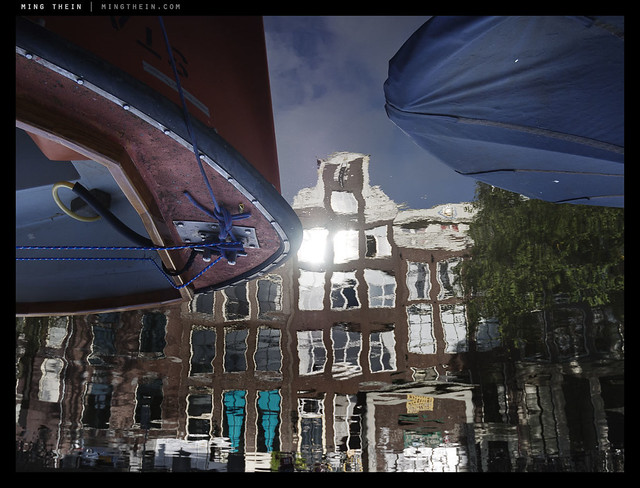
I must first apologize for the enormous processing backlog that has kept me from posting any images from the Amsterdam and Prague workshops several months ago to the site; the astute of you will have seen them go up on Flickr a little while ago, though.
2014 workshops now open – KL, Melbourne, London

From the Prague 2013 Making Outstanding Images workshop.
I’m pleased to announce dates and details for the first half of 2014’s workshops, starting with the first Masterclass in Kuala Lumpur during the Thaipusam festival, followed by Melbourne and London! Click on for more details, or if you’d like to register, please send me an email.
Reports from previous workshops can be seen here – Amsterdam/ Prague, NYC/ San Francisco, Singapore, Tokyo, Hong Kong/ Macau, Kuala Lumpur one, two and three.
Judging the 2013 Maybank Photo Awards

One of the winning images from photographer of the year, Yaman Ibrahim.
Sometimes, choice can make life difficult. A couple of weeks ago, five judges and I sat down (virtually, since everybody was in different parts of the world) to decide on the category and overall winners for the 2013 Maybank Photo Awards. I had the privilege of working with Raghu Rai from Magnum; Mike Yamashita from National Geographic; Jim Liaw and Manny Librodo. Submissions closed on 31 October after three months, with a grand total of nearly 70,000 entries from 9 ASEAN countries. Shortlisting these down to approximately 1,500 final contenders was a panel of secondary judges, with myself overseeing.
Winning images and detailed results may be viewed here at the Maybank Photo Awards website.