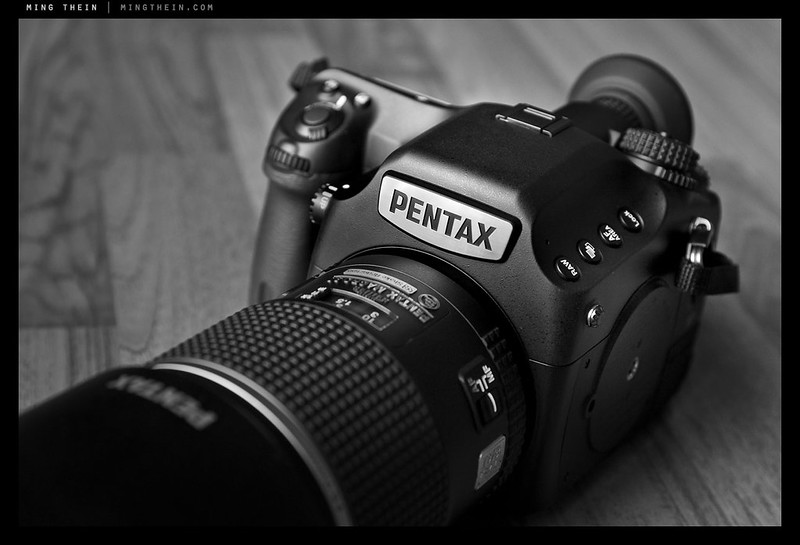
After a bit of – drought, it’s review bonanza week: at the opposite ends of the spectrum. First we had the Sony RX100 Mark III, and today will be the first part of the Pentax 645Z review; to be split into an assessment of the camera itself and a relative comparison to its predecessor, a previous generation CCD-equipped Hasselblad CFV-39 digital back, and the Nikon D800E. As far as I can tell, this is the first review of a production 645Z, anywhere. This part alone is going to be a 4500+ word monster, so grab a large coffee and settle in for a bit. Unfortunately the weather at the moment in Kuala Lumpur is extremely hazy – 120+ APIs thanks to various burning vegetation – which is not ideal for camera reviewing. However, as the 645Z is part of my personal equipment, bought at retail from Malaysia, it will be with me for some time and be subject to mid and long term updates – much like the Nikon D800E.
MF digital goes mainstream: early thoughts on the Pentax 645Z

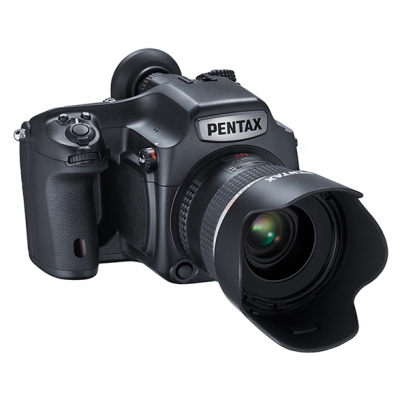
Image from Pentax UK.
A couple of days ago, Pentax threw down the gauntlet to the other medium format digital camera makers in the form of the 645Z. It uses the same ~50MP 44x33mm CMOS as the Hasselblad H5D-50C and Phase One IQ250, but with one critical difference: unlike the Hasselblad and Phase One, it’s feasibly within the reach of a whole load more people. And it isn’t just the shocking price – $8,500 plays $29,000 (Hasselblad) or $37,000 (Phase) – it’s the UI and operating gestalt, too. I think what we’ve just seen is an early game changer.
Photoessay: Following the crowd
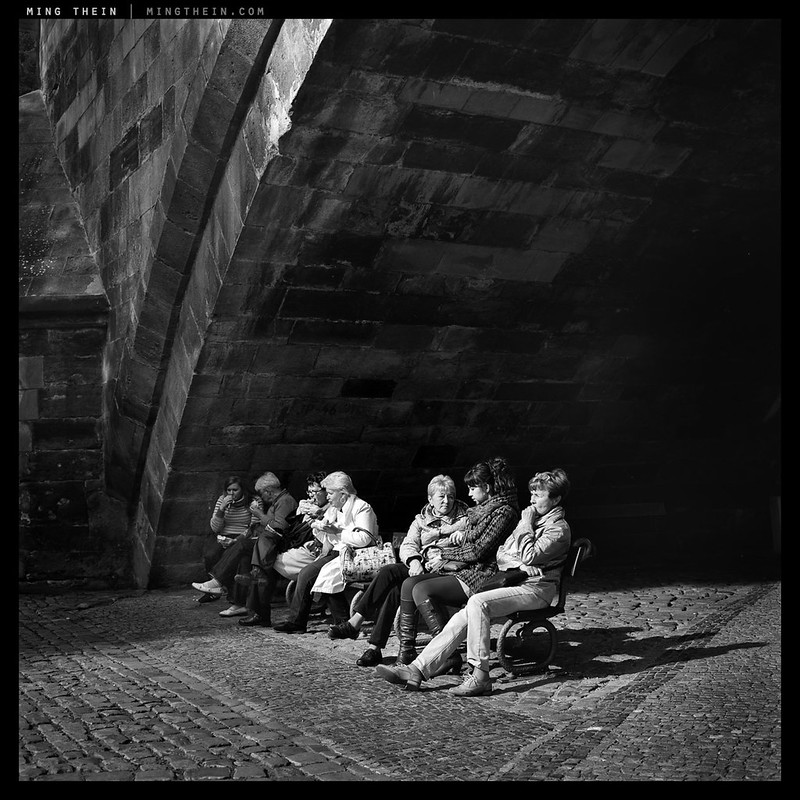
Today’s photoessay is the precursor to isolation and the concept of man – to be the subject of a future photoessay. People seek each other’s company and now congregate in their individuality – no man is an island, and all that. This is an intermediate, transitory stage before people become deindividualized again: at the end, they flow like water. And like water, even though at the microscopic level there is discreteness, at the macro level, there isn’t. Perhaps it is inevitable because there’s simply not enough space; perhaps it’s inevitable because fundamentally, humans are social creatures and deep down, most of us need some sort of affirmation and acceptance. Remember, I did say some time ago that we photographers are really also philosophers as a consequence of the way we interpret, filter and re-present the world…MT
The making of a lot of these images, and the ones in the previous photoessay, were featured, deconstructed and explained in detail in How To See Episode 2: Tokyo and Street Photography Episode 1.
This set was shot with a Hasselblad 501CM, CF 2.8/80 and CF 4/150 lenses and the CFV-39 digital back.
Objectivity, subjectivity, time and deleting images

How many of you have given serious thought to how you evaluate and delete images? From repeat experience, I find that it matters more than you might think. Today’s article examines this in a bit more detail: surprisingly, this is one of the very few times when producing better final images has nothing at all to do with the actual image capture…
Photoessay: Autumn in Tokyo
Today’s photoessay is a very special one for me: firstly because I’ve always wanted to photograph in Japan in the Autumn because of the extremely vivid colours and semi-perfected nature*; secondly, because photographing them was a very meditative and pleasant experience for me. I’ve actually never had the chance to shoot unhindered, unhurried, and unencumbered in this way before; I had the luxury of sitting, looking and just feeling the scene and the light before photographing; sometimes for hours. As a result, I was in a very different – not to be cliched, but ‘zen’ is a pretty apt description here – state of mind when creating these; as a result, they’re quite different to my usual work. In addition, the first six images in this set will go into the first ever ultra print run – to be announced in the next day or so. You’ll be able to experience these images in a way that puts you in the scene, with detail that’s immersive and colour that’s both transparent and saturated. All of these images were shot under ideal conditions, too – medium format digital back, great lenses at optimum apertures, base ISO on a tripod – which means image quality is really about as good as it gets. In all honesty, an 800-pixel jpeg doesn’t even come close – but such are the limits of the internet. I really don’t have anything else to add other than please enjoy! MT
*All of these images were shot in gardens and parks around Tokyo – the Rikyugien Garden, the Nezu Museum Garden, and the Edo Open-Air Architectural Museum. You may recognise some of them from the How To See Ep.2: Tokyo video – I discuss their creation and composition in significantly more detail there.
FD Photoessay: Amsterdam architecture, part one
No words today, just a series of images for you to enjoy. Various architectural details from my last trip to Amsterdam, shot with the Hasselblad 501C, 80/2.8 CF T* on Fuji Acros. Some of you may recognize these images from the November print sale; others may be enjoying a large print on their walls 🙂 MT
These images were made during the October 2013 Making Outstanding Images Workshop in Amsterdam; I will be holding three more of these in Melbourne, Sydney and London later this year. Click here for more info, and to sign up.
FD Photoessay: Prague monochromes, part II
The second part of the monochrome photoessay from Prague was shot on film, with a Hasselblad 501C and my favourite B&W film – Fuji Acros 100. To be honest, given the tight quarters, I’d have preferred to have had something either a little wider or a little longer – preferably both – to give me some additional ability to add context, or compress (especially with buildings clinging to hills in the background). Nevertheless, we make do with what fits inside our camera bags – after making provisions for film, I didn’t have any space left for lenses!
FD Photoessay: Perbadanan Putrajaya and the Tuanku Mizan Zainal Abidin Mosque
One of my favourite buildings in the country is the Tuanku Mizan Zainal Abidin Mosque – also known as the Iron Mosque due to its stainless-steel clad structure. It’s a very modern building located in the administrative capital, Putrajaya, that still manages to integrate traditional culture and religious cues into its design. These, together with its scale, location on the Putrajaya lakefront and sight lines, make it quite a spectacular building.
FD Photoessay: In the garden
Contrary to popular belief, I do shoot pedestrian subjects. Quite often, actually; it’s one of those ways you can condition yourself to see differently and pay more attention to light, form and composition. At the end of a long assignment some time ago, I took one of the Hasselblads, the 120/4 CF Makro-Planar and a few rolls of Acros out with me for a quick excursion to the Kuala Lumpur Orchid Park; I’d evidently gone at the wrong time of year since nothing much seemed to be in bloom. Still, I came back with a few interesting images from that outing – and all in all, was pretty satisfied with the output especially given that I hadn’t shot any film for going on two months at that point in time*.
*Work really does get in the way sometimes.