High ISO performance and ‘general operation’ are listed as improvements; though I think the X2 is frankly the camera that requires the least firmware improvement in the line…still, it’ll make a good thing even better. MT
Photoessay: More street images from the Leica 50/2 APO-Summicron ASPH and M9-P
June 21, 2012 by
Another batch of images that I just got around to processing…shot with the 50/2 APO-Summicron ASPH and M9-P. Enjoy! MT


Travel minimalism: one lens to go
June 16, 2012 by

Canterbury in autumn. Leica M8, 21/1.4 ASPH
Every time I travel for personal purposes, I’m always torn between experiencing the place, and photographing the place. Photography is such a part of me that sometimes I feel that I experience and understand things more through trying to capture the essence of them. Or perhaps it’s because doing so forces you into conscientious observer mode, and this in turn makes one’s mind more receptive to things, and more willing to question what you see and find juxtapositions or contrasts.

Canterbury Cathedral crypt. Leica M8, 21/1.4 ASPH
That aside one of the things which inevitably keeps me up the night before departure is trying to figure out what to bring equipment-wise. If it’s on assignment, then I bring everything I might possibly need, plus spares – to hell with overweight baggage, if you don’t have it, it could mean a lost job – on the other hand, if I’m traveling for myself, I’d rather carry as little gear as possible. Well, little enough that I don’t notice it after walking around for hours on end, but with sufficient coverage that I don’t get frustrated and feel like I missed a rare photographic opportunity because I didn’t bring along a wide angle. Or something along those lines.

A Parisian in her natural habitat. Leica M8, 21/1.4 ASPH
My last personal vacation saw me bringing an Olympus Pen Mini, the 14-42 kit lens and a Panasonic 20/1.7 pancake. We went to the beach. Frankly this made the choice easy as I didn’t really want to expose any of the more expensive gear to moisture, salt and sand; the M9-P definitely would not have been suitable, and the D800 might have produced great landscapes, but it would also have worked fine as a boat anchor.

Three conversations, Paris. Leica M8, 21/1.4 ASPH
I’ve been trying to fine-tune this over the years. I’ve been on trips where I did carry coverage from 14-450mm and a spare body; whilst I got some great images, I also had a sore back, and landed up leaving everything but one body and the 24-70 zoom in the hotel room for the last week. More crucially, I felt the images produced from that trip lacked focus; I brought everything, so subconsciously I was actually trying to capture everything. The upshot is a set of images that isn’t as strong as it could have been, and worse still, experiencing that slightly chaotic panicky feeling that you just might have missed a shot opportunity somewhere.

Tate Modern yard, London. Ricoh GR Digital III
My preferred travel kit is a moderate wide, and a moderate telephoto – both fast – and one body. I might carry a spare compact or something similar as a backup, just in case. I’ve gone with the D700, 24/1.4 and 85/1.4 – this is an absolutely fantastic and hugely flexible combination – plus a spare compact, either the Fuji X100, Leica D-Lux 5, or my favorite, the Ricoh GR-Digital III. Most recently, I spent two weeks in Europe with an M9-P, 28 and 50mm lenses, plus the Pen Mini and 45/1.8 (giving me 90mm in a pocket). This was also an excellent combination, and in some ways better than the Nikon based setup due to weight and instant availability of the telephoto. However, it lagged hugely in low light performance. I think the next trip I take will probably be Micro 4/3 based; an OM-D and Pen Mini with 12, 20 and 45mm lenses will cover the vast majority of situations handily. And not weigh very much, either.

Piccadilly Circus, London. Ricoh GR Digital III
So what’s all of this talk about a single lens?** Or single camera? There are advantages to this approach: firstly, you’re unencumbered and free to enjoy the atmosphere, people and culture without feeling like a packhorse; a small camera around your neck is probably much easier to manage than an entire backpack full of lenses. Also, you don’t have to worry as much about security – frankly, carrying several Leica f1.4 Summiluxes and a Noctilux around even safe Singapore made me pretty nervous.
**Let me clarify: I don’t mean going with a 28-300, though I suppose this might be a viable option for some situations. That lens has more compromises than strengths, and if you don’t know how to manage your perspectives properly, then you’ll land up with weak images too, because you’ll always be trying to ‘zoom in’.

The Shard, under construction. Ricoh GR Digital III
The main advantage, however, is that it frees up your mind from having to think about what perspective to take for a scene. Do you find the essence in the details, or do you go for something wider and more encompassing, with context? Trouble is, there is often no right answer – and from experience, I know that inevitably you’ll land up trying to make both work and being satisfied with neither. On the other hand, if you’ve got just one focal length, then you can pre visualize what your frame will look like; with sufficient experience, your eye naturally looks for compositions that fit within the perspective and angle of view of the lens you’ve got. Thus: instead of wondering what perspective to use, you’re free to spent that mental capacity on fine-tuning the elements inside the frame of the only perspective you have. It can be liberating – providing you’re thinking about the photograph, and not about the equipment you left at home. There’s also the side benefit of not having to change lenses, and thus always being ready.

The doorway, Hanoi. Nikon D700, 85/1.4 G
I actually did this on several occasions. At the end of 2009, I made short trips to Oxford, Canterbury and Paris; for these I brought two lenses (21 and 50mm for the M8) but only used the 21. I did it again in 2010; the first trip saw me bringing a D700 and several lenses, plus the Ricoh GR-Digital III; I only used the Ricoh and its fixed 28mm because it was both much more convenient, as well as matching the way my eye was tuned at the time after my first Leica-M experience. I got wiser on the second trip and left everything behind except the GR-Digital III. Hanoi later that year saw me using only the D700 and 85/1.4 G.

A Vietnamese stereotype. Hanoi. Nikon D700, 85/1.4 G
If you are going to try this exercise, I’d recommend going for a wide normal rather than an ultra wide or a tele; for the simple reason that these are the most flexible focal lengths to use. 35-50mm can appear wide or moderately telephoto depending on how you choose to use the foreground elements in your scene. And at some point, chances are you’ll probably want to take a photo of yourself or your traveling companion (or both of you, or your family…you get the point) – and it’s generally much easier with something wide or normal than say a 300mm.

Prague castle and stars. Leica M9-P, 28/2.8 ASPH
Some people may find a telephoto easier to use in these kinds of situations because they can snipe from a distance; I’d personally advise against it because it’s very difficult to make images with context; and that’s one of the cornerstones of travel photography. The bokeh may be great, but if the background gives you no clue as to where the subject is, then the image could well have been shot anywhere – and that somewhat defeats the point of travel photography.

A Viennese moment. Leica M9-P, 28/2.8 ASPH
Personally, if I had to pick, I’d go with either a 28mm, or a 35mm – depending on whether my images would likely be more people-biased (longer), or more location-biased (wider). And it’d have to be fast, too; I’d be using the lens at night, and anything slower than 2.8 wouldn’t cut it. Frankly, in some situations, even f2.8 may be a little borderline. Finally, it’d have to go on something small, light and unobtrusive; responsiveness is important because your ability to anticipate things will be a little bit diminished thanks to the foreign environment. Right now, my choice is probably between the Olympus OM-D and Panasonic 20/1.7, the Ricoh GR-Digital III/ IV, or the Leica M9-P and a 35/1.4 ASPH FLE.
Give it a try. On your next trip, just use a 35 or 50 prime for at least a day or two; if it makes you feel better, bring along your zooms too, but don’t use them until you absolutely feel that you’re missing shots. MT

Wat Arun and Boat, Bangkok. Leica M9-P, 35/1.4 ASPH FLE
____________
Visit our Teaching Store to up your photographic game – including Photoshop Workflow DVDs and customized Email School of Photography; or go mobile with the Photography Compendium for iPad. You can also get your gear from B&H and Amazon. Prices are the same as normal, however a small portion of your purchase value is referred back to me. Thanks!
Don’t forget to like us on Facebook and join the reader Flickr group!

Images and content copyright Ming Thein | mingthein.com 2012 onwards. All rights reserved
Photoessay: Pedro Miguel Schiaffino from Malabar, Lima
June 11, 2012 by
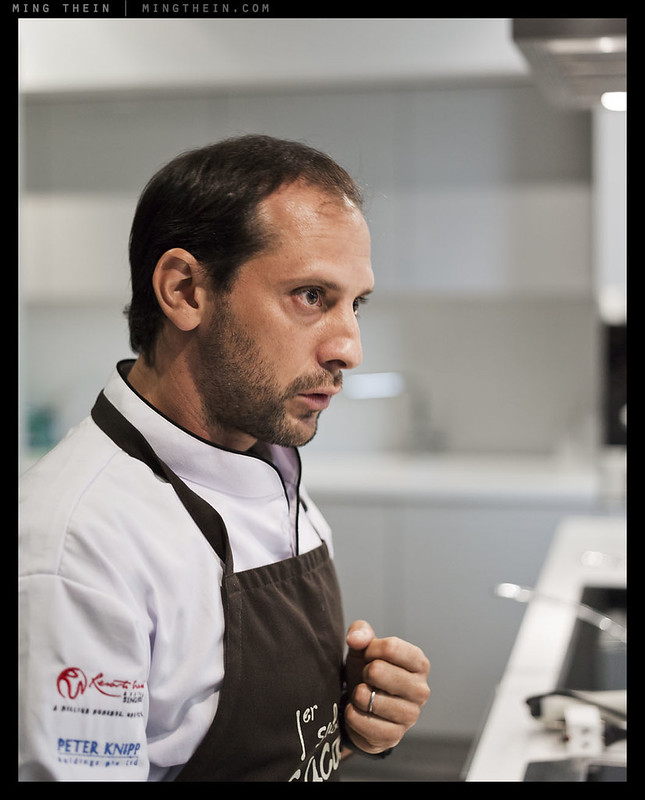
I had the opportunity recently to do some teaching (food photography, not cooking of course) with noted Peruvian chef Pedro Miguel Schiaffino from Ristorante Malabar, Lima at the World Gourmet Summit in Singapore. First off – he’s one of the nicest people I’ve met, with completely zero ego; that’s pretty darn unusual for a chef. Secondly, he has a hugely infectious enthusiasm for the native foods of Peru, most of which he has to trek into the jungle to find. Pedro says he trains locals to recognize edible plants and roots, but they subsequently tend to leave for food distributors who can pay more; to this he shrugs, and rationalizes it against anything that raises awareness of his country’s produce and helps the locals find regular employment being a good thing. As I said, one of the nicest people I’ve met. Oh, and he makes the most amazing ceviche, too. Enjoy, vicariously. MT
This set shot with a Leica S2 and 75/2.5 Summarit (people photos) and a Leica D-Lux 5 (food photos.)


Ceviche, with a domestic Peruvian speciality algae – the green blobs. Difficult to describe the taste; a little like a gelatinized gherkin but not as sour.


What looks like rocks…

…are actually Peruvian root vegetables, meticulously tourneed, and covered in a local edible river clay mix that the natives use to aid digestion. Although the clay itself tastes like…well, dirt, it lends an interesting semi-roasted texture to the skin of the vegetables. I’m sure it probably gives you your RDI for most minerals, too.

In their natural habitat, with sous-vided lamb finished on the pan. Pedro blends modern techniques – sous vide for instance – with traditional ingredients, like the clay.


Dessert. Pisco sour sorbet, stewed melon and various flowers.


Talking with the students after the meal.
Leica M rangefinder calibration service
June 8, 2012 by

I’ve had a number of enquiries about focus precision, rangefinder calibration and adjustment etc. in the last couple of weeks – I suppose it’s because of the need for precision highlighted by the Monochrom’s resolution and 50 APO’s resolving power.
I had the same problem myself in 2009 when shooting with M8s; new lenses would require calibration adjustments and the RF alignment would drift over time with frequent mounting and unmounting. A return trip to Solms for the entire kit of two bodies and several lenses would of course be impractical (both expensive and hugely time consuming), so I learned how to do it myself.
For Leica M shooters in Kuala Lumpur, I offer a rangefinder calibration service for the digital M8/ M9 bodies. It takes an hour, and you pick which lens you would like the body calibrated for – I recommend either your most used lens, or your shallowest DOF one. It is possible to have all bodies calibrated for all lenses, but this will require a long and expensive German holiday for your entire kit as there’s some lens disassembly involved to realign the helicoids…
The adjustment leaves no trace and will therefore not affect your warranty.
Please send me an email if you’d like to make an appointment or enquire about this service. MT
Photoessay: Kitchen portholes
June 5, 2012 by
I’ve never understood why kitchen windows are always round, but they are. Maybe because square is too much like a hospital or school. Nevertheless, they provide an interesting view into the inner workings of the place where our food comes from. The square format of the D-Lux 5 was perfect for this. MT
Series shot with a Leica D-Lux 5 and M9-P with 35/1.4 ASPH FLE.


On Assignment: Architecture and the concrete jungle
June 4, 2012 by
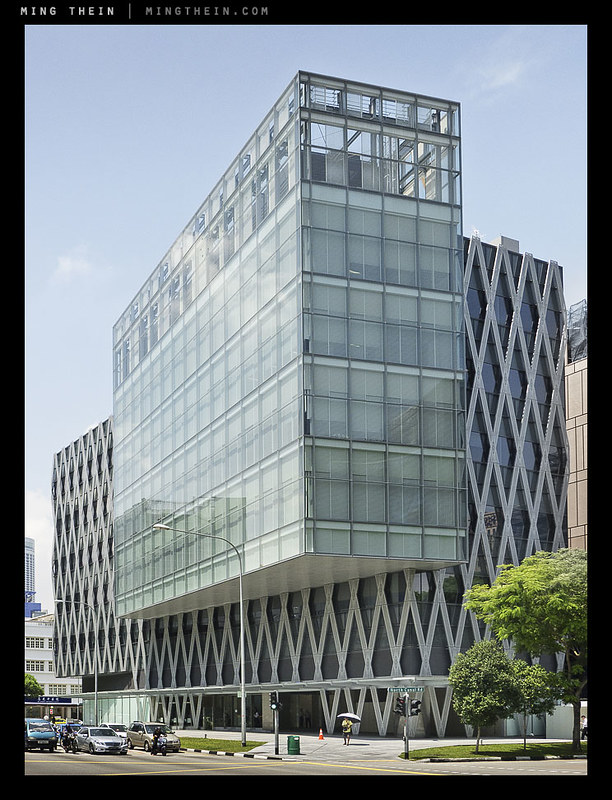
I recently shot a commission for the famous Japanese architecture firm Kenzo Tange Associates – whilst I’d heard of them before and seen their work in Japan, I didn’t realize that they had a number of projects closer to home. Turns out there are four buildings in downtown Singapore – all fairly close together – plus another one or two a little further out, and another under construction. And there are some underway in Kuala Lumpur. The scope of this assignment was to get a variety of general exterior views of the buildings during the day, at night and in the context of their environment.

Architectural photography has always been something I’ve done out of personal interest – followers of this site or my flickr page will undoubtedly have noted my predilection for geometry, abstracts and general building form. The interplay of light, shadow, texture, and how the building sits in its environment are something that I pay perhaps an unhealthy amount of attention to. You just know if the design is balanced and ‘feels right’ by looking at whether it dominates the surrounding landscape, if it disappears and looks insignificant, or whether it looks comfortable.

That said, although Singapore is an interesting architectural environment – there are a lot of modern, different cutting edge designs and a huge variety of facade treatments (that’s what happens when you have a lot of money flowing into the country; notably most of the places that spend big on their real estate are banks and malls – go figure) there’s also not a huge amount of landscape left to dominate (and that’s what happens when you’re a small island). This of course means that the dominating landscape is urban and of very high density; from a photographic point of view, this presents a huge number of challenges because of lines of sight and vantage points, not to mention permits, access and the like – you’ll need permits to shoot from somebody’s property, even if you’re not taking photos of their property itself.

Since real estate is expensive, everything is high rise. The challenge then becomes perspective: how do you find the right position to get a perspective that somehow looks natural, but at the same time isn’t blocked by a huge amount of other stuff? It all depends on location. Some buildings can be shot from their plazas with a wide angle (though this is quite conventional and boring); across the street from another building’s rooftop (if the height is right, and the street is wide enough); or much further down the street with a telephoto. Ideally, you’d want a helicopter at low height and a telephoto, but that isn’t practical most of the time.

Perspective is very important here because anything too wide will look unnatural; this isn’t how the eye sees it. I find when shooting architecture that the best results aren’t from extreme angles: they’re from natural perspectives and details; you want to be able to appreciate the building from a human perspective, because that’s how and why the damn thing was designed in the first place. It’s great if it makes a stool for King Kong, but an architectural failure if the podium steps are too high for people to climb easily.

That said, shooting in tight confines requires you to get creative. Although you do want to see the whole building, there’s nothing wrong with focusing in on the details and going for some degree of abstraction; I’m sure every architect wants the attention to detail in their work to be seen. I know I would.

For this assignment, I shot exclusively Leica; their M wide angles are superb, and much superior to anything available for the Nikon F system, though the Zeiss 21/2.8 runs pretty close. The other reason why I went with the Leica system was weight: there’d be as lot of moving around on foot to get the best angles and unique perspectives, which means schlepping everything around like a mule. Lightness is your friend. Oh, and don’t forget that the heavier your camera, the more rigid (and thus, heavier) your support needs to be.

Sadly, there are no tilt-shift lenses for Leica M; in any case, they wouldn’t have been wide enough in some of the quarters I was working in. I used the new 21/3.4 Super Elmar ASPH M with finder, 35/1.4 ASPH FLE and 50/0.95 ASPH. In hindsight, the noctilux was not the best choice for this – not because of its optics, but because I never used anything larger than f5.6 (you do want everything in focus, and critically sharp, everywhere). I wanted the 50/2.5 Summarit, but turns out it was on loan already. Oh well. The 21 and 35 performed superbly, as expected. In fact, I was surprised by just how good the 21 was – even wide open, in the corners. I think I’ll need to do a full review of this lens in future. Suffice to say, if you don’t need the f1.4 speed of the ‘lux – it’s a no-brainer. (Aside: I owned and shot with the 21/1.4 ASPH as my primary lens extensively during the M8 days, on which it became a handy fast 28mm; however, it wasn’t great for architecture because of the distortion and ever so slight field curvature. Also, overkill when you need f5.6 and smaller.). A D-Lux 5 Titanium rode shotgun for spontaneous shots and the B-roll for this article (due to licensing reasons, I obviously can’t use the original images.) I also used the S2, 30mm and 70mm lenses for some of the daylight work.

On the support side, I used my old Manfrotto 444 Carbon One – I think this thing must be at least ten years old by now, if not more. I got it used from a friend. Whilst it’s rigid and relatively light, I’d still like something lighter for travel – especially if I’m not putting anything heavier on it than a Leica M. Perhaps one of those Gitzo 00 series things. The problem is I can’t justify one because I do so little tripod work. The head – very important – was my favorite Manfrotto 468RC2 Hydrostat bullhead. This thing is amazing: it locks at any angle, with no ‘droop’ – either it’s locked, or it isn’t. As far as I know, it uses some sort of vacuum system and teflon rollers, but I haven’t needed (or wanted) to take it apart.
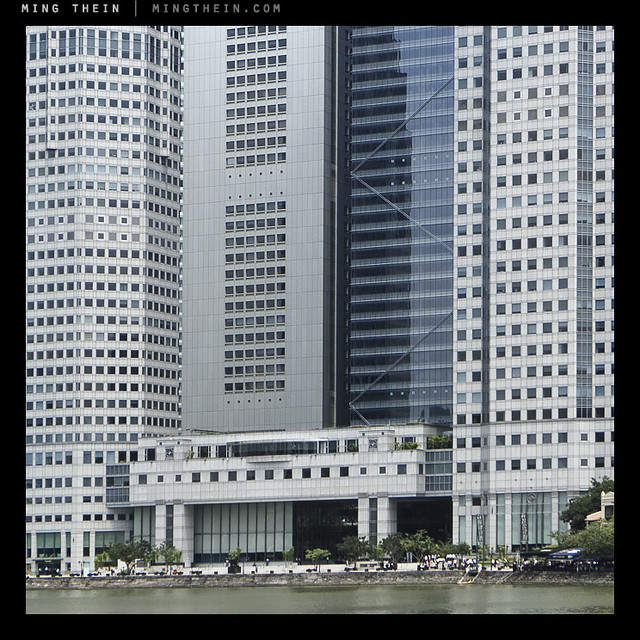
I can’t help but wonder if a V-Lux 3 with it’s excellent 24-600mm lens and a much lighter tripod would have been a better way to go – perhaps something to experiment with in future. All cameras are more than capable of deliverin the required results at base ISO and shooting RAW, anyway.
One final note about processing: to maintain optimum quality throughout the tonal range, I shot at base (160) ISO and did something I rarely do and used a two-stop HDR on the night shots – there’s simply too much difference between the spotlit parts of the building and the deep shadows – easily four or five stops. There are right and wrong ways to use HDR, and that’s a discussion I’ll save for a future article. MT
This post was brought to you by Ming Thein’s Email School of Photography – learn exactly what you want to learn, when you want to learn it. Don’t forget to like us on Facebook!
Photoessay: Bruno Menard at Forlino
June 3, 2012 by
I was in Singapore recently to run a few food photography 101 sessions under Leica at the World Gourmet Summit. One of the perks of the job was getting to enjoy the samples. In this case, by 3* Michelin chef Bruno Menard, who formerly ran L’Osier in Tokyo – widely thought to be the best restaurant in Japan at the time. I ran a very basic setup for the participants with a couple of small LED video lights, a Leica D-Lux 5 compact and some modified settings (optimized for food work); I shot tethered and showed the results instantly on a HDTV via HDMI out. There was a little PS work done to the images afterwards (i.e. for this set) but for the most part, the D-Lux 5 makes a surprisingly excellent little food camera – especially when there’s enough light around. MT
Images shot with a Leica D-Lux 5.


More street images from the Leica M-Monochrom
June 1, 2012 by
This series shot with a Leica M-Monochrom and the 35/1.4 ASPH FLE.


POTD: When color might have been preferable
May 30, 2012 by

Postmen. Leica M-Monochrom, 35/1.4 ASPH FLE
One of those times where color would actually have been better. The bright blue and red uniforms of the motorbike postmen in this shot stood out well against the gray tarmac…I reached for a camera instinctively, nailed focus and exposure, but didn’t realize I was holding the M-Monochrom instead of the M9-P! Still, the geometry of this shot is its saving grace, I feel.
Today is going to be a busy day. Many people wonder what photographers do in the time they’re not shooting – well, here’s my schedule:
1. Client meetings
2. Test prints from M-Monochrom, 50 APO and D800E for clients, and if I have time, a quick article/ note on the site about relative print quality
3. Have to buy a light, strong, compact tripod in preparation for a trip (did I mention those are all oxymorons?). Tripod choice is another minefield I’ll probably write about at some point.
4. Retouching work for another client
5. Chase payments once Europe wakes up
6. Intersperse with replying email and comments to the site – between the two, I get an average of about 100-150 per day, which eats up a good couple of hours in replies. My laptop keyboard is now mirror smooth! 🙂
I think I need an assistant. MT


 Ming Thein | Photographer