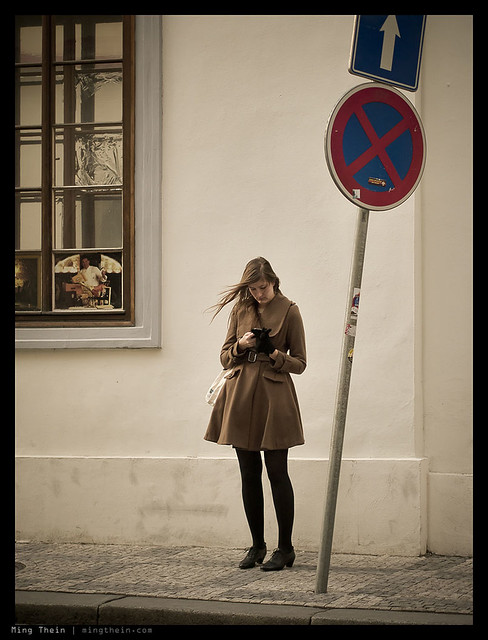
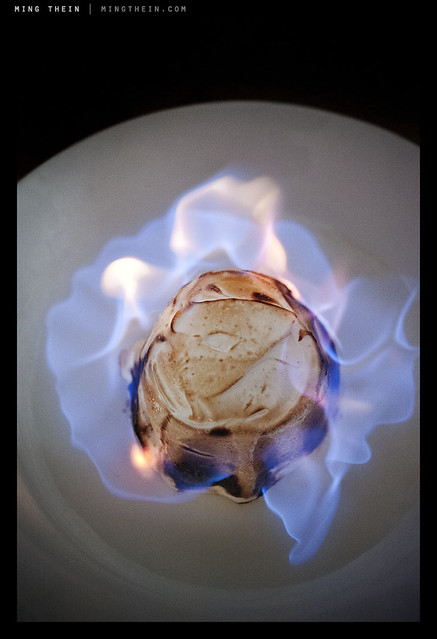
POTD: Dessert

_DL5T_L1000735 copy
Pisco sour sorbet, poached melon and a jelly I don’t remember decorated with local nuts and flowers. By chef Pedro Miguel Schiaffino of Ristorante Malabar, Lima, Peru. Leica D-Lux 5 and two LED panels.*

*One of the reasons I switched to LED panels for food photography is the matter of dessert: there’s no way you can photograph ice cream with halogens or flashes without getting more than say three or four frames before visible melting sets in. And this obviously isn’t good, though a hint of melting actually helps the viewer know that it is in fact ice cream, and not say, mashed potatoes masquerading as ice cream.** One of the most refreshing, palate-cleansing deserts I’ve eaten – a perk of running a food photography workshop in conjunction with his culinary class…

**Food photography in-joke: mashed potato is actually quite frequently used to substitute for ice cream, for this very reason. MT

Photoessay: A study of wave action

Some experiments into how the same subject can be simultaneously not the same. A bit of contemplative photography while on vacation. Or perhaps I just like water and waves for the same reasons I like clouds. Sometimes, we don’t need to think too much about it – just shoot. I need to go on holiday more often; but then again, don’t we all? MT

This series shot with an Olympus E-PM1 Pen Mini at Tanjung Jara, on the east coast of peninsular Malaysia.

_PM08131 copy

_PM08126 copy

_PM08124 copy

_PM08116bw copy

_PM08094 copy

_PM08088 copy

_PM08128bw copy

POTD: Impromptu conference

_M91_L1000093 copy

Taxi drivers checking out a new ride, new arrival or old friend passing by a rank. Leica M9-P, 50/2.5 Summarit-M

Quick updates on reviews

For the rest of this month and next month, I have planned:

Equipment:
– Olympus OM-D review – I need to do some more daylight shooting with this camera to get a better idea of its capabilities, but so far: one hell of an impressive camera. (Last week of May)
– Olympus 45/1.8 (done, earlier today)
– Nikon 45/2.8 P review – a blast from the recent past! Surprisingly good normal-Tessar that does very well on the D800E, and is compact to boot

– The Ultimate Equipment Database – a concise opinion on just about everything

Workflow:
– Achieving perfect color
– Black and white conversion options
– The black and white workflow video (well, once I shoot it at any rate)

And, cue drumroll:
– I’ve just been promised an M-Monochrom and new 50/2 APO ASPH to review by the end of the month, probably sooner. The machinery is in motion, and I think that fb post to Andreas Kaufmann’s wall might have helped in some small way. 🙂 Fingers crossed!

So, don’t forget to bookmark, follow, like me on Facebook to get the latest updates and check back again soon 🙂 MT

Lens review: The Olympus ZD 45/1.8

_PM05660 copy
Prague sunset by the river. Olympus E-PM1 Pen Mini, ZD 45/1.8

_8012322 copy

Last year’s lens surprise of the year was the Olympus M.Zuiko Digital ZD 45mm f1.8 MSC – it’s a lens that was announced with the E-P3, E-PL3 and E-PM1, seems fairly ordinary and innocuous on spec, but yet delivers in boatloads. It’s both cheap and expensive at the same time; let me explain why. Most conventional SLR mount 50/1.8 lenses go for $100-150 or thereabouts. This lens is closer to $300, and it’s all silver-painted plastic except for the mount – to be honest, it feels kinda cheap. That’s expensive. But, it doesn’t use a conventional double-Gauss optical design:


Image from Olympus. Purple bits are E-HR lenses, whatever that means. I suspect it’s ED glass or something similar. I certainly don’t see any purple elements inside my lens 😛

Whoa, what’s this? 9 elements in 8 groups? Not so simple. I suspect the reason Olympus chose this optical design was primarily due to the very short back flange distance of Micro Four Thirds; double Gauss designs work well if the back focus distance is close to the focal length, which it is for most SLRs. Changing the optical design to keep the lens compact introduces all sorts of other issues on its own, including corrections for the various complex optical aberrations that occur once a lens design becomes asymmetric.

_PM05089 copy
Waiting for that text. Olympus E-PM1 Pen Mini, ZD 45/1.8

Secondly, it has a very fast coreless focusing motor – Olympus brands these lenses as ‘MSC’, which means you won’t hear the focusing motor working while recording videos – a nice touch. It’s also blazingly fast, at least with the current generation of Olympus M4/3 bodies. Sadly, like all of the other M4/3 lenses (except the 12/2), there’s no full time focus override; it’s fly-by-wire only and you have to put the camera into MF mode on the body before the ring does anything. Still, it’s nicely damped if a little dead-feeling.

_PM05240 copy
Night in the Malastranska, Prague. Olympus E-PM1 Pen Mini, ZD 45/1.8

But never mind all that, how does it perform? In a word, brilliantly. It’s one of my favorite lenses for Micro Four Thirds. If I had to describe it in a word, it would be ‘transparent’. That’s probably a good thing for an optical device; however, what I mean is that the lens itself doesn’t impose any of its own optical quirks or peccadilloes on the image; it does its job moving light from the subject to the sensor, and then gets out of the way. It delivers sharpness across the entire frame wide open at f1.8; there is some slight improvement at 2.8, but it isn’t really necessary to stop down – perhaps this may be different on the higher density 16MP sensor of the OM-D, however.

_PM02054bw copy
All about the hair. Olympus E-PM1 Pen Mini, ZD 45/1.8

Fringing is almost entirely absent, as is longitudinal chromatic aberration; a sign that the optical designers have done their job very well indeed, and the lens is working well with the sensor. (In case you’re wondering about in-camera CA removal, I’m not shooting JPEG and the RAW files are run through ACR like the rest of my workflow – there’s no special treatment unless Olympus is doing something with the RAW files.)

_PM00679 copy
Echoes of red. Olympus E-PM1 Pen Mini, ZD 45/1.8

The lens is contrasty, but not that contrasty; it strikes a nice balance between sufficient global contrast and maintaining the microcontrast that is so important to preserving fine detail structures. In fact, I prefer lenses with lower macro contrast for digital use as they help to maximize preservation of dynamic range; this is especially important with smaller sensors that have lower dynamic range, like those used in M4/3 cameras.

_PM00576 copy
Ninja demolition. Olympus E-PM1 Pen Mini, ZD 45/1.8

Color reproduction is on the warmish side of neutral. No yellow casts like I see with Sigma and Tamron lenses, but a pleasing warm hue shift. Bokeh is also neutral to good; there are times when separation between subject and background is a little harsh – typically when the subject is fairly close to the background – but it’s also pretty darn good under ideal conditions.

_PM00530 copy
Mirrors. Olympus E-PM1 Pen Mini, ZD 45/1.8

Although it ‘only’ focuses down to 0.5m, it’s worth remembering that on Micro Four Thirds, 45mm is really a 90mm FOV, and there no non-macro lenses for full frame cameras that focus this close – it’s 0.8m if you’re lucky, or 1m if you’re using a rangefinder. The lens can be used handheld at arms’ length – i.e. live view style – and that’s how I’ve been using it so far; however, you’ll need to keep your shutter speeds up, because frankly the in-body stabilization isn’t that effective. I suppose if you were using this on the OM-D it’d be a different story as the built in EVF would let you get a bit more stability by bracing the camera against your eye.

_PM02093 copy
Dusk and the sign. Olympus E-PM1 Pen Mini, ZD 45/1.8

The 45/1.8 makes up part of my M4/3 ‘trinity’ – the 12/2 and 20/1.7 being the other two, though I might replace both with the new Voigtlander 17.5/0.95 (35mm equivalent, fast and versatile – though I prefer 28, and sadly there are very few fast 28mms). It forms a great lightweight travel kit which is still capable of delivering outstanding optical quality. It also works very well as a secondary camera in conjunction with something else; at the end of last year, I shot in Europe with a Leica M9-P, 28 and 50mm lenses as my primary body, with the Pen Mini and 45/1.8 in a coat pocket for those times I needed a little extra reach – made a great compliment to the rangefinder.

_PM01974 copy
Graffiti. Olympus E-PM1 Pen Mini, ZD 45/1.8

Even on the slightly higher density OM-D sensor, this lens is a gem; sharpness doesn’t seem to be compromised anywhere, but there is a very slight veiling flare that goes away about half a stop in. It has a lightness and transparency (lower macro contrast, but higher micro contrast perhaps?) that I don’t see with the 12/2 or 20/1.7, and it’s something that makes the way it renders very natural and appealing.

_5001020bw copy
A classical portrait, second version. OM-D, 45/1.8. The first version is here

Are there any negatives? Well, yes. At the price, you can’t expect fantastic build quality. Frankly, it feels about on par with the kit lens; Olympus chose to put all of the production money into optics rather than cosmetics, which is a decision I can agree with. However, the leaves the lens feeling just a tiny bit fragile; the plastics don’t feel that thick or robust, and that little blanking ring on the front (ostensibly to cover the hood mount threads) doesn’t really stay in place securely, and isn’t that well made, either.

Still, all that aside, this is a highly recommended lens for Micro Four Thirds users. It isn’t good enough that I’d go out and buy a Micro Four Thirds camera just for this lens alone, but then again the thought of having a fast portrait 90mm equivalent in a pocket is quite appealing, and the cost of a Pen Mini plus this lens is much cheaper than many full frame lens options on their own. Of course, you do get the DOF profile of a 45mm lens, not an 85 or 90mm lens, so don’t expect crazy thin DOF. There’s adequate separation, but true bokeh enthusiasts will probably have to wait for the upcoming ZD 75/1.8 – a lens which I’m pretty excited about, actually. MT

_PM01718 copy
Sunset in the city. Olympus E-PM1 Pen Mini, ZD 45/1.8

Get the Olympus ZD 45/1.8 here from B&H or Amazon.

____________

Visit our Teaching Store to up your photographic game – including Photoshop Workflow DVDs and customized Email School of Photography; or go mobile with the Photography Compendium for iPad. You can also get your gear from B&H and Amazon. Prices are the same as normal, however a small portion of your purchase value is referred back to me. Thanks!

Don’t forget to like us on Facebook and join the reader Flickr group!

appstorebadge

Images and content copyright Ming Thein | mingthein.com 2012 onwards. All rights reserved

POTD: Urban geometry

_DL5T_L1000615 copy
Outtake from a recent architectural assignment. Look out for a future On Assignment post about shooting buildings. Leica D-Lux 5.

Although most architectural images are shown with nothing but the building, in a vaguely abstracted product-shot-kind-of-way, I personally find the images I like best are the ones which have some human scale or context included; it’s otherwise tough to gauge scale of the building, how it fits into its environment, and more importantly, how does the end user perceive it? Do they use the intended main entrances and traffic routes, or like water, do people find a path of lower resistance? Are there flow routes that the designers didn’t envision, i.e. connections between two back streets? Does the vehicular circulation work? How does the facade look from a human perspective? Once again, it comes back down to understanding something about your subject before you shoot it. MT

Photoessay: The Speake-Marin Immortal Dragon

One of the more unusual watches I’ve photographed, the Immortal Dragon is both immaculately finished on the dial and the movement – the watch has both serious horological pedigree (being from the atelier of highly respected independent watchmaker Peter Speake-Marin and some pretty unique aesthetics. The dial was hand-engraved in relief by master engraver Kees Engelberts, and the watch is a piece unique destined for the Asian market in honor of the current lunar year of the dragon. MT

This series shot with a Nikon D700, AFS 60/2.8 G Micro, and Zeiss ZM 2.8/28 Biogon with Leica M-F adaptor and multiple speedlights.

_7055995 copy

_7055968 copy

_7055992 copy

_7055950 copy

_7055834 copy

_7055766 copy

_7055925 copy

October 2012 Tokyo Workshop

_3030515 copy
Fear of straying off the beaten path. Nikon D3, 24-70/2.8

I’m in the early planning stages of a small (3-5 participant) private workshop in Tokyo this October (2012). Dates aren’t fixed yet, that’ll depend on the participants’ schedules. Details as follows:

– 3 days, based in Tokyo (but I’m not ruling out quick side trips to appreciate the autumn foliage)
– Two days of shooting – covering whatever specific topics the participants would like to learn, but I have some ideas (travel, landscape, photojournalism and making sequences of images into stories, learning composition fundamentals with compacts, night photography etc.)
– One day of editing/ selecting images and photoshop post-processing

Depending on the number of participants, costs will range from US$1,300 to US$2,200; this is for tuition only and assumes you live in Tokyo, or can easily get there. Would be ideal for Asian residents, as it’s just a short commute.

Please drop me an email or leave a comment below if you’re interested.

Thanks! MT

Balancing content and technical perfection

_M224835 copy.jpg
Base jumping off the KL Tower. There are no do-overs for either the shot or the participants. Nikon D200, AI-P 500/4

Suppose you had one opportunity to get the shot: what do you do? The obvious answer is go for broke; who cares if it’s slightly overexposed, out of focus or the framing is a little off. Maradona is probably only going to use the ‘hand of god’ once; the millennium is only going to roll around once in your lifetime. Bigfoot will probably only appear once, and only in out of focus or foggy areas*.

That’s one end of the spectrum: it’s all about the content rather than the execution.

_7045452 copy
Benzinger Skeleton. Full control of everything, full repeatability. The second, third, fourth and fifth shots would look exactly the same.

The opposite end would be fine art still life: any one of the aforementioned photographic sloppinesses would probably get you thrown out of the gallery, unless perhaps you were very, very good at explaining why out of focus images represent the current zeitgeist of society, how rushing around and achieving complete form and ‘just getting it done’ rather than doing it well – quantity over quality – are also paradigms of modern corporate living.

_MT98674bw copy.jpg
What’s this? A situation in the middle: you can anticipate what’s going to happen and be prepared, but you don’t get a do-over. You should be able to get a perfect result with practice.

Enough sarcasm. Basically, if you’re going to create a still life, you’d better damn well be in control of the elements, or it just makes you look sloppy and incompetent as a photographer. There’s no way you can excuse compositional errors, slanted horizons, overexposure or things intruding into the edges of the frame. Studio commercial photography also falls into this category; it’s 100% controlled, and if you can’t get your image right when there isn’t anything left to chance – and the shot is repeatable – then you should probably hang up your camera.

_M9P1_L1003919bw copy
It wouldn’t have worked without the man. Schonbrunn Palace, Vienna. Leica M9-P, 28/2.8 ASPH

And that’s where the dilemma comes in: for photography that isn’t clearly at one end of the spectrum or the other, where do you draw the line of acceptability? If there is no expectation to create perfection, is there any necessity? In fact, if the expectation is of something slightly imperfect – to capture the chaos of reality – then perhaps perfection would actually weaken the impact of the overall image.

_M9P1_L1005830bw copy
I like the lyricism and movement in this image; in fact, nothing is perfect. It was underexposed because the meter gets fooled by backlit situations so I went manual and got the exposure slightly wrong; then the limitations of my equipment meant motion blur in the subject was a certainty, so I decided to work with it; finally, none of the verticals are straight – it bothers the perfectionist in me, but I bet you it wasn’t the first thing you noticed about the image. Malastranska, Prague. Leica M9-P, 28/2.8 ASPH

That last point isn’t immediately obvious. In fact, it’s quite counterintuitive; I was only made aware of it because I personally tend to drift towards the technical perfection end of the spectrum, and various clients have commented that my images look a little too perfect in some ways, especially for photojournalistic work. For studio photography, on the other hand, my clients love the attention to detail.

_7008086 copy
If This Looks Too Perfect, That’s Because It Was Staged. Artfully constructed scene for a promotional video. Nikon D700, Zeiss ZF 1.4/85 Planar

A year or two ago, I would have thought that the ideal combination would be to nail content, composition and the technical aspects of the exposure to produce a perfect image; however, this is not only nearly impossible to do, but somehow also results in slightly lifeless images. The soul is missing – or perhaps it’s not so much soul per se as humanity represented by the slight imperfections which impart the character of the photographer onto his or her image.

_M9P1_L1005824bw copy
More lyricism. Malastranska, Prague. Leica M9-P, 28/2.8 ASPH

Perhaps I’m just confusing myself with the philosophy now, because this is my current photographic worldview:
1. We strive for perfect images.
2. Technical perfection isn’t perfection per se, because that slight bit of imperfection humanizes an image and gives it personality.
3. This means that we must have skill and ability to achieve technical and compositional perfection, even under spontaneous circumstances.
4. However, we need to have even more control than that, because we need to have the ability to add imperfection at will.
5. Go out and create, with this brief of perfect imperfection in mind.

_PM04193 copy
Just your average slice of life. Olympus E-PM1 Pen Mini, Panasonic 20/1.7 G

I hear questions from the back of the room. Does this apply to every situation? More importantly, how much imperfection should we apply?

The answer to the first is obviously not; if you can do this in a situation where you have little or no control over the subject – think war zone photojournalism, for instance – that probably makes you one step removed from God, and a clear notch above the great PJs like Capa, HC-B et. al. Remember from the Magnum Contact Sheets book, even they had to work the scene a bit to get the final composition they wanted.

_8001696bw copy
The foot. The one aberration in this abstract urbanscape is actually to me what makes the image. Nikon D800, AFS 24/1.4 G

The answer to the second is nowhere near as clear cut. And frankly, I have no idea how much is too little, how much is enough, and how much is too much. The only way to determine the answer to this conclusively is to experiment, and get your work out there and opined-upon. Modern Japanese photographers tend to be at the very haphazard end of the spectrum – some of their work seems almost random, albeit very carefully constructed random – and the other end I suppose are the environmental portraitists who bring lights and modifiers and everything else with them even into the middle of conflict areas.

_7060984 copy
Flambe. Repeatable, but not controllable. You can set up the shot and do it again, but you can’t control what the flames are going to do. And this is the interesting thing that gives a little variation and makes each shot different. Seascapes are another good example. Nikon D700, AFS 60/2.8 G Micro

Personally, I’m going for something in the middle; but before I even get there, I need to shoot more – to have full intuitive control over my camera so that whatever adjustments I make come to me as second nature. And at this point something has to be said about good cameras, bad cameras, and too many cameras; good cameras are intuitive to use and require little training or practice to master. They do what you want them to, nothing more and nothing less. Bad cameras are ones that you never feel fully in control of, no matter how much practice you have. And too many cameras is just that: if you have too many cameras, you’re bound to eventually forget which button does what. And that could cost you at the most critical moment. This is why I’ll continue to use my D700 for reportage assignments until I’m fully comfortable with the D800; I know exactly habit will do under every situation, born of seventy thousand frames of experimentation – not counting the fifty thousand I shot with the D3, which is pretty much the same camera. MT

*Did anybody get the Futurama reference?

_7058402 copy
Would the burger be as appetizing without that juicy pickled onion marmalade peeking out? Probably not. Nikon D700, AFS 60/2.8 G Micro

____________

Visit our Teaching Store to up your photographic game – including Photoshop Workflow DVDs and customized Email School of Photography; or go mobile with the Photography Compendium for iPad. You can also get your gear from B&H and Amazon. Prices are the same as normal, however a small portion of your purchase value is referred back to me. Thanks!

Don’t forget to like us on Facebook and join the reader Flickr group!

appstorebadge

Images and content copyright Ming Thein | mingthein.com 2012 onwards. All rights reserved

POTD: A classical portrait

_5001019 copy
Nadiah. Olympus OM-D, 45/1.8

Sometimes, everything just comes together serendipitously. In this case, my wife (and muse, but that’s to be the subject of a future post) and I were attending a small function at a rather quirkily-decorated space in downtown Kuala Lumpur. I was going light, so I just carried the OM-D and two lenses; the 45/1.8 and 20/1.7. Just off the space, there was this small room separated by a partition; not only were there some nice details – like the Adams-family-esque hand – but the light was also beautifully directional yet soft. It just happened to be overcast outside, and with the sun at a low angle so the light went all the way into the room; see why I keep saying 99% of photography is light and timing? I grabbed my wife and shot a few frames to create what I think is one of the most satisfying portraits I’ve ever shot. MT