POTD: Urban geometry

_DL5T_L1000615 copy
Outtake from a recent architectural assignment. Look out for a future On Assignment post about shooting buildings. Leica D-Lux 5.

Although most architectural images are shown with nothing but the building, in a vaguely abstracted product-shot-kind-of-way, I personally find the images I like best are the ones which have some human scale or context included; it’s otherwise tough to gauge scale of the building, how it fits into its environment, and more importantly, how does the end user perceive it? Do they use the intended main entrances and traffic routes, or like water, do people find a path of lower resistance? Are there flow routes that the designers didn’t envision, i.e. connections between two back streets? Does the vehicular circulation work? How does the facade look from a human perspective? Once again, it comes back down to understanding something about your subject before you shoot it. MT

Balancing content and technical perfection

_M224835 copy.jpg
Base jumping off the KL Tower. There are no do-overs for either the shot or the participants. Nikon D200, AI-P 500/4

Suppose you had one opportunity to get the shot: what do you do? The obvious answer is go for broke; who cares if it’s slightly overexposed, out of focus or the framing is a little off. Maradona is probably only going to use the ‘hand of god’ once; the millennium is only going to roll around once in your lifetime. Bigfoot will probably only appear once, and only in out of focus or foggy areas*.

That’s one end of the spectrum: it’s all about the content rather than the execution.

_7045452 copy
Benzinger Skeleton. Full control of everything, full repeatability. The second, third, fourth and fifth shots would look exactly the same.

The opposite end would be fine art still life: any one of the aforementioned photographic sloppinesses would probably get you thrown out of the gallery, unless perhaps you were very, very good at explaining why out of focus images represent the current zeitgeist of society, how rushing around and achieving complete form and ‘just getting it done’ rather than doing it well – quantity over quality – are also paradigms of modern corporate living.

_MT98674bw copy.jpg
What’s this? A situation in the middle: you can anticipate what’s going to happen and be prepared, but you don’t get a do-over. You should be able to get a perfect result with practice.

Enough sarcasm. Basically, if you’re going to create a still life, you’d better damn well be in control of the elements, or it just makes you look sloppy and incompetent as a photographer. There’s no way you can excuse compositional errors, slanted horizons, overexposure or things intruding into the edges of the frame. Studio commercial photography also falls into this category; it’s 100% controlled, and if you can’t get your image right when there isn’t anything left to chance – and the shot is repeatable – then you should probably hang up your camera.

_M9P1_L1003919bw copy
It wouldn’t have worked without the man. Schonbrunn Palace, Vienna. Leica M9-P, 28/2.8 ASPH

And that’s where the dilemma comes in: for photography that isn’t clearly at one end of the spectrum or the other, where do you draw the line of acceptability? If there is no expectation to create perfection, is there any necessity? In fact, if the expectation is of something slightly imperfect – to capture the chaos of reality – then perhaps perfection would actually weaken the impact of the overall image.

_M9P1_L1005830bw copy
I like the lyricism and movement in this image; in fact, nothing is perfect. It was underexposed because the meter gets fooled by backlit situations so I went manual and got the exposure slightly wrong; then the limitations of my equipment meant motion blur in the subject was a certainty, so I decided to work with it; finally, none of the verticals are straight – it bothers the perfectionist in me, but I bet you it wasn’t the first thing you noticed about the image. Malastranska, Prague. Leica M9-P, 28/2.8 ASPH

That last point isn’t immediately obvious. In fact, it’s quite counterintuitive; I was only made aware of it because I personally tend to drift towards the technical perfection end of the spectrum, and various clients have commented that my images look a little too perfect in some ways, especially for photojournalistic work. For studio photography, on the other hand, my clients love the attention to detail.

_7008086 copy
If This Looks Too Perfect, That’s Because It Was Staged. Artfully constructed scene for a promotional video. Nikon D700, Zeiss ZF 1.4/85 Planar

A year or two ago, I would have thought that the ideal combination would be to nail content, composition and the technical aspects of the exposure to produce a perfect image; however, this is not only nearly impossible to do, but somehow also results in slightly lifeless images. The soul is missing – or perhaps it’s not so much soul per se as humanity represented by the slight imperfections which impart the character of the photographer onto his or her image.

_M9P1_L1005824bw copy
More lyricism. Malastranska, Prague. Leica M9-P, 28/2.8 ASPH

Perhaps I’m just confusing myself with the philosophy now, because this is my current photographic worldview:
1. We strive for perfect images.
2. Technical perfection isn’t perfection per se, because that slight bit of imperfection humanizes an image and gives it personality.
3. This means that we must have skill and ability to achieve technical and compositional perfection, even under spontaneous circumstances.
4. However, we need to have even more control than that, because we need to have the ability to add imperfection at will.
5. Go out and create, with this brief of perfect imperfection in mind.

_PM04193 copy
Just your average slice of life. Olympus E-PM1 Pen Mini, Panasonic 20/1.7 G

I hear questions from the back of the room. Does this apply to every situation? More importantly, how much imperfection should we apply?

The answer to the first is obviously not; if you can do this in a situation where you have little or no control over the subject – think war zone photojournalism, for instance – that probably makes you one step removed from God, and a clear notch above the great PJs like Capa, HC-B et. al. Remember from the Magnum Contact Sheets book, even they had to work the scene a bit to get the final composition they wanted.

_8001696bw copy
The foot. The one aberration in this abstract urbanscape is actually to me what makes the image. Nikon D800, AFS 24/1.4 G

The answer to the second is nowhere near as clear cut. And frankly, I have no idea how much is too little, how much is enough, and how much is too much. The only way to determine the answer to this conclusively is to experiment, and get your work out there and opined-upon. Modern Japanese photographers tend to be at the very haphazard end of the spectrum – some of their work seems almost random, albeit very carefully constructed random – and the other end I suppose are the environmental portraitists who bring lights and modifiers and everything else with them even into the middle of conflict areas.

_7060984 copy
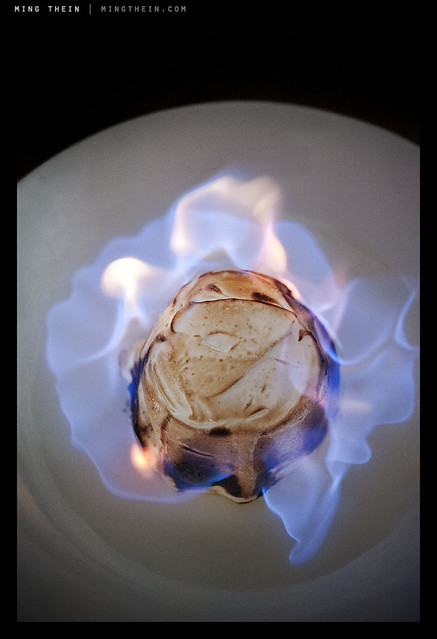
Flambe. Repeatable, but not controllable. You can set up the shot and do it again, but you can’t control what the flames are going to do. And this is the interesting thing that gives a little variation and makes each shot different. Seascapes are another good example. Nikon D700, AFS 60/2.8 G Micro

Personally, I’m going for something in the middle; but before I even get there, I need to shoot more – to have full intuitive control over my camera so that whatever adjustments I make come to me as second nature. And at this point something has to be said about good cameras, bad cameras, and too many cameras; good cameras are intuitive to use and require little training or practice to master. They do what you want them to, nothing more and nothing less. Bad cameras are ones that you never feel fully in control of, no matter how much practice you have. And too many cameras is just that: if you have too many cameras, you’re bound to eventually forget which button does what. And that could cost you at the most critical moment. This is why I’ll continue to use my D700 for reportage assignments until I’m fully comfortable with the D800; I know exactly habit will do under every situation, born of seventy thousand frames of experimentation – not counting the fifty thousand I shot with the D3, which is pretty much the same camera. MT

*Did anybody get the Futurama reference?

_7058402 copy
Would the burger be as appetizing without that juicy pickled onion marmalade peeking out? Probably not. Nikon D700, AFS 60/2.8 G Micro

____________

Visit our Teaching Store to up your photographic game – including Photoshop Workflow DVDs and customized Email School of Photography; or go mobile with the Photography Compendium for iPad. You can also get your gear from B&H and Amazon. Prices are the same as normal, however a small portion of your purchase value is referred back to me. Thanks!

Don’t forget to like us on Facebook and join the reader Flickr group!

appstorebadge

Images and content copyright Ming Thein | mingthein.com 2012 onwards. All rights reserved

More B&W sample images from the Leica X2

Today’s post is a quasi-photoessay. I’ve decided to share some more black and white samples from the Leica X2; my full review of that camera is here.

Actually, I’m being a little bit contrarian: it’s a camera that does outstanding color reproduction, but my choice of black and white is a deliberate one; not because I want to follow the popular monochrome theme going at the moment thanks to the M-Monochrom, but because one of the things I test when shooting with a new camera is the quality of its files on conversion; it tells me a lot about the tonal response curve of the sensor, which is useful information for both monochrome work and color work.

The X2’s CMOS has a very linear response, similar to the Nikon D7000; in fact, my conversion workflow for these two cameras turned out to be extremely similar. What does this mean? Great overall contrast, but perhaps a bit too much; there doesn’t seem to be that nice gentle highlight rolloff that’s the M8/M9/S2’s trademark. Dynamic range is high, but a lot of it is bunched in the shadows and requires some work to recover.

Many of you have asked about my B&W workflow – there’s an upcoming article on conversion options, and their differences, which I think you will all find useful. I’m also trying to figure out the best way to present a short walkthrough on how I personally do my conversions, which should help demystify the notion that you have to use filters or scanned film to get the look you want.

Oh, and that tilting EVF is extremely handy when you’re trying to be frame-fillingly stealthy with a 35mm lens. MT

Images shot around downtown Kuala Lumpur with a final production Leica X2.

_X21_L1020171bw copy

_X21_L1020163bw copy

_X21_L1020165bw copy

_X21_L1020096bw copy

_X21_L1020094bw copy

_X21_L1020091 copy

_x21_l1020069bw copy

_X21_L1020034bw copy

_X21_L1020039bw copy

_X21_L1020036bw copy

_X21_L1020044bw copy

____________

Visit our Teaching Store to up your photographic game – including Photoshop Workflow DVDs and customized Email School of Photography; or go mobile with the Photography Compendium for iPad. You can also get your gear from B&H and Amazon. Prices are the same as normal, however a small portion of your purchase value is referred back to me. Thanks!

Don’t forget to like us on Facebook and join the reader Flickr group!

appstorebadge

Images and content copyright Ming Thein | mingthein.com 2012 onwards. All rights reserved

POTD: A vaguely religious notion

_X21_L1020059bw copy
I don’t know why, but there’s something oddly religious suggested to me by this composition. Can’t put my finger on it, though. Leica X2.

A gentle reminder: the print offer ends next week!

_M9P1_L1014802 copy
Seeing the wood from the trees. Leica M9-P, 21/3.4 Super Elmar ASPH

Both of the prints you see in this post will be up for as a limited run. (These things help me keep the site running – creating content takes time I can’t use for anything else, and I really want to keep the site ad-free to maintain the picture viewing experience; also, it helps you decorate your walls 🙂

The print offer will be limited to 20 copies of each image, at 16×24″ (A2) printed on 20×30″ paper. Here’s the kicker: the prints will be done on 380gsm matte fine art paper, printed with 200 year archival grade pigment ink on a HP production class machine. The look of the black on the paper is indescribable – I’ve never seen anything like it before, and I knew I had to make some prints with this. There are no reflections anywhere, which means the image is so much more viewable. The blacks are dense and chalk-pastel like, with fine tonal transitions. All prints will be numbered and signed. (And no, there will be no black borders around the images in the final print).

_M9P1_L1003919bw copy
Schonbrunn Fog, Vienna. Leica M9-P, 28/2.8 ASPH

The price for either print is US$550 net to me for the 16×24″, or US$300 for the 12×18″ size – including shipping worldwide via courier in a sturdy tube. To keep things simple, payment can be made via Paypal to mingthein2@gmail.com, which means you can either use your Paypal balance or a credit card.

Please include in the message field which image you’d like, plus your shipping address, contact email address and telephone number. I’ll email a confirmation as soon as I a payment from you. If you’d like multiple copies or multiple images, that’s great too – you just make one payment.

I’ll be closing the print offer in one week at the end of May, and shipping shortly thereafter. First come first served! Remember, these images will not be offered for sale again at this size. Thanks for your support everybody! MT

Exclusive premiere: The full Leica X2 review

_7064180 copy

This morning has seen a flurry of news: the M9 Monochrom first (with a useable ISO 10,000 apparently!), then the Hermes M9-P, the 50/2 APO-Summicron-ASPH (ouch what a price tag), and trailing, the X2 and V-Lux 40. I wasn’t lucky enough to go to Berlin, so reviews of the first items will have to wait a bit. But I did manage to get a final production X2 in advance. The full review follows. Note that you can click through all images to larger versions on my Flickr page – the link takes you to the image landing page, and then the magnifying glass icon or ‘all sizes’ will take you to the larger images.

Leica’s 2009 X1 (my review is here) was a modern throwback to the Barnack era in many ways – fixed focal length lens, very simple controls, and that ‘elongated cylinder’ look. In short, it was a handsome camera that was, and still is, capable of delivering outstandingly good images; the sensor actually outperforms the M9 at ISO 1600 and above, deliver lower noise. I owned one of these for several months and used it as my daily camera, until I was lured by the siren song of the (flawed) X100.

_7064197 copy
X marks the spot.

_7064146 copy
The new flash mechanism

However, it was crippled in a number of ways – the moderate f2.8 lens speed being one, but focusing speed being by far the main one. A firmware update improved things somewhat, and brought a much improved manual focus mode (driven off the rear thumb wheel) which showed both distance and an in-focus scale that varied with the aperture selected.

_X21_L1020079 copy
Work in progress from above. Leica X2

The Leica X2 was officially launched in Berlin yesterday, along with a number of other products (which I hope to get my hands on soon); I’ve had a final production model for several days now, courtesy of Leica. It’s been enough time to shoot several hundred frames with the camera, get to know its quirks, and probe the elasticity of its files with every tool known to ACR and a Wacom tablet.**

_X21_L1020070bw copy
Lagerfeld-style cool. Leica X2

**A note and advance disclaimer on processing: I ran the X2’s DNG files through ACR 6.7 and CS5.5, using my normal workflow. I process every file as though it was a final client delivery or exhibition piece, and that means two things: firstly, I’ll use every trick in the book I know to maximize image quality, but I do that with every camera I shoot, so that’s consistent; secondly, I shoot with the end in mind, especially once I get used to the tonal response of the sensor. For this reason, please don’t ask for out of camera JPEGS or RAW files, that’s not the way I work because it isn’t representative of the end use of the equipment. Some tests – the noise comparisons, for instance – are direct conversions via ACR with no additional work done on them. Where this is the case, it’s stated. One final thing: after the D800E vs S2 review, I think it’s necessary to also add the caveat that my observations are based on looking at full size 16 bit uncompressed files on a calibrated monitor, which will necessarily give rise to different conclusions than if you just see the compressed web size JPEGs in the article.

_X21_L1020061 copy
Taxi drivers (and dynamic range torture test). Leica X2

The first thing that strikes you is that it somehow feels better than the X1 – I am aware that this is a dangerously subjective comment to make – but the choice of materials seems a bit more solid; in fact, it seems like the camera has a bit more ‘stuff’ inside it. According to Leica, it’s about 30g heavier, which doesn’t sound like a lot, but you can feel it. It also seems like the body shells are a bit thicker, which contributes to the impression of solidity; the Leica X2 feels much closer to a mini-M than the X1 did. Perhaps it’s the black chrome and leather covers mine had. (I’m told it’ll also be available in silver).

_X21_L1020058 copy
Fitting the frame. Leica X2

Now would be a good time to talk about improvements. This list is by no means exhaustive, but it’s what you’d notice and appreciate as a serious photographer:
– AF speed is a LOT faster
– The top plate dials are much stiffer, and now don’t rotate accidentally
– Greatly improved LCD; supposedly still the same number of dots, but side by side with the old X1, it seems a lot clearer and more fluid.
– EVF shoe, and matching tiltable EVF which has great resolution.
– Battery life is significantly better
– Burst mode is faster.

_X21_L1020057bw copy
Lazy observation. Leica X2

Let’s work down that list.

AF on the X1 was so slow that I’d use it only for static subjects, and zone focus the rest of the time. Not so here – it’s fine for casual snapshots, but like every contrast detect system, AF-C is best avoided. Even the best of the mirrorless cameras falls flat on its face (I’m looking at you, OM-D) – perhaps with the exception of the Nikon 1 system, but that’s cheating because it has phase detect photosites on its sensor. Subjectively, I’d say it’s definitely faster than my X100 was; about the same as my NEX-5 (sorry, haven’t used as 5N to compare) and similar to most of the Panasonic M4/3 cameras. Not as fast as the Olympus M4/3s, though. But just fast enough to stop you from feeling like you’re waiting for the camera.

_X21_L1020046 copy
Clouds and angles. Leica X2

The best news, however, is that it doesn’t slow down much in low light; so long as there’s a decent amount of contrast, focus acquisition speed remains about the same. And unlike the X-Pro1 and X10, it doesn’t freeze the image when focusing – the view remains live, so you can see what’s going on in your frame. Interestingly, the ‘H’ (high speed settings that did freeze the image) options for AF and macro focus settings are gone; the camera is faster than the H options now, and it will automatically switch to it if required. Sadly 30cm remains the near limit, however.

_X21_L1020032bw copy
Images convert well to B&W, too. Leica X2

The X1’s LCD was pretty coarse; the X2’s is a significant improvement, but I don’t think it’s as good as say the Ricoh GRD IV – which has an amazing 1 million+ dot screen. Nevertheless, it’s now much easier to judge focus. Refresh rate seems to be a lot faster too; I’d say 60Hz instead of 30Hz. You can still use the optical finder if you want, but you’re still going to miss knowing exactly what the camera is focusing on; for the price and bulk, I’d much rather have the EVF, which is excellent. The fonts look grainy, but that’s only because it seems the UI designer didn’t specify enough DPI when encoding; the image itself is very, very fine indeed – you can’t really see individual pixels. It gains up well in low light, and isn’t too grainy.

_7064155 copy

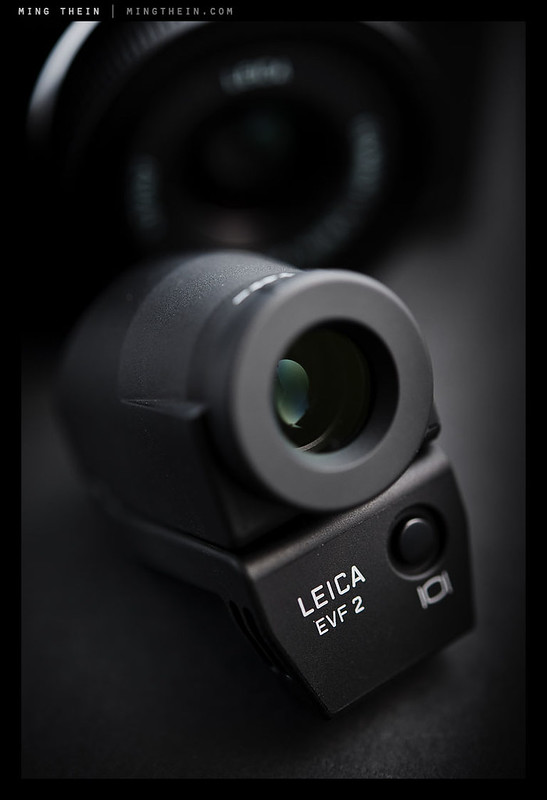
I did an experiment with the EVF out of curiosity – the plug looked like any one of the existing EVF plugs. Expecting it to fit my D-Lux 5 Titanium, I was surprised when it didn’t; but it did fit my Olympus OM-D and Pen Mini. Even more interestingly, it worked! Draw whatever conclusion you wish; it’s a very nice EVF all the same, and my preferred way of working with the camera. Oh, and it tilts, too, and locks securely in the down position (something not all tiltable EVFs seem to manage.)

_X21_L1020107 copy
Through the keyhole. Leica X2

During the last few days, I shot over 500 frames with the Leica X2. With the X1, this would have meant two battery changes; I actually had three spares for mine, which would leave me with one left over after a heavy day of shooting. (I’m the kind of person who can finish off an entire EN-EL4a on a day’s assignment and add a five figure mileage to a camera in short order). The X2 showed half – that’s a pretty darn impressive performance, considering either the LCD or EVF were on the whole time, and I was using it frequently enough that it didn’t have time to slip into power save mode. It could be the effect of a more efficient sensor (the previous sensor was a relative of the one in the D90, which was notoriously power hungry in live view) or processing internals. This is on par with my current mirrorless long-life battery champ, the Pen Mini – which will easily hit a thousand frames per charge if used carefully.

_X21_L1020099 copy
Artificial everything. Leica X2

Finally, if you’re a flash shooter, good news! The leaf shutter remains, which means 1/2000s sync speeds (unheard of for most cameras) and the popup mechanism has been redesigned. It looks a lot more complicated, but I suspect that this is actually going to be more robust than the old press-to-raise-and-lower design – I’ve heard a lot of complaints about it being easy to break.

_X21_L1020093bw copy
Untitled. Leica X2

You’ll notice I haven’t said anything about the sensor up til this point; that’s because you’re not going to notice it immediately upon shooting (duh). But what you will notice is an ISO 12,500 (no idea why it isn’t 12,800, i.e. double 6400) setting. It’s APS-C, so I didn’t expect it to be useable. What’s nice to report is that the new 16.5 MP CMOS used is class leading in every way. It even manages 5fps continuous shooting for eight frames, but the penalty is that you have to wait while the camera writes the files – it doesn’t seem to buffer in parallel. This is true whether you shoot one or eight frames. As for the sensor, I suspect we may actually have seen a relative of it before in other products, most notably one with three zeroes or an N in its name. This is a good thing.

_X21_L1020128 copy
Obligatory night test shot. ISO 3200. Leica X2

Let’s get noise out of the way: it’s all luminance. Shooting DNG, with zero noise reduction, I’d happily use ISO 3200 with a bit of work; there’s a big jump in noise to ISO 6400, which renders that and the top 12500 setting strictly for those shots of the Loch Ness Monster assassinating JFK. Or perhaps they might work well for you if you like extremely grainy B&W conversions. Even with NR zeroed out in ACR, I’m seeing some smearing at 3200 and up, but it’s less obvious at the two highest settings because of the overriding luminance noise. You might be able to retain more acuity by shooting 1600 and underexposing a stop, then bringing it up again in the raw converter afterwards. It isn’t too bad, but you’ll notice it’s there. All in all, the Leica X2 is up there with the best of the APS-C cameras, and frankly feels like it would give my D700 a run for its money on luminance noise, but loses out on dynamic range. Pixel level acuity remains excellent, though some files seem to require an extra sharpening pass – it may be the effects of diffraction starting to creep in at f8 and up.

X2-noisecrops1 copy
Some noise crops follow below. Click on the links for 100% versions.
Crop one
Crop two
Crop three

The X2 seems to have its own color signature that is different enough from the X1 that my initial experiment to use the same ACR profiles was unsuccessful. It’s tonal map also doesn’t match the Ms; dynamic range seems to be somewhat bunched in the shadows (which I don’t see on the more linear-response CCD sensors in the M and S cameras) and the relatively low noise floor responds well to shadow recovery. If anything, the color is much closer to being ‘accurate’ than any Leica to date – the skin tones are great, at least in RAW. White balance is similarly excellent – I made very, very few corrections to color; this is highly unusual for my workflow. Have to watch the red channel closely though, it doesn’t take much to hit saturation. Note that neither display gives an accurate idea of exposure or color, though. Using the histograms is highly recommended.

_X21_L1020149 copy
Pudu Plaza. Any photographer in KL will recognize this place. They’ll also recognize that the reds are both accurate and not accurate; they’re a little hot but the tone is mostly right. Leica X2

Although I’d never personally shoot JPEG with any camera, given the option – especially something whose files have as lot of processing latitude, like the Leica X2 – I know a lot of potential buyers might well do so, so I also had a close look at the native JPEG image quality. I’m pleased to report that it produces crisp, detailed files with very few artifacts; there are some customization parameters if you have a particular preference for how your files look. However, by default, the output is best described as neutral. Skin tones are still definitely better in DNG; there’s something about skin color that just seems out of gamut for most in-camera JPEG conversions.

_X21_L1020090 copy
Yellow men. This color is accurate, and identical to the scene. Leica X2

A comment on file formats, and a gripe I had with the original X1 – I don’t know why the camera can’t write DNG only – you have to do DNG+JPEG, which seems like a waste of space and buffer. Still, for single frame shooting (I can’t actually think why you’d use bursts on this camera) there isn’t any noticeable penalty in operation.

_X21_L1020051 copy
The fountain. Leica X2

There are a few other minor things that could be improved – as always. We can never have AF that’s too fast, or too continuous; in all fairness, this is a comment leveled at every camera, and the latter to mirrorless cameras in particular. The rear control dial is now far too loose and difficult to turn in single increments – especially when trying to apply exposure compensation. What would be nice is that when shooting, exposure compensation is the default setting like on the M9; but we’d definitely need a stiffer dial for that. The odd electronic stabilization ‘feature’ remains; I’d avoid it because it just gives me double images. A proper optical stabilizer would be nice, but at least we have the option not to use it.

_X21_L1020050 copy
Yawn; just another camera? Certainly a very stealthy one; nobody once gave me a second look when I was shooting them. Especially if using the finder flipped up at 90 degrees. Leica X2.

I have a little beef with the top plate dials. On every other Leica, all exposure adjustments move in half stop increments/ detents. On the X1 and X2, you get whole stops for shutter speeds, and third stops for aperture – what’s up here? Size of the shutter dial can’t be a reason, because the M9 has more speeds and is the same size – and still gives half stop detents. I like the increased dial tension, but can we please have consistency in exposure increments?

_X21_L1020030 copy
‘Hi, I’m doing a survey. Let me probe your brain for a moment.’ Leica X2

Finally, there’s the lens. It gives me mixed feelings. On one hand, it’s an excellent optic; the biting sharpness, excellent corner performance (it was after all, supposedly designed for full frame originally) microcontrast structure and general transparency which was one of the image quality hallmarks of the X1 is still there. On the other hand, it’s relatively slow at f2.8 – not a problem given the newfound low-light capabilities of the sensor; however, it doesn’t really allow isolation, and that’s one of the things people seem to expect from a Leica. Another stop – or even two – might make for some beautiful bokeh (I know I’ve seen it from the 24/1.4 Summilux-ASPH M, but then again that’s also a physically enormous and hugely expensive lens).

_X21_L1020012 copy
Reflections. Some of you might recognize this building. Leica X2

Whilst the lens delivered almost perfect results from wide open on the X1, the X2’s slightly higher density sensor seems to be pushing the resolving power a little – images shot at f2.8 are definitely a little softer than f4; it’s almost as though there’s a slight AA-filter effect at f2.8. This is easily solvable with a second sharpening pass, and doesn’t seem to materially affect the microcontrast structure of the image. Thereafter everything is good until you run into diffraction, a hint of which is visible at f8 and obvious by f11.

_X21_L1020040bw copy
Yes? Yes? Not today. Leica X2

Technical improvements are all well and good for the spec sheet and marketing people, but where does this leave us in terms of real-world usability? The X concept was almost certainly conceived by a photographer; it’s a combination of M and point and shoot that should in theory allow anybody to create images with that ‘Leica look’ (which I think most lay people mistake for bokeh, but is actually a combination of that, color transmission, sharpness, focus transition and microcontrast – but let’s not get started here) with minimal fuss. It failed fundamentally because it was too slow to be useable. However, it did have one overriding redeeming quality – the image quality was truly outstanding.

_X21_L1020037 copy
Untitled. Leica X2

The X2 takes the image quality even further, but more importantly now feels like a mature product. It’s a better distillation of the M gestalt, and definitely easier to use for the simple reason that it’s more responsive to shoot with. During the course of testing, I never felt like I lost a shot because the camera was too slow; I definitely did with the X1 and X100. There’s no single feature or area that makes you go WOW, but the combination of improvements makes it a very compelling little camera that just does its thing and delivers the most important thing – image quality – in spades. Here’s an interesting thought: if you shoot in low light a lot, you’ll probably want to get one of these instead of an M9 – the sensor is that good.

_X21_L1020014bw copy
The escape route. Leica X2

What does the future hold for the X system? Purely speculating, I think it’s unlikely we’ll ever see interchangeable lenses – it doesn’t make sense to develop new lenses given there’s already M mount, and M mount has a digital solution; the cost of developing an all-new mount and AF lens lineup is going to be pretty staggering, which would price the camera in M territory. Rather, that would make sense as a future evolution of the M line – something compatible with new autofocus lenses, as well as the older manual focus lenses. I can’t see how a rangefinder fits into this, though – the end product would probably be very Fuji X-Pro like, which overly complicates things and is far from the Leica design philosophy. But at the very least, I think the X2 needs a telephoto or long normal companion – this would be a killer studio camera due to the leaf shutter and high speed sync. And a pair of those would cover most travel photographers’ needs, without sacrificing image quality.

Time will tell. In the meantime, deciding which mirrorless camera to augment your primary system just got a lot tougher for us photographers. MT

_X21_L1020018 copy
Review complete; happy hour. Leica X2

Addendum, 10.30am 11 May 2012: My sleep-depreived brain has just remembered there’s one thing I forgot to mention: movie mode, or the lack of it. Whilst this sensor must clearly be video capable to produce the live feed, Leica has chosen not to implement a movie mode of any sort; I personally don’t see this as as huge issue as I don’t do video anyway. In any case, the inability to easily follow focus is probably a bigger impediment for moviemaking than the fixed focal length. I’d see video capability here as a nice to have, but not critical. Besides, the V-Lux 3 and D-Lux 5 are much easier to use for video, if you must have a Leica. I’ll be sticking to my D800E for the few times I do need video. MT

The Leica X2 is available in both black and silver here from B&H and Amazon.

____________

Visit our Teaching Store to up your photographic game – including Photoshop Workflow DVDs and customized Email School of Photography; or go mobile with the Photography Compendium for iPad. You can also get your gear from B&H and Amazon. Prices are the same as normal, however a small portion of your purchase value is referred back to me. Thanks!

Don’t forget to like us on Facebook and join the reader Flickr group!

appstorebadge

Images and content copyright Ming Thein | mingthein.com 2012 onwards. All rights reserved

The complete set of images from my exhibition with Jaeger Le-Coultre and Leica

For those of you who can’t make the exhibition in person, here’s the next best thing.

For the making of, see this post. MT

_M9P1_L1014229 copy

Amvox 5 chronograph detail

_M9P1_L1014172 copy

Amvox 5 Chronograph

_M9P1_L1013962 copy

The Deep Sea in a dial

_M9P1_L1013790 copy

Trilobed chaton, Master Minute Repeater

_M9P1_L1013739 copy

Master Minute Repeater

_M9P1_L1013662 copy

Duometre a Spherotourbillon

_M9P1_L1013608 copy

If only we could wear it upside down…

_M9P1_L1013556 copy

The Spherotourbillon cage

_M9P1_L1013484 copy

Balance

_M9P1_L1013449 copy

Duometre a Sphertourbillon in recline

_M9P1_L1013340 copy

Duometre a Sphertourbillon movement detail

_M9P1_L1013250 copy

Duometre 40.5

_M9P1_L1010108 copy

For the ladies

_7056884 copy

Escapement – Gyrotourbillon II

_7056862 copy

Caged – Gyrotourbillon I

_M9P1_L1009941 copy

Follow the sun – equation of time indicator on the Gyrotourbillon I

_7054011 copy

Swan Lake in a dial

_7053570bw copy

X-ray vision

_7053324 copy

Gyrotourbillon II

_7053295-LARGE copy

Gyrotourbillon II

_M9P1_L1014615 copy

Three is the magic number

_M9P1_L1014513+28 copy

Ultrathin

_M9P1_L1014454 copy

Waiting to be wound

_M9P1_L1014371 copy

Moon and stars a Rendez-Vous

_M9P1_L1014260 copy

The world on your wrist

____________

Visit our Teaching Store to up your photographic game – including Photoshop Workflow DVDs and customized Email School of Photography; or go mobile with the Photography Compendium for iPad. You can also get your gear from B&H and Amazon. Prices are the same as normal, however a small portion of your purchase value is referred back to me. Thanks!

Don’t forget to like us on Facebook and join the reader Flickr group!

appstorebadge

Images and content copyright Ming Thein | mingthein.com 2012 onwards. All rights reserved

POTD: Old and new

_M9P1_L1003401 copy
Old wing, new wing. The Albertina Museum, Vienna. Leica M9-P, 28/2.8 ASPH

An unfair fight? 35mm vs Medium Format: Nikon D800E and the Leica S2-P

_7064022 copy

I want to say upfront that until I did the test, I had no idea how the result was going to turn out. What I suspected wasn’t quite the outcome that occurred; but you’re going to have to read on to find that out 🙂 I apologize in advance, because what was supposed to be a quick A-B image comparison has turned into a 3,500 word dissertation. There are a lot of things that must be said, clarified and put into context when dealing with these cameras.

The best conceived test is completely useless if the methodology isn’t sound; likewise, a seemingly unfair fight can be actually relevant if properly executed. Both cameras are in the high 30MP range; 36.3MP for the Nikon D800E, and 37.5MP for the Leica S2. Close enough to make as near as no difference. (Also, the S2-P is the same camera as the S2 except for the sapphire cover over the screen and professional service.) Everything was shot at base ISO on a sturdy tripod (a heavy Manfrotto 444 Carbon One with Hydrostat head) and mirror lockup. Lossless compressed RAW for both, with files processed via ACR 6.7 final release with equal sharpening, zero noise reduction, and equal shadow/highlight recovery slider settings. Images were then saved as quality 12 jpegs – the full frame shots you see are reference for color only, not resolution of course – and the 100% crops are also quality 12 jpegs. There is some minor quality degradation but not a lot. The first cityscape had both cameras set to the same Kelvin temperature for white balance, however subsequent shots were point balanced in ACR to the same location as this was more representative of real-life workflow.

In addition to outdoor subjects – the dynamic range torture test – I also shot a number of indoor subjects to test both front and back bokeh, sharpness, high ISO performance, lens performance in the macro range, and a trial run for something I’d use both cameras for – watch photography.*

Similarly, I matched lenses as closely as possible; we chose the best for each system. Not difficult with the S2 – all of the lenses are incredible, and nearly flawless. It is simply one of the highlights of the system; there are no lenses worse than excellent. And each lens has its own calibration firmware embedded at the factory, to ensure perfect focus on every camera body – why other manufacturers don’t do this is beyond me. I certainly wouldn’t have had the D800 AF issue if this was the case. I used the Leica 35/2.8 Summarit-S and 120/2.5 APO-Macro-Summarit-S on the S2, and the Zeiss ZF.2 2/28 Distagon and Nikon 85/2.8 PCE Micro-Nikkor on the D800E – both lenses I consider to be the best of their focal length in F mount.

Focusing was done either via the AF system (and results checked via live view or manually bracketed) to achieve optimum sharpness. Everything was shot within minutes of each other, so there should be minimal differences in lighting. There will be some differences in the final watch shot as I couldn’t get the tripod to hold in that overhead position with the weight of the S2; the shot was handheld and there are some minor differences in lighting due to watch positioning and reflections.

*I shot part of an architectural assignment recently with the S2, 30mm and 70mm lenses; see an upcoming On Assignment for the rest of that article.

Part one: Cityscape – dynamic range and resolution test. Zeiss 2/28 and Leica 30/2.5

_8010052 copy
The full D800E + Zeiss ZF.2 2/28 Distagon frame

_S22_L1000854 copy
The full Leica S2 + 35/2.5 Summarit-S frame

The first obvious thing is that the color response of both sensors is hugely different, despite both being set to the same color temperature; I’m guessing it has to do with many factors, including a) CMOS vs CCD architecture; b) the nature of the Bayer algorithm used and the color filter array layout; c) internal signal processing and ‘company color profile’; d) ACR’s interpretation of the files.

The D800E’s file looks quite natural but is a touch too warm; the S2 is very blue-green biased and would make for great landscapes, however it doesn’t get the color right either. Both cameras could be corrected to accurate (as their sensors’ tonal response is broad enough) however neither gets it right out of the box. The S2 has slightly better dynamic range – perhaps half a stop or so – but there isn’t a lot in it. Neither camera has blown areas or blocked up shadows.

_8010051-1 copy
D800E 100% center crop, at f2.5

_8010052-1 copy
D800E 100% center crop, at f8.

_S22_L1000853-1 copy
S2 100% center crop, at f2.5

_S22_L1000854-1 copy
S2 100% center crop, at f8

In the center, the Zeiss/D800E combination is already excellent at f2.5 (set to match the S2) and barely improves at f8. The Leica, however, is even better at f2.5 (wide open!) and seems to soften a bit at f8. I repeated this test several times with the same result – the lens is best used wide open, it seems.

_8010052-2 copy
D800E 100% edge crop, at f8

_S22_L1000854-2 copy
S2 100% edge crop, at f8

The corners tell a very different story; the Zeiss/D800E is very good, but the Leica is outstanding. The former has clear softening due to CA at high contrast edges (note white building) due to field curvature; the Leica shows none of this whatsoever and is sharp enough to show minor evidence of color moire (!). This is best seen in the air conditioning condensers in the windows of the white building.

Note – shadow noise here is high because I’ve run a 50/50 setting for the shadow/highlight slider to maximize dynamic range.

Part two: Indoors, wide-angle bokeh test and flare test

_8010058 copy
D800E + Zeiss ZF.2 2/28 Distagon full frame

_S22_L1000857 copy
S2 + 35/2.5 Summarit-S full frame

There’s really not a lot in this one – both images look great. Color is accurate, and bokeh is pleasant – though I’d give the edge to the S2 because the highlight rolloff is a little smoother; which no doubt has much to do with the dynamic range of the sensor. What is noticeable here is vignetting on the D800E/ Zeiss combination; almost a stop. I guess it’s one of the factors that contributes to the cinematic look of the Zeiss. The Leica has zero vignetting, despite being shot wide open. Depth of field is about the same; the D800E/ Zeiss was shot at f2, and the Leica at f2.5.

_8010058-1 copy
D800E 100% center crop, at f2

_S22_L1000857-1 copy
S2 100% center crop, at f2.5

Both lenses are commendable in the way they handle the strong backlight with almost no flare; the coatings on both are superb and you see very little of the first few elements. However, on closer inspection at 100%, we see the Zeiss has a definite purple fringe, and the Leica appears almost completely apochromatic. I’d say resolution here is a tie.

Part three: telephoto bokeh and flare test

_8010060 copy
D800E + 85/2.8 PCE full frame

_S22_L1000860 copy
S2 + 120/2.5 APO full frame

We’ve now switched lenses to the short tele macros; the 85/2.8 PCE on the D800E, and the 120/2.5 APO-Macro-Summarit on the S2. The tripod was moved between shots to try to match the angle as the Leica 120 is about 95mm equivalent; I don’t have the AFS 105/2.8 VR handy, and besides, I think the 85/2.8 PCE is a better lens anyway – the micro contrast structure is a lot more refined, and LoCA is lower.

The D800E seems to have a slight dynamic range advantage here, though it could be due to exposure. Bokeh from the S2 is definitely better, as would be expected from a lens that’s both faster and longer. Both lens/ camera combinations deliver a very 3D feel, and pleasant foreground bokeh – something that’s frequently ignored by photographers, but contributes heavily to a workable defocused foreground as part of the composition or not.

_8010060-1 copy
D800E 100% center crop at f4

_S22_L1000860-1 copy
S2 100% center crop at f4

On closer inspection, we see both lenses are easily capable of matching the resolving power of the sensor; if forced to choose, I’d give a hair to the Leica, but there’s almost nothing in it. Where there is a difference is in longitudinal chromatic aberration (‘bokeh fringing’) which is very obvious on the Nikon crop, but almost completely absent from the Leica – the 120mm is an APO lens, after all. This may contribute to the overall impression of the Leica being slightly sharper. Interestingly, the micro contrast structure and color transmission between the two lenses is very similar indeed, which is to say very neutral.

Part four: high ISO test

_8010061 copy
D800E full frame, ISO 1250

_S22_L1000861 copy
S2 full frame, ISO 1250

The same scene, again – however, this time at ISO 1250, which is the upper limit for the S2. The D800E can of course go a lot higher – to 25,600 – but I wouldn’t touch this with a barge pole. Notice the reduction in dynamic range for both cameras – more so on the S2, as expected from its CCD sensor architecture. Color transmission is commendably consistent between the two. In case you’re not convinced it’s dark, exposure time was 1/40s at f4 ISO 1250 for both cameras. Although this isn’t pushing the limits of the Nikon with it’s CMOS sensor, it is pretty much forbidden territory for most medium format systems.

_8010061-1 copy
D800E 100% center crop, ISO 1250 f4

_S22_L1000861-1 copy
S2 100% center crop, ISO 1250 f4

THe S2 displays a similar noise profile to the M9 at the pixel level; this of course isn’t surprising because they share the same base sensor architecture from Kodak. It is clear that both cameras are showing noise (there is zero NR applied here; it could be much improved by judicious use of the noise reduction tools in ACR). The D800E’s noise pattern is very fine grained luminance noise only; there’s a hint of chroma noise in the S2, but it’s still mostly luminance. I’d put it at being 1.5-2 stops behind the D800E. This is clearly not an available light camera; frankly, neither one is; I’d pick a D3s or D4. Detail retention for both cameras is still excellent, with the edge again going to the Leica – more clearly this time – perhaps the Nikon is applying some noise reduction on its raw files (though I switched this option off in camera.)

Part five: practical applications

_8010074 copy
D800E + 85/2.8 PCE full frame

_S22_L1000870 copy
S2 + 120/2.5 APO full frame

What you see here is a processed (but un-retouched – that would take too long) final photo achieved with multiple Nikon flashes – triggered via CLS on the D800, or via an optical SU4 trigger on the S2 – which is representative of the kind of shoot I’d use either camera for. Of course, this doesn’t take into account the minimum practical frame size on the D800E being about 10x7mm, vs 60x90mm for the S2.

The S2 image pops more – it could be due to a slight change in camera position for reasons mentioned earlier – but I suspect it may be due to the Leica 120mm having slightly higher overall contrast than the Nikon PCE. Both cameras have done outstandingly well; I like both images very much. Color is commendably accurate after adjustment.

_8010074-1 copy
D800E 100% center crop, f5.6

_S22_L1000870-1 copy
S2 100% center crop, f5.6

Close up, there’s there’s a bite to the S2 image that’s lacking from the D800E; somehow the finest structures aren’t being completely transmitted by the lens; it seems the S2 lenses have more micro contrast. Once again, both images were shot at the same aperture, but somehow the S2 appears to have a hair more resolution and acuity.

Part six: specific comments on the Leica S2

There are a lot of things I like about this camera. It’s the first Leica system designed from the ground up in a long time, and it shows. There’s DNA from the R9 ‘Hunchback of Solms’ about the way the shoulders of the camera slope, the gigantic shutter dial, and the almost vertical shutter release (which is a great design choice, by the way – squeezing the grip greatly reduces camera shake compared to a vertical plane release). Even the power switch positioning is reminiscent of that lever on the R9 whose function I’d never been able to figure out. In fact, it’s pretty amazing that they managed to fit such an enormous viewfinder inside that prism hump – it’s not much bigger than the D800E’s hump, in fact (though the latter also contains a pop up flash).

Despite the legacy DNA, the control system is well thought out and remarkably simple – four hot keys around the LCD have soft functions; selections and scrolling are taken care of by the thumb wheel, which also clicks in to select or change exposure mode. It’s a very elegant and easy to use system. The camera and lenses are also fully weather sealed, with elaborately precise flanged gaskets that make the Nikon look positively crude by comparison. (Strangely, I was also told that it was probably not a good idea to shoot with the camera in the local monsoon rain). Build quality is excellent; it feels like a solid block of metal (and weighs about the same too, but a lot of this is attributable to the lenses), and there are very few external screws except on the base, which is rubberized; I’d say it’s a level above even the D4. The mirror mechanism is remarkably well damped, and for such a large mirror, blackout time is negligible. The one thing I don’t like about the ergonomics is the hand grip; that odd finger cut just doesn’t seem like it was made for Asian hands.

The viewfinder is enormous – as expected for medium format – and hugely addictive, being both of high magnification and high eye point. In fact, magnification is about 100% with the 70mm, which means you can comfortably shoot with both eyes open. I never thought I’d say this, but it makes the D800E’s finder feel like a dark tunnel. And there’s no comparison when it comes to ease of manual focus – though the D800E does of course have live view. Battery life is excellent, too – in my time shooting with the S2, I’ve never been able to make the charge indicator move more than a small fraction even during a heavy day of shooting with several hundred images. I’d estimate you’d get at least a thousand, possibly even two thousand, images off one charge.

The crown jewel of the system, however, has to be the lenses. The S system lenses are hands down the most impressive optics I’ve ever used; they’re almost flawless wide open, even in the corners, and even more perfect than the best M system lenses. And they focus themselves! Sadly they’re also enormous and heavy – which I suppose is the price paid for perfection. The 120 macro is almost the size of a 70-200 VR.

It’s not all roses, though. The S2 doesn’t work well as an available light camera; it’s very difficult to nail critical focus, stop camera or subject motion, and still stay within the good quality ISO range. I’d go to ISO 640 with reservations, and 1250 in emergencies. But then again, it was never supposed to be. The LCD could be improved, and some parts of the menu just look crude. The reverse-turning (at least relative to Nikon) aperture dial is also immensely confusing; I wish they put an option in the menu to allow users to reverse the direction. Autofocus is precise, but by no means fast; with the 120 APO-Macro it might take a while as the focusing helicoid nearly runs a full 360 degree turn of the barrel.

Part seven: specific comments on the Nikon D800E

You can find plenty of my thoughts on the nearly identical D800’s detailed first impressions review.

After a month of using the sibling of this camera in various ways, my opinion still hasn’t changed: it’s a game changer as far as image quality in the small format goes. There isn’t anything that can touch it, and the D800E stretches that bar even further. I thought the image quality of the M8 was good, but this is like having two M8 sensors welded together side by side – that’s a noticeable increase in resolution.

The D800E does require care with regards to moire; I’ve seen it several times already during my very short time with the camera. Both luminance and chrominance moire are possible; watch carefully with high frequency repeating patterns such as architectural detail or fabrics.

It’s a shame, however, that most of Nikon’s lenses don’t seem up to the task. They have built a monster of a camera body capable of incredible resolution and color that seems to have outstripped the rest of the system somewhat – very, very few Nikkors can do the sensor justice. The PCEs are a safe bet, as are most of the Zeiss lenses; of the AF glass, be careful with the primes. Yes, there were focusing problems, yes, they’re being repaired, and yes, my D800E is much better than the D800 – though still affected to a very slight degree. Enough that I’ll be careful, but not a deal breaker as most of my work with the D800E will be done under controlled studio circumstances with longer lenses.

Conclusion

What I find interesting is that we’re at a convergence point: my complaints of the S2 are because I’m treating it like a normal SLR; on the opposite hand, I’m expecting medium format quality from the D800E. This says a lot: both cameras have achieved and surpassed their design objectives. The Leica S2 was designed to make medium format easy and convenient; it does – to the point where we forget that we’re shooting with medium format. The D800E was supposed to raise 35mm-format DSLRs into the medium format realm; it does. I don’t think I’ll ever take the D800E with me on holiday; I’d certainly pack something lighter, smaller and less demanding to shoot. But I can offer my clients a new level of quality, but without the limitations of medium format (wireless TTL flash, magnification, focal length selection). By the same token, I’m quite happy walking around with the S2 and 70/2.5 (which is my favorite lens for the S system) and treating it as I would my M9-P. Both have a place in the photographer’s arsenal; however, you probably shouldn’t buy either unless you know you’re going to use the resolution – and in that case, the S2 wins on the quality its lens system.

You’ve probably read all the way to the end of this review hoping I’ll pronounce one better than the other; the reality isn’t that clear cut. The Leica S2 wins on lens quality (by a large margin), resolution (by a hair), dynamic range (though this may be debatable) and build; the D800E wins on color, practical usability (ISO 6,400 at medium format resolutions, anybody?), lens selection, speed and portability.

I honestly like both cameras and systems very much; I don’t think I could pick between the two if money weren’t an issue. The reality is that unless you’re going to torture your files and print them at enormous sizes, the D800E does deliver much better value for money. However, you’re going to have to spend a lot of money on lenses to do the sensor justice – that is if you can even find anything suitable; this lens selection is very, very small; and it’s also not cheap. I’d give the edge overall to the S2; because of the matched lenses, it feels like a more complete system, but you’ve got to climb a steep diminishing returns slope to get there. However, with the ever rising pixel densities of lower end cameras – 24MP APS-C, for instance – I’d be surprised if there wasn’t an even higher resolution D4x in the future, and given the undoubtedly huge investment for Leica, this is just the beginning of the S system. MT
Note: I don’t think I’ll be doing a direct comparison with the regular D800 as I no longer have one handy; however what I will do is try to dig out some similar files and do an approximate comparison that way. What I see from the D800E definitely has higher acuity at the pixel level, though I’ve also seen clear evidence of color and luminance moire – much in line with expectations.

____________

Visit our Teaching Store to up your photographic game – including Photoshop Workflow DVDs and customized Email School of Photography; or go mobile with the Photography Compendium for iPad. You can also get your gear from B&H and Amazon. Prices are the same as normal, however a small portion of your purchase value is referred back to me. Thanks!

Don’t forget to like us on Facebook and join the reader Flickr group!

appstorebadge

Images and content copyright Ming Thein | mingthein.com 2012 onwards. All rights reserved

Photoessay: Reflections in glass

This building is one of the more interesting in downtown Kuala Lumpur – mainly because of its highly reflective mirrored glass surface that causes its character to change with the light; it blends into its surrounding environment by reflecting it, yet stands out because it doesn’t look anything like the surrounding windowless concrete shopping plazas. Coincidentally, it also contains the offices of Leica Malaysia. MT

Series shot with a Leica M9-P and Olympus Pen Mini E-PM1.

_M9P1_L1002348 copy

_PM00545 copy

_M9P1_L1002345 copy

_PM00536 copy

_PM00517 copy

_PM00522 copy

_PM00530 copy

_PM00549 copy