On the curation of a book

_M9P1_L1007175 copy

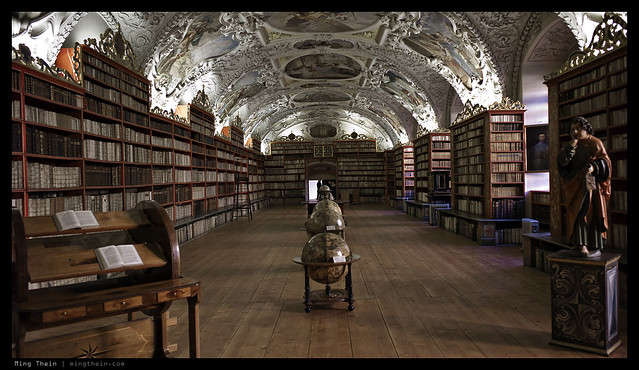
Though a book of photographs is something that I’ve been asked for time and again – I’ve honestly felt that it doesn’t really make a lot of sense to do, both because ultimately the audience is quite limited, and because the economics are a bit of a disaster if you care the slightest about quality. Speaking to many possible publishers, printers, and photographers who’ve done it (including those considered to be highly successful in this game, such as Nick Brandt) – it’s clear to me that any sort of photographic-only book is only worth doing if somebody with deep pockets is funding it for you. For example, Brandt doesn’t break even on any of his books – because his required standards for printing are so high; the problem is once you’ve seen what’s possible, it’s very difficult to compromise. Yet…I’ve not only decided to do one, but my editor and I are well into the process of putting it together already. Why? Let me attempt to rationalise – and share some of the frustrations…
[Read more…]

Cropping, sufficiency, resolution: take three (or, thoughts after shooting with the H6D-100c)

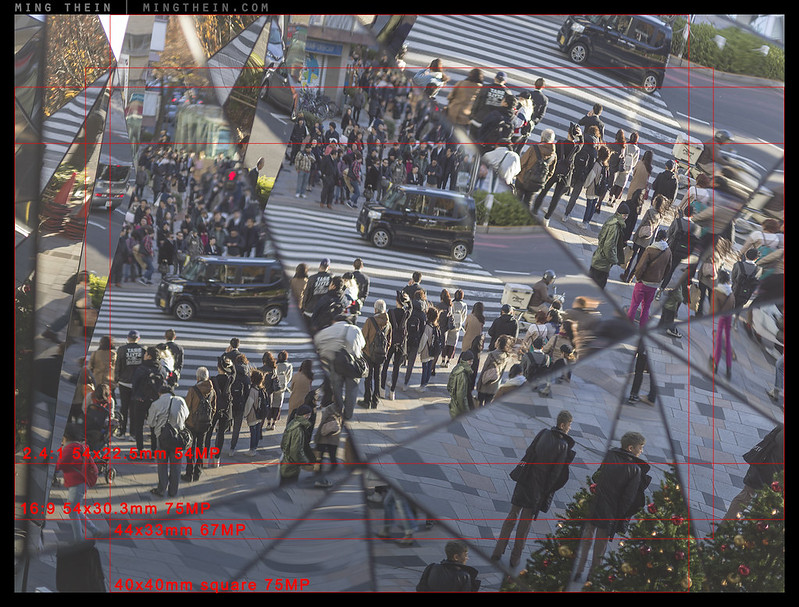
H6-100 crop marks
A little reframing – not as chaotic as I’d have expected…

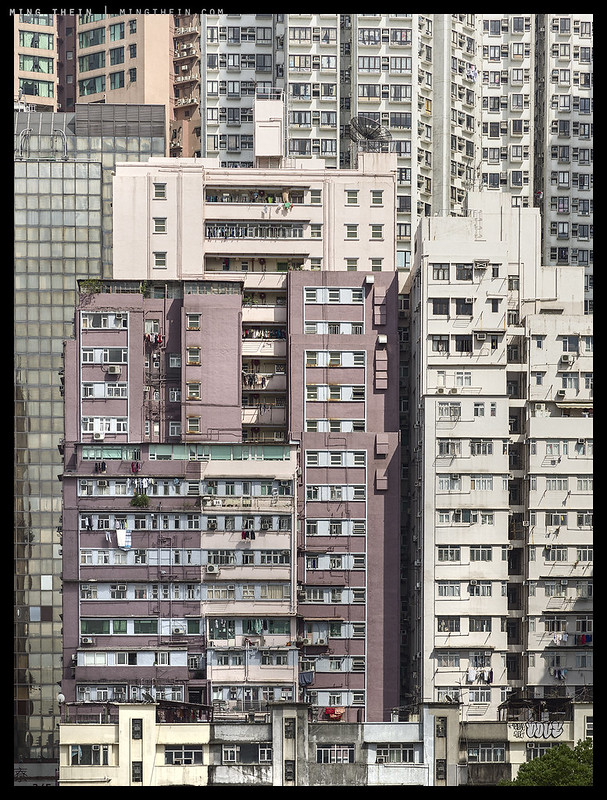
I’ve said a lot about cropping in the past, when I think it’s justified, and even a little bit about the proto-wimmelbild interpretation of recursion in composition. Bottom line: good/acceptable cropping is when the composition and restriction of edges is done deliberately and premeditatively before capture; you know you’re going to need to leave some stuff on the cutting floor because perhaps your finder edges aren’t precise or 100%, because you want a non-native aspect ratio, or because you didn’t bring a longer lens but composed for a tighter scene in the middle of the frame. Bad cropping is when you’re hunting for a composition after capture – it’s not deliberate at the time of initial composition and is basically trying your luck. The key differentiator here is one of intent.

[Read more…]

Forum thinking, part II

H51-B0020994 copy
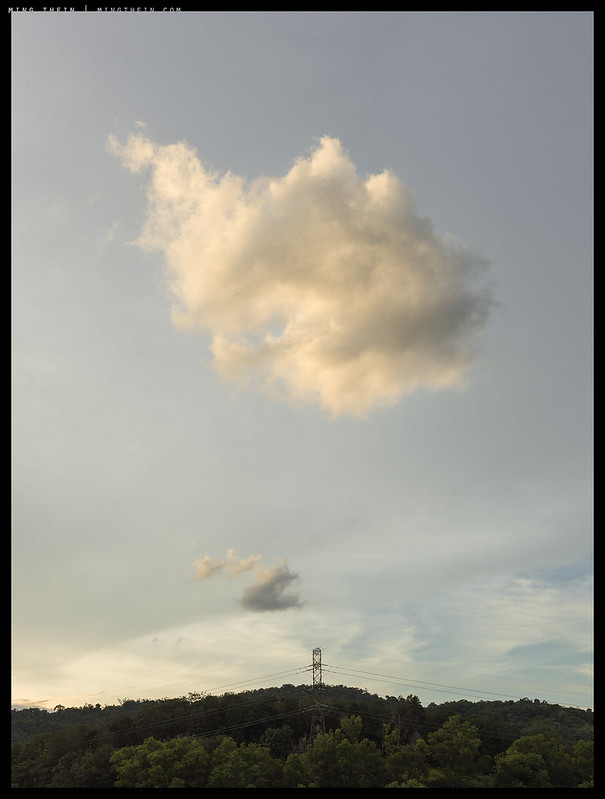
Clarity at dusk

Firstly, I’d like to say a huge thank you to everybody who contributed in the comments to the previous discussion – your ideas and support have been most helpful in clarifying my own thoughts. Fundamentally, the challenge is really one of time: how can I balance off increasing family demands against the site (which in many ways is really another child) and perhaps at the same time, make changes that both buy me time and give you something more? It isn’t a question of monetisation because all of those options require more administrative time and don’t buy time elsewhere. Having had some further time to think, here’s what I think we’ll do going forward:

[Read more…]

Off topic: personal audio, updated

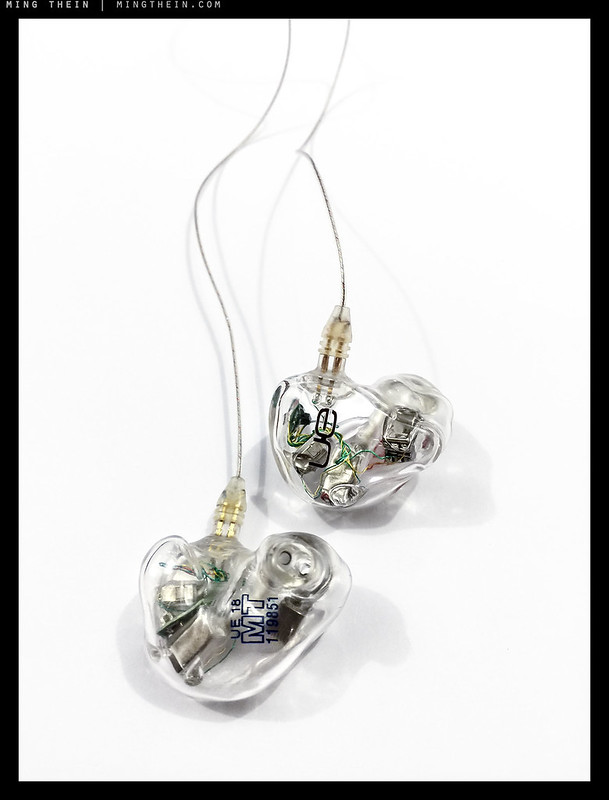
IMG_2309 copy
The price of escape?

I’ve previously written about this topic about a year and a bit ago – however, as with everything, we get itchy fingers and hardware evolves. (It’s also one of the few remaining hobbies I have outside photography.) I made what could be seen as a rather reductionist change (single output, single source) from the spread I was juggling before. Personal audio is one of those things that I think people either land up using quite heavily by virtue of personal needs (e.g. long public transport commutes, time on airplanes etc.) or never really venture into – the situation for use has to be right. It also seems to be one of those things that more photographers than not have some level of interest in; I have no idea why. Perhaps it’s the gadget factor. There’s a whole discussion around sufficiency and enjoyment and practicality that almost mirrors that of photography; the critical difference for personal audio is that user skill has no influence over the output result, unlike photography. Personal audio listening is an entirely consumptive pursuit, not a creative one. But of late, I can’t help wondering if there are some things we can take away as photographers, too.

[Read more…]

Format strengths: why do different sized media render differently?

B0000292 copy
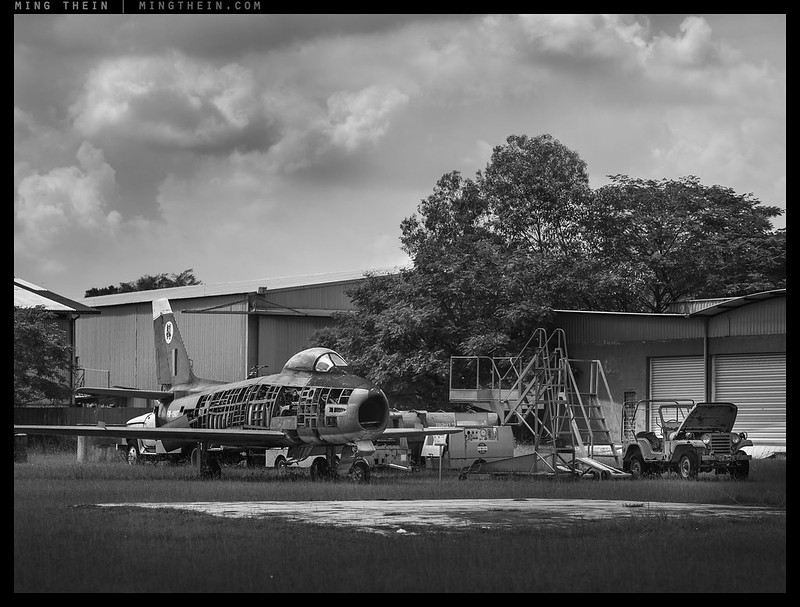
MF tonality and separation: in the full size image, the airplane is in a clearly different focal plane to the tree and hangar – even though it was shot at f8.

I’ve written previously about what exactly contributes to the ‘medium format look’. However, I think to some degree we also need to both define what constitutes the hallmarks of smaller formats, but more importantly figure out where each format’s strengths lie. Having now shot what I’d consider ‘enough’ with a complete MF system wth lenses ranging from ultra wide (24mm, or 18mm-e) to moderate tele (250mm, or 180mm-e) I think I’ve built up a much more complete picture. No doubt this will change if the recording medium size increase further – with the 54x40mm sensors, for instance – but I think it’s fairly safe to extrapolate based on the differences between subsequent smaller formats.

[Read more…]

2017 crystal-ball gazing

_8B04387 copy
Sorry, didn’t have a crystal ball handy…

I said at the start of 2016 that the overall market for photographic services (commissioned work, art, education) was getting lumpier and smaller: I don’t think that’s changed. If anything, it’s gotten worse. I suspect this is an underlying societal change more than anything: people are simply getting bored. So where does that leave us in 2017?

[Read more…]

On ugliness, beauty, and photography

H51-B0009756 copy

“Ugly boring boring boring. Such boring images despite having good equipment.” “Talentless.” “Mediocre”. Just a few of the choice statements this image brought out on Facebook for some odd reason; I have no idea why that kind of response only happened with one particular photograph; perhaps the commenters woke up on the wrong side of the bed, had an argument with their spouses or were served inferior coffee. In any case, it’s difficult to take such things seriously if there’s no body of work or any sort of artistic conviction displayed by the critic. But it did make me think about something else: what determines beautiful and ugly? What is the purpose of a photograph, if not to be a record of a unique point of view? Ideally, that point of view should trigger some sort of emotion – good or bad, because surely if there’s no emotion elicited in the audience, then the image has no impact at all – and thus won’t be remembered? Taking one step further, does it matter if the emotion is positive or negative?

[Read more…]

Reasons to have multiple lenses in the same focal length/AOV

IMG_2672b copy
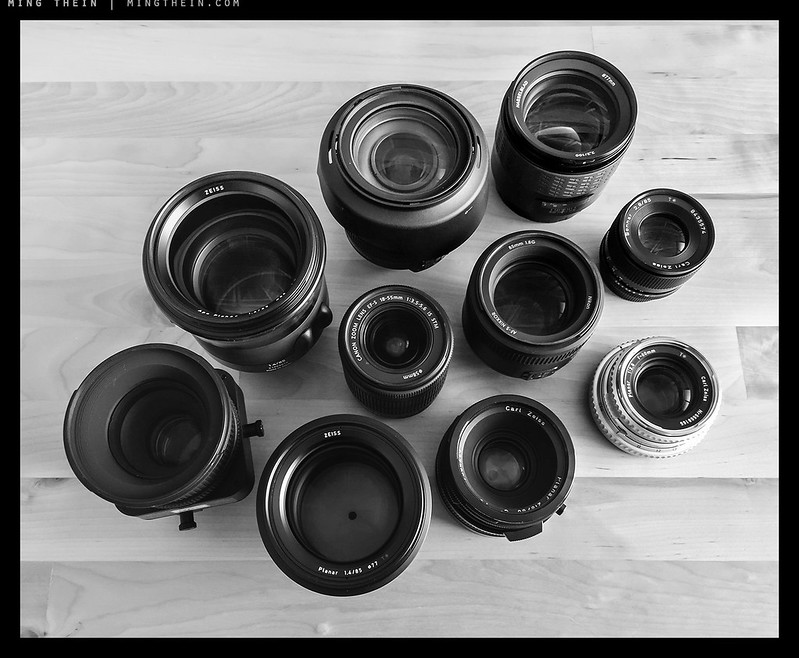
85mm lenses and equivalents on native or adapted formats – yes, I probably have too many. Upper left row: Nikon 85 PCE Macro, Zeiss 1.4/85 Otus, Nikon 24-120/4 VR, Hasselblad HC 2.2/100; middle row: Zeiss 1.4/85 Milvus, Canon EF-S 18-55 STM (APS-C), Nikon 85/1.8 G, C/Y Zeiss 2.8/85 Leitax converted to Nikon mount; lower right row: Zeiss Hasselblad CF 2.8/80, Zeiss Hasselblad C 2.8/80 T*. I wanted to add the Hasselblad HC 35-90 zoom, but it wouldn’t fit in the picture.  And there also used to be a Zeiss 1.8/85 Batis, Zeiss ZM 4/85, Nikon 80-400 G VR and Voigtlander 90/3.5 APO, but I’m recovering now…

Though this post may seem like a hoarders’ justification more than anything – I can assure you, it isn’t. Whilst you could probably pick one lens in each focal length or angle of view and hack your way into making it work, there are some pretty solid reasons why you might not want to – and this is something I’d like to discuss today. Trust me, there are reasons why I’d prefer not to have to carry two or three seemingly overlapping lenses on assignment – but often there’s simply no choice. Here’s my logic, using the 85mm-equivalent focal length as an example.

[Read more…]

Balance and composition beyond photography

_8B37775-83-3 copy
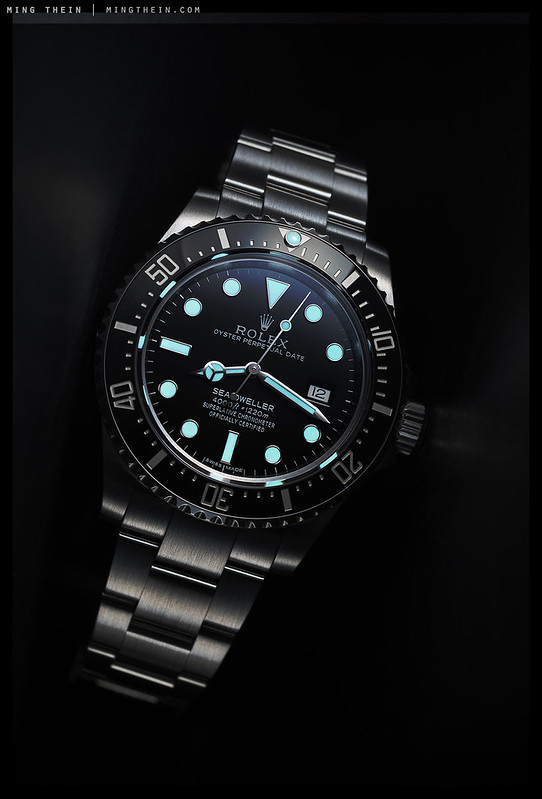
A combination of arts and senses in the appreciation: the feeling of weight; the design, composition and balance of visual elements; the subtle sound of the movement and even the sensation of temperature when you pick it up. Yet I doubt few will home in on any single one of these elements – but if you did, and only looked at the design for typography or prose, for instance, you might find quite a lot lacking…

I have a little hypothesis which I think many of you will appreciate. It’s somewhat off topic, so those of you expecting a how-to or review may want to skip today’s post. The creative person is not limited to one field: often, they have interests in other subject matter, and will try to apply themselves in a similar fashion. Musicians who enjoy photography or painting; chefs who sing; singers who cook. And often one tends to be not only good at the other, but there’s also a translation of style of sorts between the different disciplines, too. I can’t cook, or play music, but I do appreciate those two skills and can comment to some degree, in the same way that I can comment on design work which I do in addition to photography. And like my photography, people have noted my design work tends to be balanced, precise, and structured, but not necessarily simple…

[Read more…]

Photographing friends and family

_8B38609 copy

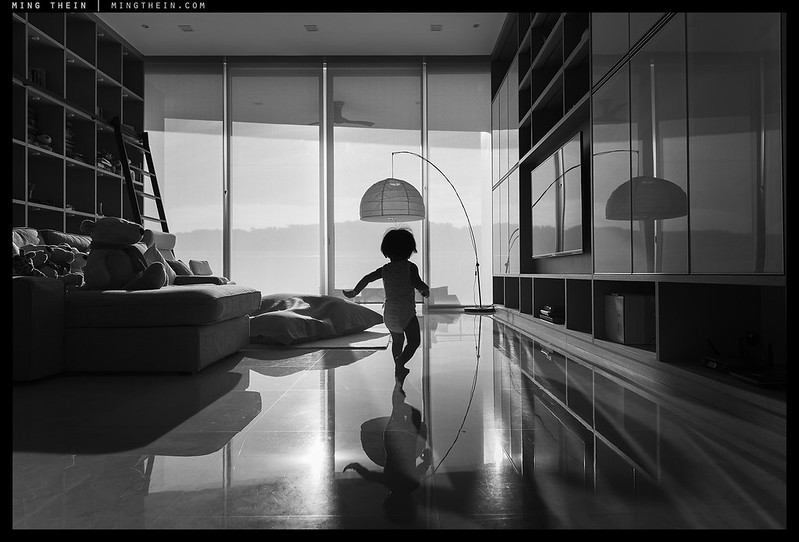
I’ve often thought that this is perhaps both the easiest and hardest subject to shoot, and shoot well. It’s also the most accessible human documentary subject for all of us, and almost always one of the chief motivations underlying our own photography. As I head into 2016, and with an increasingly active young daughter, I’m personally finding myself pointing the lens at her – as is the same for any parent, I think. Yet unlike with other forms of social or commissioned documentary photography – I find it much harder to make an image I’m happy with, even though the subject matter means more to me personally than any of my other work (to which I think most pros in the audience will agree, too). And it’s not because toddlers are fast and active little humans; I think it’s got to do with subject familiarity and some principles that also underpin quantum mechanics. Have I completely failed to make sense yet? Let me try a little harder…

[Read more…]