Photoessay: The Charles Bridge, Prague

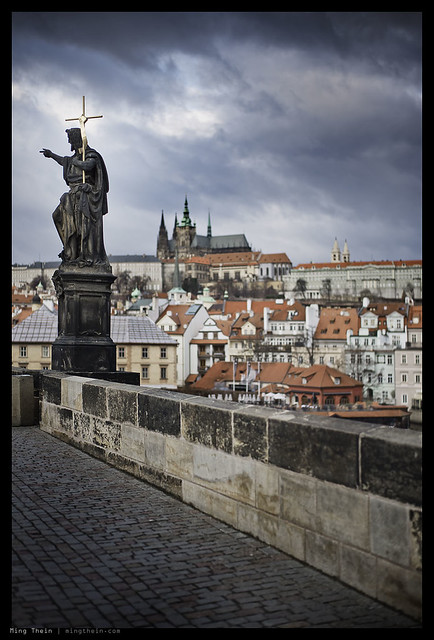
The Charles Bridge – or Karlov Most in Czech – is one of Prague’s great landmarks. Spanning the River Vltava, it was constructed in the 14th century to connect Prague Castle with the old town. Until 1841, it was the only way to get from one side of the city to the other. It is a majestic 510m long, supported by sixteen stone arches and guarded by two towers on either side. The bridge has borne witness to both countless historical events and natural disasters; being severely damaged during several of these and most recently repaired following major floods in 2002. The span itself is decorated by numerous statues, under whose auspices various tradespeople ply their wares during the day.

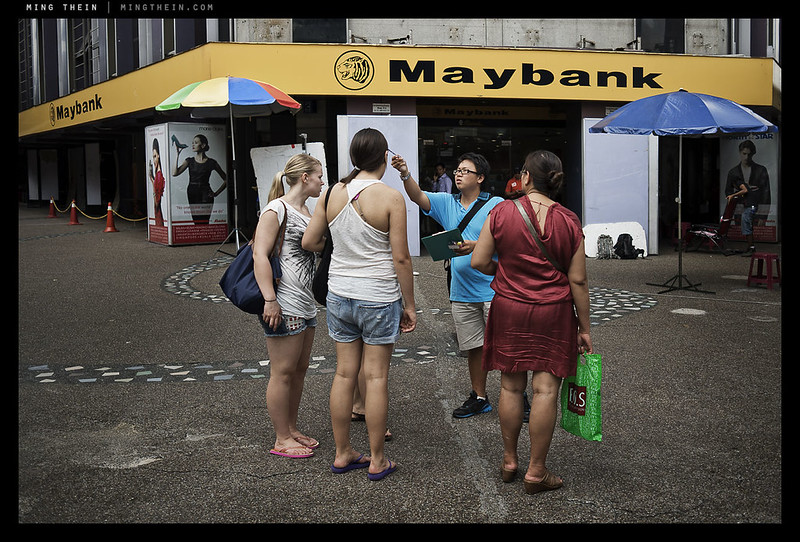
From a photographic point of view, it’s an interesting place to observe life – both locals and tourists – and a picturesque backdrop to practice street photography or photojournalism, or even a little architecture if the fancy takes you. MT

This series shot with a Leica M9-P, 28/2.8 ASPH, 50/1.4 ASPH and Olympus E-PM1 Pen Mini and 45/1.8 ZD lenses.

_M9P1_L1005751 copy

_M9P1_L1007318 copy

_M9P1_L1005986 copy

_M9P1_L1005109 copy

_PM05215 copy
Not technically of the bridge, but you can see its lookout towers in the background.
_M9P1_L1005101 copy

_M9P1_L1005072 copy

Exclusive premiere: The full Leica X2 review

_7064180 copy

This morning has seen a flurry of news: the M9 Monochrom first (with a useable ISO 10,000 apparently!), then the Hermes M9-P, the 50/2 APO-Summicron-ASPH (ouch what a price tag), and trailing, the X2 and V-Lux 40. I wasn’t lucky enough to go to Berlin, so reviews of the first items will have to wait a bit. But I did manage to get a final production X2 in advance. The full review follows. Note that you can click through all images to larger versions on my Flickr page – the link takes you to the image landing page, and then the magnifying glass icon or ‘all sizes’ will take you to the larger images.

Leica’s 2009 X1 (my review is here) was a modern throwback to the Barnack era in many ways – fixed focal length lens, very simple controls, and that ‘elongated cylinder’ look. In short, it was a handsome camera that was, and still is, capable of delivering outstandingly good images; the sensor actually outperforms the M9 at ISO 1600 and above, deliver lower noise. I owned one of these for several months and used it as my daily camera, until I was lured by the siren song of the (flawed) X100.

_7064197 copy
X marks the spot.

_7064146 copy
The new flash mechanism

However, it was crippled in a number of ways – the moderate f2.8 lens speed being one, but focusing speed being by far the main one. A firmware update improved things somewhat, and brought a much improved manual focus mode (driven off the rear thumb wheel) which showed both distance and an in-focus scale that varied with the aperture selected.

_X21_L1020079 copy
Work in progress from above. Leica X2

The Leica X2 was officially launched in Berlin yesterday, along with a number of other products (which I hope to get my hands on soon); I’ve had a final production model for several days now, courtesy of Leica. It’s been enough time to shoot several hundred frames with the camera, get to know its quirks, and probe the elasticity of its files with every tool known to ACR and a Wacom tablet.**

_X21_L1020070bw copy
Lagerfeld-style cool. Leica X2

**A note and advance disclaimer on processing: I ran the X2’s DNG files through ACR 6.7 and CS5.5, using my normal workflow. I process every file as though it was a final client delivery or exhibition piece, and that means two things: firstly, I’ll use every trick in the book I know to maximize image quality, but I do that with every camera I shoot, so that’s consistent; secondly, I shoot with the end in mind, especially once I get used to the tonal response of the sensor. For this reason, please don’t ask for out of camera JPEGS or RAW files, that’s not the way I work because it isn’t representative of the end use of the equipment. Some tests – the noise comparisons, for instance – are direct conversions via ACR with no additional work done on them. Where this is the case, it’s stated. One final thing: after the D800E vs S2 review, I think it’s necessary to also add the caveat that my observations are based on looking at full size 16 bit uncompressed files on a calibrated monitor, which will necessarily give rise to different conclusions than if you just see the compressed web size JPEGs in the article.

_X21_L1020061 copy
Taxi drivers (and dynamic range torture test). Leica X2

The first thing that strikes you is that it somehow feels better than the X1 – I am aware that this is a dangerously subjective comment to make – but the choice of materials seems a bit more solid; in fact, it seems like the camera has a bit more ‘stuff’ inside it. According to Leica, it’s about 30g heavier, which doesn’t sound like a lot, but you can feel it. It also seems like the body shells are a bit thicker, which contributes to the impression of solidity; the Leica X2 feels much closer to a mini-M than the X1 did. Perhaps it’s the black chrome and leather covers mine had. (I’m told it’ll also be available in silver).

_X21_L1020058 copy
Fitting the frame. Leica X2

Now would be a good time to talk about improvements. This list is by no means exhaustive, but it’s what you’d notice and appreciate as a serious photographer:
– AF speed is a LOT faster
– The top plate dials are much stiffer, and now don’t rotate accidentally
– Greatly improved LCD; supposedly still the same number of dots, but side by side with the old X1, it seems a lot clearer and more fluid.
– EVF shoe, and matching tiltable EVF which has great resolution.
– Battery life is significantly better
– Burst mode is faster.

_X21_L1020057bw copy
Lazy observation. Leica X2

Let’s work down that list.

AF on the X1 was so slow that I’d use it only for static subjects, and zone focus the rest of the time. Not so here – it’s fine for casual snapshots, but like every contrast detect system, AF-C is best avoided. Even the best of the mirrorless cameras falls flat on its face (I’m looking at you, OM-D) – perhaps with the exception of the Nikon 1 system, but that’s cheating because it has phase detect photosites on its sensor. Subjectively, I’d say it’s definitely faster than my X100 was; about the same as my NEX-5 (sorry, haven’t used as 5N to compare) and similar to most of the Panasonic M4/3 cameras. Not as fast as the Olympus M4/3s, though. But just fast enough to stop you from feeling like you’re waiting for the camera.

_X21_L1020046 copy
Clouds and angles. Leica X2

The best news, however, is that it doesn’t slow down much in low light; so long as there’s a decent amount of contrast, focus acquisition speed remains about the same. And unlike the X-Pro1 and X10, it doesn’t freeze the image when focusing – the view remains live, so you can see what’s going on in your frame. Interestingly, the ‘H’ (high speed settings that did freeze the image) options for AF and macro focus settings are gone; the camera is faster than the H options now, and it will automatically switch to it if required. Sadly 30cm remains the near limit, however.

_X21_L1020032bw copy
Images convert well to B&W, too. Leica X2

The X1’s LCD was pretty coarse; the X2’s is a significant improvement, but I don’t think it’s as good as say the Ricoh GRD IV – which has an amazing 1 million+ dot screen. Nevertheless, it’s now much easier to judge focus. Refresh rate seems to be a lot faster too; I’d say 60Hz instead of 30Hz. You can still use the optical finder if you want, but you’re still going to miss knowing exactly what the camera is focusing on; for the price and bulk, I’d much rather have the EVF, which is excellent. The fonts look grainy, but that’s only because it seems the UI designer didn’t specify enough DPI when encoding; the image itself is very, very fine indeed – you can’t really see individual pixels. It gains up well in low light, and isn’t too grainy.

_7064155 copy

I did an experiment with the EVF out of curiosity – the plug looked like any one of the existing EVF plugs. Expecting it to fit my D-Lux 5 Titanium, I was surprised when it didn’t; but it did fit my Olympus OM-D and Pen Mini. Even more interestingly, it worked! Draw whatever conclusion you wish; it’s a very nice EVF all the same, and my preferred way of working with the camera. Oh, and it tilts, too, and locks securely in the down position (something not all tiltable EVFs seem to manage.)

_X21_L1020107 copy
Through the keyhole. Leica X2

During the last few days, I shot over 500 frames with the Leica X2. With the X1, this would have meant two battery changes; I actually had three spares for mine, which would leave me with one left over after a heavy day of shooting. (I’m the kind of person who can finish off an entire EN-EL4a on a day’s assignment and add a five figure mileage to a camera in short order). The X2 showed half – that’s a pretty darn impressive performance, considering either the LCD or EVF were on the whole time, and I was using it frequently enough that it didn’t have time to slip into power save mode. It could be the effect of a more efficient sensor (the previous sensor was a relative of the one in the D90, which was notoriously power hungry in live view) or processing internals. This is on par with my current mirrorless long-life battery champ, the Pen Mini – which will easily hit a thousand frames per charge if used carefully.

_X21_L1020099 copy
Artificial everything. Leica X2

Finally, if you’re a flash shooter, good news! The leaf shutter remains, which means 1/2000s sync speeds (unheard of for most cameras) and the popup mechanism has been redesigned. It looks a lot more complicated, but I suspect that this is actually going to be more robust than the old press-to-raise-and-lower design – I’ve heard a lot of complaints about it being easy to break.

_X21_L1020093bw copy
Untitled. Leica X2

You’ll notice I haven’t said anything about the sensor up til this point; that’s because you’re not going to notice it immediately upon shooting (duh). But what you will notice is an ISO 12,500 (no idea why it isn’t 12,800, i.e. double 6400) setting. It’s APS-C, so I didn’t expect it to be useable. What’s nice to report is that the new 16.5 MP CMOS used is class leading in every way. It even manages 5fps continuous shooting for eight frames, but the penalty is that you have to wait while the camera writes the files – it doesn’t seem to buffer in parallel. This is true whether you shoot one or eight frames. As for the sensor, I suspect we may actually have seen a relative of it before in other products, most notably one with three zeroes or an N in its name. This is a good thing.

_X21_L1020128 copy
Obligatory night test shot. ISO 3200. Leica X2

Let’s get noise out of the way: it’s all luminance. Shooting DNG, with zero noise reduction, I’d happily use ISO 3200 with a bit of work; there’s a big jump in noise to ISO 6400, which renders that and the top 12500 setting strictly for those shots of the Loch Ness Monster assassinating JFK. Or perhaps they might work well for you if you like extremely grainy B&W conversions. Even with NR zeroed out in ACR, I’m seeing some smearing at 3200 and up, but it’s less obvious at the two highest settings because of the overriding luminance noise. You might be able to retain more acuity by shooting 1600 and underexposing a stop, then bringing it up again in the raw converter afterwards. It isn’t too bad, but you’ll notice it’s there. All in all, the Leica X2 is up there with the best of the APS-C cameras, and frankly feels like it would give my D700 a run for its money on luminance noise, but loses out on dynamic range. Pixel level acuity remains excellent, though some files seem to require an extra sharpening pass – it may be the effects of diffraction starting to creep in at f8 and up.

X2-noisecrops1 copy
Some noise crops follow below. Click on the links for 100% versions.
Crop one
Crop two
Crop three

The X2 seems to have its own color signature that is different enough from the X1 that my initial experiment to use the same ACR profiles was unsuccessful. It’s tonal map also doesn’t match the Ms; dynamic range seems to be somewhat bunched in the shadows (which I don’t see on the more linear-response CCD sensors in the M and S cameras) and the relatively low noise floor responds well to shadow recovery. If anything, the color is much closer to being ‘accurate’ than any Leica to date – the skin tones are great, at least in RAW. White balance is similarly excellent – I made very, very few corrections to color; this is highly unusual for my workflow. Have to watch the red channel closely though, it doesn’t take much to hit saturation. Note that neither display gives an accurate idea of exposure or color, though. Using the histograms is highly recommended.

_X21_L1020149 copy
Pudu Plaza. Any photographer in KL will recognize this place. They’ll also recognize that the reds are both accurate and not accurate; they’re a little hot but the tone is mostly right. Leica X2

Although I’d never personally shoot JPEG with any camera, given the option – especially something whose files have as lot of processing latitude, like the Leica X2 – I know a lot of potential buyers might well do so, so I also had a close look at the native JPEG image quality. I’m pleased to report that it produces crisp, detailed files with very few artifacts; there are some customization parameters if you have a particular preference for how your files look. However, by default, the output is best described as neutral. Skin tones are still definitely better in DNG; there’s something about skin color that just seems out of gamut for most in-camera JPEG conversions.

_X21_L1020090 copy
Yellow men. This color is accurate, and identical to the scene. Leica X2

A comment on file formats, and a gripe I had with the original X1 – I don’t know why the camera can’t write DNG only – you have to do DNG+JPEG, which seems like a waste of space and buffer. Still, for single frame shooting (I can’t actually think why you’d use bursts on this camera) there isn’t any noticeable penalty in operation.

_X21_L1020051 copy
The fountain. Leica X2

There are a few other minor things that could be improved – as always. We can never have AF that’s too fast, or too continuous; in all fairness, this is a comment leveled at every camera, and the latter to mirrorless cameras in particular. The rear control dial is now far too loose and difficult to turn in single increments – especially when trying to apply exposure compensation. What would be nice is that when shooting, exposure compensation is the default setting like on the M9; but we’d definitely need a stiffer dial for that. The odd electronic stabilization ‘feature’ remains; I’d avoid it because it just gives me double images. A proper optical stabilizer would be nice, but at least we have the option not to use it.

_X21_L1020050 copy
Yawn; just another camera? Certainly a very stealthy one; nobody once gave me a second look when I was shooting them. Especially if using the finder flipped up at 90 degrees. Leica X2.

I have a little beef with the top plate dials. On every other Leica, all exposure adjustments move in half stop increments/ detents. On the X1 and X2, you get whole stops for shutter speeds, and third stops for aperture – what’s up here? Size of the shutter dial can’t be a reason, because the M9 has more speeds and is the same size – and still gives half stop detents. I like the increased dial tension, but can we please have consistency in exposure increments?

_X21_L1020030 copy
‘Hi, I’m doing a survey. Let me probe your brain for a moment.’ Leica X2

Finally, there’s the lens. It gives me mixed feelings. On one hand, it’s an excellent optic; the biting sharpness, excellent corner performance (it was after all, supposedly designed for full frame originally) microcontrast structure and general transparency which was one of the image quality hallmarks of the X1 is still there. On the other hand, it’s relatively slow at f2.8 – not a problem given the newfound low-light capabilities of the sensor; however, it doesn’t really allow isolation, and that’s one of the things people seem to expect from a Leica. Another stop – or even two – might make for some beautiful bokeh (I know I’ve seen it from the 24/1.4 Summilux-ASPH M, but then again that’s also a physically enormous and hugely expensive lens).

_X21_L1020012 copy
Reflections. Some of you might recognize this building. Leica X2

Whilst the lens delivered almost perfect results from wide open on the X1, the X2’s slightly higher density sensor seems to be pushing the resolving power a little – images shot at f2.8 are definitely a little softer than f4; it’s almost as though there’s a slight AA-filter effect at f2.8. This is easily solvable with a second sharpening pass, and doesn’t seem to materially affect the microcontrast structure of the image. Thereafter everything is good until you run into diffraction, a hint of which is visible at f8 and obvious by f11.

_X21_L1020040bw copy
Yes? Yes? Not today. Leica X2

Technical improvements are all well and good for the spec sheet and marketing people, but where does this leave us in terms of real-world usability? The X concept was almost certainly conceived by a photographer; it’s a combination of M and point and shoot that should in theory allow anybody to create images with that ‘Leica look’ (which I think most lay people mistake for bokeh, but is actually a combination of that, color transmission, sharpness, focus transition and microcontrast – but let’s not get started here) with minimal fuss. It failed fundamentally because it was too slow to be useable. However, it did have one overriding redeeming quality – the image quality was truly outstanding.

_X21_L1020037 copy
Untitled. Leica X2

The X2 takes the image quality even further, but more importantly now feels like a mature product. It’s a better distillation of the M gestalt, and definitely easier to use for the simple reason that it’s more responsive to shoot with. During the course of testing, I never felt like I lost a shot because the camera was too slow; I definitely did with the X1 and X100. There’s no single feature or area that makes you go WOW, but the combination of improvements makes it a very compelling little camera that just does its thing and delivers the most important thing – image quality – in spades. Here’s an interesting thought: if you shoot in low light a lot, you’ll probably want to get one of these instead of an M9 – the sensor is that good.

_X21_L1020014bw copy
The escape route. Leica X2

What does the future hold for the X system? Purely speculating, I think it’s unlikely we’ll ever see interchangeable lenses – it doesn’t make sense to develop new lenses given there’s already M mount, and M mount has a digital solution; the cost of developing an all-new mount and AF lens lineup is going to be pretty staggering, which would price the camera in M territory. Rather, that would make sense as a future evolution of the M line – something compatible with new autofocus lenses, as well as the older manual focus lenses. I can’t see how a rangefinder fits into this, though – the end product would probably be very Fuji X-Pro like, which overly complicates things and is far from the Leica design philosophy. But at the very least, I think the X2 needs a telephoto or long normal companion – this would be a killer studio camera due to the leaf shutter and high speed sync. And a pair of those would cover most travel photographers’ needs, without sacrificing image quality.

Time will tell. In the meantime, deciding which mirrorless camera to augment your primary system just got a lot tougher for us photographers. MT

_X21_L1020018 copy
Review complete; happy hour. Leica X2

Addendum, 10.30am 11 May 2012: My sleep-depreived brain has just remembered there’s one thing I forgot to mention: movie mode, or the lack of it. Whilst this sensor must clearly be video capable to produce the live feed, Leica has chosen not to implement a movie mode of any sort; I personally don’t see this as as huge issue as I don’t do video anyway. In any case, the inability to easily follow focus is probably a bigger impediment for moviemaking than the fixed focal length. I’d see video capability here as a nice to have, but not critical. Besides, the V-Lux 3 and D-Lux 5 are much easier to use for video, if you must have a Leica. I’ll be sticking to my D800E for the few times I do need video. MT

The Leica X2 is available in both black and silver here from B&H and Amazon.

____________

Visit our Teaching Store to up your photographic game – including Photoshop Workflow DVDs and customized Email School of Photography; or go mobile with the Photography Compendium for iPad. You can also get your gear from B&H and Amazon. Prices are the same as normal, however a small portion of your purchase value is referred back to me. Thanks!

Don’t forget to like us on Facebook and join the reader Flickr group!

appstorebadge

Images and content copyright Ming Thein | mingthein.com 2012 onwards. All rights reserved

Photoessay: Seascapes

Inspired by Hiroshi Sugimoto. The South China Sea, off the east coast of Malaysia at Tanjung Jara.

This series shot with an Olympus E-PM1 Pen Mini and the 14-42 kit lens.

_PM08047bw copy

_PM08345 copy

_PM08014 copy

_PM08365bw copy

_PM08344 copy

_PM08348 copy

_PM08196bw copy

_PM08331 copy

The relationship between talent, creativity and experience

Let’s start with some semantics:

Talent: is your innate ability to do something – it’s inborn, and for the purposes of this essay, you can’t change it. It’s fixed. Think of it as your starting point; you also can’t lose it.

Creativity: in the photographic context centers around your ability to construct a unique composition from a given scene. It’s a continuum; the more different your composition to anything that’s come before, the more creative you are. This applies for both the elements you can control (e.g. studio lighting, flashes, focal length/ perspective etc) and the ones you can’t – the subject, for instance. The amount of creativity a person has is generally fixed; however, unlike talent, you can train yourself to be more creative.

Experience: is the knowledge you gain from having done something (or something related and relevant) before – for instance, if you’ve used a fire before, you know it’s hot and you won’t put your hand into it because it hurts. In a photographic context, it could be something as simple as knowing that telephoto lenses work better for wildlife photography than wide angles, or it could be as subtle as choosing a thick carbon-fiber monopod over a thinner steel one for its rigidity and vibration damping properties to enable as low a shutter speed as possible. This is the biggest area of opportunity for all photographers.

It’s easier to understand where I’m going next if you have a baseline: I’ll use myself as a guinea pig, and score out of 10; 10 being the best and 0 being poke-your-eyes-out-with-a-stick bad.

Ming, in 2003 (Brand-new, wet-behind-the-ears hobby photographer. Doesn’t know the first thing about shutter speeds, finds aperture numbering confusing, and can’t figure out the whole perspective thing.) Here’s an early shot:

_DSC0633 copy
Random abstract.

At the time, I thought this was actually one of my better ones. Shocking, huh? I think nobody would question an assessment of Talent = 0. Creativity – hmm, harder to judge; it obviously isn’t really a standard shot, but at the same time…execution is lacking. I’ll be generous and say this merits a 5 on the creativity scale. It does tell us something about the experience rating, though: had I known better, I wouldn’t have overexposed, and I’d have used a tripod. I’d probably also have selected a more suitable exposure combination commensurate to the effect I was trying to achieve. Let’s give experience another zero.

Fast forward a bit to today.

Ming, in 2012 (Getty Images member, Nikon Professional Services UK member, Leica Camera-sponsored, veteran of countless pro shoots, etc…I’ll stop blowing my own horn now 😉

_7053570bw copy
Jaeger Le-Coultre Gyrotourbillon 2 escapement

I don’t think anybody would argue that this is an easy shot to produce. It requires advance knowledge and mastery of a) lighting; b) composition and visual balance; c) being able to see the unique in something not immediately visible or obvious (the frame covers approximately 12x8mm); d) post processing; e) familiarity with the subject itself; f) the ability to get one’s equipment to deliver exactly what is required.

So what’s changed in the last nine years? My talent remains the same: it can’t change, and it’s approximately still zero. My creativity has definitely improved; I’m both trying different things and executing them so that they manage to communicate my initial vision – that shot was supposed to give the impression of an x-ray view into the heart of a complex machine, which this particular watch absolutely is.

But the biggest improvement is experience: in the last nine years, I’ve shot more than half a million frames – some in the course of getting the shot for a particular assignment or location; some out of pure experimentation; and some just in the course of capturing and recording life as I see it. But each one of those frames has given me the benefit of being able to refine my skills incrementally more. Although the laws of diminishing returns definitely kicked in a long time ago, I’m told there’s still some progress going on. The way I shoot now is not the same as the way I shot even a year or two ago.

Shooting lots is one thing – but remembering what you’ve learned is even more important, otherwise you’ll hit diminishing returns pretty early on in the process. There are many times where I’ll do experiments concentrating on one particular aim only – for instance, refining my x-ray processing technique – and ignoring the other elements. Or perhaps it might be to master the use of lighting very small reflective objects at close distances. I probably won’t keep any of these experiments because compositionally they don’t work (and that wasn’t the point) – but it’s the experience and knowledge that’s important. And then when I *do* need to put it all together – the above shot, for instance – then I have confidence that my techniques and experience will let me pull it off.

There is no substitute for experience. There’s plenty of evidence to support that it takes 10,000 hours of dedicated practice to master something – give or take a little depending on whether you do it continuously (benefit of not forgetting between sessions and having to backtrack or repeat) and your intellect. This means one task, continuously, for three years or more. And that’s why there were a) so few master photographers in the film days (practice cost a lot of time and money, and there was a delay between taking the shot and getting feedback, during which it was easy to forget what you tried) – and b) lots of ‘new talent’ emerging today.

Which brings us to the conclusion of this article: I’m often asked what is the one best tip I can give to an aspiring photographer: practice, practice, practice. I still do it, and I’m still learning. MT

____________

Visit our Teaching Store to up your photographic game – including Photoshop Workflow DVDs and customized Email School of Photography; or go mobile with the Photography Compendium for iPad. You can also get your gear from B&H and Amazon. Prices are the same as normal, however a small portion of your purchase value is referred back to me. Thanks!

Don’t forget to like us on Facebook and join the reader Flickr group!

appstorebadge

Images and content copyright Ming Thein | mingthein.com 2012 onwards. All rights reserved

Photoessay: Reflections in glass

This building is one of the more interesting in downtown Kuala Lumpur – mainly because of its highly reflective mirrored glass surface that causes its character to change with the light; it blends into its surrounding environment by reflecting it, yet stands out because it doesn’t look anything like the surrounding windowless concrete shopping plazas. Coincidentally, it also contains the offices of Leica Malaysia. MT

Series shot with a Leica M9-P and Olympus Pen Mini E-PM1.

_M9P1_L1002348 copy

_PM00545 copy

_M9P1_L1002345 copy

_PM00536 copy

_PM00517 copy

_PM00522 copy

_PM00530 copy

_PM00549 copy

An open invitation to my exhibition of watch photos sponsored by Jaeger Le-Coultre and Leica

If you’ve got some free time and are in Kuala Lumpur, please drop by to have a look. The exhibition is on the Adorn Floor of Starhill Gallery, Bukit Bintang – where all of the watch boutiques are located. It’s scheduled to run for the month of may but there may be some changes to venue after the first week. I’ll update accordingly here.

More details on how the images were shot here and here.

I’ll also be hosting a small gathering for readers who’d like to come and have a guided tour of the exhibition; we can go grab coffee afterwards and shoot the breeze about anything photographic. This will take place at 10.30am on Saturday 5th May; we’ll meet across the road by the fountain at Pavilion. Would be great if you could leave a comment if you want to come, so I know who to expect. If you can’t make it, drop me an email and I’ll try to meet you there another time. Thanks! MT

Photoessay: Greenwich Park

One of London’s great open green spaces, home to the Maritime Museum (formerly Naval Headquarters), the Royal Observatory, and of course the Prime Meridian – or GMT-0 line. You could theoretically be in two timezones at once here, but curiously the whole of England is still on GMT. More interestingly for the horologically inclined, the observatory houses Harrison’s pioneering marine chronometers – the H-series clocks that made accurate navigation possible at sea through the calculation of longitude. And they still work. The park itself is just a nice place to spend a winter afternoon. MT

Series shot with a Ricoh GR-Digital III

_0010744bw copy

_0010736bw copy

_0010757bw copy

_0010745bw copy

_0010763bw copy

Photoessay: Boudhanath Stupa

Bodhanarth, Boudha, Boudhanath, Bodhnath…or any one of a dozen different spellings is a large stupa on the outskirts of Kathmandu, Nepal. One of the holiest sites in Buddhism, supposedly built over the grave of the remains of the enlightened person Kasyapa, who predated Buddha. It is a UNESCO world heritage site, and one is supposed to negotiate the stupa in an anti clockwise direction only to avoid bad luck. The stupa itself is surrounded by a mix of tourist traps and other temples, and kept fastidiously maintained by monks. MT

Series shot with a Nikon D700, 24/1.4 and 85/1.4 G.

_7036410 copy

_7036669 copy

_7036441 copy

_7036407 copy

_7036427 copy

_7036437 copy

_7036526 copy

_7036603 copy

_7036739 copy

Photoessay: The urban scenery of Auckland, New Zealand

Some urban scenery captured during downtime on another work assignment at the end of 2010 – often, this is all the time I get to shoot personal work. It’s a rather pleasant city by the bay that’s really quite nice when the sun is out – when the sun isn’t out and it’s cold and windy, it’s downright miserable. Especially when you find out everything closes by 5.30pm and there’s precious little in the way of dinner options. It’s also a popular cruise ship destination/ stopover en route to the outer Pacific islands or Hawaii. MT

Series shot with a mishmash of equipment – Apple iPhone 4, Nikon D700, AFS 28-300/3.5-5.6 VR and Sony NEX-5 and 18-55 kit lens.

_N5_DSC1804bw copy
Bonus points to anybody who can tell me which shot this is in homage to.

IMG_0838b copy

_N5_DSC1920 copy

_N5_DSC1812 copy

_N5_DSC1933 copy

_N5_DSC1795 copy

_N5_DSC1864 copy
You could be in California.

_N5_DSC1861 copy
The America’s cup legacy is everywhere.

_N5_DSC1811 copy

_7018761 copy
The taxi driver I had on the return trip to the airport told me he just bought a new SUV to tow his 50ft yacht. I ran out of words, thinking solely that I was both in the wrong job, and living in the wrong country.

_N5_DSC1826 copy

_N5_DSC1821 copy

IMG_0682b copy

Zone focusing and shooting hyperfocal

Hyperfocal shooting is a subset of zone focusing. Both are very, very useful tools in the arsenal of a photojournalist or street photographer; especially so if you’re using a manual focus lens, or one with a meaningful depth of field scale engraved on it. It means that if you know what distance your subject has to be at to fill your frame correctly, you can set that and just shoot straight away when you bring the camera to your eye – a very fast way of working. It’s what I usually do when I have enough light and a wide lens on my Leica.

Let’s start with zone focusing. It’s simple if your lens has a depth of field scale:
1. Pick an aperture
2. Find the depth of field scale markings corresponding to that aperture.
They’re on the bit of the lens that doesn’t rotate.
3. There are two of them. Everything between those two marks will be inn acceptable focus. Why the hesitation around ‘acceptable’? Because sharp-at-the-100%-pixel-level defines acceptable focus, and that will vary from camera to camera – the higher your pixel density, the narrower the acceptable focus margin will be. You’ll have to experiment for your camera and find out how much (if anything) to compensate by – for some cameras, you might find you have to as much as halve the width of the gap between the two markings.

_D90_DSC7238bw copy
Leica 21/1.4 Summilux-M ASPH.

Example: in the image below, the lens is focused just after 1.5m. This means the sharpest point will be at 1.5m, but if we set f2.8, objects from 1.2m to a bit over 2m will be in focus. Selecting f5.6 expands this further to 1m to 5m.

A good rule of thumb is 1/3-2/3: one third of your DOF will be in front of the focus distance, and 2/3rds behind.

Simple, right? There are a few more things to know.
1. It works best for wide-angle lenses, because they have more DOF for a given aperture. (You could zone focus with a telephoto, but you’d need a silly small aperture and probably run out of light).
2. It works best during daytime, because you’ll have enough light to stop down a bit (and thus increase your margin for error).
3. It works best if you have some practice estimating distances, because you can adjust on the fly without having to bring the camera to your eye.
4. It works best with smaller sensor cameras, because again there’s more DOF for a given angle of view (focal length equivalent) and aperture – for instance, the Ricoh GR-Digital III has a ‘snap’ mode that sets focus to certain distance; at f2.8 and 1.5m, almost everything will be in focus from 0.75cm onwards or so.
5. You can’t do it easily with modern AF lenses – those which do have DOF scales usually only give f11 and f22, which are heavily restricted by the amount of light you’ve got to work with; then the distance scale itself is short and probably not very precise, with few distances marked; lastly, there isn’t enough precision in the focusing ring. You could do it by using the AF system to focus on a distance, switch to MF, and set your aperture – but you’d have to memorize your DOF tables, which is never easy or fun.
6. Some compacts are better than others for this than others; the best kind have manual focus with a DOF indicator bar and scale – the Leica X1 and Ricoh GR-Digital series come to mind.

Let’s move on to hyper focal. The hyper focal distance is the setting beyond which everything is in focus to infinity at a given aperture. Even super-shallow DOF lenses like the Noctilux 0.95 have a hyper focal distance – but it’s probably 50m or something at f0.95. Once again, the wider the lens, the nearer the hyper focal distance will be for a given aperture. With lenses in the 28mm range, you can work at a reasonable aperture of f8 or so and have hyper focal distance at about 3m on a full frame sensor, which is great for capturing spontaneous moments in photojournalism or street photography.

There are several very useful calculators online, such as DOF Master – playing around with this will give you a good idea of which of your camera/ lens combinations is best suited to zone focusing. I personally do it with my Leica M9-P, and sometimes with the Ricoh GR-Digital; but never with the DSLRs because AF is very nearly as fast, especially on the D700. Also, beware lenses like the Olympus ZD 12/2 for micro four thirds – it might look like it has distance and DOF scales, but the focusing ring is electronically coupled, and lacks the resolution to make it truly useful. MT