Photoessay: A study of wave action

Some experiments into how the same subject can be simultaneously not the same. A bit of contemplative photography while on vacation. Or perhaps I just like water and waves for the same reasons I like clouds. Sometimes, we don’t need to think too much about it – just shoot. I need to go on holiday more often; but then again, don’t we all? MT

This series shot with an Olympus E-PM1 Pen Mini at Tanjung Jara, on the east coast of peninsular Malaysia.

_PM08131 copy

_PM08126 copy

_PM08124 copy

_PM08116bw copy

_PM08094 copy

_PM08088 copy

_PM08128bw copy

Lens review: The Olympus ZD 45/1.8

_PM05660 copy
Prague sunset by the river. Olympus E-PM1 Pen Mini, ZD 45/1.8

_8012322 copy

Last year’s lens surprise of the year was the Olympus M.Zuiko Digital ZD 45mm f1.8 MSC – it’s a lens that was announced with the E-P3, E-PL3 and E-PM1, seems fairly ordinary and innocuous on spec, but yet delivers in boatloads. It’s both cheap and expensive at the same time; let me explain why. Most conventional SLR mount 50/1.8 lenses go for $100-150 or thereabouts. This lens is closer to $300, and it’s all silver-painted plastic except for the mount – to be honest, it feels kinda cheap. That’s expensive. But, it doesn’t use a conventional double-Gauss optical design:


Image from Olympus. Purple bits are E-HR lenses, whatever that means. I suspect it’s ED glass or something similar. I certainly don’t see any purple elements inside my lens 😛

Whoa, what’s this? 9 elements in 8 groups? Not so simple. I suspect the reason Olympus chose this optical design was primarily due to the very short back flange distance of Micro Four Thirds; double Gauss designs work well if the back focus distance is close to the focal length, which it is for most SLRs. Changing the optical design to keep the lens compact introduces all sorts of other issues on its own, including corrections for the various complex optical aberrations that occur once a lens design becomes asymmetric.

_PM05089 copy
Waiting for that text. Olympus E-PM1 Pen Mini, ZD 45/1.8

Secondly, it has a very fast coreless focusing motor – Olympus brands these lenses as ‘MSC’, which means you won’t hear the focusing motor working while recording videos – a nice touch. It’s also blazingly fast, at least with the current generation of Olympus M4/3 bodies. Sadly, like all of the other M4/3 lenses (except the 12/2), there’s no full time focus override; it’s fly-by-wire only and you have to put the camera into MF mode on the body before the ring does anything. Still, it’s nicely damped if a little dead-feeling.

_PM05240 copy
Night in the Malastranska, Prague. Olympus E-PM1 Pen Mini, ZD 45/1.8

But never mind all that, how does it perform? In a word, brilliantly. It’s one of my favorite lenses for Micro Four Thirds. If I had to describe it in a word, it would be ‘transparent’. That’s probably a good thing for an optical device; however, what I mean is that the lens itself doesn’t impose any of its own optical quirks or peccadilloes on the image; it does its job moving light from the subject to the sensor, and then gets out of the way. It delivers sharpness across the entire frame wide open at f1.8; there is some slight improvement at 2.8, but it isn’t really necessary to stop down – perhaps this may be different on the higher density 16MP sensor of the OM-D, however.

_PM02054bw copy
All about the hair. Olympus E-PM1 Pen Mini, ZD 45/1.8

Fringing is almost entirely absent, as is longitudinal chromatic aberration; a sign that the optical designers have done their job very well indeed, and the lens is working well with the sensor. (In case you’re wondering about in-camera CA removal, I’m not shooting JPEG and the RAW files are run through ACR like the rest of my workflow – there’s no special treatment unless Olympus is doing something with the RAW files.)

_PM00679 copy
Echoes of red. Olympus E-PM1 Pen Mini, ZD 45/1.8

The lens is contrasty, but not that contrasty; it strikes a nice balance between sufficient global contrast and maintaining the microcontrast that is so important to preserving fine detail structures. In fact, I prefer lenses with lower macro contrast for digital use as they help to maximize preservation of dynamic range; this is especially important with smaller sensors that have lower dynamic range, like those used in M4/3 cameras.

_PM00576 copy
Ninja demolition. Olympus E-PM1 Pen Mini, ZD 45/1.8

Color reproduction is on the warmish side of neutral. No yellow casts like I see with Sigma and Tamron lenses, but a pleasing warm hue shift. Bokeh is also neutral to good; there are times when separation between subject and background is a little harsh – typically when the subject is fairly close to the background – but it’s also pretty darn good under ideal conditions.

_PM00530 copy
Mirrors. Olympus E-PM1 Pen Mini, ZD 45/1.8

Although it ‘only’ focuses down to 0.5m, it’s worth remembering that on Micro Four Thirds, 45mm is really a 90mm FOV, and there no non-macro lenses for full frame cameras that focus this close – it’s 0.8m if you’re lucky, or 1m if you’re using a rangefinder. The lens can be used handheld at arms’ length – i.e. live view style – and that’s how I’ve been using it so far; however, you’ll need to keep your shutter speeds up, because frankly the in-body stabilization isn’t that effective. I suppose if you were using this on the OM-D it’d be a different story as the built in EVF would let you get a bit more stability by bracing the camera against your eye.

_PM02093 copy
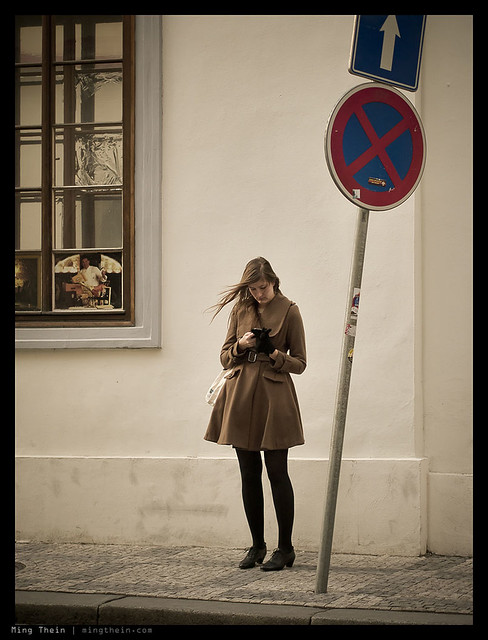
Dusk and the sign. Olympus E-PM1 Pen Mini, ZD 45/1.8

The 45/1.8 makes up part of my M4/3 ‘trinity’ – the 12/2 and 20/1.7 being the other two, though I might replace both with the new Voigtlander 17.5/0.95 (35mm equivalent, fast and versatile – though I prefer 28, and sadly there are very few fast 28mms). It forms a great lightweight travel kit which is still capable of delivering outstanding optical quality. It also works very well as a secondary camera in conjunction with something else; at the end of last year, I shot in Europe with a Leica M9-P, 28 and 50mm lenses as my primary body, with the Pen Mini and 45/1.8 in a coat pocket for those times I needed a little extra reach – made a great compliment to the rangefinder.

_PM01974 copy
Graffiti. Olympus E-PM1 Pen Mini, ZD 45/1.8

Even on the slightly higher density OM-D sensor, this lens is a gem; sharpness doesn’t seem to be compromised anywhere, but there is a very slight veiling flare that goes away about half a stop in. It has a lightness and transparency (lower macro contrast, but higher micro contrast perhaps?) that I don’t see with the 12/2 or 20/1.7, and it’s something that makes the way it renders very natural and appealing.

_5001020bw copy
A classical portrait, second version. OM-D, 45/1.8. The first version is here

Are there any negatives? Well, yes. At the price, you can’t expect fantastic build quality. Frankly, it feels about on par with the kit lens; Olympus chose to put all of the production money into optics rather than cosmetics, which is a decision I can agree with. However, the leaves the lens feeling just a tiny bit fragile; the plastics don’t feel that thick or robust, and that little blanking ring on the front (ostensibly to cover the hood mount threads) doesn’t really stay in place securely, and isn’t that well made, either.

Still, all that aside, this is a highly recommended lens for Micro Four Thirds users. It isn’t good enough that I’d go out and buy a Micro Four Thirds camera just for this lens alone, but then again the thought of having a fast portrait 90mm equivalent in a pocket is quite appealing, and the cost of a Pen Mini plus this lens is much cheaper than many full frame lens options on their own. Of course, you do get the DOF profile of a 45mm lens, not an 85 or 90mm lens, so don’t expect crazy thin DOF. There’s adequate separation, but true bokeh enthusiasts will probably have to wait for the upcoming ZD 75/1.8 – a lens which I’m pretty excited about, actually. MT

_PM01718 copy
Sunset in the city. Olympus E-PM1 Pen Mini, ZD 45/1.8

Get the Olympus ZD 45/1.8 here from B&H or Amazon.

____________

Visit our Teaching Store to up your photographic game – including Photoshop Workflow DVDs and customized Email School of Photography; or go mobile with the Photography Compendium for iPad. You can also get your gear from B&H and Amazon. Prices are the same as normal, however a small portion of your purchase value is referred back to me. Thanks!

Don’t forget to like us on Facebook and join the reader Flickr group!

appstorebadge

Images and content copyright Ming Thein | mingthein.com 2012 onwards. All rights reserved

POTD: A classical portrait

_5001019 copy
Nadiah. Olympus OM-D, 45/1.8

Sometimes, everything just comes together serendipitously. In this case, my wife (and muse, but that’s to be the subject of a future post) and I were attending a small function at a rather quirkily-decorated space in downtown Kuala Lumpur. I was going light, so I just carried the OM-D and two lenses; the 45/1.8 and 20/1.7. Just off the space, there was this small room separated by a partition; not only were there some nice details – like the Adams-family-esque hand – but the light was also beautifully directional yet soft. It just happened to be overcast outside, and with the sun at a low angle so the light went all the way into the room; see why I keep saying 99% of photography is light and timing? I grabbed my wife and shot a few frames to create what I think is one of the most satisfying portraits I’ve ever shot. MT

Photoessay: The Charles Bridge, Prague

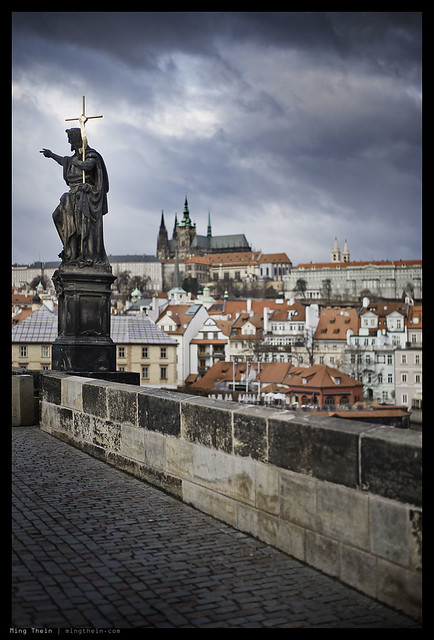
The Charles Bridge – or Karlov Most in Czech – is one of Prague’s great landmarks. Spanning the River Vltava, it was constructed in the 14th century to connect Prague Castle with the old town. Until 1841, it was the only way to get from one side of the city to the other. It is a majestic 510m long, supported by sixteen stone arches and guarded by two towers on either side. The bridge has borne witness to both countless historical events and natural disasters; being severely damaged during several of these and most recently repaired following major floods in 2002. The span itself is decorated by numerous statues, under whose auspices various tradespeople ply their wares during the day.

From a photographic point of view, it’s an interesting place to observe life – both locals and tourists – and a picturesque backdrop to practice street photography or photojournalism, or even a little architecture if the fancy takes you. MT

This series shot with a Leica M9-P, 28/2.8 ASPH, 50/1.4 ASPH and Olympus E-PM1 Pen Mini and 45/1.8 ZD lenses.

_M9P1_L1005751 copy

_M9P1_L1007318 copy

_M9P1_L1005986 copy

_M9P1_L1005109 copy

_PM05215 copy
Not technically of the bridge, but you can see its lookout towers in the background.

_M9P1_L1005101 copy

_M9P1_L1005072 copy

Photoessay: Seascapes

Inspired by Hiroshi Sugimoto. The South China Sea, off the east coast of Malaysia at Tanjung Jara.

This series shot with an Olympus E-PM1 Pen Mini and the 14-42 kit lens.

_PM08047bw copy

_PM08345 copy

_PM08014 copy

_PM08365bw copy

_PM08344 copy

_PM08348 copy

_PM08196bw copy

_PM08331 copy

POTD: Watery blessings

_5000876 copy
Water blessings. Another one from Wesak Day; look out for a full photoessay soon. Olympus OM-D, 12/2

I’m working on an exclusive which will all be revealed tomorrow at 12PM GMT+8, as soon as the embargo is lifted…stay tuned. MT

POTD: The man with the microphone, and some OM-D first impressions

_5000318 copy
The man with the microphone. Olympus OM-D, 12/2

Wesak day is one of the most important days on the Buddhist calendar, celebrating the birth, enlightenment and death of Gautama Buddha. In Malaysia it’s marked by an enormously long parade through the city, with easily tens of thousands, if not hundreds of thousands, taking part. The man on the megaphone is just one of hundreds of people chanting Buddhist scripture as the procession makes its way. Look out for a full photoessay soon.

In the meantime, this was my first outing with the new Olympus OM-D E-M5 (what a mouthful); I used the 12/2 and 45/1.8 Zuiko lenses, which continued to perform very well on the higher density sensor. Some first impressions:

– It’s fast. Very responsive in every way. 9fps is overkill, reminds me why I didn’t use that mode on the D3 too often – too many identical files to go through afterwards!
– C-AF and AF tracking are pretty much useless; it could have been the lighting conditions, but I gave up and used S-AF after a while.
– Image quality is excellent. A real step forward over the 12MP M4/3 cameras; it seems like we’ve gained both resolution AND dynamic range AND high ISO performance. I wouldn’t hesitate to use ISO 3200, whereas ISO 1600 before would be a bit borderline. I honestly feel that it delivers image quality very close to the D7000.
– Hugely customizeable, and that touch screen is quite handy for low angle shots and selecting focusing points. The control set is well thought with one exception: why can’t I assign any of the buttons to be AF-Lock when shooting C-AF?
– They’ve done another stupid design number with the strap lugs; they of course dig into your palm in true Olympus tradition. I can’t remember a single camera they’ve made without this issue.
– Battery life is outstanding. 600 shots and I was still showing full charge at the end of the night; the recharging time afterwards suggests that I used perhaps 1/3 of the capacity.
– I think I really want the grip to both balance out handling and add the vertical component. But it’s hugely expensive for what it is, and difficult to justify.
– Weather sealing was highly valued at times; the priests were blessing everybody with water sprayed from palm fronds!

I will do a full review at some point once I’ve had more of a chance to shoot with the camera, in the meantime, stay tuned. MT

POTD: Surreal portraiture

_PM08399bw copy
Floating head. Olympus E-PM1 Pen Mini and kit lens.

Sometimes, the atmospheric conditions – early morning haze resulting in a vanishing horizon – and perfectly calm seas make for interesting photography; the kind where you don’t mind risking a camera in chest-deep water. MT

Photoessay: Reflections in glass

This building is one of the more interesting in downtown Kuala Lumpur – mainly because of its highly reflective mirrored glass surface that causes its character to change with the light; it blends into its surrounding environment by reflecting it, yet stands out because it doesn’t look anything like the surrounding windowless concrete shopping plazas. Coincidentally, it also contains the offices of Leica Malaysia. MT

Series shot with a Leica M9-P and Olympus Pen Mini E-PM1.

_M9P1_L1002348 copy

_PM00545 copy

_M9P1_L1002345 copy

_PM00536 copy

_PM00517 copy

_PM00522 copy

_PM00530 copy

_PM00549 copy

POTD: Nucleation

_PM03046bw copy
Everything needs a catalyst. Olympus E-PM1 Pen Mini, Panasonic 20/1.7 G.

In case you’re wondering what it is you’re looking at, it’s boiling water at moderately high magnification, frozen by off-camera flash. High enough that my knuckles were gently steaming after about ten seconds or so. Experimentation is the source of all art…but yes, you can go too far. I’m pretty sure I got a sizable blister on one of my fingers after this. MT