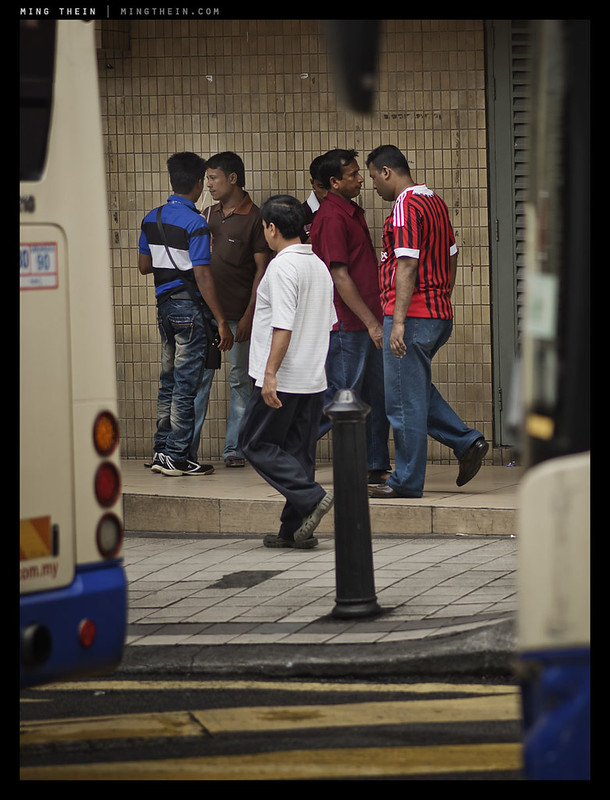
Photoessay: Hong Kong life in monochrome

The first set from my recent Hong Kong and Macau workshop. Click for larger versions or EXIF data via the flickr landing page. Enjoy! MT

Images shot with a Leica M9-P, Zeiss ZM 2.8/28 Biogon, ZM 2/50 Planar, Olympus OM-D and 45/1.8.

_M9P2_L1000243bw copy

_M9P2_L1000655bw copy

_5006315bw copy

_5006438bw copy

_5006253bw copy

_M9P2_L1000041bw copy

_M9P2_L1000348bw copy

_M9P2_L1000288bw copy

_M9P2_L1000109bw copy

_M9P2_L1000005bw copy

_5006205bw copy

_M9P2_L1000310bw copy

____________

Enter the August 2012 competition: Compact Challenge – here!

If you enjoyed this post, please consider supporting the site via Paypal (mingthein2@gmail.com); Ming Thein’s Email School of Photography – learn exactly what you want to learn, when you want to learn it or learn how to achieve a similar look with our Photoshop workflow DVDs.  You can also get your gear from Amazon.com via this referral link.  Prices are the same as normal, however a small portion of your purchase value is referred back to me. Thanks!

Don’t forget to like us on Facebook and join the Flickr group!

Photoessay: A Swiss landscape or two

On a recent assignment in Switzerland, I had the occasional break, and the even more occasional bit of interesting weather – fog or sun, it was either 5 C or 25 C with nothing in between – so I made the most of it by doing a spot of landscape work. I was surprised to discover that the Swiss countryside in summer really does look like the postcards – intensely blue skies, emerald meadows, and lots of cows. It’s positively bucolic, but in a good way.

Landscape photography is tough without a car or sufficient time to do some hiking. Part of the time was spent outside Geneva in the very scenic Vallee du Joux, home to a number of the old watchmaking manufactures. The big body of water is the Lac du Joux, which is as still as a mirror in the early mornings, but can get quite choppy once the mid-afternoon breezes start to blow. I’m told that as idyllic as it seems in summer, it hits -20 C at times in winter, and there’s nothing to see but white. I suspect I might have some problems with the small buttons on the OM-D in that weather, though.

This was the second time I’ve used Zeiss lenses on M4/3 – I actually find the ZF2s work better than the ZMs because they’re mostly telecentric designs. The 21/2.8 is particularly good, actually – it has very refined contrast that the Panasonic 20/1.7 lacks. (You’re probably wondering why I didn’t use that lens – I can put the 21 on the D800E and the 85 on the OM-D, swap them, and have a very nicely spaced set of 21, 42, 85 and 190mm 🙂 I still maintain that so far, the best color I’ve seen comes from Olympus bodies and Zeiss lenses…now if only they’d make some M4/3 AF glass. Preferably a fast 28mm equivalent…MT

This series was shot with an Olympus OM-D, Panasonic 20/1.7, Zeiss ZF.2 21/2.8 Distagon and ZF.2 85/1.4 Planar via adaptor.

_5004014 copy

_5003601 copy

_5003885 copy

_5003575 copy
One of those trees that fell in the forest which we never hear about

_5003560 copy

_5003499 copy

_5003470 copy

_5003884 copy

_5003770 copy

_5003511 copy

____________

Visit our Teaching Store to up your photographic game – including Photoshop Workflow DVDs and customized Email School of Photography; or go mobile with the Photography Compendium for iPad. You can also get your gear from B&H and Amazon. Prices are the same as normal, however a small portion of your purchase value is referred back to me. Thanks!

Don’t forget to like us on Facebook and join the reader Flickr group!

appstorebadge

Images and content copyright Ming Thein | mingthein.com 2012 onwards. All rights reserved

Review: The Olympus ZD 75/1.8 for Micro Four Thirds

_7065273 copy

One of the more eagerly awaited lenses for compact system users, the Olympus Zuiko Digital 75/1.8 ED MSC (hereafter just referred to as the 75) is one of the final confirmations that Micro Four Thirds has finally come of age. We now have all of the popular lenses we need – including a fast 24-70/2.8 equivalent, fast primes at 24, 35, 50 (multiple choices) and 90mm equivalents; the very fast portrait tele like a 150/1.8 (for example, the subject of this review) or 200/2 is now here to round out the lineup. Curious, there’s no fast 50 from Olympus, and no fast AF 35 from any of the manufacturers; that Schneider-Kruzenach 14/2 looks extremely interesting indeed.

But we’re not here to talk about that.

_7065297 copy
Compared to the 12/2.

I picked up a final production sample 75 from Olympus Malaysia a couple of weeks ago, having handled a much earlier prototype; honestly, the only thing that seems to have changed is the lens’ finish color (a light champagne color over bare metal) now matches that of the 12/2 perfectly. Unfortunately, during my free days, the weather has not been as conducive for shooting as I would have liked; I look forward to updating the review again once I’ve had a chance to use the lens for a longer period of time.

_7065290 copy

The 75 is a superbly well built lens; it’s solid, but not unexpectedly heavy, say in the same way as a brass Leica lens. However, the only plastic to be found anywhere on the lens is the cap – I’m guessing the rest of it is aluminum, including the optional hood. It sits at the top of Olympus’ lens pyramid for M4/3, together with the 12/2 – and presumably other lenses too, at some point. Curiously, for a lens of this build quality and price (RRP around RM3,200 give or take; availability at retail end-July or early August) there is no weather sealing – unlike the much cheaper (and honestly, cheap feeling too) 12-50 EZ. So, don’t get this one wet – even if your OM-D can take it. The focusing ring is well damped and smooth to rotate, with about the right amount of resistance. Sadly though, it’s once again a fly-by-wire design, like every other M4/3 lens except the 12/2. A nice touch is that all markings on the lens are engraved deeply and painted in relief – including ‘Made in Japan’ on the bottom.

_7065294 copy
With hood.

I was also given the (optional) hood; it nearly doubles the perceived size of the lens, and is thoroughly enormous. It secures with a thumb screw (why no bayonet, Olympus?) and provides good shading of the front element. I’m told that it will ship with another cap that clips on to the end of the hood; this is absolutely required as there’s no way you can get your fingers in to remove the originally supplied cap once the hood is in place. It also reverses for storage. Again, given the price of the lens…not including a hood seems a little, well, cheap.

_5006054 copy
A Bollywood still. Olympus OM-D, 75/1.8
All images in this review may be clicked on for larger versions (and click through the Flickr landing page again).

That’s about all of the improvement points i’ve got, though. There’s a lot to like about the 75, and I’ll start with focusing speed. The 75 is a fast, silent, and most importantly, accurately focusing lens. Unless there are huge changes in subject distance, the lens snaps into focus with the same speed as the 45/1.8. I’m told this is due to the design philosophy employed; there’s only one element that moves to achieve focus, and it runs along a track/ rail. The first part of this means that a) the focusing assembly is light and therefore requires little energy to move quickly or change direction; b) the focusing action can be entirely internal. The latter portion contributes to speed – most lenses contain focusing elements that are attached to a rotating helicoid assembly; a linear motor rotates this entire assembly in either direction to move it back and forth by means of a static cam and follower. However, using a linear motor or magnets (I haven’t been able to find out which), movement of the focusing element along a track/ rail can be accomplished much, much more quickly – and without the grinding sound of rotating parts. Bottom line: don’t question it too much, it just works.

_5006010 copy
Two old men. Olympus OM-D, 75/1.8

On the subject of focusing, the 75 gets much closer than most 150/200mm equivalent lenses: the near focus limit is just 0.8m, which is even a little shorter than most standard 85mms. This makes for some impressively tight frames; just remember that your depth of field is also very shallow (though of course not as shallow as a true 150/1.8), and slight movement in either the camera or the subject will result in front or back focus.

_5005840 copy
Delivery man. Olympus OM-D, 75/1.8

You’ll notice that up til this point, I haven’t said much about the optics of the lens. We are now fortunate enough to live in a time when there are very few truly bad lenses, plenty of excellent ones, and a few really exceptional ones -but the difference between excellent and really exceptional is so small, that it takes near perfect conditions to see it. I think the 75 is one of those that manages to cross the excellent threshold into exceptional – at least in my mind. It delivers absolutely stunning resolution and sharpness across the frame, even from maximum aperture at f1.8; stopping it down increases your depth of field, but doesn’t really make much difference to sharpness. In fact, it’s one of the sharpest lenses I’ve ever used for Micro 4/3. There is a tiny improvement in microcontrast visible between f1.8 and around f2.8; things are pretty static from there on down, until you hit the diffraction limit somewhere between f8 and f11 (on the OM-D).

_5005912 copy
Mirrored thought. Olympus OM-D, 75/1.8

Resolution isn’t everything, of course – if the lens had an ugly bokeh signature, a horrible transition zone, odd color transmission, or worse, massive lateral/ longitudinal CA – then we might well write it off completely for any one of those flaws alone. Except…the 75 doesn’t suffer from any of those maladies; it’s one of those very rare things: a transparent lens. It delivers a neutral, accurate rendition of the subject with very little of its own ‘personality’ (read: charmingly artistic optical flaws) impinging on your vision. The only flaw I could find was a trace of spherochromatism (color fringes on bokeh) on very strongly backlit subjects; regular lateral chromatic aberration is completely absent, and there are no odd corner gremlins to be wary of, either. Place your subject wherever you wish, with confidence.

_5005848 copy
Searching for value. Olympus OM-D, 75/1.8

I think resisting the temptation to go to f1.4 or faster has paid off here – slower lenses of course being easier to make optically perfect than fast ones. Compared to the already excellent 45/1.8, there’s no contest – the 75 outperforms it in every way; it’s just that bit crisper, that bit clearer, that bit more vivd, and that bit more transparent. (Sadly, it’s also more than just a bit more expensive).

Overall, there are very few lenses I would place in the company of the 75 – the Nikon 85/2.8 PCE, perhaps; the Nikon 200/2 VR, definitely; the Leica 35/1.4 ASPH FLE; and I would go so far as to say it has that same level of clarity I’ve seen only so far in the Leica 50/2 APO ASPH. (Who knows if the 75’s ultimate resolution is as high as the 50/2 AA; it doesn’t matter, because it wasn’t designed to cover more than 17x13mm anyway.)

_5005905 copy
Yet another stop. Olympus OM-D, 75/1.8

The question is, though, what would you use this lens for? I think it’s actually a bit long to serve as the second lens in a two-lens kit; I’d still pick the 12 and 45mms for versatility, perhaps adding the 75mm if I feel I’m going to be shooting in a larger space. I suppose it would be good for portraiture if you have enough space to make it work – remember, we’re talking 150mm FOV equivalent here; alternatively there’s indoor sport (once we have a CSC that has decent continuous AF capabilities) or perhaps landscape work (though I’d go with the 100-300 and a tripod for more flexibility, since speed isn’t required).

_5005796 copy
Suspicious lunch. Olympus OM-D, 75/1.8

It’s good for generating very cinematic images; this is a lens that will only deliver one type of look, and you must both like and know how to use it – it’s not a flaw of the lens, but more a consequence of the angle of view. No doubt street photographers will find it extremely handy to get closer to or isolate their subjects, because its relatively small and unintimidating physical size is out of proportion to its magnification. Put the 75 on an OM-D body without hood or grip, and you’ve got a package that’s still smaller than the entry-level DSLR and kit lens most people are toting around these days. After a week with it, I feel that the lens is one which you will just find a use for – solely because the way it renders images is rather addictive. It was a sad day when I had to hand mine back (even sadder, because one normally doesn’t give things away on their birthday.)

_5005781 copy
Rainy traffic jam. Olympus OM-D, 75/1.8

I can’t help but think that to round out the lineup, Olympus needs a lens like this in 17/1.4, 25/1.4 and 300/4 flavors. MT

You can order the 75/1.8 here from B&H or Amazon.

____________

Visit our Teaching Store to up your photographic game – including Photoshop Workflow DVDs and customized Email School of Photography; or go mobile with the Photography Compendium for iPad. You can also get your gear from B&H and Amazon. Prices are the same as normal, however a small portion of your purchase value is referred back to me. Thanks!

Don’t forget to like us on Facebook and join the reader Flickr group!

appstorebadge

Images and content copyright Ming Thein | mingthein.com 2012 onwards. All rights reserved

_5006031 copy
Lego city. Olympus OM-D, 75/1.8

_5006059 copy
A hand in an inappropriate place. Olympus OM-D, 75/1.8

_5005983 copy
Diner and watcher. Olympus OM-D, 75/1.8

_5006024 copy
Between destinations. Olympus OM-D, 75/1.8

_5005973 copy
The older you are, the less you care about the rules. Olympus OM-D, 75/1.8

_5005779 copy
Veiled (but empty) garden of pleasures. Olympus OM-D, 75/1.8

Photoessay: Some Hublots (and, how to shoot watches on location with available light…)

_5004410 copy

I was recently at a Hublot event – both covering the new Basel 2012 watches for fratellowatches.com as well as meeting the CEO and marketing people (it never hurts to network in this industry). I didn’t want to bring the lighting equipment, and the photos were for a blog – not commercial use – so I figured that I could get away with a lightweight rig. I used the Olympus OM-D and Panasonic Leica 45/2.8 Macro, and available light. Most of the images were shot at ISO 1600 or above; even at larger sizes, they hold up pretty well. Needless to say, for web use, they’re fine.

But I digress – all I had was whatever lights were set into the roof of the showroom, and a dark watch display tray for use as a background. By tilting the tray and camera to look for the right lighting angles – sometimes to avoid reflections, sometimes to enhance them – I managed to produce a set I was pretty happy with, but yet manages to have a very different feel to what I normally produce in the studio. (They also have zero dust retouching, which you fortunately can’t see at this size – cleaning cloths are your friend!) Enjoy! MT

_5004709 copy

_5004680 copy

_5004618 copy

_5004636 copy

_5004606 copy

_5004587 copy

_5004460 copy

_5004452 copy

_5004536 copy

_5004484bw copy

_5004379 copy

____________

The inaugural mingthein.com photography contest closes 31 July 2012 – the more people entering, the larger the cash prize! Enter here

If you enjoyed this post, please consider supporting the site via Paypal (mingthein2@gmail.com) or via Ming Thein’s Email School of Photography – learn exactly what you want to learn, when you want to learn itYou can also get your gear from Amazon.com via this referral link.  Prices are the same as normal, however a small portion of your purchase value is referred back to me. Thanks!

Don’t forget to like us on Facebook!

Extended photoessay: A visit to manufacture Jaeger-LeCoultre

For most horological afficionados, visiting their favorite manufacture is a necessary pilgrimage along the path. I’ve had the privilege to visit a few in my time, however living halfway around the world makes this a bit more of an expedition than is convenient. However, on my last assignment to Switzerland, I happened to have a free day, and the folks at Jaeger LeCoultre were extremely accommodating…

Enjoy the photoessay – it’s more of a story of how a watch is made, and a slight deviation from normal programming, but I think you’ll find it interesting all the same.

Images shot with an Olympus OM-D and Panasonic 20/1.7 and 45/2.8 macro lenses. Each image can be clicked on for a larger version.

01_5003883 copy

I was given this and a lab coat, presumably to keep out street dust (or perhaps add to the authenticity of the experience for some). Sadly, they didn’t issue me with any tools – perhaps for my own good.

That pass, gets you into here:

02_5003892 copy

03_5003880 copy

Once past the obligatory heavy Eastern Europeans (presumably there to ensure you don’t leave with any watches you didn’t come in with), one is greeted by this sculpture a little further down the hall; signed by all of the thousand employees who work at the Manufacture.

04_5003728 copy

05_5003726 copy

The old Manufacture, now the reception area and offices.

06_5003725 copy

07_5003720 copy

Views from this place are incredible. It’s like working in a postcard.

Life of a watch starts in the prototype and R&D department; for understandable reasons, I wasn’t allowed to take photos in here – or even go in, for that matter. From a production standpoint, things begin here – in the parts fabrication department, where things are cut, stamped, shaped, machined, CNC’d, bent…

08_5003731bw copy

09_5003729bw copy

12_5003797bw copy

14_5003837bw copy

15_5003843bw copy

The output of which can be seen here – Reverso case blanks, thousands upon thousands of tiny, perfect blued screws, and a whole bunch of spare gears (I believe these are offcuts that didn’t pass QC).

10_5003790 copy

11_5003808bw copy

13_5003847 copy

Those cases marked in red (along with other parts) are then sent to the QC department, where a laser alignment rig checks that the parts are within extremely fine (think micron level) tolerances. You can see that rig at work here:

16_5003850bw copy

Next up is finishing – parts are polished, grinded, striped, anglaged, perlaged, engraved, plated, and generally prettied up in yet another department. Two things surprised me: stripes and perlage are surprisingly fast to apply; polishing a Reverso case is not – in fact, it takes a lot longer than I would have imagined.

17_5003854bw copy

18_5003858bw copy

19_5003830bw copy

Anglage.

20_5003822bw copy

Rotor engraving.

21_5003817bw copy

22_5003835bw copy

Setting microscopically small jewels; that pile of what looks like dust off to the top right is actually a pile of unset ruby bearing stones. Needless to say, it takes a microscope and hands of stone.

23_5003793bw copy

Anchor setting room.

24_5003620 copy

Up some stairs, with a quick pause (note scenery) and through an attic doorway…

25_5003767 copy

26_5003617bw copy

…takes us to the haute horologie department.

27_5003733 copy

Don’t forget your protection. And those wrapped things at bottom left aren’t sweets, they’re earplugs.

28_5003624bw copy

On a tray for visitors to enjoy as you enter. Sadly, no ‘Please Take One’ sign was to be seen anywhere.

29_5003625bw copy

30_5003632 copy

This part of the workshop is an incredibly quiet, calm environment; you get the feeling you’re in a high precision lab rather than a manufactory – which I suppose is pretty much what it is. You’ll notice that most of the employees are plugged into their iPods; the music and isolation help concentration.

32_5003647bw copy

31_5003646bw copy

Assembling a Spherotourbillon.

33_5003655 copy

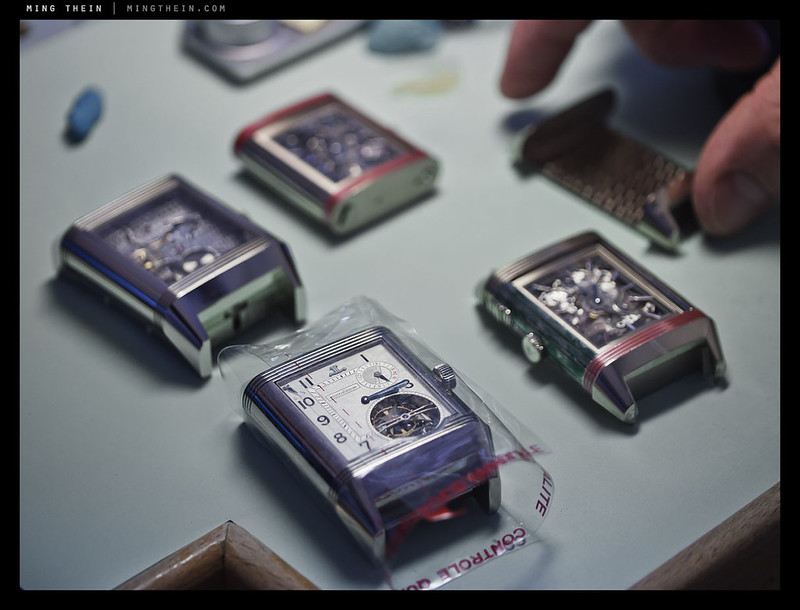
Ta-da! Look what I made earlier. This is possibly the only photograph to date with five of them in one place…

34_5003656bw copy

35_5003666bw copy

Beginning to case up inside a negative pressure cabinet, so dust gets sucked out.

36_5003670bw copy

Moving over to another bench, we find:

41_5003701 copy

37_5003674 copy

The red and blue plastic is a protective layer to prevent scratches as the watches are cased, assembled, and final adjustments made.

38_5003696bw copy

There’s also a Repetition Minutes a Rideau present – but not just any one, a blue one!

39_5003698bw copy

40_5003681 copy

It sounded great. I suspect the double case (the movement is actually based on the earlier limited edition series of 500 in pink gold) improves the tonal qualities of the chime significantly. It also looks absolutely stunning, though I’d gladly forgo the outer slide mechanism and just have the inner watch – apparently the inner case is about the same size as a regular Reverso GT, which isn’t very big at all.

42_5003712bw copy

On the way out, we pass a Gyrotourbillon in final stages of regulation. The dial on the left (which actually looks complete) is a work dial, used for adjustment only. I’m told that it takes one watchmaker between 1.5 and 3 months to assemble one of these; the huge time difference is if after assembly, it doesn’t run to spec, then the whole thing has to be taken apart and the cage re-balance and re-adjusted.

43_5003714bw copy

The gemsetting atelier is next.

44_5003868bw copy

45_5003871bw copy

I’m not a huge fan of gem set pieces (they showed me bracelet links for a Master Tourbillon, which when completed, would retail for around one million Euros – the entire thing was covered in diamonds, including the dial); however, this particular piece was pretty intriguing – it’s called a ‘chaotic’ setting, and you actually can’t see where the setting ends and the stones begin. They use around 200-240 diamonds of various sizes to cover a ladies’ Reverso case.

46_5003875 copy

47_5003737bw copy

49_5003757bw copy

51_5003760bw copy

We appear to have found the Atmos division.

48_5003750bw copy

I actually found this portion quite fascinating, as you seldom see so many of these in one place – and more interestingly, so many vintages; there were clocks here dating from easily fifty years go. I suppose it’s one of the few products whose fundamental parts have changed very little over time. Interestingly, they still cure the balance suspension wire; except these days, it’s done with weights and electric current rather than horse urine and time.

50_5003746 copy

Oh look, a Klimt! In all seriousness, this was an incredibly stunning piece which I think few have been lucky enough to see in person.

52_5003776 copy

View from the employee canteen.

I did also visit the museum, but wasn’t allowed to take any photos. Suffice to say there are some incredibly rare and very interesting pieces in there. And while all the Atmoses are running, charmingly none of them show the exactly same time 🙂 MT

I would like to say a personal thank you to Marina Shvedova, Janek Deleskiewicz, Cecile Tichant, Alexis Delaporte, Reena Tan, and all the patient employees whom patiently answered my endless barrage of questions.

____________

Visit our Teaching Store to up your photographic game – including Photoshop Workflow DVDs and customized Email School of Photography; or go mobile with the Photography Compendium for iPad. You can also get your gear from B&H and Amazon. Prices are the same as normal, however a small portion of your purchase value is referred back to me. Thanks!

Don’t forget to like us on Facebook and join the reader Flickr group!

appstorebadge

Images and content copyright Ming Thein | mingthein.com 2012 onwards. All rights reserved

Lens review: The Olympus M.Zuiko Digital 12-50/3.5-6.3 EZ for Micro Four Thirds

_5A00197 copy
Waiting.

Olympus’ latest zoom covers a useful 24-100mm equivalent range (12-50mm actual) and is the kit lens accompaniment to the OM-D in most parts of the world. (I’ve also seen a variant that includes the 14-42 IIR instead.) It’s a bit of a Swiss army knife – the lens has a power zoom feature for video, which can be decoupled to provide a mechanical zoom ring (more on this later) plus a fixed focal length macro mode, at 43mm. It’s also got a programmable function button on the lens barrel. Like all M4/3 lenses except the 12/2, the lens is focus-by-wire only and has a continuously turning focusing ring that has no DOF markings.

       
Lens and optical formula. The various colored elements represent different types of glass. Image from Olympus Malaysia

Construction is all plastic, except for the metal mount. It’s pretty solid, though the plastics used feel a notch below those in comparable Nikon kit zooms; still, the lens is weather sealed and is the first of the Olympus lenses to feature a rear gasket. It’s not a small lens, by M4/3 standards – it’s about the same physical size as the Voigtlander 25/0.95, but nowhere near as heavy or well built. The best comparison I can give is to one of those miniature cans of mixers they give you on an airplane to go with your shot of whiskey. Like all Olympus lenses, it doesn’t include a hood or pouch (shame on you, Olympus).

_5A00399 copy
This lens is not meant for low light. This shot – 1s at ISO 800 – says more about the IS capabilities of the OM-D than anything else.

All images in this article shot with an Olympus OM-D E-M5, and the 12-50/3.5-6.3 EZ lens. Clicking on any image will bring you to the flickr landing page, where you and see larger versions.

Optically, the lens uses a 10/9 construction with several exotic elements; with aspherical elements, ED elements, HR elements, and one mysterious DSA element – I think it’s a double aspherical, but it could also be a Japanese government agency. Zooming and focusing is all internal. A quick note on the former: zooming can be accomplished by servo – in the intermediate position, the zoom ring turns into a rocker switch, with one speed in either direction – or mechanically, by pulling it backwards.

_5A00067 copy
Just your average youth on Saturday

The mechanical zoom is my preference, except in this case it has no real clear stops at either end – so when you turn the camera on, it’s very difficult to tell in advance where you are exactly in the zoom range. The complete lack of external cues doesn’t help, either – there are no focal length markings, and the lens doesn’t change length. I find this very disconcerting, not to mention costing valuable seconds when trying to get a shot.

_5A00465 copy
Swirl.

The good news is that focus speed is excellent – just as fast as any of the other Olympus ‘MSC’ lenses; I’m told that the system uses some form of magnetic solenoids and a single moving element to keep things silent and fast. Whatever technology used, it’s fast and precise, and has no problem moving in small increments to match small changes in subject distance.

_5A00277 copy
Untitled

A bonus feature is a 1:3 macro mode – this covers a 36x48mm frame area at a near focus distance of 20cm (normal minimum focus is 35cm), which actually makes it pretty handy at a pinch. Optically, performance is surprisingly good too in this range – completely at odds with one’s expectations for a zoom-with-macro. The macro mode is accessed by holding down a mechanical interlock button on the side of the lens and sliding the zoom ring all the way forwards, which locks the focal length at 43mm.

_5A00272 copy
Urban geometry

You’ll notice I haven’t said much about optical performance up to this point. That’s because it’s honestly quite a mixed bag. It can be good – if you stop down a little (though not past f8, because diffraction starts to rob you of resolution by that point) – but not in the corners. The 12mm end comes close to the 12/2 in the center, but is very soft in the corners; actually, soft is not the right term, the resolution is there, but there’s very clear CA causing apparent softness due to the separation of the blue and red components in the image. It’s a similar story at the 50mm end, though not as pronounced in the corners. There’s some internal flare that creates slight haloes around contrast edges, and it lacks the crispness of the 45mm. In fact, the 45mm at f1.8 is sharper than the 12-50 ever gets.

_5A00430 copy
Waves overhead.

Personally, I find the biggest problem to be not the lack of sharpness, or resolution, or CA – but the poor microcontrast. Textures are not very well defined at all; there’s a decent amount of macro contrast, but overall, the images produced just feel blocky – things seem to fall into either highlights or shadows, and nothing much in the middle.

_5A00281 copy
The Canyon

All that said, it does pretty well for a kit lens – though personally, I actually think the 14-42 IIR actually performs a little better overall; it just feels like it’s got more ‘bite’ than the 12-50. I could of course have a bad copy. Finally, you’ve also got to watch out for the small maximum aperture; f6.3 on the long end is not bright at all. However, thanks to the relatively small number of elements, the lens’ T stop seems to be fairly close to its f stop.

_5A00241bw copy
Night crossing.

I struggle a little with the conclusion on this one. It’s a lens that is convenient, and does so many things; but at the same time, I don’t feel like the optics do the OM-D’s sensor justice at all. However, if you’re out in the sunshine, and only want to carry one lens, it’s a good option.

_5A00053 copy
Balance

I purchased the lens as part of a bundled kit with my second OM-D; the price difference was quite small compared to body-only; certainly much less than the cost of the bare lens alone. This in my mind made it a worthwhile experiment; however, I don’t think I’ll be using it much, unless I happen to go to the beach or skiing or some other bright environment where I’d rather not be changing lenses. So, if you’d like the convenience, or can’t find a body-only OM-D, it’s not a bad buy; but if you’re expecting it to come close to the resolution of the M4/3 system’s primes, you’re going to be disappointed. MT

_5A00001 copy
A lens like an umbrella: take it just in case.

The 12-50 is available here from B&H in black or silver.

____________

Visit our Teaching Store to up your photographic game – including Photoshop Workflow DVDs and customized Email School of Photography; or go mobile with the Photography Compendium for iPad. You can also get your gear from B&H and Amazon. Prices are the same as normal, however a small portion of your purchase value is referred back to me. Thanks!

Don’t forget to like us on Facebook and join the reader Flickr group!

appstorebadge

Images and content copyright Ming Thein | mingthein.com 2012 onwards. All rights reserved

Olympus OM-D lockup problems

I’ve found a particular combination of button presses that makes my OM-D lock up – admittedly it’s probably one that only I use, but I thought people should be aware so they can avoid it:

1. I’ve got my camera set to Continuous-L, 4fps, RAW.
2. Play back a file
3. Press the Fn1 button to zoom to 10x, keep pressing to zoom out again to the screen that shows the zoom slider and thumbnail toggle (i.e. keep pressing the button)
4. At that screen, press the Fn2 button to protect the file
5. You’ll now find the camera has locked up and requires a battery removal.
6. The file will still be there, though.

So there you have it. Unfortunately it happens to follow the way I work (zoom in to check focus, zoom out, protect file) – same thing I do with my Nikons – just that here it seems to trigger some sort of firmware panic, which requires a battery removal to resolve. MT

Photoessay: Burlesque party

A continuation of the sequences theme from a few weeks ago; let’s just say this was one of the more fun parties I attended. And being a party, it’s a social occasion; I certainly wasn’t working, but that didn’t prevent me from packing some pocket firepower in case photographic opportunities presented themselves, or I simply got bored with the conversation. (My wife is a long-suffering social and conversational martyr when it comes to me, photography, vacations and parties – thanks Nadiah!) Yes, it was dark, and there is motion blur because I ran out of apertures and shutter speeds (not to mention having trouble focusing on the rapidly moving dancers) – but I definitely think the motion blur adds to the action and slight sense of chaotic fun. MT

This series shot with an Olympus E-PM1 Pen Mini and Panasonic 20/1.7 G.

_PM03612 copy

_PM03580 copy

_PM03592 copy

_PM03625 copy

_PM03594 copy

_PM03589 copy

Shooting professionally with the Olympus OM-D E-M5

_5003127%20copy
Rice. Olympus OM-D and Panasonic Leica 45/2.8 Macro-Elmarit

I had an interesting food assignment recently, which was challenging for several reasons – not least the location:

_5002420 copy
Doesn’t look so bad? Look again:

_5002274 copy

Turns out this particular client’s restaurant wasn’t ready; the assignment was concept food for the menu, website and marketing materials for a new local chain. So they borrowed the (primitive) kitchen of another friend, who happened to run a small cafe in an office-building-cum-training-center-cum-community-college. The only place they had for me to shoot that was both close to the kitchen and powered (for the lights) was literally off to the side of a hallway! I’ve never thought of photography as performance art before, but judging by the crowds that stopped by to rubberneck throughout the two days, I should probably have charged admission. To be honest though, I was more worried about people tripping over the cables or moving lights, or worse still, equipment going missing. (Fortunately, none of that happened – thanks in no small part to the wonders of duct tape.)

IMG_1850 copy
Setup shot – Apple iPhone 4

In the past, I would have done this shoot with a Nikon FX body, macro lens, tilt-shift, and a few speedlights and umbrellas. After much experimentation with LED panels for both casual work and teaching – I’ve come to the conclusion they’re a much better option for food photography, both enabling you to see straight away the light effects, plus minimize the effects of heat on food – especially important with things like ice cream or raw fish.

I don’t have any questions about the image quality of the OM-D – at base ISO, it’s better than the D700 – but what did concern me was the client reaction to me using a ‘small’ camera, given their expectations and my rates. I even packed a D700 and full set of lenses just in case. However, so far those concerns have been completely unfounded. I’ve mixed in a number of images from the OM-D with a recent submission to a watch client, and they haven’t said anything negative (the bulk of the job was shot with a D800E; the OM-D images were upsized to 25MP) – however, they didn’t see me shoot as I wasn’t working on location.

Fortunately those fears turned out to be unfounded. There was no negative reaction from the client to the camera or image quality. (Though to be on the safe side, I added the HLD-6 to bulk things out a bit – and give me some more battery life.) In fact, I have to say I’m extremely impressed with the color reproduction of the OM-D – after shooting a WhiBal card under the LED panels to lock in the white balance, the images needed almost zero color correction in ACR – this is something I’ve never experienced before. I think the combination of high CRI LED panels and the OM-D for food photography is a revelation, and not having to do extensive color rebalancing work to achieve perfect color saves a huge amount of processing time afterwards. The extended DOF for a given FOV/ aperture combination helped too; f8 was about as low as I could go with the LED panels and still manage 1/90s or so at base ISO. I did bring a tripod along – my shiny new Gitzo GT1542 Traveller which I haven’t had a chance to use yet – but didn’t need it due to the image stabilization and reasonably high shutter speeds.

_5002312 copy
More rice. Olympus OM-D and Panasonic Leica 45/2.8 Macro-Elmarit

A note on the gear used – one OM-D body with HLD-6; the Panasonic Leica 45/2.8 Macro-Elmarit for the majority of the shots, with the Voigtlander 25/0.95 (the near focus ability is extremely useful for food photography, but I’m not so enamored with the wide open performance – review coming soon) for the wider shots; I brought the 12/2 and 45/1.8 just in case, but didn’t land up using either. A D700, 24/1.4, 60/2.8 G Macro and 85/2.8 PCE rode shotgun as backup. In future, I think I’m just going to bring a pair of OM-D bodies and save a lot of space and weight. Battery life on the OM-D was pretty good – not as good as the Nikons (the D700 usually gets me around 700-800 shots per charge with the commander flash firing, or 1000+ with no flash; the D800E is good for 2000+) – but a respectable 650-700 per charge with heavy chimping. One slightly concerning behavior I did see with the OM-D was an occasional lockup – it seems that if I review and zoom in fairly soon after taking the shot, the camera sometimes freezes on zooming out again. Popping the battery from the grip is the only way to solve this. I only see this behavior with the battery grip, and it’s not always repeatable. Hmm. Fortunately, it doesn’t eat shots or corrupt things. I will be following up with Olympus in due course…probably after I’m done processing this assignment, and after next week’s assignment in Geneva.

All in all – a positive experience. I was surprised by how much less fatiguing using the OM-D is for studio work; I always thought I didn’t really notice the weight of a full sized DSLR, but I guess it turns out I do. Even with the HLD-6 and heaviest Voigtlander 25/0.95 – it weighs in at just over 1kg instead of the 1.6kg or so for a D700/D800 and 85 PCE; more if I’m using the vertical grip for those cameras.

Now, time to decide if my second body should be black or silver…MT

A note for all of those complaining my previous images were over sharpened – I think I’ve fixed the problem, but please let me know if they still look off. I can’t do anything about the images already in the system, so there may still be a few that I post in the future that appear a little over sharpened.

____________

Visit our Teaching Store to up your photographic game – including Photoshop Workflow DVDs and customized Email School of Photography; or go mobile with the Photography Compendium for iPad. You can also get your gear from B&H and Amazon. Prices are the same as normal, however a small portion of your purchase value is referred back to me. Thanks!

Don’t forget to like us on Facebook and join the reader Flickr group!

appstorebadge

Images and content copyright Ming Thein | mingthein.com 2012 onwards. All rights reserved

Full review: The Olympus OM-D E-M5

_8012314 copy
My stealthed-up OM-D. Note lack of strap D rings; these are the clip points from the Crumpler strap.

I did a double take after seeing the teaser images for the OM-D, way back at the start of the year. Olympus managed to make a 2012 camera look like a 1970 one; not only that, why on earth would you need a prism hump for a camera that doesn’t even have a prism? My first impressions of the spec sheet were ho-hum, yet another over-cramped sensor with too many pixels, inside a tiny body. And it wouldn’t fit my workflow, because there was no ACR support of any kind. And what’s with having two cryptic names? Then, after a long wait, and at a camera shop in Singapore looking for some lighting gear, I made the mistake of playing with one. Not only did it not feel plasticky and toy-like as its appearance would suggest, but the camera was also very responsive – in a connected-to-your-synapses-good way that I’ve only felt with the pro Nikons up to this point. I was intrigued.

_8012328 copy
Reach out and touch me. Tilt and capacitative-touch LCD; there’s actually another accessory port under the flash hotshoe for things like GPS, macro LED lights (that look like tentacles), or for a completely bizarre twist, another EVF.

A little more research on reaching home in Kuala Lumpur revealed that the OM-D was not only surprisingly expensive for what it was – D7000 money – but perhaps enough camera that you could use one on assignment and be taken seriously. And whilst a nice idea, the two-part vertical grip both managed to look dinky and defeat the point of having a compact system in the first place.

_5001096 copy
Ladies at lunch. OM-D, 45/1.8 – this has rapidly become my favorite lens for the camera. It’s a little long to use at arms’ length on the Pen Mini, but excellently stealthy on the OM-D.

I admit, following reading a number of excellent reviews on the web, temptation peaked. ACR support was the final straw – one day, it followed me home. (My dealer has a joke about my car washes being very expensive, because while waiting for the car to be ready, I usually drop by; most of the time, I buy something. This was another one of those expensive car washes.) After all, I reasoned that I already had the Pen Mini and excellent 12/2, 20/1.7 and 45/1.8 lenses for Micro Four Thirds, plus there was all of this Leica M glass sitting around and an adaptor. The Pen Mini was surprisingly excellent. How bad could it be?

_5000140 copy
The Kicker. OM-D, 45/1.8

Actually, a lot better than expected. Turns out there’s a very good reason for that prism hump, just not one you’d expect. Aside from the 1.44 million dot EVF, there’s also a five-axis gyroscope – supposedly a world first – inside the camera that controls the matching five-axis moving-sensor stabilization system. I’m not a fan of sensor based systems, because they don’t generally have as much correction power (from an angle of view basis) as lens-based systems for longer lenses, and they tend to do odd things like ‘snap’ back into position once the limits of travel are reached. The OM-D’s system displays a little bit of the latter, but very, very little. And it’s surprisingly effective, too – it activates with a decisiveness I haven’t seen before on a sensor-IS system – but then again I don’t have any lenses over 90mm EFOV, and if I did, I’d probably buy the Panasonic 100-300 which already has lens-based IS built in, giving me the choice of both systems (but not together, as apparently both manufacturers claim they don’t play nice). You still need to give the stabilizer a moment to lock down though, otherwise you might get that unexpected jump.

_5001019 copy
A repost of one of my favorite portraits. OM-D, 45/1.8

And that brings me to the next popular point of contention with the OM-D: the fan noise. Turns out it’s the a combination of the gyroscope and the electromagnets that move the sensor, or keep it in place (if the IS system is off). In fact, you can hear a similar noise in Nikon’s VR lenses when VR is engaged if you listen carefully. I don’t think it’s a big deal, personally. You can only hear it in near-silent environments.

_5000219 copy
A shave and two bits. OM-D, 45/1.8

The OM-D is a tricky body to get a feel for – it’s smaller in person than you’d expect from pictures; it’s a little taller than the E-P3 due to the finder hump, but nowhere near as bulky and unwieldy as the E-P3 with the VF2 viewfinder attached. Ergonomically, this is good and bad news; the camera sits in the hand well, and both exposure adjustment dials fall easily to thumb and forefinger. The arrow keys on the back are still OK, but a little bit of a cramp to reach; the delete button and power switch are both far too low. Moving the power switch to that little empty bit of deck underneath the shutter button would be fantastic – a split second fumble to power the camera on can often cost your the shot. More on this later.

_5000076 copy
Damn you, Magritte. OM-D, Leica 35/1.4 ASPH FLE via adaptor

For the most part, ergonomics are solid. There are plenty of programmable buttons; the two on the top deck (Fn and record), one next to play (Fn) and the arrow pad. The play and Fn buttons are a bit small – perhaps making them pointier and longer might help – I’d be concerned about being able to hit them reliably with gloves, but then again they seem to be fine for bare-handed use. The arrow pad is set to pick focus point by default, and this is the behavior I prefer. You can assign shortcuts like ISO and WB to it, but why bother when there’s the excellent SCP which shows all settings at a glance? Hit the OK key and use your finger to select the setting, then use the front dial to change it.

_5000108 copy
Night Tree. OM-D and 45/1.8. ISO 2000, would you believe?

Oh, I forgot to mention the OM-D has also inherited the touch screen from the E-P3; Olympus has done a good job of making its operation unintrusive so you’re not accidentally shooting with your nose (you can do a touch-to-focus-and-shoot operation when in live view). It’s handy to select focus points quickly, as well as scroll and zoom images – though this behavior is just a little counterintuitive, because I don’t do it on any of my other cameras.

In addition to being hugely customizable, there are several neat touches with the operation of the camera – in playback, the FN1 button next to play zooms into the focus point to the last magnification with two presses: first to enable (after which you can also use your finger to drag the enlarged area box) and another to magnify. Amongst all cameras, only the pro Nikons do this. Better yet, you can skip between zoomed-in images to compare areas of the image using the front command dial. On top of all this, you can even select clipping levels for the shadow/ highlight warning display. Nice.

_5000206 copy
Memorial for a leaf. OM-D, 45/1.8

The OM-D has other functions which I don’t really use, but which might be nice for JPEG shooters like special effects and a form of live curve control using the dials; it isn’t very precise, but it is better than nothing.

Remember I was talking about losing shots to a powered-off camera earlier? There’s a good reason for this: if you leave the battery, it’ll probably be dead after about 300 or so frames because the EVF and LCD appear to be always on, even if the camera is in standby; the LCD might be black but mine at least has a telltale glow. My friends who don’t power off between shots are reporting battery life in this range. I’ve got no problem getting 500 shots out and barely making a dent in the battery (one little segment missing), however. I think I’ve only charged it a handful of times since getting the camera, and never has the battery been fully depleted.

_5001073 copy
Untitled. OM-D, 45/1.8

I think the EVF saves power over the LCD, but then again I’m not entirely sure; there’s a lot of dots on that little monitor. It’s definitely one of the better ones I’ve seen, with a very high refresh rate, low lag, good usability in low light (though oddly the live preview tonality etc doesn’t accurately match the captured image sometimes) and a fine dot pitch. Do I miss my real viewfinder? Yes, but to be honest, I seem to have adapted to this one. And being able to see a quick review of the image you just shot in the finder is great – you don’t have to take your eye away from it to check your composition. Similarly, if you want to shoot discretely at waist level – the tilting LCD is great. I prefer these to the swivel kind that frankly always feel like they’re going to snap off at the hinge point.

_5000222 copy
In praise of tilt screens. OM-D, 45/1.8

In use, the OM-D shows that it was designed by photographers – or at least has had heavy photographer input in most of the engineering decisions. Menus are logical, and settings are mostly easy to find – though it could really use a way of saving settings to an SD card to transfer between multiple cameras (this is a ‘pro’ feature for users of multiple bodies), or reload if somebody plays with yours. It’s solid, and surprisingly hefty for its size – the body is made of magnesium alloy a mix of magnesium alloy, plastic, and some stamped metal (brass?) parts; it’s weather sealed to the same level as the E-5. If you look closely, there are gaskets on every compartment. Although I’ve seen videos of people washing their E-5s, note that the only weather sealed M4/3 lens at the moment is the 12-50 kit lens. All in all, I’m pretty confident that the camera could take a decent beating and survive.

_5000876 copy
Remember this shot from Wesak Day? The camera was already soaked by similar blessings at this point. OM-D, 12/2

The critical thing that makes a good camera, in my mind, is responsiveness. And the OM-D has it in spades. I think it’s the fastest-focusing contrast detect camera out there; it’s noticeably faster than the Pen Mini, which I already thought was pretty speedy. It even shoots at 9fps, in RAW, with no buffer indigestion. Frankly, in good light, with a contrasty subject, it gives my D800E a run for its money. The catch is that you must use the Olympus lenses for this. Despite the supposed openness of the Micro Four Thirds standard, there are definite speed advantages to be had for using a manufacturer’s own lenses on its own bodies.

_5000941 copy
Bulding blocks. OM-D, 45/1.8

There is a catch with autofocus, however. As good as single AF is – I would say easily class leading, and giving most DSLRs a run for their money (with none of the AF alignment problems, because the imaging sensor does the focusing) – continuous AF is a completely different story. Even though Olympus claims that continuous and tracking AF is greatly improved with the OM-D, frankly, it’s unusable. Continuous autofocus can’t seem to anticipate subject motion; it drops after the first frame, and usually comes close but fails to re-acquire the subject. Tracking AF is a similar story; you can see the camera manages to find the subject in the frame and displays this in the finder, but somehow it just fails to move the lens by the right amount to keep up with it. I would personally avoid these two modes, and instead rely on its extremely fast S-AF, low shutter lag, and the higher DOF of Micro 4/3 (for a given FOV and aperture) to save you. In fact, I don’t think I’d use this camera for moving subjects at all; that’s why I still keep the D700 and battery grip around.

_5000653 copy
Holy man. OM-D, 45/1.8. Even at the slow, predictable speed of the moving float, getting this shot was a lucky break.

I haven’t seen any AF errors for single AF, except when there are objects at multiple distances inside the focusing box (whose size can’t be changed) and something other than the intended subject is the most contrasty. It’s also worth noting that because the imaging sensor is used, the AF grid covers almost the entire frame. These are two huge advantages of mirrorless systems that frankly I miss with full frame cameras, whose AF grid usually covers the central third of the frame at best.

All of this usability would be utterly, well, useless, if the image quality didn’t match. The OM-D reportedly uses the same sensor as the Panasonic GX1 I’ve been told by a number of sources that it’s a different sensor; 16MP and 3.63 micron pixel pitch. That’s tiny; the 10MP 1/1.7″ compacts run at about 2.3 microns or so. By comparison, the D7000 and D800E have a 4.88 micron pitch, and the D700/D3, an enormous 8.5 microns. (Every time you double the pitch, you quadruple the photo site area.) Even factoring in advances in technology, I’d expect pixel-level performance to be on par with the Pen Mini; going from 12 to 16MP while maintaining the same pixel quality is pretty much what Nikon did with the D3s to D4 move, and in about the same gestation period.

_5000967bw copy
Hot day. OM-D, 45/1.8

Wrong. It seems that either the old sensor was pretty old, or the new sensor has skipped half a generation – pixel level image quality is on par with the D7000, as far as acuity and noise goes; it may even be slightly better on the noise front. Color accuracy is better, too; the OM-D is both accurate and delivers excellent skin tones. The best way to describe its tonal palette is ‘natural’ – very little work is required to get my desired output from the RAW file, which isn’t necessarily the case with other cameras. The only place where it can’t quite keep up (and this is a fact of the laws of physics) is in dynamic range; I don’t know exactly how much it has, but my gut puts it at around 11-12 stops useable at base ISO with careful RAW processing, which is a little less than the D7000, and two stops less than the D800E. The sensor is further limited at higher ISOs, at which point dynamic range falls further. There’s probably no more than 6-7 useable stops at ISO 3200. This is still excellent performance for such a small sensor!

_5000552bw copy
Migrant workers. OM-D, 45/1.8. ISO 3200

On the noise front, I limited my Pen Mini’s auto ISO to 1600; anything beyond was just too grainy and edge-compromised to use. I’m happy to raise that one stop to 3200 for the OM-D; perhaps 6400 if I have no choice, since there are a few more pixels to play with – but by then dynamic range and color are really suffering quite badly. All in all, though, I’d put the noise performance on par with the Leica X2 I recently tested. One more stop of useable high-ISO, the hugely improved stabilizer, and the ability to use an eye-level finder and brace the camera against your face (increasing stability and reducing the minimum shutter speed required to handhold) means that the OM-D is capable of delivering 2-3 stops of additional usability over the Pen Mini (and by extension, E-P3/ E-PL3 cameras of that generation) – which is a huge step forward. In fact, it gives better color and detail than my D700 at base ISO, and keeps up with it noise-wise to about ISO 800. It’s probably about as flexible as the D800E in that sense. In daylight, picking this camera is a no-brainer.

_5000228 copy
The thinking man’s camera. With beer, too. OM-D, 45/1.8. ISO 2000

This doesn’t of course mean that the OM-D is perfect; there are many things that only reveal themselves with extended use, and one of the reasons why this review has taken so long (other than the X2 and M-Monochrom arrivals) is because I didn’t feel like I’ve had enough time to shoot with it to fully understand this camera; there’s a lot of functionality in here I haven’t even tried, like video mode for instance. What I do want to test more extensively – and haven’t had the chance to, because FL-50Rs aren’t exactly cheap or easy to borrow – is the wireless flash system. If it’s as accurate and flexible as Nikon’s CLS, I may well have found a replacement lightweight system for anything that doesn’t require 36MP. I did briefly play with the two-part grip; it’s very solid, and improves handling and balance dramatically – with or without the vertical portion. It takes another battery and is sealed to the same degree as the rest of the camera. The only problem I have with it is the rather stiff price for what is effectively a few bits of plastic and some buttons; it’s fully 1/3rd of the camera – at least where I live.

_5001213 copy
Untitled portrait. OM-D, 45/1.8

Things I’d like to see improved:
– Strap lug placement is awful. Using the included D-rings, the strap digs into your palm, or the web between your fingers. It seems like this is an Olympus tradition; every single Olympus I’ve owned has had this problem. I solve it in the usual way: remove the D rings, and either use a thin lanyard hand strap (fortunately, the camera is light) or a Crumpler Urban Disgrace that attaches via a lanyard-style string that threads through the remaining eyelets.
– Continuous AF. It’s not usable now, period.
– The power switch is in a terrible location.
– The buttons could be more tactile, they feel, well, mushy. It’s not always clear if you’ve pressed something.
– Playback and FN1 buttons are too small, and you can quite easily press the wrong one.
– It seems battery life could be improved, perhaps through more intelligent use of sleep modes. The camera could be a bit faster in waking up and powering on, too.
– Some way of saving settings to an SD card and transferring them to another camera – this is meant to be a pro grade camera after all, and pros have more than one camera. With that many custom settings, resetting a second camera is a colossal pain.

_5001123 copy
Contemplating the upgrade (note watches). OM-D, 45/1.8

Notice that with the exception of continuous AF performance, there are no real big issues here. In all fairness, continuous AF is something that none of the mirrorless cameras do well (with the exception of the Nikon 1, which has phase detect photo sites on the sensor).

With the arrival of the OM-D, it finally feels like Micro Four Thirds has come of age. The original promise of ‘smaller, same quality’ which was made with Four Thirds I felt was never fulfilled with earlier cameras; they weren’t small enough, or able to deliver the same image quality. Although Micro Four Thirds went a long way to fulfilling the smaller part of the equation, image quality, speed and usability were lagging behind until the last generation; only now has the promise been met. I don’t look at the OM-D’s files and think ‘wow, this isn’t bad for such a small sensor!’; instead, I look at the files and am satisfied enough to not think about the sensor size. It’s hugely liberating to be able to carry a pro grade body and three lens fast-prime kit – 24, 40 and 90 equivalents – whose total weight is around 600g, and without feeling like I’m compromising anything (at least not for what I shoot; if it were sport, it’d probably be a different case). That’s the weight of one lens for the D800, or the M9-P body only. That’s hugely appealing for travel. Even two bodies wouldn’t weigh that much.

In conclusion: it’s an exciting time to be a photographer. For the vast majority of my work, this is more than enough camera; I just need a solid macro option (there’s a 60mm 1:1 on the way) and a good wireless flash system, and I’d be seriously tempted to switch over. MT

_5000959bw copy
Waiting for more rebar. OM-D, 45/1.8

More of my work with the OM-D can be found here on flickr. This is a set which will be continuously updated as time goes by…

Update: I’ve been made aware of an excellent thread on DPReview by Archer Sully here documenting some of the ‘hidden’ features of the OM-D that the manual doesn’t cover. It’s good reading for any OM-D shooter.

Get the Olympus OM-D here from B&H or Amazon.

____________

Visit our Teaching Store to up your photographic game – including Photoshop Workflow DVDs and customized Email School of Photography; or go mobile with the Photography Compendium for iPad. You can also get your gear from B&H and Amazon. Prices are the same as normal, however a small portion of your purchase value is referred back to me. Thanks!

Don’t forget to like us on Facebook and join the reader Flickr group!

appstorebadge

Images and content copyright Ming Thein | mingthein.com 2012 onwards. All rights reserved