On Assignment: concert photojournalism

_5007533 copy
Tompi. Olympus OM-D, 100-300

I recently played the role of official photographer for a producer friend’s concert – it was a moderately large affair featuring a good number of famous local musicians. The nice thing about this event was that it was large enough to have professional acts, decent lighting and good organization, but not so large that I didn’t have access to everything – and I mean everything, including the stage itself during the performance*.

*One thing a good concert photographer should never do is interfere with the act; so even though the stage might be open to you, one should never get between the performers and the audience unless it’s absolutely necessary, and even then only for the shortest possible period of time. Oh, and remember that the shutter sound carries quite clearly through any microphones that have been placed near equipment.

_7065766 copy
Through the legs. Nikon D700, 28/1.8G

Although I’m not normally a huge fan of the types of music being played, I have to say this was one of the more enjoyable events I’ve attended and shot; I guess I’d be the restless type of concertgoer who’s only happy with a camera in hand and backstage pass – not so much to meet the artists, but to shoot. Although it’s the first photojournalism assignment I’ve done in quite some time – and the first concert assignment in many years. (In 2005/6 I was the house photographer at one of the jazz clubs in Kuala Lumpur, but I eventually stopped because I wasn’t getting enough sleep after gigs and before work the next day.) This job made me realize just how much I missed photojournalism.

_7065800 copy
Nikon D700, 28/1.8 G

There were a number of photographers there from other local/ national media and international agencies; the locals were mostly using midrange APS-C bodies, kit lenses and off-brand flashes; you could tell the major agencies by their standard issue pro bodies and f2.8 zooms. Interestingly, the proliferation of lower end cameras amongst media/ newsmen – at least in Malaysia – has been getting increasingly common as these organizations seek to cut cots. I can understand the bodies passing the threshold of sufficiency and being capable of producing great results in the hands of any competent photographer, but the use of slow kit zooms just hamstrings the ability to create a picture that preserves the ambient light and feel of the scene without resorting to a flash.

_5007777 copy
In the moment. Olympus OM-D, 100-300

From experience, I know that when wearing my photojournalism hat, the lighter you can go, the better. I was carrying my D700/ MB-D10, 28/1.8 G and 85/1.8 G for close distance coverage; the OM-D and 100-300 rode shotgun for more reach. (I was also carrying the 12/2 and 45/1.8 as backup in case the D700 developed a problem, plus an SB900 for balanced fill which I didn’t land up using. My motto is go light, but not so light that you have no insurance when it comes to equipment failure.) Many of you will know that the new Nikon 28/1.8 G has proven itself to be a very capable lens even on the demanding sensor of the D800E; I’m pleased to report that both the 28 and 85 f1.8 G lenses performed flawlessly on the D700, both in terms of focusing accuracy and optical performance. The 85/1.8 G does exhibit some moderate flare with strongly backlit point sources (the hood makes almost no difference here), but I personally don’t mind it as I feel that it adds to that atmosphere and pictorial value of the image somewhat.

_7065836 copy
Keyboards. Nikon D700, 28/1.8 G

The big surprise of the night was the OM-D and 100-300 combination, however. I didn’t use AF-C; most of the time careful timing, a short burst and the extended depth of field for a given FOV due to the smaller sensor was enough. It’s rather counterintuitive for DSLR shooters, but I find that with the OM-D, just depressing the shutter all the way down and trusting the camera’s AF system yields a considerably higher hit rate than using AF-C, or worse, AF-Tracking. The 100-300 delivered excellent optical performance, even out to the 300mm limit; due to the lighting conditions I was working wide open the whole time. The lens did hunt somewhat above 200mm, but so long as I was in the ballpark, focusing was reasonably fast.

_5007353 copy
Blue note. Olympus OM-D, 100-300

So far, no surprises – I’d shot with the 100-300 in good light conditions, and been pleased with the results. The OM-D, on the other hand, seems to excel under tricky mixed-light or strong-color situations; to get a sufficiently high shutter speed – I was in the 1/45-1/60s region most of the time, at 300-400mm equivalent – I was solidly in the ISO 3200 to ISO 6400 band. In all honesty, I don’t feel the files were noticeably more noisy than the D700 for a given ISO; the only place where the smaller sensor made itself known was in dynamic range – the D700 had probably two stops extra on the OM-D. I can definitely see where the 75/1.8 would be useful though – 100mm was a bit long at times, and the extra 2 1/3 stops (probably more in transmission) would have pushed image quality even higher still.

_7067129 copy
Strumming out. Nikon D700, 28/1.8 G

All in all, a very satisfying nights’ work. Come work delivery time, the litmus test is always the client; I’m happy to say that this one passed with flying colors. “I can’t stop looking at the pictures, they’re amazing!” was the text message I got a few days after delivery. So, anybody else need a concert photographer? MT

____________

Visit our Teaching Store to up your photographic game – including Photoshop Workflow DVDs and customized Email School of Photography; or go mobile with the Photography Compendium for iPad. You can also get your gear from B&H and Amazon. Prices are the same as normal, however a small portion of your purchase value is referred back to me. Thanks!

Don’t forget to like us on Facebook and join the reader Flickr group!

appstorebadge

Images and content copyright Ming Thein | mingthein.com 2012 onwards. All rights reserved

_7066968 copy
One – Ramli Sarip. Nikon D700, 85/1.8 G

_7066384 copy
This is what rockers do. Nikon D700, 28/1.8 G

_5007765 copy
The loud pedal. Olympus OM-D, 100-300

_7067121 copy
Thank you to my band. Nikon D700, 28/1.8 G

_7066530 copy
The hair. Nikon D700, 85/1.8 G

_5007741 copy
Olympus OM-D, 100-300

_7067301 copy
Backstage with the fans. Nikon D700, 28/1.8 G

The Olympus E-PL5 PEN Lite review: a mini-OM-D

_5009231 copy

I make no secret of the fact that I’m a huge fan of the original Olympus E-PM1 Pen Mini (full review here); it brought big-camera speed and image quality to a very compact package. However, the OM-D clearly demonstrated that the image quality potential of Micro Four Thirds could be taken quite a bit further without entailing any compromises. After enjoying a period of exclusivity to that body, the same sensor and imaging processor has now made its way into Olympus’ lower end offerings – the E-PL5 Pen Lite and E-PM2 Pen Mini, both recently announced at Photokina. I was given the opportunity to try out a final production E-PL5 recently by Olympus Malaysia.

_5009281 copy

_5009276 copy
Removable grip.

The two cameras retain their original differentiation – a tilting screen and a few buttons. But the E-PL5’s screen now pivots through 170 degrees for self-portrait narcissists (I can’t personally imagine ever using this feature, though tilting it up for waist-level shooting is great for stealthy capture or a better angle without having to bend over). Both also gain the same capacitative touch screen capability of the E-P3 and OM-D, which I’m find increasingly useful and missing on my Nikons. Sadly though, the LCD on the two smaller cameras remains as a 3″, 16:9 aspect ratio unit, which is great for video but leaves a lot of unused real estate in the form of black bars when you’re shooting in the native 4:3 aspect ratio of the sensor. Useable area is probably closer to 2.5″.

_5L20165 copy
Bookstore abstract. E-PL5, 15/8 body cap

Aside from the 15MP sensor of the OM-D, the E-PL5 also gains a few additional art filters, and compatibility with Olympus’ new OI.Share SD card and app for smartphones and tablets (currently, Apple iOS and Android are supported). There are also interchangeable grips – similar to the E-P3. There are also some minor cosmetic changes that give the camera a slightly blockier, more textured appearance. Personally, I prefer the smooth look of the older cameras. Sadly, Olympus still hasn’t moved the strap lugs – they still dig into your hands in the normal shooting position. I can’t help but feel a narrow loop would be a much better solution for a camera of this size, as well as being silent during video recording.

_5009239 copy
It’s grown in size a little, but it’s still roughly in the same ballpark as the original (and Pen Mini, in background.)

In use, the camera is snappy and responsive for all normal operations; AF speed remains excellent, if perhaps fractionally faster than the last generation. (I’m comparing it with my Pen Mini, since I don’t have an E-PL3 handy – they share the same innards anyway.) The menu system is redesigned and now looks very similar to the OM-D, complete with most of the custom functions and extensive customizability that is unusual for a camera in this class, which has become one of Olympus’ hallmarks. It also gains 8fps shooting, though without AF, of course. I use it as a single-shot camera, or at most in bursts of two or three shots to gain some added stability.

_5L20204 copy
Closed for the weekend. E-PL5, 15/8 body cap

On the subject of stability, the in-body sensor-shift stailization system is improved over the last generation; I actually turned it off on my Pen Mini because it tended to give odd double images under some conditions. I left it on on the E-PL5, but it’s worth noting that it still isn’t as effective as the 5-axis gyro system in the OM-D.

_5L20365 copy
Pirates can still be found in some parts of Malacca. E-PL5, 45/1.8

One of the things I missed from the OM-D was the configurable single-button magnify option that allowed one-touch enlargement of either live view or the playback image to your desired ratio at the focus point (10x is actual pixels) – until I discovered that you could just double-tap the screen to achieve the same result. Needless to say, score one for the touch screen. You can of course also use it to select the focus point and release the shutter; speaking of focus points, you can now select a smaller point size by default, which the camera remembers when turned off – something I sorely miss on the OM-D as the large boxes often aren’t precise enough. A good number of the other buttons are user-configurable, too.

_5L20184 copy
Sunset over the straits. E-PL5, 15/8 body cap

Something I had trouble getting used to was the feel of the shutter button. Since it’s probably the single most important control on the camera, the way it feels is actually quite critical in how you feel towards shooting it; in this respect, the pro Nikons and Canons get it right – a soft but distinct half-press, and no clicky transition but a firm increase in resistance to release. There’s enough travel between positions to avoid accidental releases, but not so much to induce lag. The OM-D feels pretty good, too. Other cameras get it wrong – the Sony RX100’s shutter release is far too soft; I’m always accidentally firing off a frame when I meant only to focus. The digital Leica Ms are far too notchy and difficult to press smoothly; it’s as though there’s something rough inside the button’s housing or something; perhaps to do with the three positions. Shame, since the mechanical Ms were fantastic. Unfortunately, the E-PL5 just falls on the wrong side of soft – it isn’t so much the pressure required, but the near-zero difference in travel between half and full press that feels off. And to make things worse, even though the travel is short, the pressure required is very firm – making it difficult to hold the camera steady when releasing. Lack of an eye-level finder only compounds this.

_5L20353 copy
Determination in the face of choices. E-PL5, 45/1.8

I don’t’ have a lot to say about image quality – if you’ve used the OM-D, you can safely skip this section. The files look exactly the same, and deliver the same amount of flexibility in postprocessing. Colors are typical Olympus – slightly warm, reasonably saturated, and biased towards delivery of very pleasing skin tones. Dynamic range is around 11-12 stops from a carefully processed raw file at base ISO, which also remains at 200. The tonal range tends to be somewhat midtone and shadow biased; the relatively small pixel pitch of the sensor makes itself known in the highlights; expose with care because there isn’t a whole load of recoverable headroom – perhaps a stop at most. Fortunately, there is a live shadow and highlight clipping display option, which allows for precise exposure adjustment at the time of capture. Noise is minimal to ISO 800, and I feel the camera is useable up to ISO 3200, or ISO 5000 under certain lighting conditions.

_5L20257 copy
Just your average chaotic street scene. E-PL5, 45/1.8

At this point it’s worth talking a bit about the Olympus Viewer software – I’ve never had to use it before since ACR always supported the files of cameras I’d purchased. This time, I use the built in raw converter to make a relatively low-contrast TIFF with accurate white balance and exposure, which I’d then take into Photoshop. The native environment is very familiar – it looks a lot like Bridge, from which you can develop and save your files in…you guessed it, something that looks a lot like ACR – or at least an early version of it, without the huge number of options the current version has.

_5L20175 copy
Late afternoon. E-PL5, 15/8 body cap

Previews are fast, and general responsiveness and usability was good. This is easily amongst the better own-brand pieces of software out there. (Nikon, I’m looking at you. For shame.) In fact, the only critical things I can find missing are shadow/ highlight recovery sliders and a gradient tool. I’m not so happy with the output, though – the files seem to have a decidedly magenta cast to them which is both difficult to remove, and renders color not as accurately as the JPEGs – especially skin tones, which I find my Olympus cameras generally excel at even via ACR.

_5L00051 copy
Harley after the rain. E-PL5, 45/1.8

Battery life is excellent; I estimate around 500-600 shots with moderate LCD use and power-off between shots. It uses the same battery as the E-PL3 and E-PM1, too, which is nice if you’ve got a few spares already lying around. Note that there are two models of battery and charger, some of which are compatible and some of which aren’t – the light gray model is the latest version of both.

_5L20346 copy
Where Elmo does his shopping. E-PL5, 45/1.8

Throughout the review period, I kept asking myself who this camera was aimed at; the DSLR user/ enthusiast/ amateur looking for a second, more compact body, or the compact upgrader? I personally think it fits the latter better, much like the original Pen Mini. Although it’s compatible with the various accessories that connect to the accessory port under the hotshoe (including an EVF) – the lack of a built-in viewfinder means that if youre going to keep the camera compact, you’re restricted to arms-length style shooting. The huge number of art filters – also useable in movie mode at the expense of reduced frame rate – and in-camera processing options offers a relatively simple (if slightly lacking in control) method for the amateur user to achieve their desired look without resorting to Photoshop. I personally don’t use any of these, but I do know plenty of friends and family who might. What I did really enjoy was using it with the new 15/8 body cap lens as a hyperfocal snapshot camera; in this configuration it’s lag-free, and lets you focus solely on timing and composition. It’s also just about pocketable.

Ultimately, success at this end of the market will depend heavily on the camera’s price point. The rich feature set and overall refinement in operation make me curious to see what will succeed the E-P3; now if only they’d make one with a built-in EVF like the NEX-6…

The Olympus E-PL5 PEN Lite is available here from B&H and Amazon.

____________

Visit our Teaching Store to up your photographic game – including Photoshop Workflow DVDs and customized Email School of Photography; or go mobile with the Photography Compendium for iPad. You can also get your gear from B&H and Amazon. Prices are the same as normal, however a small portion of your purchase value is referred back to me. Thanks!

Don’t forget to like us on Facebook and join the reader Flickr group!

appstorebadge

Images and content copyright Ming Thein | mingthein.com 2012 onwards. All rights reserved

_5L20396 copy
Where are my customers? E-PL5, 45/1.8

_5L20255 copy
Somewhere in here is a human being. E-PL5, 45/1.8

_5L10109 copy
Abstract Kuala Lumpur skyline. E-PL5, 15/8 body cap

Macro shootout on Micro Four Thirds: four lenses, one winner

_5009894 copy

Today’s post is a continuation of yesterday’s review of the new Olympus M.Zuiko Digital 60mm f2.8 Macro; aimed at answering two questions: what is the best macro lens for Micro Four Thirds, and just how much better are the system-specific lens designs? Firstly, a bit of background logic. I’ve selected lenses around the same focal length range – 50mm+/- – in mounts that can easily be adapted to fit M4/3; this pretty much means native lenses and Nikon; Canon and Sony do not have mechanical aperture control, and thus no way of stopping down; besides, Zeiss makes the same lens in multiple mounts. I haven’t used conventional lenses with extension tubes* as these are not real macro lenses; their optics have not been designed with optimization for close range performance in mind. Exotic optics and things that aren’t easily available such as the Coastal Optics 60/4 APO-UV-VIS-IR were also excluded for obvious reasons.

*With one exception, explained later

This left us with four practical contenders: the Panasonic Leica 45/2.8 Macro-Elmarit (PL45), the Carl Zeiss ZF.2 2/50 Makro-Planar, the Nikon AFS 60/2.8 G Micro, and of course the Olympus M.Zuiko Digital 60/2.8 Macro (ZD60). Some are going to cry foul at not having the older Zuiko Digital 50/2 Macro present, but there’s a good reason for that – I didn’t have one handy, and the newer lens has a much higher MTF. Basically, we have here the best short focal length macros available for the respective systems – I might have missed one, but the test would be meaningless unless repeated with all lenses at the same time.

These tests would be useless without consistent methodology – so a quick note on that is necessary to provide some background context to the tests. The camera used was an Olympus OM-D, the highest resolution camera available for Micro Four Thirds, and with a pixel pitch equivalent to a 64MP full-frame sensor; this was shot RAW, converted in ACR with identical settings and zero sharpening. I used a Manfrotto 468MGRCO Hydrostat head and Gitzo GT 5562 GTS legs with no center column; this combination is rock-solid and rated to far higher loads than I can even physically carry. To completely rule out camera shake, the test subjects were illuminated with flash – in this case, a pair of Olympus FL-600Rs, triggered wirelessly using the supplied flash for the OM-D. The lens was defocused serveral times for each shot and the best image selected.

Focusing was performed with either AF and checked with 10x live view, or manually with 10x live view, at the intended point of comparison. A G-compatible adaptor was used to mount the Nikon and Zeiss lenses; the aperture on the 60mm was set to the same approximate size (as viewed from the front, object side) as the Zeiss when stopped down. The magnification of each scene was matched between the different lenses by moving the tripod.

The test scenes were artificial constructs to investigate specific properties: resolution at center, border and corner wide open; bokeh, longitudinal and lateral chromatic aberrations and distortion. The lenses were tested in the range they would be typically used – moderately close distances down to the 1:1-1:2 magnification range. All use floating elements, and infinity performance is excellent across the board – it isn’t difficult to design a normal lens that performs well at infinity.

With regards to the commentary, please go off what I say and not what you see: even though these are low-compression jpegs of screen shots of 100% crops, there will inevitably be some differences in color and resolution compared to the actual files which I’ve viewed on a calibrated monitor, at full resolution. Clicking on the ‘full resolution’ links takes you to the original screen shot file.

1. Center resolution at mid distance, f2.8

_5009081 copy
Full frame

ZD60 comparison center mid distance
Click here for the full resolution 100% screen crop.

Wide open, the ZD60 has both the best resolution and microcontrast here, taking the crown from the PL45 by a hair; there seems to be just a tiny bit of CA or bleed on the edge of the lettering of the PL45 that’s robbing the lens of crispness. You can also see that the lens doesn’t seem to be resolving on as fine a level as the ZD60  – note the fiber in the right hand center edge black portion. Neither the Nikon nor the Zeiss are anywhere near in the running here; both have internal veiling flare that clearly lower contrast and resolution, especially in the texture of the label. The Zeiss is a bit better than the Nikon, but then again it should be; it’s the only lens in this group that’s been stopped down by a stop. The legacy lenses are a little disappointing but not entirely surprising; even on the larger pixel pitch D800E they require some stopping down to reach optimum resolution.

2. Bokeh and longitudinal CA, f2.8

ZD60 comparison loca-bokeh
Full resolution. From the previous frame. A set of keys was lit directly with another flash to provide a bright, contrasty and reflective background subject.

Bokeh is pretty good in all of these, but not perfect in any of them. If I had to choose one, I’d say my vote is betweens the Nikon and the Olympus; the Nikon appears the smoothest of the bunch, but also suffers from significant longitudinal chromatic aberration. The Olympus has almost no longitudinal CA, but it does have some texture in the OOF highlight area, as well as a bright edge to the same area. The PL45 is clearly the worst of the bunch, with uneven highlights, bright edges, and longitudinal CA to top things off; it seems that it might also be prone to double imaging with certain out of focus subjects. The Zeiss falls somewhere in the middle for smoothness, but has the worst longitudinal CA. Remember that the relative merits of bokeh are very subjective – what might be to my taste may not be to yours. CA, however, is CA, and can require significant postprocessing work to fix if present in the OOF areas.

3. Corner resolution at approx. 1:3 magnification, f2.8

_5009115 copy
Full frame

ZD60 comparison corner
Full resolution

As with the initial center crop, it’s a very close race between the PL45 and the ZD60; both appear to have contrast, but the ZD60 has slightly higher resolving power and microcontrast. I see a small amount of CA on the PL45 image too; the top edge of the white line has a slight green fringe. The Nikon lags behind both for resolution, and has some visible CA; note the top edge of the white line. The Zeiss is the worst here – there’s visible CA, a tiny bit of coma, low contrast, some flare, and markedly lower resolution than the others. It also has the warmest rendition of the lot (WB was manually set to the same Kelvin temperature for all images).

4. Center resolution at 1:2 magnification, f2.8

_5009132 copy
Full frame

ZD60 comparison center 1-2mag
Full resolution

Things haven’t changed much in the center and at closer distances; the two legacy lenses are closer in resolving power to the native M4/3 lenses, but both still lack microcontrast. In overall resolution, there’s little to choose between the Nikon and Zeiss, the PL45 is only a bit better. It’s actually surprising how much crisper the ZD60 appears here.

5. Border resolution at 1:1.2 magnification and distortion, f5.6

_5009170 copy
Full frame; a 20mm extension tube was required for the Zeiss ZF.2 2/50 MP to achieve this magnification as it’s normally limited to 1:2.

ZD60 comparison edge 1-1
Full resolution

A more practical application – for me, at any rate. None of the lenses had any noticeably distortion, so I didn’t bother to include full crops from them. For all intents and purposes, it’s a non-issue. The focus point of this image was the center pinion of the second hand of the watch (the round thing), not the 60 text. Note that the hand is very dark blue, and the left-edge blue highlight is the color of the hand. The color fringing visible on the high contrast edge of the steel pinion itself, on the other hand, is chromatic aberration. On stopping down a little, the Zeiss has caught up with the PL45 and ZD60 in both resolution and microcontrast; there’s very, very little to choose between the three. The PL45 appears to have the most contrast overall, followed by the Zeiss; the ZD60 still seems to be resolving slightly more than the other two (note micro-machining marks in the highlights of the silver guilloche pattern) but with lower contrast; perhaps its coatings cannot deal with the reflections from the silvered pattern as well as the Zeiss T* or Leica coatings. The Nikon is clearly struggling to deliver the same macro- and microcontrast, though resolution appears to be only a hair behind the other three. I think the PL45 looks the best here, with the Zeiss and Olympus tied for second, but it is very, very close indeed.

Conclusions

Given that you’ll have to shoot all of these lenses at relatively large apertures (for a macro lens) to avoid diffraction, wide open performance and close to it are both very important. Although both the Zeiss and Nikon are relatively modern designs, it’s clear that the legacy mount lenses simply don’t do as well as the dedicated designs, which isn’t surprising. As a practical option, although image quality is more than acceptable – we are very much into the realm of pixel peeping here – the dedicated M4/3 lenses are simply much easier to use thanks to autofocus; it’s nearly impossible to nail critical manual focus wide open and handheld, though quite doable on a tripod. If resolution is your priority, then your choice should be either the ZD60 or PL45; however, if it’s bokeh, you might want to think about an adaptor. Bottom line: if you have these lenses around, and work in a controlled environment, you could quite happily make do with an adaptor.

All of these lenses are capable of producing stellar images technically; the artistic content is of course very much down to the photographer. I don’t think it’s difficult to pick a winner here; although the PL45 and ZD60 are both excellent lenses, the ZD60 simply has far fewer optical shortcomings than the PL45, and a transparency about it that makes it look as though the other lenses have a veil or film or something pulled over them. I own all of these lenses, and have extensive experience with them. The Nikon has been my mainstay lens for watch photography since its release several years ago; the Zeiss I use for food, and the PL45 has increasingly been my lens for both product and food shoots because of the extended depth of field available with an 45mm real focal length and the M4/3 system. I’ve generally avoided shooting wide open with the Nikon and Zeiss at close distances, though. However, this test (and the preceding review of the Olympus ZD60) is seriously making me reconsider the position of the former two lenses; the Olympus is so much better on M4/3 than the other two even on the Nikons, let alone adapted to M4/3.

I think you don’t need me to tell which lens is the clear winner here…MT

The various lenses tested are available here from Amazon: Olympus ZD 60/2.8 Macro, Panasonic-Leica 45/2.8 Macro-Elmarit, Nikon AFS 60/2.8 G Micro, Zeiss ZF.2 2/50 Makro-Planar.

____________

Visit our Teaching Store to up your photographic game – including Photoshop Workflow DVDs and customized Email School of Photography; or go mobile with the Photography Compendium for iPad. You can also get your gear from B&H and Amazon. Prices are the same as normal, however a small portion of your purchase value is referred back to me. Thanks!

Don’t forget to like us on Facebook and join the reader Flickr group!

appstorebadge

Images and content copyright Ming Thein | mingthein.com 2012 onwards. All rights reserved

Review: The Olympus ZD 60mm f2.8 Macro and FL-600R wireless flash system

_5009896 copy

Although ‘development announced’ (i.e. officially leaked) several months ago together with the 75/1.8, Olympus’ newest macro lens – the M.Zuiko Digital 60mm f2.8 (hereafter known as the ZD60) was formerly announced at Photokina 2012, and should be available sometime in October 2012 at a price of around RM2,000. It’s also only the second macro lens available natively with a Micro Four Thirds mount (and autofocus), the other one being the Panasonic-Leica 45/2.8 Macro-Elmarit, which I reviewed earlier here. Being an OM-D shooter, and heavily product-photography oriented, I was invited by Olympus Malaysia to review the ZD60 together with the new PEN Lite E-PL5 (review coming in the next week or so). The macro work I do almost always involves flash, so I had them loan me a set of their most recent flashes – the FL-600R. This review will therefore be approached from the point of view I’m most familiar with: photographing watches with speedlights, in a pretty much identical manner to how I do it with my main Nikon system. There will be comparative notes throughout, and no pictures of flowers, cats, eyes, coins, trinkets or other typical macro subjects. Let us begin.

_5009907 copy

All images in this review were shot with an Olympus OM-D and FL-600R wireless flashes; the images are all from the ZD60, except the images of the ZD60, which were shot with the PL 45/2.8.

Let’s talk about the lens first: it offers 1:1 reproduction ratio at a minimum distance of 19cm from the sensor plane, which translates into a healthy 7-8cm of working distance at maximum magnification. This is great news for people who want tight frame coverage; by comparison, if I try to get the same subject coverage (i.e. 2:1 on full frame) with my D800E and Nikon 60 macro, I’m down to around 4 of working distance, which makes even lighting control much more difficult. The optical design has 13 elements in 10 groups, with one ED element, two HR elements and one E-HR element (I presume these are different types of optical glass).

Optical design and MTF chart. From Olympus Malaysia

Three of the groups float and perform focusing functions. This is not a simple optical design! There are traces of a double-Gauss base design in there, but it looks as though heavy modifications and extra elements were added to optimize resolution and close range performance. By comparison, the excellent Nikon AFS 60/2.8 G Micro – which has been my mainstay lens up til now – has one less element and one less group.

_5009904 copy

Size-wise, it’s similar to the 12-50 kit lens for the OM-D; build quality is definitely better, but still plastic and nowhere near as nice as the 12/2 and 75/1.8 lenses. The plastic used is matte, feels reasonably robust, but curiously has visible moulding lines in several places – I’ve not noticed this on any of the polycarbonate-shelled Nikon or Canon lenses before, but it may be because those tend to have a spatter-finish paint that hides the seams better. It’s also weather sealed, with ‘SPLASH PROOF’ in big letters on the bottom of the lens barrel. The lens is made in China.

_5009558 copy

Omega Speedmaster 9300.

_5009558 crop
100% crop of the above.

Two small points of interest on the ergonomics of the lens itself – firstly, although the (optional, shame on you, Olympus) hood is a bayonet fit, it telescopes in and out; neat, but I found it annoying after a while as if you support the lens by the hood and put too much pressure on it, the hood will easily shift or start to collapse back in. Second is the little rotary knob to control the focus range, accompanied by a pointer scale showing the subject distance and corresponding magnification level. The switch has several settings – full range, 0.4m to infinity, 0.19m to 0.4m, and a sprung detent to take the lens to 1:1. It sounds clunky but is actually very practical in use – selecting the right range keeps focusing fast and positive, and the 1:1 position is very helpful in traversing the focusing range when you don’t have a full-time mechanically coupled focusing ring. Overall, ergonomics are excellent.

_5009726 copy

_5009726 crop
100% crop of the above.

Once in a while, (though increasingly frequently with today’s computer-designed optics) you come across a lens that is truly outstanding – the last two that come to mind were the Olympus ZD 75/1.8 and Leica 50/2 APO-Summicron-M ASPH. I’ve used a number of competent, but imperfect, lenses in the meantime, none of which were that memorable for their optics. Fortunately, the ZD60 is another one of those lenses that falls into the ‘truly outstanding’ category – I’ve tried hard under many varied test conditions to find fault with the optics, and come up with an extremely short list. If you want the short answer, you can skip the next few paragraphs: this lens offers excellent optical performance at every aperture and focus distance.

_5009610 copy

The lens has an even more impressive MTF chart than its highly-regarded predecessor, the ZD 50/2 macro for Four Thirds; granted, both designs only have to cover the small Four Thirds frame, and they used a lot of elements to do it, but still: it clearly outresolves the OM-D’s sensor, even wide open. On my copy, I simply didn’t see any improvement in stopping down – you get increased depth of field, and sharpness stays constant (i.e. outstanding) at every part of the frame. There’s diffraction beyond f8, and that’s about it. The plane of focus is also flat, as far as I can make out, and there’s almost zero distortion present. Let’s just say that the ZD60’s resolving power is not going to be the reason for any soft images. Like most of the extremely sharp lenses, the ZD60 also has very high microcontrast – these characteristics are related because high resolving power is required to differentiate between subtle tonal differences in the subject. In fact, it’s amongst the best lenses I’ve ever seen; deserving of the superlative classification (for lenses, at any rate) – of transparent.

_5009812 copy

For reference, the screws on the right are about 1.5mm across.

Although overall resolution would support a much higher-density sensor, it wouldn’t be practical in use: on the OM-D’s 16MP sensor, you already have minor diffraction from f8, and visible diffraction at f11 and up (even though the lens can stop down to f22, I really wouldn’t recommend it; you might as well use a pinhole at that point). I suppose it would have been nice if it had tilt control too, but I think given the target market for Micro Four Thirds, that option might be a long time coming. I believe Novoflex has a T/S bellows system, which might be worthy of investigation at some point in the future.

_5009392 copy

Jaeger-LeCoultre Reverso Latitude.

As for the other optical qualities of the lens – bokeh, chromatic aberration, color rendition and transmission – there are very few flaws. The only one I could find was some slight texture in the bokeh, and even then only in a couple of frames with circular out of focus highlights at a certain brightness level – one of the signatures of a moulded hybrid aspherical element somewhere in the construction. To keep things in perspective, even the Panasonic Leica 45/2.8 Macro exhibits this trait, and more obviously. Aside from that, bokeh is smooth and pleasant, with very minimal bright edges on defocused highlights. Chromatic aberration was nonexistent laterally, and more commendably, almost completely absent longitudinally, too, even wide open. I have not seen this level of CA performance in any macro lens I’ve used to date, even the Leica 120/2.5 APO-Summarit-S. Color rendition is neutral and pleasingly saturated, and taken in tandem actually quite reminiscent of the Zeiss lenses. Olympus uses their new ZERO coating on the lens, which keeps transmission high – I would estimate the lens to be around T3.0.

The ZD60 uses Olympus’ MSC system, which has the elements moving linearly on a rail; it’s not as fast as the 12/2 or 45/1.8, but with the limiter in the 0.4m-infinity position, it’s similar in speed to the 75/1.8, and definitely faster than the Panasonic-Leica 45/2.8.

_5010037 copy

FL-600R compared to the Nikon SB900. One would fit in your pocket; pocket the other and you’d probably be arrested on a public indecency charge.

Next up, we have the FL-600R flash; it has a guide number of 50m at ISO 200, or 36m at ISO 100, running off four AA batteries, with a wide panel and zoom head covering from 16 to 85mm. Full-power cycle time is claimed to be 2.0s with NiMH batteries; it didn’t feel any slower than my Nikon SB900s or SB700s, which I find to be pretty fast. In addition to the usual TTL and manual modes, the flash can also act as both wireless commander and slave using Olympus RC system. It’s also got a bright single LED in the base portion – ostensibly for video use, but I actually found it to be a useful modelling light for macro work, making focusing and composition quite a bit easier. If only it was in the head itself and even brighter…

_5009382 copy

In use, the flashes are fairly simple to operate, though the very low number of external controls means that a lot of button presses are required, and you have to remember what does what – I much prefer the softkey and physical switches approach of the SB900 and SB700. That said, the units are physically much smaller than even the SB700 and SB600, and positively dwarfed by the SB900 – this leaves very little real estate on the back for the LCD and controls.

_5009485 copy

Overall, I found TTL flash exposure to be mostly good; wireless TTL on the other hand, was a bit hit and miss. There were certain situations – specifically when one flash was firing at the background, and the other at the subject – where the subject exposure was a bit inconsistent. Not much of an issue, I just dialled in manual power. The limited external controls and display space also mean that adjusting settings for remote flashes with the FL-600R as master isn’t so easy, and requires far more button presses than I would like. Fortunately, even with the FL-600R on the hotshoe, the camera itself can be used to set the remotes; the hot shoe contacts then transmit the data to the flash. Coupled with the OM-D’s touchscreen, it’s a fast and easy experience – in this respect, better than the Nikon system. And you can control all three groups of flashes from the camera, regardless of which flash is attached to the hotshoe – which is one more than the Nikon system. There are also three available channels so other users’ flashes aren’t triggered by yours and vice-versa if there are a few of you. I can see this being useful if you shoot Nikon or Canon, but to be honest, I’ve never encountered an Olympus flash shooter…

_5009342 copy

The only major issue I have with the wireless flash system is triggering – the sensor on the flash unit itself seems to be very small, aimed forwards and somewhat recessed – this makes no sense whatsoever, seeing as the flash is likely to be facing the subject, which means that the sensor will be away from the camera. Even the Nikons – with side and front mounted sensors – still have problems picking up the optical trigger signal at times. With the FL-600Rs in orientations where the sensor wasn’t almost facing the camera directly, triggering was somewhat hit and miss, especially with the small flash supplied with the OM-D. Use of one of the FL-600R units as a master improved this somewhat, but camera companies really need to start making flashes with multiple optical sensors, or better yet, built in radio triggers for both camera and flash. I know some of you might suggest external radio triggers, but has anybody tried looking for a TTL PocketWizard for Olympus lately? It just doesn’t exist.

_5009513 copy

To date, when using the OM-D for macro work, I’ve either been using my large LED panels (and hence continuous lighting) or the SU-4 optical slave mode on my SB900s and the supplied small flash set to 1/64 power, which works well, but lacks the convenience of being able to set the power output from the flashes either via TTL metering or directly from the camera, let alone both. This can be inconvenient at the best of times – worse still if your flashes aren’t easily accessible. I’ve wanted to try the Olympus wireless flashes for some time now; my thoughts are that so long as you can spare one unit to use as a master trigger, they’re a viable alternative to the Nikon system; the problem is that I’d have to buy another five flashes to get the same flexibility as I have now, which seems somewhat silly.

_5009319 copy

That said, the Olympus system – and Micro Four Thirds – for macro work has a lot going for it; firstly, a truly outstanding lens which is almost completely CA-free; flashes that aren’t that expensive, and very, very small – like the rest of the system. I could fit an equivalent system to what I use now in a bag half the size. Although on the face of things, the Nikon system has a huge resolution advantage – you lose something in diffraction (despite the D800E not having an AA filter), and the OM-D files are clean enough to upsize well to 25MP or so. The difference is much less than you might think. I think I’d have a very difficult time deciding what to buy if I was starting over again with the same objectives. As it is, I won’t be returning the ZD60 to Olympus; it’s unquestionably earned a place in my arsenal, edging out the 45/2.8 (it’s also nice that I no longer have a focal length overlap with the faster 45/1.8). As far as I’m concerned, this is the new reference lens for Micro Four Thirds. It’s that good. MT

The Olympus M.Zuiko Digital 60/2.8 Macro is available here from B&H and Amazon.

The FL600R flash is also available here from B&H and Amazon.

Come back again tomorrow for part two: a four way shootout between the M.Zuiko Digital 60/2.8 macro, Panasonic Leica 45/2.8 Macro-Elmarit, Zeiss ZF.2 2/50 Makro-Planar and Nikon AFS 60/2.8 G Micro!

____________

Visit our Teaching Store to up your photographic game – including Photoshop Workflow DVDs and customized Email School of Photography; or go mobile with the Photography Compendium for iPad. You can also get your gear from B&H and Amazon. Prices are the same as normal, however a small portion of your purchase value is referred back to me. Thanks!

Don’t forget to like us on Facebook and join the reader Flickr group!

appstorebadge

Images and content copyright Ming Thein | mingthein.com 2012 onwards. All rights reserved

_5009375 crop
Parting shot – another 100% crop.

Review: The Panasonic Leica 45/2.8 Macro-Elmarit for Micro Four Thirds

_8015681 copy

One of the earliest lenses for the Micro Four Thirds system, the Panasonic Leica 45/2.8 Macro-Elmarit (hereafter known as just the 45 for the rest of the article) is also perhaps one of the most underrated. It acquired a reputation of being a slow focuser; that might have been as much due to the bodies available at the time as the lens mechanics. (The lens actually has a range limiter switch).

_8015687 copy
Square hoods are a very typically Leica thing – just look at the S lenses. Oddly, the hood for the 25/1.4 is much deeper than this one.

Something I’ve always wondered was whether this was a Panasonic design, a Leica design, or a mix of both. Turns out that the answer is that the optics are designed by Leica in Germany; they’re assembled at Panasonic’s factories in Japan, and QC’d by a Leica rep who’s based there. Regardless, the optics are pretty darn superb. The lens is very useable even wide open at f2.8; unsurprisingly, for a macro lens, every focus distance is sharp. Performance is slightly worse in the corners than the center, but even this slight degree of blurring is removed by stopping down to f4 or smaller.

_8015675 copy
The midsize lens balances well on the Olympus OM-D.

Don’t go any smaller than f11 though, because after this point there is clear diffraction softening visible on the OM-D’s sensor; fortunately due to the short real focal length, you’re unlikely to need to do so even if you require extended depth of field. f2.8-f8 is a good practical working range.

I’m pleased to report that the lens is also very low in chromatic aberrations of any kind; lateral CA is almost completely absent, and longitudinal CA (spherochromatism or ‘bokeh fringing’) is mild, and completely gone by f5.6. This suggests that the lens’ design is almost entirely tele centric, and definitely optimized for the M4/3 mount as we don’t see any evidence of purple fringing.

_5001658 copy
Study of a pepper, 1. OM-D and 45/2.8 Macro

Bokeh is a slightly different story. Whilst bokeh is superbly smooth and uniform with no ghosting or double images if you have enough distance between subject and out of focus area, there is a very odd transition zone immediately on either side of the focal plane that is both slightly nervous and displays bright edges on highlights. It’s worse at larger apertures and complex/ busy subjects. If you stop down to f5.6 or so, this property goes away.

_5004410 copy
Hublot Big Bang Ferrari Chronograph Magic Gold. OM-D and 45/2.8 Macro

Outside of macro work, in truth, a 45/2.8 as a multipurpose lens just isn’t that exciting because it’s a bit in no mans’ land. You have the equivalent FOV of 90mm, but none of the bokeh separation; it isn’t a sufficiently compressed perspective to be exciting or let you do something compositionally different with all-in-focus telephoto shots. In fact, it feels more like shooting with a 60-75mm lens in that regard. Yet you can’t be lazy with your shooting discipline, because it really needs about 1/100s for a consistently sharp image – providing you’ve got either one of the stabilizers off.

_5001346 copy
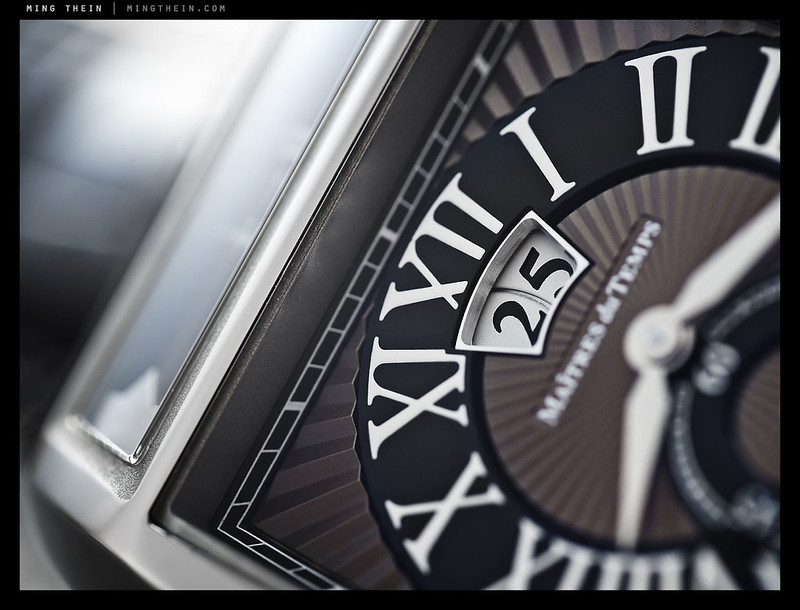
Maitres du Temps Chapter Two Tonneau. OM-D and 45/2.8 Macro

As with all of the Panasonic lenses on Olympus bodies, you have a choice of which stabilization system to use – either the moving-lens based system, controlled by a switch on the side of the lens, or the sensor-shift type built into the body. I did quite a lot of testing comparing the two systems – unfortunately there’s no real quantifiable way of doing this – and didn’t see any significant benefit of one over the other. As with all IS systems, you need to turn it off if the shutter speed is high enough otherwise you will actually land up with double images. The threshold is probably around 1/500s. I think this is because it can’t react fast enough to the high-frequency vibration caused by the shutter, but I’m sure there are others far more knowledgeable on this subject.

_5001978 copy
Doctor Zoidberg. OM-D and 45/2.8 Macro

There’s a second switch on the side of the barrel, and that’s to control the focus limiter. Like all M 4/3 lenses, manual focus is entirely fly-by-wire; I personally don’t like these systems because they don’t give you enough tactile feedback and lack hard infinity or near limit stops. Although I prefer to use manual focus when shooting close focus so I can set my magnification before focusing, this is one of the few lenses where I have no choice but to rely on autofocus.

_5004225bw copy
Street scene in Geneva. OM-D and 45/2.8 Macro

It will hunt a bit if you have the lens set to full range and aren’t focusing on a close subject; but for the most part, focusing is actually pretty swift if only small changes in focus distance are required. Switching on the limiter – near focus of 45cm – makes things much faster. (The full limit is 25cm, which gives 1:1 magnification and about 10cm or so of working distance from the front of the lens). I haven’t actually tried it on the E-PM1, but I don’t expect focusing performance to be much worse.

_5004606 copy
Hublot Ultra Thin. OM-D and 45/2.8 Macro, ambient light on location.

The 45 works much better as a dedicated macro lens, and will serve handily as a portrait lens in a pinch; however, my general purpose pick would be the Olympus 45/1.8. Image quality is superb; there’s a biting sharpness and fine microcontrast structure you’d expect from a lens with this price tag and implied heritage. It definitely renders in a very different way to the Olympus 45/1.8; I suppose the best way to describe it would be tight and controlled.

_5004169 copy
Geometry. OM-D and 45/2.8 Macro

It’s a midsize (for M 4/3, but about the same size as a 50/1.8 for any SLR mount) lens which balances well on an OM-D, with or without the optional grip. Sadly, the only metal parts in this lens appear to be the lens mount and screws; whilst the plastics are of high quality and the build quality and tolerances are tight, it just doesn’t have the feel of a precision instrument in the same way that say the Leica M or Zeiss ZF lenses do.

_5001673 copy
Study of a pepper, 2. The full size shot shows some nervousness of bokeh around the focus transition zone near the stem. OM-D and 45/2.8 Macro

I would personally prefer a bit more control over my depth of field in a macro lens. Having said that, the extended depth of field offered here can be useful for certain applications where you need to get a large amount of the subject in focus. Perhaps the forthcoming Olympus 60/2.8 macro will better suit my requirements. However, it does offer some advantages over my normal setup – at maximum magnification, it covers a 17x13mm frame, against 36x24mm for full frame, and without the need for any extension tubes and the accompanying degradation in quality*. I can also see some uses for it for macro video, though the fly-by-wire focus ring may prove to be a bit of a problem.

_5002024 copy
Grilled wagyu done right. OM-D and 45/2.8 Macro

*Extension tubes add another set of mount interfaces into the optical system; any slight deviations in planarity, or looseness, or give, will result in the optics being slightly off-axis. This is visible as softening, coma or astigmatism.

For now, though, the Panasonic Leica 45 retains a place in my bag, especially for use as part of my backup system on watch shoots. Don’t let the plastic exterior fool you: optically, this is a serious lens, and in the grand scheme of things it actually represents fairly good value for money despite being one of the more expensive lenses in the M 4/3 system. MT

The Panasonic Leica 45/2.8 is available from B&H and Amazon.

____________

Visit our Teaching Store to up your photographic game – including Photoshop Workflow DVDs and customized Email School of Photography; or go mobile with the Photography Compendium for iPad. You can also get your gear from B&H and Amazon. Prices are the same as normal, however a small portion of your purchase value is referred back to me. Thanks!

Don’t forget to like us on Facebook and join the reader Flickr group!

appstorebadge

Images and content copyright Ming Thein | mingthein.com 2012 onwards. All rights reserved

_5004452 copy
Hublot Diver’s Chronograph. OM-D and 45/2.8 Macro

Watch photography with the Olympus OM-D, and thoughts on its use as a backup system

_5001608 copy
The Maitres du Temps Chapter Two Tonneau China special edition.

For a system to be able to serve as backup, it must fulfill one important function: the ability for me to continue working with it and delivering images if my main system should fail for any reason. And it should be able to cover all genres of what I shoot, without too many workarounds or compromises. The obvious choice would of course be to buy two of the same camera, but a) where’s the fun in that, and b) sometimes it’s also useful to have a different camera system to give you other shooting options not available from your primary.

_5001346 copy

For the past couple of months, I’ve been shooting with the Olympus OM-D for most jobs which do not require special purpose lenses (e.g. tilt shifts) or huge resolution; the Nikon D800E of course covers everything else. What I’ve found so far is that from a usability and image quality point of view, the camera has no problems delivering the goods consistently; the only exception being a peculiar lockup problem that only happens if you use the Fn1 button to zoom into an image after shooting, then hit the protect button if you’re in the screen with the zoom toggle slider on one side. Unfortunately that does seem to be part of my workflow, but I’m learning to avoid it.

_5001447 copy

The biggest question, in my mind, was whether the system was a viable alternative to the D800E for doing watch work – rather important, given that this is the majority of what I do commercially. I acquired a Panasonic-Leica 45/2.8 Macro Elmarit (yes, a review is in the works) for this purpose. Suffice to say – the lens isn’t the limiting factor at all, it’s pretty darned awesome (and one of the better macro lenses I’ve used, actually).

_5001632 copy

Although Olympus does have a wireless flash system (FL36R, FL50R and FL500R) which is IR-triggered like Nikon and Canon’s systems, I wasn’t about to buy another set of speedlights, and certainly not about to carry them around along with the primary system, too. Fortunately the Nikon SB900s I use have a SU4 optical slave trigger mode – with manual flash power, of course. I used this and manually set the output levels. Yes, it’s much slower than using iTTL and dialing in adjustments directly through the camera, but it works.

_5001532 copy

All in all, as you can see from the images here, I think the results are pretty darned good – my client didn’t say anything about the file quality, or lack of it; the OM-D’s files interpolated very cleanly to 25MP and their required resolution.

Depending on what I shoot, I’ll carry the OM-D body and 12mm and 45mm macro lenses, or just the 45; the 20/1.7 rides along as a body cap. One nice thing is its ability to use the Zeiss ZF glass I’ll normally carry for my D800E via an adaptor, so I don’t even have to carry the 45 and 20mms if I’ve got the 50/2 Makro-Planar and 21/2.8 Distagon.

One note of caution – during my recent Hong Kong workshop, the camera decided to stop working in a very humid environment (light rain, probably 90-95% humidity) and didn’t come back to life again until being dried out in air conditioning and with a few blasts from a hair dryer for good measure – so they’re probably not as well weather sealed as they claim. It continued to work intermittently for a few days afterwards, with menus self-navigating (as though one of the buttons was shorted out) before working normally thereafter. Odd. MT

The Olympus OM-D in various configurations is available here from B&H and Amazon.

____________

Visit our Teaching Store to up your photographic game – including Photoshop Workflow DVDs and customized Email School of Photography; or go mobile with the Photography Compendium for iPad. You can also get your gear from B&H and Amazon. Prices are the same as normal, however a small portion of your purchase value is referred back to me. Thanks!

Don’t forget to like us on Facebook and join the reader Flickr group!

appstorebadge

Images and content copyright Ming Thein | mingthein.com 2012 onwards. All rights reserved

Photoessay: Kowloon in color

Shot on a particularly rainy night in Kowloon, post-typhoon with a Leica M9-P and Zeiss ZM 28/2.8. Surprisingly, both functioned fine despite the moisture and humidity. I must be one of the few strange photographers who actually like shooting in the rain – it’s not masochism, despite what it might appear as. Three simple reasons: one, there’s a lot more texture and color from the water, reflections and umbrellas; two, the light is a bit more diffuse; three, nobody pays you any attention – everybody is simply too busy trying to keep dry. And this makes street photography significantly easier. MT

_M9P2_L1000628 copy

_M9P2_L1000463 copy

_M9P2_L1000492 copy

_M9P2_L1000609 copy

_M9P2_L1000567 copy

_M9P2_L1000554 copy

_M9P2_L1000518 copy

_M9P2_L1000490 copy

_m9p2_l1000481 copy

_M9P2_L1000473 copy

____________

Enter the August 2012 competition: Compact Challenge – here!

If you enjoyed this post, please consider supporting the site via Paypal (mingthein2@gmail.com); Ming Thein’s Email School of Photography – learn exactly what you want to learn, when you want to learn it or learn how to achieve a similar look with our Photoshop workflow DVDs.  You can also get your gear from Amazon.com via this referral link.  Prices are the same as normal, however a small portion of your purchase value is referred back to me. Thanks!

Don’t forget to like us on Facebook and join the Flickr group!

Photoessay: Macau, part two

A continuation of the set from Macau. Shot in the tail end of a typhoon with a Leica M9-P, Zeiss ZM 2.8/28 Biogon and ZM 2/50 Planar lenses. MT

_M9P2_L1000693 copy

_M9P2_L1000923 copy

_M9P2_L1000971 copy

_M9P2_L1001019 copy

_M9P2_L1000967 copy

_M9P2_L1000801 copy

_M9P2_L1000918 copy

_M9P2_L1001042 copy

_M9P2_L1001011 copy

_M9P2_L1001032 copy

_M9P2_L1000927 copy

_M9P2_L1000840 copy

_M9P2_L1000755 copy

____________

Enter the August 2012 competition: Compact Challenge – here!

If you enjoyed this post, please consider supporting the site via Paypal (mingthein2@gmail.com); Ming Thein’s Email School of Photography – learn exactly what you want to learn, when you want to learn it or learn how to achieve a similar look with our Photoshop workflow DVDs.  You can also get your gear from Amazon.com via this referral link.  Prices are the same as normal, however a small portion of your purchase value is referred back to me. Thanks!

Don’t forget to like us on Facebook and join the Flickr group!

Photoessay: Macau, part one

Part one from Macau; immediately post-typhoon and still very, very rainy, not to mention humid. This set was shot with an Olympus OM-D, 45/1.8 and Panasonic 20/1.7 lenses. Images can be clicked on for larger versions, or to go to the flickr hosting page where exif data is available. Enjoy! MT

_5006741 copy

_5006727 copy

_5006756 copy

_5006785 copy

_5006784 copy

_5006828 copy

_5006872 copy

_5006803 copy

_5006701 copy

The curious thing about outbound Macau customs was that there were none…take whatever you will from that (and the country).

_5006891 copy

____________

Enter the August 2012 competition: Compact Challenge – here!

If you enjoyed this post, please consider supporting the site via Paypal (mingthein2@gmail.com); Ming Thein’s Email School of Photography – learn exactly what you want to learn, when you want to learn it or learn how to achieve a similar look with our Photoshop workflow DVDs.  You can also get your gear from Amazon.com via this referral link.  Prices are the same as normal, however a small portion of your purchase value is referred back to me. Thanks!

Don’t forget to like us on Facebook and join the Flickr group!

Photoessay: New car time

I don’t normally shoot cars – I leave that to my good friend Darren Chang – but my wife recently got herself a new ride. Since I photograph everything that moves or doesn’t move as a matter of habit and for practice, I couldn’t help myself. The 6R Volkswagen Polo GTI is one of the best bang for the buck cars you can find here – 185bhp from a 1.4 turbocharged and supercharged four; it gets to 100km/h in the mid-six second range, and has a great growly exhaust note. Also, it’s a lot of fun. MT

This series shot with an Olympus E-PM1 Pen Mini and 14-42 kit lens.

_PM07912 copy

_PM07976 copy

_PM07919 copy

_PM07889 copy

_PM07960 copy

_PM07961 copy

_PM07903 copy

____________

Visit our Teaching Store to up your photographic game – including Photoshop Workflow DVDs and customized Email School of Photography; or go mobile with the Photography Compendium for iPad. You can also get your gear from B&H and Amazon. Prices are the same as normal, however a small portion of your purchase value is referred back to me. Thanks!

Don’t forget to like us on Facebook and join the reader Flickr group!

appstorebadge

Images and content copyright Ming Thein | mingthein.com 2012 onwards. All rights reserved