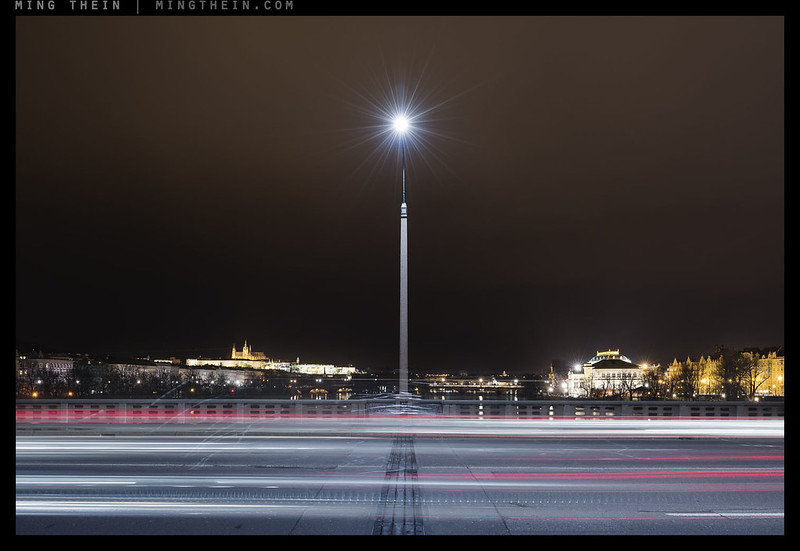
Today’s photoessay is a series off nightscapes from Prague. I’ve always found night photography requires a bit of an ‘inertial hump’ to get over – especially if you’re out hauling the tripod for some long exposures; there’s an optimum window just after dusk when the sky is a dark blue and not totally black, balancing off with the ambient illumination of the buildings. It means you have to carefully plan your locations and/or route in order to be at the right place at the right time; on top of that, I find the actual shooting window is pretty small – perhaps two hours at best unless you’re living at extreme latitudes in summer.
On Assignment: architecture by night
Sometimes, one is given some pretty sweet assignments. Quite near the top of that list is a commission to photograph beautiful buildings by one of the country’s – arguably the world’s, too – leading architects with the rare thing of a completely open creative brief. This is the position I found myself in a couple of months ago, camera bag in one hand, Mother Of All (somewhat portable) Tripods in the other, and sheaf of permission letters and permits from Hijjas Kasturi Associates tucked away safe inside the camera bag just in case.
Photoessay: The Yatai of Fukuoka
During the day, you sometimes come across one or two of these food carts hiding dormant and parked in an alleyway, shuttered up and slumbering. Lights off, boarded up, you have no real idea as to their purpose. However, as night falls, Fukuoka’s traditional food carts start to emerge from their various hiding places, spread their wings, awnings, seats, sidewalk tables, makeshift walls/ partitions, lights, signs (in effect being a complete portable mini-restaurant around a counter-cum-kitchen) and cooking paraphanelia, and more attractively, their fragrant smells. Most of them congregate by the river under some trees in a stretch that’s bounded by Hakata Canal City on one side, and the seedier red light district on the other. I suppose they cater to the shoppers before they go home, and the punters before they go out.
POTD: Seeing stars
I posted this image on the site’s Facebook page yesterday and received both a record number of likes, shares and responses/ questions – some doubting the authenticity of the image – so I thought it’d be a good candidate for reviving POTD.
Here’s the backstory: the image was shot out of an airplane window at 32,000 feet while returning from the USA tour; my wife was in the window seat and idly wondered if she could see stars, after the crew turned off the cabin lights for the night to encourage passengers to sleep (I suppose to theoretically help them get over jetlag). She stared for a while, acclimatising her night vision, and said there were quite a surprising number. I finished editing the batch I was working on, and joined her at the window. I could actually make out a very faint band of something running through the middle; I thought it might make an interesting photography experiment.
Photoessay: Tokyo nights
I love shooting at night in Japan for many reasons – firstly, the city never sleeps so there’s always something interesting to photograph; secondly, the quality and layout of the light itself is interesting – their designers obviously pay a lot of attention to this; finally, it’s easy to achieve high image quality. There’s simply so much light it’s rarely necessary to venture into the higher ISO regions, so you can actually get some tonally very rich images covering a large dynamic range with little noise and reasonable shutter speeds. It was better in the pre-Fukushima days when electricity was abundant in Japan; I remember being surprised that in late 2008 I could seriously shoot ISO 200 at night, handheld.
Needless to say, on my last trip, I did plenty of roaming the streets after dark. Here is a collection of my favourite images in that theme. Enjoy! MT
This set was shot with an Olympus OM-D with the 12/2 and 45/1.8 lenses, and a Sony RX100.
____________
If you enjoyed this post, please consider supporting me via Paypal (mingthein2@gmail.com). Visit our Teaching Store to up your photographic game – including Photoshop Workflow DVDs and customized Email School of Photography; or go mobile with the Photography Compendium for iPad. You can also get your gear from Amazon.comhere. Prices are the same as normal, however a small portion of your purchase value is referred back to me. Thanks!
Don’t forget to like us on Facebook and join the reader Flickr group!
Images and content copyright Ming Thein | mingthein.com 2012 onwards. All rights reserved
Photoessay: Burlesque party
A continuation of the sequences theme from a few weeks ago; let’s just say this was one of the more fun parties I attended. And being a party, it’s a social occasion; I certainly wasn’t working, but that didn’t prevent me from packing some pocket firepower in case photographic opportunities presented themselves, or I simply got bored with the conversation. (My wife is a long-suffering social and conversational martyr when it comes to me, photography, vacations and parties – thanks Nadiah!) Yes, it was dark, and there is motion blur because I ran out of apertures and shutter speeds (not to mention having trouble focusing on the rapidly moving dancers) – but I definitely think the motion blur adds to the action and slight sense of chaotic fun. MT
This series shot with an Olympus E-PM1 Pen Mini and Panasonic 20/1.7 G.
Photoessay: Bruno Menard at Forlino
I was in Singapore recently to run a few food photography 101 sessions under Leica at the World Gourmet Summit. One of the perks of the job was getting to enjoy the samples. In this case, by 3* Michelin chef Bruno Menard, who formerly ran L’Osier in Tokyo – widely thought to be the best restaurant in Japan at the time. I ran a very basic setup for the participants with a couple of small LED video lights, a Leica D-Lux 5 compact and some modified settings (optimized for food work); I shot tethered and showed the results instantly on a HDTV via HDMI out. There was a little PS work done to the images afterwards (i.e. for this set) but for the most part, the D-Lux 5 makes a surprisingly excellent little food camera – especially when there’s enough light around. MT
Images shot with a Leica D-Lux 5.