(hereafter known as the Pen Mini for simplicity.)
First things first: I don’t do measurement style reviews; there are other sites that do that much better than I can. I write from a shooter’s perspective: is it a good tool? Do I enjoy using it? Are there any critical flaws potential purchasers should know about? If you’re fine with that, read on.

Olympus E-PM1 Pen Mini, taped up for stealth and wearing the excellent Zuiko Digital 12/2. I’ve since switched to using a small lanyard strap, because a strap this chunky is overkill for such a small camera – and I wanted to use it on my M9-P.
At the end of 2011, Olympus introduced an interesting trio of cameras. Although they were ostensibly positioned at different market segments, just a couple of hundred dollars covered the spread, and they all shared the same sensor and AF system. Two of them even almost had the same body (the E-PL3 and E-PM1 only differ by a mode dial, flip screen and another button or two). The E-P3 had sightly different firmware, better build, and a greatly increased number of manual controls.

Prague river evenings. Olympus Pen Mini, 45/1.8
Let me be honest upfront: I was not a fan of the original E-P1, nor any of its descendants or sub-lines. They were slow to operate and focus, had frankly quite poor image quality, and were neither small nor light. They were also ergonomically pretty poor.
So what changed? Firstly, the ergonomics. The Pen Mini is tiny. As in compact camera tiny, without a lens attached; and not much larger than a LX5 if you use one of the pancake lenses. The main thing is operation speed. The latest generation are fast. Fast enough that you’re constantly impressed that it’s found focus, and done so accurately. And fast in every other way too – navigating menus, playback, zooming review images, shot-to-shot, etc. Curiously, the small-bodied E-PM1 and E-PM3 are both faster than the flagship E-P3; they’ll shoot at around 5fps with the stabilizer off, but the E-P3 is limited to 3fps. Apparently it’s a limitation of the older shutter or stabilizer design. (But that’s not as fast as it gets; the new E-M5 will do 9fps with AF locked, and focusing is supposed to be even faster – not that you’d really be able to tell the difference.) Bottom line: you’re not waiting for the camera, and it isn’t what’s stopping you from getting the shot. After trying one in a store – a friend bought the E-P3 – I instantly decided it was fast enough; if the image quality was okay, then we’d be in business.

Rush hour storm. Olympus Pen Mini, Panasonic 20/1.7
Autofocus is very fast indeed for static subjects in good light; I can’t tell the difference between the Pen Mini fitted with the right lenses (the new Olympus ones) and my D700. In lower light, there’s a difference; in very low light, sometimes the camera will fail to find focus at all. Forget about moving subjects; although there’s notionally a tracking mode, it’s essentially useless. Fall back to prefocus, timing and the larger DOF afforded by the small sensor in such situations. There is one quirk with the Olympuses (Olympii?) that I haven’t seen with other contrast-detect AF systems: it gets confused by extreme contrast (for example, focusing on the sun or a point light source) and just hunts, or perhaps reports good focus after settling at an intermediate point. That’s odd, because something that high contrast should be a perfect focusing target, right? Maybe it’s the pixel overload – blown channels – that stops it from working properly.

The assembly of modernist cuisine. Olympus Pen Mini, Panasonic 20/1.7
The headline spec isn’t that exciting – just 12MP, and seemingly the same sensor as the previous generation of cameras. What Olympus did was increase the sensor readout speed to 60Hz, which has the effect of doubling autofocus speed (slightly more, actually, when the new focusing algorithm is taken into account) and making the view smoother. A good 12MP is more than enough for almost all but the most demanding uses; I’ve been plenty happy with the output of my D700, and guess what, that has exactly the same resolution.

Afroman. Olympus Pen Mini, 45/1.8
A D700 it is not, however. The Pen Mini (and by extension, other cameras using the same sensor) produce detailed, sharp images when used with the right lens and within their optimum shooting envelope; in some ways the output reminds me of the Leica M9 at low ISO. The antialiasing filter is very weak, if there is one; single pixel detail is excellent, especially when paired with the right lenses – the Olympus 45/1.8 that accompanied the cameras at launch is a good example of that. I’d say the sensor provides clean output up to ISO 800; it’s useable at 1600, and perhaps 3200 in a pinch. What you see isn’t the increased luminance/ chroma noise (but maintained detail) of the M9; there’s definitely a gentle smeary noise reduction going on even for the RAW files which seems to kick in around ISO 1250. Fine detail structures are the first to go, followed by edge detail. It’s noticeably by ISO 1600, and annoying if you go any higher. More critical is the narrowing dynamic range as the sensitivity increases – by ISO 1600 you’re probably looking at no more than 6 good stops from a RAW file. Note the reduced dynamic range is also noticeable at base ISO – specifically, the highlight recovery slider in Adobe Camera Raw does very little if the image is overexposed, and what little it does is tinged with false color information. The shadow slider still shows that there’s a decent amount of information in the quarter tones, but at the expense of luminance and chroma noise.
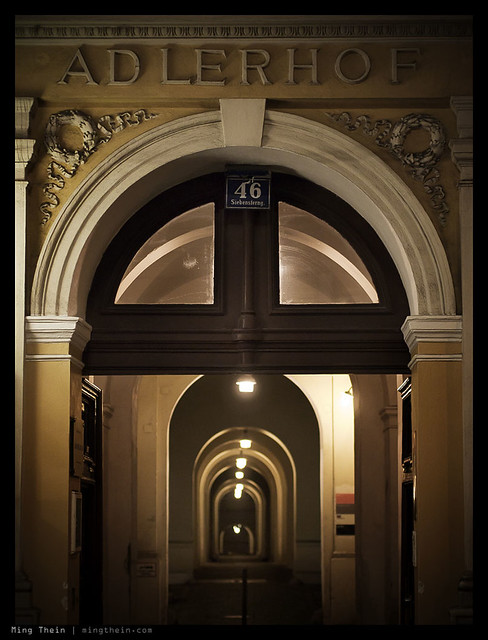
Arches, Vienna. ISO 1600 – looks good at this size, right? Visible edge erosion due to non-cancelable noise reduction at 100% though. Olympus Pen Mini, 45/1.8
You’d think this sounds pretty damning – it’s not. The files are punchy, and respond well to tweaking. However, the color palette is pleasing rather than accurate; something you need to take into account of if shooting objects, scenery or architecture. It excels at skin tones, however – in both RAW and JPEG. I’m a stickler for accurate color, especially after curve tweaking; it required quite a number of tries before I could accurately correct for the Olympus color palette (but still leave some residual camera signature in place).
Overall, image quality is right where you’d expect it to be for a sensor of this size: better than the 1/1.3″ compacts, but probably lagging a stop or so behind the best of the current APS-C cameras (Nikon D7000, for instance.)

Cathedral reflections, Prague. Olympus Pen Mini, 45/1.8
Let’s talk about ergonomics. With a body that small, there’s no way you can fit a huge amount of external controls in. And they didn’t even bother trying. In fact, there are so few buttons on the back of the camera that you really HAVE to use the ‘super control panel’ screen to make settings changes – or suffer through the absolutely horrible menu system. I also find the camera quite slippery to hold because it has no thumb grip other than the movie record button and a vestigial rubber protrusion above the D-pad/dial combo; I fitted a spare ThumbsUp and haven’t looked back since. It doesn’t really fit properly, but it does the job well and hugely improves handling. I suspect one of those stick on front grips by Richard Franiec would also make a big difference. There’s only one programmable function button – the record button under your thumb. You’ll have to decide what your most frequently used function is from a rather short list. I’m using it for center AF point during shooting and instant delete during playback; you could also use it for the usual AF/AE functions and a few other things.

Magritte strikes again. The camera really does quite lovely blues, especially sky tones. Olympus Pen Mini, 45/1.8
I have a love-hate affair with the menu. On one hand, the menu button brings up something that’s clearly aimed at a complete novice – you have a choice between scene modes, movies, PSAM, and a deeper-level settings menu. Curiously, the settings menu has two versions: the simple ‘idiot’ version with only basic options such as time, date, format etc – and a super-comprehensive version that makes the camera’s behavior more customizable than my D700. For instance, I can even adjust the LCD’s color temperature (!). The nice thing about this is you can set up the camera once to suit your shooting style, and not really touch it again after that. I shoot RAW, auto-ISO to 1600 with a lower limit of 1/60th (small cameras held at arms’ length mean higher propensity towards camera shake blur) and auto-WB. It’s in continuous high mode, with the stabilizer off, single point AF-C. The JPEG color settings do affect the RAW preview, so as usual I turn the saturation and contrast down, and crank up the sharpening so I can more easily tell whether what I’ve shot is in focus or not.

New year’s eve rebel. Olympus Pen Mini, 12/2
You’re probably wondering why I don’t use the stabilizer: basically, it’s pretty much useless. I have much better results by shooting fast bursts and keeping the middle image. Turning the stabilizer on creates an odd double image effect that I suspect is an artifact of not being fully able to compensate for the shutter recoil. At higher shutter speeds, you shouldn’t be using stabilization at all on any camera, because it won’t react fast enough. And don’t even think about using the stabilizer for movie recording; it’s a digital effect and creates horrible rolling-shutter jello. That said, I tried shooting video once with the camera, and was horrified by the jellocam effect even with stabilizer off; sufficient to say, this isn’t a good choice for movie makers. This is rather odd, since the sensor can read out at at least 60fps; furthermore, the design of the cameras actually seems somewhat video-centric – why else would you fit a 16:9 LCD to a camera whose native aspect ratio is 4:3? That’s actually one of my pet peeves with the Pen Mini: you’ve got a lot of unused LCD space in normal shooting mode, so the 3″ LCD is effectively more like 2.5″. At least there are plenty of pixels, so the image is sharp and fluid.

Architectural trees. This is about as bad as flare gets with the 45/1.8, with the sun in the frame – it’s not technically great, but it is very pleasing in a cinematic sort of way. Which suits my shooting style pretty well. Olympus Pen Mini, 45/1.8
Assuming you can figure out the menu and set up the camera to suit your style, the Pen Mini is actually a joy to shoot. I enjoy using it because it’s so small; it un-encumbers me and allows me to just be there with the option to shoot (without much compromise, if any) rather than consciously be shooting, as I would be if I was carrying a larger, bulkier camera. On a recent trip to Europe, I carried a Pen Mini and three lenses as my secondary/ backup system – all in the spare pockets of my jacket! I didn’t notice it was there until I needed a 90/1.8 equivalent, and out it came.

Sushi. Seared isaki with momeji oroshii chili. Olympus Pen Mini and Panasonic 20/1.7
Ultimately, the make or break for any camera system is the available lenses; it’s why the NEX and Nikon 1 haven’t quite taken off with anything other than then beginner/ upgraded market, and it’s unlikely the Ricoh and Pentax systems will appeal to anything other than a very niche audience. Argueably, Micro Four Thirds is the most complete compact system; it certainly has the most lens options other than Leica M (and there are plenty of adaptors that allow you to use those lenses, too). I could find fast primes in the focal lengths I’d want to use, which is more than I can say of any of the other systems; better yet, I had a few choices. Fast and wide? No problem – there’s the excellent Olympus 12/2, or the compact Panasonic 14/2.5. And then there are a few zooms, too. I went with the 12/2, smitten by its clutched focusing ring (but finding later that it lacked sufficient resolution to be truly useful for zone focus, and wishing I’d bought the much smaller Panasonic instead). Midrange? Olympus 17/2.8 pancake, Panasonic 20/1.7, Panasonic-Leica 25/1.4, or the insane Voigtlander 25/0.95. All are good except for the 17, which is an utter dog. I went with the 20 for the size; it’s a fantastic and very versatile lens, except being an older model, focusing isn’t as fast as the newer lenses. The Voigtlander looks insanely cool and offers very close minimum focus, but is hugely impractical (magnified live view focus at arms’ length, anybody?) and expensive. The Leica is a nice option, but too bulky for my liking. I shoot usually 24/28 and a short tele pair; on the D700 for instance it’s the 24/1.4 or Zeiss 2/28 Distagon plus the Nikon 85/1.4 G. Olympus released a new 45/1.8 together with the trio of cameras; it’s probably the standout lens in their range. It’s light, cheap, fast to focus, has great bokeh, biting sharpness and a very pleasing overall rendition – what more can you ask for? Sure, metal build would be nice, but I’m happy saving that for the new 75/1.8 (150mm equivalent) exotic. I was considering a macro solution, but I have the D700 for that – and don’t think that will be changing anytime soon.

Edible foam. Olympus Pen Mini, 14-42/3.5-5.6 IIR kit lens
I know in my mirrorless tips article I recommended using an external finder/ EVF for stability; I don’t with the Pen Mini for one simple reason: the stability I gain from bracing my face against the finder is negatively offset by the loss of stability caused by removing the ThumbsUp. Plus it makes the camera rather bulky, not pocketable, and fragile-feeling – I’d be constantly worried about snapping the finder off because it pivots through 90deg for waist level shooting, and doesn’t really lock in place all that securely.

Graffiti. Olympus Pen Mini, 45/1.8
With all cameras, the ultimate litmus test for me is how much I use it: the cameras I like more tend to be workhorses or go-to cameras, either because I enjoy using them or they’re the best tool for the job. Anything that stays around for longer than around 2-3,000 exposures is a keeper for me; none of the other mirrorless systems I tried (NEX-5, X100, X1) lasted that long. The Olympus is rolling over 7,000 and going strong – which is nearly as much as I shot with the M9-P during the same period (since November last year). My D700 has seen just a couple of thousand frames, which is unusual.

The embarrassment of having a pigeon crapping on your head. Olympus Pen Mini, 45/1.8
In conclusion, it’s a competent, fun camera. And at the current price of around $499 (I’ve seen it as low as $399 after rebates) in the US, it’s a no brainer. In fact, I’m thinking of picking up another one in electric pink to use as a spare or street photography camera; nobody is going to see me as a concern or take me seriously with one of those, which should make for some very interesting images. Micro Four Thirds has finally made good on its promise of smaller, just as good with this camera – its cheapest entry level option – not the flagship. I just hope the current corporate farce doesn’t kill the company, now that they’ve finally figured out how to produce a great product. MT

Haunted house. Olympus Pen Mini, Panasonic 20/1.7







 Ming Thein | Photographer