Nikon D800 quick update: Diffraction and studio work

One of the most frequent questions I’ve heard about the Nikon D800 is “where are the new diffraction limits?”

I spent the last two days using the camera for a studio product shoot – watches, of course – and now feel qualified to answer that question. Yes, my camera does have a misaligned AF module, but since you manual focus and stop down, it isn’t much of an issue for this kind of work. Low light wide-angle photojournalism, yes. But I digress.

Bottom line: with the 60/2.8 AFS Micro (which I think is the best of the macro lenses Nikon currently makes), everything is good up to f16, there are hints of it by f22, clear diffraction at f25, and I wouldn’t go past f29 even in emergencies – you’re probably back down to maybe 18MP of real resolution.

This is obviously a serious problem for the kind of photography I do. The solution? I just ordered the PC-E 85/2.8 Micro. MT

Addendum: I don’t know how many people this is going to matter to, but I notice the refresh rate of the built-in flash is slower – it matters to me because I’m an iTTL-CLS kinda guy, especially for my product and food photography work. What’s worse is that with the D700, if the camera wasn’t going to let the flash fire, you could cycle the power once and have a shot straight away. But with the D800, you’ve just got to wait, and wait, and wait for the capacitor to cool down and recycle. Cycling the power makes absolutely no difference whatsoever.

POTD: Voyeur, reflected

_PM03125bw copy
Voyeur, reflected. Olympus E-PM1 Pen Mini, Panasonic 20/1.7

Breaking news: Leica + Apple partnership!

A recent, reliable source has told me that the much hyped Photokina announcement for Leica won’t be a new M, but instead a further step towards documentary photography: to put better tools in the hands of citizen photojournalists, they have decided to finally give in to collaboration requests from mobile phone makers. Apple – probably the only design equal of Leica in the phone world – has decided to take on Nokia’s Carl Zeiss partnership and gone to Leica. It’s not exactly surprising after Jobs’ launch of the iPhone 4 – which compared the design gestalt as aspiring to the Leica philosophy.

The announcement makes a lot of sense as it will also tie in with the iPhone 5’s arrival, which has traditionally been around Q3. It’s also time for a redesign of the iPhone 4, which has now seen two generations of service – much like the plastic design of the 3G/3GS.

No concrete details on the sensor – my contact was very tight-lipped about that – other than ‘it will be more than 8MP, but not as many as that ridiculous Nokia 808 thingy; image quality will be fantastic because it will be bigger than most cellphone sensors and have no anti-aliasing filter.’ The real killer, however, will be the lens: an f0.95, 35mm equivalent. It will have AF with limited (10cm, I suppose?) macro functionality, is a Leica design, and will carry the NOCTILUX-C ASPH 0.95 inscription – presumably C stands for ‘compact’? I have no idea how thick this is going to be though – maybe there’s a lens protrusion, or folded optics, or a similar trick to keep the thickness down. Hopefully it won’t be too much of a pocket lump.

What excites me the most, however, is that they apparently got Apple to cave in an offer not only a physical, two-stage shutter button, but the option of saving a DNG file too – hooray! MT

POTD: Morning pistes

_M102398 copy
Morning Pistes. Nikon D2H, 70-200/2.8 VR

One from the archives – I haven’t been skiing in ages. I think it’s the adrenaline rush that does it for me; what other sport (except skydiving) allows you to go this fast without an engine? Next year, year after…I keep promising myself but life, work and everything else get in the way. It’s important to remember to take time out to relax, observe your surroundings and be inspired again – especially for somebody involved in the visual arts. Perhaps creativity in accounting or tax is best avoided, though. MT

Photoessay: Dawn over Kuala Lumpur

Although not technically aerial shots, the 421-m tall platform (plus hill) afforded by Menara Kuala Lumpur (KL tower) is a great place to get some interesting images of the city downtown at dawn or dusk – though it usually rains in the evening, so morning is a better bet. MT

Series shot with a Nikon D700 and 28-300VR.

_7049662 copy

_7049646 copy

_7049526 copy

_7049524 copy

_7049521 copy

POTD: Spot the famous photojournalism reference

_N5_DSC1804bw copy
Nomos Tangomat GMT-12 Prototype in Auckland. Bonus points for those of you who can spot the famous photojournalism reference here – hint: think Prague. Sony NEX-5, 18-55 kit lens.

On assignment this weekend, so I apologize in advance if it’s a little quiet here or on flickr. I will still be using the D800 for most things as it won’t involve much, if any, wide-angle work; there’s a D3x in case it does, though. MT

Update on Nikon D800 focusing issues

It seems that I’m going to have to redo all of my focus tracking and lens evaluation tests: my AF sensor module is misaligned. I’ve come to this conclusion after a) trying out a number of wide angle lenses, all of which exhibit a soft left side when the AF system or focus confirmation dot reports achieving focus; and b) sending it in to Nikon locally to diagnose. Curiously, the problem is only exhibited with wide angle lenses (telephotos are mostly fine), and live view confirms it’s an AF sensor issue not an imaging sensor issue.

The bad is that it’s serious enough to require a new camera because the calibration is a very high precision adjustment that takes time (and unclear if it can be done locally); the good news is that NPS Malaysia made the situation right: a couple of hours after reporting the problem, I met with a representative who informed me a new D800 will arrive next Wednesday, and I’ve been loaned a D3x until the replacement arrives – at which point it will just be swapped out. Kudos to NPS for handling the problem well though – that’s how professional service should work (though a new camera on the same day would be even better…)

Still, a bit of a shame, because I planned to use the D800 for its first commercial shoot this weekend – looks like I’ll only be using it for the stop-down telephoto shots. MT

Coda: It’s interesting just how sluggish the D3x feels when shooting in 14-bit raw mode – just 1.8fps, with what feels like a good 200ms or more of lag between hitting the button and the shutter firing. It’s very noticeable if you put the camera back into 12 bit mode, after which it feels responsive and snappy like it should. Even the menus feel a little laggy, like the camera’s processor is working very hard. The D800, by comparison, runs happily along at 5fps in 14-bit mode – 3x the frame rate with files that are 50% larger, for a total of 450% more data. You don’t feel any lag, and zoomed in images – even 14 bit raw – are very fast to navigate around. Faster than the D700, even. I don’t know how many other people have noticed this, but it’s pretty darn impressive, in my opinion.

____________

Visit our Teaching Store to up your photographic game – including Photoshop Workflow DVDs and customized Email School of Photography; or go mobile with the Photography Compendium for iPad. You can also get your gear from B&H and Amazon. Prices are the same as normal, however a small portion of your purchase value is referred back to me. Thanks!

Don’t forget to like us on Facebook and join the reader Flickr group!

appstorebadge

Images and content copyright Ming Thein | mingthein.com 2012 onwards. All rights reserved

Review: The Leica X1

_3100_DSC1318 copy

Why write about this camera now? The X1 may not be a new camera by any means, but curiously I think if anything it has become relevant again, now that large sensor compacts are all the rage (I can only hope for a digital full frame Ricoh GR1v or Olympus Mju II). I owned one of these for the second half of 2010 and into early 2011, before swapping it for the much-vaunted (and somewhat disappointing) Fuji X100 – to be the subject of another review.

What is interesting is that X1s are popping up used here and there at quite reasonable prices – though like most Leicas, they seem to resist extreme depreciation quite well. At the time, I couldn’t resist, and I was getting impatient waiting for the X100, so I traded in my Sony NEX-5 and bit the bullet.

_3100_DSC1400 copy

A little background: early attempts at mirrorless cameras seemed like a great idea to me – but also somewhat half-baked; here was a camera large enough to be inconvenient, but not large enough to do the job properly. And slow enough to make you want to tear your hair out. But yes, the image quality was definitely better than a small sensor compact. So I persevered. Early micro four thirds attempts weren’t just terrible, they were utterly dire. The Olympus E-P1 was so slow as to be unusable. And the control layout from the Panasonic G1 somehow just didn’t work well – despite being just fine on the LX3. Hmmm. The Sony NEX-5 was next; decently fast, getting smaller, but oh boy the interface was utterly horrible. And none of them had a good EVF, let alone a nice optical finder. Like every other equipment fanboy, the X100 seemed to be the perfect fix – EVF, OVF, manual controls, nice fast lens.

But the X1 got in the way.

_X1_L1000849 copy Hood reflections. Leica X1

First impressions: whoa, it’s light. There really isn’t that much inside the camera – although it’s metal, it gives the impression of being hollow rather than solidly packed like the Ms. It’s also nice and simple: the limited menu from the M8/9 made it over, keeping the important things and not adding anything superfluous. Shutter speed and aperture control dials are nicely obvious and pleasantly tactile, although they could perhaps be a bit stiffer to prevent accidental knocking. I’d ask for a lock button, but that isn’t part of the Leica gestalt. In fact, it looks and feels like nothing so much as a Barnack camera – especially if you put a compact finder on top. I like the Ricoh GV-2 28mm bright line – yes, it’s a 36mm equivalent lens, but if you use the insides of the 28mm bright line, it actually provides more accurate framing than a dedicated 35/36mm finder, which tends to be a bit too conservative for my liking. (I’m one of those people who composes their shots with the outside of their M’s frame lines.)

_X1_L1000782 copy
KLPAC. Leica X1

So, a digital Barnack – that’s a good thing, right? Well, yes and no. Let’s get the bad out of the way first: it’s slow; not in the control/ UI interface, but AF and MF were positively glacial. MF required too many turns of the little wheel to use accurately for zone focus; AF was just slow, period – even with the fastest ‘single point HI’ setting chosen. And it doesn’t focus closer than 30cm, though at times it seems even that’s a little generous. A firmware update improved things somewhat, but still doesn’t bring this camera into ‘this feels fast’ territory. I’m faster with an M9. And let’s not even talk about the Olympus Pen Mini. While I’m griping, I want to bring up two more issues: the battery life is abysmal – I mean I can exhaust a battery in an hour or two of shooting. Perhaps 300 frames and it’s flashing at me. Finally, in low light, the LCD doesn’t gain up enough; maybe it can’t without being grainy and unusable. It also doesn’t have enough pixels to manual focus easily. There are a few other niggles too – like peeling leatherette, which I was told is a tropical climate + glue compatibility issue and has been fixed on newer cameras; the flash sometimes not popping up…a bigger buffer would be nice, too.

_X1_L1001362 copy
Corporate sponsored roaring 40s party. Leica X1

With that done, let’s talk about the good things.

1. The sensor’s image quality is really excellent. For a 12MP camera using a last generation sensor. I understand it’s a derivative of the Sony sensor used in the Nikon D90, which was excellent but very much a first generation product for large sensor live view and video, and certainly without a fast enough refresh rate to be used for contrast detect autofocus – which is what the X1 does. ISO 3200 is definitely useable, and produces crisp results – with compromised dynamic range, of course; but the grain is nice and random, and mostly in the luminance channels. The tonal response of the sensor makes it excel at black and white work, even at higher ISOs. I believe the X1 also has a very weak (or possibly no) AA filter – and it shows.

_X1_L1001345bw copy
Shadow of the photographer. Leica X1

2. The lens’ image quality is also excellent. I was told that the optics are identical to the discontinued but highly regarded 24/2.8 Elmarit-M ASPH – except in a collapsible, autofocus version with an extended helicoid to allow focusing to 30cm instead of 70cm. It’s sharp corner to corner, and at every aperture. The lens clearly out resolves the sensor – aperture control is for depth of field control only, not improving optical performance. Microcontrast structure, flare resistance and chromatic aberration performance are all exemplary. Moreso when you remember that the lens is collapsible, with all of the various small potential alignment errors introduced by moving tubes and the like.

_X1_L1001184 copy
Redhead. Leica X1

3. The camera seemingly never fails to focus. Wait a minute, didn’t I say before that AF was terrible? I said slow: not inaccurate. It might take several seconds, but the camera will find focus. And that will be on the money. It doesn’t seem to get confused by point light sources, unlike most other compact system cameras I’ve used.

_X1_L1001273 copy
The mysterious oval in the mountains. Very, very low contrast – but no focusing problems. Leica X1

4. Flash sync speed is…1/2000s! Really? Yes, really. Say thank you to the leaf shutter. That means you can do a lot of creative work with it because you can sync at outdoor daylight speeds, as well as freeze motion very well. Oh, and there’s that handy built in flash: it’s quite useless for social work and as a primary, but as an optical slave trigger when manually set to minimum power, it’s great. One other benefit of the leaf shutter is that it’s an incredibly low-vibration camera – the release is just a smooth, quiet ‘snick’. I wish the Ms had a shutter like this – and the nice-feeling shutter button to go with it.

_X1_L1000998 copy
Hair flick. Leica X1, 1/2000s, Nikon SB900s in umbrellas.

Does it deliver the ‘Leica look’? Yes and no. These days, with enough processing, you can make a image shot from any camera look like it was shot using another one; however, there are some subtle differences like tonal accuracy and dynamic range that you can’t easily fake. The X1 feels to me like a half-Leica: the sensor is a CMOS, which by definition will have a very different – much more linear in the shadows and highlights – tonal response to a CCD, which is what is used in the M8/M9/S2 (and responds much more similarly to film, i.e. non-linearly). However, the lens definitely imparts some Leica DNA; you can see it in the way the images ‘pop’, but the color and palette might not be quite what you expect – that’s the sensor.

_X1_L1000466bw copy
Looking down. Leica X1

The bottom line is that this camera delivers what it’s supposed to: image quality. Ease of use is there, but speed could be seriously improved. And I’d like to see either a short zoom version (a 28-35-50 Tri-Elmar style lens arrangement could be interesting too) or a telephoto – say an 85/2 – which would be great for studio work.

_X1_L1000845 copy
More building color. Leica X1. I actually really liked this camera for architectural work; more than my Ms because of the precise framing afforded by the LCD. Wider would be nice, though.

I’m still trying to figure out who this camera is aimed at, though: it’s not automatic enough for a novice-who-wants-a-Leica to use and appreciate without feeling frustrated; you do need to know something about photography to get the most out of it by working around its limitations. (Hint: pre focusing is your friend). I think it’d make a good backup camera for an M user – if they sorted out manual focus; the wheel should be a bit more responsive, and it needs virtual DOF scales, I think – or an upgrade camera for a D-Lux 5 owner; but they might still want to keep the D-Lux around for the added focal length flexibility. It might also make the perfect weekend toy for the jaded SLR owner who wants to try something different.

_X1_L1001167 copy
Ferrari 430. Leica X1

One final word: as with all of the large sensor compacts I’ve used so far, don’t expect to shoot it the same way you shoot your SLR – it’s not designed for that. Instead, think of it more as an introduction to M-style photography – slower, more contemplative and more anticipative – and I believe the results will come. MT

_X1_L1001174bw copy
Lamborghini Gallardo. Leica X1

POTD: Flambé

_7060984 copy
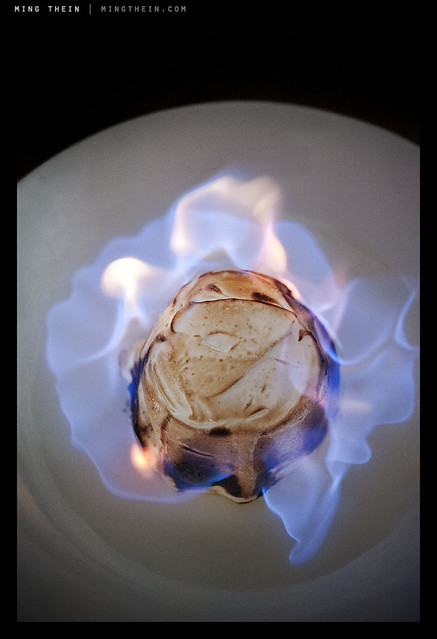
Baked Alaska. Nikon D700, AFS 60/2.8 G Micro

Flames are a funny thing – they don’t photograph well. Simply, yellow flame is bright because it contains a lot of incandescent little particles; usually, it’s too bright to photograph well relative to surroundings – you land up losing detail in the flame if you have context, or losing context if you have detail in the flame. Blue flame is almost impossible to photograph because most of its energy is heat – there isn’t much in the way of light-emitting incandescent particles. Flames are also very random in an interesting fractal kind of way; photographically that means you’ve got to do many, many takes – four Alaskas, in the case of this shot. And dozens of frames until we got just the right flame.

The problem for food photography – specifically baked Alaskas – is that the lit brandy you pour over the dessert burns blue, which isn’t so great to shoot. Sure, you could composite flames in after, but it would both look unnatural and just be dishonest. So what do we do? Simple: add a little something to the alcohol that makes it burn brighter, and a little yellower.

Interestingly, this is where the high ISO capabilities of the D700 become useful: ISO 6400 with a good amount of remaining dynamic range and very low noise. I don’t think this shot would have worked as well with the D800. MT

On assignment: Bistro food

_7060396 copy
This set shot with a Nikon D700, AFS 60/2.8 G Micro and several SB900 flashes.

I’m seeing an increasing shift in my commercial work these days towards food – as a gourmet (or perhaps as a greedy person) I’m certainly not complaining. Interestingly, food photography actually shares a lot of techniques in common with watch photography – with the huge benefit of not having any reflective surfaces to worry about. But from a lighting point of view, it’s the same.

Last week, I shot what was probably my final job with the Nikon D700 – some highlights of which are presented here. The D800 studio update will probably be towards the end of next week due to job scheduling.

I wanted to use this opportunity to say a few things about both food photography, and draw some conclusions on the D700’s use as a studio camera.

_7060499 copy

Food may not have any reflective surfaces, but it certainly presents some challenges of its own: firstly, temperature. Things don’t look optimally appetizing for that long (think ice cream) which means you’ve got to work quickly, and studio strobes are pretty much out of the question because the heat would make anything fresh wilt in less time than your fastest flash sync speed. The solution I’ve found to that is either use low-temperature LED panels or use flashes. For the most part, I use flashes because they’re more flexible in terms of light output deliverable, and have enough power to accommodate larger setups. LED panels don’t have as much throw or power, and go through batteries like crazy. And there are also color temperature issues – so far, very few panels can deliver a relatively even, neutral spectrum – and those that can are both hideously expensive and not all that bright.

_7060545 copy

The next challenge is actually detail: most people don’t want to look too closely at what it is they’re eating. I mean, a steak looks great as a whole, but I don’t think you want to start looking at meat fibers and thinking about exactly what motor function that muscle did when it was still part of the cow; there’s a huge compositional tradeoff between detail, suggestion, and emotion.

_7060248 copy

Bottom line: food images are about emotion: they must make you feel like you want to eat them. The ultimate litmus test for me is: would I want to order the dish if I saw this image in a menu? Lighting is your one control here: both softness and position of the light sources, and less intuitively, color temperature. (I’ll go into this more in a future article).

_7061864 copy

I’m going to conclude with a few words about the D700 as a studio camera. It may not deliver the most resolution, but it does have a few advantages over say a D3x or medium format – providing you don’t have clients that must absolutely have that pixel count. Firstly, there’ the built in flash with commander function – that was the #1 reason why I went for a D700 instead of a D3s, and I don’t regret it one bit. Speed isn’t an issue, but putting an ENEL4a in the MB-D10 grip gives you both speed and an incredible amount of shooting time: I can easily shoot a full day assignment on one battery. This assignment (2,000 frames in total) was completed with 60% power left over on the ENEL4a, and the ENEL3e in the camera still full. Finally, base ISO of 200 gives your speed lights a boost – and even if you don’t need the extra power, it reduces cycle time as well as extending your battery life.

_7061009 copy

Curiously, the internal flash can’t handle more than about a dozen shots or so in reasonably rapid succession before it cuts out to take a breather – unclear whether this is due to the capacitor’s limitations, or an overheat protection system of some sort to prevent your prism catching fire (which would probably be a fatal disaster considering the camera is both touching your face and made of highly inflammable magnesium.)

I’m looking forward to the quality the D800 brings, though I can’t say I’m so enthused about the amount of retouching it will require – especially for watches and other similar product. But for food, bring it on! MT

I will be attending the World Gourmet Summit in Singapore at the end of April to conduct some sessions for Leica; details to come soon. MT

_7060779 copy