Lens review: The Olympus M.Zuiko Digital 12-50/3.5-6.3 EZ for Micro Four Thirds

_5A00197 copy
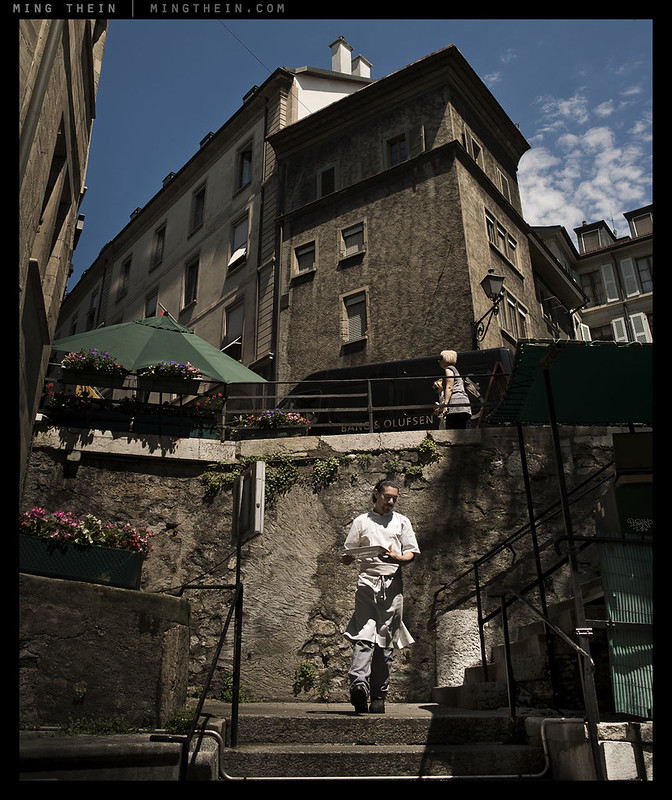
Waiting.

Olympus’ latest zoom covers a useful 24-100mm equivalent range (12-50mm actual) and is the kit lens accompaniment to the OM-D in most parts of the world. (I’ve also seen a variant that includes the 14-42 IIR instead.) It’s a bit of a Swiss army knife – the lens has a power zoom feature for video, which can be decoupled to provide a mechanical zoom ring (more on this later) plus a fixed focal length macro mode, at 43mm. It’s also got a programmable function button on the lens barrel. Like all M4/3 lenses except the 12/2, the lens is focus-by-wire only and has a continuously turning focusing ring that has no DOF markings.

       
Lens and optical formula. The various colored elements represent different types of glass. Image from Olympus Malaysia

Construction is all plastic, except for the metal mount. It’s pretty solid, though the plastics used feel a notch below those in comparable Nikon kit zooms; still, the lens is weather sealed and is the first of the Olympus lenses to feature a rear gasket. It’s not a small lens, by M4/3 standards – it’s about the same physical size as the Voigtlander 25/0.95, but nowhere near as heavy or well built. The best comparison I can give is to one of those miniature cans of mixers they give you on an airplane to go with your shot of whiskey. Like all Olympus lenses, it doesn’t include a hood or pouch (shame on you, Olympus).

_5A00399 copy
This lens is not meant for low light. This shot – 1s at ISO 800 – says more about the IS capabilities of the OM-D than anything else.

All images in this article shot with an Olympus OM-D E-M5, and the 12-50/3.5-6.3 EZ lens. Clicking on any image will bring you to the flickr landing page, where you and see larger versions.

Optically, the lens uses a 10/9 construction with several exotic elements; with aspherical elements, ED elements, HR elements, and one mysterious DSA element – I think it’s a double aspherical, but it could also be a Japanese government agency. Zooming and focusing is all internal. A quick note on the former: zooming can be accomplished by servo – in the intermediate position, the zoom ring turns into a rocker switch, with one speed in either direction – or mechanically, by pulling it backwards.

_5A00067 copy
Just your average youth on Saturday

The mechanical zoom is my preference, except in this case it has no real clear stops at either end – so when you turn the camera on, it’s very difficult to tell in advance where you are exactly in the zoom range. The complete lack of external cues doesn’t help, either – there are no focal length markings, and the lens doesn’t change length. I find this very disconcerting, not to mention costing valuable seconds when trying to get a shot.

_5A00465 copy
Swirl.

The good news is that focus speed is excellent – just as fast as any of the other Olympus ‘MSC’ lenses; I’m told that the system uses some form of magnetic solenoids and a single moving element to keep things silent and fast. Whatever technology used, it’s fast and precise, and has no problem moving in small increments to match small changes in subject distance.

_5A00277 copy
Untitled

A bonus feature is a 1:3 macro mode – this covers a 36x48mm frame area at a near focus distance of 20cm (normal minimum focus is 35cm), which actually makes it pretty handy at a pinch. Optically, performance is surprisingly good too in this range – completely at odds with one’s expectations for a zoom-with-macro. The macro mode is accessed by holding down a mechanical interlock button on the side of the lens and sliding the zoom ring all the way forwards, which locks the focal length at 43mm.

_5A00272 copy
Urban geometry

You’ll notice I haven’t said much about optical performance up to this point. That’s because it’s honestly quite a mixed bag. It can be good – if you stop down a little (though not past f8, because diffraction starts to rob you of resolution by that point) – but not in the corners. The 12mm end comes close to the 12/2 in the center, but is very soft in the corners; actually, soft is not the right term, the resolution is there, but there’s very clear CA causing apparent softness due to the separation of the blue and red components in the image. It’s a similar story at the 50mm end, though not as pronounced in the corners. There’s some internal flare that creates slight haloes around contrast edges, and it lacks the crispness of the 45mm. In fact, the 45mm at f1.8 is sharper than the 12-50 ever gets.

_5A00430 copy
Waves overhead.

Personally, I find the biggest problem to be not the lack of sharpness, or resolution, or CA – but the poor microcontrast. Textures are not very well defined at all; there’s a decent amount of macro contrast, but overall, the images produced just feel blocky – things seem to fall into either highlights or shadows, and nothing much in the middle.

_5A00281 copy
The Canyon

All that said, it does pretty well for a kit lens – though personally, I actually think the 14-42 IIR actually performs a little better overall; it just feels like it’s got more ‘bite’ than the 12-50. I could of course have a bad copy. Finally, you’ve also got to watch out for the small maximum aperture; f6.3 on the long end is not bright at all. However, thanks to the relatively small number of elements, the lens’ T stop seems to be fairly close to its f stop.

_5A00241bw copy
Night crossing.

I struggle a little with the conclusion on this one. It’s a lens that is convenient, and does so many things; but at the same time, I don’t feel like the optics do the OM-D’s sensor justice at all. However, if you’re out in the sunshine, and only want to carry one lens, it’s a good option.

_5A00053 copy
Balance

I purchased the lens as part of a bundled kit with my second OM-D; the price difference was quite small compared to body-only; certainly much less than the cost of the bare lens alone. This in my mind made it a worthwhile experiment; however, I don’t think I’ll be using it much, unless I happen to go to the beach or skiing or some other bright environment where I’d rather not be changing lenses. So, if you’d like the convenience, or can’t find a body-only OM-D, it’s not a bad buy; but if you’re expecting it to come close to the resolution of the M4/3 system’s primes, you’re going to be disappointed. MT

_5A00001 copy
A lens like an umbrella: take it just in case.

The 12-50 is available here from B&H in black or silver.

____________

Visit our Teaching Store to up your photographic game – including Photoshop Workflow DVDs and customized Email School of Photography; or go mobile with the Photography Compendium for iPad. You can also get your gear from B&H and Amazon. Prices are the same as normal, however a small portion of your purchase value is referred back to me. Thanks!

Don’t forget to like us on Facebook and join the reader Flickr group!

appstorebadge

Images and content copyright Ming Thein | mingthein.com 2012 onwards. All rights reserved

Calling for entries: The inaugural Mingthein.com photography contest!

_M9P1_L1009716 copy

I’m happy to announce a new and (hopefully long-term) feature for the site; something that’ll foster more active participation, buy me time to add more content, and of course, give back more to the readers: I’m going to run a photography contest.

The basic principles:
– It will be 100% merit based. I will be judging.
– There will be a cash award for the winner and runner up!
– The prizes will be supported by a small entry fee of US$5 – the more people who enter, the bigger the award pot becomes. So share it with your friends!
– You will learn something: the final 10 images will be given a detailed critique on the site.
– Unlike just about every other competition out there, I won’t keep the rights to your images; all you need to agree to is allow me to publish the image here if you win, or if you make the final 10.
– There are no restrictions on equipment or date the picture was shot.
– You do of course need to have shot the photo, and own the rights to the image.
– Images must be in the theme of the competition.

This is designed to be a competition by photographers, for photographers.

First theme: The Human Element

Judging criteria: The winning photo must be compositionally strong, have an obvious subject, be technically well executed in a manner that supports the subject, and above all, it must generate an emotional response in the viewer. There’s got to be a person in there somewhere. Color or black and white are both equally acceptable, as are posed and candid images. It doesn’t matter if you’re an amateur or professional, I’m only looking at the quality of your image.

Closing date: Midnight GMT, 31 July, 2012.

How to enter:
– Each participant is allowed to enter one image.
– Images must be in jpeg format, 1500 pixels wide on the long side.
– Watermarks are fine but must not obscure the subject (obviously)!
– Send an email with “July 2012” [space] plus your name in the subject line to mingthein2(at)gmail.com. The body of the email should contain your paypal address (payment is required for participation), name, your image and its title.
– Send your entry fee of US$5 via Paypal gift to [email protected]
– I will confirm receipt of both to the email address the image came from.
– Judging will take place in the first week of August, with results to come thereafter.
– Multiple entries are not allowed.

The fine print:
– First place takes 50% of the total entry fees received.
– The runner up takes 20% of the total entry fees received.
– The balance of 30% will go towards running and supporting this site.
– You must own the rights to the image submitted.
– Rights for all images submitted remain property of the photographer, but in order to be eligible to win, the photographer must grant mingthein.com the rights to publish the image either as part of the final 10 critique, or as the winner.
– The judges’ decision is final.
– Photoshop allowed, but digital editing is limited to adjustments to color/ contrast/ dodge & burn/ sharpening/ minor retouching including spot removal etc. Changes of substantial portions of the image in order to alter the overall impression of the photograph are not allowed, and if detected are subject to disqualification.
– Your email address and other personal data will remain confidential and not be shared with any third party.

– Entries are welcome from any country, it’s an international competition!

Remember: the prize grows directly proportional to number of entries, so share this with your other photography friends and on Facebook!

Good luck, and may the best image win! Looking forward to seeing all of your entries. MT

Second Singapore reader meetup

_8017355 copy
A quick competition. More details to follow…

Just wanted to say a big thank you to the readers who attended the Singapore meetup yesterday – great to see familiar faces and new ones; a shame several of you couldn’t make it, but there’s always next time.

And by the way, the collage of images/ iPhones above is something I’m going to run at all future meet ups – I’ll pick a subject, everybody finds an image to enter, puts $5 or $10 in the pot, I’ll do a critique, then the best image takes all. Think of it as an opportunity to learn something, and possibly a free lunch 🙂

See you all next time! MT

Book review: Workers, by Sebastiao Salgado

_5A00513 copy

One of my favorite photography books of all time is Sebastiao Salgado’s Workers, published by Phaidon. There are various printings around – some hard cover, some soft; the one I have is soft cover with a dust jacket. I actually find these easier to read, but I do worry about the long term durability of the bindings. Groups of pages are stitched together then held in a glued matrix at the spine – this kind of binding has given me some issues in the past, if the quality of the glue isn’t up to par.

But I digress. The book is about the photographs, and to a lesser extent, the printing; not the binding.

Brazillian-born Salgado is a photojournalist who needs no introduction – his long and distinguished career has included a stint at Magnum before founding his own agency, Amazonas Images; he’s also a UNICEF ambassador and has worked with the UN, WHO and other NGOs. He’s one of the few people who’s even had a special edition Leica set produced for him, which I believe was eventually auctioned off for charity. (As of late, he also seems to be a Canon brand ambassador.)

_5A00525 copy

Salgado has a preference for megaprojects – photographic assignments that last for years, or decades, rather than mere days or weeks; his latest and final project, Genesis, begun in 2004 and supposedly nearing completion. Workers was shot on medium format and Leicas; he has recently switched to a digital capture workflow, however, physical negatives are made from the select files and printed the old-fashioned way – which undoubtedly contributes to how his images have such a unique look.

That look – best described as tonally rich, with well-executed dodge and burn in the highlight and shadow quarter tones – is extremely distinctive, and highly textural. You can usually tell at a glance if an image is a Salgado. What elevates Salgado into the great photographic pantheon is his ability to combine perfect presentation with perfect framing, dynamically strong lighting and emotionally arresting subjects – each image provokes an emotional reaction in the viewer – anger, hope, pity, awe, fear – sometimes all at once, even.

_5A00521 copy

The content of Workers is very much encapsulated in the title – it’s a look at the people who keep the great economic machine turning over; curiously, there’s very little seen of the ‘managers’ and clerks; you get the impression that he either doesn’t think they’re worth bothering with because they do little to no real work. The reality is probably a mix of that, and the fact that piles of paper and meeting tables in faceless offices don’t typically make arresting photographic subjects. What you do get is a very intimate view into the spectrum of physical labor – from sulfur mining with bare hands to the construction of the Channel Tunnel. Nothing is clean and industrialized, perhaps with the exception of an auto production line; Salgado’s images portray reality: dirty, oily, textured and visually stunning.

The book itself contains several hundred images in black and white – I don’t think Salgado has ever tried working in color – there’s very slight bronzing to the printing, but I personally feel it adds to the overall look and feel of the images. I’ve had the privilege to see original prints at the Tokyo Metropolitan Museum of Photography, and feel these are very authentic indeed. The density of printing is also excellent, with blacks being extremely deep and the rich tonal variations faithfully reproduced. There are also numerous foldout pages for larger subjects.

_5A00519 copy

If you have a single photojournalistic bone in you, Workers and his other books are highly, highly recommended – it’s a book I go to for both compositional and tonal inspiration. Even if you have no interest in photojournalism, it’s difficult not to be awed by Salgado’s images; they show us a side of the world that few get to see, but for some people forms their entire reality. And hopefully, that incremental understanding and tolerance we take away from seeing into the lives of others goes beyond the enjoyment of the images. MT

____________

If you enjoyed this post, please consider supporting the site via Paypal ([email protected]) or via Ming Thein’s Email School of Photography – learn exactly what you want to learn, when you want to learn it.

You can also get your gear from Amazon.com clicking through this referral link. It doesn’t cost you any more, but a small portion of your purchase value is referred back to me. Thanks!

Don’t forget to like us on Facebook!

Quick poll: Photoshop workflow video tutorial

I’ve had a number of emails about my Photoshop workflow already, but they’re difficult to answer because a lot of this stuff is demonstration-based. I could make a video, but that’s very time consuming and means I can’t do other stuff. However, for a tutorial of this sort to be  useful and meaningful, it will have to be properly recorded and edited, supplied in HD on DVD, and will take some time to do. The tradeoff is always blogging vs commercial work – realistically it’ll probably cost a little something in order to justify producing.

So, before I go off and spend a couple of days producing one – I’d like to get an idea of how you all feel about it via the two quick questions below. Thanks! MT


Singapore reader meetup details

Hi everybody,

Just to confirm the reader meetup tomorrow – we’ll do it at The National Museum of Singapore; looks like I’m going to be holed up there all day with various other meetings/ events.

Venue: meet at the front entrance, the National Museum of Singapore – we’ll go find a place for food/ drinks after that; Novus is quite nice from memory.
Time: 1-3pm

Feel free to bring any other friends who might be interested. Free and easy like the last one, and perhaps we’ll run an impromptu photo contest, so bring your smartphones/ tablets etc…

In case you decide to come last minute, are running late, or get lost, my phone number is +60 17 387 6700.

See you all tomorrow! MT

Photoessay: Master Baker Daniel Jorda at the World Gourmet Summit

Master Baker Daniel Jorda is from the small neighborhood of Trinitat in Barcelona, and a third generation chef. In addition to running his own bakery, he also works with Michelin-starred chefs to produce custom breads to complement their meals; having tried them personally, I have to say that his work has the perfect balance of softness, crustiness, and flavor. Most importantly, it never seems artificial or forced – the bread is always rustic, but somehow perfectly controlled.

This short photoessay covers the class he gave at the World Gourmet Summit in Singapore a few months back. Series shot with a Leica M9-P and 35/1.4 ASPH FLE. MT

_M9P1_L1015677bw copy

_M9P1_L1015670bw copy

_M9P1_L1015647bw copy

_M9P1_L1015603bw copy

_M9P1_L1015615bw copy

_M9P1_L1015703bw copy

_M9P1_L1015685bw copy

_M9P1_L1015649bw copy

_M9P1_L1015612bw copy

_M9P1_L1015609bw copy

_M9P1_L1015607bw copy

_M9P1_L1015598bw copy

____________

If you enjoyed this post, please consider supporting the site via Paypal ([email protected]) or via Ming Thein’s Email School of Photography – learn exactly what you want to learn, when you want to learn it.

You can also get your gear from Amazon.com clicking through this referral link. It doesn’t cost you any more, but a small portion of your purchase value is referred back to me. Thanks!

Don’t forget to like us on Facebook!

Nikon D800/ D800E left focus problem update: fixed successfully!

Just got my D800E back from NPS. Apparently, the cause of the focusing problem in all cases is some inaccurate calibration data entered during the alignment/ calibration process. I was told it’s basically a case of hooking the camera up to the laser calibration jig, and letting a piece of software run a calibration routine point by point – there are no physical or mechanical adjustments made to the camera. The software then writes this somewhere in the camera’s ROM for future use. All testing is done with the 50/1.4, and the instrumentation is apparently sensitive enough to detect minor focus errors – they’re also present even on teles, but less obvious, is what I was told.

Also asked about the new firmware that’s appearing in some cameras – apparently it’s legitimate, but not officially downloadable yet. No news on when that might be. My camera still has the same firmware it went in with – A 1.00, B 1.01, L 1.006.

The good news is that all of the wides I tried the camera with now focus consistently between AF and live view, i.e. there’s no difference between the results from either AF system. I repeated the test a number of times, each time with the camera locked down on a Manfrotto Hydrostat head on top of a Gitzo 5-series systematic tripod, using flash. (Let’s just say that camera shake is a non-issue.) However, it’s also revealed that lenses are a lot less perfect and symmetrical than we would like them to be…the D800E has one seriously demanding sensor.

D800E-af test-post-fix

This example set shot with the 28/1.8G at f1.8. The original size is visible here, which is a screen shot of 100% crops.

Conclusion: problem solved. If you do have the left side AF issue, then send it in and insist they look at it – because there exists a fix, and it works. Barring any further AF oddities (it’s night time here and I haven’t had a chance to test AF tracking or 51-point 3D yet), I’m considering this issue solved. Thanks to the folks at Nikon Malaysia for turning around the camera so fast!

I’m off to break out the LensAlign to run AF fine tune on the rest of my lenses again. MT

____________

Visit our Teaching Store to up your photographic game – including Photoshop Workflow DVDs and customized Email School of Photography; or go mobile with the Photography Compendium for iPad. You can also get your gear from B&H and Amazon. Prices are the same as normal, however a small portion of your purchase value is referred back to me. Thanks!

Don’t forget to like us on Facebook and join the reader Flickr group!

appstorebadge

Images and content copyright Ming Thein | mingthein.com 2012 onwards. All rights reserved

Review: The Nikon AFS 28/1.8 G

_8015822 copy

Due to a risky mixture of popular request and a slight but gnawing dissatisfaction with my the performance of my 24/1.4 G on the D800E, I recently acquired the Nikon AFS 28mm f1.8 G to review. (Hereafter referred to as the 28G) The 28G was released earlier this year, and is now available with relative ease. It’s a 11/9 design with a near focus limit of just 25cm, and magnification of 0.22x.

All images in this review may be clicked on for larger versions. Photographs from this review were shot with a Nikon D800E on my last assignment to Geneva.

A note on testing methodology: I’m not a lab reviewer, but I do try and make my testing as scientific as possible. It’s part of getting to know the limitations of you gear, so you can make the most out of it on assignment and in the field. This means that if I see some odd behavior, I’ll do my best to replicate it before reporting it’s an issue. Please go by what I say, not by the images – it’s impossible to judge optical characteristics on web-sized jpegs; I’ve been looking at hundreds of D800E raw files.

_8015800 copy

The lens is both light in the hand, and fortunately also light on the wallet. At a street price of around US$650 (in Malaysia, at least) – it represents excellent value for money compared to both the AFS 24/1.4 G, and the notoriously difficult to find AF 28/1.4 D. Being a huge fan of the 28mm focal length, I find myself with few options – 24 and 35 are much more popular, and have everything from f1.4 options to macros and tilt-shifts. (To the best of my knowledge, the only perspective-control 28mm made was an early Nikon 28/3.5, which only allowed shift and no tilt.) Until now, my go-to lens at 28mm has been the Zeiss ZF.2 2/28 Distagon T* – to be the subject of a future review – which has some pretty unique optical qualities, not least its hugely pronounced field curvature.

_8015090 copy

Although the 28G carries the gold front ring signifying contents of ED glass and professional level construction, it definitely doesn’t feel like it. This is one of the lightest lenses for its size I’ve ever handled; similar in weight and size to the 18-135 DX kit lens, actually. The shell is entirely polycarbonate, and the only metal to be found anywhere is on the mount and screws. Looking at the edges of the back element, I suspect there’s a moulded aspherical element or two in there also. Still, build quality seems decent enough, with no creaks, rattles or clunking, and the focusing ring is both easy to turn and without any free play. The lens also has a rear gasket and is weather sealed.

_8015136 copy

This is a proper AF-S lens, which means that there’s full time focus override, no hard stops at either end of the focusing scale (though the resistance increases noticeably) and reasonably fast and accurate focus. It acquires focus at about the same speed or slightly faster than the 24/1.4, actually. Most of the time, the lens snaps into focus quickly and positively. I’ve had a couple of occasional ‘near misses’ where the camera thought the lens was in focus but it was just out of critical sharpness range – near enough – but only when shooting at f1.8. I don’t know if this is an issue with the lens or the D800E (and its focusing issues). Some further investigation is in order, I think. The lens is somewhat prone to the left-side AF issue of the D800/D800E, though only for the extreme most points (the column of three) – all of the other points focus as expected, at least on my D800E body.

_8014986 copy

_8014986 crop
100% crop of above

Optically, the 28G does a great job in the center – it’s sharp from wide open even on the D800E, however you need to stop down a bit to reach maximum microcontrast. Optimal sharpness in the center comes at about f5.6. There’s almost no CA or flare, even when shooting high contrast subjects; a testament to Nikon’s Nano-Crystal Coating doing the job it was designed for. There is, however, some uncorrected speherochromatism and longitudinal chromatic aberration – the latter which appears as both bloom and red/green fringing when shot wide open. The lens makes nice sunstars, too – with minimal ghosting.

_8014939 copy

_8014939 crop
100% crop of the above image, shot through glass (hence the fringing)

The corners, are a different story – they’re not sharp til about f8, and noticeably vignetted. However, it seems that the 28G also suffers from pronounced field curvature – much like the Zeiss Distagon – because there is a sharp plane of focus, curved in front of the subject and back towards the camera. It isn’t quite as pronounce as the Zeiss, but it’s definitely there. Technical shooters will hate this because it isn’t a flat-field lens, but personally I think it’s great for environmental portraiture and reportage – placing your subject somewhere in the central region means that the lens actually helps you to achieve better separation by relatively defocusing the background further. Speaking of technical shooters, there’s a hint of pincushion distortion, but nothing that isn’t easily fixable with the profiles available in Photoshop/ ACR.

_8015140 copy

Let’s talk a bit about bokeh – it’s best described as neutral to good. There are some bright edges on circular OOF highlights, but nothing too bad; there’s also a hint of texturing inside the same circles, which points to the use of a moulded aspherical element or two somewhere inside. I can’t help but think a circular 9-bladed diaphragm, similar to that used in the f1.4 G lenses, would have improved things a bit – the pennies had to be saved somewhere, and we have to make do with a 7-bladed and slightly angular iris.

_8015087 copy

If you’ve got enough distance between subject and background, the lens renders the scene with rather nice ‘pop’ – subjects are well separated from the background. Although the 28G has a maximum aperture of f1.8, it has about the same isolating power as the 24/1.4 due to the slightly longer focal length. I still wouldn’t use it for close up portraits though, the wide angle perspective distortion is definitely not flattering.

_8014954 copy

In what must be a first for any Nikon lens, the 28G seems to out-transmit its Zeiss counterpart, aperture-for aperture. The 28G has a T stop that’s about 1/3 stop greater than the 28 Distagon; a rather surprising result. (The Zeiss 85 Planar is nearly a whole T stop faster than the 85/1.4 D, and about a third of a stop faster than the 85/1.4 G.) The front elements have the same nearly-invisible look as those of the Distagon. More importantly, transmission throughout the color range is pleasingly neutral; scenes are rendered with clarity and natural saturation – though not quite with the same microcontrast punch and overall saturation of the Zeiss

_8015154 copy
Oops, missed the sensor dust.

If at this point it seems that the review has somewhat turned into a comparison between the Zeiss ZF.2 28 Distagon and the 28G, you’d be right – in my mind, these are natural competitors (at least they are in my lens cupboard, at any rate). It’s very difficult to choose between the two – the Zeiss does have a certain hard-to-define quality about its microcontrast structure and bokeh that just makes images shot with it slightly more vivid and three-dimensional; however, you lose very little with the Nikon, and gain much convenience by way of autofocus.

_8014991 copy

I am a 28mm junkie (at the last count, I’ve got nine ways to get there on four different sensor sizes) so you might want to take this conclusion in context – I can see reasons for having both. If I was shooting something for which I had time to be deliberate in the setup and craft the scene – I’d pick the Zeiss. However, if I was doing documentary work, or travel, or anything which might possibly have a hint of run-and-gun to it – I’d mount the Nikon. MT

The Nikon AFS 28/1.8 G is available here from B&H or Amazon.

____________

Visit our Teaching Store to up your photographic game – including Photoshop Workflow DVDs and customized Email School of Photography; or go mobile with the Photography Compendium for iPad. You can also get your gear from B&H and Amazon. Prices are the same as normal, however a small portion of your purchase value is referred back to me. Thanks!

Don’t forget to like us on Facebook and join the reader Flickr group!

appstorebadge

Images and content copyright Ming Thein | mingthein.com 2012 onwards. All rights reserved

_8014927 copy

_8014996 copy

_8015069 copy

Update: My 28 stopped working yesterday; up til this point it hasn’t had any issues, but suddenly none of my cameras would recognize the lens. Nikon service says it’ll be three weeks to get replacement parts (AF motor, PCB, some connectors) – which frankly is pretty unacceptable for a lens that’s only three weeks old! To make it worse, there aren’t any loan units or similar lenses other than a slow zoom or two.

To their credit though, they arranged a replacement through my usual dealer within about half an hour. With the number of problems with Nikon’s recent products, I’m starting to think that QC has suffered quite a bit following the tsunami – or it could just be because the lens is made in China.

Singapore reader meetup this Friday – 6 July – last call!

I’ll be in Singapore this Friday, 6th July for some meetings – if you’d like to attend the reader meetup lunch, from 1-3pm – probably around the Orchard area but TBC (will definitely be somewhere in town) – please leave a comment below with your email address, and I’ll send out the details in the next day or so. Thanks and looking forward to seeing you all there! MT