Photoessay: Macau, part two

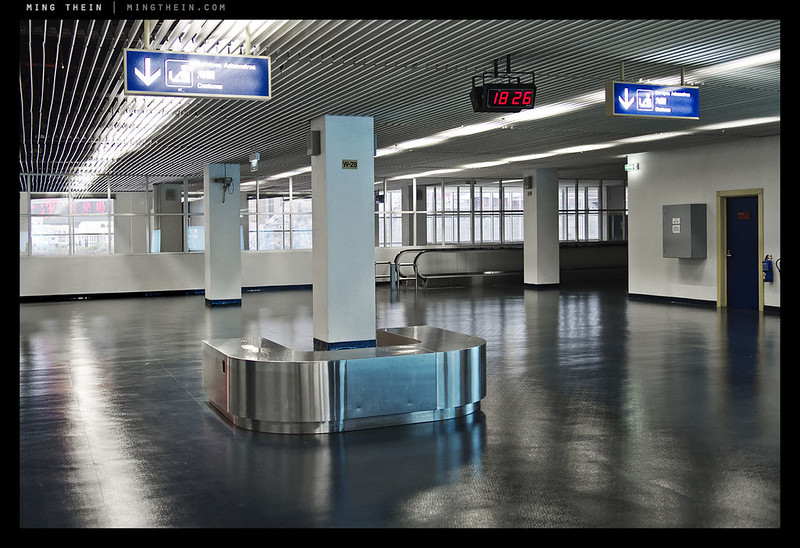
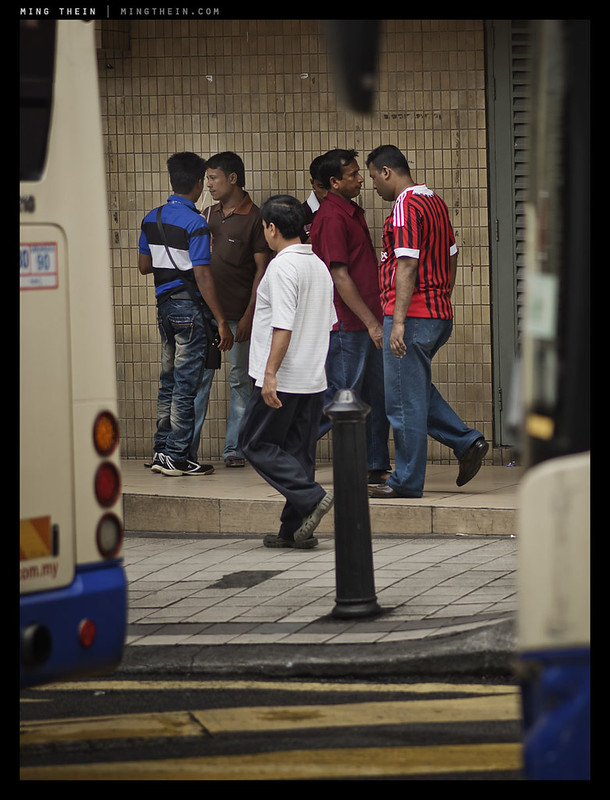
A continuation of the set from Macau. Shot in the tail end of a typhoon with a Leica M9-P, Zeiss ZM 2.8/28 Biogon and ZM 2/50 Planar lenses. MT

_M9P2_L1000693 copy

_M9P2_L1000923 copy

_M9P2_L1000971 copy

_M9P2_L1001019 copy

_M9P2_L1000967 copy

_M9P2_L1000801 copy

_M9P2_L1000918 copy

_M9P2_L1001042 copy

_M9P2_L1001011 copy

_M9P2_L1001032 copy

_M9P2_L1000927 copy

_M9P2_L1000840 copy

_M9P2_L1000755 copy

____________

Enter the August 2012 competition: Compact Challenge – here!

If you enjoyed this post, please consider supporting the site via Paypal (mingthein2@gmail.com); Ming Thein’s Email School of Photography – learn exactly what you want to learn, when you want to learn it or learn how to achieve a similar look with our Photoshop workflow DVDs.  You can also get your gear from Amazon.com via this referral link.  Prices are the same as normal, however a small portion of your purchase value is referred back to me. Thanks!

Don’t forget to like us on Facebook and join the Flickr group!

Photoessay: Macau, part one

Part one from Macau; immediately post-typhoon and still very, very rainy, not to mention humid. This set was shot with an Olympus OM-D, 45/1.8 and Panasonic 20/1.7 lenses. Images can be clicked on for larger versions, or to go to the flickr hosting page where exif data is available. Enjoy! MT

_5006741 copy

_5006727 copy

_5006756 copy

_5006785 copy

_5006784 copy

_5006828 copy

_5006872 copy

_5006803 copy

_5006701 copy

The curious thing about outbound Macau customs was that there were none…take whatever you will from that (and the country).

_5006891 copy

____________

Enter the August 2012 competition: Compact Challenge – here!

If you enjoyed this post, please consider supporting the site via Paypal (mingthein2@gmail.com); Ming Thein’s Email School of Photography – learn exactly what you want to learn, when you want to learn it or learn how to achieve a similar look with our Photoshop workflow DVDs.  You can also get your gear from Amazon.com via this referral link.  Prices are the same as normal, however a small portion of your purchase value is referred back to me. Thanks!

Don’t forget to like us on Facebook and join the Flickr group!

Review: the Voigtlander 25/0.95 Nokton MFT

_8015656 copy

There are several fast-normal options available today for Micro 4/3 users – the Panasonic 20/1.7, the Panasonic-Leica 25/1.4 DG Summilux, and the fastest of them all, the Voigtlander 25/0.95. There are also a whole host of modified CCTV and C-mount lenses, some of which cover the whole M4/3 frame, some of which don’t. None of them have enough resolving power to match the resolution of the sensor at full aperture, either.

_8015663 copy

Given the limited high-ISO capabilities of the earlier M4/3 sensors, there was an obvious gap left for a hyperspeed lens of any sort; being one of the M4/3 consortium members, Voigtlander stepped in to fill the gap. However, not having AF technology, Cosina had to make do with a manual-focus only design, but with a native M4/3 mount. The lens feels nothing like the M4/3 lenses from Panasonic, Olympus or Sigma; it’s a hefty lump of metal, built with the same solid feel as the more premium modern manual focus lenses. It’s not a small lens, especially once you attach the supplied hood – it’s actually about the same size (and much heavier) than the Voigtlander 75/1.8 for M mount. This lens rates very highly on the tactility scale; the focus ring is well-damped but turns smoothly without much effort; there’s no backlash and this makes focusing a very pleasing experience. The aperture ring has neat half-click detents, but I would prefer the stops to be a bit more decisive and less easy to turn.

_5003348 copy
Cinnamon. Olympus OM-D, 25/0.95

Let’s talk a bit about focusing – because one of the most frequently asked questions I’ve had with this lens. I would say it’s easier than expected, but not as easy as I would like – especially when using the lens stopped down. Since there’s no electronic linkage between the lens and camera, aperture is entirely mechanical; this means that you’re always seeing the stopped down view through the finder or on the LCD. The trick is to shoot raw, and turn focusing on your jpeg settings up to the maximum – this actually creates a little bit of a shimmery halo in the finder. (These settings of course do not affect the raw file). It also accentuates sharpness of the image, which makes it easier to tell when things are in focus – as you turn the focusing ring past then point of focus and back again, there’s a slight shimmer in the live preview. The focusing ring is also well-spaced – the normal range from about ~0.4m to infinity is easily covered by a turn of the wrist without having to reposition your hand; the near range – down to just 0.17cm – is more widely spaced, and allows for precise placement of the focal plane.

_5002263 copy
The whole frame at the near limit and f1.4. Olympus OM-D, 25/0.95

One doesn’t buy this lens with the intention to use it at any other aperture than wide open, at least most of the time. There’s simply no point in paying so much (it’s considerably more expensive than the Panasonic-Leica, which of course has autofocus and is about one stop slower) and carrying around so much extra weight if you’re going to use it at f2. In fact, you might as well get the Panasonic 20/1.7 – it’s cheaper, much smaller and focuses itself. The good news is that the center produces acceptable sharpness, even wide open – providing you focus it accurately. (The shallow depth of field transition profile of a 25mm focal length lens means that that finding the optimum plane isn’t always easy, either.)

_5002844 copy
Satay. Olympus OM-D, 25/0.95

There’s a considerable improvement in acuity at f1.4 in the center, and again at f2; however, the corners don’t reach anywhere near central levels of sharpness until f2.8 and beyond. Note that I use the term ‘acceptable’: it’s not great at f0.95, and there’s a distinct softness that’s probably caused by internal flare; I suspect that if the internal surfaces of the barrel were better coated against reflection, we’d see a corresponding improvement in contrast and sharpness. Microcontrast is simply nonexistent until f2, and macro contrast is generally quite flat, too – making it good for retaining dynamic range under extreme lighting situations, but poor for fine texture reproduction.

_5003457 copy
The hills are made of rice. Olympus OM-D, 25/0.95

What about the other common lens shortcomings, like vignetting, chromatic aberration, flare and distortion? The 25 has all of them, and in quite generous amounts, too. It will vignette wide open, but this is easily corrected and gone by f2.8. Chromatic aberration is a bit more problematic; we see that and purple fringing against high-contrast backgrounds, especially when subjects are backlit. If you get a bright point light source in the wrong part of the frame, you’re going to have fun with flare, lowering already low contrast even further – and the hood isn’t going to help you much. I didn’t actively look for distortion, so I can’t comment on it; the types of subjects this lens is suited to probably wouldn’t show it anyway.

_5002183 copy
Family corner, at f0.95. Due to the short real focal length, f0.95 doesn’t have as shallow depth of field as you might have otherwise imagined. Olympus OM-D, 25/0.95

After all of that, you might have come to the conclusion that this lens is pretty bad – optically, it’s definitely not the best I’ve used. But, what other lens offers a true f0.95 aperture (and T stop that’s not far off, either) at US$1200? I can see some uses for the 25 – portraiture, mostly – but it just doesn’t suit what I do. Even though the optics at f4-5.6 are excellent, and the 17cm near focus distance makes it quite useful for food photography, there just isn’t enough reason for me to keep the lens around since it replicates the performance of the Panasonic 20/1.7.

_5002247 copy
Untitled. Olympus OM-D, 25/0.95

As much as I love using the lens simply because it feels like a real lens, not a plastic shell – I just can’t recommend it for the kind of photography I do; it’s not sharp enough wide open to be used as an available-light lens, and is further hampered by the difficulty of focusing it under low light conditions; it’s big enough to defeat the point of the compact M4/3 system, and expensive enough that I think having the 20/1.7 and 45/1.8 lenses instead makes much more sense.

_5002826 copy
Burger time. Olympus OM-D, 25/0.95

If you’re an object shooter, as tempting as the close focus capability is, you can’t really use it wide open without dealing with rendering that’s best described as ‘impressionist’; you’re better served by the Panasonic-Leica 45/2.8 Macro, or the forthcoming Olympus 60/2.8. If you’re an available light shooter, and don’t mind the occasional softness due to focusing misses, then go ahead; if sharpness bothers you, then go for the Panasonic Leica 25/1.4 Summilux. However, I can see a very narrow niche of portrait photographers for whom pictorial style takes precedence over sharpness; this is your lens, and it offers a look previously limited to larger format systems.

If you must still have one, get it here from B&H or Amazon.

____________

Visit our Teaching Store to up your photographic game – including Photoshop Workflow DVDs and customized Email School of Photography; or go mobile with the Photography Compendium for iPad. You can also get your gear from B&H and Amazon. Prices are the same as normal, however a small portion of your purchase value is referred back to me. Thanks!

Don’t forget to like us on Facebook and join the reader Flickr group!

appstorebadge

Images and content copyright Ming Thein | mingthein.com 2012 onwards. All rights reserved

_5002233 copy
Crash test portrait dummy. Olympus OM-D, 25/0.95

Photoessay: Hong Kong life in monochrome

The first set from my recent Hong Kong and Macau workshop. Click for larger versions or EXIF data via the flickr landing page. Enjoy! MT

Images shot with a Leica M9-P, Zeiss ZM 2.8/28 Biogon, ZM 2/50 Planar, Olympus OM-D and 45/1.8.

_M9P2_L1000243bw copy

_M9P2_L1000655bw copy

_5006315bw copy

_5006438bw copy

_5006253bw copy

_M9P2_L1000041bw copy

_M9P2_L1000348bw copy

_M9P2_L1000288bw copy

_M9P2_L1000109bw copy

_M9P2_L1000005bw copy

_5006205bw copy

_M9P2_L1000310bw copy

____________

Enter the August 2012 competition: Compact Challenge – here!

If you enjoyed this post, please consider supporting the site via Paypal (mingthein2@gmail.com); Ming Thein’s Email School of Photography – learn exactly what you want to learn, when you want to learn it or learn how to achieve a similar look with our Photoshop workflow DVDs.  You can also get your gear from Amazon.com via this referral link.  Prices are the same as normal, however a small portion of your purchase value is referred back to me. Thanks!

Don’t forget to like us on Facebook and join the Flickr group!

Photoessay: A Swiss landscape or two

On a recent assignment in Switzerland, I had the occasional break, and the even more occasional bit of interesting weather – fog or sun, it was either 5 C or 25 C with nothing in between – so I made the most of it by doing a spot of landscape work. I was surprised to discover that the Swiss countryside in summer really does look like the postcards – intensely blue skies, emerald meadows, and lots of cows. It’s positively bucolic, but in a good way.

Landscape photography is tough without a car or sufficient time to do some hiking. Part of the time was spent outside Geneva in the very scenic Vallee du Joux, home to a number of the old watchmaking manufactures. The big body of water is the Lac du Joux, which is as still as a mirror in the early mornings, but can get quite choppy once the mid-afternoon breezes start to blow. I’m told that as idyllic as it seems in summer, it hits -20 C at times in winter, and there’s nothing to see but white. I suspect I might have some problems with the small buttons on the OM-D in that weather, though.

This was the second time I’ve used Zeiss lenses on M4/3 – I actually find the ZF2s work better than the ZMs because they’re mostly telecentric designs. The 21/2.8 is particularly good, actually – it has very refined contrast that the Panasonic 20/1.7 lacks. (You’re probably wondering why I didn’t use that lens – I can put the 21 on the D800E and the 85 on the OM-D, swap them, and have a very nicely spaced set of 21, 42, 85 and 190mm 🙂 I still maintain that so far, the best color I’ve seen comes from Olympus bodies and Zeiss lenses…now if only they’d make some M4/3 AF glass. Preferably a fast 28mm equivalent…MT

This series was shot with an Olympus OM-D, Panasonic 20/1.7, Zeiss ZF.2 21/2.8 Distagon and ZF.2 85/1.4 Planar via adaptor.

_5004014 copy

_5003601 copy

_5003885 copy

_5003575 copy
One of those trees that fell in the forest which we never hear about

_5003560 copy

_5003499 copy

_5003470 copy

_5003884 copy

_5003770 copy

_5003511 copy

____________

Visit our Teaching Store to up your photographic game – including Photoshop Workflow DVDs and customized Email School of Photography; or go mobile with the Photography Compendium for iPad. You can also get your gear from B&H and Amazon. Prices are the same as normal, however a small portion of your purchase value is referred back to me. Thanks!

Don’t forget to like us on Facebook and join the reader Flickr group!

appstorebadge

Images and content copyright Ming Thein | mingthein.com 2012 onwards. All rights reserved

Photoessay: Summer in Geneva

The sun comes out in Geneva (apparently quite rare). A quick travel series using the Olympus OM-D and 45/2.8 Macro – my backup lens while on assignment.

Enjoy! MT

As usual, all images can be clicked on for larger versions.

_5004114 copy

_5004162 copy

_5004179 copy

_5004169 copy

_5004157 copy

_5004247 copy

_5004236 copy

_5004215 copy

_5004240 copy

_5004231 copy

_5004209 copy

_5004166 copy

____________

Enter the August 2012 competition: Compact Challenge – here!

If you enjoyed this post, please consider supporting the site via Paypal (mingthein2@gmail.com) or via Ming Thein’s Email School of Photography – learn exactly what you want to learn, when you want to learn itYou can also get your gear from Amazon.com via this referral link.  Prices are the same as normal, however a small portion of your purchase value is referred back to me. Thanks!

Don’t forget to like us on Facebook and join the Flickr group!

Review: The Olympus ZD 75/1.8 for Micro Four Thirds

_7065273 copy

One of the more eagerly awaited lenses for compact system users, the Olympus Zuiko Digital 75/1.8 ED MSC (hereafter just referred to as the 75) is one of the final confirmations that Micro Four Thirds has finally come of age. We now have all of the popular lenses we need – including a fast 24-70/2.8 equivalent, fast primes at 24, 35, 50 (multiple choices) and 90mm equivalents; the very fast portrait tele like a 150/1.8 (for example, the subject of this review) or 200/2 is now here to round out the lineup. Curious, there’s no fast 50 from Olympus, and no fast AF 35 from any of the manufacturers; that Schneider-Kruzenach 14/2 looks extremely interesting indeed.

But we’re not here to talk about that.

_7065297 copy
Compared to the 12/2.

I picked up a final production sample 75 from Olympus Malaysia a couple of weeks ago, having handled a much earlier prototype; honestly, the only thing that seems to have changed is the lens’ finish color (a light champagne color over bare metal) now matches that of the 12/2 perfectly. Unfortunately, during my free days, the weather has not been as conducive for shooting as I would have liked; I look forward to updating the review again once I’ve had a chance to use the lens for a longer period of time.

_7065290 copy

The 75 is a superbly well built lens; it’s solid, but not unexpectedly heavy, say in the same way as a brass Leica lens. However, the only plastic to be found anywhere on the lens is the cap – I’m guessing the rest of it is aluminum, including the optional hood. It sits at the top of Olympus’ lens pyramid for M4/3, together with the 12/2 – and presumably other lenses too, at some point. Curiously, for a lens of this build quality and price (RRP around RM3,200 give or take; availability at retail end-July or early August) there is no weather sealing – unlike the much cheaper (and honestly, cheap feeling too) 12-50 EZ. So, don’t get this one wet – even if your OM-D can take it. The focusing ring is well damped and smooth to rotate, with about the right amount of resistance. Sadly though, it’s once again a fly-by-wire design, like every other M4/3 lens except the 12/2. A nice touch is that all markings on the lens are engraved deeply and painted in relief – including ‘Made in Japan’ on the bottom.

_7065294 copy
With hood.

I was also given the (optional) hood; it nearly doubles the perceived size of the lens, and is thoroughly enormous. It secures with a thumb screw (why no bayonet, Olympus?) and provides good shading of the front element. I’m told that it will ship with another cap that clips on to the end of the hood; this is absolutely required as there’s no way you can get your fingers in to remove the originally supplied cap once the hood is in place. It also reverses for storage. Again, given the price of the lens…not including a hood seems a little, well, cheap.

_5006054 copy
A Bollywood still. Olympus OM-D, 75/1.8
All images in this review may be clicked on for larger versions (and click through the Flickr landing page again).

That’s about all of the improvement points i’ve got, though. There’s a lot to like about the 75, and I’ll start with focusing speed. The 75 is a fast, silent, and most importantly, accurately focusing lens. Unless there are huge changes in subject distance, the lens snaps into focus with the same speed as the 45/1.8. I’m told this is due to the design philosophy employed; there’s only one element that moves to achieve focus, and it runs along a track/ rail. The first part of this means that a) the focusing assembly is light and therefore requires little energy to move quickly or change direction; b) the focusing action can be entirely internal. The latter portion contributes to speed – most lenses contain focusing elements that are attached to a rotating helicoid assembly; a linear motor rotates this entire assembly in either direction to move it back and forth by means of a static cam and follower. However, using a linear motor or magnets (I haven’t been able to find out which), movement of the focusing element along a track/ rail can be accomplished much, much more quickly – and without the grinding sound of rotating parts. Bottom line: don’t question it too much, it just works.

_5006010 copy
Two old men. Olympus OM-D, 75/1.8

On the subject of focusing, the 75 gets much closer than most 150/200mm equivalent lenses: the near focus limit is just 0.8m, which is even a little shorter than most standard 85mms. This makes for some impressively tight frames; just remember that your depth of field is also very shallow (though of course not as shallow as a true 150/1.8), and slight movement in either the camera or the subject will result in front or back focus.

_5005840 copy
Delivery man. Olympus OM-D, 75/1.8

You’ll notice that up til this point, I haven’t said much about the optics of the lens. We are now fortunate enough to live in a time when there are very few truly bad lenses, plenty of excellent ones, and a few really exceptional ones -but the difference between excellent and really exceptional is so small, that it takes near perfect conditions to see it. I think the 75 is one of those that manages to cross the excellent threshold into exceptional – at least in my mind. It delivers absolutely stunning resolution and sharpness across the frame, even from maximum aperture at f1.8; stopping it down increases your depth of field, but doesn’t really make much difference to sharpness. In fact, it’s one of the sharpest lenses I’ve ever used for Micro 4/3. There is a tiny improvement in microcontrast visible between f1.8 and around f2.8; things are pretty static from there on down, until you hit the diffraction limit somewhere between f8 and f11 (on the OM-D).

_5005912 copy
Mirrored thought. Olympus OM-D, 75/1.8

Resolution isn’t everything, of course – if the lens had an ugly bokeh signature, a horrible transition zone, odd color transmission, or worse, massive lateral/ longitudinal CA – then we might well write it off completely for any one of those flaws alone. Except…the 75 doesn’t suffer from any of those maladies; it’s one of those very rare things: a transparent lens. It delivers a neutral, accurate rendition of the subject with very little of its own ‘personality’ (read: charmingly artistic optical flaws) impinging on your vision. The only flaw I could find was a trace of spherochromatism (color fringes on bokeh) on very strongly backlit subjects; regular lateral chromatic aberration is completely absent, and there are no odd corner gremlins to be wary of, either. Place your subject wherever you wish, with confidence.

_5005848 copy
Searching for value. Olympus OM-D, 75/1.8

I think resisting the temptation to go to f1.4 or faster has paid off here – slower lenses of course being easier to make optically perfect than fast ones. Compared to the already excellent 45/1.8, there’s no contest – the 75 outperforms it in every way; it’s just that bit crisper, that bit clearer, that bit more vivd, and that bit more transparent. (Sadly, it’s also more than just a bit more expensive).

Overall, there are very few lenses I would place in the company of the 75 – the Nikon 85/2.8 PCE, perhaps; the Nikon 200/2 VR, definitely; the Leica 35/1.4 ASPH FLE; and I would go so far as to say it has that same level of clarity I’ve seen only so far in the Leica 50/2 APO ASPH. (Who knows if the 75’s ultimate resolution is as high as the 50/2 AA; it doesn’t matter, because it wasn’t designed to cover more than 17x13mm anyway.)

_5005905 copy
Yet another stop. Olympus OM-D, 75/1.8

The question is, though, what would you use this lens for? I think it’s actually a bit long to serve as the second lens in a two-lens kit; I’d still pick the 12 and 45mms for versatility, perhaps adding the 75mm if I feel I’m going to be shooting in a larger space. I suppose it would be good for portraiture if you have enough space to make it work – remember, we’re talking 150mm FOV equivalent here; alternatively there’s indoor sport (once we have a CSC that has decent continuous AF capabilities) or perhaps landscape work (though I’d go with the 100-300 and a tripod for more flexibility, since speed isn’t required).

_5005796 copy
Suspicious lunch. Olympus OM-D, 75/1.8

It’s good for generating very cinematic images; this is a lens that will only deliver one type of look, and you must both like and know how to use it – it’s not a flaw of the lens, but more a consequence of the angle of view. No doubt street photographers will find it extremely handy to get closer to or isolate their subjects, because its relatively small and unintimidating physical size is out of proportion to its magnification. Put the 75 on an OM-D body without hood or grip, and you’ve got a package that’s still smaller than the entry-level DSLR and kit lens most people are toting around these days. After a week with it, I feel that the lens is one which you will just find a use for – solely because the way it renders images is rather addictive. It was a sad day when I had to hand mine back (even sadder, because one normally doesn’t give things away on their birthday.)

_5005781 copy
Rainy traffic jam. Olympus OM-D, 75/1.8

I can’t help but think that to round out the lineup, Olympus needs a lens like this in 17/1.4, 25/1.4 and 300/4 flavors. MT

You can order the 75/1.8 here from B&H or Amazon.

____________

Visit our Teaching Store to up your photographic game – including Photoshop Workflow DVDs and customized Email School of Photography; or go mobile with the Photography Compendium for iPad. You can also get your gear from B&H and Amazon. Prices are the same as normal, however a small portion of your purchase value is referred back to me. Thanks!

Don’t forget to like us on Facebook and join the reader Flickr group!

appstorebadge

Images and content copyright Ming Thein | mingthein.com 2012 onwards. All rights reserved

_5006031 copy
Lego city. Olympus OM-D, 75/1.8

_5006059 copy
A hand in an inappropriate place. Olympus OM-D, 75/1.8

_5005983 copy
Diner and watcher. Olympus OM-D, 75/1.8

_5006024 copy
Between destinations. Olympus OM-D, 75/1.8

_5005973 copy
The older you are, the less you care about the rules. Olympus OM-D, 75/1.8

_5005779 copy
Veiled (but empty) garden of pleasures. Olympus OM-D, 75/1.8

Photoessay: Geneva monochromes with the Olympus OM-D

Some street photography from Geneva with the Olympus OM-D andy 45/2.8 Macro. I didn’t use the 45/1.8 (my choice for this kind of thing) because I was decompressing with my backup lenses after being on assignment…

Enjoy! MT

As usual, all images can be clicked on for larger versions.

_5004225bw copy

_5004177bw copy

_5004129bw copy

_5004200bw copy

_5004086bw copy

_5004146bw copy

_5004111bw copy

_5004102bw copy

_5004097bw copy

_5004088bw copy

____________

The inaugural mingthein.com photography contest closes 31 July 2012 – the more people entering, the larger the cash prize! Enter here

If you enjoyed this post, please consider supporting the site via Paypal (mingthein2@gmail.com) or via Ming Thein’s Email School of Photography – learn exactly what you want to learn, when you want to learn itYou can also get your gear from Amazon.com via this referral link.  Prices are the same as normal, however a small portion of your purchase value is referred back to me. Thanks!

Don’t forget to like us on Facebook!

Photoessay: Some Hublots (and, how to shoot watches on location with available light…)

_5004410 copy

I was recently at a Hublot event – both covering the new Basel 2012 watches for fratellowatches.com as well as meeting the CEO and marketing people (it never hurts to network in this industry). I didn’t want to bring the lighting equipment, and the photos were for a blog – not commercial use – so I figured that I could get away with a lightweight rig. I used the Olympus OM-D and Panasonic Leica 45/2.8 Macro, and available light. Most of the images were shot at ISO 1600 or above; even at larger sizes, they hold up pretty well. Needless to say, for web use, they’re fine.

But I digress – all I had was whatever lights were set into the roof of the showroom, and a dark watch display tray for use as a background. By tilting the tray and camera to look for the right lighting angles – sometimes to avoid reflections, sometimes to enhance them – I managed to produce a set I was pretty happy with, but yet manages to have a very different feel to what I normally produce in the studio. (They also have zero dust retouching, which you fortunately can’t see at this size – cleaning cloths are your friend!) Enjoy! MT

_5004709 copy

_5004680 copy

_5004618 copy

_5004636 copy

_5004606 copy

_5004587 copy

_5004460 copy

_5004452 copy

_5004536 copy

_5004484bw copy

_5004379 copy

____________

The inaugural mingthein.com photography contest closes 31 July 2012 – the more people entering, the larger the cash prize! Enter here

If you enjoyed this post, please consider supporting the site via Paypal (mingthein2@gmail.com) or via Ming Thein’s Email School of Photography – learn exactly what you want to learn, when you want to learn itYou can also get your gear from Amazon.com via this referral link.  Prices are the same as normal, however a small portion of your purchase value is referred back to me. Thanks!

Don’t forget to like us on Facebook!

Extended photoessay: A visit to manufacture Jaeger-LeCoultre

For most horological afficionados, visiting their favorite manufacture is a necessary pilgrimage along the path. I’ve had the privilege to visit a few in my time, however living halfway around the world makes this a bit more of an expedition than is convenient. However, on my last assignment to Switzerland, I happened to have a free day, and the folks at Jaeger LeCoultre were extremely accommodating…

Enjoy the photoessay – it’s more of a story of how a watch is made, and a slight deviation from normal programming, but I think you’ll find it interesting all the same.

Images shot with an Olympus OM-D and Panasonic 20/1.7 and 45/2.8 macro lenses. Each image can be clicked on for a larger version.

01_5003883 copy

I was given this and a lab coat, presumably to keep out street dust (or perhaps add to the authenticity of the experience for some). Sadly, they didn’t issue me with any tools – perhaps for my own good.

That pass, gets you into here:

02_5003892 copy

03_5003880 copy

Once past the obligatory heavy Eastern Europeans (presumably there to ensure you don’t leave with any watches you didn’t come in with), one is greeted by this sculpture a little further down the hall; signed by all of the thousand employees who work at the Manufacture.

04_5003728 copy

05_5003726 copy

The old Manufacture, now the reception area and offices.

06_5003725 copy

07_5003720 copy

Views from this place are incredible. It’s like working in a postcard.

Life of a watch starts in the prototype and R&D department; for understandable reasons, I wasn’t allowed to take photos in here – or even go in, for that matter. From a production standpoint, things begin here – in the parts fabrication department, where things are cut, stamped, shaped, machined, CNC’d, bent…

08_5003731bw copy

09_5003729bw copy

12_5003797bw copy

14_5003837bw copy

15_5003843bw copy

The output of which can be seen here – Reverso case blanks, thousands upon thousands of tiny, perfect blued screws, and a whole bunch of spare gears (I believe these are offcuts that didn’t pass QC).

10_5003790 copy

11_5003808bw copy

13_5003847 copy

Those cases marked in red (along with other parts) are then sent to the QC department, where a laser alignment rig checks that the parts are within extremely fine (think micron level) tolerances. You can see that rig at work here:

16_5003850bw copy

Next up is finishing – parts are polished, grinded, striped, anglaged, perlaged, engraved, plated, and generally prettied up in yet another department. Two things surprised me: stripes and perlage are surprisingly fast to apply; polishing a Reverso case is not – in fact, it takes a lot longer than I would have imagined.

17_5003854bw copy

18_5003858bw copy

19_5003830bw copy

Anglage.

20_5003822bw copy

Rotor engraving.

21_5003817bw copy

22_5003835bw copy

Setting microscopically small jewels; that pile of what looks like dust off to the top right is actually a pile of unset ruby bearing stones. Needless to say, it takes a microscope and hands of stone.

23_5003793bw copy

Anchor setting room.

24_5003620 copy

Up some stairs, with a quick pause (note scenery) and through an attic doorway…

25_5003767 copy

26_5003617bw copy

…takes us to the haute horologie department.

27_5003733 copy

Don’t forget your protection. And those wrapped things at bottom left aren’t sweets, they’re earplugs.

28_5003624bw copy

On a tray for visitors to enjoy as you enter. Sadly, no ‘Please Take One’ sign was to be seen anywhere.

29_5003625bw copy

30_5003632 copy

This part of the workshop is an incredibly quiet, calm environment; you get the feeling you’re in a high precision lab rather than a manufactory – which I suppose is pretty much what it is. You’ll notice that most of the employees are plugged into their iPods; the music and isolation help concentration.

32_5003647bw copy

31_5003646bw copy

Assembling a Spherotourbillon.

33_5003655 copy

Ta-da! Look what I made earlier. This is possibly the only photograph to date with five of them in one place…

34_5003656bw copy

35_5003666bw copy

Beginning to case up inside a negative pressure cabinet, so dust gets sucked out.

36_5003670bw copy

Moving over to another bench, we find:

41_5003701 copy

37_5003674 copy

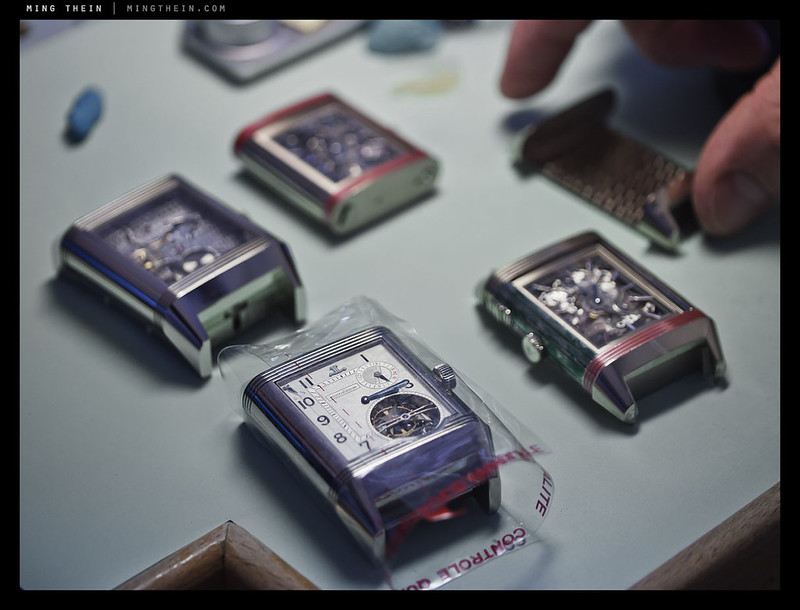
The red and blue plastic is a protective layer to prevent scratches as the watches are cased, assembled, and final adjustments made.

38_5003696bw copy

There’s also a Repetition Minutes a Rideau present – but not just any one, a blue one!

39_5003698bw copy

40_5003681 copy

It sounded great. I suspect the double case (the movement is actually based on the earlier limited edition series of 500 in pink gold) improves the tonal qualities of the chime significantly. It also looks absolutely stunning, though I’d gladly forgo the outer slide mechanism and just have the inner watch – apparently the inner case is about the same size as a regular Reverso GT, which isn’t very big at all.

42_5003712bw copy

On the way out, we pass a Gyrotourbillon in final stages of regulation. The dial on the left (which actually looks complete) is a work dial, used for adjustment only. I’m told that it takes one watchmaker between 1.5 and 3 months to assemble one of these; the huge time difference is if after assembly, it doesn’t run to spec, then the whole thing has to be taken apart and the cage re-balance and re-adjusted.

43_5003714bw copy

The gemsetting atelier is next.

44_5003868bw copy

45_5003871bw copy

I’m not a huge fan of gem set pieces (they showed me bracelet links for a Master Tourbillon, which when completed, would retail for around one million Euros – the entire thing was covered in diamonds, including the dial); however, this particular piece was pretty intriguing – it’s called a ‘chaotic’ setting, and you actually can’t see where the setting ends and the stones begin. They use around 200-240 diamonds of various sizes to cover a ladies’ Reverso case.

46_5003875 copy

47_5003737bw copy

49_5003757bw copy

51_5003760bw copy

We appear to have found the Atmos division.

48_5003750bw copy

I actually found this portion quite fascinating, as you seldom see so many of these in one place – and more interestingly, so many vintages; there were clocks here dating from easily fifty years go. I suppose it’s one of the few products whose fundamental parts have changed very little over time. Interestingly, they still cure the balance suspension wire; except these days, it’s done with weights and electric current rather than horse urine and time.

50_5003746 copy

Oh look, a Klimt! In all seriousness, this was an incredibly stunning piece which I think few have been lucky enough to see in person.

52_5003776 copy

View from the employee canteen.

I did also visit the museum, but wasn’t allowed to take any photos. Suffice to say there are some incredibly rare and very interesting pieces in there. And while all the Atmoses are running, charmingly none of them show the exactly same time 🙂 MT

I would like to say a personal thank you to Marina Shvedova, Janek Deleskiewicz, Cecile Tichant, Alexis Delaporte, Reena Tan, and all the patient employees whom patiently answered my endless barrage of questions.

____________

Visit our Teaching Store to up your photographic game – including Photoshop Workflow DVDs and customized Email School of Photography; or go mobile with the Photography Compendium for iPad. You can also get your gear from B&H and Amazon. Prices are the same as normal, however a small portion of your purchase value is referred back to me. Thanks!

Don’t forget to like us on Facebook and join the reader Flickr group!

appstorebadge

Images and content copyright Ming Thein | mingthein.com 2012 onwards. All rights reserved