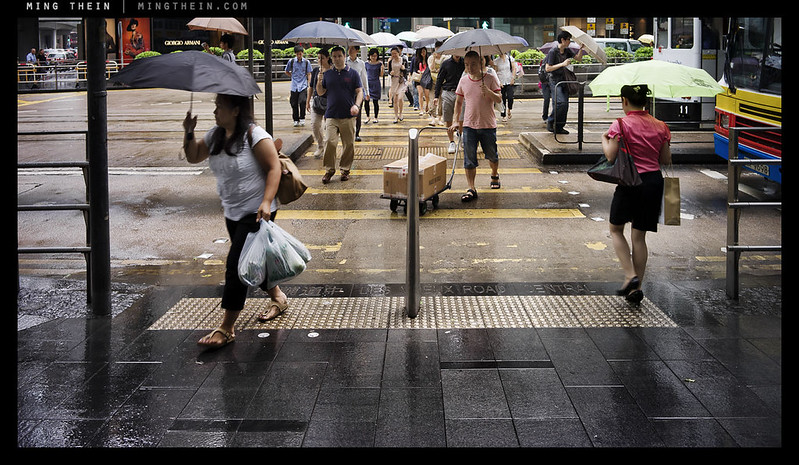
Film diaries: Postcards from Fukuoka, and thoughts on Fuji Acros 100

_13_8031493 copy

On the last day of my recent trip to Fukuoka, I somehow managed to run out of film. The entire brick and both magazines of Delta 100 were depleted in a couple of hours; I was lucky enough to have magical light and the inspiration to shoot, so making the most of it, shoot I did. Let me tell you I wish they still made 220…12 frames for street work means reloading at least every half an hour or less if you’re in the thick of things.

[Read more…]

Ignorance, fear and photographic freedoms in Malaysia

_M9P1_L1006044bw copy
Photograph all you want. Prague, Leica M9-P, 50/1.4 ASPH

Several recent experiences in Kuala Lumpur have prompted me to write this article. They’re all pretty similar: I’m out and about walking on a public road, photographing various objects – never people – and I will be accosted by a rent-a-cop or security guard telling me that I am not allowed to photograph. Photograph what, specifically? Everything and anything which he deems is under his jurisdiction. There are two problems here: firstly, photographing from a public place is allowed so long as you are not on private property; the intended use is actually irrelevant – at least in Malaysia. The second problem is that these people are often immigrants who have both a very poor command of any of the local languages, zero to no education, and often questionable immigration status.

_3100_DSC0650 copy
Think carefully. Though this was shot a few years ago from the street and a good 50m away, I still subsequently had unhappy people waving and holding out stop-hands at me. Nikon D3100, 28-300VR

What this means is that even though you might be able to legitimately convince another person that you’re within your legal rights to photograph where you’re standing, you’re at a dead end because the rent-a-cop you’ve got to deal with is both ignorant and incommunicable. It’s extremely annoying because I’ve had this happen four times in the past week; I know my legal rights and won’t push it in a situation where I’m on private property and I’m trying my luck. The trouble is that this seems to be a worrying trend; it’s happened with increasing frequency over the last year or two. And it’s not because I’m photographing any different subjects than normal, or any more frequently – if anything, I’m shooting a bit less of my own personal work.

Although you could try very hard to convince them that you are a) harmless and b) within your rights, I’ve since found it less frustrating to simply move on to the next place and try to continue shooting – assuming of course that I’m still in the mood at all.

I can see why some of the more interesting places might be off limits – building owners have a legitimate interest in protecting their property rights after all; the problem comes when somebody is trying to protect rights that are not legitimately theirs in the first place. In fact, smart building owners should generally encourage non-commerical photography – in a world that is now full of social-media savvy consumers, you’d be stupid not to do otherwise. I can’t see any downside in having hundreds of images – some of them probably quite good – of your property out there, especially if it’s a commercial building and high tenancy rates are one of your objectives.

This level of ignorance is a very sad thing for Malaysia, because it compounds the existing lack of appreciation for art the population at large already suffers from. People are very happy to pay hundreds of thousands of dollars for a stack of PowerPoint slides that contain absolute garbage and executionally impossible strategies, or for life insurance schemes with an EV far less than parity – yet something that actually requires skill such as the production of a photograph, or copywriting – goes completely unappreciated.

The underlying problem is twofold: firstly, education, and secondly, something a little more deep-seated that’s a cultural mentality which we shouldn’t be proud of – and certainly shouldn’t keep encouraging. The lack of education keeps the population as a whole focused on assigning value to tangible things only – ignorance keeps people from realizing the added value of service, design, packaging, visuals – in short, the whole customer experience. It seems that repeat customers are not really a high priority for most businesses here – they just want your money; whether you come back or not is not their problem. It certainly isn’t the problem of the minimum wage employees actually doing the work.

A viciously destructive cycle is born: you don’t get repeat customers because the service is crap, so you have to cut costs to maintain profitability, which means even worse service, and even fewer customers. Do something wrong, and everybody is reading about it on Facebook or Twitter in a matter of minutes. Make the wrong person angry, and that number can easily run into the tens of thousands. The inverse is also true, of course. (It’s just one of the many reasons why I try to reply to every single message I get.)

I can’t help but wonder if a lot of why we’re stopped from photographing things is because there may be some borderline illegal elements at play – foreign workers without permits or operation without permits or licenses are at the top of the list, and both are rampant in Malaysia. In cases like this, I can understand why proprietors get understandably nervous about any form of documentary, especially cameras. A government that seems to turn a blind eye to this kind of thing for the right amount of ‘convincing’ does not help things, either. Once again, it boils down to a lack of education – forget prioritizing a sustainable business over a profitable one – and the cultural obsession with making money any way possible. Again: if you’re running a legitimate operation, a smart person would want as much publicity as possible to create awareness. It would seem that there are not so many smart people here.

On the whole, I’m both saddened and frustrated. Malaysia remains one of the most rich countries for photographic opportunity because of both the pace of change, depth and variety of cultural traditions and large social contrasts. It’s a great place to practice social documentary and architectural photography – or it would be, if we could just photograph within our rights. Interestingly, I’ve almost never experienced this kind of restriction overseas – I don’t know if it’s because I fit the stereotypical Asian tourist profile, or because the general level of education is higher, but the difference can be felt. In fact, I think I only remember being stopped from photographing something once in London – and I was at fault because I was trying to be stealthy despite the liberally posted ‘No Photography’ signs inside a private museum.

There is one workaround, however. Despite proliferation of cameras and variety, the perception of ‘big black camera equals threatening’ remains; use a small, nondescript compact and you’re generally ignored. (In fact, I was most frequently stopped when shooting with the F2T; it probably doesn’t help that I’m very, very slow with this camera due to a lack of built in metering, manual focusing and general care with film.) Fortunately, compact camera technology has evolved enough that using one doesn’t entail as much of a compromise in image quality as it would have done a few years ago – even under low light conditions. Granted, I love the D700+85/1.8G’s ability to make beautifully cinematic stills at night, but I can still do exhibition-grade work with the RX100 and it’s 28/1.8 equivalent. What it does mean is that a change of style is in order; mainly because I no longer have the same freedom of choice in equipment if I want to shoot the same subjects – or, I simply have to shoot different subjects.

I suppose one really has to look at the bright side of things here – I could continue to bemoan the ignorance and diminiution of photographic freedom, or I could embrace the forced change as a challenge to push me out of my comfort zone which would in turn force my evolution as a photographer. I might not like it, or think the overall change in societal attitude is a good thing, but it’s not as though we have much of a choice is it? MT

____________

Visit our Teaching Store to up your photographic game – including Photoshop Workflow DVDs and customized Email School of Photography; or go mobile with the Photography Compendium for iPad. You can also get your gear from B&H and Amazon. Prices are the same as normal, however a small portion of your purchase value is referred back to me. Thanks!

Don’t forget to like us on Facebook and join the reader Flickr group!

appstorebadge

Images and content copyright Ming Thein | mingthein.com 2012 onwards. All rights reserved

Experiments with street photography and motion

_5013173 copy

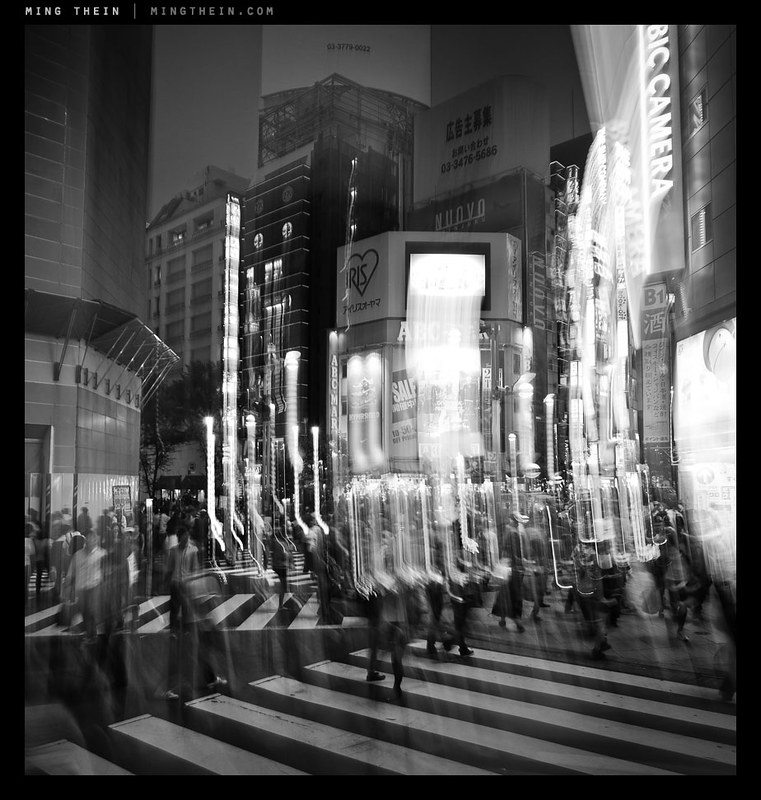
This series of images was captured around dusk in Shinjuku, Tokyo during my last workshop. While my students were off completing their final assignment, I decided to challenge myself to capture the feel and essence of the place in a different way to what I would have normally done. (After all, it wouldn’t be fair for me to put my students outside their comfort zone by insisting on the importance of having a central idea or theme in their images for their assignment if I couldn’t delivery myself, would it?)

_5012881 copy

At the same time, I’d felt as though I’d been reaching a little creative stagnation of late, and wanted to force myself to do something different anyway. Having your own style is good, but at the same time, that style has to evolve and grow in order not to get stale or boring. One of the things I’d been doing a lot of lately is jacking my shutter speeds up very high to ensure I was getting every last pixel of resolution out of the new cameras; whilst this made for great definition under the majority of circumstances, this crispness of capture doesn’t always suit the theme you’re trying to shoot to.

_5013351 copy

The idea I decided to follow for this series was flow – people as water, life as transient, a moment being more than a moment and altogether insufficient to capture the sheer volume of activity of what was going on around me. It’s a very strong impression I got simply by standing in place and watching life moving around me – people simply didn’t stop, torpedoing from location to location with some objective in mind, dispatching that objective, then moving on to the next one. (I’m guilty of this at times too; it’s a consequence of running your own business. Perhaps this experiment was as close to my subconscious was going to get to forcing me to slow down and smell the roses.)

_5013736bw copy

The only two ways I could see of communicating this idea were either to have a huge number of people lining streets and thoroughfares to appear as a continuous mass (there were a lot of people, but not that many, and moreover there was no way or achieving that vantage point) or through the use of motion blur – not a little bit, of the kind that appears at 1/30s and with people walking, but something altogether a bit more abstract. In hindsight, this would have been very easy to accomplish with a tripod, but without it, I didn’t have the foresight to pack one in – much less bring one on the day. Even a mini-pod or a Gorillapod would have been useful.

_5013181bw copy

Instead, I was forced to test the stabilizer of the OM-D to its limits – even with something to brace against (And sometimes not), I’d be needing shutter speeds in the 1/2s-1/5s range to achieve the effects I was looking for. Needless to say, you can only do this when the sun is going down. To give me a higher chance of success, I used the 12/2 for most of these shots, and shot in continuous high burst mode – not for the frame rate, but because I’d be able to keep my finger on the shutter button to minimize camera shake, and have only short intervals between frames. When I had to shoot using the LCD instead of the EVF, I would pull the neck strap tight to tension the camera somewhat against my neck and hopefully reduce shake – this technique is actually surprisingly effective. In hindsight, I should have used the self timer + burst function to completely eliminate finger-induced shake.

_5013468 copy

One of the things with this kind of photography is that you really don’t know exactly what you’re going to get until you get it; there may not be enough motion, or too much, or you might have streaks in the wrong part of the frame; all you can do is do a lot of takes until you get the right one.

Compositionally, the most important thing to remember when involving motion in your shot is that there must always be some clearly static and sharp object in the frame to serve as a visual anchor for your composition; if this is missing, the photograph just appears to be blurred or out of focus without the same directionality and focus that is implied by motion blur. In fact, having a large number of people moving through the frame is somewhat reminiscent of the energy of strong, dynamic brush strokes in a painting. I like the idea of abstracting out the people from the scene, and the contrast between the animate and inanimate. For these images, I chose the visual anchor first, then followed it by imagining where I’d want my flows of people to go; needless to say, there were a lot that didn’t work out because I didn’t have enough people moving close to the camera – a foreground is of course a necessity of using a wide-angle lens.

_5013253 copy

I did use the 45/1.8 for some of the images, but this proved to be extremely challenging as the lower practical limit for handholding a 90mm equivalent was somewhere in the 1/10s range on the OM-D, which is fractionally higher than what I needed for the desired effect. Still, I did manage to get lucky a couple of times with both very stable shots and convenient things to lean against. I also tried some more and less conventional techniques – panning blur, and combining staticness with abrupt motion of the entire camera to impose an impression of chaos whilst maintaining some semblance of a visual anchor. Overall, I’m pretty happy with the results though. Notes for a future experiment: I’d love to try this with a tripod and a longer lens. MT

____________

Visit our Teaching Store to up your photographic game – including Photoshop Workflow DVDs and customized Email School of Photography; or go mobile with the Photography Compendium for iPad. You can also get your gear from B&H and Amazon. Prices are the same as normal, however a small portion of your purchase value is referred back to me. Thanks!

Don’t forget to like us on Facebook and join the reader Flickr group!

appstorebadge

Images and content copyright Ming Thein | mingthein.com 2012 onwards. All rights reserved

_5013236 copy

_5013681 copy

_5013109 copy

_5013834 copy

Photoessay: Street photography with the OM-D and ZD 60/2.8 macro

_5010194 copy
From outside looking in

All images in this series shot with the Olympus OM-D and ZD 60/2.8 macro.

There’s nothing that says you can’t use macro lenses for non-macro purposes; the old myth of the optics being poorer at longer distances is just that: a myth. In fact, macro lenses tend to perform better than most standard lenses even at long distances because they are so well corrected in the first place. There are two drawbacks: firstly, the apertures tend to be slower, which isn’t so good for achieving subject separation and is solely a physical property of the focal length and aperture combination of the lens; secondly, the focus throw tends to be shorter.

_5010332bw copy
Not wanting to be part of the crowd

This is a both good and bad – good because if an autofocus lens, the focusing elements don’t have to move as far since the lens must also be able to provide sufficient effective extension to focus at macro distances, bad because it means that if you have a manual focus lens – like the ZF.2 2/50 Makro-Planar I use – you have very, very little travel between mid distances – say 2-3m or so – and infinity, which can make precise focusing very difficult. For manual focus lenses, using the camera’s built-in rangefinder/ focus confirmation dot simply isn’t precise enough as the dot stays lit for some not inconsiderable displacement of the focusing barrel*. For autofocus lenses, the camera/ lens combination may not have the ability to consistently move the elements by the precise displacements required for very small changes in focusing distance – this is especially apparent with older screwdriver-focused lenses like the Nikon 60/2.8 D. Newer coreless motor lenses (AFS, EFS, M4/3 lenses etc) generally don’t have problems as there is very little backlash in the focusing system.

_5010144 copy
The writing’s on the wall

*Do this simple test to see what I mean: shoot the same subject, at the same distance, with the cameras on a tripod and your desired test lens attached. Using the viewdfinder or EVF, try to focus the lens/ camera manually from both infinity and near limit, stopping just once the focus confirm indicator lights. Do this with the aperture wide open, otherwise other focus errors like backfocusing or mirror misalignment can’t be identified and compensated for. Shoot the same frame again, focusing with live view to use as a comparison image. What you’ll probably see – is that neither image using focus confirm is as sharp as the live view image. This effect is even worse for telephotos, because of the depth of field characteristics of the focal length. The shorter the focus throw, the worse this problem becomes.

_5010527 copy
Untitled.

Potential focusing issues notwithstanding, so long as you have enough light for a sufficiently high shutter speed to avoid camera shake, the results are generally excellent. Specifically in the case of the ZD60, (my full review at macro distances is here) I’m pleased to report that the lens’ already excellent optical properties do not change at all at longer distances. In fact, the one niggling flaw I saw at close range is mostly gone – I’m not seeing any bright edges to out of focus highlights. Both foreground and background bokeh is smooth and non-distracting. Subjects fall nicely in planes and are separated in a manner that has plenty of 3D pop; this is characteristic of a lens with excellent microcontrast.

_5010353 copy
Arches

Focusing is not an issue at all, and is just as fast as the ZD 45/1.8 providing you have the 4-way limiter switch in the right position. The one minor issue I did find was that the lens with hood is not exactly inconspicuous (and nowhere as compact as the 45), being nearly 15cm long with everything in place. Relatively small by DSLR standards, but probably not exactly what M4/3 users have in mind.. Personally, I find this combination of interest not because I’d take it out on dedicated street photography/ travel expeditions, but because I frequently carry the OM-D system either as a backup camera (or as a primary for assignments that don’t require the D800E’s resolution) – and the ability for a lens to do double-duty means one less thing to carry, break, fail or potentially lose. It’s always nice to have options. MT

The Olympus OM-D, 60/2.8 Macro and 45/1.8 are available through Amazon by clicking on their respective links.

____________

Visit our Teaching Store to up your photographic game – including Photoshop Workflow DVDs and customized Email School of Photography; or go mobile with the Photography Compendium for iPad. You can also get your gear from B&H and Amazon. Prices are the same as normal, however a small portion of your purchase value is referred back to me. Thanks!

Don’t forget to like us on Facebook and join the reader Flickr group!

appstorebadge

Images and content copyright Ming Thein | mingthein.com 2012 onwards. All rights reserved

_5010264 copy
A pick-me-up before the pick up

_5010106 copy
Hiding from the dishes

_5010217 copy
Guardedly relaxed

_5010340 copy
I’m on the way

_5010076 copy
Hop to rainbow row

_5010091 copy
A surprisingly good soup

Basic street photography techniques

_RX100_DSC0385b copy
Offerings for sale. Sony RX100

Continuing in this mini-series on street photography, there are a number of techniques that I use while shooting. Although it’s possible to describe most of them in some detail, full understanding requires both demonstration and practice – this is where joining one of my workshops is ideal 🙂 Together with the basic principles of balance, perspective, composition and what makes a good image – these techniques may be used singly or in combination to generate strong street images. In fact, they also apply to documentary and reportage work, too; the only difference between good street photography and photojournalism is that the latter has a consistent theme and subject.

It’s important to note that not every technique is suitable for every situation, and vice versa; as always, a good portion of making a strong image is knowing what to leave out.

_M9P2_L1000182 copy
Hiding from the rain. Leica M9-P, Zeiss ZM 2.8/28

Timing and anticipation
In a photographic situation where you have effectively zero influence of any of the elements in your frame except the composition and exposure, timing is the one key bastion of control that remains in the hands of the photographer. By making a conscious choice of when you push the shutter, you decide when each and every single one of the moving elements in the frame is in the position you want them to be in. However, it is too late to react only at the exact instant you see the composition you want. It is therefore important for photographers to be able to see a scene, visualize the potential contained there, and be able to imagine what the finished frame will look like once all of the desired elements are in place. It is then a matter of simply waiting for those elements to all come together, and being ready with the camera when they are. No matter how fast reflexes, or your camera, the fact is that if you react off to you see something, it’s too late; training yourself to anticipate action is something that can give you the critical second or half-second which can make all the difference between getting the that and missing it completely.

_5006872 copy
Progression. Olympus OM-D, Panasonic 20/1.7

Shoot stopped down
A lot of these techniques are about timing. Specifically, gaining yourself a little bit of extra breathing room to react. In this case, shooting stopped down allows you to simplify the process somewhat by not having to decide what to have in focus, and what not to have in focus. If you’re shooting with an autofocus camera, it also allows a little bit of leeway for the camera to misfocus, yet still allow the final shot to be in focus thanks to extended depth of field. Note that of course this technique does not work under low-light situations, where you need every stop of aperture you can get. Compositionally, shooting with great depth of field actually forces you to create stronger images. This is because you have to think more about your subject placement, leading lines, empty spaces, etc – which all affect the overall balance of the image. If you can make interesting image without relying on the crutch of bokeh, then you will find yourself with increased compositional and artistic flexibility when you do have this option in your toolkit.

_M9P2_L1000213 copy
Divided. Leica M9-P, Zeiss ZM 2.8/28

Shoot wider
There are many reasons to shoot with a wider lens. First of these, is of course the enhanced foreground perspective emphasis that it provides, hopefully on your subject and not an expanse of pavement. Having a lens with a shallower and more forgiving depth of field profile both allows greater latitude for focusing errors, as well as allowing extended depth of field without having to stop down too much. There are also other non-obvious advantages of going wider – not only do you eliminate or minimize the possibility of having unwanted elements come between you and your subject due to physical distance (and you subsequently missing the shot because in the time it takes for your frame to clear, your primary subject has already moved on or changed position), but also you can get people in the periphery of the frame as edge subjects or context without them suspecting anything. In this sense it’s also about minimizing the reaction time between you visualizing the shot and executing it.

_RX100_DSC0688b copy
The taxi men. Sony RX100

Act as though you belong
In pretty much all situations, you will notice the confident people rarely – if ever – get challenged. This of course also applies to street photography. By acting like you belong, and you’re confident and know what you’re doing, casual observers to the scene assume that you have every right to be there and generally allow you to go about your business without interference. A subset of this is acting like a tourist. Tourists are not self-conscious and they are generally expected to take photographs of everything encountered; by doing this you’re fitting the expected stereotypes. And, as you will no doubt already know by having read my earlier articles, a large portion of photography – including the execution – is seriously influenced by human psychology at a subconscious level. Spend some time understanding how people think, and you will find that you both have more control over the way you images are interpreted, as well as how people react to you while you’re out shooting.

_M9P2_L1000693 copy
A glitch in the matrix. Leica M9-P, Zeiss ZM 2/50

Hyperfocal and zone focusing
One way of speeding up the shooting process is by completely eliminating focusing altogether. Hyperfocal focusing means that you have everything in focus beyond a certain point; it requires the lens to have a comprehensive depth of field scale in order to set your focus distance precisely. Manual focus lenses tend to be better for this, I suppose because manufacturers of autofocus lenses think that photographers will not use the manual option and therefore simply choose not to include proper depth of field scales. (Most of the time, they’re right.) Zone focusing is similar. What you do, is ensure that your desired subject distances fall between the two aperture markings on opposite ends of your depth of field scale. For the current bunch of high density digital sensors (anything over 12MP or so), you will need to use an aperture one stop smaller than indicated on the depth of field scale because these scales were calibrated for the circle of confusion corresponding 35mm film, and haven’t been updated since. There is a game played by rangefinder shooters that can help you improve your skills at estimating distances; pick a subject, set distance on the lens, and then check through the rangefinder to see how accurate you up. Do this often enough, and you will find that your focusing ability has magically improved. The upshot is that with sufficient practice, it is possible to estimate distances without even having to look through the viewfinder. This means that you can focus the camera and have it ready even while at waist level or in your hands, before you frame up the shot – once again, it’s all about reducing your reaction time.

_5001813 copy
Querry. Olympus OM-D, Panasonic 20/1.7

Stages
I don’t believe ‘stages’ is a commonly used terminology. I use it to refer to a setting, or scene, where the light is interesting and directional, and all it needs to complete the image is a human element of some sort to add context. I’m constantly on the lookout for these ‘stages’ when I shoot; when I find one, I will stay and work to seeing for his long as it takes for me to get an image that I’m satisfied with. Sometimes this is within seconds; sometimes it can take hours and I leave without getting the shot I wanted. But if I have a chance, and it’s a case of ‘unrequited stage’, then generally I’ll return again at some future point in time to get the shot I’d originally envisioned.

_M9P2_L1001019 copy
Haircut. Leica M9-P, Zeiss ZM 2.8/28

Layering
Layering is a technique that you can use to add context and depth to an image. It requires the use of a longer lens, which is ideally suited to this because it naturally separates out your scene into foreground, midground and background, all with relatively similar prominence. This allows you to place your subject in any one of these zones, and use the remaining zones to form the context and tell the story. Aside from using a longer lens, the other way to achieve layering is by the use of reflections; whether it be in a building’s glass, a puddle or perhaps some other shiny object. In this case, a wider lens is actually preferable because it allows you to capture more of the reflection. Note that when you’re composing, your reflected background is going to be further away than you think because the light has to come from the subject, to the point of reflection and then back out again to the camera; this can affect perspective in strange ways if it not consciously compensated for.

_X21_L1020034bw copy
They don’t know you’re there. Leica X2

Shoot through people
The most difficult and counterintuitive technique that I use is something I call ‘shooting through’. It basically requires you to stand still in a flow of oncoming people, and just shoot into the crowd. Although this will feel strange but first because you’re pointing your lens directly in people’s faces, offer a while you get used to it. The challenge then becomes actually separating out individual frames from the general scene as a whole. This technique works better in busy spaces and thoroughfares, simply because this means people tend to be more concerned with where they are going rather than what you’re doing. In a relatively quiet space, this technique is not very effective because people can see you coming – or rather, standing there – from a mile away. It is important to note that the psychological reaction to somebody standing still with a camera held up and ready to shoot is very different to if the same person stood there and suddenly brought out the camera to shoot; the action of raising the camera draws attention to yourself. Psychologically, sudden movements also catch us unawareness and make us uncomfortable. By looking like you have been there for a while, and will continue to be there, people are put at ease which allows you to operate without drawing unnecessary attention to yourself. In fact, oncoming pedestrians will probably take pity on you (poor tourist, trying to take a photo but we’re all in his way), not knowing that they themselves are actually the subject of your image.

_5A00477 copy
Garden of earthly delights. Olympus OM-D, 45/1.8

Stealth or flamboyance?
The final technique is simply being inconspicuous. This involves techniques such as not making any sudden moves, and most of the time, not even having the camera raised to your face when you take a photograph. The smaller, blacker and more nondescript the camera you use, the better, because it does not draw any attention. This is one of the reasons I like to use compact cameras for street photography – not only do I look like a tourist, but what possible threat could a small Asian man with a point and shoot pose? He’s probably just lost and on holiday. The complete opposite of this, and also viable option, is to be completely flamboyant and ridiculous. You stand out to the point that nobody takes you seriously; and this allows you to get on with your serious work in peace. I’m talking about shooting a bright pink camera dressed and perhaps being dressed red and blue; or maybe using a view camera on a tripod whilst dressed a three-piece suit and top hat. Then, you become a subject of interest and curiosity rather than the potential threat. (I have never done the latter myself, although in the interest of improvements in image quality, and perhaps the different look to my images, I am quite tempted. I plead the fifth on the former.)

Although this list is by no means exhaustive, I hope this article has given you some insights into both how I shoot when I’m on the street, and some new techniques for you to try out yourself when perhaps you see a great shot but you’re too shy to go out and get it. Bottom line is that street photography is not very different to being a Boy Scout: be prepared and confident. MT

____________

Visit our Teaching Store to up your photographic game – including Photoshop Workflow DVDs and customized Email School of Photography; or go mobile with the Photography Compendium for iPad. You can also get your gear from B&H and Amazon. Prices are the same as normal, however a small portion of your purchase value is referred back to me. Thanks!

Don’t forget to like us on Facebook and join the reader Flickr group!

appstorebadge

Images and content copyright Ming Thein | mingthein.com 2012 onwards. All rights reserved

Photoessay: The people of Tokyo

Another one of the continuing series from my last Tokyo trip – this time focusing on is inhabitants. Enjoy! MT

This set was shot with an Olympus OM-D and the ZD 45/1.8. As usual, click on any image to go to its Flickr landing page; EXIF data is intact on the right hand side link.

_5010738 copy
Plenty to spare, Ginza

_5011648 copy
Geisha in training, Asukusa

_5011064 copy
Maid for hire, Akihabara

_5012573 copy
Only in Tokyo would this be considered normal. Shibuya

_5011662 copy
Putting up a wager, Asakusa

_5011178 copy
Untitled. Senso-Ji temple grounds, Asakusa

_5011598 copy
Coffee break, Shibuya

_5011672 copy
A considered proposition. Somewhere along the Yamanote line

_5011753 copy
Reading the fine print, Akihabara

_5011580 copy
What happens after closing time. Asakusa

_5011268 copy
Elegant shopping. Ginza

_5012509 copy
Public opinion, Shibuya

_5012286 copy
A Japanese cliche, Shibuya

_5010852 copy
Even the chauffeur gets lost sometimes. Ginza

____________

If you enjoyed this post, please consider supporting the site via Paypal (mingthein2@gmail.com); Ming Thein’s Email School of Photography – learn exactly what you want to learn, when you want to learn it or learn how to achieve a similar look with our Photoshop workflow DVDs.  You can also get your gear from Amazon.com via this referral link.  Prices are the same as normal, however a small portion of your purchase value is referred back to me. Thanks!

Don’t forget to like us on Facebook and join the Flickr group!

Images and content copyright Ming Thein | mingthein.com 2012 onwards. All rights reserved

What is street photography?

_RX100_DSC1889 copy
Calling in to check if the city is really there. Sony RX100

Sometimes, I think I’m a bit of a masochist. I actually like to shoot difficult subjects, and increasingly of late I’m also starting to write a lot about difficult topics. Today’s article seems like a very simple question to answer: what is street photography?

The more I try to nail it down – and I spent a considerable amount of time on this before the Finding Light workshop – so I would know what to cover, and more importantly, what my students would expect me to cover. The first point of confusion comes when you try to decide what is ‘street’ and what isn’t: what about public spaces? What about museums, galleries, fora etc? Stairs? Restaurants? Hawker centers? Public transport, like the Underground?

And here’s another question: does street photography always have to have human subjects in the frame? And when does street photography turn into travel reportage?

You can see how this becomes confusing. I’ve decided that in general, the genre is loosely defined around several broad guidelines (at least for me; your mileage may vary). Let’s take a closer look at these.

_VL31_L1010048 copy
Hands up. Leica V-Lux 3.

Street photography is unplanned.
If you’re controlling any of the elements in the scene, then it starts to become a conceptual or even outdoor studio shoot – posed models in public definitely do not count as street photography: the photographer knew (or should have known) exactly what poses, look and lighting he wanted before beginning the shoot. (You certainly wouldn’t hire a model and get shooting permission if you had no intention to shoot there, would you?) There is also a reactive element to it – spontaneity and the ability to anticipate are both critical tools for the street photographer. You really never know what you’re going to get on any given day, and that’s what draws photographers to the genre: a never-ending source of material.

_5010054bw copy
Breakfast. Sony RX100

Street photography mostly uses available light.
In fact, the only exception I can think of to this rule is the work of Bruce Gilden and his imitators. Setting up lights on the street corner or using a big flash tends to make the photographer extremely conspicuous, which that removes the unplanned element. People either go out of their way to be photographed, or alternatively, avoid you completely. Part of the challenge and attraction to street photography is the very fact that the light, amongst other things, is not under your control. A photographer has to train their eye to see interesting light, and their muscle memory to be able to take advantage of it – sometimes under extremely fleeting circumstances.

_RX100_DSC0731b copy
Rojak. Sony RX100

Street photography may or may not involve people.
This is a question of scale; at the near or human scale, you have that which are dominated by people as the primary subject; at the large scale you have entire cityscapes and street scenes, that use people to give context and scale to the image. The farther away you go, the more the image becomes about the atmosphere and the feeling of the place, rather than the people who inhabit it. That said, there is no reason why you cannot take photos of something which you happen to see while walking around looking for these scenes or people; this is the kind of thing which I like to call ‘street furniture’ – interesting lampposts, mail boxes and other geometries are also fair game. I think it is also possible to make an argument to include casual architecture in the genre; I know that when I travel, I tend to shoot a lot of interesting buildings with or without human context involved – simply because these are things I see while walking around, and they add a lot to the context and general feel of a place.

_RX100_DSC0728b copy
Morning papers. Sony RX100

Street photography, if involving people, tends to do so under situations where they generally do not expect to be photographed.
I suppose this sounds both a little bit voyeuristic, and slightly contradictory when it comes to frequently photographed public tourist attractions such as Trafalgar Square, but in general even though a person may know that you are photographing them, they certainly didn’t leave the house preparing for in the morning. This variety and unpredictability of people is yet one more aspect of what makes street photography interesting.

_RX100_DSC0628bw copy
Door symmetry. Sony RX100

Street photography, if involving people, generally has subjects that are unfamiliar or unknown to the photographer.
Perhaps this may be an overly fine distinction to make, however if a subject is known to the photographer and the photographer is familiar with the subject, there is usually some form of interaction between them. This relationship is usually clearly reflected in the photograph. I personally find that one of the things that makes street photography interesting is the fact that for that brief moment while you’re photographing somebody, there is that instant of connection between you and your subject which is then preserved for posterity – even if you never happen to see them again.

_RX100_DSC0351bw copy
Sometimes, smaller is better. Sony RX100

Street photography must always have a subject, regardless of any of the above restrictions.
This rule is a fundamental of photography in general, not just street photography. However, I feel it necessary to draw attention to this specifically because there are so many images out there on the Internet which claim to be ‘street photographs’ – yet they fail fundamentally as photographs because they lack a clear subject or idea. Even though the photograph itself may not be planned, this does not mean that you can’t have an idea in the instant instant when you see a potential frame, which is then executed immediately.

_RX100_DSC0645b copy
Evening. Sony RX100

Street photography must observe certain ethical restrictions.
This is very much a personal thing. There are certain people or things that I will not photograph because I do not feel comfortable doing so. In general however, a good rule to go by is not to do to other people what you would not want done to you; this includes intrusion into personal space, photographing people in potentially compromising positions, or under duress. I do not believe in taking photographs of the homeless, because I feel this is both exploitative and does not help them in any way. Similarly, paying somebody money to take their photograph may be an acceptable way to make a living in certain countries where there is no choice, however this is not something I want to encourage because I feel that widespread proliferation of this both discourages social documentary as well as taking away from the authenticity of the image.

_RX100_DSC0397bw copy
Christo comes to Kuala Lumpur. Sony RX100

Street photography has an element of reportage or the documentary to it.
Given that a strong photograph must have a distinct subject and a clear idea, the easiest way to do this in a street photography image is by capturing a moment. This is where HCB’s idea of the decisive moment becomes critical; in that one moment, all of the elements in the frame come together to tell a story. There is only one decisive moment for each story, but many possible stories for any given scene. If all street images have a story to them, then becomes clear that what we street photographers are collectively doing is capturing daily life for posterity. In areas where the pace of change is increasingly rapid – especially in developing countries – I feel there is a certain element of social responsibility here for all able photographers. (Or, at very least, the desire to show your descendants what life was like during your time.)

_M9P2_L1000663 copy
Outside the W. Leica M9-P, Zeiss ZM 2.8/28

Street photography is not restricted to black and white.
There are many reasons why historical street photography was done in black and white; most of them because that was either the only film available, or because it was a lot cheaper than color – especially in the quantities that prolific street photographers tend to shoot. Today, I sometimes get the feeling that black and white is overused as a distraction to cover up the fact that the image itself is fundamentally mediocre. Instagram certainly does not help things. Is important to remember the fundamental rules of color and composition to decide when black and white or color may be more appropriate. (Black and white works well for strong luminance contrasts and oblique lighting; color should be used when it is the primary means of isolation of your subject.)

_M9P2_L1000234 copy
Looking up. Leica M9-P, Zeiss ZM 2.8/28

Street photography takes place in public spaces.
In a private, or restricted access space, the people who use the space tend to be known to each other, which changes the dynamics of interaction between them (and the photographer). Public spaces maintain a degree of unpredictability simply because you never know who is going to be your subject.

Street photography doesn’t always have to have a purpose, but each image must aim to say something.
In fact, most photographers tend to shoot in the street genre simply because they feel like going out to photograph, but may not necessarily have any specific subjects in mind; I do this all the time. This of course does not mean that week images are acceptable!

_M9P2_L1000119 copy
Contemplating the markets. Leica M9-P, Zeiss ZM 2.8/28

Street photography doesn’t require you to fill the frame with a random stranger’s face.
One of the common misconceptions is that street photography always requires a clearly identifiable stranger or or person dominating the frame; let’s take a step back and think about the way we perceive the world when we are out walking on the streets. Our eyes scan around us, taking in the entire scene, and this generally corresponds to something around the 28mm field of view. It is very rare that our attention lingers on any one particular person or point, unless they are strikingly outstanding. Personally, my photographic style is developing in a direction that makes me want to replicate and reconstruct what I see both in reality altered by the filter of my mind’s eye, which means that the perspective I choose to frame my images tend to correspond to what I see. These tend to take one of two distinct perspectives, the first of which is slightly wide, corresponding to my general field of view; the second is narrower, akin to when you are focused on something and the rest of the scene gets ignored – 28, and 85mm.

_X21_L1020014bw copy
Escape route. Leica X2.

Street photography can be done with any equipment.
Although there are some cameras that are better suited to street photography than others, there is really no reason why you can’t use anything you happen to feel like using on the day. There are two ways of shooting street; the first is always to be set up and ready, which requires you to preset focus and exposure and work solely on framing at the instant of capture; the second is to be reactive and have a camera that is capable of both focusing and exposing very quickly. However no matter how fast the camera, a degree of anticipation is required in order to capture the decisive moment – there will always be some lag between you seeing the moment, due process happening, and the shutter firing.

_M9P1_L1012531 copy
Shadows. Leica M9-P, 35/1.4 ASPH FLE

Street photography and travel photography are largely interchangeable.
The only difference between the two is purpose and intention: the former can be when you are shooting with no specific goal or project in mind; the latter is almost always when you want to capture the feeling or mood of a place that happens to be both unfamiliar to you and fleeting or temporary; there’s a time limit on how long the photographer has to absorb and observe. That also introduces a perspective difference: when you travel, you look at a place through different eyes than a local; however, most street photographers operate primarily in their home cities.

_M9P1_L1012454 copy
Bangkok bus. Leica M9-P, 35/1.4 ASPH FLE

Having broken down my thought process in this article, I’m actually no longer sure that there is a concrete definition of street photography. At the same time, I don’t think that it should be a catch-all genre for everything else that doesn’t have its own category. Perhaps the simplest, and most accurate, definition is simply to think of it as ‘reporting on life’; through our images we are documenting the daily life of the people around us. I wouldn’t go so far as to think of ourselves as social anthropologists, but who’s to say what these extensive collections of images – assuming they survive – may be used for a few hundred years from now? MT

____________

Visit our Teaching Store to up your photographic game – including Photoshop Workflow DVDs and customized Email School of Photography; or go mobile with the Photography Compendium for iPad. You can also get your gear from B&H and Amazon. Prices are the same as normal, however a small portion of your purchase value is referred back to me. Thanks!

Don’t forget to like us on Facebook and join the reader Flickr group!

appstorebadge

Images and content copyright Ming Thein | mingthein.com 2012 onwards. All rights reserved

Photoessay: Tokyo monochromes

This set is a whole bunch of little snippets of life from around Tokyo – mostly Shibuya, Shinjuku and Ginza. I’ve tried to get into the Japanese style of street photography/ reportage a little; the intentional chaos is somewhat unnerving to my perfectionist nature and definitely not so easy to replicate. Still, I think I got just enough of an influence in there to get something different to my normal work. MT

This set was shot with an Olympus OM-D, ZD 12/2, 45/1.8 and Sony RX100. As usual, click on any image to go to its Flickr landing page; EXIF data is intact on the right hand side link.

_RX100_DSC2507bw copy
Shadow of a head

_RX100_DSC2388bw copy
Look before you leap

_RX100_DSC2577bw copy
Untitled

_RX100_DSC1956bw copy
Diagonal

_RX100_DSC1956bw copy
Trapped

_RX100_DSC2480bw copy
Meditation nap

_RX100_DSC2373bw copy
Lines I

_RX100_DSC2014bw copy
Lines II

_RX100_DSC2528bw copy
Overpackaged

_RX100_DSC2349bw copy
Ginza reflections

_5011952bw copy
Confidence

_5013897bw copy
Bad boy I

_5012315bw copy
Bad boy II

_5012063bw copy
Just another afternoon in Shibuya

____________

If you enjoyed this post, please consider supporting the site via Paypal (mingthein2@gmail.com); Ming Thein’s Email School of Photography – learn exactly what you want to learn, when you want to learn it or learn how to achieve a similar look with our Photoshop workflow DVDs.  You can also get your gear from Amazon.com via this referral link.  Prices are the same as normal, however a small portion of your purchase value is referred back to me. Thanks!

Don’t forget to like us on Facebook and join the Flickr group!

Images and content copyright Ming Thein | mingthein.com 2012 onwards. All rights reserved

Workshop report: 30 Sep Finding Light in Kuala Lumpur

_RX100_DSC1732 copy
Group portrait with chiaroscuro. Sony RX100

Two days after the Making Light Workshop, three of the original (masochistic?) participants joined three more new ones for a part two: Finding Light. I originally decided to run these as a pair to collaborate with photographer Kristian Dowling, who was unfortunately not able to make either one of the workshops in the end. No biggie.

_RX100_DSC1846bw copy
Quartered. Sony RX100

The underlying point behind the pair of workshop sessions was that street and studio are far more related than you might think: how are you going to create stunning light and compositions if you don’t know what it looks like? Similarly, how is one going to recognize it if you don’t know what is possible when all of the elements of the photograph are within the control of the photographer?

_5010070 copy
Why would this not be street photography? Olympus OM-D, ZD60/2.8

We started off with the obligatory coffee, a discussion on what street photography is and isn’t, and some thoughts on etiquette, before finishing with a quick critique of participant images. Street photography, to me, is something that is a very ill-defined genre (and to be the subject of another article, I think) – let’s just say for now that anything you see when walking is fair game – people, street scenes, abstracts, architecture. I generally approach it from a reportage perspective. On the subject of etiquette, I think it’s simple: don’t do anything you wouldn’t want done to you. This includes unflattering images and invasion of personal space.

_RX100_DSC1838 copy
Untitled. Sony RX100

For the first hour or so, we just walked – no cameras were allowed. This was to encourage participants to start seeing and looking for frames; I would stop and point out interesting things, compositions, geometries and other potential shots, to the point that before we reached the first staging point, there were several cameras out…

Exercise one covered seeing in place: conveniently, the place I selected for lunch was deliberately done so because of both the quality of its beef noodles, as well more importantly, the fact that it was an extremely rich photographic hunting ground. Once duly refueled, the participants were required to stay in their seats, and shoot from that position. Lens changes were allowed. This forced them to think carefully about perspectives, foregrounds, potentially intrusive elements, as well as of course composition and light.

_RX100_DSC1736 copy
Shooting in place. It forces you to find compositions in a scene; those little documentary moments.

For the second exercise we did something I like to call ‘stages’. The stage, in street photography, is a background or backdrop with a interesting texture or light; it’s a good way of teaching anticipation and timing because the composition is predetermined, and the photographer just waits for subject to walk through the right portion of the stage before pressing the shutter button.

_RX100_DSC1725bw copy
A staged example. Sony RX100

Next came timing and anticipation – I like to use point and shoots to teach this because they have just about the right amount of shutter lag to represent your reaction time when shooting with a responsive camera; however for this exercise we substituted with a 2-second self timer.

_5010258 copy
Practicing timing with the help of a handy wall, and lots of pedestrians. The objective was to trap the pedestrian at the very edge of the wall – but while the 2-second self timer was running. Olympus OM-D, ZD60/2.8

Another tool I like to use is layering; this can be achieved by means of reflections, stacked foregrounds and backgrounds, or longer perspectives – or perhaps a combination of all three. This technique works quite well when there’s a lot of glass around, but becomes more challenging when you are in a ‘dirty’ environment and nothing is clean or reflective.

_5010087 copy
Bus reflections. Olympus OM-D, ZD60/2.8

The final, and most difficult exercise of the day was to learn to hold your ground and shoot through people – this lets you get very, very close indeed, to the point of having headshots with a 50mm. It requires some courage to position yourself in the middle of a stream of pedestrians, but once the participants built up their confidence, it became easy – just look like you belong.

_RX100_DSC1841 copy
Shoot through exercise. Sony RX100

_5010374 copy
And a result of this technique. Olympus OM-D, ZD60/2.8

Putting everything together wrapped up the day – an opportunity for the participants to figure out which of the techniques best suited their style by just shooting anything and everything – and I’m pleased to report a huge improvement in composition and angle from the images I saw at the first briefing. I think what was most telling is that none of them really had the same style – it was a consistent mix of the various techniques taught, and with different subjects. Well done!

_RX100_DSC1851bw copy
Divided reality – my personal shot of the day. Note leading lines, quadrants, context, perspective use, human elements…Sony RX100

Based on the success and feedback of this session, I’ll probably be doing another introduction to street photography workshop in Kuala Lumpur at some point, as well as a standalone introduction to Photoshop day – both will be for a very limited number of participants – I like to keep things small because it allows me to give each person more attention – please visit again regularly for updates. MT

_RX100_DSC1895 copy
A visual metaphor for our banking system. Sony RX100

____________

If you enjoyed this post, please consider supporting the site via Paypal (mingthein2@gmail.com); Ming Thein’s Email School of Photography – learn exactly what you want to learn, when you want to learn it or learn how to achieve a similar look with our Photoshop workflow DVDs.  You can also get your gear from Amazon.com via this referral link.  Prices are the same as normal, however a small portion of your purchase value is referred back to me. Thanks!

Don’t forget to like us on Facebook and join the Flickr group!

Images and content copyright Ming Thein | mingthein.com 2012 onwards. All rights reserved

Street photography in context: diversion, documentary or nuisance?

_M9P1_L1006378 copy
The Police are everywhere. Prague. Leica M9-P, 28/2.8 ASPH

After spending some time thinking about it, I’ve come to the conclusion that street photography – I prefer to think of it as ‘reporting on life – is an increasingly popular genre of photography for several reasons:

1. It’s easy to do, and accessible to all – the barriers to entry are low. Wildlife or say automotive photography, for instance, is not. There isn’t any setup involved beyond remembering to take your camera with you when you leave the house, no matter where you live.
2. The definition of the genre is extremely broad; to the point that you could probably almost say there was no definition at all. This means it’s both open to much creative interpretation, and also an excuse for anybody whose generic images have no specific idea or subject in mind.
3. As humans, we are psychologically drawn to other people: no man is an island. Street photography lets us get our fill of humans without having the tread the social minefield of heaven forbid, actually having to interact with them. (It’s a bit like the internet in this regard.)
4. Everybody likes to play documentary photojournalist once in a while.
5. Building on from #4, some photographers have a burning need to record everything and everybody around them – I’m one of these people – and sometimes we just shoot out of compulsion, because our compositional minds just simply do not turn off. Having trained yourself to see workable frames in the most unlikely of places, it’s difficult to un-learn this skill (or curse, depending on whether you’re the photographer or the one waiting for the photographer to hurry up).

I believe the sum of these things is that street photography falls into one of three categories for the vast majority of photographers and audiences – diversion, documentary, or nuisance.

Diversion
For the unafflicted photographer, it can be a nice genre to experiment with when you have the desire to shoot something, but you have no clear subject in mind. Taking a walk with a camera allows you to go in with a blank but receptive mind, and just wait for an endless parade of subjects to pass you by. They’re all time-sensitive, however; if you don’t react fast enough, they’re gone. This doesn’t matter, however, because there are always more subjects where they came from, and you weren’t going out shooting with something specific in mind anyway. Serendipity is probably the best way to sum up your overall attitude towards it.

Similarly, for casual viewers, street photography can provide an interesting window into the lives of others; an unusual or otherwise missed moment preserved for posterity. You see it, appreciate it for a little longer than the actual fleeting instance of the moment, and move on. It doesn’t really stick in your mind.

Of course, this all depends on the strength of one’s compositions; of chief importance for all images, street or otherwise, is having a prominent subject and a clear idea of what the image is supposed to achieve or say. Purely aesthetic images are fine, too; but the execution must obviously support the idea.

Documentary
Those who take street photography a bit more seriously start to tip over into the documentary category – they view the images they capture as preserving a slice of life, or singling out an interesting instant from the constant flow of life around them. This is of course a continuum; you can be looking for just that little bit more over your normal street photographer, or you could be very, very serious about the decisive moment like HC-B. These photographers don’t always have a clear idea of what they want in an image, but they recognize an interesting scene when it happens and are ready to respond and capture the shot.

I think I fall into this category. Whilst I still make some images that I consider to be aesthetically pleasing rather than saying anything strong or documenting a particular moment of life, I do look for something out of the ordinary in my images; I think it’s probably the natural progression for all street photographers as they eventually land up with far too many ordinary looking images. This leads to seeking the common theme that separates out the strong images from the weak ones – and it always comes back to idea, subject, and execution (which covers framing, light, processing etc.)

To some extent, as a competent photographer, I feel that we have a moral duty to record life for posterity – especially so in fast-changing environments such as developing countries. I’ve lived in the same neighbourhood of downtown Kuala Lumpur for the last seven years; in that time the landscape and flow of people has changed so much that there are things I don’t even remember seeing, much less capturing, in my old images from just a few years ago. If we, the first hand observers, don’t even remember – how are any future generations going to manage? I’ve shown images to fellow residents, and will inevitably be told at least once or twice something along the lines of ‘I’ve never seen that before’, or ‘Where’s this? So nearby, really?’.

The observer must therefore be an impartial one, with an abstract but fixed idea of what is ‘ordinary’ in their minds. This is something that gets harder and harder the longer you live in a place, or the more familiar you get with it; the foreign soon becomes the commonplace and soon you won’t notice anything at all. Observation and recognition of differences is an innate human skill; but continuous observation and attentiveness is very much a trained one.

The nuisance
In trying to be both observers and recorders, we must endeavour not to become public nuisances. In a previous article, I talked about the ethics of street photography and the importance of maintaining basic human standards of politeness and courtesy; something that many modern photographers choose to ignore behind the pretence of anonymity, or simply choose to ignore. It’s true that we feel less inhibited as photographers when we are not in our own comfort zones or cities of residence; at the same time, this is when we are also at our most observant and probably least culturally sensitive state. It’s worth remembering that what we might not find culturally offensive at home could well be the opposite overseas.

Often, the most interesting things happen well within the boundaries of polite personal space; intruding that makes me (personally) feel uncomfortable; it’s important to remember that we as photographers have both our personal and group reputations to maintain – it certainly won’t help anybody if street photographers are eventually perceived as being at the same level as paparazzi.

So where does this all leave us?

My personal opinion – and I stress this is highly subjective – is that those of us who have the ability and inclination, should go beyond the realm of causal snapping and treat street photography as social documentary/ reportage; try to say something with every shot, but at the same time, do this in an ethical way that doesn’t intrude on the privacy, rights or personal space of the subject(s). The overarching goal should be to preserve these little vignettes on present-day life for posterity; this also means making the work accessible and viewable to as great an audience as possible, which is one of the reasons why I use flickr.

I’ve noticed that my personal street photography style has evolved over the years from – get a worthwhile composition, to get people in frame, to get as close as possible, to cinematic style with plenty of OOF areas, to get close but retain context. It seems that today I’m working towards a style that documents man in the context of his environment, natural or built; I don’t specify a man and his individual, personal characteristics as much as use that figure as an abstract for the idea of humans in a particular situation. Where you choose to take it (and if you even bother with street photography or reporting on life) is very much a function of personal style – something you will have to discover and define for yourself, if you haven’t already done so. I just thought it might be interesting to throw another perspective out there. MT

____________

Visit our Teaching Store to up your photographic game – including Photoshop Workflow DVDs and customized Email School of Photography; or go mobile with the Photography Compendium for iPad. You can also get your gear from B&H and Amazon. Prices are the same as normal, however a small portion of your purchase value is referred back to me. Thanks!

Don’t forget to like us on Facebook and join the reader Flickr group!

appstorebadge

Images and content copyright Ming Thein | mingthein.com 2012 onwards. All rights reserved