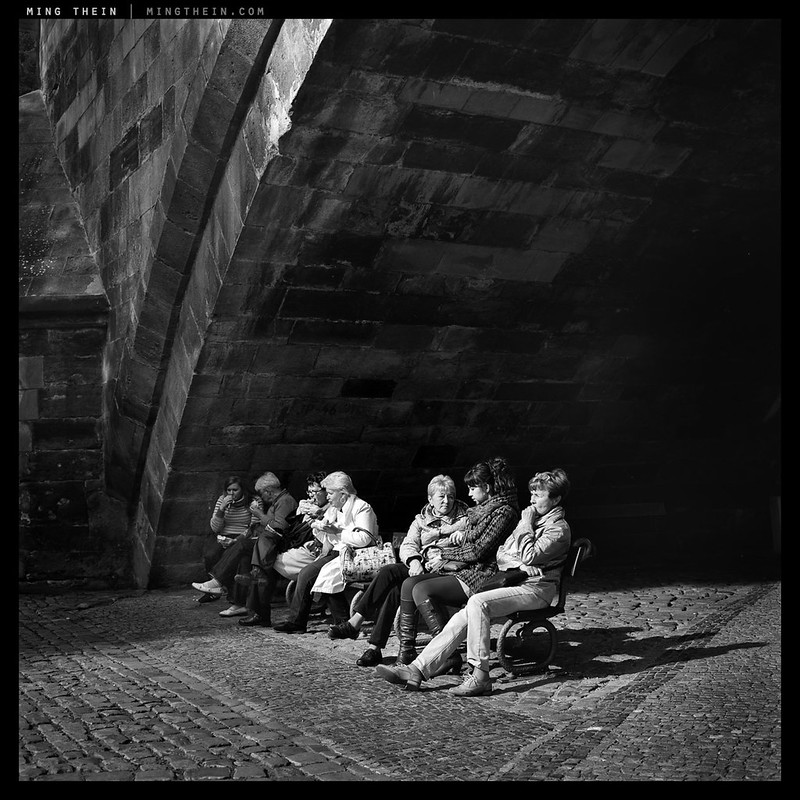
The second part of the monochrome photoessay from Prague was shot on film, with a Hasselblad 501C and my favourite B&W film – Fuji Acros 100. To be honest, given the tight quarters, I’d have preferred to have had something either a little wider or a little longer – preferably both – to give me some additional ability to add context, or compress (especially with buildings clinging to hills in the background). Nevertheless, we make do with what fits inside our camera bags – after making provisions for film, I didn’t have any space left for lenses!
Photoessay: Prague monochromes, part I
I actually shot very little black and white in Prague; a few hundred from the Ricoh GR, and a couple of rolls with the ‘Blad; of course they were all of varying subjects with a heavy architectural emphasis, but I did get some very satisfying street images out of my time there. Despite the very strong luminance contrast available – October at these latitudes means all-day shadows and intense sun with blue skies – I just found color to pack a little something extra in most situations. That said – this set would not have worked in color at all.
Now available: How To See: Tokyo & Street Photography!

For your holiday viewing pleasure…I’m pleased to offer up the next two instalments in the workshop video series: How To See Ep2: Tokyo, and Street Photography Ep1.
Coming *very* soon: How To See Ep2: Tokyo and Street Photography Ep1!
For your holiday viewing pleasure…I’m pleased to offer up the next two instalments in the workshop video series: How To See Ep2: Tokyo, and Street Photography Ep1.
FD Photoessay: Life in Amsterdam
Sometimes, the film photography gods deign to make life easy for you: you happen to be in the right place at the right time, with the right light, interesting subjects, lots of opportunities, carrying the right camera and lens combination, just enough film to get you through a day with a roll left over as insurance, and even airport security guards who’ll hand check your film so they don’t have to make multiple passes through x-ray machines. The last European trip and workshop tour was one of those occasions for me. I went with my usual small digitals (OM-D, Ricoh GR) for teaching, and the Hasselblad 501C with one magazine, a few boxes of Acros 100, and the 80/2.8*. And I came back with a huge number of keepers. It’s interesting to note that despite its size, shutter noise and conspicuity, the Hasselblad never attracted negative attention – usually curiosity or nostalgia. In that sense, it’s actually an excellent street photography tool in the modern age. No more words are required, I think – other than for me to say ‘enjoy!’ MT
*Some of the rolls were pushed to ISO 200 due to lack of light; with Acros this also has the benefit of deepening your shadow tones. There doesn’t seem to be any grain penalty that I can discern, though – anything up to ISO 800 is fine, but the shadows just keep getting denser and denser. Digitized with a D800E, 60/2.8 macro and my custom rig.
Photoessay: Semiclassical NYC street photography, part two
Today’s photoessay continues my exploration of NYC’s streets in black and white. Perhaps I’m being masochist in continuing this series after the dissenting opinions expressed in the comments in Part one (found here) – but once again, photography is subjective interpretation and each observer has their own views and preferences. I happen to like the precision and perfection others call ‘clinical soullessness’ – and I’d argue that the lack of imperfection is a style and skill of its own; consistently being able to find ‘perfect moments’ in a sea of uncontrolled chaos is extremely difficult indeed – which anybody would know if they’ve tried it. Enjoy. MT
Photoessay: Semiclassical NYC street photography, part one
Given how ingrained certain locations are in the popular photographic consciousness due to heavy presentation in a particular style by multiple photographers – Paris and NYC in black and white of course come to mind – I think it’s possible to do one of two things: either avoid that style altogether and try to find your own, or explore a little in the genre and see what falls out. I had a chance to try both the last time I was in New York; to be honest, I found B&W with moderate contrast to suit the timeless feel of the location a bit better – as opposed to expressing the fleetingly temporal nature of life. There’s of course no right or wrong. (My attempt at individual style can be found here, in the NYC cinematics photoessay.)
Photoessay: New York City street colour
Today’s photoessay is a set of images shot with the Nikon Coolpix A on the streets of New York City during my earlier workshop trip this year. NYC on a blue sky spring day is seriously difficult to beat. Not much to add, other than enjoy! MT
_______________________________________
If you’d like to learn how to make images like this, you’ll be pleased to know that one last seat has opened up for the Prague workshop (2-5 Oct) due to a participant’s conflicting work commitments. Now available at the special price of $1,900 instead of $2,150!For full details and to make a booking, click here. Thanks! MT
Photoessay: Small format Fukuokan monochromes
Most of these are square because I was under the influence of Hasselblad at the time; with your primary camera set up to shoot black and white squares, it’s difficult to break your shooting rhythm to see much of anything else. However, this set was shot entirely with a Leica(sonic) D Lux 6. I think what’s interesting here is when I used the DL6 over the ‘Blad: mainly in situations where a) I wouldn’t be fast enough with MF; b) when it was too dark and I didn’t have the 400 back already on the camera; c) when I needed longer or wider perspectives I didn’t have as most of the time I was only carrying 50 or 80mm lenses. There’s still very much room in the bag (pocket?) for a smaller format and a smaller camera, even if you have to give up image quality: a shot is better than no shot at all. Admittedly, at these sizes and this presentation format, it’s not easy to tell what camera was used. Regardless, it’s always about the images: enjoy! MT
Thoughts on street photography with medium format
Ostensibly, this is already perhaps not the most practical of ideas; if one is extremely masochistic, things can be compounded further into the really bad idea class by using film. And a manual focus camera. Without a meter. I think it takes a certain amount of insanity – or at least a healthy dose of optimism – to even attempt it. Street photography (the genre itself being discussed in this previous article) is the kind of thing that’s handled best with a responsive, unobtrusive camera that also has a goodly amount of depth of field for a given aperture, plus what I like to think of as being very forgiving of slightly loose shot discipline. This generally means good high-ISO ability, perhaps a stabilization system, a low-vibration shutter and decently large pixels to make the effects of camera shake less obvious.