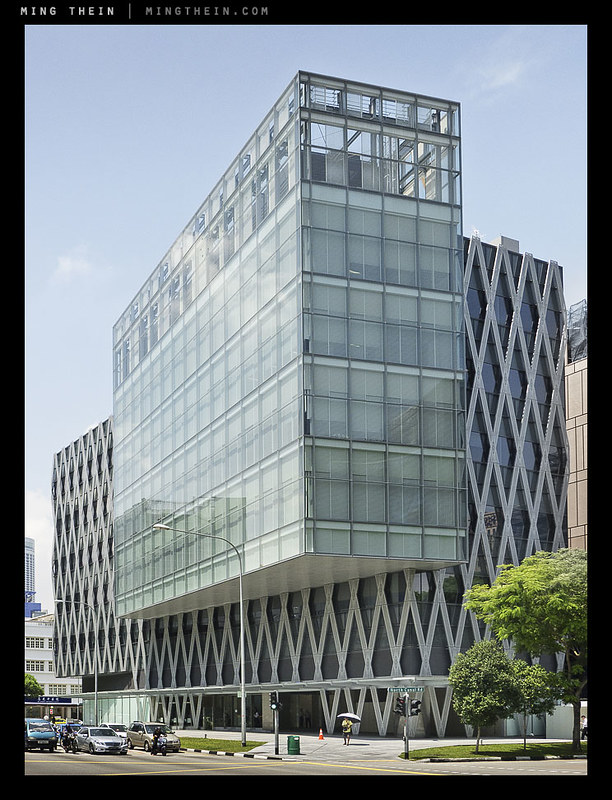
I recently shot a commission for the famous Japanese architecture firm Kenzo Tange Associates – whilst I’d heard of them before and seen their work in Japan, I didn’t realize that they had a number of projects closer to home. Turns out there are four buildings in downtown Singapore – all fairly close together – plus another one or two a little further out, and another under construction. And there are some underway in Kuala Lumpur. The scope of this assignment was to get a variety of general exterior views of the buildings during the day, at night and in the context of their environment.

Architectural photography has always been something I’ve done out of personal interest – followers of this site or my flickr page will undoubtedly have noted my predilection for geometry, abstracts and general building form. The interplay of light, shadow, texture, and how the building sits in its environment are something that I pay perhaps an unhealthy amount of attention to. You just know if the design is balanced and ‘feels right’ by looking at whether it dominates the surrounding landscape, if it disappears and looks insignificant, or whether it looks comfortable.

That said, although Singapore is an interesting architectural environment – there are a lot of modern, different cutting edge designs and a huge variety of facade treatments (that’s what happens when you have a lot of money flowing into the country; notably most of the places that spend big on their real estate are banks and malls – go figure) there’s also not a huge amount of landscape left to dominate (and that’s what happens when you’re a small island). This of course means that the dominating landscape is urban and of very high density; from a photographic point of view, this presents a huge number of challenges because of lines of sight and vantage points, not to mention permits, access and the like – you’ll need permits to shoot from somebody’s property, even if you’re not taking photos of their property itself.

Since real estate is expensive, everything is high rise. The challenge then becomes perspective: how do you find the right position to get a perspective that somehow looks natural, but at the same time isn’t blocked by a huge amount of other stuff? It all depends on location. Some buildings can be shot from their plazas with a wide angle (though this is quite conventional and boring); across the street from another building’s rooftop (if the height is right, and the street is wide enough); or much further down the street with a telephoto. Ideally, you’d want a helicopter at low height and a telephoto, but that isn’t practical most of the time.

Perspective is very important here because anything too wide will look unnatural; this isn’t how the eye sees it. I find when shooting architecture that the best results aren’t from extreme angles: they’re from natural perspectives and details; you want to be able to appreciate the building from a human perspective, because that’s how and why the damn thing was designed in the first place. It’s great if it makes a stool for King Kong, but an architectural failure if the podium steps are too high for people to climb easily.

That said, shooting in tight confines requires you to get creative. Although you do want to see the whole building, there’s nothing wrong with focusing in on the details and going for some degree of abstraction; I’m sure every architect wants the attention to detail in their work to be seen. I know I would.

For this assignment, I shot exclusively Leica; their M wide angles are superb, and much superior to anything available for the Nikon F system, though the Zeiss 21/2.8 runs pretty close. The other reason why I went with the Leica system was weight: there’d be as lot of moving around on foot to get the best angles and unique perspectives, which means schlepping everything around like a mule. Lightness is your friend. Oh, and don’t forget that the heavier your camera, the more rigid (and thus, heavier) your support needs to be.

Sadly, there are no tilt-shift lenses for Leica M; in any case, they wouldn’t have been wide enough in some of the quarters I was working in. I used the new 21/3.4 Super Elmar ASPH M with finder, 35/1.4 ASPH FLE and 50/0.95 ASPH. In hindsight, the noctilux was not the best choice for this – not because of its optics, but because I never used anything larger than f5.6 (you do want everything in focus, and critically sharp, everywhere). I wanted the 50/2.5 Summarit, but turns out it was on loan already. Oh well. The 21 and 35 performed superbly, as expected. In fact, I was surprised by just how good the 21 was – even wide open, in the corners. I think I’ll need to do a full review of this lens in future. Suffice to say, if you don’t need the f1.4 speed of the ‘lux – it’s a no-brainer. (Aside: I owned and shot with the 21/1.4 ASPH as my primary lens extensively during the M8 days, on which it became a handy fast 28mm; however, it wasn’t great for architecture because of the distortion and ever so slight field curvature. Also, overkill when you need f5.6 and smaller.). A D-Lux 5 Titanium rode shotgun for spontaneous shots and the B-roll for this article (due to licensing reasons, I obviously can’t use the original images.) I also used the S2, 30mm and 70mm lenses for some of the daylight work.

On the support side, I used my old Manfrotto 444 Carbon One – I think this thing must be at least ten years old by now, if not more. I got it used from a friend. Whilst it’s rigid and relatively light, I’d still like something lighter for travel – especially if I’m not putting anything heavier on it than a Leica M. Perhaps one of those Gitzo 00 series things. The problem is I can’t justify one because I do so little tripod work. The head – very important – was my favorite Manfrotto 468RC2 Hydrostat bullhead. This thing is amazing: it locks at any angle, with no ‘droop’ – either it’s locked, or it isn’t. As far as I know, it uses some sort of vacuum system and teflon rollers, but I haven’t needed (or wanted) to take it apart.
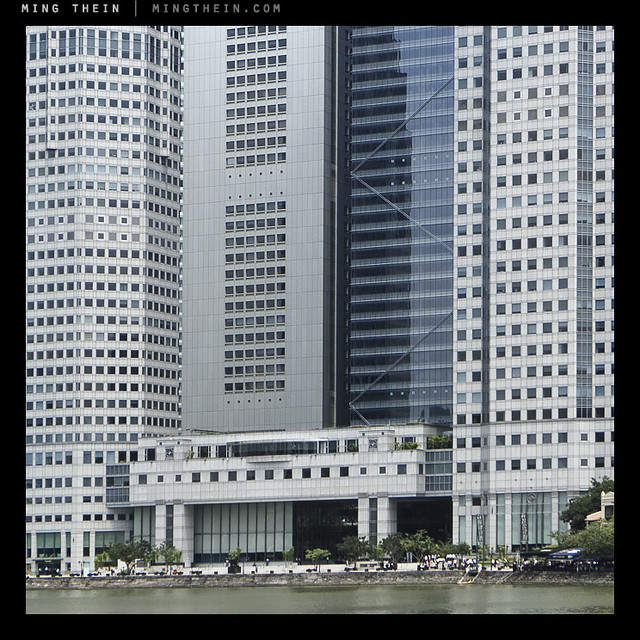
I can’t help but wonder if a V-Lux 3 with it’s excellent 24-600mm lens and a much lighter tripod would have been a better way to go – perhaps something to experiment with in future. All cameras are more than capable of deliverin the required results at base ISO and shooting RAW, anyway.
One final note about processing: to maintain optimum quality throughout the tonal range, I shot at base (160) ISO and did something I rarely do and used a two-stop HDR on the night shots – there’s simply too much difference between the spotlit parts of the building and the deep shadows – easily four or five stops. There are right and wrong ways to use HDR, and that’s a discussion I’ll save for a future article. MT
This post was brought to you by Ming Thein’s Email School of Photography – learn exactly what you want to learn, when you want to learn it. Don’t forget to like us on Facebook!







 Ming Thein | Photographer