Photoessay: Lisboan chiaroscuro

H51-B0003532 copy

Given the clear skies and very strongly directional light we experienced, in conjunction with the interesting shadows projected off oddly shaped roofs and down narrow alleyways…it would be a shame not to make the most of it to add a little ambiguity into the frame. Conventionally ‘good light’, yes, but who’s complaining? I do realise some of these stretch the definition of chiaroscuro a little – especially the somewhat wimmelbild reflection – but I felt they fitted the overall mood of the subject and this collection of images, so MT

This series was shot mostly with a Hasselblad H5D-50c, 50/100mm lenses and post processed with the Cinematic Workflow from Making Outstanding Images Ep.5.

[Read more…]

Photoessay: dark matter

B0002505 copy

I initially thought about renaming this one something to do with shadows, but then realized that we have an association of vagueness and indefinition to the term shadow. This doesn’t quite fit the nature of these images; I wanted to go for something a bit more solid and dense. Filmic shadows were what came to mind at the time of capture. Despite the apparent contrast level, a high degree of dynamic range was required to be able to carefully control exactly where the inflection point of white to black lay (which in turn affects compositional balance). There’s probably potential for a mini-project here; further exploration is required. Who knew a 10m stretch of garden could be so productive? MT

This series was shot with a Hasselblad 501CM, 4/50 C T*, 4/150 CF T*, CFV-50C digital back and processed with the Monochrome Masterclass workflow.

[Read more…]

Front bokeh

X1D2-B7023081 copy

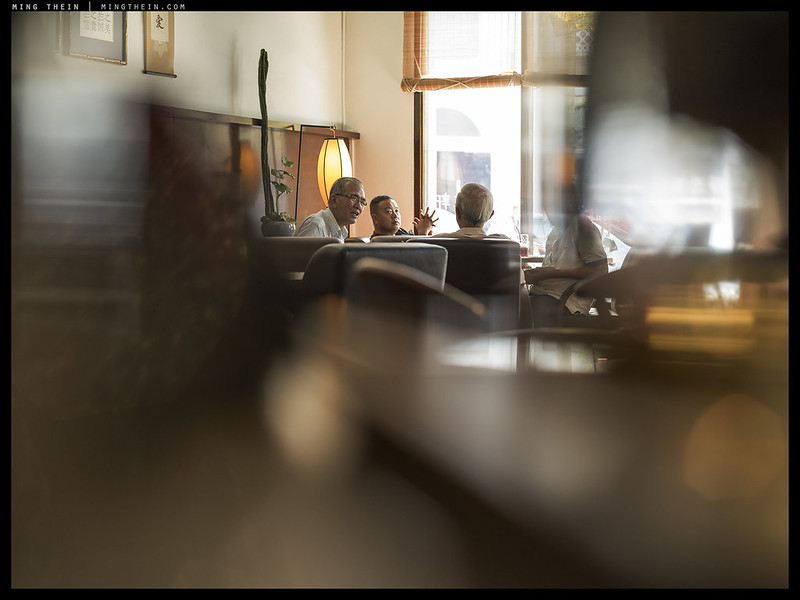
Technically: out of focus foregrounds. Whilst much emphasis is placed on the way a lens renders out of focus areas – the oft-overused ‘bokeh‘ – it’s almost always used to describe the areas that fall behind the focal plane. I think we can generally agree on a few things – ‘good’ bokeh doesn’t distract from the subject with uneven or sharp luminance transitions, double images, harsh rendering, rings or irregular textures in the ‘highlight balls’, patterns, bright edges, coloured fringing etc.; too much bokeh might be pretty but completely negates any sort of context other than what mood can be inferred by the feel of the light and some bokeh is always preferable to none because it helps with subject isolation. However, few outside cinematographic circles talks much about the way the foregrounds render. For that matter, few outside cinematography actively seek to use out of focus foregrounds as part of the underlying structure of their compositions. I think that’s a shame, and here’s why.

[Read more…]

Photoessay: Lisbon monochromes I

_Q116_L1110903 copy
He who watches the watchers

Few words today, just a series of singles from Lisbon in the style of Idea of Man. It’s too late to put them into the first series because that now has a mature and complete narrative; they don’t really fit the second series because I changed the presentation style – so they stand alone. You might wonder why I still photograph in this style given the first two statements; in this case, partially because I was demonstrating for a couple of students at the Lisbon Masterclass, partially because I felt the aesthetic suited the feeling at some of the starker and heavier locations – Oriente station, for instance. Enjoy! MT

This series was shot with a Hasselblad H5D-50c, various lenses, a Leica Q 116 and post processed with the Monochrome Masterclass workflow.

[Read more…]

Tradeoffs

_64Z0573 copy
Not a people mover, and never meant to be. Similar things abound photographically: resolution, or bulk? Reach, or size? Ease of file handling, or quality? Edge resolution, or weight and filter size? Controllability or compactness?

The story of photography is really a series of compromises – I suppose the same can be said of life in general, though there are specific consequences and considerations when it comes to making images. At the risk of appearing to contradict myself*, I’m writing this post somewhere over the South China Sea, after having a little epiphany. The difference between life and photography is that compromises made in the former usually come with a mixed bag of consequence that are both unknown since we have affected causality and the flow of events by making a choice, but in photography, we almost always know what we’re giving up – or we think we have a fair idea of it. Surely this should make creative and technical choices in image capture easier to make?

*Forcing creative development through restriction is not the same as knowing you’ve stopped before you’re done.

[Read more…]

Photoessay: Salt pans, Useless Loop

H51-B0008435 copy

Useless Loop, postcodes 6537, Western Australia, is located inside the UNESCO World Heritage site of Shark Bay; it’s a closed private town for the employees of the Solar Salt Operation Shark Bay – as whose name suggests, uses the sun’s heat over shallow ponds to evaporate seawater and leave behind salt. With a name like that, one can only imagine it might have been somewhat tricky to attract the initial employees. The salt pans themselves are kilometres vast, perfectly still without wind, and as glassy as a mirror. There’s a slight haze to some of them as the salinity increases and salt falls out of suspension, rendering the water murky. Each pond is at a different stage of evaporation, yet irregular in shape and fitted to the geography of the peninsula – giving the whole place the odd feeling of being like a giant insect’s wing, especially when viewed from the air. This series was shot through the open rear doors of a Cessna 203 at about 1500 feet during pretty ideal light and atmospheric conditions. Enjoy the transient colors – from the milky blues of salt reflecting clouds and sky to the deeper sea green of freshly flooded ponds, and the tans of the dams holding back the bay. I’ve always thought each individual pond felt like a window into alternate world, or perhaps the same place at a different time. MT

This series was shot with a Hasselblad H5D-50C, HC 24, 50 and 100mm lenses and post processed with Photoshop and Lightroom Workflow III.

[Read more…]

On quality of light

H51-B0002884 copy

‘Quality of light’ is one of those phrases I use often, but perhaps should explain a little better. Similarly, we are all guilty of overusing the ‘good light/bad light’ phrase; but what does it (and we) actually mean? To a certain degree, we photographers are programmed both with preconceptions of what constitutes favourable light – based on our own or others’ historical work – and what constitutes ‘bad’ light. At the same time, we also have our own aesthetic biases and preferences – some of us may prefer flatter or more diffuse light as a consequence of spend childhoods at extreme latitudes, or be predisposed towards hard contrast because we’re tropical people. Here’s the kicker, though: I believe there is no such thing as truly bad or wrong light; there is only suitability for a given subject and set of aesthetic preferences.

[Read more…]

Photoessay: Boats of Porto

H51-B0004745 copy

Something a little less intellectual today: nothing more than boats at rest along the Douro, running through Porto. I honestly have trouble finding the romance in the whole notion of sea travel (it just seems a slow way of moving anything that can economically be transported by plane, and an inefficient mode of relaxation since space, supplies and locations are constrained) – but they are undeniably attractive objects to photograph. As always, the challenge is how not to repeat something that’s been done before – and I think you can tell from the emergence of the little blue and white dinghy that my thoughts continually strayed to the graphic and abstract… MT

This series was shot with a Hasselblad H5D-50C, HC 24, 50 and 100mm lenses and post processed with Photoshop and Lightroom Workflow III.

[Read more…]

Photoessay: Coastal texture

H51-B0008278 copy

Today’s series is a continuation of the Australian aerials – this time exploring the abstracted textures of the coastal interface and immediately surrounding areas on both water and land. The myriad fractal textures generated by wave action are both infinitely varied and fascinating; each has its own aesthetic strengths. I actually had a very hard time curating it for this precise reason: it’s very difficult to prefer one abstract over another because each had some unique merits of its own. Nevertheless, I think the color flow works here, even if some of the finer textures can only be appreciated in a large print, including schools of marine mammals and the occasional tire track to lend a sense of scale. It also makes me wonder just how different this area would be in a few months given time and tide… MT

This series was shot over Francois Peron National Park in Western Australia from a light aircraft at about 1200ft, with a Hasselblad H5D-50c and processed with Photoshop and Lightroom Workflow III.

[Read more…]

On Assignment photoessay: Overpass

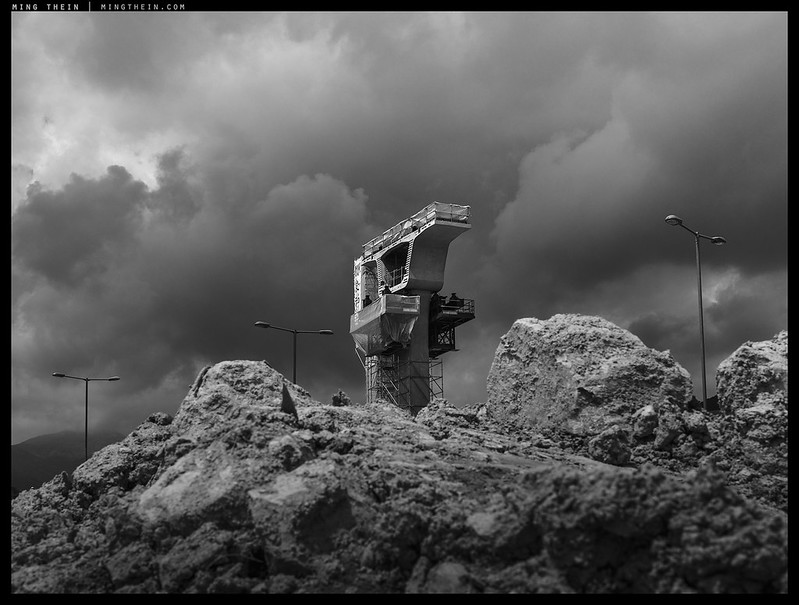
H51-B0009513bw copy

My biggest challenge with projects and assignments of this scale is always adequately capturing them and conveying that scale – too wide or too far away, and you lose identifiable detail; too close and you don’t get a feeling for the immensity. There’s no way you can keep an identifiable and isolated human figure in the shot and show the whole extent of a 3km+ long project; even with a silly-sized print from a camera of extremely high resolution. This is where the narrative comes into strength, but also poses challenges. It’s much easier to give a complete impression of something by detailing critical parts; however, with the narrative in mind, you’ll find that there are certain ‘filler’ images required for continuity that might not necessarily stand on their own – and similarly, certain hero shots just don’t flow with the rest of the sequence. This of course leads to a very focused curation, which may well change massively should the intended message also change.

[Read more…]