Workers of heavy metal – a combined On Assignment Film Diaries Photoessay, part two

_8035818 copy

The second portion of this photoessay concludes (part one is here) with a plenty of images and couple of final thoughts: firstly, another huge thank you to the client for giving me this opportunity – he’s a reader of this site too – very rarely do professional and personal creative goals mesh with such rewarding results. Secondly, I think there are a couple of things I need to look for in future assignments: it’s a bit abstract, but basically one needs to have a subject with potential and a client who’ll trust you enough to let you run with it – without either, the ensuing images will always be a compromise. MT

[Read more…]

Workers of heavy metal – a combined On Assignment Film Diaries Photoessay, part one

_8035586 copy
The welder.

If ever I had a dream assignment, this has got to have been one of them. (And the job isn’t quite finished yet; there are a few other outstanding items that need to be taken care of.) Imagine being presented with a scene of near-infinite photographic opportunity by a client who says ‘I hired you because I like your work, and I don’t want to restrict your artistic vision – so go ahead and shoot as you see fit.’ Then throw in the ability to shoot with the system(s) of your choice – including film – and a couple of good lunches to boot. And a chauffeured 7-series to and from the location. I swear a) I’m not joking, and b) this doesn’t happen often, but hey: if it did, we certainly wouldn’t be able to appreciate it.

[Read more…]

A question of sensor size

IMG_2438
The contenders.

Conventional wisdom states that the bigger the sensor, the better. The bigger the pixels, the better. All things equal, that’s true; however, 10-micron pixels would mean very low resolution compacts, and medium format digital doesn’t sell in sufficient volumes to justify the same sort of R&D spend that consumer or even midrange pro gear would get. I admit I’d always been curious to see just how much the technological improvements from generation to generation offset pixel pitch etc.; some time ago, I did a comparison of the Leica S2 against the then-new Nikon D800E. Today, we go one step further to see exactly what kind of gap exists between the various grades of equipment. Spoiler: it’s not as wide as you might imagine in some areas.

[Read more…]

Thoughts on street photography with medium format

_9_8031312 copy

Ostensibly, this is already perhaps not the most practical of ideas; if one is extremely masochistic, things can be compounded further into the really bad idea class by using film. And a manual focus camera. Without a meter. I think it takes a certain amount of insanity – or at least a healthy dose of optimism – to even attempt it. Street photography (the genre itself being discussed in this previous article) is the kind of thing that’s handled best with a responsive, unobtrusive camera that also has a goodly amount of depth of field for a given aperture, plus what I like to think of as being very forgiving of slightly loose shot discipline. This generally means good high-ISO ability, perhaps a stabilization system, a low-vibration shutter and decently large pixels to make the effects of camera shake less obvious.

[Read more…]

Photoessay: Fukuoka without people

_2_8030998 copy

What is a city without its people? What if a person from several thousand years ago were simply transported into the present day and dropped in any moderately-sized metropolis without any explanation – especially on a Sunday, when only a few brave souls are to be seen wandering the streets, purposefully running the gauntlet or perhaps acting as keepers of the strange world? Nature appears to have taken over in places, though the square rocks remain. Even the animals mostly avoid the place. Strange movable objects line every path. Did something bad happen here? Would they view the cities as strange landscapes? Or recognize them as artificial constructs? Perhaps they would wonder why anybody would leave nature to be all squashed together in square rectangular blocks…or maybe they wouldn’t even view the blocks as fit for human dwelling. To question, to wonder, to dream, to adapt, and go forth out to explore out of curiosity even if it makes us feel a little bit scared. That is what makes us human.

Or, perhaps, I just scared the Fukuokans off with the mighty clap of my Hasselblad mirror 😛 MT

[Read more…]

Film diaries: Watches and a Hasselblad

blad watches negatives contact sheet
Digital contact sheet of the negs.

I’ll admit that deep down, from the day I decided to buy the Hasselblad, I’d harboured a deep, masochistic desire to do this. During previous evaluations of medium format for my main commercial subjects, it didn’t really fit the bill: too difficult to achieve the degree of magnification required for watches, and digital medium format wouldn’t give me the width I needed for architectural work. It’d also be overkill for food photography in this country, given the current state of affairs*.

*I recently had a large corporate client ask for a portfolio and quote, then turn around and give the job to another photographer who quoted less and said ‘here, copy’. The results were crude because of harsh lighting and repetitively boring subject placement, but I suppose if they can’t tell the difference…perhaps I’m the one who’s got unrealistic expectations?

But hey, on film, for fun and in the spirit of creative experimentation, why not?

[Read more…]

Film diaries: Postcards from Fukuoka, and thoughts on Fuji Acros 100

_13_8031493 copy

On the last day of my recent trip to Fukuoka, I somehow managed to run out of film. The entire brick and both magazines of Delta 100 were depleted in a couple of hours; I was lucky enough to have magical light and the inspiration to shoot, so making the most of it, shoot I did. Let me tell you I wish they still made 220…12 frames for street work means reloading at least every half an hour or less if you’re in the thick of things.

[Read more…]

Film diaries: A quick introduction to Hasselblad V-series cameras

_5015926 copy

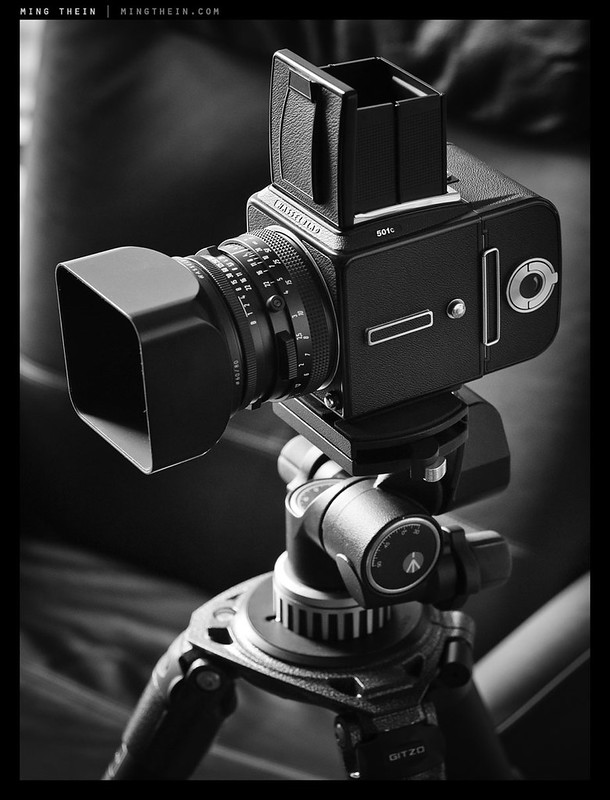
Since acquiring and shooting with my 501C, a lot of my readers, students and photography friends have been asking for more information about these beauties. I certainly don’t claim to have the depth of knowledge of some of the longer-lived collectors or photographers, but what follows is a (hopefully) handy collation of what I do know, from the point of view of the practical photographer.

The Hasselblad V series is a system camera: that’s to say that lenses, bodies, finders, backs and other general accessories are interchangeable. The body contains the reflex mirror, film winding mechanism and secondary shutter only, plus a way of triggering and rewinding the leaf shutter in the lens, of course. Lenses of various vintages can be used on all bodies, with varying degrees of functionality. Flash sync terminals – PC sync – are in the lens, since this is triggered mechanically by the leaf shutter. Several types of backs are available, including digital and polaroid (rare) options; the same goes for finders. The ‘classic’ configuration is an 80/2.8 lens, collapsible waist level finder and A12 film back.

Bodies
Generally, for a shooter, you want to look at buy the 500-series (also known as the V series; includes 500, 500C, 500C/M, 501, 501C, 501C/M, 503CW, 503CX etc). The C means that it uses C-mount lenses which have built in leaf shutters (first Synchro-Compur and later Prontor); anything with /M means upgraded/ modified. The bodies contain the mirror, winding mechanism, and a secondary shutter to prevent light leaks. A nice user is better than a safe queen that’s never been exercised, because you must remember the whole thing is mechanical. Later versions have TTL flash metering and electronic coupling. I would go for either a 501CM or 503 of some description; the 500s are older. Mine is a 501C and dates to 1995; I also have a 1999 501CM. The 501CM and 503CW have upgraded mirror geometry that doesn’t black out at the top portion when used with longer lenses or extension tubes. The electronic 553 and 555 bodies have built in motor drives, but are bulky and eat batteries for breakfast. I think fully mechanical is the way to go; partially because of long-term reliability (gears can be fixed; small-volume electronics is often unrepairable without spares). There are also tilt shift bodies (ArcBody and FlexBody), and a super wide viewfinder camera – the 900 series (903 SWC, 905 SWC and earlier SWC and SWC/M), which has a fixed 38/4.5 Biogon but takes standard backs. Finally, we have the 200-series bodies – these have a built in focal plane curtain shutter that requires batteries to run, but permits much higher (1/2000s) shutter speeds and faster (generally by a stop) lenses; they share the same mount as the regular V series, and V series lenses can be used if the shutter speed is locked to the F position, but not the other way around – the V series require a shutter in the lens to operate, which the 200-series lenses lack.

When testing a body, the winding action should have some springy resistance, and the shutter action should be snappy – the mirror should get out of the way fast, and stay there; same goes for the secondary shutter curtains at the rear of the body. Note that the mirror doesn’t come down again until the camera is rewound. You can check mirror alignment by turning the lens all the way to infinity: find a suitably distant subject and check that it is indeed in focus with the magnifier. (The lenses have hard infinity stops.) Needless to say, there should be no loose or rattling parts inside. Check also that the lens drive shaft on the mount turns when you release the shutter and wind the crank, and that the vertical gear on the right also winds with the crank – this advances the film. Finally, the little lever that protrudes from the body on the bottom right where the back mounts should also be sharp and not worn – this advances the film status indicator.

_5015921bw copy

Related bodies
The ArcBody and FlexBody are two V-mount bodies that also take the same A-series backs and accessories (but not finders); these have bellows or bags in the middle that permit some technical camera movements; noticeably shifts and tilts. In some ways, they’re miniature view cameras. The ArcBody is primarily geared towards shifts; it has its own accompanying set of Rodenstock lenses and is ideal for architectural work. The FlexBody is mainly for tilts, and DOF control/ product photography or landscape. Personally, if I do move over to medium format for my work, I’d be looking at one of these – they also accept digital backs. Note that both are relatively uncommon and seriously expensive.

Lenses
The type you want to go with the V series are C T*, CF T*, CFE T* or CFI T* lenses. The earlier C (non T*, i.e. no fancy coating) lenses work too; they’re cheap but low contrast and relatively high flare. The T* lenses denote optics with the Zeiss T* coating – their rendition and performance is much like the modern ZF.2 series. They all also have long back focus distances, so you can mount them on your SLRs too – though the resolving power may not be as high as the latest 35mm optics.

CF lenses are the best bang for the buck. They have coupled aperture/shutter speed rings (with the exception of the 80/2.8 CF T*) and upgraded shutter mechanisms; CFE and CFI lenses are later models with electronic coupling and are several times more expensive than CF, often for no particularly good reason. The bodies almost always come with the standard 80mm – it has a similar diagonal FOV as a 50mm on 35mm, but you have to remember it’s a little bit different because you’re comparing square to 3:2 aspect ratios. The good lenses – all CF or higher – are the 40/4 Distagon FLE, the 50/4 Distagon FLE, the 80/2.8 Planar, 120/4 Makro-Planar, 150/4 Sonnar and 180/4 Sonnar. These are roughly 24, 28, 45-50, 85, 100 and 120 equivalents. The FLE lenses have a separate correction ring for optimising close-range performance.

Note that the tip of one of the shutter blades may appear bent in the lens; this is a design feature to prevent catching at high shutter speeds. The shutter action of a lens should be snappy and crisp; the slower speeds tend to be where there are problems, so it can be beneficial to test the 1/2 and 1 second speeds with a stopwatch to get an idea if they’re roughly within spec. A slightly metallic noise when changing shutter speeds is normal, especially if you are traversing large ranges of shutter speeds – this is just the internal springs changing tension. Be very, very vigilant for broken drive shafts – these cost a fortune to fix!

One final note on lenses: they require bayonet filter adaptors (designated B-something) which allow you to mount standard screw-in filters. I suppose this is for ease of changing in case the threads get munched up, but it can be a pain if you’ve lost the bayonet ring. Fortunately, they take mostly standard sizes – except for the 4/40 Distagon, which requires an enormous 93mm (!!) filter.

_5015930bw copy

Backs
Three main kinds: A12, A16 and A24. There’s also an A70 bulk rolling back – it has a 200-shot capacity. The number denotes # of shots; A12 and A16 work with 120 film, and A24 works with thinner 220 film; it has no paper backing for twice the number of shots. Note however you can’t buy 220 film here anymore (update: I did see fresh Provia 100 in 220 at Yodobashi in Tokyo in November 2013), so it’s kinda useless – don’t buy an A24. You can load 120 film into an A24, but the difference in length means that it won’t wind or count frames properly. Just avoid it. The A12 is the standard back and gives 12 6×6 shots on a 120 roll. The A16 is a 645 back that gives 16 shots per 120 roll, but requires a separate viewfinder mask to show only the 645 film area – this should be included if you plan to buy an A16. Note that it’s not very practical because shooting a waist level finder in portrait orientation is nearly impossible. Backs should come with dark slides – the little piece of metal that goes between body and back – if you don’t have this, you can’t detach the back. It’s to prevent light leaks when interchanging backs – the ability to do this mid-roll is one of the huge strengths of the system. Buy multiple backs to make the most of this. Note: some sellers will note ‘matching numbers’ which means the roller mechanism inside’s serial # matches the housing – it doesn’t make any functional difference, but it does seems to affect prices quite a bit. If you’re going to use it and not collect it, it doesn’t matter.

You might see something called a ‘Lindahl dark slide holder’ mentioned – this is a clip on that goes on the back of the back (really) that holds your dark slide while you’re shooting. It’s functionally useful, but I personally think it looks ugly because it spoils the lines of the camera. A better solution is just to tuck the dark slide into your wallet.

There are also many digital options, both from Hasselblad (the CFV series backs) and other manufacturers. Note that none of them make a true 6×6 back; there’s always some crop factor involved. The earlier CFV and Phase backs did have square sensors, but these were 1.5x crop, 37x37mm affairs that were much like using FX lenses on a DX body. The newer backs – CFV-39 and CFV-50 – use 645 aspect ratio sensors in a 1.1x horizontal crop, and a 1.5x square crop. They are accompanied by viewfinder masks that I personally find very confusing – much like trying to compose with an overlaid tennis court. Note that some backs have sync issues with purely mechanical triggering, especially if your shutter mechanism is a bit worn. The solution is to use the PC sync cable off the lens to synchronise it with the back, but this can result in issues like worn terminals from frequent lens changes, and lack of anywhere to hook up your flash.

_5015925bw copy

Finders
There are two kinds: prism and waist level. Waist level is the collapsible, left-right reversed type with a built in magnifier. It’s the standard finder. Prism finders come in metered (PME-x) flavours and unmetered flavours (PM3, PM5). It’s basically an enormous SLR finder, but in 45 degree and 90 degree (the later PME-90) flavours. They’re all interchangeable, once you take the back off. Note that the prisms are meters only, and do not transfer the settings to the camera – you still have to do that manually.

Metering
Unless you have a metered finder, the cameras are fully manual and unmetered. This means using a trained eyeball, or getting a meter prism; otherwise, the simplest solution is to use a compact camera in aperture priority mode with spot meter set. Match apertures and ISO, then transfer the shutter speed reading to the lens. Important note: if you’re using a compact, I’ve found that the Hasselblad requires half a stop to a stop less shutter speed than the compact for the same exposure (i.e. if the compact reads 1/100s, the ‘blad will use 1/150-1/200s). This is partially due to the tonal response characteristics of film, and partially due to the transmission properties of the lens: T* coated V lenses have a T stop very close to their physical F stop, whereas compacts usually don’t because of inferior coatings or complex designs with large numbers of elements.

Pricing
This is perhaps the most sensitive/ subjective topic here, but to give you an idea – a solid user condition 500CM, waist level finder, 80/2.8 CF T* or C T* and A12 back should run under a US$1,000. Price varies depending on variant and condition, of course. Later models like the 503 series will of course cost more – sometimes considerably so. That said, I still find it pretty amazing that you can buy a camera of this quality at little more than the price of a consumer DSLR kit – and you can be sure that the ‘Blad will outlast you, and probably your children. I don’t know what happened to the millions of 300D Digital Rebels they made, but I suspect that most bit the dust a long time ago.

Important notes:

  • The shutter should be stored in a cocked state, i.e. wind the back after every shot.
  • VERY IMPORTANT: DO NOT MOUNT OR UNMOUNT THE LENS IF THE SHUTTER IS NOT COCKED. The drive shaft for the lens (to cock the leaf shutter in the lens) can break if it is not in the correct orientation.
  • The dark slide needs to be inserted before removing the back
  • The dark slide needs to be removed before shooting (shutter button is blocked)
  • When you shoot, hold down the shutter button – do not release it immediately after pressing. The secondary curtains in the body only stay open as long as the button is held down.
  • Don’t lose or bend your dark slides; you won’t be able to insert them, and without the dark slide in, you can’t remove the back, and there’s nothing to block the shutter from firing accidentally in a bag. Get spares, if you can.
  • Always wind the camera before attaching a back – if not, when you wind it, you’ll lose a frame. The right procedure for assembling a camera is 1. wind body; 2. attach lens (check that the little slot in the lens’ mount lines up with the dot, if it doesn’t, use a coin or screwdriver to turn it in the direction of the arrow – this is to cock the lens shutter); 3. slide in finder of choice; 4. load and attach back – this is a whole separate section on its own.

I’m now wondering how many of you are going to give it a try…MT

The best place to find vintage gear is on the secondary market in Japan – send an email to Bellamy Hunt of Japan Camera Hunter; he can source to spec and budget. I get a good chunk of my stuff from him and can’t recommend him highly enough. Send him an email and tell him Ming sent you!

____________

Enter the January 2012 black and white challenge – win a multispectral Sony NEX-5 B&W machine modified by yours truly!

If you enjoyed this post, please consider supporting me via Paypal (mingthein2@gmail.com). Visit our Teaching Store to up your photographic game – including Photoshop Workflow DVDs and customized Email School of Photography; or go mobile with the Photography Compendium for iPadYou can also get your gear from Amazon.comhere. Prices are the same as normal, however a small portion of your purchase value is referred back to me. Thanks!

Don’t forget to like us on Facebook and join the reader Flickr group!

appstorebadge

Images and content copyright Ming Thein | mingthein.com 2012 onwards. All rights reserved

Film diaries: medium format revisited, with the Hasselblad 501C

_8025831bw copy

Many of you might remember my earlier serious revaluation of medium format photography (article here) – and the conclusion I reached from a couple of months ago, which was that whilst there was a slight but noticeable gain in image quality, it simply didn’t work for me – not only would the solution for my regular commercial subjects be rather clunky and impractical. For my personal work, it didn’t feel different enough from shooting FX digital to force me to think different; in fact, the slow AF and generally sluggish UI made me frustrated. You’ll probably also recall that I very briefly evaluated the CF-V 39 back for the V series and quickly abandoned it because somehow it just left me confused – “…somewhere between the combination of the multiple crop lines, the left0-right inversion and everything else that was different, my brain shut down. I just couldn’t see anything other than what should have fit into the square 6×6 frame…”. Logically, this shouldn’t have been the case, given that rangefinders have far more confusing framelines, and any DSLR has a maze of AF boxes and grids and the rest inside the finder. But it did, and I summarily ruled out shooting with any of the V-series cameras.

_8025998bw copy

This actually wasn’t my first experience with the V-series. Many, many years ago, one of my students acquired a 503 and CFV-16; I played with it briefly and found that to be equally frustrating and counterintuitive. (I also remember the back just shutting down and refusing to cooperate at one point, too.) It didn’t leave much of an impression, and certainly not a positive one.

Yet somehow despite all of this, I seem to have performed an abrupt 180 degree turn in the last couple of months. I acquired a rather nice 501C, which according to its serial number, is around 17 years old. For some irrational reason – and that’s the only thing I can put it down to – I am taking to this camera in a way that I certainly didn’t with the others. It doesn’t feel counterintuitive. It doesn’t feel finnicky or fragile. And it certainly isn’t confusing. Unlike the others, it makes me want to go out and shoot; it’s also got me seeing square compositions, which I certainly didn’t do before. In fact, I like working with it so much – and of course the results it produces – that I’ve also ordered a second back and 50/4 Distagon FLE, and the 120/4 Makro-Planar to complete the kit.

_8025994bw copy

The obvious question is of course, what changed?

I’m not entirely sure myself. Other than that perhaps the shooting experience is different enough to give me the kick I was looking for; the basic controls are all still there, in a logical layout, without so many quirks that you go mad trying to remember them. Don’t get me wrong: using a V-series Hasselblad is still very much an exercise in masochism; your finder is reversed, the focus throw is extremely long, you only get 12 shots per roll (24 if you can find an A24 back and 220 film) and your shutter speed tops out at just 1/500s. Not to mention little quirks like having to remember to cock the shutter before mounting or unmounting lenses to avoid breaking the leaf shutter drive shaft, or putting the dark slide in before changing backs/ taking it out before shooting, the oddly positioned shutter release etc. And let’s not even talk about how fiddly it is to load the backs in the first place*. Somehow, the experience works for me.

*That said, unlike my first film Leica M, I managed to load it properly and not get a blank roll at the other end. I think I was just more careful this time.

It also helps that the experience is a pleasantly tactile one. ‘Serious’ cameras from the film era were built like the proverbial brick outhouse; the choice of materials and attention to detail made them objects to last, and objects that were enjoyable to use and handle. If you’re holding your camera for hours on end every day, believe me, this matters; that little, rattly, cheap-feeling plastic switch can drive you nuts after a while. The 501C, on the other hand, is every gram a real camera with a feel that is unmatched by just about every modern piece of gear, excepting perhaps the Leicas and Zeiss lenses – certainly not anything from a mass manufacturer. Historically, the cost of these things was non-trivial, and it certainly shows. What I do find amazing is that a very, very good condition complete outfit can be acquired for around the same cost as a midrange prosumer DSLR – yet I still get comments from people fawning over it as though it’s a Bugatti.

_8025990bw copy

I suspect the latter may be as much to do with the perceived (historical) costs of entry, as much as the masochism required to pilot one well which results in quite a large psychological barrier overall. I personally have no issue with meterless cameras, or manual focus; I’m training my eyes to be a light meter, and for the most part, I’m within about a stop of the intended exposure. For commercial flash work, it’s usually manual through a mix of experience and quick guide number calculations. It’s actually quite liberating to be in full control of the outcome and not have to second-guess whether the camera is going to give you what you want or not.

There are also some very clever things I like about the V system: firstly, the ability to change backs mid-roll means that you can carry a high ISO back and a low ISO back, and not waste film or miss shots. The lenses are calibrated so that turning both shutter and aperture rings in the same direction by the same number of stops maintains a certain EV exposure; most of the CF lenses even have a coupling button to lock the rings together. Not letting you take out the back without a dark slide in place (and blocking the shutter if it is in place) makes sense too, if you think about it: you don’t want to accidentally waste a frame. You can also easily interchange finders and focusing screens; later cameras also take winder grips and motor drives.

_8025992bw copy

With film, the shooting experience is only half the story. To control the output completely, you also have to develop and scan your own (assuming your output is digital rather than print). I’m still refining my process for both, so I’ll refrain from commenting too much on that for now; suffice to say that the grain is a bit large for my taste, probably because tap water here is 27 C and far too warm for slow development. As for the scanning process – I’m using a single-shot capture from a D800E and Zeiss 2/50 Makro-Planar, duplicating the negatives sandwiched between glass for flatness. The tonality and conversion process definitely needs some refinement, too.

It seems like a lot of work – and it is – but I am enjoying the process. And all up, I don’t think I’m spending much (if any) more time than I would with a digital workflow – I have fewer, but better, images to work on; the conversion process after scanning is largely written up as a macro, so I don’t have to do anything other than load my files, crop, dust spot and press a button; there is no curve or dodge and burn work involved anywhere. If I wanted that level of control and cleanliness, I’d use the D800E. That said, if they did ever offer a ‘full 6×6’ (or close to it) digital back, I’d probably mortgage a kidney and buy one. I could see myself using this thing commercially if throughput and control were faster and more consistent.

_8025987bw copy

In short: so far, so good. I’d highly, highly recommend the experience if you have any interest in shooting film, or trying something different – the best thing about it is that if you don’t like it, you can resell the camera for pretty much what you paid for it. If you do like it – I did the economics – I’d have to shoot 25,000 frames with my complete (two lenses, two backs, two finders, including film and chemical cost) 501C setup to equal the cost of a new H4D-40. And there’s no way I’d be shooting in such quantity with either camera – I have other workhorses for that. More thoughts to come soon. MT

____________

Visit our Teaching Store to up your photographic game – including Photoshop Workflow DVDs and customized Email School of Photography; or go mobile with the Photography Compendium for iPad. You can also get your gear from B&H and Amazon. Prices are the same as normal, however a small portion of your purchase value is referred back to me. Thanks!

Don’t forget to like us on Facebook and join the reader Flickr group!

appstorebadge

Images and content copyright Ming Thein | mingthein.com 2012 onwards. All rights reserved

Experience log: the Hasselblad H4D-40 and medium format

_8022716 copy

I shot almost only Leica M and a couple of lenses for the majority of 2009/10; it completely changed the way I approached photography. I no longer focused on getting everything – every nuance, every detail, every highlight, every shadow – instead, the limitations of the camera forcing me to focus on the moment and the subject, making them strong enough and isolated enough that the edges and everything else in the exposure were clearly of secondary importance. Every image I’ve shot thereafter has followed the same principles: the importance of subject and quality of light on the subject have become indelibly ingrained onto my visual cortex.

A6557673 copy
Night in the city. H4D-40, 80/2.8

The second shift came when I focused on both accuracy of color and its use to consciously influence perceptual impressions in the viewer of an image as part of my experiments into the cinematic style of reportage; this added another tool to my repertoire. A third, less major, shift came after the Nikon D800E forced me to shoot mostly tripod based: I would shoot with precision, with more depth of field, and even more care over lighting; control was – and is – now the aim of the game. It’s had two effects for me: I shoot less with available light, and more with constructed light; also, I’m now working slower and frequently with a tripod. It means I shoot street very differently; it’s now about people, situations and context – almost abstracted people – and less of the ‘stolen moment’ type of photography I used to practice.

A6557650 copy
Decay. H4D-40, 80/2.8

Part of the reason for this is my shifted focus towards commercial work, part of the reason is because I’ve come close to exhausting the possible available-light street/ reportage locations available to me locally. I’m hoped that by changing the way I work again, I’d once again challenge myself to add a new skill to my repertoire, and thus up my game a notch. In hindsight, the problem was that the medium format options were either too similar or too vastly different to the way I was (and am) currently working with the D800E.

I had two options: buy a V-series 500CM or 503CW, and shoot film; there was also an ex-demo CFV-39 back available to purchase, which would give me a long term digital solution if I decided it fit me. The second option was a second-hand H4D-40. Both would represent a significant investment even before counting lenses, and thus I managed to arrange an extended test drive with the local Hasselblad distributor, Shriro – for which I am extremely grateful. I want to say upfront that it was not the quest for more pixels or image quality that led me to consider medium format; if anything, my clients have been extremely happy with the quality of the files from my D800E. Anything over that would be a bonus (or a curse for some, who are already struggling in handling the enormous 36MP 16-bit TIFF files the camera produces). Rather, I was looking for something that would force me to change the way I saw the world through forcing me to change the way I worked.

A6557637bw copy
Stalls. H4D-40, 80/2.8

From the get-go, the 503CW and CFV-39 were just too different. It wasn’t the waist-level finder (though it did make it very difficult to see the frame and focus under bright situations); it wasn’t the reversed directions (the V series Hasselblad waist-level finders do not invert and correct the image like a normal SLR finder). It wasn’t the manual focusing, or the need to wind the camera to re-cock the shutter between each shot, or the shutter speeds being on the lens (leaf shutter). It wasn’t the square format. Of all things – and this might seem odd when you remember that I’m an experienced rangefinder user – it was the assortment of crop lines overlaid on top of the focusing screen. The whole screen showed the 6×6 film negative. The first set of lines showed the entire capture area of the sensor – ostensibly a 1.1x crop horizontally, but rather more vertically – and a second set showed a square crop of the sensor, which gave something along the lines of a 37x37mm sensor.

A6557667 copy
Overpass. H4D-40, 80/2.8

Ostensibly, if one used the CFV-39 as a square sensor, the way that camera was intended to be shot, you’d be looking at a 1.6 linear crop, and a sensor that was about 50% larger than the 35mm full frame. (Note that cropped square, a FX frame becomes 24x24mm, and about 40% of the area of the medium format-square sensor.) I think somewhere between the combination of the multiple crop lines, the left-right inversion and everything else that was different, my brain shut down. I just couldn’t see anything other than what should have fit into the square 6×6 frame; digital on the V series was simply not an option for me, and it wouldn’t make sense to buy one solely for use with film especially since the H series can take both film and digital backs.

A6557694 copy
Experimenting with 2.4:1 widescreen on the street, I. H4D-40, 80/2.8

That left behind the H4D. Available in multiple flavors, the 40 made the most sense to me – it balanced price, specification and resolution. And it was available second-hand, which brought the price to the same ballpark as the CFV-39 and V-seriesd combination. The 40MP, 44x33mm sensor has a crop factor of about 1.36x, giving it a little under twice the image area of a full frame DSLR, and a tiny bit more area than the Leica S2’s 45x30mm sensor. Here, we have an interesting three-way comparison on our hands: the Nikon D800E, with a 36x24mm sensor and 36MP; the Leica S2, with 45x30mm and 37MP; and finally, the Hasselblad H4D-40 with 44x33mm and 40MP. From a raw sensor resolution perspective, near enough as makes no difference. The lenses would of course be another story entirely.

A6557705 copy
Experimenting with 2.4:1 widescreen on the street, II. H4D-40, 80/2.8

I’ve used the Leica S2 in the past, and found that it handled very well indeed for a medium format camera – in fact, it handled very much like my D800E, with the exception of being a bit larger and heavier, and having an enormously better viewfinder and somewhat simplified control system. In practice though, I didn’t treat it any differently from the D800E except that it had a single center focusing point – necessitating a lot of focus-and-shift-to-recompose. Focusing was fast enough that you could still use it as a street camera in much the same fashion as a regular DSLR. The H4D-40 was a bit different, though: firstly, though it has both autofocus and a gyroscope-adjusted True Focus system (the camera uses the gyro to determine how much it was moved by, then adjust focus by an appropriate amount accordingly depending on the lens) it was a much, much slower camera to focus than either the S2 or D800E. In fact, it was so slow that you couldn’t really do any spontaneous shooting with it; prefocus was the best way to go. Part of the problem is that it wouldn’t always lock on to your intended subject, and there was no real consistency to this – there were times whens it would find focus just fine on a low contrast subject you’d expect to cause a miss, and other times when it wouldn’t lock on to something with high contrast. In that respect, it reminded me a lot of the Fuji X100 running first-generation firmware – and what made me dump that camera was the overall lack of responsiveness.

A6557627bw copy
Steamed tree. H4D-40, 80/2.8

So, the idea of using the H4D-40 as an available-light documentary camera – the majority of my personal work – was already severely handicapped from the beginning. Add to that a maximum lens speed of f2.2 (with the HC 2.2/100) and sensitivity limit of ISO 1600, and you’re going to run into trouble early with handholding and camera shake. Fortunately, it was possible to program mirror lockup onto one of the function buttons; a quick one-two to prefire the mirror then release the leaf shutter with the main shutter release solved the shake problem. In fact, the leaf shutter is so low-vibration that I found myself able to get critically sharp images handheld down to 1/50s with the standard 80mm lens.* It’s a shame that a similar system isn’t used in DSLRs; I suppose it’s understandable when the speed limits for a leaf shutter are both relatively low, and made lower as the distance it has to traverse increases – the leaf shutter is probably going to be at a huge disadvantage compared to a focal plane shutter for very fast lenses like an 85/1.4.

A6557613 copy
Building canyon shadows. H4D-40, 80/2.8

*If you fire the mirror at the same time, 1/2x focal length is about the bare minimum required for a 50% hit rate for pixel-level sharpness – similar to the D800E. I am now of the opinion that the minimum shutter speed required to handhold and achieve critical sharpness at 100% magnification is now dependent solely on the pixel density per angle of view, and independent of format and sensor size. The only thing that changes this equation is the presence or absence of image stabilisation systems. It appears that for up to about 20MP or so, 1/focal length is acceptable most of the time; anything above this requires 1/2x or even 1/3x. With non-stabilized lenses, the D800E, S2 and H4D-40 were all happiest at 1/3x and above; 1/2x still yielded visible shake on a fairly regular basis.

A6557704bw copy
Building reflections. H4D-40, 80/2.8

From a shooting experience point of view, it felt like an early-generation digital: nail the exposure and focus, and the results were surprising; you had to be patient, above all things, and finally, if you got it wrong, no amount of Photoshop was going to save the day; processing latitude – especially shadow recovery – was very low. It was slow, clunky, bulky, and a bit on the kludgy side with the UI (though I understand that many aspects have been improved substantially with the H5D series). That said, the H4D-40 had a number of big advantages in its favour.

A6557630 copy
The cloud. H4D-40, 80/2.8

Firstly, the viewfinder was absolutely fantastic. It’s bright and sharp, the focusing screen is snappy – making it easy to determine which bits of your frame are in focus – and truly enormous. It makes going back to my D800’s finder like the difference between looking out of a cardboard tube and a panoramic floor-to-ceiling window. Secondly, the image quality was bipolar in a good way: images that worked required almost zero work in Photoshop; a quick color adjustment, some very minor curves, and that was it. Native dynamic range was good (though similar to the D800E), with few scenes exhibiting blown highlights. The files are best described as natural; they render with a tonal map that I feel replicates the actual scene very closely, with punch in the midtones and beautiful rolloff in the shadows and highlights.

A6557596bw copy
Nadiah. H4D-40, 80/2.8 at ISO 800

On the high ISO front, compromised dynamic range and quite serious luminance noise started at ISO 800; I’d say at this point the H4D-40 was about a stop behind the D800E. By ISO 1600, two stops. Yet the quality of the noise was remarkably pleasant and almost completely monochromatic; the tight grain reminded me very much of a good roll of black and white film. I wouldn’t hesitate to use the camera at all sensitivities, which is probably a good thing seeing as you’d definitely have to for handheld work.

A6557638 copy
Urban camo. H4D-40, 80/2.8

Interestingly, the native tonal map means that it seems as though the dynamic range is already optimally allocated; the tonal response of the D800E’s sensor means that details are blocked up in the shadows and some recovery must be done in order to achieve pleasing tonality; similarly, there is more recoverable highlight headroom than with the H4D-40, but in the first place, you do have to recover it. If they were trying to replicate the tonal response of a good negative film, they managed admirably. Needless to say, there is no question over resolution. No medium format backs or cameras have anti-aliasing filters; as a result, the amount of detail captured is spectacular. Subjectively, I’d say the D800E and S2 are very, very close in terms of resolving power; the H4D-40’s files seem to be a slight notch above both, with a noticeable increase in acuity at the pixel level. Dynamic range on all three cameras is very similar, but the two CCD-based medium format cameras produce much more pleasing native tonality. Both of the medium format systems offer consistently better optics across the system than what’s natively available for the D800E, with the exception of the 2.2/100 for the H-system – it’s a portrait lens, and it shows.

A6557642 copy
Territoriality. H4D-40, 80/2.8

Most importantly though, the H4D-40 did make me shoot differently – slower, with an increased awareness of the quality of light; however, I was mostly drawn towards static subjects; I attempted street photography with it once and gave up; not only was it enormously conspicuous, but it simply wouldn’t focus fast enough – and I lacked the skills to do it manually. The trouble was, the kinds of things I was shooting I could do just fine with any of the cameras I currently owned – even the RX100. And at typical viewing sizes, there would not be any big differences, either. If I was that conscious of light, or constructing my own, then I could easily photograph scenes that fell within the native tonal range of the cameras I did have to hand. Perhaps the bigger problem was that I didn’t really like the kind of images I was producing; they were too static and lifeless; I didn’t really see an evolution path in there, either.

A6557640 copy
Wondering what happened to the owner of the bike? H4D-40, 80/2.8

Yet in a way, I found the whole experience far too similar to the way I shoot now with the D800E – operation of the camera was very DSLR-like, and I could do exactly the same thing, with almost identical image quality, without having to spend a single cent. Perhaps it might be different if I were to shoot landscapes more often, which would be better suited to a slow, meditative style; the trouble is, there aren’t exactly many such opportunities where I live, and the quality of light in the tropics doesn’t really lend itself to it, either. Unfortunately, after a week with the H4D-40, the only conclusion I can come to is that at this point, medium format is not for me: there is no commercial justification**, it doesn’t advance my personal work, or suit the kinds of subjects I typically encounter. The one thing that did stick in my mind, however, is how little work the files required – it makes me wonder why on earth can’t we get the same tonal quality out of our DSLRs? It certainly isn’t a dynamic range or bit depth limitation; the 16-bit native color on the H4D-40 does render slightly more pleasing colors than the 14-bit D800E, but you had to look for it. I suppose it should theoretically be possible to engineer a default tone curve or series of curves that would at least get the tonal output of the D800E to a similar baseline…food for thought. MT

**A full set of lenses to cover all of my requirements would be prohibitively expensive even after selling all of my current equipment; there would be no wideangle solution to match the Zeiss ZF.2 2.8/21 Distagon, and the maximum macro magnification would be nowhere near what I can easily achieve now with a couple of extension tubes. On top of that, I’d have to use a more powerful set of lights to deal with the smaller apertures I’d have to use to achieve equivalent depth of field on the smaller format, and I’d lose TTL flash metering and remote control. None of my clients need the extra image quality, and certainly wouldn’t pay extra for it.

The Hasselblad H4D-40 is available here from B&H

____________

Visit our Teaching Store to up your photographic game – including Photoshop Workflow DVDs and customized Email School of Photography; or go mobile with the Photography Compendium for iPad. You can also get your gear from B&H and Amazon. Prices are the same as normal, however a small portion of your purchase value is referred back to me. Thanks!

Don’t forget to like us on Facebook and join the reader Flickr group!

appstorebadge

Images and content copyright Ming Thein | mingthein.com 2012 onwards. All rights reserved