Personal evolution: changes in style

_RX100_DSC1851bw copy
2012.

This essay is a loose continuation of the previous article on Ignorance, fear and photographic freedoms in Malaysia; increasing paranoia and protection of perceived rights. It’s just the latest driver in the evolution of my photographic style over the last couple of years. There are two reasons for writing this essay: firstly, as an exercise in self-reflection and analysis, and secondly, to help my readers understand the effect of environmental factors on one’s photography. Actually, a good place to observe this trending is on my Flickr stream; there are lots of images dating from several years ago, in mostly chronological order, and it’s regularly updated.

_N200653 copy.jpg
2007. No way I’d be able to shoot that today; I tried using an RX100 two months ago and was confronted by security – this shot was with a D200 and 70-200VR.

Restrictions in subject

The aforementioned limitations on where I can shoot have forced me to revisit the easy places – cityscapes, street photography, and any abstracts I can get from public property. One of my favorite subjects – geometric architectural abstracts with human elements for scale – is now pretty much a no-go. I’m even trying out minimalist landscapes and general abstracts now; though the subjects aren’t as strong, it is forcing me to pay even closer attention to the strength of my compositions. An image with an abstract subject must be very strong indeed to stand on its own, because you’re effectively removing one of the four fundamental must-haves – leaving you only with light, composition and the idea.

_0011295bw copy
2010

A preference for physically smaller cameras

Many years of intensive laptop use (I blame this entirely on consulting), air travel and simply carting around far too much junk are now starting to take their toll on my back and neck; I simply can’t carry around as much as I used to without feeling sore after a couple of hours. I even use a roller bag on assignment now, where previously I’d have made do with a backpack for better mobility.

Although I’ve always had a compact camera for as long as I can remember, my preference has always been for larger sensors due to the benefits in image quality. It is only recently that technological evolution has permitted the quality of small sensors to reach and surpass the point of sufficiency for the majority of applications. Of course, the image quality from larger sensors has improved by a similar margin; the bigger the better continues to hold true in situations where ultimate image quality is paramount. Of course, there are restrictions involved: mostly around lenses and depth of field control. On the former, there are few high quality fast telephoto equivalents in fixed-lens compacts – Micro Four Thirds is a nice exception – which shifts one’s shooting style to prefer wider perspectives.

_7001742 copy
2010

Less bokeh, more context

A general lack of depth of field control on smaller formats forces you to avoid relying on bokeh as a crutch to save what would be an otherwise boring image – I see this as a very good thing, because the focus returns to light, strength of composition and overall balance. Depth of field control is a nice bonus when you do have it – I find I can now precisely control just how much context I want in a shot. Conversely, I also find that I’m making a lot more compositions that work with or without shallow depth of field; this can sometimes lead to paralysis by choice.

Although I think this shift in shooting style was brought on largely by my increased use of small-sensor cameras, I think it’s also a related consequence to an increasingly commercial mindset to my images; clients usually want to have more of the overall scene in focus.

_RX100_DSC1087b copy
2012 – I was on holiday, but it looks pretty darn commercial to me.

The shift from personal work to commercial work

This is a change that’s been a double-edged sword for me. Although it has forced me to up my game when it comes to lighting control and compositional variety, the fairly conservative nature of all of the industries I cover mean that there are generally accepted styles and norms, and a very low client appetite for something different. I’ve noticed the majority of my work now trending towards a very standardized, clean-looking style – I feel the unconventional angles and compositions that used to be my hallmark eroding somewhat.

There’s now a definite trending of my personal work towards the commercial style; it’s almost as though I’m almost unconsciously avoiding the grit of reality. I’m taking a lot more time to set up a shot that previously, paying more attention to potential still lifes and lighting control. Needless to say, I’m doing very little to no reportage these days – a friend’s wedding I recently attended brought home just how out of practice I was. (I suppose it didn’t really help that I chose to use two manual focus lenses that are known to be rife with field curvature.) At least I’m still continuing to put my individual stamp on color; if anything, I’m even more picky about it, because color accuracy is absolutely critical for product work.

_5013834 copy
2012. Shot RAW, converted with a little curve. That’s all – 30 seconds of work, maximum.

Efficiency in postprocessing

A part of me used to enjoy the Photoshop portion of the workflow – in some ways, it was the place where all the ingredients came together with a little alchemy to make something special. I suppose it’s akin to finding a sculpture in a rough block of marble. To put it bluntly, spending large amounts of time in front of the computer is no longer a preferred activity for me. Perhaps it’s due to the time spent on keeping this site running; then again, it’s more likely to be the D800E: the enormity of the files place huge demands on my computer and slow down the whole process by a factor of two or three. And when you’ve got a lot of images to process, this can make a huge difference in one’s tolerance. Furthermore, time spent on postprocessing is effectively dead time: you can’t do anything revenue-generating, or lead-generating, so it makes sense to keep it to a minimum. And when you work freelance for yourself, these two things are what keeps you afloat. (That, and debt collection.)

_8018238 copy
2012. Almost zero postprocessing – just dust removal.

Practically, instead of visualizing the physically impossible, getting a good base image to work from and then spending time on it in Photoshop, I’m now trying to do everything I can in-camera to minimize the amount of postprocessing. Granted, there will be some things that have to be done post-capture, but the more you can get right the first time, the faster your workflow can be. This has always been the case for commercial work – I’ve always believed that if you have to do heavy postprocessing on an image to make it look right, you’re not really in control of your lighting – but it’s increasingly also becoming the case for my personal work. If it doesn’t look 95% there in the actual scene, I probably won’t bother taking the camera out. It’s one of the main reasons I’m revisiting film.

_M8_L1026119bw copy
2009.

Seeking control with consistency

Another upshot of being more commercially-focused with my photography is increased consciousness of elements you’re changing in order to be able to replicate the shot later. This is especially true with watch photography where you might have several models of the same type where you need to have identical or near-identical images for catalogs etc; you might not be able to shoot them on the same day, but the lighting had better damn well be identical. (There are, of course, postprocessing tricks to get around this and make up for any small differences.)

_5011121 copy
2012.

From cinematic to natural

Perhaps one of the most difficult things to do is create a very natural-looking image from a natural, human perspective and still have it appear unique and arresting; I suppose having mastered the cinematic, perceptual color style and growing bored of it, I’m being masochistic and forcing myself to take on a new challenge. Or perhaps it’s a consequence of heightened color-awareness due to increased commercial work; or maybe even because small-sensor cameras do not lend themselves well to cinematic work: you need extensive depth of field control for that.

_D90__DSC6200bw copy
2009.

This site

Reviews require images, and I simply don’t have the time or budget to be able to travel somewhere new every time I want to get to know a camera; similarly, I can’t take the risk of using something untested on a commercial job, and even if I do, I frequently can’t release the images due to licensing agreements. So this means that whatever I shoot for a review has to be located relatively nearby; being nearby and having reviewed hundreds of cameras and lenses in my past life as a magazine editor means that I cannot avoid revisiting the same places multiple times. The tough part here is avoiding repetition: you don’t want to see the same test images as the last review, nor do I want to produce something boring; it is after all also my personal work. I am thus forced to revisit familiar places with eyes for a different image and composition every time; it gets increasingly difficult, but I think it’s also forced me to open my mind to different subjects and angles. In short: I am forced to experiment, and in experimenting, evolve my skill set.

_0011069bw copy
2010

Workshops and articles are the complete opposite to reviews: they rely on repetition and consistency. I have to have enough understanding of both the shooting process and my thought process to be able to give an objective account and description of the mostly qualitative elements involved. In a workshop, I have to be able to structure and demonstrate the techniques I use when I shoot. The trouble is, there are a lot of them which may be minor variations on a few major themes, and you may need to use one or several in any given situation. How does one decide what is a conscious technique choice, and what is a fundamental skill that runs on autopilot in the background of a photographer’s brain? It’s not easy to find a balance – too basic and you appear patronizing, and too complex and your students get frustrated or confused.

_RX100_DSC2119b copy
2012.

I’ve always found photography to be fascinating because it involves mastery of both quantitative and qualitative skills: there is only one correct exposure to get a certain luminance value in your image, but how you decide what that luminance value should be is an entire matter altogether. This of course is just one of the hundreds of tools a photographer has at their disposal; the evolution of style is a process that requires one to continually test, evaluate (objectively, but with a consistent level of personal and artistic bias) and experiment. I have no idea what or how I’ll be shooting a year from now, but I’m almost certain there will be value in repeating this evaluation exercise. MT

____________

Visit our Teaching Store to up your photographic game – including Photoshop Workflow DVDs and customized Email School of Photography; or go mobile with the Photography Compendium for iPad. You can also get your gear from B&H and Amazon. Prices are the same as normal, however a small portion of your purchase value is referred back to me. Thanks!

Don’t forget to like us on Facebook and join the reader Flickr group!

appstorebadge

Images and content copyright Ming Thein | mingthein.com 2012 onwards. All rights reserved

Ignorance, fear and photographic freedoms in Malaysia

_M9P1_L1006044bw copy
Photograph all you want. Prague, Leica M9-P, 50/1.4 ASPH

Several recent experiences in Kuala Lumpur have prompted me to write this article. They’re all pretty similar: I’m out and about walking on a public road, photographing various objects – never people – and I will be accosted by a rent-a-cop or security guard telling me that I am not allowed to photograph. Photograph what, specifically? Everything and anything which he deems is under his jurisdiction. There are two problems here: firstly, photographing from a public place is allowed so long as you are not on private property; the intended use is actually irrelevant – at least in Malaysia. The second problem is that these people are often immigrants who have both a very poor command of any of the local languages, zero to no education, and often questionable immigration status.

_3100_DSC0650 copy
Think carefully. Though this was shot a few years ago from the street and a good 50m away, I still subsequently had unhappy people waving and holding out stop-hands at me. Nikon D3100, 28-300VR

What this means is that even though you might be able to legitimately convince another person that you’re within your legal rights to photograph where you’re standing, you’re at a dead end because the rent-a-cop you’ve got to deal with is both ignorant and incommunicable. It’s extremely annoying because I’ve had this happen four times in the past week; I know my legal rights and won’t push it in a situation where I’m on private property and I’m trying my luck. The trouble is that this seems to be a worrying trend; it’s happened with increasing frequency over the last year or two. And it’s not because I’m photographing any different subjects than normal, or any more frequently – if anything, I’m shooting a bit less of my own personal work.

Although you could try very hard to convince them that you are a) harmless and b) within your rights, I’ve since found it less frustrating to simply move on to the next place and try to continue shooting – assuming of course that I’m still in the mood at all.

I can see why some of the more interesting places might be off limits – building owners have a legitimate interest in protecting their property rights after all; the problem comes when somebody is trying to protect rights that are not legitimately theirs in the first place. In fact, smart building owners should generally encourage non-commerical photography – in a world that is now full of social-media savvy consumers, you’d be stupid not to do otherwise. I can’t see any downside in having hundreds of images – some of them probably quite good – of your property out there, especially if it’s a commercial building and high tenancy rates are one of your objectives.

This level of ignorance is a very sad thing for Malaysia, because it compounds the existing lack of appreciation for art the population at large already suffers from. People are very happy to pay hundreds of thousands of dollars for a stack of PowerPoint slides that contain absolute garbage and executionally impossible strategies, or for life insurance schemes with an EV far less than parity – yet something that actually requires skill such as the production of a photograph, or copywriting – goes completely unappreciated.

The underlying problem is twofold: firstly, education, and secondly, something a little more deep-seated that’s a cultural mentality which we shouldn’t be proud of – and certainly shouldn’t keep encouraging. The lack of education keeps the population as a whole focused on assigning value to tangible things only – ignorance keeps people from realizing the added value of service, design, packaging, visuals – in short, the whole customer experience. It seems that repeat customers are not really a high priority for most businesses here – they just want your money; whether you come back or not is not their problem. It certainly isn’t the problem of the minimum wage employees actually doing the work.

A viciously destructive cycle is born: you don’t get repeat customers because the service is crap, so you have to cut costs to maintain profitability, which means even worse service, and even fewer customers. Do something wrong, and everybody is reading about it on Facebook or Twitter in a matter of minutes. Make the wrong person angry, and that number can easily run into the tens of thousands. The inverse is also true, of course. (It’s just one of the many reasons why I try to reply to every single message I get.)

I can’t help but wonder if a lot of why we’re stopped from photographing things is because there may be some borderline illegal elements at play – foreign workers without permits or operation without permits or licenses are at the top of the list, and both are rampant in Malaysia. In cases like this, I can understand why proprietors get understandably nervous about any form of documentary, especially cameras. A government that seems to turn a blind eye to this kind of thing for the right amount of ‘convincing’ does not help things, either. Once again, it boils down to a lack of education – forget prioritizing a sustainable business over a profitable one – and the cultural obsession with making money any way possible. Again: if you’re running a legitimate operation, a smart person would want as much publicity as possible to create awareness. It would seem that there are not so many smart people here.

On the whole, I’m both saddened and frustrated. Malaysia remains one of the most rich countries for photographic opportunity because of both the pace of change, depth and variety of cultural traditions and large social contrasts. It’s a great place to practice social documentary and architectural photography – or it would be, if we could just photograph within our rights. Interestingly, I’ve almost never experienced this kind of restriction overseas – I don’t know if it’s because I fit the stereotypical Asian tourist profile, or because the general level of education is higher, but the difference can be felt. In fact, I think I only remember being stopped from photographing something once in London – and I was at fault because I was trying to be stealthy despite the liberally posted ‘No Photography’ signs inside a private museum.

There is one workaround, however. Despite proliferation of cameras and variety, the perception of ‘big black camera equals threatening’ remains; use a small, nondescript compact and you’re generally ignored. (In fact, I was most frequently stopped when shooting with the F2T; it probably doesn’t help that I’m very, very slow with this camera due to a lack of built in metering, manual focusing and general care with film.) Fortunately, compact camera technology has evolved enough that using one doesn’t entail as much of a compromise in image quality as it would have done a few years ago – even under low light conditions. Granted, I love the D700+85/1.8G’s ability to make beautifully cinematic stills at night, but I can still do exhibition-grade work with the RX100 and it’s 28/1.8 equivalent. What it does mean is that a change of style is in order; mainly because I no longer have the same freedom of choice in equipment if I want to shoot the same subjects – or, I simply have to shoot different subjects.

I suppose one really has to look at the bright side of things here – I could continue to bemoan the ignorance and diminiution of photographic freedom, or I could embrace the forced change as a challenge to push me out of my comfort zone which would in turn force my evolution as a photographer. I might not like it, or think the overall change in societal attitude is a good thing, but it’s not as though we have much of a choice is it? MT

____________

Visit our Teaching Store to up your photographic game – including Photoshop Workflow DVDs and customized Email School of Photography; or go mobile with the Photography Compendium for iPad. You can also get your gear from B&H and Amazon. Prices are the same as normal, however a small portion of your purchase value is referred back to me. Thanks!

Don’t forget to like us on Facebook and join the reader Flickr group!

appstorebadge

Images and content copyright Ming Thein | mingthein.com 2012 onwards. All rights reserved

Photographic integrity and the use of Photoshop

Even amongst photographers, I think it is very important to demystify something which has plagued the photography community and the craft in general, especially since the early days of digital capture. I’m talking about Photoshop; yes, that dirty word which has now come to be associated with over-airbrushed models, extra crowds, and general media hoaxes and fakes of all possible descriptions. I think never has a creative tool been so universally reviled and misunderstood by the general population. The word ‘Photoshop’ in itself has almost come to be synonymous with making alterations or changes to something to the point that it is no longer representative of the original object or subject.

Whilst it is, of course, possible to turn a Oprah into Britney Spears and vice versa; to do it well exceeds photography and solidly enters the realm of digital illustration. I am not going to discuss that in this article*; suffice to say that it is a completely different challenge and requires the hand and eye of a painter combined with the logical, structured thinking of a programmer.

*In the interests of full disclosure, I was taught the vast majority of my Photoshop knowledge by one of the best illustrators in the UK. He also happened to be a photography enthusiast, my neighbor in London, and also the reason why I now shoot with a Nikon instead of Canon. I also use Photoshop for illustration, layout and design purposes, but in my experience, that requires an almost completely different set of tools to what a photographer would use – another story for another time.

That is not to say the retouchers couldn’t learn a thing or two from the digital illustrators; too often a much-too heavy-handed approach is applied to any corrections that are performed on an image. It is very important to have an eye for the original subject, a sensitivity to the natural pre-existing lighting in the frame, and the touch of a feather to seamlessly and imperceptibly blend any changes made with the original image. This applies not just to airbrushing and heavy commercial grade retouching, (such as smoothing skin and removing dust or unwanted reflections) but also to normal photographic corrections during postprocessing – I’m thinking specifically of dodging and burning or saturation adjustments.

This is one of the reasons why I’m a huge fan of using an editing tablet and pen; the pressure sensitive and tilt sensitive nature capabilities of the setup allow you to have very fine control over precisely how strong the effect applied is. Both size and density can change depending on the pressure on or angle of the pen; it’s very much like drawing or painting. I suppose if one were to substitute the brush tool for the dodge and burn brush and start a new layer, the resulting image – representing the corrections applied – would almost like a sketch of the original image. (I like to use the Wacom Intuos series because of their high precision and natural feel.)

There are a few worthwhile rules that I think all photographers should keep in mind as they are retouching and postprocessing:

It is possible to overdo it. precisely how much is enough is actually not a very easy thing to determine. However, this is where it is useful to see plenty of other images; look at enough photographs and you will eventually develop a sense of those that work and those that don’t, and more importantly, an eye for just how much processing is required to achieve the desired look.

If you can see where an image was retouched/ edited/ processed, you’ve gone too far. if the corrections also obvious, then the resulting image is no longer photograph but a very poor illustration. This of course is not the intention of photography.

Do things in small, gentle increments. this permits finer control as well as better blending and integration of the changes with the structure of the original image. It is also much easier to undo things and not have to repeat signification amounts of work if you happen to make a mistake.

Any sort of documentary or reportage photography which is intended for editorial news or recording purposes should not have the contents of the image altered at all.

The final point brings me to the second half of my article. In a situation where a photograph is meant to serve as witness to an event, object or place, integrity is paramount. This includes news, reportage, documentary legal documentation, or any sort of archive or historical reference. Although it is perfectly acceptable for the color, contrast and general tone of an image to be altered in such a way as to best present the subject to the viewer; it is definitely not acceptable to change what constitutes the contents of the image. Overenthusiastic use of the clone stamp, healing brush, and most notoriously, mask, copy and paste have cemented Photoshop in the popular consciousness as the tool of choice when deliberate deception or obfuscation is the intention.

That said, I think it is equally important to define what is acceptable in the context of not altering the contents of the image; this list includes exposure, shadow and highlight recovery, curves, levels, dodging and burning, desaturation/ black and white conversion, and minor hue and saturation adjustments. Frankly, the final item – hue and saturation – is also a little bit borderline. This is because a decisive change in the color of a photograph or subject can result in very different interpretations, for example, naturally occuring blue carrots would be an event of note, but postprocessed ones would not. It is therefore the responsibility of the photographer to ensure that color is as accurate and faithful to the original subject as possible. The alternative is to shoot in black and white; this has the effect of removing the psychological aspects of color from the image.

Determining what is naturally occurring and what is the product of Photoshop skill has become more and more difficult since the increasing popularity of shooting in RAW. It is actually nearly impossible to spot well executed retouching; in fact, I actually make it a point to look for flaws in retouching in order to avoid these mistakes in my own commercial work. Even in very good work, there are two giveaways. The first is that everything simply looks too perfect; reality is dirty, rough and full of flaws; an image that is meant to serve as documentary witness should also reflect that. It is possible (but highly unlikely) that a subject will be perfect and flawless at the full resolution level; and this is where such inspection should begin. The second clue is a lot more subtle, hidden in the noise characteristics of the camera. Even by eyeball, if this texture microtexture is not properly replicated in a retouched area of an image it will be fairly obvious. Although it is possible to have images with zero noise even in the shadow zones, or alternatively add it back, it is almost impossible to perfectly replicate the native noise pattern of the sensor, or have zero noise in the shadows. It is also possible to reveal these inconsistencies either through extreme total manipulation – which amplifies the differences between the retouched and surrounding areas – or through the use of forensic statistical analysis software.

There is a big gray area between documentary photography and conceptual or artistic photography. This twilight zone is home to the commercial photographer. Understandably, it is highly desirable to make your product or service or people look as appealing, flawless and perfect as possible; however there is also the question of integrity. This is where too much Photoshop can get you into trouble. Once a photograph no longer reasonably represents the actual product or service you are going to receive; in some countries it is quite reasonable to take legal action on the grounds of misrepresentation. One very good example of this is fast food; in the hundreds of times I’ve at McDonalds, I can’t recall ever having received a burger which actually resembles anything on the menu. Natural lettuce is simply not that green most of the time, nor are the burgers that big! (I also remember an oldish article circulating on the Internet which shows just how much effort and preplanning is used in the preparation of a burger for one of these shoots; there were spare parts for everything and a huge pile of discarded ingredients that would be perfectly edible, but due to a slight blemish were rendered unsuitable for photography. This was obviously in the days of film, before Photoshop retouching.)

I personally deal with this issue on a fairly regular basis. As you know know, I’m a commercial photographer whose work covers subjects that are meant to be desirable – expensive watches, gourmet food and avant-garde buildings. There is therefore some degree of retouching required to ensure that the subjects look as perfect as possible; you can reasonably expect there to be no loose drips of sauce around your entree, or dust and scratches on your new watch. But just where do you stop making the tomatoes redder, and the meat more golden brown? To complicate things, it’s also a tough balance between finding a unique and aesthetically pleasing angle (a commercial photography requirement) against representing a perspective that a normal person might reasonably expect to experience. I honestly don’t have an answer for this question; the personal guidelines I generally work to are that the images I produce must look natural, even if they are conceptual in nature and require compositing multiple images (which frequently happens to manage reflections, deal with large dynamic range while maintaining shadow image quality, or photographing prototypes that might not be representative of final finishing). A dedicated and careful viewer should not be able to tell which part of the images has been retouched or composited, oh where the break points used were.

For my limited documentary work, I do absolutely zero retouching or airbrushing on any portions of the image and seek to deliver as faithful color to the original scene as possible. Adjustments are limited to curves, dodging and burning and sharpening; hue and saturation adjustments are made solely in the quest to deliver more accurate color. Personal or artistic work is basically open season; however, if I want to do illustration, I’ll do illustration; since I’m focusing on the photography, and my style these days is predominantly natural, I try to do as little retouching as possible. (It also helps me to speed up my workflow and throughput.)

By no means am I saying these guidelines are a hard and fast set of rules for every photographer to follow, however they are worth keeping in mind depending on the intended usage and purpose of your photographs. In the interests of maintaining the reputation and integrity of both the profession and the individual; working photographers should be open to fully disclose if an image has been edited or retouched, if it is ever called into question. The editing and retouching of images has been around for many years before Photoshop – there were even services for adding color to black and white images – but during the film days, retouching was never perceived as a threat to integrity, perhaps because the tools available were rudimentary, and it was nearly impossible to achieve a perfectly natural looking result. Today, it is very much our responsibility as photographers to do our best to restore public trust in the integrity of documentary images, as well as faith that what you pay for is actually going to be what you receive. MT

____________

If you enjoyed this post, please consider supporting the site via Paypal ([email protected]); Ming Thein’s Email School of Photography – learn exactly what you want to learn, when you want to learn it or learn how to achieve a similar look with our Photoshop workflow DVDs.  You can also get your gear from Amazon.com via this referral link.  Prices are the same as normal, however a small portion of your purchase value is referred back to me. Thanks!

Don’t forget to like us on Facebook and join the Flickr group!

Images and content copyright Ming Thein | mingthein.com 2012 onwards. All rights reserved

Experiments with street photography and motion

_5013173 copy

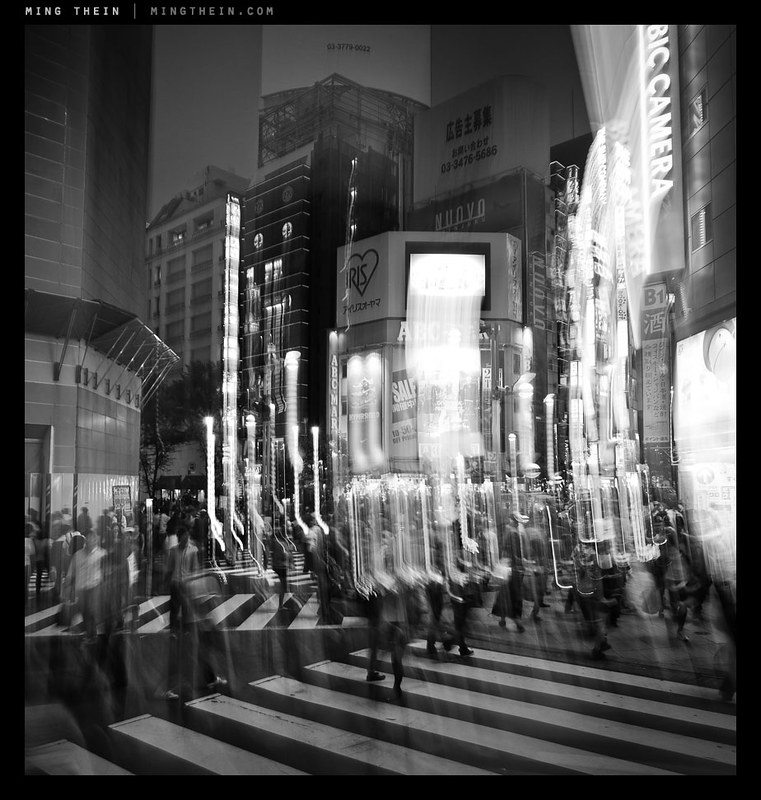
This series of images was captured around dusk in Shinjuku, Tokyo during my last workshop. While my students were off completing their final assignment, I decided to challenge myself to capture the feel and essence of the place in a different way to what I would have normally done. (After all, it wouldn’t be fair for me to put my students outside their comfort zone by insisting on the importance of having a central idea or theme in their images for their assignment if I couldn’t delivery myself, would it?)

_5012881 copy

At the same time, I’d felt as though I’d been reaching a little creative stagnation of late, and wanted to force myself to do something different anyway. Having your own style is good, but at the same time, that style has to evolve and grow in order not to get stale or boring. One of the things I’d been doing a lot of lately is jacking my shutter speeds up very high to ensure I was getting every last pixel of resolution out of the new cameras; whilst this made for great definition under the majority of circumstances, this crispness of capture doesn’t always suit the theme you’re trying to shoot to.

_5013351 copy

The idea I decided to follow for this series was flow – people as water, life as transient, a moment being more than a moment and altogether insufficient to capture the sheer volume of activity of what was going on around me. It’s a very strong impression I got simply by standing in place and watching life moving around me – people simply didn’t stop, torpedoing from location to location with some objective in mind, dispatching that objective, then moving on to the next one. (I’m guilty of this at times too; it’s a consequence of running your own business. Perhaps this experiment was as close to my subconscious was going to get to forcing me to slow down and smell the roses.)

_5013736bw copy

The only two ways I could see of communicating this idea were either to have a huge number of people lining streets and thoroughfares to appear as a continuous mass (there were a lot of people, but not that many, and moreover there was no way or achieving that vantage point) or through the use of motion blur – not a little bit, of the kind that appears at 1/30s and with people walking, but something altogether a bit more abstract. In hindsight, this would have been very easy to accomplish with a tripod, but without it, I didn’t have the foresight to pack one in – much less bring one on the day. Even a mini-pod or a Gorillapod would have been useful.

_5013181bw copy

Instead, I was forced to test the stabilizer of the OM-D to its limits – even with something to brace against (And sometimes not), I’d be needing shutter speeds in the 1/2s-1/5s range to achieve the effects I was looking for. Needless to say, you can only do this when the sun is going down. To give me a higher chance of success, I used the 12/2 for most of these shots, and shot in continuous high burst mode – not for the frame rate, but because I’d be able to keep my finger on the shutter button to minimize camera shake, and have only short intervals between frames. When I had to shoot using the LCD instead of the EVF, I would pull the neck strap tight to tension the camera somewhat against my neck and hopefully reduce shake – this technique is actually surprisingly effective. In hindsight, I should have used the self timer + burst function to completely eliminate finger-induced shake.

_5013468 copy

One of the things with this kind of photography is that you really don’t know exactly what you’re going to get until you get it; there may not be enough motion, or too much, or you might have streaks in the wrong part of the frame; all you can do is do a lot of takes until you get the right one.

Compositionally, the most important thing to remember when involving motion in your shot is that there must always be some clearly static and sharp object in the frame to serve as a visual anchor for your composition; if this is missing, the photograph just appears to be blurred or out of focus without the same directionality and focus that is implied by motion blur. In fact, having a large number of people moving through the frame is somewhat reminiscent of the energy of strong, dynamic brush strokes in a painting. I like the idea of abstracting out the people from the scene, and the contrast between the animate and inanimate. For these images, I chose the visual anchor first, then followed it by imagining where I’d want my flows of people to go; needless to say, there were a lot that didn’t work out because I didn’t have enough people moving close to the camera – a foreground is of course a necessity of using a wide-angle lens.

_5013253 copy

I did use the 45/1.8 for some of the images, but this proved to be extremely challenging as the lower practical limit for handholding a 90mm equivalent was somewhere in the 1/10s range on the OM-D, which is fractionally higher than what I needed for the desired effect. Still, I did manage to get lucky a couple of times with both very stable shots and convenient things to lean against. I also tried some more and less conventional techniques – panning blur, and combining staticness with abrupt motion of the entire camera to impose an impression of chaos whilst maintaining some semblance of a visual anchor. Overall, I’m pretty happy with the results though. Notes for a future experiment: I’d love to try this with a tripod and a longer lens. MT

____________

Visit our Teaching Store to up your photographic game – including Photoshop Workflow DVDs and customized Email School of Photography; or go mobile with the Photography Compendium for iPad. You can also get your gear from B&H and Amazon. Prices are the same as normal, however a small portion of your purchase value is referred back to me. Thanks!

Don’t forget to like us on Facebook and join the reader Flickr group!

appstorebadge

Images and content copyright Ming Thein | mingthein.com 2012 onwards. All rights reserved

_5013236 copy

_5013681 copy

_5013109 copy

_5013834 copy

The four stages of creative evolution of a photographer

_7037765 copy
As close as I got to Everest. Nikon D700, 85/1.4 G

On careful reflection, there are a number of stages which every photographer (hopefully) goes through as their creative vision develops. In fact, it’s more like a pyramid or mountain that requires climbing: the higher you go, the more difficult it gets, and the more commitment is required. The lower slopes are gentle, easy and well-charted; the higher slopes are rocky, icy, treacherous and the preserve of the supremely brave or foolhardy. At the same time, far more people visit base camp than the summit; and few do it without supplemental oxygen.

Perhaps that metaphor has gone a bit too far. Like every pursuit, photography is one of severely diminishing returns: it isn’t difficult or expensive to become reasonably good, but if you’re trying to push the boundaries, be prepared for frequent dead ends, wrong turns, and never-ending criticism: the simple reality is that if you are always experimenting, not all experiments turn out better than the previous one, let alone tried and true methods.

I was at a dinner with a number of fellow commercial photographers recently where this point was discussed in some detail: we work in an environment of shrinking budgets and drying up jobs, yet there will always be some clients who perhaps are more like patrons than business as usual: they don’t mind you trying to push the boundaries. The comparison to the art world was drawn: a piece that may not make any sense to a casual, external observer makes no sense precisely because of the casualness of the observation: the viewer does not have the benefit of having experienced and seen the evolution of the artist from the starting point into their current form of expression. I think the same thing is true with photography, though to a lesser extent; we were discussing another recent batch of image submission which had to be graded/ sorted/ reviewed etc. and how to judge whether something had extremely deep and complex metaphors, or whether it was simply a bad image – the conclusion was that the caption was the giveaway. (It stands to reason that a casual-looking image with a deep meaning and careful execution would have an equally-carefully crafted caption that supports the message of the photograph. None of these particular images did.)

Pre stage
The vast majority of the population falls into this group. These are the people who own cameras and perhaps use them at social occasions, or for recording/ documentary purposes, or when they are expected to – like when on vacation – but do not actively seek to go out and take photographs. They may be creative in other areas, but just not photography. Composition is not something that they actively think about and technical skill is limited to turning the dial to the green mode. For the purposes of this discussion, I will classify them but not discuss their traits in any greater detail; I’m almost certain that none of my readers fall into this category anyway.

First stage
To progress to the first stage, you need to have the intention; you have to make a conscious choice in wanting to make a image. You may or may not know what is good, what works and what doesn’t, or the technical aspects of photography; the bottom line is that a person in this category has the desire to photograph. I suppose this is what separates newbie photographers from the rest of the population who might merely own a camera. Intention is what gives people the motivation to actually get out and do something – in this case, learning, experimenting, and trying out things. It is impossible to learn photography solely by reading or looking at other people’s images, though this can be very useful – you really don’t get a feel for things without experience, and this experimentation is something which is a common factor to all forms of creativity.

The other characterizing traits of a person in the first stage of creativity is that the way they shoot and the work they produce is reactive; they may make a conscious choice to embark on an outing whose sole purpose is to take photographs, however, it is very much a case ‘of shoot what you see’, and only photographing a subject if it’s obvious and front and centre. There is no element of anticipation, preconception, or previsualization involved; this means that the images are frequently lacking in a story – ‘the idea’ – because the photograph frequently contains only the subject and no related elements (the context) – or worse still, a bunch of distracting and misleading elements.

Second stage
The next phase of development involves some awareness of ‘the idea’. It is usually also accompanied by a heightened consciousness of one’s surroundings; this is caused by the development of one’s sense of observation and anticipation. The photographer in the second stage will visit a particular place and feel that it is photographically ‘rich’, with a lot of opportunities or stories; or perhaps that there are certain elements that must be included in a shot in order to the essence of the location.

However, the idea may not be fully formed, or the photographer may lack the technical ability to execute what they are envisioning in their minds. Images produced by the photographers in the second stage tend to feel a little bit chaotic; this is because not all of the elements in the scene are under control, or were included or excluded as a conscious choice on the part of the photographer. It is very possible for a second stage photographer to occasionally produce a brilliant piece image; the problem is that although the outcome may match the intended story perfectly, it was more due to luck than planning and would not be consistently repeatable. Most dedicated amateurs will reach this stage.

Third stage
The first part of this stage – let’s call it 3A – is when a photographer firstly has a vision in their mind of what the end product should look like, can consistently execute this, and have the image communicate its meaning or intention to a viewer on its own merits, without the help of a caption, or intervention from the photographer. These photographers tend to have nearly every element of the image under conscious control; and have a level of technical skill that enables them to consistently repeat the execution if required. There is practically nothing left to chance, and no detail is too small. A good commercial photographer would fall into this category, and it’s probably beneficial for them not to push too much farther, especially in Asia and other conservative markets – there are far more clients that prefer the ‘safe’ route rather than the experimental one.

At the same time, there’s something missing from the images – they’re too safe, too perfect; stage 3B is where the creative realizes this and is trying to produce something different, but can’t quite make it work; it isn’t a bad image, but the full idea or story isn’t getting through. On the way to the pinnacle, one has to expect to fail at least some, if not most of the time. And by fail, I mean produce images that are not quite satisfactory for some reason or another – usually because they fall short of fully and clearly communicating the photographer’s idea at the time of capture. If this isn’t happening, then chances are you’re playing it overly safe and stagnating.

Fourth stage
Defining what makes a photographer qualify for this level is tough, simply because it’s impossible to pin a concrete set of limits on creativity. Perhaps it’s best to say they have to be gifted in some way and give examples; we start with Louis Daguerre, include Oskar Barnack, H-CB, Capa, Kubrick, Salgado, Majoli and perhaps also Avedon and Leibowitz; I think some of the Japanese photographers like Araki would also qualify, though I don’t claim to fully understand their work – but it is clearly a very developed, evolved style. I’m sure there are plenty more out there whose work I haven’t yet had the chance to see, or whose work is either kept private (Vivian Maier, for example – though I don’t think she’s a stage four) or not well publicised. There are but a small handful of people who ever reach this point; they have the common trait of pushing the boundaries in one or more aspects of the image making process simply because they can imagine and envision things which the majority of the population are unable to. I suppose in some ways, this aberration of the mind or difference in thinking is a bit like having a disability, but in a way that’s more beneficial than debilitating.

Although these people have the benefit of being able to see in a way that the rest of us cannot; a lot of them are also handicapped by it because this way of seeing is so ingrained into their thought processes and consciousness that it is very difficult, if not impossible, to break away from. This is in a way analogous to a form of savantism in which the subject has a narrow, obsessive focus on one particular topic that leads them to consider every possibility and outcome; including the ones that are normally discarded through a more balanced rational thought process. This focus results and creativity or games in one very specific niche; a slightly less intense variant of this is the development of personal style. Discovery and adoption of a personal style, in a way, is the development of and obsession with a particular look or mood to an image.

One little thing I notice about photographers who are at the fourth stage is that none of them will ever admit it: their work is never excellent, it is merely good enough (and rarely, if that). They are proud of what they do, but they know that things can still be taken further with another push; ideas fleshed out and illustrated more fully. Their work is always technically very well executed, and frequently polarising; their creativity is so far ahead of the interpretative capacities of most people that there are two camps of viewers: the concept or message is so fundamental that either you understand it, or you don’t. They have a deep passion in what they do, bordering on the obsessive; and are frequently difficult people to interact with in social settings, simply because their thought processes are so different to the majority of people that there is no common ground or reference basis on which for them to interact, leading to frequent miscommunication and awkward gaps in conversation. This in turn contributes to such artists being misunderstood or developing a reputation for genius – it’s not that they don’t want to explain the rationale behind their thought processes, it’s because they simply cannot – what seems perfectly ordinary to them and not requiring a second thought is something that requires a huge number of mental leaps for somebody else.

The conclusion of this article has deviated somewhat into an examination of the mind of how an extremely talented and gifted person would think; this was not intentional however in the interest of full disclosure it is a topic that is very personal to me because of things I have faced in my own life. I graduated young, and have always been – by a large margin – the youngest person at my level in any organization I’ve worked at; in my last corporate job, my peers were in their 50s (I was 25). I had no problems doing the job – the huge delta in thought processes and social experience is what made me feel highly uncomfortable with my day to day situation.

One of the reasons I’m so passionate about photography is because it is one of the last few truly meritocratic fields; it doesn’t matter how old you are or who you’re related to (there are of course exceptions); in an anonymous viewing, a crap image will always be a crap image; there is far less discrimination based on age than in other fields. Perhaps it’s because a perception thing: you can instantly judge the merits of a photograph visually, but it’s impossible to know if somebody is a good investment manager or consultant or operations director simply by looking at them. (And even several years down the line, it’s still difficult to tell; it’s impossible to separate out the person from the other environmental factors affecting their work.)

This is of course not to claim that I fall into stage four or even 3B; I think it takes recognition by a large body of people for a person to be recognized as gifted. But I do know that I plan and think about my images to the point of being neurotically obsessive; there is always something that can be better, there is always something else to try, another article to write or another thought to elucidate and share. And in a weird way, I think I rather enjoy it. MT

____________

Visit our Teaching Store to up your photographic game – including Photoshop Workflow DVDs and customized Email School of Photography; or go mobile with the Photography Compendium for iPad. You can also get your gear from B&H and Amazon. Prices are the same as normal, however a small portion of your purchase value is referred back to me. Thanks!

Don’t forget to like us on Facebook and join the reader Flickr group!

appstorebadge

Images and content copyright Ming Thein | mingthein.com 2012 onwards. All rights reserved

Clearing up the myth of higher resolution, shot discipline and image quality once and for all

Empirical observation #1: Cameras with higher resolutions, for a given sensor size, are harder to hand-hold and get a good result than those with a lower resolution.

And I define a good result as one which the image is critically sharp at 100% actual-pixels view, with no motion blurring or other artefacts such as slightly missed focus (we’ll get to this later). Motion blur is when the camera moves by a greater amount than a pixel during the time when the shutter is open; if it’s less than this, then you see either hard edges on your subject as a perfect sharp edge, or with slightly lower contrast than expected due to the image projected by the lens on the sensor plane ‘spilling over’ into the next adjacent pixel slightly when the camera moves.

The simple reason why higher resolution cameras are less forgiving is that for a given angle of view, the camera with the high resolution will put the greater number of pixels per degree of field of view on the subject. This means, that less angular movement is needed before it becomes visible as blur on the image – i.e. you need to be more static than with a lower resolution camera to avoid seeing the effects of motion blur at the pixel level.

But what about the image when viewed as a whole at the same reproduction size? If we started out with a huge number of pixels with both – say 24MP and 36MP and resized both them down to say, 4MP or so – we would not see any difference between two cameras assuming one assuming both were equally downsized. This is because the downsampling process has enough information for each pixel to accurately determine its color and luminance value and therefore appears as true detail. If we downsize 36MP to 24MP, it might or might not look better: a lot of the outcome depends on the interpolation process. It isn’t a ‘clean’ situation where each new, downsized pixel has multiple pieces of information (the original pixels) to form an average that would be the same whether you used 8 or 12 pixels originally. Since 36 doesn’t divide cleanly into 24 – you get 1.5 old pixels per new one – there’s always going to be some guesswork as to precisely how that half pixel is allocated. And depending on the algorithm, any one of the following might happen – blur edges; stairstep artefacts; haloes or abrupt transitions; odd discontinuities in diagonal lines.

Let’s take an example: if you have a scene shot with 12 (8.45um pixel pitch) and 36 MP (4.88um pixel pitch) cameras, and both are equally motion-blurred. The degree of camera shake may be less than a pixel on the 12MP camera – let’s say 5um for argument’s sake, which will still produce a critically sharp image. However, the 36MP camera is now blurred by more than one pixel, which definitely will not look critically sharp at 100%. Yes, we can downsize – but you are downsizing not to 1/2 of the original linear dimension (which would yield 8MP, and bin the two blurred pixels into one sharp one that looks perceptually okay), but to 1.7x of it – and once again, we run into potential issues in trying to fit discrete, nonlinear data into a linear continuum.

This is one of the reasons why less pixels might actually produce a perceptually sharper/ crisper image for a given reproduction size, providing that this size is reasonable for the amount of resolution you’ve got in the smaller image.

The upshot of all of this in practical shooting is that you’ll need to use a higher shutter speed than you expect, which lowers your shooting envelope by a corresponding number of stops as noise increases as you ramp up the sensitivity to keep shutter speeds high. Perceptually, if you’re going to be shooting under already borderline conditions to get a critically sharp image with a 12MP camera, you’re not going to get one with a 36MP one – even if you print them at the same size.

Empirical observation #2: Cameras with higher resolution require more precise autofocus.

Comparatively, this one is very simple to explain: if the camera misses focus, the resolving power of the lens is diminished. You need to have the ability to resolve slightly smaller structures than the pixel pitch of the camera in order to create a perfectly sharp image at the sensor plane. If you miss focus by an arbitrary amount – let’s say 1% of your subject to camera distance – this may result in a loss of resolution corresponding to the inability to resolve structures below 5um in size. For our 36MP, 4.88um pitch camera, this will appear to be a blurry shot. For our 12MP, 8.45um one, things still look critically sharp.

A lot of what we’re seeing isn’t necessarily worse autofocus; what’s happening is that we are now visibly reaching the limits of tolerances and precision since sensor quality is now high enough to resolve at or close to the previously acceptable tolerances.

A lot of the reasons why an image appears sharp or not has to do with the reproduction medium, as well as how our eyes interpret information: an image with hard edge is seen to be ‘sharper’ than an image without one, even if there is less fine detail or edge definition. The fact that digital capture splits out our images into distinct zones – the pixels – doesn’t help this at all, either. It’s important to remember that a slightly blurred image (depending on the degree of blur, of course) from a higher resolution camera may technically still have more detail, our eyes don’t necessarily pick up on this; it’s a perceptual thing. Bottom line: don’t use more pixels than you are capable of handling properly for a given situation. It’s one of the reasons why I don’t shoot the D800E for casual work…but it’s also the reason it’s my camera of choice when I have full control of the execution. MT

____________

Visit our Teaching Store to up your photographic game – including Photoshop Workflow DVDs and customized Email School of Photography; or go mobile with the Photography Compendium for iPad. You can also get your gear from B&H and Amazon. Prices are the same as normal, however a small portion of your purchase value is referred back to me. Thanks!

Don’t forget to like us on Facebook and join the reader Flickr group!

appstorebadge

Images and content copyright Ming Thein | mingthein.com 2012 onwards. All rights reserved

Basic street photography techniques

_RX100_DSC0385b copy
Offerings for sale. Sony RX100

Continuing in this mini-series on street photography, there are a number of techniques that I use while shooting. Although it’s possible to describe most of them in some detail, full understanding requires both demonstration and practice – this is where joining one of my workshops is ideal 🙂 Together with the basic principles of balance, perspective, composition and what makes a good image – these techniques may be used singly or in combination to generate strong street images. In fact, they also apply to documentary and reportage work, too; the only difference between good street photography and photojournalism is that the latter has a consistent theme and subject.

It’s important to note that not every technique is suitable for every situation, and vice versa; as always, a good portion of making a strong image is knowing what to leave out.

_M9P2_L1000182 copy
Hiding from the rain. Leica M9-P, Zeiss ZM 2.8/28

Timing and anticipation
In a photographic situation where you have effectively zero influence of any of the elements in your frame except the composition and exposure, timing is the one key bastion of control that remains in the hands of the photographer. By making a conscious choice of when you push the shutter, you decide when each and every single one of the moving elements in the frame is in the position you want them to be in. However, it is too late to react only at the exact instant you see the composition you want. It is therefore important for photographers to be able to see a scene, visualize the potential contained there, and be able to imagine what the finished frame will look like once all of the desired elements are in place. It is then a matter of simply waiting for those elements to all come together, and being ready with the camera when they are. No matter how fast reflexes, or your camera, the fact is that if you react off to you see something, it’s too late; training yourself to anticipate action is something that can give you the critical second or half-second which can make all the difference between getting the that and missing it completely.

_5006872 copy
Progression. Olympus OM-D, Panasonic 20/1.7

Shoot stopped down
A lot of these techniques are about timing. Specifically, gaining yourself a little bit of extra breathing room to react. In this case, shooting stopped down allows you to simplify the process somewhat by not having to decide what to have in focus, and what not to have in focus. If you’re shooting with an autofocus camera, it also allows a little bit of leeway for the camera to misfocus, yet still allow the final shot to be in focus thanks to extended depth of field. Note that of course this technique does not work under low-light situations, where you need every stop of aperture you can get. Compositionally, shooting with great depth of field actually forces you to create stronger images. This is because you have to think more about your subject placement, leading lines, empty spaces, etc – which all affect the overall balance of the image. If you can make interesting image without relying on the crutch of bokeh, then you will find yourself with increased compositional and artistic flexibility when you do have this option in your toolkit.

_M9P2_L1000213 copy
Divided. Leica M9-P, Zeiss ZM 2.8/28

Shoot wider
There are many reasons to shoot with a wider lens. First of these, is of course the enhanced foreground perspective emphasis that it provides, hopefully on your subject and not an expanse of pavement. Having a lens with a shallower and more forgiving depth of field profile both allows greater latitude for focusing errors, as well as allowing extended depth of field without having to stop down too much. There are also other non-obvious advantages of going wider – not only do you eliminate or minimize the possibility of having unwanted elements come between you and your subject due to physical distance (and you subsequently missing the shot because in the time it takes for your frame to clear, your primary subject has already moved on or changed position), but also you can get people in the periphery of the frame as edge subjects or context without them suspecting anything. In this sense it’s also about minimizing the reaction time between you visualizing the shot and executing it.

_RX100_DSC0688b copy
The taxi men. Sony RX100

Act as though you belong
In pretty much all situations, you will notice the confident people rarely – if ever – get challenged. This of course also applies to street photography. By acting like you belong, and you’re confident and know what you’re doing, casual observers to the scene assume that you have every right to be there and generally allow you to go about your business without interference. A subset of this is acting like a tourist. Tourists are not self-conscious and they are generally expected to take photographs of everything encountered; by doing this you’re fitting the expected stereotypes. And, as you will no doubt already know by having read my earlier articles, a large portion of photography – including the execution – is seriously influenced by human psychology at a subconscious level. Spend some time understanding how people think, and you will find that you both have more control over the way you images are interpreted, as well as how people react to you while you’re out shooting.

_M9P2_L1000693 copy
A glitch in the matrix. Leica M9-P, Zeiss ZM 2/50

Hyperfocal and zone focusing
One way of speeding up the shooting process is by completely eliminating focusing altogether. Hyperfocal focusing means that you have everything in focus beyond a certain point; it requires the lens to have a comprehensive depth of field scale in order to set your focus distance precisely. Manual focus lenses tend to be better for this, I suppose because manufacturers of autofocus lenses think that photographers will not use the manual option and therefore simply choose not to include proper depth of field scales. (Most of the time, they’re right.) Zone focusing is similar. What you do, is ensure that your desired subject distances fall between the two aperture markings on opposite ends of your depth of field scale. For the current bunch of high density digital sensors (anything over 12MP or so), you will need to use an aperture one stop smaller than indicated on the depth of field scale because these scales were calibrated for the circle of confusion corresponding 35mm film, and haven’t been updated since. There is a game played by rangefinder shooters that can help you improve your skills at estimating distances; pick a subject, set distance on the lens, and then check through the rangefinder to see how accurate you up. Do this often enough, and you will find that your focusing ability has magically improved. The upshot is that with sufficient practice, it is possible to estimate distances without even having to look through the viewfinder. This means that you can focus the camera and have it ready even while at waist level or in your hands, before you frame up the shot – once again, it’s all about reducing your reaction time.

_5001813 copy
Querry. Olympus OM-D, Panasonic 20/1.7

Stages
I don’t believe ‘stages’ is a commonly used terminology. I use it to refer to a setting, or scene, where the light is interesting and directional, and all it needs to complete the image is a human element of some sort to add context. I’m constantly on the lookout for these ‘stages’ when I shoot; when I find one, I will stay and work to seeing for his long as it takes for me to get an image that I’m satisfied with. Sometimes this is within seconds; sometimes it can take hours and I leave without getting the shot I wanted. But if I have a chance, and it’s a case of ‘unrequited stage’, then generally I’ll return again at some future point in time to get the shot I’d originally envisioned.

_M9P2_L1001019 copy
Haircut. Leica M9-P, Zeiss ZM 2.8/28

Layering
Layering is a technique that you can use to add context and depth to an image. It requires the use of a longer lens, which is ideally suited to this because it naturally separates out your scene into foreground, midground and background, all with relatively similar prominence. This allows you to place your subject in any one of these zones, and use the remaining zones to form the context and tell the story. Aside from using a longer lens, the other way to achieve layering is by the use of reflections; whether it be in a building’s glass, a puddle or perhaps some other shiny object. In this case, a wider lens is actually preferable because it allows you to capture more of the reflection. Note that when you’re composing, your reflected background is going to be further away than you think because the light has to come from the subject, to the point of reflection and then back out again to the camera; this can affect perspective in strange ways if it not consciously compensated for.

_X21_L1020034bw copy
They don’t know you’re there. Leica X2

Shoot through people
The most difficult and counterintuitive technique that I use is something I call ‘shooting through’. It basically requires you to stand still in a flow of oncoming people, and just shoot into the crowd. Although this will feel strange but first because you’re pointing your lens directly in people’s faces, offer a while you get used to it. The challenge then becomes actually separating out individual frames from the general scene as a whole. This technique works better in busy spaces and thoroughfares, simply because this means people tend to be more concerned with where they are going rather than what you’re doing. In a relatively quiet space, this technique is not very effective because people can see you coming – or rather, standing there – from a mile away. It is important to note that the psychological reaction to somebody standing still with a camera held up and ready to shoot is very different to if the same person stood there and suddenly brought out the camera to shoot; the action of raising the camera draws attention to yourself. Psychologically, sudden movements also catch us unawareness and make us uncomfortable. By looking like you have been there for a while, and will continue to be there, people are put at ease which allows you to operate without drawing unnecessary attention to yourself. In fact, oncoming pedestrians will probably take pity on you (poor tourist, trying to take a photo but we’re all in his way), not knowing that they themselves are actually the subject of your image.

_5A00477 copy
Garden of earthly delights. Olympus OM-D, 45/1.8

Stealth or flamboyance?
The final technique is simply being inconspicuous. This involves techniques such as not making any sudden moves, and most of the time, not even having the camera raised to your face when you take a photograph. The smaller, blacker and more nondescript the camera you use, the better, because it does not draw any attention. This is one of the reasons I like to use compact cameras for street photography – not only do I look like a tourist, but what possible threat could a small Asian man with a point and shoot pose? He’s probably just lost and on holiday. The complete opposite of this, and also viable option, is to be completely flamboyant and ridiculous. You stand out to the point that nobody takes you seriously; and this allows you to get on with your serious work in peace. I’m talking about shooting a bright pink camera dressed and perhaps being dressed red and blue; or maybe using a view camera on a tripod whilst dressed a three-piece suit and top hat. Then, you become a subject of interest and curiosity rather than the potential threat. (I have never done the latter myself, although in the interest of improvements in image quality, and perhaps the different look to my images, I am quite tempted. I plead the fifth on the former.)

Although this list is by no means exhaustive, I hope this article has given you some insights into both how I shoot when I’m on the street, and some new techniques for you to try out yourself when perhaps you see a great shot but you’re too shy to go out and get it. Bottom line is that street photography is not very different to being a Boy Scout: be prepared and confident. MT

____________

Visit our Teaching Store to up your photographic game – including Photoshop Workflow DVDs and customized Email School of Photography; or go mobile with the Photography Compendium for iPad. You can also get your gear from B&H and Amazon. Prices are the same as normal, however a small portion of your purchase value is referred back to me. Thanks!
Don’t forget to like us on Facebook and join the reader Flickr group!

appstorebadge

Images and content copyright Ming Thein | mingthein.com 2012 onwards. All rights reserved

What is street photography?

_RX100_DSC1889 copy
Calling in to check if the city is really there. Sony RX100

Sometimes, I think I’m a bit of a masochist. I actually like to shoot difficult subjects, and increasingly of late I’m also starting to write a lot about difficult topics. Today’s article seems like a very simple question to answer: what is street photography?

The more I try to nail it down – and I spent a considerable amount of time on this before the Finding Light workshop – so I would know what to cover, and more importantly, what my students would expect me to cover. The first point of confusion comes when you try to decide what is ‘street’ and what isn’t: what about public spaces? What about museums, galleries, fora etc? Stairs? Restaurants? Hawker centers? Public transport, like the Underground?

And here’s another question: does street photography always have to have human subjects in the frame? And when does street photography turn into travel reportage?

You can see how this becomes confusing. I’ve decided that in general, the genre is loosely defined around several broad guidelines (at least for me; your mileage may vary). Let’s take a closer look at these.

_VL31_L1010048 copy
Hands up. Leica V-Lux 3.

Street photography is unplanned.
If you’re controlling any of the elements in the scene, then it starts to become a conceptual or even outdoor studio shoot – posed models in public definitely do not count as street photography: the photographer knew (or should have known) exactly what poses, look and lighting he wanted before beginning the shoot. (You certainly wouldn’t hire a model and get shooting permission if you had no intention to shoot there, would you?) There is also a reactive element to it – spontaneity and the ability to anticipate are both critical tools for the street photographer. You really never know what you’re going to get on any given day, and that’s what draws photographers to the genre: a never-ending source of material.

_5010054bw copy
Breakfast. Sony RX100

Street photography mostly uses available light.
In fact, the only exception I can think of to this rule is the work of Bruce Gilden and his imitators. Setting up lights on the street corner or using a big flash tends to make the photographer extremely conspicuous, which that removes the unplanned element. People either go out of their way to be photographed, or alternatively, avoid you completely. Part of the challenge and attraction to street photography is the very fact that the light, amongst other things, is not under your control. A photographer has to train their eye to see interesting light, and their muscle memory to be able to take advantage of it – sometimes under extremely fleeting circumstances.

_RX100_DSC0731b copy
Rojak. Sony RX100

Street photography may or may not involve people.
This is a question of scale; at the near or human scale, you have that which are dominated by people as the primary subject; at the large scale you have entire cityscapes and street scenes, that use people to give context and scale to the image. The farther away you go, the more the image becomes about the atmosphere and the feeling of the place, rather than the people who inhabit it. That said, there is no reason why you cannot take photos of something which you happen to see while walking around looking for these scenes or people; this is the kind of thing which I like to call ‘street furniture’ – interesting lampposts, mail boxes and other geometries are also fair game. I think it is also possible to make an argument to include casual architecture in the genre; I know that when I travel, I tend to shoot a lot of interesting buildings with or without human context involved – simply because these are things I see while walking around, and they add a lot to the context and general feel of a place.

_RX100_DSC0728b copy
Morning papers. Sony RX100

Street photography, if involving people, tends to do so under situations where they generally do not expect to be photographed.
I suppose this sounds both a little bit voyeuristic, and slightly contradictory when it comes to frequently photographed public tourist attractions such as Trafalgar Square, but in general even though a person may know that you are photographing them, they certainly didn’t leave the house preparing for in the morning. This variety and unpredictability of people is yet one more aspect of what makes street photography interesting.

_RX100_DSC0628bw copy
Door symmetry. Sony RX100

Street photography, if involving people, generally has subjects that are unfamiliar or unknown to the photographer.
Perhaps this may be an overly fine distinction to make, however if a subject is known to the photographer and the photographer is familiar with the subject, there is usually some form of interaction between them. This relationship is usually clearly reflected in the photograph. I personally find that one of the things that makes street photography interesting is the fact that for that brief moment while you’re photographing somebody, there is that instant of connection between you and your subject which is then preserved for posterity – even if you never happen to see them again.

_RX100_DSC0351bw copy
Sometimes, smaller is better. Sony RX100

Street photography must always have a subject, regardless of any of the above restrictions.
This rule is a fundamental of photography in general, not just street photography. However, I feel it necessary to draw attention to this specifically because there are so many images out there on the Internet which claim to be ‘street photographs’ – yet they fail fundamentally as photographs because they lack a clear subject or idea. Even though the photograph itself may not be planned, this does not mean that you can’t have an idea in the instant instant when you see a potential frame, which is then executed immediately.

_RX100_DSC0645b copy
Evening. Sony RX100

Street photography must observe certain ethical restrictions.
This is very much a personal thing. There are certain people or things that I will not photograph because I do not feel comfortable doing so. In general however, a good rule to go by is not to do to other people what you would not want done to you; this includes intrusion into personal space, photographing people in potentially compromising positions, or under duress. I do not believe in taking photographs of the homeless, because I feel this is both exploitative and does not help them in any way. Similarly, paying somebody money to take their photograph may be an acceptable way to make a living in certain countries where there is no choice, however this is not something I want to encourage because I feel that widespread proliferation of this both discourages social documentary as well as taking away from the authenticity of the image.

_RX100_DSC0397bw copy
Christo comes to Kuala Lumpur. Sony RX100

Street photography has an element of reportage or the documentary to it.
Given that a strong photograph must have a distinct subject and a clear idea, the easiest way to do this in a street photography image is by capturing a moment. This is where HCB’s idea of the decisive moment becomes critical; in that one moment, all of the elements in the frame come together to tell a story. There is only one decisive moment for each story, but many possible stories for any given scene. If all street images have a story to them, then becomes clear that what we street photographers are collectively doing is capturing daily life for posterity. In areas where the pace of change is increasingly rapid – especially in developing countries – I feel there is a certain element of social responsibility here for all able photographers. (Or, at very least, the desire to show your descendants what life was like during your time.)

_M9P2_L1000663 copy
Outside the W. Leica M9-P, Zeiss ZM 2.8/28

Street photography is not restricted to black and white.
There are many reasons why historical street photography was done in black and white; most of them because that was either the only film available, or because it was a lot cheaper than color – especially in the quantities that prolific street photographers tend to shoot. Today, I sometimes get the feeling that black and white is overused as a distraction to cover up the fact that the image itself is fundamentally mediocre. Instagram certainly does not help things. Is important to remember the fundamental rules of color and composition to decide when black and white or color may be more appropriate. (Black and white works well for strong luminance contrasts and oblique lighting; color should be used when it is the primary means of isolation of your subject.)

_M9P2_L1000234 copy
Looking up. Leica M9-P, Zeiss ZM 2.8/28

Street photography takes place in public spaces.
In a private, or restricted access space, the people who use the space tend to be known to each other, which changes the dynamics of interaction between them (and the photographer). Public spaces maintain a degree of unpredictability simply because you never know who is going to be your subject.

Street photography doesn’t always have to have a purpose, but each image must aim to say something.
In fact, most photographers tend to shoot in the street genre simply because they feel like going out to photograph, but may not necessarily have any specific subjects in mind; I do this all the time. This of course does not mean that week images are acceptable!

_M9P2_L1000119 copy
Contemplating the markets. Leica M9-P, Zeiss ZM 2.8/28

Street photography doesn’t require you to fill the frame with a random stranger’s face.
One of the common misconceptions is that street photography always requires a clearly identifiable stranger or or person dominating the frame; let’s take a step back and think about the way we perceive the world when we are out walking on the streets. Our eyes scan around us, taking in the entire scene, and this generally corresponds to something around the 28mm field of view. It is very rare that our attention lingers on any one particular person or point, unless they are strikingly outstanding. Personally, my photographic style is developing in a direction that makes me want to replicate and reconstruct what I see both in reality altered by the filter of my mind’s eye, which means that the perspective I choose to frame my images tend to correspond to what I see. These tend to take one of two distinct perspectives, the first of which is slightly wide, corresponding to my general field of view; the second is narrower, akin to when you are focused on something and the rest of the scene gets ignored – 28, and 85mm.

_X21_L1020014bw copy
Escape route. Leica X2.

Street photography can be done with any equipment.
Although there are some cameras that are better suited to street photography than others, there is really no reason why you can’t use anything you happen to feel like using on the day. There are two ways of shooting street; the first is always to be set up and ready, which requires you to preset focus and exposure and work solely on framing at the instant of capture; the second is to be reactive and have a camera that is capable of both focusing and exposing very quickly. However no matter how fast the camera, a degree of anticipation is required in order to capture the decisive moment – there will always be some lag between you seeing the moment, due process happening, and the shutter firing.

_M9P1_L1012531 copy
Shadows. Leica M9-P, 35/1.4 ASPH FLE

Street photography and travel photography are largely interchangeable.
The only difference between the two is purpose and intention: the former can be when you are shooting with no specific goal or project in mind; the latter is almost always when you want to capture the feeling or mood of a place that happens to be both unfamiliar to you and fleeting or temporary; there’s a time limit on how long the photographer has to absorb and observe. That also introduces a perspective difference: when you travel, you look at a place through different eyes than a local; however, most street photographers operate primarily in their home cities.

_M9P1_L1012454 copy
Bangkok bus. Leica M9-P, 35/1.4 ASPH FLE

Having broken down my thought process in this article, I’m actually no longer sure that there is a concrete definition of street photography. At the same time, I don’t think that it should be a catch-all genre for everything else that doesn’t have its own category. Perhaps the simplest, and most accurate, definition is simply to think of it as ‘reporting on life’; through our images we are documenting the daily life of the people around us. I wouldn’t go so far as to think of ourselves as social anthropologists, but who’s to say what these extensive collections of images – assuming they survive – may be used for a few hundred years from now? MT

____________

Visit our Teaching Store to up your photographic game – including Photoshop Workflow DVDs and customized Email School of Photography; or go mobile with the Photography Compendium for iPad. You can also get your gear from B&H and Amazon. Prices are the same as normal, however a small portion of your purchase value is referred back to me. Thanks!

Don’t forget to like us on Facebook and join the reader Flickr group!

appstorebadge

Images and content copyright Ming Thein | mingthein.com 2012 onwards. All rights reserved

Candid thoughts on the online photography ecosystem

Let’s start off with a bit of a definition: the ecosystem covers all of the photography-centric bloggers, reviewers, pro photographers with blogs, corporatized review sites, e-commerce sites that might have some reviews, rumor mills, niche manufacturers of little photo-related widgets, gadget websites that might cover photographic equipment, testing houses, subscription review sites, point-and-click review factories, brand forums, community forums, photo sharing and hosting sites, facebook pages for photographers, columnists, contributors and so on and so forth – anything that’s photography-related, offering an opinion, and online.

This post is going to potentially offend a lot of people, but in the interests of continuing transparency and trust, I feel it is necessary to fully clarify my position.

There seems to be a bit of schism that’s taken place over the last couple of years, as the photography industry has both matured and moved truly into the digital age: correction, the primary consumer market of the photography industry has moved into the digital age. By that, I mean that increasing numbers of camera buyers are actually spending the time reading and then relying on the opinions of a relatively small (but growing) group of reviewers and websites. What I basically mean, is that photography online is becoming very much like either the automotive industry or the hi-fi industry. (I can understand why it’s so important to seek opinions in the auto industry – a car is a large, long-term purchase and you’ll probably only own one or at most two at a time; curiously photographers tend to own dozens of pieces of gear, whose combined purchase price probably exceeds their cars.)

Everybody and their dog (and their dog’s trainer and groomer) have an opinion, and many become self-proclaimed experts overnight.

It’s now both easier and harder than ever to check credibility: the louder a person shouts – and there are some bloggers who shout very loud about nothing much, or worse, illogical nonsense – the more weight an opinion seems to be given. This ‘expert opinion’ becomes repeated, quoted, and taken as gospel – all when the writer probably hasn’t done a shred of research, or worse, said something as a throwaway comment. People who in the real world, are generally sensible and making considered, planned decisions, are now following the town crier with their wallets open and thousands of dollars in their hands. Worse still, major camera makers are encouraging this by supporting the people with the loudest voice – not necessarily the most factual credibility. Where has common sense gone?

Perhaps it’s a case of information overload; the more text we have to read, the less we want to spend time looking for it, and so the first item on Google (or maybe the second, too, if we don’t have any meetings lined up) is all we read. The writers get more and more popular, and it’s a self-destructive cycle. The problem for the camera makers is that in the short term, people will follow the loudest voice. Obviously, this helps to sell a lot of cameras, which is what the companies want. In the longer term, as consumers get more educated, they’ll discover the louder voices are often incorrect, which discredits the previously ‘expert’ loud sources – and individuals are less inclined to trust future claims, which will have a negative impact on sales. It seems that feast now, famine later isn’t a problem for most executives because this year’s bonus assessment is coming up next month, and somebody else will be the one in the middle of the future famine.

As a consumer, you’re spending a not inconsiderable sum of your hard-earned money on something. Make sure that you know yourself, and what you’re going to use it for, before trusting the opinion of somebody who’s never used the item in question for your intended purpose. Most importantly: give weight to the review according to the output, i.e. the images. If a reviewer writes badly but is able to produce stunning images, then chances are they have enough knowledge that their opinion is meaningful. Do not trust reviews with mediocre (or worse, no) images – this is an obvious sign that the reviewer has no clue what they’re doing, and probably doesn’t even know what the equipment is for.

As a manufacturer, there’s a natural inclination to support those who are blindly loyal to promoting your product, especially if it’s at the expense of other companies. Wake up: if you can’t see that using many products gives a reviewer if anything even more credibility, then you might run the risk of being caught with your pants down when your customers (or somebody else with an even louder voice) says something to the contrary. A case of the Emperor’s New Clothes you do not want.

Forums full of equipment-masturbating fanboys are probably the worst hotbed of this kind of activity: people with relatively little knowledge go to seek the company of other people with similarly little knowledge, to try and reinforce the validity of their purchases – sometimes at the expense of common civility, or just being openly hostile to any challengers. Wake up: there is no absolute right or wrong piece of gear, the very reason that there’s a variety is because there’s no such thing as one size fits all. I don’t need my choices to be validated by somebody else to be able to take a good picture – that’s stupid.

One related trend that’s popped up and taken to the fore in the last year or so are the rumor sites: they serve an underlying malcontent insecurity amongst hobbyists who prefer to spend money on equipment in the mistaken belief that it will solve all of their problems and make them instantly better photographers. Worse still, titanically huge noises are made when the rumors aren’t as expected, and people forget that a) most rumors are intentionally leaked by manufacturers; b) nothing that might be released tomorrow will change your skill level or ability today; c) they’re rumors!!

What I really cannot understand is how people – and a lot of popular ‘reviewers’ fall into this category – can pass opinion on something that neither they nor anybody else have physically handled or used, and then treat this as gospel. Once again, the problem is that if something is repeated enough, and a sufficient number of people believe it, it becomes true.

But I’m probably preaching to the choir here: I don’t think the majority of my readers are under the illusion that practice and skill come second to equipment.

And that brings me to the crux of the matter: yes, cameras are now more than sufficiently prolific to be considered consumer goods (and with similarly short life cycles) – but ultimately, the pursuit of photography is about the production of images, not the collection of gear. There is nothing wrong with collecting cameras for the sake of collecting cameras*, or because you enjoy the designs, or for whatever other reason – just don’t confuse it with photography. It annoys me to no end when I’m challenged or criticised by people online, often hiding behind the anonymity of an ambiguous username on a forum, on something I’ve written that perhaps offends them because they purchased something I might have deemed to be slightly inferior to something else, or who insists on arguing a point that makes absolutely no difference in the real world. It is clear that these discussions are pointless, because a) you’re never going to convince a fanatic, but they can definitely waste a lot of your time; b) more often than not, they either haven’t posted a single image anywhere, or certainly none worthy of note: these are not photographers, they’re equipment fetishists.

*I highly doubt that anything mass produced and reviewed by every popular site on the internet is ever going to be collectible; there will simply be too many of them out there to appreciate in value – simple economics.

With that, I want to make some things clear about the principles under which I have so far and will continue to operate this site:

I am a photographer first, a writer second, and an equipment reviewer a distant third.
Everything I write about, I do so because it’s either interesting to me, or because I plan to (or already) use it in my professional or personal work. Time is far too limited for me to review things to promote them for manufacturers (several accusations) or bother testing extensively and reviewing a bad product. That is pointless, especially when I have to spend my own money to buy it!

My methodology is consistent.
I am a scientist by training, and know that a comparison with no baseline or repeatability or consistency in methodology is meaningless. I also know when the results are so close that the differences are within the margin of probable error, it’s impossible to call one superior over another.

If something seems off or unexpected, I double and triple check my results.
If there is a question in the results due to the possibility of sample variation, I will test enough samples to rule this out. The best example of this is the D800 and its focusing issues: I was accused of a) covering up the issue (!!) and b) crying wolf initially. I tested five bodies with a good spread of serial numbers variety of lenses; every single combination exhibited the problem. We can therefore conclude that there is a problem. If it had only been one out of the five, it would most likely be an individual sample defect.

I won’t ever post unedited JPEGs or similar images.
This is like making a judgement on a restaurant by eating half-cooked food. It isn’t giving the equipment a fair chance against other equipment, nor does it take into account the potential – and as a photographer, that’s what I want to have some concrete idea of. Would I buy a camera with crappy JPEGs but incredible RAW files? Of course, because I don’t shoot JPEG for the reason that I’m not maximizing the potential of my equipment.

I don’t do quantitative testing or pixel-peeping.
There are other sites that do this if you’re so inclined; however, sensor and camera technology has long past the point of sufficiency for the vast majority of uses, and even for those of us who make a living from images, our clients haven’t said anything about image quality for some time now (assuming of course you’re maximizing the potential of your camera). The fact that I need 3x higher a shutter speed to handhold adequately, or the fact that I can’t reach several of the major controls without contortion is far more important to me than the fact that the signal-to-noise ratio might be 5% better than its predecessor. One affects the way I work in practice, the other doesn’t.

I try to keep things relative.
In a previous life, I served as Editor and Contributing Editor to a photography magazine for over five years; in this time, I reviewed and used just about every major piece of equipment made; this totals some 300+ reviews. Using a variety of equipment both allows me to pick the best tool for the job, as well as have a good basis for comparison for one piece of gear against another. It’s of course impossible to use everything, but it’s also important to use enough that you can’t get called out for a glaring error.

I am not allied to any brand, though I work with many of them.
The brands I work with are fully accepting of the fact that I do so with no exclusive interest, and because I feel their product is the best for whatever I happen to want to do with it. I have full editorial freedom over what I write. And yes, there are brands and companies (I think you can figure out which ones by elimination) that I do not work with because they insist on censoring everything written first. That completely defeats the point of having an independent review, not to mention undermining everybody’s credibility. Saying something is good when it really is good is fine; it’s when people say something is good when it clearly isn’t that problems of objectivity arise. You won’t see me saying much (if anything at all) bad about most things, because it if’s bad, I won’t waste my time using it, or potentially affect my relationship with the brands by posting something negative that might be later constituted as inflammatory.

If I don’t know something, I’ll admit it.
There are aspects of photography where my knowledge is next to zero – sport, videography etc – and I’ll be the first to admit that. I’ll also not pass opinions on something that I have no knowledge of, or no ability to support through fact or experience.

My opinion is subjective, but I do try to be as objective as possible.
The outcome of any qualitative assessment is open to interpretation; photography very much qualifies as subjective in this regard. It is impossible to completely remove any interpreter bias, even moreso when it comes to the aesthetic considerations of an image – yet this is the area in which I receive the least (almost zero) discussion and challenge, by a long margin. I’ve always strongly encouraged my students and readers to seek a second opinion and not make a choice solely based on what I say; what works for me may not work for you, and what I like may differ from what you like. Seeking the opinions of multiple credible sources helps you to build up a objective, balanced picture – and hopefully make a better decision.

The primary focus of this site remains the creation of images.
From day one, this site has been about the pictures, and the creation of images. Everything else is a tool, technique or enabler, nothing more. It is information for the reader to absorb, and in turn allow themselves to be guided or influenced (or not) as they choose in their photographic journey. I initially didn’t want to review equipment, but eventually saw that it was a necessary part of photography – because so much of the way we see and create is inextricably linked to the tools we use, it is important to have an objective view on these tools from the point of view of a person whose primary focus was images. Don’t get me wrong: I like a good camera or lens as much as the next person (probably more so because I’ve used enough crap to be able to tell the difference) – I just don’t and will never let it be the dominating factor.

One final point: above all else, I value integrity and honesty – it takes a long time and several lucky breaks to build up a solid readership; but only one or two mistakes to erase your credibility. The danger comes when the commercial value of being dishonest is greater than the commercial value of being honest; this site remains a labor of love and a platform for me to share my knowledge with the photography community, and is nowhere close to being my primary source of income. (I think in over the last three months I’ve made a grand total of $400 or so from referral fees; nice pocket money, but not even close to being enough for a decent lens.) This allows me to maintain a level of objectivity that is impossible for pretty much everybody else – and I intend to keep it this way. MT

One final reminder for Malaysians: Today is the last day to enter the Maybank Photography Awards. Lots of great prizes up for grabs – and yes, I’m judging. 🙂

____________

Visit our Teaching Store to up your photographic game – including Photoshop Workflow DVDs and customized Email School of Photography; or go mobile with the Photography Compendium for iPad. You can also get your gear from B&H and Amazon. Prices are the same as normal, however a small portion of your purchase value is referred back to me. Thanks!

Don’t forget to like us on Facebook and join the reader Flickr group!

appstorebadge

Images and content copyright Ming Thein | mingthein.com 2012 onwards. All rights reserved

Film Diaries: Revisiting film under the pretext of creative development

_MT57330bw copy

Followers of my facebook page and those who joined me for the Tokyo workshop will know that I’ve recently acquired two vintage cameras, ostensibly in the name of investment, however in reality it’s simply because I enjoy using cameras of this generation; they really don’t make them like they used to.

For the curious, my acquisitions were a 1979 Nikon F2 Titan, and what is approximately a 1986 Nikon 58/1.2 Noct-Nikkor Aspherical*. In my mind, these two represent pretty much what is the pinnacle of 100% completely manual technology. The camera body is 33 years old, and looks just as pristine as the day it left the factory floor. (I doubt my D800E will be functional 10 years from now, much less 33; I think the batteries will be long dead and unavailable, and the media and file formats either unsupported or unreadable. Hell, my D2H is already dead, and judging by the slow disappearance of cameras from just six years ago on the secondary markets, it’s likely that a lot of those have either died or entered a quiet retirement too.) Testing the shutter speeds using a digital stopwatch and point-and-shoot on long exposure with the film back open is proof that despite its age, the mechanicals are still functioning perfectly. This is actually fairly amazing given the condition of the camera, because either it has not been used, or was shot by exceedingly careful and paranoid photographer. It is unclear, though unlikely, that the camera has ever undergone a CLA. At the time of writing, the accompanying lens has not yet arrived from Japan so I will refrain from drawing conclusions; however, given the relatively simple nature of the mechanics inside lenses, I’m not expecting any issues.

*In case you’re wondering why I selected this combination, there are some simple reasons: firstly, because I’ve always wanted an F2T since seeing one – the paint finish and weight are much like a modern Nikon, but the rest of the camera is entirely classical. Secondly, it’s familiar to me because I shot extensively with an F2A before; thirdly, the camera distills everything down to the bare minimum – no custom functions or AF issues to worry about; you focus where you want, you adjust exposure manually, hell, it has no meter, let alone DX coding or exposure compensation. Part of what I want to do is retrain my eyes to be my meter – I have this skill, but it isn’t accurate enough for my liking – a stop plus minus isn’t good enough for slide film or digital. At the moment while I’m learning, my Sony RX100 has now become a ridiculously over-specified meter.

For a person whose photographic credo throughout the digital age has pretty much followed the pursuit of perfection through control, you probably are going to think that the use of film is a little unexpected, to say the least. My history and experience with film so far has been somewhat chequered. Not counting my use of film cameras in the days before I had any meaningful interest in photography, I had a brief affair with a Nikon FM3a in my early digital (D70) days; I couldn’t get along with it and in the end landed up trading it in (with one of the rare black 45/2.8Ps) for a 12-24. I think I shot all of four rolls with it. Then, when I got serious, I picked up another film camera (Nikon F2A); the majority of my learning of photographic techniques was accomplished in parallel on both film and digital. In fact, I even shot watches on slide film (of all things), manually calculating guide numbers, diffusion factors, magnification factors and bracketing just to make sure. I got so used to shooting film, that I was almost treating it like digital. This led me to put on the brakes once again; I simply could not afford to pay for the amount of slide film and processing that I was running through on a weekly basis, much less find time to do the scanning.

At this point, we enter a silver halide desert. The next time I even so much looked at a roll of film was in mid 2009, when I picked up a Leica M6TTL as a backup body to my M8. The two biggest things I remember about that experience were that I completely wasted the first roll because I loaded it incorrectly, and as a result landed up with precisely zero images on it; and secondly the feel of the horizontal cloth focal plane shutter of the film Leicas is completely different – much smoother and quieter – than the vertical-travel, metal-bladed units in the modern digital Leicas. I think I must’ve used it on and off for a couple of months, and then decided I wanted the 50 Summilux ASPH more – so off it went.

By this point, I was too preoccupied with both work and the seemingly newfound degree of control that I was able to obtain through digital capture. There were also things I simply could not easily do with film – such as dodging and burning – unless I developed it myself – and I definitely didn’t have time for that. Ironically, this is one of the reasons that I am choosing to revisit film at this point. I’m finding myself spending far too much time in front of the computer post processing. It isn’t because I’m slow – far from it; it’s because I’m trying to do more with each image, and I’m simply shooting a much larger number of images these days.

Of course I am not shifting my commercial work back to film; that would just be stupid. There is no way, I can achieve the same degree of control and quality as I can with digital. And I’m certainly not going to take the risk of something unforeseen happening to the film in the intermediate process between shooting and client delivery. For the mall, there is simply no way I can keep up with the volume if I have to develop and scan every single print plus don’t forget this also dust spotting, retouching and color/ density correction required. Needless to say, I don’t think any of the clients these days would be impressed if you had to bill back the film costs – especially if you shot the same number of images as you normally would with digital.

For my pistol what however, I feel that it’s time to shift gears. I’m definitely experimenting and shooting more, but the improvement seems to be incremental and diminishing. Perhaps part of the problem is that I’m simply shooting too much. I need to be more selective before I take the picture; and again after take the picture. If this sounds like a breakdown in the editing process, that’s perhaps because in some ways, it is. Even though I usually throw away 98% of what I shoot in the quest for perfection every single frame, that 2% is starting to become quantitatively a very large number. Combined that with ever increasing file sizes, and the usual photographers attachment to the images which they shoot, and you have a recipe that’s going to eventually result in either of two things: you spend all of your time processing your personal work and doing nothing else, or you eventually give up shooting for yourself altogether. Obviously, neither of these is a ideal; the first results and you not having any income; the second, creative stagnation. (I’m not sure which is worse for a photographer. I suppose we’re all somewhat accustomed to the former.)

The unstriped come up with, is that I need to find a balance. A change to my shooting process that forces me to think even harder about the image before capture; to minimize the amount of postprocessing I have to do by ensuring that the critically important elements of a strong image are already in place before I press the shutter; and moreover something that forces me to think differently from a creative point of view. I need to play mind games with myself in order to improve to the next level. I suppose I could accomplish most of the former by forcing myself to shoot cameras with relatively small files, and even then only with a very small card – say 2GB, which is probably good for about the equivalent of two rolls of film in a D800E, or even 512MB, which would get me just over a roll from a D700.

The problem is really the creative portion. Although I find changing equipment does frequently force me to think differently, I spend just as much time figuring out how to get the most out of the equipment as shooting, which of course results in more experiments, more files, and even more computer time. This would just land me back in square one, not to mention significantly worse off thanks to the depreciation costs of new equipment. I even seriously considered switching to medium format at one point. However, this would have to be as much a commercial decision as a creative one, and the market in Malaysia, plus the majority of my overseas work being macro-centric simply does not justify the increased expenditure.

It seems as though once again there are good reasons to revisit film. In some ways, it’s much like shooting with a compact; you are removing an element of creative control so that you are forced into making the most of the others. This element of course is postprocessing and post-capture control**. The other added bonus is somewhat progress; every time you press the shutter it cost you money – I calculated to be around $.40 per shot, including processing. This makes you think very carefully before you push the button. I’ve met a lot of people say, that if you get one keep up on a roll you doing well; however, I think my keeper rate is far, far higher with film the digital; simply because it forces you to do everything you can to get the image right the first time. A nice bonus is that it’s also possible to try larger formats for not that much money; possibly because nobody seems to want the equipment anymore, and partially because the gear will be second hand, and therefore not lose a lot of value when you eventually move on and resell it. (You might well even make money on some of the rarer equipment – at least, that’s part of my plan with the F2T and 58/1.2; I also see a Hasselblad 501CM in my future.)

**Granted, I will be digitizing the negatives using one of the Nikons and a slide coping adapter, which of course creates the opportunity for me to intervene digitally at this point, but that’s not the objective of the exercise – there will be far fewer images to deal with, and I’m almost certainly not going to be doing any heavy duty RAW processing.

You’re probably wondering why there are no images to accompany this post. The reason why is simple; it’s because I haven’t developed any film yet. Instead of shooting hundreds of image a day, I’m now shooting perhaps half a dozen, if that. And I’m fairly sure (providing I didn’t mess up loading the camera), that the images I do eventually show will have helped my creative development. You’ll just have to wait and see. MT

____________

Visit our Teaching Store to up your photographic game – including Photoshop Workflow DVDs and customized Email School of Photography; or go mobile with the Photography Compendium for iPad. You can also get your gear from B&H and Amazon. Prices are the same as normal, however a small portion of your purchase value is referred back to me. Thanks!

Don’t forget to like us on Facebook and join the reader Flickr group!

appstorebadge

Images and content copyright Ming Thein | mingthein.com 2012 onwards. All rights reserved