The crinkled building. Or maybe it should be called architectural origami. Starhill Gallery, Kuala Lumpur. And in keeping with yesterday’s article, it was shot with an Apple iPhone 4. MT
POTD: The crinkled building
April 13, 2012 by
Professional photography with compact cameras
April 12, 2012 by

Regent Square architecture, London. Ricoh GR-Digital III
The title of this article isn’t a contradiction: I did really just suggest shooting for clients, for money, with a compact camera. I’m not talking about compact system cameras or ILCs like Micro Four Thirds; those have recently come of age and are very, very competent indeed – in fact, for most purposes, they produce indistinguishable final results (think print, or web, rather than pixel-peeping at 400% on a perfectly calibrated monitor) from larger cameras if used within their limits.

GuB Marine Chronometer. Ricoh GR-Digital III
The reality is that while the big guns have been steadily improving, and have almost all surpassed the image quality level any professional photographer may require, there have been steady improvements in compact cameras (fixed lens, small sensor) too. It’s often not clear which arm of sensor development leads which: the desire for lower noise and improved photosite efficiency has undoubtedly helped improve dynamic range and noise properties of larger sensors. And vice versa, development of CMOS technology for larger sensors is slowly finding its way into point and shoots.

Gas Malaysia. Ricoh GR-Digital III
What does this mean? In the real world, my clients almost never have final uses for the images that require more than 12MP when properly shot and composed (i.e. not heavily cropped). We can delude ourselves into thinking more is better – all else equal, it usually is – but most of the time, it makes no difference. Even if you’re doing a billboard, you don’t need medium format – I’ve done a couple with the mere 4MP Nikon D2H – simply because the individual pixels are about the size of golf balls, but nobody notices because you never get any closer than 20 meters.

Selfridges, London. Ricoh GR-Digital III
I recently shot some wildlife images for the local Malaysian launch for the Leica V-LUX 3 (a full review is here on the official Leica Blog). The spec is ambitious: a fixed 24-600mm lens,12MP, and full resolution images to ISO 3200. Did I mention the sensor was just 1/2.33” in size? It doesn’t get much smaller in the compact realm; there’s 1/2.5”, 1/3”, and then you’re into cellphone sensors.

Scarlet Ibis. Leica V-Lux 3
In any case, the images were printed to at least 20×30”, and in some cases, larger. I even used ISO 400 (base of 100) and very dodgy shutter speeds for some of them. Was the color odd? Did they look grainy and horrible? Not one single bit, even with your nose pressed up to the print. I shot raw and did zero noise reduction – zero. Would they pass for fine art, let alone commercial use? Absolutely. In fact, the results were on par with the Nikon D200 and it’s APSC sensor that I used for the same kind of thing about five or so years ago.

Leica Visoflex III on M9-P. Leica V-Lux 3
I did some other testing with that camera, too: studio product work with flash. Here, the result was even more difficult to distinguish from a larger sensor camera – at base ISO, controlled lighting and optimal apertures, everything looks superb even to the pixel level. In fact, possibly better, because to achieve the same depth of field in the final image, I’d have to stop down so far on a full frame camera that I’d be incurring a softness penalty due to diffraction.

Tulip staircase, Queen’s House, Greenwich. Ricoh GR-Digital III
So what about putting my money where my mouth is? I have already. There are photos I submitted to Getty Images – which were shot with an iPhone 4 (5MP) – and accepted. I swear the file quality is fine for A3+ prints, so long as you’re shooting at base ISO and watch exposure carefully – I’ve tried. I recently shot another job (to be the subject of a future On Assignment article) with another compact – the Leica D-LUX 5. Yes, it has a slightly larger sensor, and I was using LED light panels, but the result was successful: the client (and I) would not have been any happier had I used a larger camera.

KL Drift. Ricoh GR-Digital III
We all know Alex Majoli made his name shooting with compacts – famously half a dozen Olympuses C5060s – because of their silence, unobtrusiveness and low replacement cost, especially important in combat or hostile environments. (I’m told he uses an M9-P now, though.)

Welders; Hommage a Majoli. Ricoh GR-Digital I
I should probably talk a bit about the situations in which a compact would be more useful than a larger DSLR or even ILC:
1. When size or weight is a priority. I haven’t done it (and probably never will) – but I wouldn’t want to climb Everest with a Nikon D4 and suitable lenses. There’s plenty of light, so I’d probably go with one of the more robust compacts.

Shipyard inspection. Ricoh GR-Digital I
2. When you don’t want to stand out. Sensitive or covert photojournalism/ documentary photography immediately springs to mind. Nobody is going to pay you a second thought or glance if you’re ‘just shooting with your cellphone’ – everybody else is doing it, so you just blend in. Compacts are pretty much socially acceptable and transparent in most situations; if you’re not 100% sure of that, adopt the shooting pose of a complete photographic ignoramus and you’ll soon see what I mean.

Nepalis protesting in London. Ricoh GR-Digital III
3. When there’s a lot of light. This sounds stupid: it’s not, because you’re going to have a to stop down a DSLR in the tropics if you’re shooting in bright sunlight; I’ve hit the 1/8000s limit even at f4 or f5.6 and base ISO before – especially with anything even slightly reflective, like water or glass. Short of using a grad ND so you can open up the aperture a bit more, you’re going to land up having to stop down anyway. And guess what: compositionally, there’s no longer any difference between the images cameras of a different sensor size produce. (Dynamic range is something else entirely).

Tea time. Ricoh GR-Digital III
4. When you need extended depth of field. There are compositions that only work with compact cameras precisely because everything is in focus – something which may be optically impossible with an SLR, especially if you need a telephoto perspective. You’re probably wondering why I don’t use one for macrophotography: simple, nobody makes something that delivers the right perspective, and since you can’t change lenses, there’s not a lot I can do to rectify that. Secondary optics and adaptors are an option, but then you’re going to be getting compromised image quality because you’re adding components to an optical system that’s optimized for something else.

Trees. Ricoh GR-Digital III
5. When you want a different look. There are times when the harsher, higher contrast look that’s a property of smaller photosite sensors (specifically: lower dynamic range, because the electron wells are physically smaller and can’t collect as many photons before reaching full charge capacity and overflowing – i.e. blowing out or saturating). If you’re shooting in bright daylight, this could look like exposing for the shadows and completely losing the highlights to white; or exposing for the highlights and leaving the shadows dark (or even black). The latter produces some very arresting black and white work, actually. Or if you’re totally masochistic, perhaps you like the look of massive chroma and luminance noise.
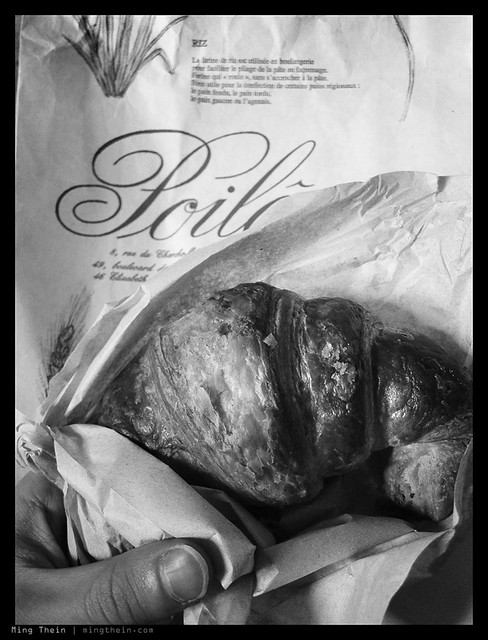
Croissants a Poilane. Canon SD780 IS
The one final piece of advice I suggest is that you talk to your clients beforehand to make sure they’re okay with you using a small camera: very often, it’s about perception rather than reality; your client may not be aware that you can deliver the same image quality or unique images through your choice of equipment – it may negatively affect your reputation. Most importantly, make sure you have enough practice and confidence that you can actually deliver what you claim with your compact – don’t experiment on paid work, unless it’s B-roll. And as ever, always carry a backup. MT
____________
Visit our Teaching Store to up your photographic game – including Photoshop Workflow DVDs and customized Email School of Photography; or go mobile with the Photography Compendium for iPad. You can also get your gear from B&H and Amazon. Prices are the same as normal, however a small portion of your purchase value is referred back to me. Thanks!
Don’t forget to like us on Facebook and join the reader Flickr group!

Images and content copyright Ming Thein | mingthein.com 2012 onwards. All rights reserved
POTD: Vacation time
April 12, 2012 by

Tanjung Jara beach, Kuala Terengganu, Malaysia. Nikon D700 and 85/1.4 D
I’m off to the beach for a few days for a short vacation (the same beach in the image, coincidentally) and to practice my hommages a Daido Moriyama Hiroshi Sugimoto (I have no idea how I got that one mixed up). I’ll still have internet access though, so please keep commenting. There’s also a couple of very interesting posts completed and scheduled, including an On Assignment covering shooting watches with the Leica M9-P system – I wouldn’t leave you guys without something to read, would I? 🙂 MT
Photoessay: Over Australia
April 11, 2012 by
This series was shot while on a long flight home from Auckland, New Zealand; the transit via Singapore meant that most of the flight was actually spent crossing the vast Australian landmass, over its northeast corner. The landscape through the window changed every ten minutes or so, presenting vastly different scenes – more abstract paintings than scenery. I was entranced, and didn’t manage to finish the presentation I was supposed to put together on the flight. But, I think it was probably worth it. MT
This series shot with a Nikon D700 and AFS 28-300/3.5-5.6 VR.


____________
Visit our Teaching Store to up your photographic game – including Photoshop Workflow DVDs and customized Email School of Photography; or go mobile with the Photography Compendium for iPad. You can also get your gear from B&H and Amazon. Prices are the same as normal, however a small portion of your purchase value is referred back to me. Thanks!
Don’t forget to like us on Facebook and join the reader Flickr group!
Images and content copyright Ming Thein | mingthein.com 2012 onwards. All rights reserved
POTD: Step on it
April 11, 2012 by

Speeding is illegal. Acceleration isn’t. Nikon D700, 28-300VR. BMW 135i M sport.
Reader meet-ups: Kuala Lumpur and Singapore
April 10, 2012 by
I’ll be in Singapore at the end of this month from the 23rd-30th of April, representing Leica at the World Gourmet Summit. Since there’s bound to be some downtime between sessions, and I know there’s a decent chunk of traffic here from people in Singapore, I’d like open up the idea of a reader meet up – you know, coffee and a chitchat. Anybody interested? If so, please leave a comment below.
Similarly, I’d like to do something in Kuala Lumpur once I’m back (sorry, packed out until then work-wise) – perhaps at the beginning of May? Once again, please drop a comment below to let me know if you’re interested. I’m thinking a weekend afternoon or weekday evening. MT
Finding inspiration, or the lack of it
April 10, 2012 by
We’re all familiar with the feeling: sometimes you go to a place or an event and there’s just no end to the photographic opportunities you see. At other times, life is an artistic desert: there’s just nothing inspiring you to shoot at all, and all subjects are too familiar, too uninteresting, or just plain flat and boring.

Shadow crossing. Leica M9-P, 35/1.4 ASPH FLE
I thought of the idea for this article on a recent business trip to Bangkok (last month). Ostensibly, I was there for a conference but did have some down time between sessions, some of which was spent socializing with my group, some of which was spent trying to shoot.

Untitled. Leica M9-P, 35/1.4 ASPH FLE
Bangkok is familiar ground for me. I worked there (in something non-photographic) for just over a year in 2006, right up until the first round of protests against the government. The photojournalist in me wishes I’d been stationed there during the action, but the rest of me is happy that I didn’t have to do my day job with everything severely disrupted. During that year, I did find things to shoot, but looking back I realize that most of it was social – there was very little documentary photography or travel photojournalism going on.

More traffic. Leica M9-P, 35/1.4 ASPH FLE
I put that down to two things: it really isn’t a city made for walking; it’s too big, for one; the climate is too hot to spend much time outdoors, for two; and the public spaces are predominantly malls and shopping complexes, with the exception of the 500 various temples and shrines that dot the city. It’s also a concrete jungle, with overpasses and highways and monorail lines arcing high overhead even downtown. Unlike Tokyo, where there’s plenty of money left over for beautification, there is nothing of the sort in Bangkok – anything new becomes grey and grimy and coated with a layer of urban dust after not much time at all.

Concrete jungle. Leica M9-P, 35/1.4 ASPH FLE
The upshot of all this is that when walking, you feel like you’re in some sort of canyon – everybody who can afford to, drives. And there’s not really a lot of things you can do with people in cars, or trying to shoot from cars – except perhaps traffic.

Interesting light, and yet more traffic. Leica M9-P, 35/1.4 ASPH FLE
There is of course the adult entertainment industry, which does advertise on the streets (even if the transactions take place behind closed doors) – but that’s not something advisable to shoot casually, or without a local guide. I was told by a reliable source that there are a lot of underworld figures involved, and they don’t take too kindly to the seedier aspects of their business being documented. It is not something that interests me, in any case.

The relentless pace of progress. Leica M9-P, 35/1.4 ASPH FLE
So we return to the initial point of this article: there will be times when you’re stuck in a photographic or inspirational desert; it happens. But what can you do to get out of it?

The monk. I was in Chinatown for this one; off my normal circuit but good enough to get something different. 2006. Nikon D2H, 80-200/2.8
1. The obvious thing to do would be to change location.
2. If you can’t do that, look specifically for things within your location that do interest you – I landed up doing a lot of abstract geometry and architecture – Bangkok does really have some nice buildings.
3. Change something in the mechanics of how you shoot: in other words, run an experiment. Reality is that something different will increase your chances of wanting to get out and shoot – it could be forcing yourself to work with maximal or minimal depth of field; getting a new piece of equipment, or using one that’s been neglected for a while; or simply trying to replicate a different style or trying a new idea. It’s because it forces you to change the way you perceive the world (or the world through the viewfinder) – which in turn makes you have to consciously focus on looking for shots or adjusting your composition to make it work; you can’t just run on autopilot anymore.

Zap. Through the office windows, long exposure. 2006. Nikon D80, 17-55/2.8
And this is where a modicum of self-reflection and assessment is useful: I didn’t change anything, but in hindsight I realized I should have, which is the genesis of this article. I did initially go with only one lens in an unfamiliar and un-intuitive – to me, anyway – focal length of 35mm; but I don’t think it was different enough to force the creativity out. I should have tried shooting with only my iPhone or something. Or perhaps painting the camera pink, just to disarm the public to provoke some interesting reactions from street photography subjects.
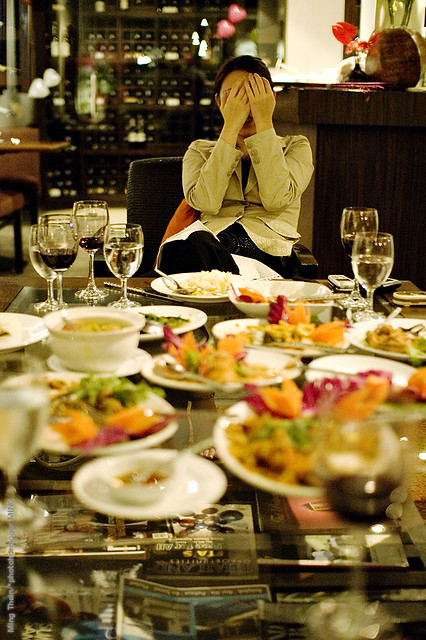
The embarrassment of gluttony. 2006. Nikon D50, Sigma 30/1.4
By the opposite logic, it’s also worth making conscious observation of what does inspire you – what do your favorite subjects or images have in common? It might be one simple thing – I’m drawn to the mechanical intricacy of watches, for instance – or something much more complex; like the juxtaposition between man and environment; dramatic lighting; harmonious geometry – or a mix of all three.

Seafood seller. 2006. Nikon D2H, Sigma 30/1.4
The underlying moral of the story is action: don’t wait until afterwards to change things, it might be too late. I’ll never know what shots I’ll have missed, but you can bet next time I won’t wait to find out. MT
Bonus points to those who noticed the difference between the first set of images in this series – shot this year with an M9-P – and the second set, from my first long stint in Bangkok, shot with various other equipment? Why is this? Many things have changed: location (different parts of the city), equipment, most of all, experience, and the benefit of a lot more experimentation in the intervening years.
POTD and Off Topic: Test drive notes of a different sort
April 10, 2012 by

Eyes, part one. New F30 BMW 328i Sport. Nikon D800, 28-300VR.

Eyes, part two. Outgoing E90 LCI BMW 320d M. Nikon D700, 28-300VR.
Perhaps I should have called this post ‘a parable in headlights’. I am a BMW fan, which isn’t to say I don’t like other makes; the lower vehicle is my daily car, and serves me well in a versatile manner for everything from grocery shopping to ferrying the wife around to the occasional spot of sideways driving along my favorite piece of road on Sunday morning. It also has a remarkable engine that puts out somewhere in the region of 210bhp and 450Nm after a little ECU tweaking – oh, whilst managing a consistent 35mpg in our abysmal traffic. (I’ve seen it go as high as 58mpg for long distance cruising, and it’ll do 0-62mph in about seven seconds). I’d say this is much like the car equivalent of the D700: you can do pretty much anything with it, and it does a very competent job and doesn’t get in your way. Even the standard non-M sport base 320i petrol version is a nice drive, and the only difference between the two is body roll, power and suspension stiffness. Otherwise, they handle much the same – think of one as moving along at five-tenths, and the other as eight-tenths.
The new model – codename F30 for BMW geeks – is a bit of a different beast. I test drove two versions – the normal, base, bog-standard 320d with no frills or options; and the ‘sport’ package 328i with (optional) adaptive suspension, active steering and BMW’s new masterpiece turbocharged 2-litre petrol that puts out about 250bhp and 350Nm. The 328i was one of the most nimble, responsive cars I’ve ever driven. It was just so easy to drive; I felt confident straight away and able to push the car to perhaps 90% of its limits (or at least the limits to which I feel comfortable driving on public roads). Even the new electric power steering system, whilst oddly and irregularly weighted at low speeds – the sensation of the rack ratio changing while maneuvering at 5mph feels like the front wheels are losing traction, but you’re most certainly not – becomes perfectly weighted and direct (if a little less communicative than I’m used to) at speed. The paddle shifters, combined with the new 8-speed ZF gearbox, make firing off a gear change fast and easy. And that engine…oh boy. It’s got power and torque everywhere in the rev range, and just feels more eager to rev than the 2 litre turbo diesel I’m driving now, even though the car I drove only had 40km on the odometer. The only thing I didn’t like about the car (apart from the increased price tag, nearly 10%!) was the odd-feeling steering at low speeds. Would I buy this? Hell yes, if I could find some spare organs I didn’t need, or perhaps a hidden hoard of diamonds under my floorboards.
The base 320d (F30) on the other hand, was utterly horrid. I hated it. I didn’t feel confident in the car at all; the suspension wallowed and rolled; the steering was equally odd at low speeds, but strangely disconnected and uncommunicative at high speeds; even the interior materials felt a step down from the other car – even though they were supposedly built at the same plant. Even though the engine was a supposedly updated version of the one in my car, it felt tight and underpowered, lacking the midrange punch between 1800 and 2800rpm that I’m used to. Would I buy this one? No.
I felt that this odd duality gave the new 3 series a similar personality to the D800: a specific tool, which if configured (optioned?) correctly, would do a peerless job; but was also capable of being entirely inappropriate in some situations compared to the old model.
Conclusion: newer isn’t always better, often the refinements mean that what you’re going to use it with (i.e. the engine and options, in this case) is almost equally as important as how you’re going to use it. As a consumer, don’t always get fooled into thinking that you need to change something. Just because a new model is out doesn’t in any way reduce the capability of the existing model you own: yes, it might be better for some things, but if those things aren’t important to you, then why spend more money? You’d be surprised at the number of emails I’ve been getting in the last few days asking ‘D800 or D700?’ when clearly the person using the camera has no need for large file sizes, but every need for speed or higher ISO. Know what you need your tools to do first before you buy them. MT
100,000!
April 9, 2012 by

I would like to say a big thank you to all of my readers and followers, because as of late this morning, this site has hit a new milestone: 100,000 views in the last month. To know that there are that many of you out there who are interested enough to spend a few minutes looking at my images and reading my posts is both humbling and very encouraging at the same time – thank you.
Please continue to return, revisit, reblog, share with your friends, comment, ask questions…it will enable this site to grow, and hopefully achieve my objectives of helping whoever I can out there to be a better photographer – one frame at a time. I’ve got a whole load of great content already in the works for the next few months; but in the meantime, if there’s anything you’d like to see, please ask – either in the comments or drop me an email. Enjoy! MT
Photoessay: St. Vitus Cathedral, Prague
April 9, 2012 by
A fantastic piece of gothic architecture, St. Vitus is arguably the centerpiece of Prague Castle – itself at the northern part of the old Malastranska district and overlooking the rest of the city itself. I’ve been inside a number of famous cathedrals – St. Paul’s, Canterbury, Notre Dame, St. Vitus, the Sagrada Familia, and Stefansdom – and the one thing that always amazes me is that we humans could build such structures as early as nine hundred years ago, when the majority of people were living in shacks and huts without sanitation or any other modern infrastructure. Even more amazing is the degree of architectural finesse involved in building these structures in stone – remember, there were no structural members that could take tensile loads, let alone pre formed or pre stressed panels. Everything was reliant on gravity to stay in place. Construction took generations; even with modern building techniques, the Sagrada Familia began in 1882 and isn’t expected to be complete until 2026 – that’s <em>144 years</em>. Frankly, it doesn’t look very different today than when I first visited in 2003. Glass <em>had</em> to be made with lead frames holding together small pieces, simply because there was no way to make big sheets. But the craftsmen of the day found a way to make that beautiful, creating the incredible stained-glass mosaics that survive to this day; a lasting testament to their devotion to their faith. MT
Series shot with the Leica M9-P, 28/2.8 ASPH and 50/1.4 ASPH