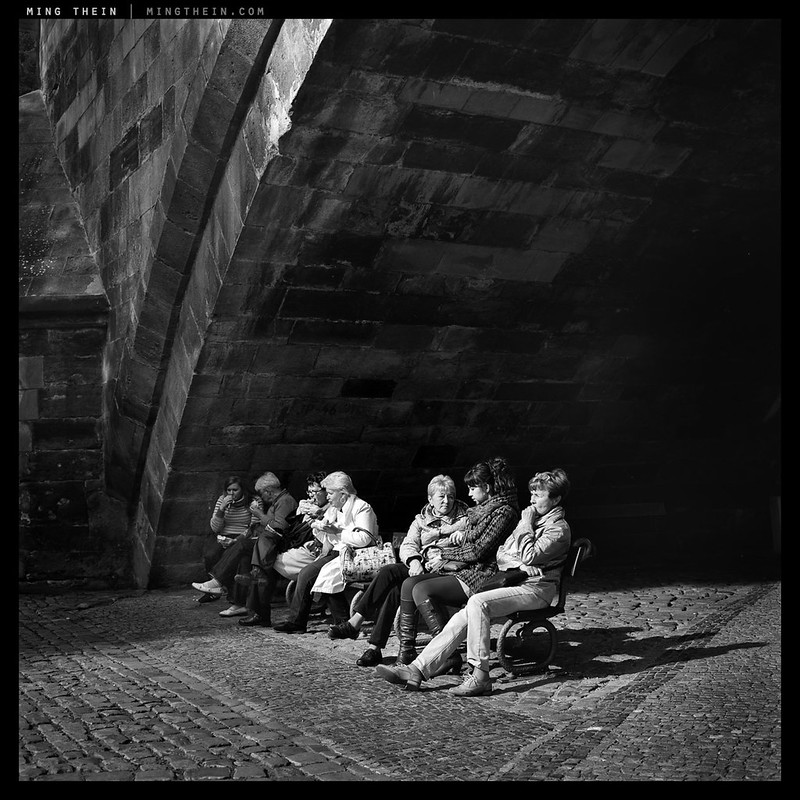
There’s a big difference between travelling for photography, and taking photographs while travelling. I think it all boils down to priorities: is your priority photography, or travel? Or are you like me: photographing gives you a reason to travel, and forces you to observe and thus enrich your experience?
FD Photoessay: Amsterdam architecture, part one
No words today, just a series of images for you to enjoy. Various architectural details from my last trip to Amsterdam, shot with the Hasselblad 501C, 80/2.8 CF T* on Fuji Acros. Some of you may recognize these images from the November print sale; others may be enjoying a large print on their walls 🙂 MT
These images were made during the October 2013 Making Outstanding Images Workshop in Amsterdam; I will be holding three more of these in Melbourne, Sydney and London later this year. Click here for more info, and to sign up.
Photoessay: Invisibility, revisited
Towards the end of 2013, I put forward some thoughts on the idea of photographic invisibility. I now realize that we can actually get pretty darned close to this: the concept of hiding in plain sight comes to mind. If something is commonplace, then it no longer stands out. Big cameras and lenses used to; less so now simply because of the increasing proliferation of DSLRs. Even more than that, the cameraphone is so ubiquitous that we are effectively conditioned to ignore it. So, why not harness this invisibility?
Goodbye, 2013; photographic resolutions for 2014

Things on a distant horizon are not as far away as they might seem; it’s all a question of perspective.
Some of you will be disappointed to learn that this post does not involve any megapixel numbers. At the end of 2012 – precisely one year ago, in fact, I published a similar post for 2013. It got a surprising amount of attention, so I’d like to both turn it into an annual tradition, as well as examine whether I was able to keep any of the promises – now that the year is over…
FD Photoessay: Prague monochromes, part II
The second part of the monochrome photoessay from Prague was shot on film, with a Hasselblad 501C and my favourite B&W film – Fuji Acros 100. To be honest, given the tight quarters, I’d have preferred to have had something either a little wider or a little longer – preferably both – to give me some additional ability to add context, or compress (especially with buildings clinging to hills in the background). Nevertheless, we make do with what fits inside our camera bags – after making provisions for film, I didn’t have any space left for lenses!
Photoessay: Prague monochromes, part I
I actually shot very little black and white in Prague; a few hundred from the Ricoh GR, and a couple of rolls with the ‘Blad; of course they were all of varying subjects with a heavy architectural emphasis, but I did get some very satisfying street images out of my time there. Despite the very strong luminance contrast available – October at these latitudes means all-day shadows and intense sun with blue skies – I just found color to pack a little something extra in most situations. That said – this set would not have worked in color at all.
How to see: tips for travel photographers

My first and probably only time in this location (Harborview Restaurant/pier, Manila, Philippines).
If you’re only going to be in a place once, how can you ensure that the images you get are unique and strong? Though it sounds a lot like the question of what makes an outstanding image, it’s really got a bit more of a travel bent to it. Though the macrolinear and causal nature of time (a topic for another article, if there ever was one) means that no single moment will ever be repeated again during our lifetimes, and thus every image will be unique – probable reality is that due to the difficulty in accessing the location again, we almost certainly won’t get the chance for a do-over. It’s not like shooting sunset in your own home town: pick a night, any night. So what can you do to increase your chances of coming away with images you’re happy with? Here’s my list of tips.
On Assignment: shooting a car
It’s been a little while since I’ve done one of these – partially because of respect for client embargos, partially because my recent assignments have been so hectic that I haven’t had time to pause for breath let alone b-roll; however, I’m hoping to rectify that today with a report from one of my larger recent shoots. In Malaysia, Nissan is phasing out the current 2013 Teana to make way for the all-new 2014 model. I was brought in originally with the intention of consulting on the 2014 campaign creative direction and shoot for the new car, however, at the last moment I got roped into the final campaign for the current car, too. And that shoot will be the subject of today’s post.
Landscape photography, part two: applied landscapes
In the previous article, we looked at some of the fundamental principles of landscape photography. Today, we’re going to question more of those assumptions and see how those principles apply equally to a very diverse range of subjects.
Let’s start with what is, on the face of things, a fairly obvious question: At what point does a landscape turn into a cityscape turn into architecture turn into urban reportage/ flaneur photography? If you have an expansive natural scene with one remote house on it, is it still a landscape? I think nobody would argue with you on that one. Two houses? A small town? Maybe it’s a question of scale, or visual dominance? What about a physically small scene with predominantly natural elements – that’s a landscape, surely. But what if the scene is man-made with merely the inclusion of natural elements? I’m sure a carefully-planned Japanese garden is definitely landscape material. Regardless of the answer, I think we can all agree that the lines become increasingly blurred.