I actually shot very little black and white in Prague; a few hundred from the Ricoh GR, and a couple of rolls with the ‘Blad; of course they were all of varying subjects with a heavy architectural emphasis, but I did get some very satisfying street images out of my time there. Despite the very strong luminance contrast available – October at these latitudes means all-day shadows and intense sun with blue skies – I just found color to pack a little something extra in most situations. That said – this set would not have worked in color at all.
How to see: tips for travel photographers

My first and probably only time in this location (Harborview Restaurant/pier, Manila, Philippines).
If you’re only going to be in a place once, how can you ensure that the images you get are unique and strong? Though it sounds a lot like the question of what makes an outstanding image, it’s really got a bit more of a travel bent to it. Though the macrolinear and causal nature of time (a topic for another article, if there ever was one) means that no single moment will ever be repeated again during our lifetimes, and thus every image will be unique – probable reality is that due to the difficulty in accessing the location again, we almost certainly won’t get the chance for a do-over. It’s not like shooting sunset in your own home town: pick a night, any night. So what can you do to increase your chances of coming away with images you’re happy with? Here’s my list of tips.
Landscape photography, part two: applied landscapes
In the previous article, we looked at some of the fundamental principles of landscape photography. Today, we’re going to question more of those assumptions and see how those principles apply equally to a very diverse range of subjects.
Let’s start with what is, on the face of things, a fairly obvious question: At what point does a landscape turn into a cityscape turn into architecture turn into urban reportage/ flaneur photography? If you have an expansive natural scene with one remote house on it, is it still a landscape? I think nobody would argue with you on that one. Two houses? A small town? Maybe it’s a question of scale, or visual dominance? What about a physically small scene with predominantly natural elements – that’s a landscape, surely. But what if the scene is man-made with merely the inclusion of natural elements? I’m sure a carefully-planned Japanese garden is definitely landscape material. Regardless of the answer, I think we can all agree that the lines become increasingly blurred.
Landscape photography, part one: a few principles
I’ll be straight up honest here: I’m not known as a landscape photographer. Far from it, in fact. But that hasn’t stopped me from experimenting, and as we all know, experimentation is the key to artistic development and evolution: applying what you learn in one discipline to your others can result in something unique, and vice versa. I think the relationship between landscape, cityscape and architectural photography is pretty obvious. Might I approach a watch or food plating as a landscape in future? Why not! Or treat a landscape as an abstract? Certainly.
Exclusive: an interview with Nick Brandt
After my review of his first book, I received a very complimentary email from Nick thanking me for my review and expressing something between relief and gratitude that the lengths he went to to get to prints right were being appreciated. A short correspondence developed, and he has very graciously agreed to an exclusive interview for the site, which follows my review of the final book in the series – Across The Ravaged Land – and constitutes today’s post. I admit that writing the questions for that interview made me somewhat nervous, because Nick is one of my few true photographic heroes; a rockstar with integrity, talent, and beyond that, passion. Let us begin.
Book review: Across The Ravaged Land, by Nick Brandt
I think many of you will recall me being quite blown away by the power of the images and the quality of the printing/ presentation in my review of Nick Brandt’s earlier twin book On This Earth, A Shadow Falls (here). I’m fairly sure many of you were too, judging from my email traffic, the comments, and the number of orders via Amazon. I’ve turned into an enormous fan of Nick’s work: he is the photographer’s photographer, a man who clearly thinks about what he’s doing, photographs with integrity, for a reason, with an idea, with the most appropriate tool for the job, and presents the images in the best possible way. Across The Ravaged Land, the final volume in the trilogy, raises the bar even further. I spent an hour with the book and felt like I’d been smacked upside the head with the Pentax 67II he favours. Allow me to explain why.
Note: in this article, I’ve attempted to reproduce the tonal feel and colour of the images as accurately as possible, but reality is that it’s simply impossible to do so via a screen and a JPEG. Just buy the book, and from the print quality alone you’ll see why every photographer should spend some time making prints. I can’t even begin to imagine the impact of the large format images.
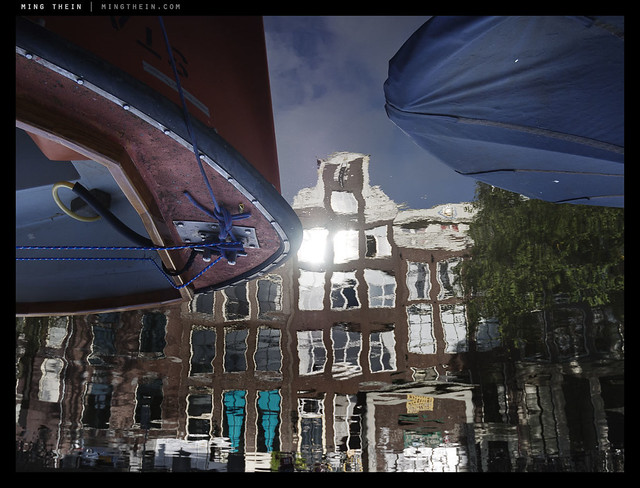
Photoessay: The boats of Amsterdam
I must first apologize for the enormous processing backlog that has kept me from posting any images from the Amsterdam and Prague workshops several months ago to the site; the astute of you will have seen them go up on Flickr a little while ago, though.
Photoessay: recent iPhone work
Today’s post is a small collection of recent work – I suppose a better description is grab shots encountered in the course of life when I didn’t have another camera available to me. I make no excuses for the medium; the work stands on its own. It’s to serve as a reminder that the camera really doesn’t matter. Enjoy! MT
Photoessay: artistic experiments in the home
And now for something a little different. Shooting purely for message isn’t new to me; shooting purely for message through metaphor with found objects is, to some extent. Today’s photoessay is an experiment; make of it what you will – but I’m very curious to see what you all think…please leave a comment after the jump. And yes, the captions matter. MT
Originality is dead: or is it?
Today’s post is going to be something of a counterpoint to yesterday. Every time we frame up an image, we ostensibly try to capture something different, unique – in essence, to take a photograph that has never been taken before. But more importantly, the resultant outcome must actually look like it has never been taken before, by appearing quite distinctly different from anything else. That’s the part which is not so easy.
Each of the images in this set represents the outcome of a new experiment for me: subject, idea, execution, processing, equipment or something else. They are almost certainly unique, but I cannot say that they have not been attempted before, by somebody else. Take, for example, the fact that they were all shot on film: film is not new, even to me. But developing my own film and looking at the tonality achievable undoubtedly influences the way I process my digital files. Just as composing in squares does affects the way I see the world, too; and so on.