The relationship between talent, creativity and experience

Let’s start with some semantics:

Talent: is your innate ability to do something – it’s inborn, and for the purposes of this essay, you can’t change it. It’s fixed. Think of it as your starting point; you also can’t lose it.

Creativity: in the photographic context centers around your ability to construct a unique composition from a given scene. It’s a continuum; the more different your composition to anything that’s come before, the more creative you are. This applies for both the elements you can control (e.g. studio lighting, flashes, focal length/ perspective etc) and the ones you can’t – the subject, for instance. The amount of creativity a person has is generally fixed; however, unlike talent, you can train yourself to be more creative.

Experience: is the knowledge you gain from having done something (or something related and relevant) before – for instance, if you’ve used a fire before, you know it’s hot and you won’t put your hand into it because it hurts. In a photographic context, it could be something as simple as knowing that telephoto lenses work better for wildlife photography than wide angles, or it could be as subtle as choosing a thick carbon-fiber monopod over a thinner steel one for its rigidity and vibration damping properties to enable as low a shutter speed as possible. This is the biggest area of opportunity for all photographers.

It’s easier to understand where I’m going next if you have a baseline: I’ll use myself as a guinea pig, and score out of 10; 10 being the best and 0 being poke-your-eyes-out-with-a-stick bad.

Ming, in 2003 (Brand-new, wet-behind-the-ears hobby photographer. Doesn’t know the first thing about shutter speeds, finds aperture numbering confusing, and can’t figure out the whole perspective thing.) Here’s an early shot:

_DSC0633 copy
Random abstract.

At the time, I thought this was actually one of my better ones. Shocking, huh? I think nobody would question an assessment of Talent = 0. Creativity – hmm, harder to judge; it obviously isn’t really a standard shot, but at the same time…execution is lacking. I’ll be generous and say this merits a 5 on the creativity scale. It does tell us something about the experience rating, though: had I known better, I wouldn’t have overexposed, and I’d have used a tripod. I’d probably also have selected a more suitable exposure combination commensurate to the effect I was trying to achieve. Let’s give experience another zero.

Fast forward a bit to today.

Ming, in 2012 (Getty Images member, Nikon Professional Services UK member, Leica Camera-sponsored, veteran of countless pro shoots, etc…I’ll stop blowing my own horn now 😉

_7053570bw copy
Jaeger Le-Coultre Gyrotourbillon 2 escapement

I don’t think anybody would argue that this is an easy shot to produce. It requires advance knowledge and mastery of a) lighting; b) composition and visual balance; c) being able to see the unique in something not immediately visible or obvious (the frame covers approximately 12x8mm); d) post processing; e) familiarity with the subject itself; f) the ability to get one’s equipment to deliver exactly what is required.

So what’s changed in the last nine years? My talent remains the same: it can’t change, and it’s approximately still zero. My creativity has definitely improved; I’m both trying different things and executing them so that they manage to communicate my initial vision – that shot was supposed to give the impression of an x-ray view into the heart of a complex machine, which this particular watch absolutely is.

But the biggest improvement is experience: in the last nine years, I’ve shot more than half a million frames – some in the course of getting the shot for a particular assignment or location; some out of pure experimentation; and some just in the course of capturing and recording life as I see it. But each one of those frames has given me the benefit of being able to refine my skills incrementally more. Although the laws of diminishing returns definitely kicked in a long time ago, I’m told there’s still some progress going on. The way I shoot now is not the same as the way I shot even a year or two ago.

Shooting lots is one thing – but remembering what you’ve learned is even more important, otherwise you’ll hit diminishing returns pretty early on in the process. There are many times where I’ll do experiments concentrating on one particular aim only – for instance, refining my x-ray processing technique – and ignoring the other elements. Or perhaps it might be to master the use of lighting very small reflective objects at close distances. I probably won’t keep any of these experiments because compositionally they don’t work (and that wasn’t the point) – but it’s the experience and knowledge that’s important. And then when I *do* need to put it all together – the above shot, for instance – then I have confidence that my techniques and experience will let me pull it off.

There is no substitute for experience. There’s plenty of evidence to support that it takes 10,000 hours of dedicated practice to master something – give or take a little depending on whether you do it continuously (benefit of not forgetting between sessions and having to backtrack or repeat) and your intellect. This means one task, continuously, for three years or more. And that’s why there were a) so few master photographers in the film days (practice cost a lot of time and money, and there was a delay between taking the shot and getting feedback, during which it was easy to forget what you tried) – and b) lots of ‘new talent’ emerging today.

Which brings us to the conclusion of this article: I’m often asked what is the one best tip I can give to an aspiring photographer: practice, practice, practice. I still do it, and I’m still learning. MT

____________

Visit our Teaching Store to up your photographic game – including Photoshop Workflow DVDs and customized Email School of Photography; or go mobile with the Photography Compendium for iPad. You can also get your gear from B&H and Amazon. Prices are the same as normal, however a small portion of your purchase value is referred back to me. Thanks!

Don’t forget to like us on Facebook and join the reader Flickr group!

appstorebadge

Images and content copyright Ming Thein | mingthein.com 2012 onwards. All rights reserved

The process of editing

Let me clarify: by editing, I mean the process of selecting which images to keep, which make the final cut, and which aren’t wroth bothering with. I’ll generally do three edits: one almost immediately after shooting, in-camera; one when I get home and dump the cards/ start converting raw files; and the final cut after I’m done making finished files, but before I archive or deliver complete sets to clients.

As an example, let’s take the contact sheet I used in an earlier article on how to use contact sheets. For the purposes of this exercise, assume that this set is one that came fresh out of the camera (in reality, it’s already been through the complete selection process, and no, I don’t shoot jpeg unless I have no other choice.)

First cut (in camera)
I’ll delete images which are:
– Clearly out of focus
– Incorrectly exposed
– Compositional failures/ experiments that didn’t work
– Clearly meaningless/ no obvious subject
I’ll leave duplicates or near-duplicates of good shots; you can’t judge fine detail or critical focus off the back of a camera screen.

For the example, I’ve already taken out the first cut in camera, so let’s move on.

Second cut (before raw conversion)
I’ll delete images which are:
– Not critically sharp
– Didn’t work as well as expected when viewed at a reasonable size (full screen, usually)
– Compositionally weaker than the rest of the set
At this point, I also pick the best image if there are a series of duplicates or near-duplicates. (Duplication is something I do where possible to give me the best possible selection of raw material to work with.)

Final cut (before delivery)
– Eliminate similar images, so that what you’re left with is a series of individually very strong photos, each with a clearly different character
– Chose only the best X images, where X is your delivery target/ agreement


Final cut. Notice how each image in the final set is distinctly different from the other, yet I haven’t ‘lost’ any critical shots, and manage to capture the essence of the movement of the watch.

I’ll leave you with one final thought: the mark of a truly good photographer is not how many good shots he produces, but rather how many good shots the audience remembers: if you only show good shots, nobody is going to think you’re capable of producing a dud. Furthermore, if you aren’t your own harshest critic, your skill level is never going to improve. This is why editing is so crucial to the entire photographic process; I force myself to keep only the best 1-2% of everything I shoot. MT

Finding inspiration, or the lack of it

We’re all familiar with the feeling: sometimes you go to a place or an event and there’s just no end to the photographic opportunities you see. At other times, life is an artistic desert: there’s just nothing inspiring you to shoot at all, and all subjects are too familiar, too uninteresting, or just plain flat and boring.

_M9P1_L1012712 copy
Shadow crossing. Leica M9-P, 35/1.4 ASPH FLE

I thought of the idea for this article on a recent business trip to Bangkok (last month). Ostensibly, I was there for a conference but did have some down time between sessions, some of which was spent socializing with my group, some of which was spent trying to shoot.

_M9P1_L1012732 copy
Untitled. Leica M9-P, 35/1.4 ASPH FLE

Bangkok is familiar ground for me. I worked there (in something non-photographic) for just over a year in 2006, right up until the first round of protests against the government. The photojournalist in me wishes I’d been stationed there during the action, but the rest of me is happy that I didn’t have to do my day job with everything severely disrupted. During that year, I did find things to shoot, but looking back I realize that most of it was social – there was very little documentary photography or travel photojournalism going on.

_M9P1_L1012673 copy
More traffic. Leica M9-P, 35/1.4 ASPH FLE

I put that down to two things: it really isn’t a city made for walking; it’s too big, for one; the climate is too hot to spend much time outdoors, for two; and the public spaces are predominantly malls and shopping complexes, with the exception of the 500 various temples and shrines that dot the city. It’s also a concrete jungle, with overpasses and highways and monorail lines arcing high overhead even downtown. Unlike Tokyo, where there’s plenty of money left over for beautification, there is nothing of the sort in Bangkok – anything new becomes grey and grimy and coated with a layer of urban dust after not much time at all.

_M9P1_L1013094bw copy
Concrete jungle. Leica M9-P, 35/1.4 ASPH FLE

The upshot of all this is that when walking, you feel like you’re in some sort of canyon – everybody who can afford to, drives. And there’s not really a lot of things you can do with people in cars, or trying to shoot from cars – except perhaps traffic.

_M9P1_L1012658 copy
Interesting light, and yet more traffic. Leica M9-P, 35/1.4 ASPH FLE

There is of course the adult entertainment industry, which does advertise on the streets (even if the transactions take place behind closed doors) – but that’s not something advisable to shoot casually, or without a local guide. I was told by a reliable source that there are a lot of underworld figures involved, and they don’t take too kindly to the seedier aspects of their business being documented. It is not something that interests me, in any case.

_M9P1_L1012660 copy
The relentless pace of progress. Leica M9-P, 35/1.4 ASPH FLE

So we return to the initial point of this article: there will be times when you’re stuck in a photographic or inspirational desert; it happens. But what can you do to get out of it?

_MT87548 copy.jpg
The monk. I was in Chinatown for this one; off my normal circuit but good enough to get something different. 2006. Nikon D2H, 80-200/2.8

1. The obvious thing to do would be to change location.

2. If you can’t do that, look specifically for things within your location that do interest you – I landed up doing a lot of abstract geometry and architecture – Bangkok does really have some nice buildings.

3. Change something in the mechanics of how you shoot: in other words, run an experiment. Reality is that something different will increase your chances of wanting to get out and shoot – it could be forcing yourself to work with maximal or minimal depth of field; getting a new piece of equipment, or using one that’s been neglected for a while; or simply trying to replicate a different style or trying a new idea. It’s because it forces you to change the way you perceive the world (or the world through the viewfinder) – which in turn makes you have to consciously focus on looking for shots or adjusting your composition to make it work; you can’t just run on autopilot anymore.

_M80_DSC3030 copy.jpg
Zap. Through the office windows, long exposure. 2006. Nikon D80, 17-55/2.8

And this is where a modicum of self-reflection and assessment is useful: I didn’t change anything, but in hindsight I realized I should have, which is the genesis of this article. I did initially go with only one lens in an unfamiliar and un-intuitive – to me, anyway – focal length of 35mm; but I don’t think it was different enough to force the creativity out. I should have tried shooting with only my iPhone or something. Or perhaps painting the camera pink, just to disarm the public to provoke some interesting reactions from street photography subjects.

_1_DSC0620 copy.jpg
The embarrassment of gluttony. 2006. Nikon D50, Sigma 30/1.4

By the opposite logic, it’s also worth making conscious observation of what does inspire you – what do your favorite subjects or images have in common? It might be one simple thing – I’m drawn to the mechanical intricacy of watches, for instance – or something much more complex; like the juxtaposition between man and environment; dramatic lighting; harmonious geometry – or a mix of all three.

_MT92533 copy.jpg
Seafood seller. 2006. Nikon D2H, Sigma 30/1.4

The underlying moral of the story is action: don’t wait until afterwards to change things, it might be too late. I’ll never know what shots I’ll have missed, but you can bet next time I won’t wait to find out. MT

Bonus points to those who noticed the difference between the first set of images in this series – shot this year with an M9-P – and the second set, from my first long stint in Bangkok, shot with various other equipment? Why is this? Many things have changed: location (different parts of the city), equipment, most of all, experience, and the benefit of a lot more experimentation in the intervening years.

Sushi, and the philosophy of photography

_PM07501 copy
Seared Wagyu beef with momeji oroshii.

Sushi is a universe in itself – there are so few components that if you get any one of them slightly wrong, the taste will be horrible. But if you get every one of them right, the experience can be magical. Specifically, your fish must be fresh and in season; precisely the right amount of soy sauce should be brushed on to the top, with a little dab of wasabi hiding between the rice and the fish. The fish itself is cut slightly concave so it drapes perfectly over the rice, itself measured to precisely the right quantity to make a mouthful and shaped by hand, not too tightly packed and not too loose, either.

_PM07411 copy
Katsuo (bonito) with ginger.

And then there’s the seasoning that accompanies the rice – a mix of mirin and rice vinegar – which must offer the right degree of tartness and sweetness to provide a counterpoint to the fish and soy sauce, but not so much that it overpowers or tastes sour. And this is before we even talk about more complicated creations that involve multiple types of fish, or searing, or additional condiments and seasoning.

_PM07492 copy
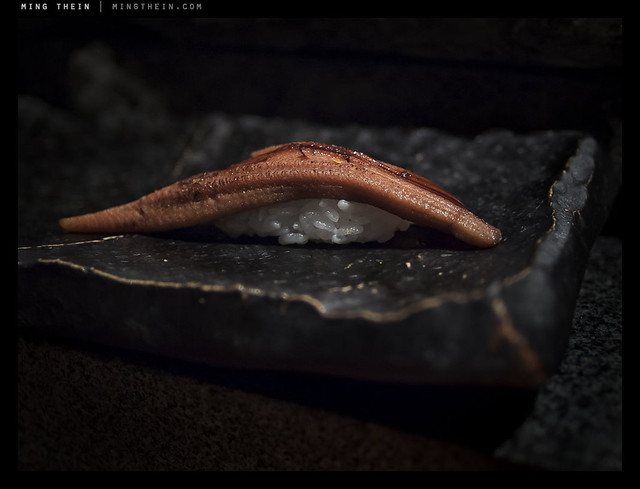
Broiled anago (freshwater conger eel).

There’s a parallel between sushi and photography (and sushi and many other things, actually) – aside from the obvious that it’s art, sushi making requires both technical skill and creativity. There are constraints, but you can work around them. It can be learned, it can be honed by experience, but there’s definitely an element of talent and intuition involved which all great sushi chefs possess. Photographs and sushi both come in small, bite-sized increments – they require little time to create if all the elements come together, and can be enjoyed in moments or contemplated for hours – I’ve eaten sushi dinners with 20+ different varieties served over many hours; I suppose that would be like going through the Magnum annual. Neither photography nor sushi is cheap, either; and mastery can take years.

_PM07485 copy
Torigai clam.

There’s even an anticipative element to it – the feeling of curiosity before you go to eat (wondering what is in season and came from Tsukiji today) is much like the feeling I get before a shoot; you’re all excited and ready to go. It’s also entirely possible that it’s just me.

_PM07471 copy
Seared katsuo

The best sushi I’ve ever eaten – so far – comes from a local chef in Kuala Lumpur at a restaurant called Hanare; Kenny Yew is an absolute genius when it comes to creating new things – for instance, seared wagyu with momeji oroshii chili – as a sushi. I need to go at least once a month or I get withdrawal symptoms and the DTs, because I just can’t eat sushi anywhere else now. The few lucky friends I’ve taken there feel the same way. It really is art – some of the pieces make me tingly and others nearly bring me to tears. I’ve eaten things there I never would have though edible, let alone ordered – and loved them. That’s much like how certain exhibitions, art or equipment inspire me to try photographic experiments that work out a lot better than expected.

_PM07446 copy
Seared hama-tai (sea bream)

And best of all, you can mix the two. The lighting conditions at that restaurant are pretty horrible, but they save me a seat at the counter which happens to have a halogen spot over it; I position my sushi carefully to be well-lit. This set might appear the same, but that’s because I wanted a consistent point of view; (and comparison)
they were also shot during the same meal. I discovered one other thing that night: the best color I’ve yet managed to achieve is delivered by a combination of Zeiss glass and Olympus cameras.

_PM07395 copy
Oo-toro. (Fatty yellowfin tuna belly)

I had the ZF.2 2/28 Distagon on the Pen Mini via an adaptor, and was utterly floored by the color when I opened up the raw files on my computer – the sushi literally looked like it had in real life. Every bit of the color, texture, iridescence and freshness was captured. I’m guessing it’s a combination of the fortuitous lighting, the great color and micro contrast of Zeiss lenses in general, and the pleasing color palette of Olympus cameras. Whatever it is, I think I’ve found my perfect sushi-camera.

_PM07426 copy
Red snapper.

My parting advice is that if you do get a chance to eat sushi made by a master, do as you would do at an exhibition of photographs by a great photographer: put away your preconceptions, go in with an open mind, and enjoy. You’ll probably be surprised. MT

_PM07424 copy
Kamburi (giant yellowtail).

Observing vs. participating: behind the camera

Today’s post is a follow-on spurred by the discussion following yesterday’s article on hiding behind the subject. Apologies to anybody if I lose you in the second paragraph, but I promise it will be worth it.

A camera can be many things.

A tool, to produce an image.

A bridge, to start a conversation.

An observer, to record an event, or bear witness to something.

A shield, to distance and separate the photographer from the scene he or she is attempting to capture.

There’s a big difference between being part of the action, and just being a witness to the action. Which do you think makes for stronger images? Unquestionably, the former. However, it’s not that simple: photojournalism is like quantum mechanics.

Let’s take a little detour. Quantum mechanics 101: under the quantum mechanical realm – i.e. the very small – an observable event has no distinct state, but rather a continuum of probability. This means that there’s the potential for any possible outcome to our observable event; however, until we observe it, we don’t know what the outcome will be. However, the very act of observing the event changes the outcome – because once the outcome has been observed, it can no longer be any of the other possible outcomes. This changes the probability continuum for the event, thus changing the event itself.

The best example of this is Erwin Schrodinger’s (the famous physicist) cat experiment. A box contains a live cat, whose lid triggers a mechanism that <em>might</em> kill the cat. So until you open the lid of the box, you don’t know if the cat is dead or alive; by observing the cat, you interfere with its state of being: namely, you might kill it by checking if it’s really alive or not.

_PM05775 copy
A demonstration of the link between quantum mechanics and photography. Behaviour of the person in the middle didn’t change until he saw me bring the camera up.
New year’s eve 2011-12, Kuala Lumpur. Olympus Pen Mini E-PM1, 12/2

Back to photography. As a photojournalist, if you are an observer, you do not generally interfere with the course of events – other than any secondary impact arising from people viewing your images, and possibly taking action or interfering with the course of history. However, if you are a participant rather than an observer – then by taking photographs, you are directly interfering with the event. From a photographic point of view, it means that the images you get may be more powerful, but not necessarily as genuine because the subjects are aware of the camera and will almost certainly change their behavior accordingly, which again changes the image and changes the course of events because the subjects change the way they act around the camera. As a stealth operative, you will capture the natural reactions of your subjects – but at the expense of involvement for the viewing audience.

_PM04759 copy
Active participation at a family event. Olympus Pen Mini E-PM1, 12/2

They’re very different types of images, and both have their advantages and disadvantages – to say nothing of the ethical dilemmas posed for a photojournalist when covering certain events, for instance wars and natural disasters. I can’t say whether one is better than the other, but I do know that it’s much more difficult to get powerful images if you are not a participant – simply because the focus of the subject is not the camera.

_7048120 copy
Passive observer. Epicure 2011. Nikon D700, 85/1.4G

I’ve always felt the best compromise is to be an observer, but an active one: anticipate and seek out your targets; study behavior and be ready for what comes next, so when that one fleeting moment of critical action – what HC-B memorably termed ‘the decisive moment’ – you are ready, and manage to capture it.

_N8_L1000374bw copy
The kiss, hommage a HC-B. London. Leica M8, Zeiss ZM2.8/21.

Required a lot of anticipation because a) the M8 is manual focus; b) you have to shoot wide open in the low light conditions of the Underground; c) here’s the kicker: they were on an escalator moving in the opposite direction to me, so there was really only one chance to get the shot.

There are times when you should not be a passive observer. In intimate social situations, for example – hiding behind your camera would just come across as awkward, antisocial and downright rude. Portraiture is another example. People naturally connect and express emotion more easily when there’s another human on the receiving end, rather than an enormous and intimidating piece of glass attached to a big black camera.

Perhaps this is why smaller cameras such as the compact system cameras and rangefinders are seeing a modern resurgence (aside from the obvious size and weight benefits) – they remove a layer between you and your subject in a couple of ways. Firstly, if you’re interacting with your subject, they can see your face; body language is the vast majority of communication, and your subject will take visual cues from you. If you’re not interacting with your subject, smaller cameras attract a lot less attention, and let you shoot without the subject being conscious of your presence. I have no problem shooting in very close quarters with a good point and shoot or mirrorless camera – the Ricoh GR-Digital III and Olympus Pen Mini are my favorites because of size and responsiveness – and to a lesser extent, the Leica M9-P. The full-sized Nikons are a no-no (especially anything with a battery grip or large aperture lens) unless you’re in a public situation where the expectation is a lot of people will have cameras and be taking photos.

_M8_L1022749bw copy
Never a problem finding a protest if you’re shooting a Leica. Just look like you’re a world-weary photojournalist and you’d be surprised how many ‘official’ lines you can get past. Leica M8, Voigtlander 50/1.1 Nokton

Speaking of expectations, this should be a good guide to what equipment and technique is best suited to get the best images: if you’re expected to look and play the part of a photographer – a fashion shoot, for instance – using a small camera so the model can see your face probably isn’t going to get you the results you desire. If you’re trying to be stealthy and cover an insurgent protest, then a point and shoot probably is a good idea to help you keep a low profile. Street photography is something else that’s best done with compacts, too. Bottom line: take your cue from your subjects.

One final word: if you are not comfortable, then it will show in your body language. Remember, most communication is nonverbal: this means you’re also going to make your subjects aware of your discomfort (and probably also make them feel uncomfortable with the situation). Most important tip: be confident, regardless of whatever your equipment choice, and however you chose to shoot. Photographers create images: appearing the part is a very important piece of the puzzle. MT

Hiding behind the subject

Photographers normally hide behind the camera (though we shouldn’t, because it distances us from what we’re shooting and makes us observers rather than participant-observers, but that’s another story for another time) right? So what’s with hiding behind the subject?

A friend once said this to me about a watch: I’m expecting exceptional photos because it’s an extraordinary subject. I didn’t quite understand what he meant at first, but I do now. How many images are famous because of the content – maybe the rarity of the subject, the famousness of the person, the momentousness of the situation – rather than because the photograph itself is exceptional? Look carefully. For instance, imagine the photo wasn’t of say Obama, but instead an ordinary man. Would it still be a special photograph? Probably not. The examples go on. Some of these images are truly special for their composition etc – but a lot are also well known solely because the photographer happened to be in the right place at the right time.

I’m not saying that news photographers can’t shoot, but there is a continuum. I often wonder whether I’d be able to produce images as good or better than other people if I was in one of those once-in-a-lifetime situations. The honest answer is, I don’t know.

But I digress; back to the watch.

Supposing you make what is perceived as an ordinary photo of an ordinary subject; that is probably par for the course. If you can make an exceptional photo of an ordinary subject, then the talent lies with you as the photographer rather than the subject for being special. However, if you fail to make a ‘wow’ photo with a very special subject – I dunno, say a Bugatti Veryron for instance – then you’ve both failed to capture the essence of the subject in the photograph, and failed to apply your nascent talent as a photographer.

I bore this in mind as I photographed the watch – a Lange & Sohne Datograph.

The image on the manufacturer’s site looks like this (slightly different to the actual watch shot because this is an updated model):

It’s technically competent, but a very flat, very boring shot that fails to capture any of the magic of the piece. I can’t say I was happy with my first, second or even third try; I too made an ordinary photo out of an exceptional subject (you’ll see why, shortly) or at best, a good photo. Which still didn’t do the subject justice, in my mind.

_7051575 copy
Early attempt. Nikon D700, 60/2.8 G

_7051614 copy
Later attempt, which you’ve probably seen in another article; I use this for illustration purposes. Yes, it’s compositionally and technically much stronger, but also fails in many ways to capture the essence of the subject. Nikon D700, 60/2.8 G

_PM03763 copy
Here’s an interesting attempt to capture the idea of cool precision. I think by throwing out conventional notions of how I’d shoot a watch, I was definitely making progress. I didn’t even use my usual D700 and 60 macro combination with flashes; this was shot with the Olympus Pen Mini, Panasonic 20/1.7 and continuous LED lights.

_7052948 copy
Final attempt. I like this idea because it subtly represents the ‘best of Germany’-teutonic-aesthetic, yet it’s still a little bit imperfect (like anything handmade, especially the subjects) and a bit surreal. The watch was actually resting on the same surface as the lens, but the laws of optics reverse the projection (and in turn required mirror-imaging in photoshop to make the orientation look correct). Nikon D700, 60/2.8 G and a Leica Noctilux 0.95 ASPH.

This philosophy is something I now keep in the back of my mind when I shoot: don’t hide behind your subject. At very least, do it justice. If you can, then make an extraordinary photo. If you can’t, then try, or at least know when it doesn’t come up to scratch. It isn’t easy to do, but I think just one more way to raise your game. MT

Photography equipment is a circle…

…and not because the lenses and control dials are round.

[Tongue in cheek] The phases of equipment euphoria go something like this:

Absolute newbie: Buys the sexiest, smallest point and shoot they can find. Then gets frustrated that it’s slow or the pictures look horrible in low light.

Modern alternative: Cameraphone.

_D90_DSC4534bw copy
Canon IXUS SD780IS. It was the sexiest, smallest, point and shoot I could find at the time. But I had my reasons for buying it, as you’ll see later.

Beginning hobbyist: Upgrades to a prosumer thing, the more buttons and dials the better; a longer zoom is just a bonus, as is if it looks like a DSLR – take that Nikon thingy with the 24-1000mm lens, for instance. 1000mm!

_0012295bw copy
Leica D-Lux 5.

Amateur: A DSLR is a must. But why bother with the SLR bit if you’re going to hold it at arms’ length and use live view?

_D90_DSC0506bw copy
Nikon D40, swallowed by 400/2.8VR hood.

Serious amateur: A bigger, more serious DSLR. Maybe the same one as before, but with a battery grip and telephoto lens. Carries it around everywhere they go, complete with backpack containing 1001 other ‘essentials’ such as cleaning supplies, chargers, spare tripod heads, etc. Given a few years, will develop into an aspiring pro.

Semi-pro: An anomaly: may just use whatever midrange DSLR is given by their company, or use serious amateur gear.

P1070221 copy.jpg
Why choose between systems when you can have both?

Aspiring pro: Always has the latest and greatest; a pair of pro bodies, full set of f2.8 zooms and f1.4 primes, carbon fiber tripods, and…no work to pay for it all.

Pro: Only carries what they need; usually a matched pair of bodies for redundancy, with one lens each, and maybe a flash. No superfluous gear, because they know how much of a pain it is to carry. After several years, will develop a pronounced lean towards the shoulder that carries the spare body and a stoop from carrying 5kg around their necks.

_7048856bw copy
Going light. Olympus Pen Mini.

Old hand: May or may not have been a pro, but now forced to sell some or all of their gear to cover chiropractor bills and divorce settlement after wife got ignored on too many holidays in favor of sunsets and sunrises and magic hour reflections; still can’t quite let go of the photography bug, so they look for the lightest thing they can find that just manages to do the job, but at the same time not require eating ramen or baked beans for a year.

And guess what: we’re right back where we started.

Now, you’re probably wondering why I’ve got photos of all of this gear: at some point or other, I went through it. Read carefully, and seriously, learn from my costly mistakes before you have both a bad back and an empty wallet. You have been warned. MT

Meet your photographer: A virtual interview

Blogs are personal things. They’re alive only so long as the owner(s) are active and interested in maintaining and regularly updating content. By the same token, they take on the personality of the author(s); after a while, a reader probably has a pretty good sense of what the author is like – or at least how he wants to be perceived.

_7027432 copy
Salutation to the fire god. D700, 24/1.4

So, this virtual interview is my attempt to reach out to my readers – both now and in posterity – to help you put a personality behind the images and words. First clue: I’m writing this from my iPhone in the middle of one of Kuala Lumpur’s legendary traffic jams. It’s rush hour, and raining. I haven’t moved more than 100m in the last hour. I hate traffic, especially when there’s plenty to be done. In fact, hate isn’t strong enough a word to describe how I feel about it. The waste of opportunity and productivity just drives me mad.

_M9P1_L1000019 copy
Kuala Lumpur at 7pm. M9-P, Noctilux 0.95

But enough of that. You probably want to know more about what makes me tick as a photographer. My self-confessed impatience is telling, though: I’m a very restless person who always has to be doing something. And that also applies to photography: I want to push the limits, challenge myself and make better images. Without further ado, to the questions.

_M9P1_L1007318 copy
Gap in the shadows, Prague. M9-P, 28/2.8 ASPH

Why start yet another blog?
Because I want to get to know my audience – it’s nice to have that relationship, as well as feedback to know what people like and what people don’t. It doesn’t mean I’m going to change my shooting style to all HDR, for instance, but it helps me to tweak things. I do take this seriously though. It’s a huge commitment and a lot of work to regularly update and generate content – especially when it’s free and at the expense of other work.

_M8_L1024114bw copy
Matriculation day, Oxford. M8, 21/1.4 ASPH

Do you have any formal photography training?
No – I’m actually a physicist by training (Balliol College, Oxford) and a ‘corporate raider’ – I’ve spent just as much time in the consulting and M&A businesses as photography. I taught myself by practicing, reading, experimenting, looking at other people’s photographs, and talking to a lot of people.

_7022531 copy
The hidden treasure inside us all. D700, AFS 60/2.8 Micro

What are your favorite subjects?
I’m a diverse photographer. I shoot pretty much everything, though my speciality is watches/ macrophotography and photojournalism; I dabble in food, architecture and travel/ landscape. I used to be a very serious birder, spending entire weekends in swamps being eaten alive by mosquitoes, but these days my back protests at the weight of the lenses, and frankly I’m just tired of scratching insect bites. I was even official photographer for a popular local jazz club for a year, which was fun, but left me bleary eyed the next day at work. Curiously, the only thing I’ve never shot is sport – with the exception of some motor racing. I like to apply different techniques to different subjects – this inevitably yields a different perspective on things.

_7052364-78 copy
Lange Datograph. D700, AFS 60/2.8 Micro

Do you have an aim or objective when shooting?
Yes and no. Yes if I’m on assignment, no if I’m just out and about – but I’ll always have a camera on me. Preferably something small and portable; it used to be the Ricoh GR Digital III, but that was supplanted by a spate of mirror less cameras that I never really liked except for the Olympus Pen Mini; now it’s a Leica M9-P. Above all though, I try to present a view of the world (or my subject) that’s unusual, compelling, and aesthetically pleasing. I do try for perfect compositions even under demanding conditions, which is why my keeper rate is pretty low – 2-5% is normal. It’s worse than fixed deposit returns.

_M9P1_L1006378 copy
The police are everywhere! Prague. M9-P, 28/2.8 ASPH

What’s the most frequent question you get asked?
Hands down, which camera/lens/widget should I buy. The answer is always, if you know you need it, you won’t be asking me. If you don’t need it, then buy it if you want it but don’t expect it to make you a better photographer.

_VL31_L1000804 copy
Indirectly inspired by Alex Majoli – shot with a compact. Cattle Egret, Kuala Lumpur. V-Lux 3

Do you have any heroes?
Aside from XYZ-man and his ilk? Photographically, there are a few. Ansel Adams, of course, for his ‘processing’ – I try to do what he did in the darkroom, but with photoshop (and color!). Cartier-Bresson for his sense of timing. Sebastiao Salgado, for his epic photojournalism – the images are masterful in their composition, moving in their content, and excellent in their processing, especially considering most of his work was done on film! Alex Majoli, for his work with compact cameras. I think it was from him that I realized the camera really didn’t matter at all.

_0010675bw copy
Workers, London. Inspired by both Majoli, HC-B and Salgado. GR Digital III

Why do you like shooting? What keeps you inspired after all of these years?
Many reasons. It’s the freedom to create, in manageable bite-sized chunks; you don’t need a huge amount of time to produce something very satisfying. And everybody does it differently. It’s meritocratic; the better your skill, the better your image. I also admit that part of me likes the gear…

_M9P1_L1002370 copy
Back alley, Kuala Lumpur. M9-P, 28/2.8 ASPH

Doesn’t having more people interested in photography make it harder to be successful?
Having lots of people interested in photography isn’t a bad thing – yes, there’s more noise out there, but it also means there’s more awareness and new/ different opportunities. May the best man win – more true than ever.

_7049662 copy
KLCC dawn, Kuala Lumpur. D700, 28-300VR.

What’s the favorite image from your career so far?
I’m going to say it’s one I haven’t taken yet. If I’m not improving, I need to try harder.

_7046583 copy
Girard-Perregaux F1-047. D700, AFS 60/2.8 Micro.

How do you know when a photograph is good enough to keep?
This is a tough one to answer. I think after a while you build up an instinctive sense of what works and what doesn’t, and what you like and what you don’t. If I’m selecting one image from a sequence, then I pick the one with a mix of a) the most emotion; b) the best composition; and c) the best technical aspect – exposure, focus, etc. If I’m culling a set from a shoot, then firstly I figure out roughly how many images I need to tell the story or deliver to the client – and then progressively cull the weakest.

_M9P1_L1003356 copy
Look up. Sometimes wonderful things happen. St. Peter’s, Vienna. M9-P, 28/2.8 ASPH

How do you shoot and not disturb the flow of events around you, or miss something else when you’re shooting?
Be fast, and be prepared. If you’re ready, that means being observant and with camera held at high port; I can get in, get a few shots, and get out again most of the time without anybody noticing. Sometimes it doesn’t matter if people notice anyway – it can be a good thing when you want to capture intense emotion, too. Always, always, look around you – above and below too – you never know what you might miss otherwise.

_7037081bw copy
Commando training, Nagarkot, Nepal. D700, 24/1.4

If you could only shoot with one body and one lens, what would it be. Also what equipment do you miss the most?
I see we’re back to gear again! I can have one body and one lens for each subject type, but for obvious reasons the same setup I use for watches isn’t going to work for photojournalism, birding or sport. I wish I had a high magnification tilt-shift lens to maximize depth of field and resolution, but sadly the tilt-shift macros only reach 1:2 and are not useable with extension tubes or bellows.

_3100_DSC2009 copy
Dusk launch. D3100, AFS 85/1.4

What annoys you most about photography/ photographers these days?
People who believe equipment makes the image, and that the more expensive the camera, the better the image.

_7047519 copy
Panerai Mare Nostrum. D700, AFS 60/2.8 Micro

What’s more important – talent or practice?
Talent comes from practice.

_7026879 copy
Cheers. D700, AFS 85/1.4

What advice would you give to someone who is just starting in photography?
Practice, practice, practice. Use your imagination, experiment and try out. Ask other people what they think of your images; get them to give you constructive feedback; but remember also that opinions are personal, and everybody’s got one – so don’t get discouraged.

_M9P1_L1007485 copy
People flow, Prague. M9-P, 28/2.8 ASPH