What makes a good photographer?

_M9P2_L1001055 copy

Frequently asked, but rarely answered is the question of what makes a good photograph; rarely, if ever, asked is ‘what makes a good photographer?‘ In the first place, does it matter? I think the answer is yes, both because of the importance of self-assessment in the grand scheme of things if you want to continually improve as a photographer, and because we can all benefit from a goal to aim for. Obviously, the answer to this question is going to depend very much on the type of photographer you want to be; being loud, brash and in-your-face might serve you well as a paparazzo, but it’s almost certainly going to result in early retirement if you’re a war photographer.

However, before examining those details – and I’m only going to write on the genres of photography I’m somewhat familiar with (please feel free to weigh in under the comments section if you have any further thoughts or experiences to share) – there are definitely some general traits that are beneficial to all photographers, and we’ll examine those first.

[Read more…]

Maintaining your creative edge

_5013736bw copy

The obvious question would be, why? If you’re already happy shooting in whatever style it is you’re shooting, why bother to push or do something different? Why not just continue to refine within your niche? Actually, the more I think about it, the more I don’t think it’s an obvious or trivial consideration. There is definitely value to be the best in your chosen field at any one particular task or technique; perhaps you specialize palladium contact prints, or gigapixel HDR, or cameraphone photography. After a while of doing this, and only this, you will almost certainly know all there is to know, and keep up with any current developments in the field – assuming you don’t get bored of it after several years.

_VL31_L1010016 copy

For example, I shoot watches – both for personal pleasure, and for a living. I’ve done literally hundreds, if not thousands, of the things – and each watch from multiple angles. Sometimes I’ll do an extended study of one particular piece and land up with hundreds of images. I’ve tried a lot of different formats and techniques, and hell, even put them inside X-ray machines. I suppose you could say I’m a bit of an expert at it. But if I do the same thing again and again, even with slight variations on a theme, my photographs will become formulaic and boring* – regardless of the subject. Clearly, some experimentation and variety is needed – this continual evolution and difference is what I like to think of as the creative edge.

_8025998bw copy

*Ironically, if you’re shooting for a large client that already has a pre-determined corporate style or look, variation is the last thing they generally want. Hence we reach a dilemma: most pros will shoot in a particular style which is either demanded by the client or what they’re known for; as a result, they creatively stagnate, and when the agency suddenly decides that it wants something fresh, the poor incumbent photographer is unable to delivery simply because he or she has been doing the same thing for the last ten years and doesn’t know how to restart that creative machinery anymore. It is therefore very important for pros especially to keep pushing, even if only for their personal work – the ability to access this process of experimentation will almost certainly come in useful in future.

_M8_L1017820 copy

I think we need to decouple creativity from expertise. Expertise is the ability to handle any given situation and execute the desired result; creativity is the process required to conceptualize and visualize that result in the first place. The two are not the same; they can be linked or not. You can have a creative eye but not know how to capture the angle you see, or you can know all there is to know about camera operation, but be unable to see compositions even if they came pre-framed. It is therefore of paramount importance to nurture both.

_M8_L1025469bw copy

So far, my articles on this site have dealt almost exclusively with the technical expertise portion; we did dip occasionally into the hows and whys and philosophies of composition, but these forays still ultimately boil down to trying to shoehorn the process into a set of repeatable, consistent rules. Creativity is far more nebulous than that. It relies on seeing something different in the ordinary, which in turn relies on the observer/ photographer having that different point of view in the first place; this can be physical or interpretative. The former is fairly straightforward – get a ladder, or a wider lens, for example. The latter is far more complex, and a product of one’s personal biases, which are created as a result of one’s life experience and everything else you might have gone through in the course of your life.

_0011006bw copy

There are therefore two obvious ways to push one’s creativity: change your physical perspective, or change your personal biases. The former is easy – go out and shoot with an unfamiliar focal length, or with the camera on a pole, or on the ground, or perhaps a different aspect ratio. It’s one of the reasons why people like new gear so much: it gives you a different perspective, and in turn inspires you to get out and shoot something different. But of course, this wears off after a while, and you go back to being bored or shooting in your usual style. Hopefully though, the burst of inspiration lasts long enough for you to incorporate some of what you tried – and liked – into your instinctive ‘baseline’ style. I admit I do this a lot: half of the gear I buy, I buy because I need its particular function for an assignment; the other half I buy because it looks interesting and makes me want to go out and shoot with it – film falls squarely into this category.

Does it work? For the most part, I’d say yes; sometimes the effects last longer than others, though. Sometimes you’re stymied by lack of new material, which really forces you to either take a long, hard look at the things you’ve perhaps already shot to find a new angle, or just get out of your comfort zone geographically.

_7018771 copy

The second, and much more difficult method of stimulating one’s inspirational juices involves changing your point of view, and altering your biases. The easiest way to do this is look at other people’s images – photographs, after all, are a representation of the way the photographer sees the world; the more different viewpoints you can amass, the more ideas you can get for different perspectives of your own. The internet has made this easy; I’m suggesting looking at serious work on flickr or 1x or whatever your favorite social media site is; avoid Facebook, Instagram and the like because firstly there tends to be a huge amount of thoughtless crap posted, and even if it’s not thoughtless crap, then the presentation method compresses the hell out of the image and generally kills any subtlety deliberately put there by the photographer. The portfolios of other pros are a mixed bag – some are good, some are cliched, some are formulaic. And some are old work – which reminds me, I need to update mine at some point.

_7035186 copy

Books and exhibitions are the other good method – you can see examples of why the greats were great, and take your time to understand and decompose their vision. Exhibitions can be hit and miss. During the Tokyo workshop, I took my students though a couple of shows at the Tokyo Metropolitan Museum of Photography; both to show them what was out there and hopefully stimulate a little creativity, as much as to instil a sense of how to assess an image and figure out what works and what doesn’t. The latter is important: feedback is the only way you’re going to know if your creative experiments are going in the right direction or not.

Since for most of you photography is a hobby rather than a profession, you need to be happy with your own output. Be honest with yourself: do you like the new direction the experiments are taking? Why? Why not? What specifically is different to your old style of shooting, and how can you incorporate these elements into future compositions? Of course, you need some sort of framework to assess relative merit in the first place – I recommend starting with this article on what makes an outstanding image.

_DL5T_L1000636 copy

The second part of feedback is having some sort of peer group – one that’s at a similar level to you skill-wise, and has no hidden agenda or incentive to see your work stagnate – a wedding pro should probably not seek the advice of other wedding pros in his area and price bracket, for instance. Watch for reactions and body language rather than what they’re actually saying: a lot of the time, the English language simply lacks the vocabulary to describe some of what we’re seeing. Body language, on the other hand, is much harder to disguise and conveys quite succinctly whether first impressions are of liking or revulsion.

_8016759 copy

Finally, if you can, seek the opinion of a ‘mentor’ – I use that term loosely because it doesn’t have to be a formal teaching relationship (though if you’re serious about learning, I highly recommend my Email School of Photography) – but it should be somebody who’s both at a higher skill level, and has the ability to communicate in about images in a way that’s both easily understandable, and hopefully gives you some sort of constructive, actionable feedback. Even more ideally, they should shoot similar subjects to you so you can use their work as a point of reference.

_8019332 copy

The higher up the skill chain you go, the higher the expectations: experimentation can be daunting because it may produce some very visible failures. (I admit, this was one of my main initial hangups about revisiting film; simply, what if the images looked like crap and didn’t match the standards I’d already set both here and professionally?) You can either take things in small steps – like say shooting an aperture-priority film M alongside your M9 – or dive in the deep end and make the learning curve as steep as possible (go medium format without a meter and develop your own). The latter may not give you the creative kick you need, the former may put you off because there are simply too many variables to control – I distinctly remember my first experience with a V-series Hasselblad was not a pleasant one; everything simply felt ‘off’.

Bottom line: you have to want to do it. Sometimes overcoming that mental block can be the hardest step of all.

In the course of thinking and researching this article, I spent some time talking to and corresponding with people in other various art disciplines – music, painting, writing – all creatives face similar challenges, I think. As a photographer, my instinctive reaction to the need to find inspiration was to look within my own discipline; for the others, they go outside: the musicians also paint, the painters also write poetry, and the writers are also photographers**. Of course, what they’re doing is merely creating a different point of view – albeit a very different one, which may or may not pay creative dividends later. I suppose the greatest inspirations come from going ever wider outside your field, as the field gets more and more populated.

_5008311 copy

**To some extent, I’ve already done this with painting, but perhaps I haven’t gone far enough. Here I was thinking that shooting architecture and still lifes would help my watch photography – perhaps I should be drawing buildings instead.

I think I’m going to have to explore this concept more. I’ve always had a particularly odd feeling when listening to a song, on my own, which I’d previously listened to a lot in another period of my life; it’s vaguely melancholic and reminiscent, but at the same time, not; there’s this strange temporal disconnect you experience because your surroundings clearly put you in the here and now, yet your mind feels as though it’s elsewhere^. It invariably happens when I’m driving, almost always at night. Now – here’s the inspiration part – what if I could somehow translate that into a photograph? MT

^Discourse on the nonlinearity of time should probably be left for another essay.

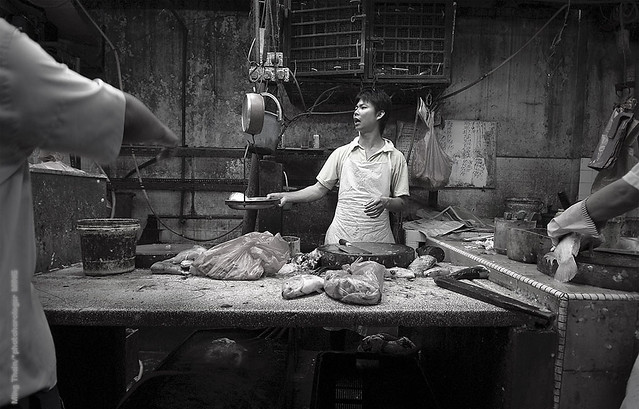
Note: the images used to illustrate this essay are representative of various creative ‘breaks’ I’ve had in my photographic career – experimentations with other styles or inspirations that have caused fundamental shifts in the way I see, and the way I shoot.

____________

Visit our Teaching Store to up your photographic game – including Photoshop Workflow DVDs and customized Email School of Photography; or go mobile with the Photography Compendium for iPad. You can also get your gear from Amazon.comhere. Prices are the same as normal, however a small portion of your purchase value is referred back to me. Thanks!

Don’t forget to like us on Facebook and join the reader Flickr group!

appstorebadge

Images and content copyright Ming Thein | mingthein.com 2012 onwards. All rights reserved

Street photography in context: diversion, documentary or nuisance?

_M9P1_L1006378 copy
The Police are everywhere. Prague. Leica M9-P, 28/2.8 ASPH

After spending some time thinking about it, I’ve come to the conclusion that street photography – I prefer to think of it as ‘reporting on life – is an increasingly popular genre of photography for several reasons:

1. It’s easy to do, and accessible to all – the barriers to entry are low. Wildlife or say automotive photography, for instance, is not. There isn’t any setup involved beyond remembering to take your camera with you when you leave the house, no matter where you live.
2. The definition of the genre is extremely broad; to the point that you could probably almost say there was no definition at all. This means it’s both open to much creative interpretation, and also an excuse for anybody whose generic images have no specific idea or subject in mind.
3. As humans, we are psychologically drawn to other people: no man is an island. Street photography lets us get our fill of humans without having the tread the social minefield of heaven forbid, actually having to interact with them. (It’s a bit like the internet in this regard.)
4. Everybody likes to play documentary photojournalist once in a while.
5. Building on from #4, some photographers have a burning need to record everything and everybody around them – I’m one of these people – and sometimes we just shoot out of compulsion, because our compositional minds just simply do not turn off. Having trained yourself to see workable frames in the most unlikely of places, it’s difficult to un-learn this skill (or curse, depending on whether you’re the photographer or the one waiting for the photographer to hurry up).

I believe the sum of these things is that street photography falls into one of three categories for the vast majority of photographers and audiences – diversion, documentary, or nuisance.

Diversion
For the unafflicted photographer, it can be a nice genre to experiment with when you have the desire to shoot something, but you have no clear subject in mind. Taking a walk with a camera allows you to go in with a blank but receptive mind, and just wait for an endless parade of subjects to pass you by. They’re all time-sensitive, however; if you don’t react fast enough, they’re gone. This doesn’t matter, however, because there are always more subjects where they came from, and you weren’t going out shooting with something specific in mind anyway. Serendipity is probably the best way to sum up your overall attitude towards it.

Similarly, for casual viewers, street photography can provide an interesting window into the lives of others; an unusual or otherwise missed moment preserved for posterity. You see it, appreciate it for a little longer than the actual fleeting instance of the moment, and move on. It doesn’t really stick in your mind.

Of course, this all depends on the strength of one’s compositions; of chief importance for all images, street or otherwise, is having a prominent subject and a clear idea of what the image is supposed to achieve or say. Purely aesthetic images are fine, too; but the execution must obviously support the idea.

Documentary
Those who take street photography a bit more seriously start to tip over into the documentary category – they view the images they capture as preserving a slice of life, or singling out an interesting instant from the constant flow of life around them. This is of course a continuum; you can be looking for just that little bit more over your normal street photographer, or you could be very, very serious about the decisive moment like HC-B. These photographers don’t always have a clear idea of what they want in an image, but they recognize an interesting scene when it happens and are ready to respond and capture the shot.

I think I fall into this category. Whilst I still make some images that I consider to be aesthetically pleasing rather than saying anything strong or documenting a particular moment of life, I do look for something out of the ordinary in my images; I think it’s probably the natural progression for all street photographers as they eventually land up with far too many ordinary looking images. This leads to seeking the common theme that separates out the strong images from the weak ones – and it always comes back to idea, subject, and execution (which covers framing, light, processing etc.)

To some extent, as a competent photographer, I feel that we have a moral duty to record life for posterity – especially so in fast-changing environments such as developing countries. I’ve lived in the same neighbourhood of downtown Kuala Lumpur for the last seven years; in that time the landscape and flow of people has changed so much that there are things I don’t even remember seeing, much less capturing, in my old images from just a few years ago. If we, the first hand observers, don’t even remember – how are any future generations going to manage? I’ve shown images to fellow residents, and will inevitably be told at least once or twice something along the lines of ‘I’ve never seen that before’, or ‘Where’s this? So nearby, really?’.

The observer must therefore be an impartial one, with an abstract but fixed idea of what is ‘ordinary’ in their minds. This is something that gets harder and harder the longer you live in a place, or the more familiar you get with it; the foreign soon becomes the commonplace and soon you won’t notice anything at all. Observation and recognition of differences is an innate human skill; but continuous observation and attentiveness is very much a trained one.

The nuisance
In trying to be both observers and recorders, we must endeavour not to become public nuisances. In a previous article, I talked about the ethics of street photography and the importance of maintaining basic human standards of politeness and courtesy; something that many modern photographers choose to ignore behind the pretence of anonymity, or simply choose to ignore. It’s true that we feel less inhibited as photographers when we are not in our own comfort zones or cities of residence; at the same time, this is when we are also at our most observant and probably least culturally sensitive state. It’s worth remembering that what we might not find culturally offensive at home could well be the opposite overseas.

Often, the most interesting things happen well within the boundaries of polite personal space; intruding that makes me (personally) feel uncomfortable; it’s important to remember that we as photographers have both our personal and group reputations to maintain – it certainly won’t help anybody if street photographers are eventually perceived as being at the same level as paparazzi.

So where does this all leave us?

My personal opinion – and I stress this is highly subjective – is that those of us who have the ability and inclination, should go beyond the realm of causal snapping and treat street photography as social documentary/ reportage; try to say something with every shot, but at the same time, do this in an ethical way that doesn’t intrude on the privacy, rights or personal space of the subject(s). The overarching goal should be to preserve these little vignettes on present-day life for posterity; this also means making the work accessible and viewable to as great an audience as possible, which is one of the reasons why I use flickr.

I’ve noticed that my personal street photography style has evolved over the years from – get a worthwhile composition, to get people in frame, to get as close as possible, to cinematic style with plenty of OOF areas, to get close but retain context. It seems that today I’m working towards a style that documents man in the context of his environment, natural or built; I don’t specify a man and his individual, personal characteristics as much as use that figure as an abstract for the idea of humans in a particular situation. Where you choose to take it (and if you even bother with street photography or reporting on life) is very much a function of personal style – something you will have to discover and define for yourself, if you haven’t already done so. I just thought it might be interesting to throw another perspective out there. MT

____________

Visit our Teaching Store to up your photographic game – including Photoshop Workflow DVDs and customized Email School of Photography; or go mobile with the Photography Compendium for iPad. You can also get your gear from B&H and Amazon. Prices are the same as normal, however a small portion of your purchase value is referred back to me. Thanks!

Don’t forget to like us on Facebook and join the reader Flickr group!

appstorebadge

Images and content copyright Ming Thein | mingthein.com 2012 onwards. All rights reserved

On the value of having a muse

_PM03501 copy
Starburst. Olympus E-PM1 Pen Mini, Panasonic 20/1.7

This has been another one of those tricky articles to write – mainly because a lot of self-reflection went into it, and as we all know, it’s very difficult to do that and remain objective. The essays is illustrated with images that are representative of experiments that worked – things I was inspired to try with various muses, and in turn learned something from.

What is a muse? In its purest form, a muse is perhaps best defined as something that triggers inspiration in an artistic or creative sense. It doesn’t have to be an inanimate object; most artists’ muses tend to be people; in fact, most artists tend to land up romantically involved with their muses. Creativity is impossible to separate from inspiration, and inspiration is a very close bedfellow of attachment – attachment to an idea. (I know this sounds like Inception, but bear with me here.*)

*On an unrelated note, that movie contains one of the most spectacular dining rooms I’ve ever seen – from a design and architectural point of view. And I suspect it would be pretty cool as both a photographic subject and backdrop, too.

_PM08399bw copy
Floating head. Olympus E-PM1 Pen Mini, 14-42 kit lens

This attachment can take many forms. From a specifically artistic point of view, the main one is to try and capture the essence of the subject in the artist’s work; in fact, an extremely challenging muse is probably the best thing an artist can have, because no matter how hard they try, they will never feel as though they’ve done the subject justice – and this is what drives the growth of creativity. It’s not so much attachment to the subject per se, as an obsession with the desire to capture the subject in a medium or object other than the subject itself – which is in itself doomed to failure, because the more one understands about a subject, the more one realizes that it’s impossible to reproduce it in another medium – especially if the subject is something live and changing, like a person.

_M9P1_L1006748 2 copy
Prague sunset. Leica M9-P, 28/2.8 ASPH

So in effect, muses are necessary stimulants to creativity. There are a few things that make a good muse: complexity and multidimensionality is one; ease of access is another (you never know when an idea might strike, and you just have to try something out); finally, some sort of flux or dynamism is another – which is why most muses tend to be things that offer infinitely variable possibilities – for instance, Ansel Adams and Yosemite – or a person.

_M9P1_L1007739 copy
Journey ending. Leica M9-P, 28/2.8 ASPH

Having a muse is also an admission of the artist to imperfection – at least in their own minds. If the artist was happy with their work, they’d finish one piece of art – take one photograph – feel like they’ve nailed the shot, and then never look at the subject again. By trying to photograph something repeatedly, it says both that there’s perhaps more to capture than is possible in a single frame, as well as all of the past frames being insufficient or incomplete in some way.

_M9P1_L1003010 copy
Vienna at Christmas. Leica M9-P, 50/1.4 ASPH

A person may have many muses. You might, for instance, be inspired by a particular place or location; an object, and a person. Most of mine fall into the latter two categories, though the objects tend to be somewhat short-lived. I’ll start with the easy one – objects. I tend to accumulate objects of design. I have a huge weakness for things which have unique (but functional) design elements; things made of unusual or highly tactile materials and textures; and things that just look good. Past random acquisitions include a miniature fountain pen with no clip; a vase with a hole so impractically small that you would be hard pressed to fit even a single flower stem in it, but an incredibly unique texture; and fifteen stuffed polar bears.** And of course there are the watches, too.

**You may have already seen these make cameo appearances in various camera tests. Their white fur is an excellent test subject for highlight tonality, microcontrast, and of course fine detail reproduction.

_7023376 copy
Bob. Nikon D700, Voigtlander 20/3.5

Most of these objects will be the subjects of several photo sessions, or until I’m happy with at least one or two of the images I’ve captured. After that, they don’t change, so they don’t really serve much of a challenge photographically; however they litter my apartment as monuments to my design curiosity. But by far the biggest guilty pleasure of mine are cameras and lenses; yes, they are technical tools used to capture an image. But different cameras also force you to shoot differently and think about composition in different ways; a great example is a compact, or a monochrome-only camera. The former removes the crutch of bokeh, and forces you to rely on subject differentiation solely via framing and light; the latter forces you to see luminance, texture and shadow, rather than contrasts in color. Both are refreshing, and mastery helps you improve overall as a photographer.

_5100_DSC0390 copy
Red vase and erstwhile contents. Nikon D5100, 60/2.8 G Micro

Then there’s the difference between rangefinders and SLRs – viewing and focusing method aside, I find the biggest difference is that a rangefinder forces you to focus more on your subject – you can’t see what’s in focus and what isn’t; you can’t frame precisely. Shot properly, both of those things subconsciously make you concentrate more on ensuring that the subject itself is the most immediately obvious thing in the frame, and the primary composition is so strong that whatever might be in the edges or out of focus areas of the frame become secondary, and do not detract from the subject. A new camera makes you want to go out and shoot with it, too – and that motivation is often enough to make you get images you wouldn’t otherwise have managed if you’d either stayed at home or not bothered to experiment with.

_M8_L1025458bw copy
A Parisian cliche. Leica M8, 21/1.4 ASPH. I don’t think I would even have attempted this with a big black DSLR.

Japan is also a source of endless inspiration for me – perhaps because the place is just so different from anywhere else in the world, especially the old world of Europe where I used to live, and the developing world of South-East Asia where I now live. I step off the plane and feel excited – those very differences that pervade every aspect of daily life force you to approach subjects with fresh eyes and curiosity; you take experimental risks and try things you normally wouldn’t at home or on a commercial shoot, where risk might equal loss of a client. I think every photographer needs these creative trips on a semi-regular basis as a way of forcing your eyes not to take things for granted, especially when back home. Seeing something done differently overseas tends to make you wonder what’s normal – it is of course all relative – but perhaps enough for you to find a worthwhile frame in the course of your daily life you might have otherwise ignored.

_7012680bw copy
Waiting for the train, Sapporo. Nikon D700, Zeiss ZF.2 2/100 Makro-Planar

My biggest muse, by far, is my long-suffering wife. She is crash test dummy for new equipment and technique, a partner in crime for experimentation, and a handy anonymous body when an empty scene happens to need one to complete the frame. (She isn’t that patient, though, which also forces me to hone my instinctive composition and technical skills – the less one has to think about something, the faster one works.) And as a person, I find her endlessly fascinating*** – which means that there are always facets of her personality that I’m trying to capture; regardless of whether I do or not, I’ll always feel there’s something left over the next hill – and that motivates me to keep shooting.

***I suppose if this wasn’t the case, then I probably married the wrong person. Perhaps there’s a photographic metaphor in this – maybe in choice of camera or choice of subject – but that remains another topic for another day.

_X1_L1000373 copy
Medusa sleeps. Leica X1

Conversely, there are places I visit frequently with a camera – either as part of testing, or because I always have a camera of some sort on me – I will take some photos, but nothing in the location compels me to return. These I do not consider to be muses because they don’t inspire me; I just happen to be there and see something.

IMG_1769b copy
Bukit Bintang reflections. Apple iPhone 4

I highly recommend you find your own muse; it doesn’t have to be a person, or even a fellow photographer (my wife doesn’t really have any interest in taking pictures, and she is almost always surprised by the way the images turn out – despite having participated instrumentally in their creation). Rather, your muse is a reflection of you as a photographer – what is it that fascinates you? What inspires you? What makes you want to create? Finding and understanding that is a hugely important step to unlocking your creativity. MT

This post was brought to you by Ming Thein’s Email School of Photography – learn exactly what you want to learn, when you want to learn it. Muses not included, but I’m always happy to talk psychology to figure out what drives you. Don’t forget to like us on Facebook!

Travel minimalism: one lens to go

_M8_L1025017 copy
Canterbury in autumn. Leica M8, 21/1.4 ASPH

Every time I travel for personal purposes, I’m always torn between experiencing the place, and photographing the place. Photography is such a part of me that sometimes I feel that I experience and understand things more through trying to capture the essence of them. Or perhaps it’s because doing so forces you into conscientious observer mode, and this in turn makes one’s mind more receptive to things, and more willing to question what you see and find juxtapositions or contrasts.

_M8_L1024931bw copy
Canterbury Cathedral crypt. Leica M8, 21/1.4 ASPH

That aside one of the things which inevitably keeps me up the night before departure is trying to figure out what to bring equipment-wise. If it’s on assignment, then I bring everything I might possibly need, plus spares – to hell with overweight baggage, if you don’t have it, it could mean a lost job – on the other hand, if I’m traveling for myself, I’d rather carry as little gear as possible. Well, little enough that I don’t notice it after walking around for hours on end, but with sufficient coverage that I don’t get frustrated and feel like I missed a rare photographic opportunity because I didn’t bring along a wide angle. Or something along those lines.

_M8_L1026056bw copy
A Parisian in her natural habitat. Leica M8, 21/1.4 ASPH

My last personal vacation saw me bringing an Olympus Pen Mini, the 14-42 kit lens and a Panasonic 20/1.7 pancake. We went to the beach. Frankly this made the choice easy as I didn’t really want to expose any of the more expensive gear to moisture, salt and sand; the M9-P definitely would not have been suitable, and the D800 might have produced great landscapes, but it would also have worked fine as a boat anchor.

_M8_L1026132bw copy
Three conversations, Paris. Leica M8, 21/1.4 ASPH

I’ve been trying to fine-tune this over the years. I’ve been on trips where I did carry coverage from 14-450mm and a spare body; whilst I got some great images, I also had a sore back, and landed up leaving everything but one body and the 24-70 zoom in the hotel room for the last week. More crucially, I felt the images produced from that trip lacked focus; I brought everything, so subconsciously I was actually trying to capture everything. The upshot is a set of images that isn’t as strong as it could have been, and worse still, experiencing that slightly chaotic panicky feeling that you just might have missed a shot opportunity somewhere.

_0011006bw copy
Tate Modern yard, London. Ricoh GR Digital III

My preferred travel kit is a moderate wide, and a moderate telephoto – both fast – and one body. I might carry a spare compact or something similar as a backup, just in case. I’ve gone with the D700, 24/1.4 and 85/1.4 – this is an absolutely fantastic and hugely flexible combination – plus a spare compact, either the Fuji X100, Leica D-Lux 5, or my favorite, the Ricoh GR-Digital III. Most recently, I spent two weeks in Europe with an M9-P, 28 and 50mm lenses, plus the Pen Mini and 45/1.8 (giving me 90mm in a pocket). This was also an excellent combination, and in some ways better than the Nikon based setup due to weight and instant availability of the telephoto. However, it lagged hugely in low light performance. I think the next trip I take will probably be Micro 4/3 based; an OM-D and Pen Mini with 12, 20 and 45mm lenses will cover the vast majority of situations handily. And not weigh very much, either.

_0011022 copy
Piccadilly Circus, London. Ricoh GR Digital III

So what’s all of this talk about a single lens?** Or single camera? There are advantages to this approach: firstly, you’re unencumbered and free to enjoy the atmosphere, people and culture without feeling like a packhorse; a small camera around your neck is probably much easier to manage than an entire backpack full of lenses. Also, you don’t have to worry as much about security – frankly, carrying several Leica f1.4 Summiluxes and a Noctilux around even safe Singapore made me pretty nervous.

**Let me clarify: I don’t mean going with a 28-300, though I suppose this might be a viable option for some situations. That lens has more compromises than strengths, and if you don’t know how to manage your perspectives properly, then you’ll land up with weak images too, because you’ll always be trying to ‘zoom in’.

_0011001bw copy
The Shard, under construction. Ricoh GR Digital III

The main advantage, however, is that it frees up your mind from having to think about what perspective to take for a scene. Do you find the essence in the details, or do you go for something wider and more encompassing, with context? Trouble is, there is often no right answer – and from experience, I know that inevitably you’ll land up trying to make both work and being satisfied with neither. On the other hand, if you’ve got just one focal length, then you can pre visualize what your frame will look like; with sufficient experience, your eye naturally looks for compositions that fit within the perspective and angle of view of the lens you’ve got. Thus: instead of wondering what perspective to use, you’re free to spent that mental capacity on fine-tuning the elements inside the frame of the only perspective you have. It can be liberating – providing you’re thinking about the photograph, and not about the equipment you left at home. There’s also the side benefit of not having to change lenses, and thus always being ready.

_7017234bw copy
The doorway, Hanoi. Nikon D700, 85/1.4 G

I actually did this on several occasions. At the end of 2009, I made short trips to Oxford, Canterbury and Paris; for these I brought two lenses (21 and 50mm for the M8) but only used the 21. I did it again in 2010; the first trip saw me bringing a D700 and several lenses, plus the Ricoh GR-Digital III; I only used the Ricoh and its fixed 28mm because it was both much more convenient, as well as matching the way my eye was tuned at the time after my first Leica-M experience. I got wiser on the second trip and left everything behind except the GR-Digital III. Hanoi later that year saw me using only the D700 and 85/1.4 G.

_7017494 copy
A Vietnamese stereotype. Hanoi. Nikon D700, 85/1.4 G

If you are going to try this exercise, I’d recommend going for a wide normal rather than an ultra wide or a tele; for the simple reason that these are the most flexible focal lengths to use. 35-50mm can appear wide or moderately telephoto depending on how you choose to use the foreground elements in your scene. And at some point, chances are you’ll probably want to take a photo of yourself or your traveling companion (or both of you, or your family…you get the point) – and it’s generally much easier with something wide or normal than say a 300mm.

_M9P1_L1005025 copy
Prague castle and stars. Leica M9-P, 28/2.8 ASPH

Some people may find a telephoto easier to use in these kinds of situations because they can snipe from a distance; I’d personally advise against it because it’s very difficult to make images with context; and that’s one of the cornerstones of travel photography. The bokeh may be great, but if the background gives you no clue as to where the subject is, then the image could well have been shot anywhere – and that somewhat defeats the point of travel photography.

_M9P1_L1004062 copy
A Viennese moment. Leica M9-P, 28/2.8 ASPH

Personally, if I had to pick, I’d go with either a 28mm, or a 35mm – depending on whether my images would likely be more people-biased (longer), or more location-biased (wider). And it’d have to be fast, too; I’d be using the lens at night, and anything slower than 2.8 wouldn’t cut it. Frankly, in some situations, even f2.8 may be a little borderline. Finally, it’d have to go on something small, light and unobtrusive; responsiveness is important because your ability to anticipate things will be a little bit diminished thanks to the foreign environment. Right now, my choice is probably between the Olympus OM-D and Panasonic 20/1.7, the Ricoh GR-Digital III/ IV, or the Leica M9-P and a 35/1.4 ASPH FLE.

Give it a try. On your next trip, just use a 35 or 50 prime for at least a day or two; if it makes you feel better, bring along your zooms too, but don’t use them until you absolutely feel that you’re missing shots. MT

_M9P1_L1013074 copy
Wat Arun and Boat, Bangkok. Leica M9-P, 35/1.4 ASPH FLE

____________

Visit our Teaching Store to up your photographic game – including Photoshop Workflow DVDs and customized Email School of Photography; or go mobile with the Photography Compendium for iPad. You can also get your gear from B&H and Amazon. Prices are the same as normal, however a small portion of your purchase value is referred back to me. Thanks!

Don’t forget to like us on Facebook and join the reader Flickr group!

appstorebadge

Images and content copyright Ming Thein | mingthein.com 2012 onwards. All rights reserved

How serious do you want to get?

At some point, every enthusiast photographer is going to want an upgrade. It’s a natural consequence of human society; more and newer is better. Since money doesn’t necessarily correlate to ability – in fact, it’s frequently the complete opposite situation – the people who’ve bought the best and latest gear generally aren’t the best photographers. In fact, I think a solid argument can be made that if you are very committed and passionate about your hobby, then you’ll find ways to make do without resorting to technology.

Advance warning: this article is as much about individual soul searching as it is about gear lust. Many of you will probably disagree with what I have to say, or find the truths a little uncomfortable; you of course don’t have to listen to me, but you might well find doing so unburdens you and allows you to develop even more as a photographer. Why am I saying this? Because I went through the process myself, and have to make a conscious effort to stop myself from falling into the gear trap. (It’s actually a lot worse when you’re a pro because you can justify buying anything as ‘work related’ and a tax-deductible expense.)

Notice the question I asked was ‘how serious do you want to get?’ not ‘how serious are you?’. There’s a difference: the former is aspirational, and the latter is slightly insulting, specifically in the implied stagnation and doubt of one’s ability.

Rule Number One: don’t confuse need and want.

There’s nothing wrong with wanting something. It’s what makes us human, in many ways. But don’t think you need it. Having a D800 will not make you a better photographer than D700. In fact, it might well make your images worse if you lack the discipline to use it properly. But if you desire one, and that’s all there is to it, then go ahead. If the ownership experiences gives you pleasure, and you’re happy carrying the weight around, then who’s going to stop you? These types of purchases tend to be accompanied by positive personal emotions.

Need is different: you’re going to find it difficult to do product photography without lighting gear. That’s a need, if the situation calls for it. I wouldn’t argue any other way. These types of purchases often feel like paying tax: we do it because we have to, not because we want to.

This brings me on to Rule Number Two: only buy something if you know you’ve exhausted the limits of your equipment.

There are so many advantages here: you’ll buy exactly what you need. You won’t waste money on trying things that ‘might’ be useful. You will actively seek the skillset required to make the most of the new acquisition.

Rule Number Three: learn to use what you’ve got. This one is a biggie. The number of people who keep buying bigger and faster lenses and cameras thinking that it’s going to solve basic compositional problems never ceases to amaze me. Fps and bokeh are tools and enablers, not a crutch for compositional imbalance! Yes, the ‘Photoshop tax’ is painful, but if you think about it, not unreasonable. I use photoshop for every single image I shoot. There is no other piece of equipment that falls into this category, yet some of the other tools I own cost far more. How is this unreasonable? I look at it as cheaper than having a darkroom, or paying somebody to develop films for you. Furthermore, signing up for a decent course or educational program is going to cost less than a new camera, but teach you far, far more. Buying a professional camera without understanding photography is like driving a Ferrari with traction control off in the rain: you can go fast, kinda wing it, probably hold it together most of the time, but sooner or later, you’re going to crash in a big, messy way.

This brings us around full circle. I don’t define seriousness in photography as whether you make your living from it or not; there are plenty of ‘pros’ who make big money but don’t really care about the output – so long as it’s about 90% there, the clients can’t tell the difference. Even more shockingly, I was told this in person, by more than one person whose fees are rather high. Similarly, there are amateurs who are outstandingly good photographers – probably without the commercial inclination or personal interest in making a living out of it – but their shooting discipline and workflow shows incredible attention to detail, even though very few people (if any) see their images.

Rather, seriousness is probably closer to how much of a sacrifice you’re willing to make; this comes in many forms. Cost. Weight of equipment. Time spent processing, which could be spent on other things. Sleep sacrificed for that perfect sunrise or sunset. Personal security, to get the shot in a dangerous area. Photographers who try to capture things they cannot control – think photojournalists and wildlife shooters – rank pretty darn high on the seriousness ladder.

I think it’s very important to know where this boundary lies personally. Like every other wildlife photographer, I once had aspirations to shoot for National Geographic; the reality is that after a bit more research into what they do while on assignment; I don’t think I’d be happy with that kind of life; sacrifices are high. But on the opposite side of the coin, I’m willing to put up with PC lenses, tripods, focusing racks etc. in order to eke out a tiny bit more image quality for my watch photography – which I don’t think many people would bother with.

Perhaps another definition of the spectrum is whether you’d go out of your way to get the shot or not: a serious photographer would either go far, far out of their way and plan specifically to get that one image; a not-serious one would be more opportunistic and just make causal images as and when the opportunity arises.

Knowing where you stand on this continuum  – enables you to make decisions without that slight discomfort and doubt that you’re compromising on other things at the expense of photography – but without really knowing why. It’s a lot easier to be happy about the choice to carry 20kg of equipment on holiday because you know that you aim to get some very specific shots that can only be done with that equipment; as opposed to bringing-it-along-because-you-bought-all-of-it-already-because-it-made-you-look-like-a-pro-and-now-you-should-probably-use-it. Similarly, you won’t feel bad about missing that amazing sunset your 20kg-toting friend got because he woke up at 5am, and you were hungover after partying the night before – but you know how to make a decent shot with your mirrorless camera when the opportunity arises, even if you don’t actively go out of your way to look for it.

That liberation brings happiness and contentment. Very simply, that makes it a hell of a lot easier to enjoy what you do; the fact that you’re here and reading means you’ve got a choice. And given that choice, would you want to do anything for any other reason? MT

____________

Visit our Teaching Store to up your photographic game – including Photoshop Workflow DVDs and customized Email School of Photography; or go mobile with the Photography Compendium for iPad. You can also get your gear from B&H and Amazon. Prices are the same as normal, however a small portion of your purchase value is referred back to me. Thanks!

Don’t forget to like us on Facebook and join the reader Flickr group!

appstorebadge

Images and content copyright Ming Thein | mingthein.com 2012 onwards. All rights reserved

Start with the end in mind: visualizing your shots

_M9P1_L1004614 copy
Lighting candles at Christmas outside Stefansdom, Vienna. Leica M9-P, 28/2.8 ASPH

Most of the time, we shoot first and then figure out what to do with the images later. That’s the wrong way of doing things. A healthy portion of famous photojournalism work was premeditated: not in the sense of the scenes being staged, but the photographers had some idea of what they were looking for, what might happen, and if it did, how they wanted to capture it. The final composition was most probably unplanned and spontaneous, relying on the photographer’s experience and training to deliver the precisely ‘right’ combination of elements in the scene.

_M220119bw copy.jpg
Market thespian, Kuala Lumpur. Nikon D200, 12-24/4

Even street photography works best with some degree of forethought: you might not know what’s going to come into your frame, but you do have to be conscious of light direction, possible backdrops or natural frames, and of course the flow of people. It isn’t planned, but a lot of the time I see locations with interesting urban geometries and abstractions, then wait around for something interesting to happen or for a person to be in precisely the right location to complete the shot. Often, most of these scenes would be acceptable but slightly boring without the human element – however, short of hiring a model, all you can do is wait and be prepared for somebody to turn up at the right place and time – and for that, you have to be both able to see what the difference would be, and ready to capture that instant.

_N215560 copy.jpg
Vintage Lemania chronograph for a book on military watches. Double page spread, text in white to go on the black column at right – planned and shot as such. Nikon D200, 105/2.8 VR Micro

On the other side of the spectrum, almost all commercial work is planned, right down to the smallest of details. There are blank spaces left in compositions that look awkward on their own, but are there because of intended text placements or cropping to fit strange aspect ratio spaces. And that doesn’t even begin to touch on the conceptual side of things – often most clients know what they want, but are unable to communicate it to the photographer because describing visual things requires a wholly different an unfamiliar language to somebody working in say, hamburger sales. The trick here then becomes trying to understand the end use of the image, its intended goal, and how you translate that into a photograph – in a sense, we photographer have become more than just executors – we have to think actively about human psychology to some extent, too.

_7021848 copy
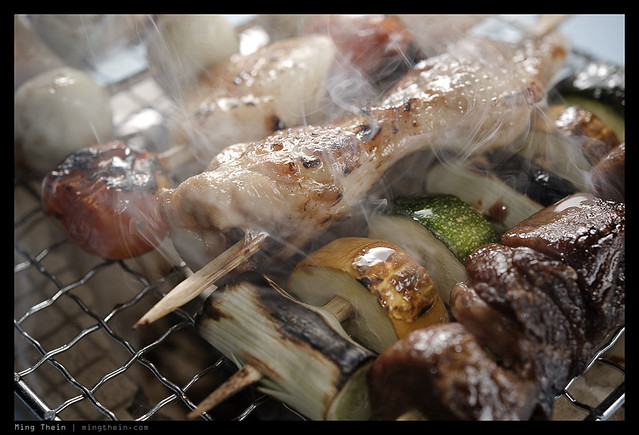
I bet you feel like a grilled snack on a skewer right now. And that’s the end goal. Nikon D700, AFS 60/2.8 G Micro

Fortunately, this is usually pretty simple: the end goal of commercial photography is almost always to sell more product. Which means that if you look at the image and it doesn’t stir some desire in you – whether it’s to go out and buy something or make you feel hungry – then the photograph has failed its objective.

I’m digressing here. What I really want to talk about is how the previsualization process works. I’ve already said a little bit about how I go about street photography – find the location and light, and then wait for the people or the action – but it’s different for every subject. Although photojournalism is pretty close in technique and execution to street photography, there’s one huge difference: you have to capture the story in a frame or a few frames, not just find an interesting random slice of life that may or may not be significant in a greater societal context. This means you have to identify what key elements you want in the frame beforehand – what you need to tell the story, in effect – and then go out and actively look for them. Throw the unpredictability of lighting and action into the mix, and you can see why it’s such a difficult job. You can also see why most photojournalists favor wide angle lenses; they allow the primary subject to be easily made prominent, and then context to be easily included in the frame as background – but not dominating the subject.

_0010675bw copy
Construction works on evacuation break. Ricoh GR-Digital III

In fact, wildlife, sport and photojournalism use similar processes. This is because you have no control of the subjects, but need to include key elements in order for the image to work.

Architecture is actually fairly simple: the architect usually wants to showcase a particular design detail or feature of a building, which means all you need to do is visualize how to present it in several ways – either with human-scale context, with environmental context, or in a more abstract, purer design-focuesd form. The remainder of the planning goes into figuring out what time of the day produces the most favorable light, and which vantage point and perspective you need to use. (I’ve got an upcoming On Assignment feature on an architectural shoot in Singapore, within a few days, actually.) In fact, the most unpredictable thing is the weather: there’s no way you can control it, and a few days of rain can completely kill your schedule.

_X1_L1000845 copy
Rain would have killed this job. Leica X1

Food, watches and other commercial object-things work in a very similar manner to architecture, with one key difference: you can control the light. And you can plan the light to give the object certain characteristics, and in turn create controlled emotions in the viewer – remember the earlier article on color and emotion – it applies equally to light, too, since color equals light equals image. Most commercial shoots have controlled compositions, too – for the reasons mentioned above – most of the time, there’s an intended final use. And frequently, the client knows exactly where the text is going to go, or what other layout features the image has to work around.

_7045122 copy
Jaeger Le-Coultre Master Ultra Thin 1833 limited edition. Nikon D700, AFS 60/2.8 G Micro.

Finally, there’s portraiture. I’ve left this one to last because it’s really a mix of everything; you can choose your background like street photography; elect to include or exclude contextual elements like photojournalism; pick the best and most flattering features of your subject like architecture; and finally, control the lighting like for food and watches. But yet there’s an uncertain element in the form of your subject; no matter how well you know a person, 99.99% of people will act differently in front of a camera, and that makes capturing a natural expression hugely challenging. Often I’ll find I shoot or pretend to shoot lots of frames at the start of a portrait session, but the ones that I submit in the end (and the client prefers) are the unplanned candids grab shots that happen during the informal downtime. In fact, doing this has almost become a habit with me – I should see if I can figure out how to drop the pretense in the future and just go straight to the informal bit.

_D90_DSC7558 copy
The beefeater. Nikon D90, 18-200VR

The upshot of all of this is one simple thing: no surprises. You get what you are expecting, and you can safely say a) job done, work delivered and b) the preplanning frees up your mind to focus on the other parts of execution, like lighting and fine tuning composition. All in all, producing a stronger image. MT

This post was brought to you by Ming Thein’s Email School of Photography – learn exactly what you want to learn, when you want to learn it. Don’t forget to like us on Facebook!

Color or black and white?

In advance of tomorrow’s review of the Leica M-Monochrom, it seems that this is a an appropriate question to tackle (if a completely academic one if your camera doesn’t shoot color in the first place.) It’s actually one of the tougher problems I face on a regular basis. Does a shot work better in color or black and white? What if it’s both? There are generally a few things that I look for which help, either to define the obvious or if I’m on the fence. This article is a short distillation of that process.

1. Is it commercial? If so, then 99% of the time, the required output will be color. Especially if it’s food or product; architecture can be either.

_7059099 copy
Commercial architecture. Nikon D700, AFS 24/1.4 G

2. Are there strong dominant colors in the image? If so, then color. Generally, if the image is about strong color, monochrome almost always never works because for a color to be perceived as strong, you need to have fairly constant luminance values across the scene. And luminance variation is what you need for a good B&W. If the strong dominant color as a good range of luminance values, then either can work.

_M9P1_L1011009 copy
Offerings of strong color. Leica M9-P, 35/1.4 ASPH FLE

3. Is the image naturally washed out or low saturation because of the subject or lighting? Generally, black and white works better here; however, you’d be surprised at how different an image with subtle color and very low saturation looks vs one that is completely colorless.

_M9P1_L1006123 copy
Subtle color works well, sometimes. Prague castle. Leica M9-P, 28/2.8 ASPH

_M9P1_L1003919bw copy
But sometimes there is just no color to be had – the scene in reality was almost monochrome already due to the flat lighting and fog. Schonbrunn Palace, Vienna. Leica M9-P, 28/2.8 ASPH

4. Is the subject isolated or highlighted by the lighting of the scene? Either can work, but my personal preference is for black and white because you’ve got enough luminance isolation already without having to overdo it.

_M8_L1025558bw copy
Isolation by lighting. Note how the backlight rings the subject. Paris. Leica M8, Voigtlander 50/1.1

5. Is the subject isolated by color? Stupid question, easy answer. Go with color. If not, you risk running into the problem of small differences in luminance values again. Sometimes, color IS the subject.

_M8_L1017941 copy
Isolation by color. Goa, India. Leica M8, Voigtlander 15/4.5

6. What emotion or feeling are you trying to achieve with the image? Classical timelessness always requires B&W, otherwise, go with color and shift the white balance a little.

_M8_L1023455bw copy
Film Noir. This could have been 8 days or 80 years ago. It was neither, actually. London, Leica M8, 35/2 ASPH

7. Is the image part of a series, group or set? Whatever the answer is, be consistent. You could produce two different sets, but make sure the style (including color or lack thereof) is consistent between images in the set. If you’re only delivering or using one set, then don’t change styles halfway through. See what best fits the images and overall goal of the series.

_7007311 copy
The man behind the scenes, literally. If the backdrop was monochrome, would the blue screen effect metaphor have been as obvious? I think not. Nikon D700, Zeiss ZF 1.4/85 Planar

Of course, the easiest way to avoid all of these problems and questions it to pre visualize your shot and start with the end already in mind, so you know what you’re going to do with it. And that will be the subject of a future article 🙂 MT

This post was brought to you by Ming Thein’s Email School of Photography. Don’t forget to like us on Facebook!

The inexact science of color and emotion

_7037890 copy
What makes this photo identifiable as dawn instead of sunset? Hint: it’s the color. We expect sunsets to be warm, but mornings to be cool and clear.

A series of experiments was done many years ago that showed humans have been conditioned to expect certain things in the way of color: blue ketchup just doesn’t fly, for instance. The theory is that it’s a primeval subconscious response to warn us of danger. Think of it this way: rancid meat looks a certain way, and has a certain color. Even if we can’t smell it – looking at a photograph of vomit or something decomposing makes us go ewwww. Such examples are to be found in nature all the time – think of those brightly colored poisonous beetles, for instance. In fact, the link between color and range (and thus emotion) is so strong that many species mimic the coloring of more dangerous species to warn away predators, but at the same time rely solely on that as protection because they pack no venom or toxicity. (Toxicity is energy-consuming to produce, and in food-scarce environments, you want to waste as little of your nutritional intake as possible producing something that’s only going to help you if you’re eaten – and thus probably going to die anyway.)

_7049521 copy

_7049526 copy

A tale of two cities. Shot minutes apart, though. How does the first image make you feel? The second?

How does this relate to photography? Quite simply, when you look at a photograph, how does it make you feel? Ignore the subject for a moment. The remaining emotional response is mostly down to your reaction to the processing: specifically, color. Why do black and white images have that ‘timeless’ or ‘ageless’ quality? Why do they make you feel slightly detached, as you’re an observer but not really part of the scene? It’s all due to color, or in this case, the lack of it. It’s difficult to relate to something if your information or perception on it is limited to tonal information only.

_7060545 copy
Why does this shot imply richness and juiciness? How would you feel about pale gray steak with red tomatoes, even if it tasted the same?

In fact, if you look through historical photographs and video – you’ll see that each recent era or block of ~10 years in modern history actually has quite distinct color and tonal styles. And looking at this often makes one feel something – nostalgia, hatred, wondering what one was doing with their youth. Early color photos from the 1930s and 40s have that vintage look, for instance.

_7036896bw copy
To me, this screams classical photojournalism – because of the contrast, the tonality, and the lack of color. Early photographers didn’t purposely go for that look – they learned to work with it because of the limitations of darkroom chemistry.

A lot of modern photography software capitalizes on this. Instagram and all of those software filter packages are a good example – hell, even Lomography to some extent – they let you instantly create a feeling through a combination of color fiddling and contrast manipulation. There’s a reason why a photo from a Lomo or Instagram looks like a vintage hippy polaroid: it’s because the white balance was shifted warmer by several notches, the saturation decreased slightly, the contrast decreased a lot, and the relative luminance and hue of the red and yellow channels shifted. And there’s probably some grain and gaussian blur in the mix, too. Try it yourself in Photoshop, if you don’t believe me.

_7014252 copy
Cool mountain. Nikon D700, Zeiss ZF.2 2/100 Makro-Planar

The point is, polaroids looked that way because of the chemical process of the day: not because they wanted them to look that way. I’m pretty sure the engineers there were chasing perfect color, too. The upshot of all of this is that a modern photograph processed that way invokes memories of the polaroid era, because that’s how most social images looked then.

_7013736 copy
Mmm, natural green freshness.

Most humans respond in similar ways to color, namely:
Red – danger, warning, attention;
Blue – cool, calming, relaxing;
Yellow – warm, friendly, open;
Green – natural, fresh;
Black – mysterious, sinister, classic, premium, heavy;
White – pure, open, light, honest, clean
Gray – apathy

_7035572 copy
Multiple light sources can be confusing as hell, but almost always signal ‘party!’

Simply put, there’s a reason why most Ferraris are red, and most hospitals are white.

How does this help you as a photographer?

Actually, it’s fairly simple. Color enters your image everywhere, but makes an impact in at least two major ways. The first is if you’ve got one dominant color in the scene that registers on the subconscious of the viewer even before they figure out what the subject is; it can be the color of the backdrop, for instance. A more subtle way is the ambient light temperature – for instance, a warmer white balance setting will result in a shift towards the red and yellow channels; this in turn imparts the ambient light with a particular quality and tone.

_5100_DSC1276 copy
Warmth. The ambient WB was shifted further away from the primary light source (the flame) to preserve the warm color.

The second major way is through contrast: if you’ve got a subject of one color against a backdrop of another completely opposite color (red and green or blue and yellow, for instance) then it’ll stand out because it’s the only thing in the scene that is visually discordant. It’s a good thing, in this case, because it draws your eye to the subject and lets the background serve as a stage – which is the way it should be.

_7037150 copy
Why does my subject stand out? It’s a different color to the background, of course.

But what if your scene has no dominant color, or is very washed out or low in saturation? Do what the cinematographers have been doing for years, and either impart a global tint as described above – you can easily do this if you shoot raw by shifting the white balance; lower color temperatures that what is accurate are cooler and bluer, and vice versa for higher color temperatures. The other alternative is to use a filter over your lens, or color the light – the latter obviously assumes you’ve got some control over your lighting, though. By far the easiest way to shift color and not land up with odd hues due to the nature of color addition and subtraction is to adjust your white balance.

_7049662 copy
KLCC dawn, color slightly shifted. Nikon D700, 28-300VR

One final comment: you need to start with an accurate white balance before you shift the color temperature. This is so you don’t land up with strange colors due to shifts along the green to magenta axis (white balance and color temperature affects only blue to orange/red). Also, remember not to overdo the saturation: shifting the white balance can cause other channels to blow, even if the original appeared to be correctly exposed. And over saturated images just look crude, frankly.

And on that note, I’m going to break until the next topic: chasing perfect color, and white balance myths. MT

_7029367 copy
Funky diner colors. Sometimes, your ambient light is close to exactly what you want – and all you have to worry about is color accuracy. Nikon D700, 85/1.4 G

____________

Visit our Teaching Store to up your photographic game – including Photoshop Workflow DVDs and customized Email School of Photography; or go mobile with the Photography Compendium for iPad. You can also get your gear from B&H and Amazon. Prices are the same as normal, however a small portion of your purchase value is referred back to me. Thanks!

Don’t forget to like us on Facebook and join the reader Flickr group!

appstorebadge

Images and content copyright Ming Thein | mingthein.com 2012 onwards. All rights reserved

Balancing content and technical perfection

_M224835 copy.jpg
Base jumping off the KL Tower. There are no do-overs for either the shot or the participants. Nikon D200, AI-P 500/4

Suppose you had one opportunity to get the shot: what do you do? The obvious answer is go for broke; who cares if it’s slightly overexposed, out of focus or the framing is a little off. Maradona is probably only going to use the ‘hand of god’ once; the millennium is only going to roll around once in your lifetime. Bigfoot will probably only appear once, and only in out of focus or foggy areas*.

That’s one end of the spectrum: it’s all about the content rather than the execution.

_7045452 copy
Benzinger Skeleton. Full control of everything, full repeatability. The second, third, fourth and fifth shots would look exactly the same.

The opposite end would be fine art still life: any one of the aforementioned photographic sloppinesses would probably get you thrown out of the gallery, unless perhaps you were very, very good at explaining why out of focus images represent the current zeitgeist of society, how rushing around and achieving complete form and ‘just getting it done’ rather than doing it well – quantity over quality – are also paradigms of modern corporate living.

_MT98674bw copy.jpg
What’s this? A situation in the middle: you can anticipate what’s going to happen and be prepared, but you don’t get a do-over. You should be able to get a perfect result with practice.

Enough sarcasm. Basically, if you’re going to create a still life, you’d better damn well be in control of the elements, or it just makes you look sloppy and incompetent as a photographer. There’s no way you can excuse compositional errors, slanted horizons, overexposure or things intruding into the edges of the frame. Studio commercial photography also falls into this category; it’s 100% controlled, and if you can’t get your image right when there isn’t anything left to chance – and the shot is repeatable – then you should probably hang up your camera.

_M9P1_L1003919bw copy
It wouldn’t have worked without the man. Schonbrunn Palace, Vienna. Leica M9-P, 28/2.8 ASPH

And that’s where the dilemma comes in: for photography that isn’t clearly at one end of the spectrum or the other, where do you draw the line of acceptability? If there is no expectation to create perfection, is there any necessity? In fact, if the expectation is of something slightly imperfect – to capture the chaos of reality – then perhaps perfection would actually weaken the impact of the overall image.

_M9P1_L1005830bw copy
I like the lyricism and movement in this image; in fact, nothing is perfect. It was underexposed because the meter gets fooled by backlit situations so I went manual and got the exposure slightly wrong; then the limitations of my equipment meant motion blur in the subject was a certainty, so I decided to work with it; finally, none of the verticals are straight – it bothers the perfectionist in me, but I bet you it wasn’t the first thing you noticed about the image. Malastranska, Prague. Leica M9-P, 28/2.8 ASPH

That last point isn’t immediately obvious. In fact, it’s quite counterintuitive; I was only made aware of it because I personally tend to drift towards the technical perfection end of the spectrum, and various clients have commented that my images look a little too perfect in some ways, especially for photojournalistic work. For studio photography, on the other hand, my clients love the attention to detail.

_7008086 copy
If This Looks Too Perfect, That’s Because It Was Staged. Artfully constructed scene for a promotional video. Nikon D700, Zeiss ZF 1.4/85 Planar

A year or two ago, I would have thought that the ideal combination would be to nail content, composition and the technical aspects of the exposure to produce a perfect image; however, this is not only nearly impossible to do, but somehow also results in slightly lifeless images. The soul is missing – or perhaps it’s not so much soul per se as humanity represented by the slight imperfections which impart the character of the photographer onto his or her image.

_M9P1_L1005824bw copy
More lyricism. Malastranska, Prague. Leica M9-P, 28/2.8 ASPH

Perhaps I’m just confusing myself with the philosophy now, because this is my current photographic worldview:
1. We strive for perfect images.
2. Technical perfection isn’t perfection per se, because that slight bit of imperfection humanizes an image and gives it personality.
3. This means that we must have skill and ability to achieve technical and compositional perfection, even under spontaneous circumstances.
4. However, we need to have even more control than that, because we need to have the ability to add imperfection at will.
5. Go out and create, with this brief of perfect imperfection in mind.

_PM04193 copy
Just your average slice of life. Olympus E-PM1 Pen Mini, Panasonic 20/1.7 G

I hear questions from the back of the room. Does this apply to every situation? More importantly, how much imperfection should we apply?

The answer to the first is obviously not; if you can do this in a situation where you have little or no control over the subject – think war zone photojournalism, for instance – that probably makes you one step removed from God, and a clear notch above the great PJs like Capa, HC-B et. al. Remember from the Magnum Contact Sheets book, even they had to work the scene a bit to get the final composition they wanted.

_8001696bw copy
The foot. The one aberration in this abstract urbanscape is actually to me what makes the image. Nikon D800, AFS 24/1.4 G

The answer to the second is nowhere near as clear cut. And frankly, I have no idea how much is too little, how much is enough, and how much is too much. The only way to determine the answer to this conclusively is to experiment, and get your work out there and opined-upon. Modern Japanese photographers tend to be at the very haphazard end of the spectrum – some of their work seems almost random, albeit very carefully constructed random – and the other end I suppose are the environmental portraitists who bring lights and modifiers and everything else with them even into the middle of conflict areas.

_7060984 copy
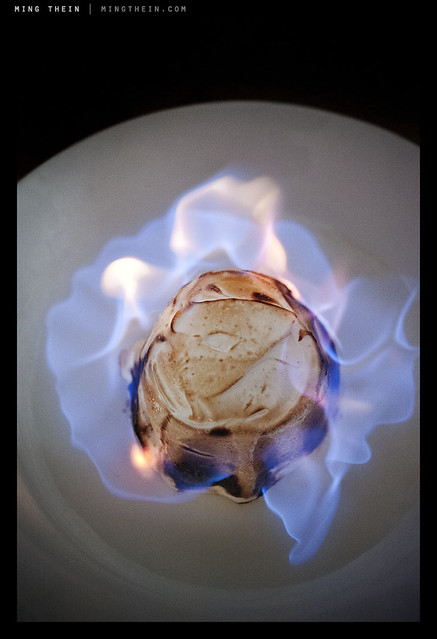
Flambe. Repeatable, but not controllable. You can set up the shot and do it again, but you can’t control what the flames are going to do. And this is the interesting thing that gives a little variation and makes each shot different. Seascapes are another good example. Nikon D700, AFS 60/2.8 G Micro

Personally, I’m going for something in the middle; but before I even get there, I need to shoot more – to have full intuitive control over my camera so that whatever adjustments I make come to me as second nature. And at this point something has to be said about good cameras, bad cameras, and too many cameras; good cameras are intuitive to use and require little training or practice to master. They do what you want them to, nothing more and nothing less. Bad cameras are ones that you never feel fully in control of, no matter how much practice you have. And too many cameras is just that: if you have too many cameras, you’re bound to eventually forget which button does what. And that could cost you at the most critical moment. This is why I’ll continue to use my D700 for reportage assignments until I’m fully comfortable with the D800; I know exactly habit will do under every situation, born of seventy thousand frames of experimentation – not counting the fifty thousand I shot with the D3, which is pretty much the same camera. MT

*Did anybody get the Futurama reference?

_7058402 copy
Would the burger be as appetizing without that juicy pickled onion marmalade peeking out? Probably not. Nikon D700, AFS 60/2.8 G Micro

____________

Visit our Teaching Store to up your photographic game – including Photoshop Workflow DVDs and customized Email School of Photography; or go mobile with the Photography Compendium for iPad. You can also get your gear from B&H and Amazon. Prices are the same as normal, however a small portion of your purchase value is referred back to me. Thanks!

Don’t forget to like us on Facebook and join the reader Flickr group!

appstorebadge

Images and content copyright Ming Thein | mingthein.com 2012 onwards. All rights reserved