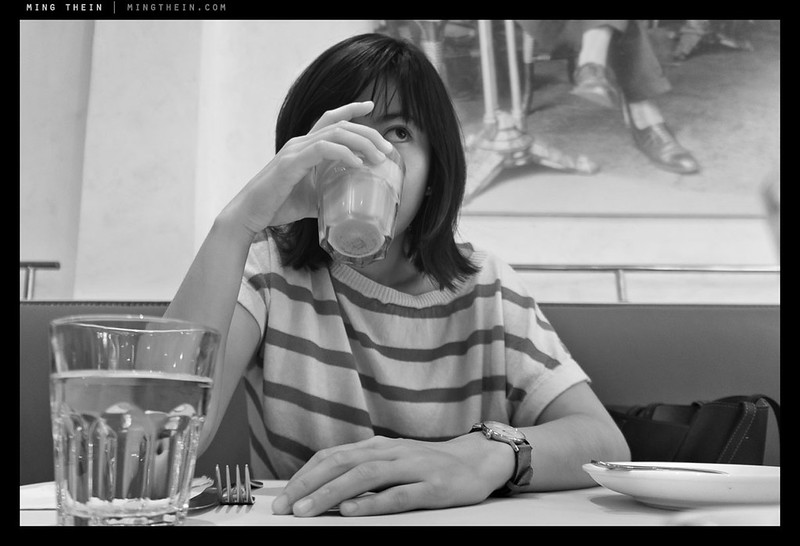
Today’s photoessay continues my exploration of NYC’s streets in black and white. Perhaps I’m being masochist in continuing this series after the dissenting opinions expressed in the comments in Part one (found here) – but once again, photography is subjective interpretation and each observer has their own views and preferences. I happen to like the precision and perfection others call ‘clinical soullessness’ – and I’d argue that the lack of imperfection is a style and skill of its own; consistently being able to find ‘perfect moments’ in a sea of uncontrolled chaos is extremely difficult indeed – which anybody would know if they’ve tried it. Enjoy. MT
Photoessay: Semiclassical NYC street photography, part one
Given how ingrained certain locations are in the popular photographic consciousness due to heavy presentation in a particular style by multiple photographers – Paris and NYC in black and white of course come to mind – I think it’s possible to do one of two things: either avoid that style altogether and try to find your own, or explore a little in the genre and see what falls out. I had a chance to try both the last time I was in New York; to be honest, I found B&W with moderate contrast to suit the timeless feel of the location a bit better – as opposed to expressing the fleetingly temporal nature of life. There’s of course no right or wrong. (My attempt at individual style can be found here, in the NYC cinematics photoessay.)
Photoessay: KLCC abstracts in monochrome

Half of perhaps the most iconic building in Malaysia.
Rather frustratingly, I’d actually typed out a long history about KLCC, but WordPress ate it and it’s nowhere to be found. Here we go again…
The Petronas Twin Towers – 88 stories, and part of the greater KLCC complex (including a park, two hotels, conventionn center, mall, mosque and another two office blocks) – put Malaysia on the map for megaprojects. Opened in 1998, the towers were designed by Cesar Pelli and completed by competing Korean and Japanese firms. It was paid for entirely by petroleum revenues from the eponymous national oil company; during the Asian Financial Crisis, occupancy was low – again with the exception of the name tenant – these days, things are back to normal and space is at a hideous premium, even on an international level. Architecturally, the site is challenging as it’s a former racecourse with very little bedrock and a lot of clay and porous limestone; this is the main reason for putting the taller, heavier structures around the periphery. Even so, extensive piling and foundation works had to be done, and many of the lower basement levels underneath the main towers are filled with concrete to settle the ground and form a floating slab on which some of the other outlying structures sit.
Photoessay: San Francisco monochromes, part two: channeling Winogrand
One of the exercises I did at the last round of US workshops was an exploration into finding style. Naturally, having taken both of the groups in San Francisco to see the Garry Winogrand exhibition that was on at SFMOMA, there was more than a healthy curiosity amongst the groups to attempt to shoot replicate his way of shooting. I of course had to demonstrate. Whilst I don’t particularly care for his off-center/ misaligned/ ‘loose’ framing and various forms of blurring, I do appreciate his sense of timing and getting into the moment and the scene. Plenty of shooting from the hip or with the tilt screen and a wide lens ensued; the OM-D and 12/2 was weapon of choice. Enjoy! MT
Photoessay: San Francisco monochromes, part one
I can’t really say these have a common theme other than reporting on life in the city; however, subjects, light and various urban geometry cooperated at times to make some images I was rather fond of. Enjoy! MT
Photoessay: Fukuoka without people
What is a city without its people? What if a person from several thousand years ago were simply transported into the present day and dropped in any moderately-sized metropolis without any explanation – especially on a Sunday, when only a few brave souls are to be seen wandering the streets, purposefully running the gauntlet or perhaps acting as keepers of the strange world? Nature appears to have taken over in places, though the square rocks remain. Even the animals mostly avoid the place. Strange movable objects line every path. Did something bad happen here? Would they view the cities as strange landscapes? Or recognize them as artificial constructs? Perhaps they would wonder why anybody would leave nature to be all squashed together in square rectangular blocks…or maybe they wouldn’t even view the blocks as fit for human dwelling. To question, to wonder, to dream, to adapt, and go forth out to explore out of curiosity even if it makes us feel a little bit scared. That is what makes us human.
Or, perhaps, I just scared the Fukuokans off with the mighty clap of my Hasselblad mirror 😛 MT
Photoessay: Monochrome vignettes from Shwedagon Pagoda with the Leica M Typ 240
Perhaps the most famous landmark in Burma, Shwedagon Pagoda has been a focal point for life in Yangon for a very long time – it has reputedly existed in some form or other for the last 2,600 years. It reached its current height of approximately 114m in the late 1700s after the most recent rebuilding as a result of multiple earthquakes. It is thought of as the most sacred location for Buddhists in Burma, with the relics of multiple past Buddhas housed within: the staff of Kakusandha, the water filter of Koṇāgamana, a piece of the robe of Kassapa and eight strands of hair from Gautama – the one traditionally thought of as Buddha. An exact replica exists in Naypyidaw (the new capital of Burma).
B&W samples from the Leica M Typ 240
Quite a number of readers have asked about the Leica M Typ 240‘s potential for black and white usage. I think perhaps a more accurate description of the question would be: do the M 240’s files convert well to black and white? And if so, how do they compare to the output of the M Monochrom? I’m going to answer this in the context of raw conversion – there will be some users who only employ out of camera JPEGs, however, like the Monochrom, the M 240 requires processing of a DNG file to get the most out of it. And yes, there is a very significant difference.
Photoessay: The people of Tokyo
Another one of the continuing series from my last Tokyo trip – this time focusing on is inhabitants. Enjoy! MT
This set was shot with an Olympus OM-D and the ZD 45/1.8. As usual, click on any image to go to its Flickr landing page; EXIF data is intact on the right hand side link.

Only in Tokyo would this be considered normal. Shibuya

Untitled. Senso-Ji temple grounds, Asakusa

A considered proposition. Somewhere along the Yamanote line

Reading the fine print, Akihabara

What happens after closing time. Asakusa

Even the chauffeur gets lost sometimes. Ginza
____________
If you enjoyed this post, please consider supporting the site via Paypal ([email protected]); Ming Thein’s Email School of Photography – learn exactly what you want to learn, when you want to learn it or learn how to achieve a similar look with our Photoshop workflow DVDs. You can also get your gear from Amazon.com via this referral link. Prices are the same as normal, however a small portion of your purchase value is referred back to me. Thanks!

Don’t forget to like us on Facebook and join the Flickr group!
Images and content copyright Ming Thein | mingthein.com 2012 onwards. All rights reserved