Photoessay: A few cityscapes

It’s been a while since I’ve posted any pure-photoessays, so I thought I’d rectify that oversight today. This series of images is not so much a photoessay as perhaps a collection of cityscapes: I have to ask myself, does the photograph represent the feeling or emotion I get when I’m in that place, in that city? Some images cover a broader sweep, some are merely vignettes.

Shot over the year or so with a variety of cameras and lenses; EXIF data is intact on flickr if you click through the images and look at the right-hand panel. Enjoy! MT

_6002400 copy
Putrajaya, Malaysia

_6002066 copy
Putrajaya, Malaysia

_6000559b copy
Melaka, Malaysia

_M9P2_L1000409 copy
Hong Kong

_8001979 copy
Kuala Lumpur

_8017760 copy
Kuala Lumpur

_5003471 copy
Le Pont, Switzerland

_RX100_DSC2007b copy
Tokyo

A6557667 copy
Kuala Lumpur

_5000076 copy
Magritte in Kuala Lumpur

_RX100_DSC1836 copy
Kuala Lumpur

_M9P1_L1013156 copy
Bangkok

_VL30_L1000151b copy
Prague

_VL30_L1000228b copy
Prague

____________

Visit our Teaching Store to up your photographic game – including Photoshop Workflow DVDs and customized Email School of Photography; or go mobile with the Photography Compendium for iPad. You can also get your gear from Amazon.comhere. Prices are the same as normal, however a small portion of your purchase value is referred back to me. Thanks!

Don’t forget to like us on Facebook and join the reader Flickr group!

appstorebadge

Images and content copyright Ming Thein | mingthein.com 2012 onwards. All rights reserved

Quick review: CarrySpeed DS-2 sling strap

_5016081 copy

Full disclosure upfront: I was recently sent a couple of interesting camera straps by the folks at CarrySpeed/ Kroxmedia – the DS-2 is of the sling variety and has a fixed portion that goes diagonally around your shoulders as shown in the image above, and a sliding loop that holds your camera and allows it to rest around waist level, or be easily brought up to shooting position. There are quite a lot of similar products, which I’ve not really been too enamoured with for a couple of reasons: firstly, the camera connection point doesn’t have a quick release, which means that if you need to take it off or stow it, it’s not easy to do so; secondly, the hardware just doesn’t inspire confidence.

The DS-2 doesn’t have the second problem. It’s a very well made strap; perhaps over engineered in some ways – I feel there are just too many plastic loops and buckles through the webbing portion – but the thick neoprene padding with non-slip backing is certainly appreciated and spreads out the load nicely. There’s also a quick release buckle to allow you to detach the strap completely, which has a safety interlock to prevent accidental release and expensive crunching noises.

_5016086 copy

The first problem is partially solved on all models through the use of a ball and locking threaded socket connector; the former screws into the tripod socket of your camera, and the latter is fixed to the strap with a metal loop. It’s easy to attach and detach when needed, but not easy to accidentally detach – and the locking screw has to be fully undone before the ball releases, which is a good half a dozen turns. If you’re a tripod user, there’s an optional Arca-compatible quick release plate whose ball swings out of the way when mounting; unfortunately, no joy to those of us who are stuck with the enormous 410PL plates Manfrotto uses on its geared heads.

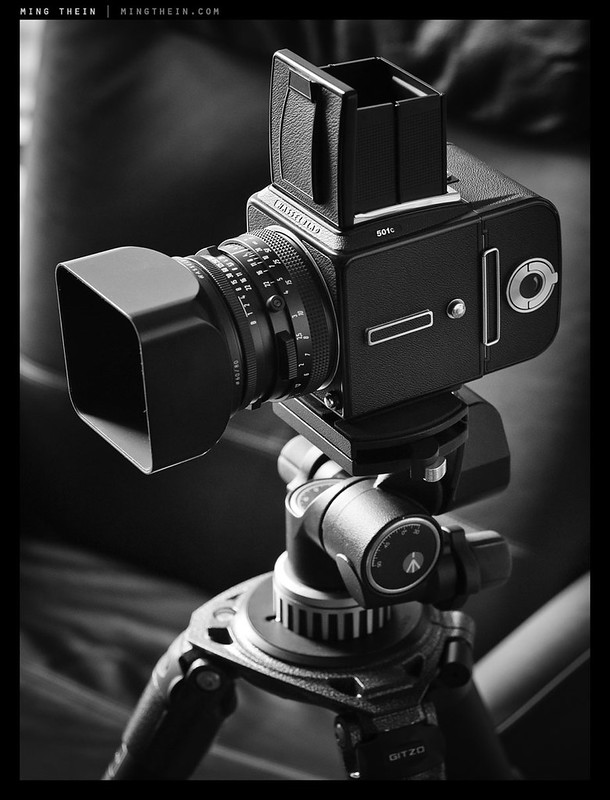
Try as I might, I couldn’t find a way to get comfortable with this strap on my (mostly) tripod-based Nikons; it simply isn’t designed for that. However, I did find that it seemed to work best used on the Hasselblad 501C – where it now lives – because most of the time I shoot this handheld, and it simply isn’t comfortable around the neck or easy to swing into position when worn over one shoulder. The heavier weight of the camera helps to anchor it in place and stop it from moving around too much, too. I admit I was a bit nervous putting this much weight on the connection at first, and held a hand under the camera to cradle it in case it fell; I’ve since become much more comfortable and it now pretty much swings around freely. There’s one other little bonus I’ve discovered: the plain little knob-shaped quick release is useful for two things: firstly, on the Hasselblad, it helps me stabilize the camera because I’ve got somewhere to hook a finger around; secondly, it’s useful as a mini-monopod cum-ballhead when resting the camera on a table – just take it off the strap and use a hand to support it.

There are some cameras I probably wouldn’t use it on though – the smaller mirrorless cameras might swing around a bit because they’re not big enough or have lenses long enough to stay in place against your body; and be a bit careful with the digital Leica Ms, because their baseplates are not known to be the strongest – especially the small metal lip that hooks over the opposite end to the locking nut…

In short: if you’re looking for a sling-type strap, the CarrySpeed DS-2 does the job nicely. It’s a good product for street photographers and people who want to have the option of using both hands but at the same time have a camera in a comfortable quick-draw position. MT

____________

Visit our Teaching Store to up your photographic game – including Photoshop Workflow DVDs and customized Email School of Photography; or go mobile with the Photography Compendium for iPad. You can also get your gear from Amazon.comhere. Prices are the same as normal, however a small portion of your purchase value is referred back to me. Thanks!

Don’t forget to like us on Facebook and join the reader Flickr group!

appstorebadge

Images and content copyright Ming Thein | mingthein.com 2012 onwards. All rights reserved

Maintaining your creative edge

_5013736bw copy

The obvious question would be, why? If you’re already happy shooting in whatever style it is you’re shooting, why bother to push or do something different? Why not just continue to refine within your niche? Actually, the more I think about it, the more I don’t think it’s an obvious or trivial consideration. There is definitely value to be the best in your chosen field at any one particular task or technique; perhaps you specialize palladium contact prints, or gigapixel HDR, or cameraphone photography. After a while of doing this, and only this, you will almost certainly know all there is to know, and keep up with any current developments in the field – assuming you don’t get bored of it after several years.

_VL31_L1010016 copy

For example, I shoot watches – both for personal pleasure, and for a living. I’ve done literally hundreds, if not thousands, of the things – and each watch from multiple angles. Sometimes I’ll do an extended study of one particular piece and land up with hundreds of images. I’ve tried a lot of different formats and techniques, and hell, even put them inside X-ray machines. I suppose you could say I’m a bit of an expert at it. But if I do the same thing again and again, even with slight variations on a theme, my photographs will become formulaic and boring* – regardless of the subject. Clearly, some experimentation and variety is needed – this continual evolution and difference is what I like to think of as the creative edge.

_8025998bw copy

*Ironically, if you’re shooting for a large client that already has a pre-determined corporate style or look, variation is the last thing they generally want. Hence we reach a dilemma: most pros will shoot in a particular style which is either demanded by the client or what they’re known for; as a result, they creatively stagnate, and when the agency suddenly decides that it wants something fresh, the poor incumbent photographer is unable to delivery simply because he or she has been doing the same thing for the last ten years and doesn’t know how to restart that creative machinery anymore. It is therefore very important for pros especially to keep pushing, even if only for their personal work – the ability to access this process of experimentation will almost certainly come in useful in future.

_M8_L1017820 copy

I think we need to decouple creativity from expertise. Expertise is the ability to handle any given situation and execute the desired result; creativity is the process required to conceptualize and visualize that result in the first place. The two are not the same; they can be linked or not. You can have a creative eye but not know how to capture the angle you see, or you can know all there is to know about camera operation, but be unable to see compositions even if they came pre-framed. It is therefore of paramount importance to nurture both.

_M8_L1025469bw copy

So far, my articles on this site have dealt almost exclusively with the technical expertise portion; we did dip occasionally into the hows and whys and philosophies of composition, but these forays still ultimately boil down to trying to shoehorn the process into a set of repeatable, consistent rules. Creativity is far more nebulous than that. It relies on seeing something different in the ordinary, which in turn relies on the observer/ photographer having that different point of view in the first place; this can be physical or interpretative. The former is fairly straightforward – get a ladder, or a wider lens, for example. The latter is far more complex, and a product of one’s personal biases, which are created as a result of one’s life experience and everything else you might have gone through in the course of your life.

_0011006bw copy

There are therefore two obvious ways to push one’s creativity: change your physical perspective, or change your personal biases. The former is easy – go out and shoot with an unfamiliar focal length, or with the camera on a pole, or on the ground, or perhaps a different aspect ratio. It’s one of the reasons why people like new gear so much: it gives you a different perspective, and in turn inspires you to get out and shoot something different. But of course, this wears off after a while, and you go back to being bored or shooting in your usual style. Hopefully though, the burst of inspiration lasts long enough for you to incorporate some of what you tried – and liked – into your instinctive ‘baseline’ style. I admit I do this a lot: half of the gear I buy, I buy because I need its particular function for an assignment; the other half I buy because it looks interesting and makes me want to go out and shoot with it – film falls squarely into this category.

Does it work? For the most part, I’d say yes; sometimes the effects last longer than others, though. Sometimes you’re stymied by lack of new material, which really forces you to either take a long, hard look at the things you’ve perhaps already shot to find a new angle, or just get out of your comfort zone geographically.

_7018771 copy

The second, and much more difficult method of stimulating one’s inspirational juices involves changing your point of view, and altering your biases. The easiest way to do this is look at other people’s images – photographs, after all, are a representation of the way the photographer sees the world; the more different viewpoints you can amass, the more ideas you can get for different perspectives of your own. The internet has made this easy; I’m suggesting looking at serious work on flickr or 1x or whatever your favorite social media site is; avoid Facebook, Instagram and the like because firstly there tends to be a huge amount of thoughtless crap posted, and even if it’s not thoughtless crap, then the presentation method compresses the hell out of the image and generally kills any subtlety deliberately put there by the photographer. The portfolios of other pros are a mixed bag – some are good, some are cliched, some are formulaic. And some are old work – which reminds me, I need to update mine at some point.

_7035186 copy

Books and exhibitions are the other good method – you can see examples of why the greats were great, and take your time to understand and decompose their vision. Exhibitions can be hit and miss. During the Tokyo workshop, I took my students though a couple of shows at the Tokyo Metropolitan Museum of Photography; both to show them what was out there and hopefully stimulate a little creativity, as much as to instil a sense of how to assess an image and figure out what works and what doesn’t. The latter is important: feedback is the only way you’re going to know if your creative experiments are going in the right direction or not.

Since for most of you photography is a hobby rather than a profession, you need to be happy with your own output. Be honest with yourself: do you like the new direction the experiments are taking? Why? Why not? What specifically is different to your old style of shooting, and how can you incorporate these elements into future compositions? Of course, you need some sort of framework to assess relative merit in the first place – I recommend starting with this article on what makes an outstanding image.

_DL5T_L1000636 copy

The second part of feedback is having some sort of peer group – one that’s at a similar level to you skill-wise, and has no hidden agenda or incentive to see your work stagnate – a wedding pro should probably not seek the advice of other wedding pros in his area and price bracket, for instance. Watch for reactions and body language rather than what they’re actually saying: a lot of the time, the English language simply lacks the vocabulary to describe some of what we’re seeing. Body language, on the other hand, is much harder to disguise and conveys quite succinctly whether first impressions are of liking or revulsion.

_8016759 copy

Finally, if you can, seek the opinion of a ‘mentor’ – I use that term loosely because it doesn’t have to be a formal teaching relationship (though if you’re serious about learning, I highly recommend my Email School of Photography) – but it should be somebody who’s both at a higher skill level, and has the ability to communicate in about images in a way that’s both easily understandable, and hopefully gives you some sort of constructive, actionable feedback. Even more ideally, they should shoot similar subjects to you so you can use their work as a point of reference.

_8019332 copy

The higher up the skill chain you go, the higher the expectations: experimentation can be daunting because it may produce some very visible failures. (I admit, this was one of my main initial hangups about revisiting film; simply, what if the images looked like crap and didn’t match the standards I’d already set both here and professionally?) You can either take things in small steps – like say shooting an aperture-priority film M alongside your M9 – or dive in the deep end and make the learning curve as steep as possible (go medium format without a meter and develop your own). The latter may not give you the creative kick you need, the former may put you off because there are simply too many variables to control – I distinctly remember my first experience with a V-series Hasselblad was not a pleasant one; everything simply felt ‘off’.

Bottom line: you have to want to do it. Sometimes overcoming that mental block can be the hardest step of all.

In the course of thinking and researching this article, I spent some time talking to and corresponding with people in other various art disciplines – music, painting, writing – all creatives face similar challenges, I think. As a photographer, my instinctive reaction to the need to find inspiration was to look within my own discipline; for the others, they go outside: the musicians also paint, the painters also write poetry, and the writers are also photographers**. Of course, what they’re doing is merely creating a different point of view – albeit a very different one, which may or may not pay creative dividends later. I suppose the greatest inspirations come from going ever wider outside your field, as the field gets more and more populated.

_5008311 copy

**To some extent, I’ve already done this with painting, but perhaps I haven’t gone far enough. Here I was thinking that shooting architecture and still lifes would help my watch photography – perhaps I should be drawing buildings instead.

I think I’m going to have to explore this concept more. I’ve always had a particularly odd feeling when listening to a song, on my own, which I’d previously listened to a lot in another period of my life; it’s vaguely melancholic and reminiscent, but at the same time, not; there’s this strange temporal disconnect you experience because your surroundings clearly put you in the here and now, yet your mind feels as though it’s elsewhere^. It invariably happens when I’m driving, almost always at night. Now – here’s the inspiration part – what if I could somehow translate that into a photograph? MT

^Discourse on the nonlinearity of time should probably be left for another essay.

Note: the images used to illustrate this essay are representative of various creative ‘breaks’ I’ve had in my photographic career – experimentations with other styles or inspirations that have caused fundamental shifts in the way I see, and the way I shoot.

____________

Visit our Teaching Store to up your photographic game – including Photoshop Workflow DVDs and customized Email School of Photography; or go mobile with the Photography Compendium for iPad. You can also get your gear from Amazon.comhere. Prices are the same as normal, however a small portion of your purchase value is referred back to me. Thanks!

Don’t forget to like us on Facebook and join the reader Flickr group!

appstorebadge

Images and content copyright Ming Thein | mingthein.com 2012 onwards. All rights reserved

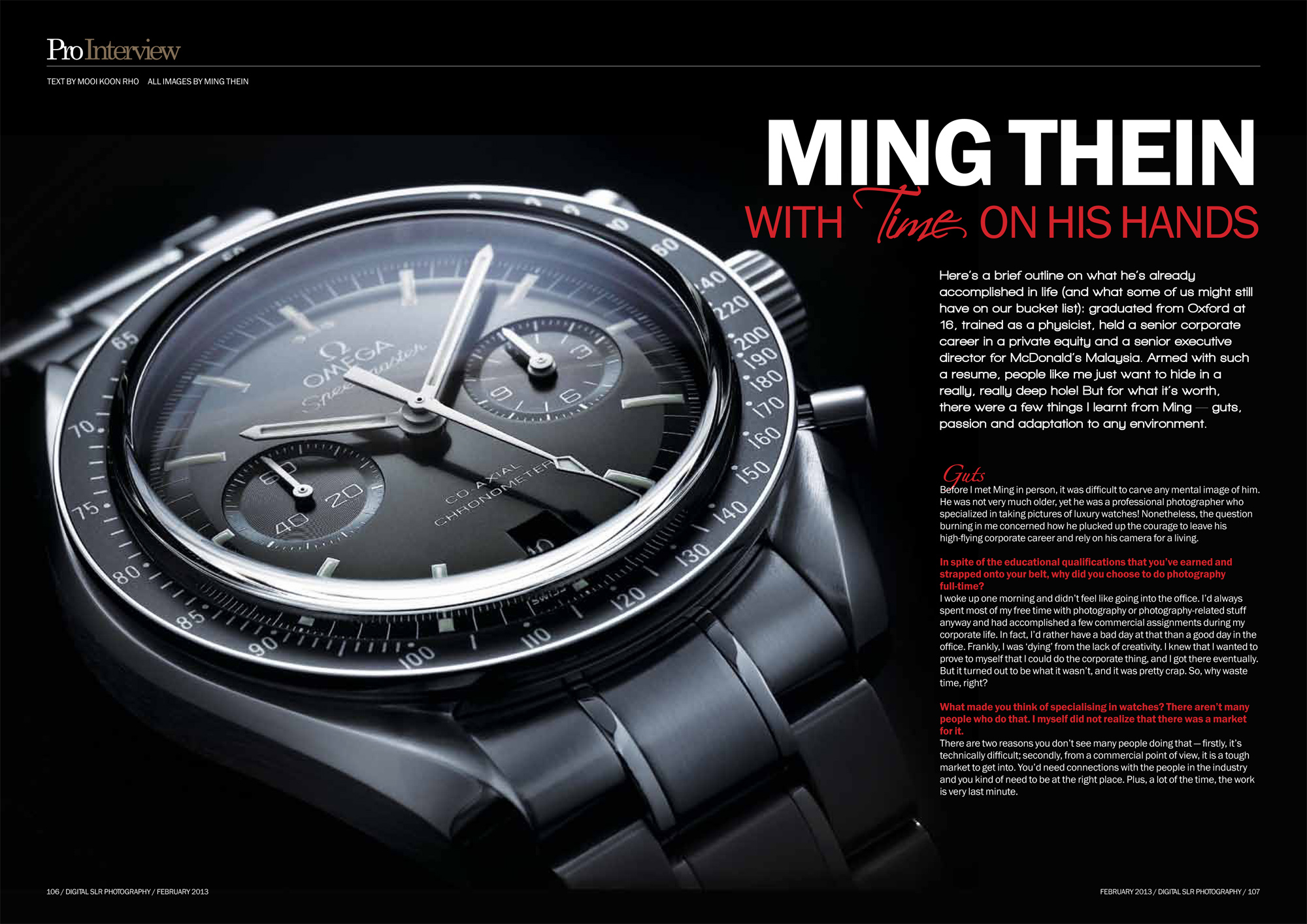
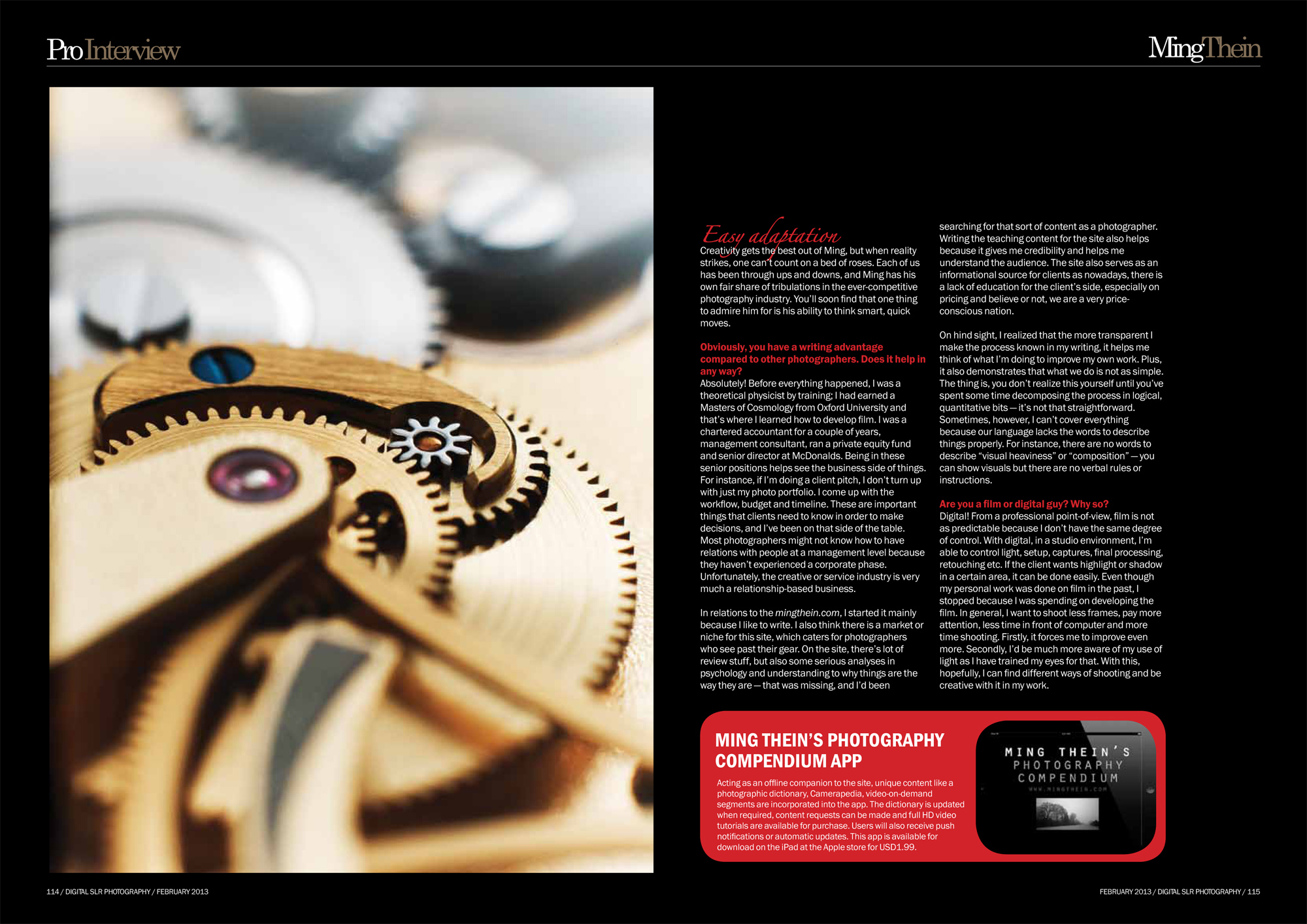
Cover interview: DSLR Magazine, Feb 2013 edition

DSLR-MT-cover

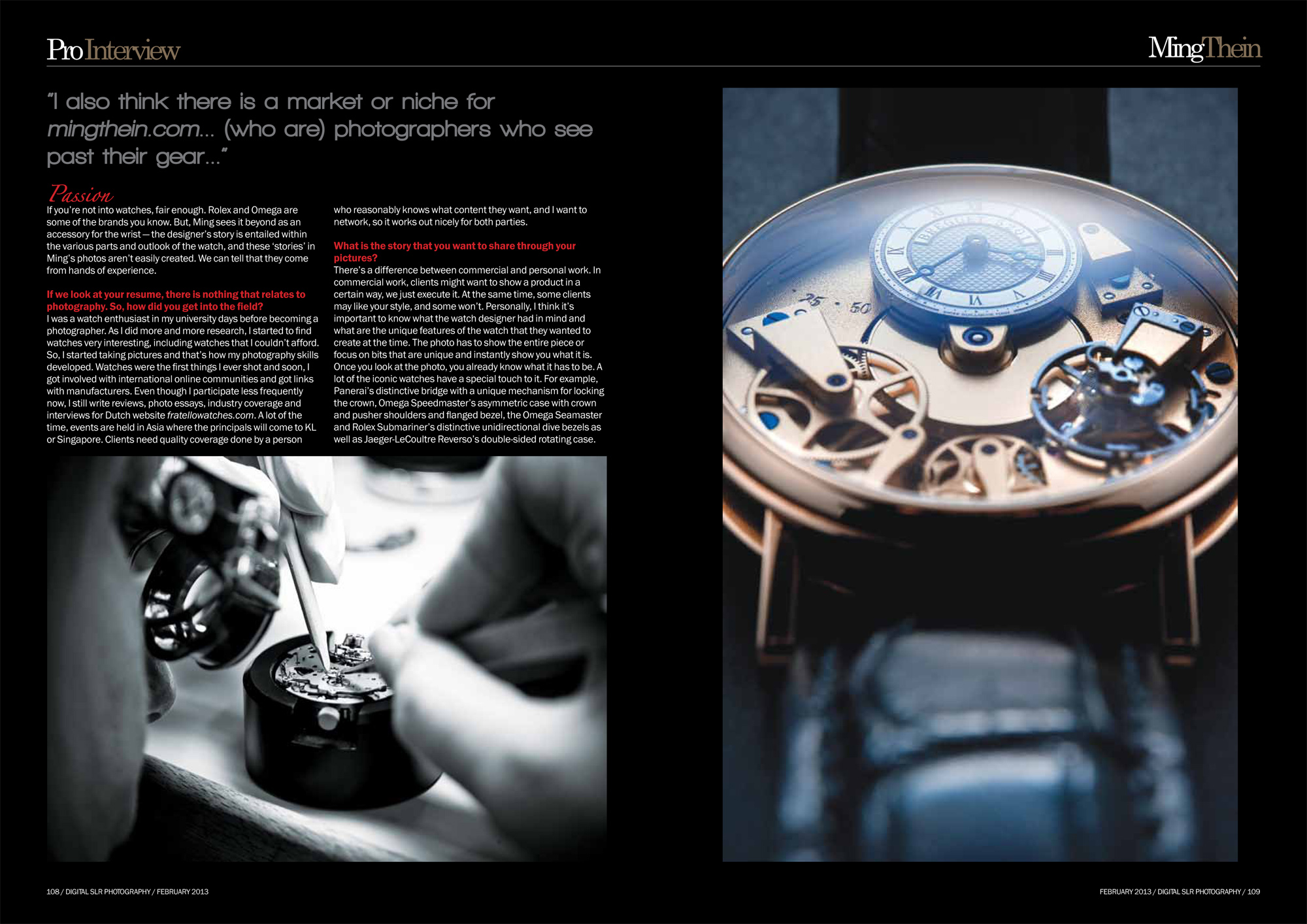
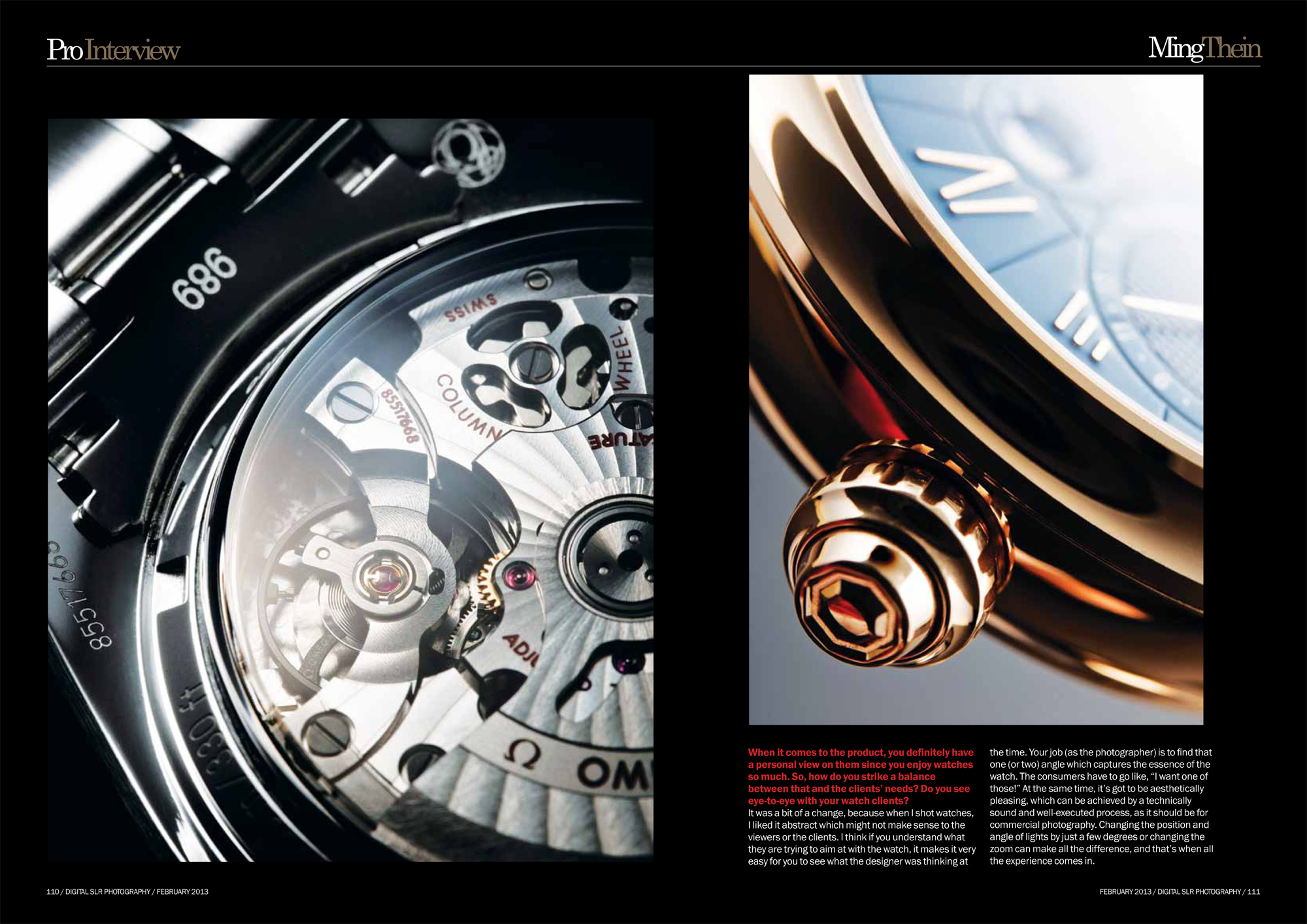
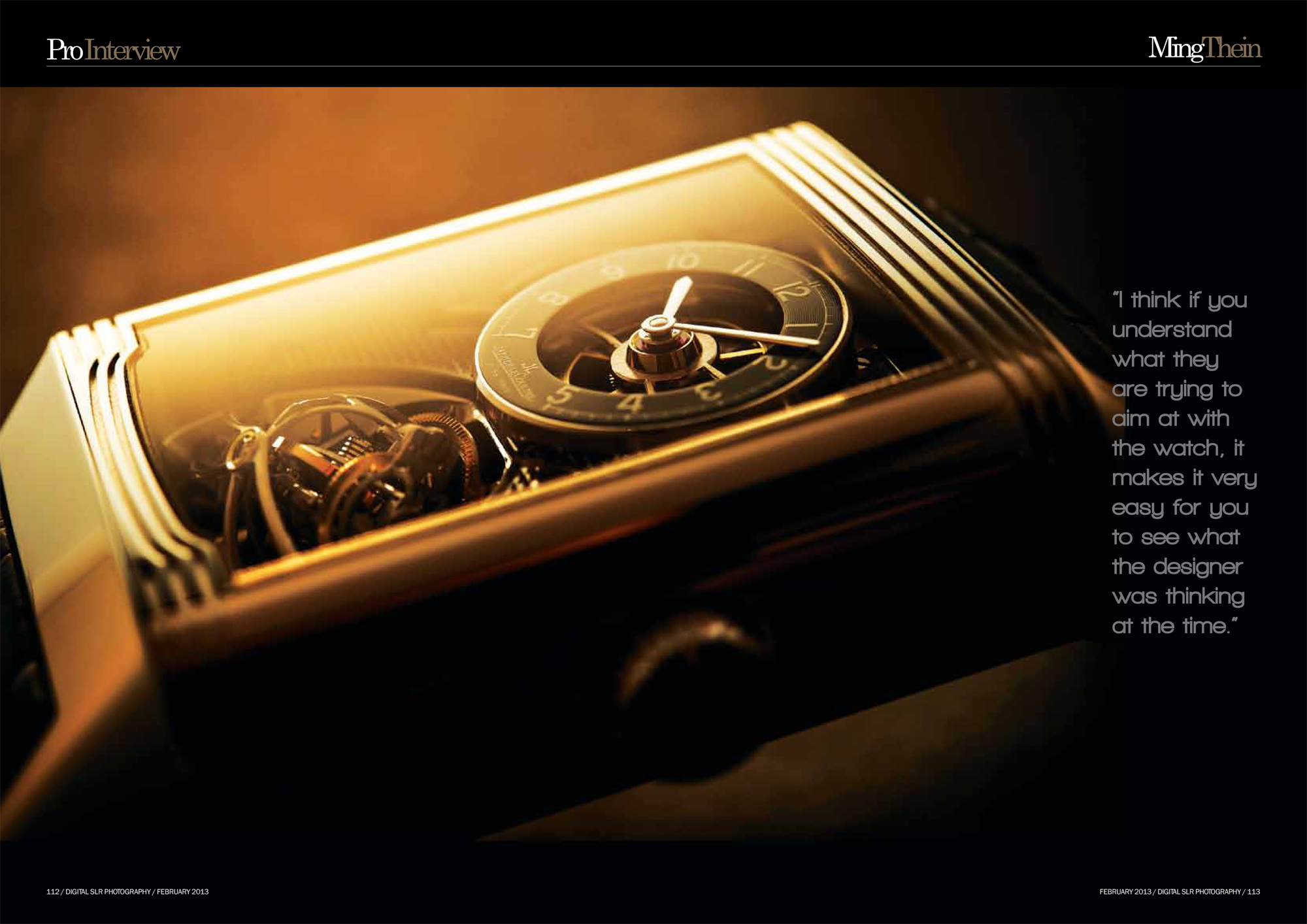
For those of you who live somewhere where this magazine isn’t available, the publishers have been kind enough to provide me with digital copies to share with my international readers. Somehow I landed up with both the cover shot and feature interview in their February 2013 edition 🙂 Click through the images to full size versions on flickr for easy reading. MT

A big thank you to KL Yeam and Rachel at DSLR Magazine!

DSLR-MT-interview-1

DSLR-MT-interview-2

DSLR-MT-interview-3

DSLR-MT-interview-4

DSLR-MT-interview-5

____________

Visit our Teaching Store to up your photographic game – including Photoshop Workflow DVDs and customized Email School of Photography; or go mobile with the Photography Compendium for iPad. You can also get your gear from Amazon.comhere. Prices are the same as normal, however a small portion of your purchase value is referred back to me. Thanks!

Don’t forget to like us on Facebook and join the reader Flickr group!

appstorebadge

Images and content copyright Ming Thein | mingthein.com 2012 onwards. All rights reserved

Lens review: The Nikon AFS 60/2.8 G Micro

_8015826 copy

In what appears to be a hideously enormous oversight on my part, I seem to have neglected to review what is ostensibly my most used lens: the Nikon AFS 60mm f2.8 G Micro-Nikkor. As you might expect, I use this lens for the majority of my commercial watch photography. I prefer it over the 85 PCE for images that require high magnification, as this lens natively reaches 1:1 magnification on its own; thus requiring fewer extension tubes to reach even smaller levels of frame coverage.

_8015235 copy
Nitro Experiment One

Before we start talking about the lens specifically, I would like to debunk some myths about macro vs micro photography: both have to do with the reproduction ratio created by the lens on the imaging medium; it is format independent. Simply, macro refers to 1:1 or greater magnification (i.e. a 20mm wide object in reality would be 20mm or wider when projected on the sensor plane); whereas micro refers to magnification slightly less than this but more than would be encountered during normal photography – ‘close focus’ might perhaps be a more accurate term. Almost nobody seems to get this right online, even the manufacturers; ‘macro’ mode almost never yields 1:1 magnification, and there aren’t that many lenses that achieve this natively. (I suppose Carl Zeiss gets away with it by sounding German and putting a ‘k’ in Makro-Planar – these are 1:2 lenses.)

_3100_DSC0450bw copy
Water on slate

The 60/2.8 G replaces its predecessor, the 60/2.8 D, both of which are 1:1 lenses; unlike its predecessor, it reaches 1:1 through internal focusing alone, and the lens doesn’t extend – the front element on the G is a lot closer to the front of the barrel, and as a result, offers greater working distance at a given magnification than the D (which has a very heavily recessed front element). The lens has been completely redesigned with a new optical formula; it’s a 12/9 design with aspherical and ED elements, as well as Nikon’s Nano Crystal Coating. It also has a silent wave motor, but no focus distance limiter (oddly, the older version did have this). Focusing is fast and silent, but occasionally the lens does get ‘lost’ – if you’re say at the near focus limit and point it a subject at infinity, then sometimes it can hunt and fail to find focus. A quick tweak of the focusing ring solves this. One thing I have noticed with all of the Nikon SWM macro lenses is that they appear to be very ‘nervous’ when focusing at close distances; they’ll chatter and hunt and rack back and forth slightly. This could be because I’ve got the camera in AF-C most of the time, but it doesn’t really make sense given that everything is static – camera on tripod, inanimate subject. Still, I haven’t noticed any focusing errors, even on the D800E; in fact, this lens is the only one I’ve got that doesn’t require AF fine tune correction on any of my cameras.

_7050126 copy
Cigar

I also owned the previous version of this lens, and the difference mechanically is night and day; optically, somewhat less so, but the newer version is clearly better. (I suspect part of the reason why the G appears sharper is simply because it can focus more accurately without any of the backlash inherent to screwdriver-focusing lenses.) The biggest difference in optics between the two version are seen in off-center performance – specifically to do with CA – and bokeh. The new lens has very little lateral chromatic aberration; you have to be shooting something very, very contrasty and bright to excite it. For most subjects and shooting conditions, you probably won’t see any lateral CA at all. Longitudinal CA is a different matter – whilst again better than the old lens (and much better than the 105/2.8 VR), longitudinal chromatic aberration is still visible, as are traces of spherochromatism. It’s not a disaster, but it does mean that some work has to be done in postprocessing to remove traces of this – especially on say, white metal watches. On the bokeh front, the new lens has a 9-bladed, perfectly round aperture diaphragm that makes for very smooth out of focus areas; amongst the best I’ve seen, actually – though at normal distances, a 60/2.8 will not yield a huge amount of separation.

_7047913 copy
Alphabet pasta

It’s worth noting that the lens’ maximum effective aperture at 1:1 is about f4.8; this isn’t because it’s a variable-aperture lens, but rather because additional magnification always results in some light loss. The Nikon lenses and bodies are the only combination that reports this correctly – not that it matters, because the meter takes care of any necessary exposure adjustments anyway. I suppose it might be important if you were to calculate flash exposure with guide numbers, but I can’t think of anybody who still does that.

On the subject of flash, shooting into the light yields no problems at all; the Nano-coated element is clearly doing its job when it comes to suppressing flare. (I use partial backlight quite often to clean out backgrounds or help define the texture in watch dials.) Macro-and micro-contrast are both very good, improving slightly on stopping down. I feel this lens has a bit more microcontrast ‘bite’ than overall global macro-contrast; this isn’t a bad thing at all as it helps to extend dynamic range somewhat.

_7057468 copy
Breguet La Tradition

I actually don’t have much to say about resolution and optics: what do you expect? It’s a macro lens. There’s almost zero distortion or field curvature, and nothing funny going on with the focal plane. Sharpness is already excellent at f2.8, though with the D800E you’ll probably have to go to f4 or f5.6 to hit peak resolving power across the frame. Note that diffraction softening will set in by around f13 or so with the D800E; I try not to go past f16 unless I absolutely have no choice. That said, you can get away with f22 on the 12MP FX cameras if you need to.

Something I’ve been asked in the past is why I don’t use the 105/2.8 VR instead for greater working distance; the answer is that for the kind of work I do, the 60 actually holds several advantages. Firstly, I don’t need as many extension tubes to achieve higher magnifications*; secondly, the lens itself has much lower chromatic aberration than the 105 – lateral is fairly well controlled on both, but longitudinal is ugly on the 105 – and requires a lot of work to fix afterwards. Finally, there’s the issue of depth of field: for any given aperture, you’ll get more with the shorter focal length**. And given that you’re already challenged to find enough as it is, I’ll take any advantage I can get.

_7060545 copy
Who could resist a steak like that?

*The more mounts you put between your optics and your camera, the higher the chance of something going out of plane.

**A longer focal length does not mean that you can stop down more before diffraction sets in; that’s a property of the sensor’s pixel pitch, not the lens.

Of course, for those situations when I really need to manipulate depth of field, there’s the 85/2.8 PCE Micro – note it’s a Micro lens, because it only reaches 1:2 – and its full array of movements. That – and an accompanying piece on the Scheimpflug effect and how to properly use a tilt-shift lens – will be the subject of another article.

_7046476 copy
Girard-Perregaux F1-047

For the work I typically do with macro lenses – watches and food – the pairing of 60/2.8 G and 85/2.8 PCE is usually more than sufficient to deal with any possible scenario. If you shoot bugs, or want the lens to do double-duty for portraits, the 105 is probably a better choice; that’s not to say that the 60 can’t do the job; it just won’t give you the working distance or depth of field control you’d like to have. (The optics remain similarly excellent at longer distances – you could quite happily use this as a long normal lens if you didn’t mind the slowish f2.8 aperture; it out resolves all of the ‘regular’ 50 1.4s and 1.8s I’ve used, especially in the corners.) Perhaps the most telling fact I can leave you with is that of all of the lenses I own, it’s the one that’s been with me the longest. MT

The Nikon AFS 60/2.8 G Micro is available here from B&H and Amazon.

____________

Visit our Teaching Store to up your photographic game – including Photoshop Workflow DVDs and customized Email School of Photography; or go mobile with the Photography Compendium for iPad. You can also get your gear from B&H and Amazon. Prices are the same as normal, however a small portion of your purchase value is referred back to me. Thanks!

Don’t forget to like us on Facebook and join the reader Flickr group!

appstorebadge

Images and content copyright Ming Thein | mingthein.com 2012 onwards. All rights reserved

Last day to enter – win the multispectral Sony NEX-5!

_5015948 copy

Today is the last day to enter the Mingthein.com black and white challenge. The prize is a Multispectral Sony NEX-5 (complete with kit lens and everything else a new one comes with, except the strap which I can’t seem to find) that shoots in UV, IR and Visible light – modified by yours truly. It is an outstanding machine for B&W photography, and has no anti-aliasing filter to boot.

I’ve created a new group on Flickr here: The Mingthein.com B&W Challenge specifically for this purpose.

1. Like the site’s Facebook page – title your submission with your Facebook username so I can check. Entries without Facebook usernames will be disqualified.
2. To submit an image, enter it in The Mingthein.com B&W Challenge Flickr group pool.
3. Your image must be in black and white; toning is NOT allowed.
4. Any subject, medium or cameras is fair game. You can shoot large format sheet film if you are so inclined.
5. Postprocessing is allowed, but anything overly done will almost certainly not win on aesthetic grounds.
6. Judging will be by me and the anonymous donor of the camera; our decision is final. The best image will win. And yes, it’s subjective etc – but this is a photography contest, photography is art, and art is a matter of taste.
7. Images will have a better chance of winning if they meet most or all of the important factors; you can find a lengthy discourse here…
8. You must own the rights to the image you submit.
9. The competition will run until the end of January 2013; closing time is 00:00 1 Feb 2013, GMT+8 (i.e. the end of the 1st of Feb when it hits midnight in Kuala Lumpur; easier to give the people in odd timezones a fair chance)
10. Multiple entries are allowed, but I’m going to restrict the pool to one per person per week: think carefully before you submit. You can remove and replace if you shoot something better.
11. You will need a flickr account to post images to the pool, but it’s free to sign up.
12. By entering, you give me and the mingthein.com site the right to re-post your image as part competition announcements and posts.
13. The winner will be announced in the first couple of weeks of February 2013 – depending on when I can meet up with our donor for the judging. We’ll ship the camera to you by EMS shortly thereafter.

Shoot me an email if there are any questions. I think that’s about it – good shooting, and good luck! MT

Beauty is in the eye of the beholder: the relativity of aesthetics, and a (partial) reconciliation with hipstagram-things

A4517116bw copy
A slight inclination for coffee. This image goes against so many of my personal rules – the horizons are slanted, the main subject is out of focus, and very out of focus, and the light is so-so – but I like it. The important question here is, why?

This is an old carrot: it’s been used to lead the same set of donkeys around the garden path so many times that the donkey himself doesn’t even believe it he’s ever going to get to eat it anymore, at least not deep down in its heart of hearts. But I think it’s still a topic worth discussing because relativity affects people in many more ways than they are conscious of; and being conscious of what works for you and what doesn’t is of course a very, very important part of making strong images, and moreover, ensuring those images are in a style that’s consistent and reflective of the personality of the photographer. (And of course the latter exploration and understanding of one’s personal style is important because following what comes naturally to you makes it much easier to develop and evolve as a photographer.)

Of course, what we’re really talking about here is relativity: everybody has a different point of reference. If you’ve never left Saharan Africa, then the concept of a suit would seem rather foreign to you; but if you came from an upper-class English family, you’ve probably owned one since you could walk. Hence the roots of relativity: an observers’ – let’s leave photography out of this for now, because it introduces some additional complications – personal taste is defined much by the familiar, be that good or bad. For the most part, people are naturally curious to varying degrees. Add that to the mix, and preferences can start to vary wildly: just because it’s not familiar doesn’t mean that it isn’t good or favorable, and just because it is doesn’t mean that it isn’t extremely distasteful – think of teenage rebellion, for instance. (I’m told by a psychologist that a good portion of teenage rebels grow out of that stage fairly quickly and land up turning into their parents in middle age; it’s the silent, too-good types we have to worry about.)

The attractiveness of a piece of art is of course purely a function of personal taste; art is inherently controversial simply because of the sheer number of potential forms it can take. By definition, almost anything can be art – be it completely familiar, or completely not. To a limited extent, the same goes for photography. However, because of the nature of the medium, there are more constrained limits the artist has to operate within – you’re (mostly) stuck in two dimensions, cannot use moving imagery, have finished work that is (today) viewed at many reproduction sizes, and (again, today) is affected by the quality of the viewing device. Making it worse, is the fact that it’s perhaps the medium with the highest diminishing returns; it takes no skill to take a photograph, and not much more to luck out and produce a good one if you take enough of them. Yet to do so consistently and in a way that’s fully controlled is incredibly difficult because of the sheer number of variables that one has to deal with, often in a very short space of time.

Perhaps it’s this medium-induced limitation that has meant photography in the early days took some time to be taken seriously as proper art form in its own right; imitation of reality was always the intention, but until relatively recently, the results were but a poor facsimile. The same of course cannot be said for art, because nobody expects a painting or sculpture to be a copy of the original subject, but an interpretation of the subject as seen and translated by the artist. In reality, what this means is that the photographer’s primary tool of control is subject and composition, and to some extent the reproduction method – this includes format, color and output. The difference between a fairly good photographer and a truly oustanding one can be subtle, and I’m of the opinion you can’t really tell if you only see one image: it’s simply too easy to get lucky. Repeatability and demonstrable control is not to be underestimated.

And here we run into a bit of a dilemma: what if a lack of control is the desired output? What if some degree of uncontrolled randomness is a signature of the artist? (I personally don’t find it appealing, but I suppose this is one of the reasons Lomos and Holgas have become popular in recent times, along with the digital-fake hipstagram-alikes.) This of course is personal taste too: taking off my photographer hat and putting on one belonging to an objective commentator, it’s important to recognize that whilst I might not personally like putting artificial light leaks and scratches onto my cameraphone images to disguise poor composition and hand shake, there are a lot of people who find it appealing – hence the success of such products.

But is there anything inherently wrong with it? A recent – let’s say heated – discussion with my wife over her use of instagram has lead me to seriously consider this question. Whilst deep down it offends my artistic sensibilities greatly to even consider using such things, I admit that I cannot think of a single objective reason against it. But why am I against it? My full (and definitely not-objective) thoughts can be found in this article, but the gist is that basically you’re outsourcing a large chunk of the creative decision making to the preferences of a third party; worse still, all of your images will have the same style and look as everybody else who uses the same program. By nature, it’s designed to make images look like something they’re not. It’s the integrity of the thing – or specifically, the lack of it – that really irks me. The fact that some of those looks were products of a certain workflow or method that was developed, learned over time and refined; earned, if you will. Yet now they’re being adopted and trivialized by a bunch of hipsters who have no clue that Tri-X is a film, or Rodinal comes in bottles.

Let’s back up a minute, and be objective again. The two core points in that argument are really hokum: firstly, that one is in total creative control of the photographic process from end to end; secondly, that one has to earn the right to use a method or technique through understanding and practice. By that flawed logic, I shouldn’t have the right to use a camera unless I grind my own lenses made out of glass I fused myself from sand I collected off a beach somewhere, with optical formulae I derived myself, coupled to a camera I made myself, with either film whose emulsion I concocted out of household chemicals, or a sensor whose chip pattern I photolithographed from a hand-drawn mask and a projector. And I can’t use Photoshop unless I wrote the program myself, either. Clearly, this is utter crap.

I can prefer to take over some elements of the process because they give me more creative control over elements that matter to me; postprocessing or developing, for instance. But whilst I might prefer a Distagon design to a Sonnar, there’s no way I’m going to go out and make myself one. I think the cutoff in this process is generally the point where you can no longer do a better job than the third party – be it in processing, or lens design. But preferences change this: whist we may get better results if we sent our film off to a pro lab, or avoided mucking around with retina-searing HDR and just using our camera’s expanded dynamic range JPEGs, we might prefer to do it for whatever reason – personal accomplishment or satisfaction, learning, or perhaps something else. I suppose it’s just like how most drivers would be faster with a double-clutch gearbox or a modern automatic, but might still prefer a stick for the feel and experience.

This preference – subjectivity – extends of course to equipment, images, compositions and subjects, too. We use certain types of cameras because we prefer to, either because of the way they make us feel, or because somebody we respect says they’re the best, or because we simply want to. Cameras that seem masochistic, ugly and antiquated to some – meterless Hasselblads come to mind – might be really quite enjoyable to others (me, for instance).

It’s of some critical importance to a photographer to understand both what they like, but also why it appeals. This exploration upfront saves a lot of time both in avoiding exploring creative avenues that might later prove to be dead ends, but also helps hone artistic development by focusing on the elements or subjects that feel inherently natural and instinctive to the creator. There’s no point in forcing yourself to try and replicate somebody else’s style if it doesn’t come naturally to you, or shooting with a wideangle lens if you natively see normal or telephoto compositions. It might be worth trying it as an experiment, but why bother if you simply know you don’t like the way the images look? Now, if you knew that it was because you didn’t like the diminished background or lack of depth of field separation or the keystone distortion when you point the camera in any orientation away from the horizon, then you could avoid buying that lens and wasting three months shooting with it in mild dissatisfaction instead of just enjoying that 85/1.4 and making cinematic.

Bottom line: look at lots of images in a wide variety of styles; it’s likely that you’ll find some you like the look of, but it’s also likely that none of them will be a perfect fit for your own personal preferences. You’ll just have to understand which elements about them you do like, as much as which you don’t; the next step is to translate this into a technical how – if it’s not obvious, then find yourself a mentor or friend. (My Email School of Photography is designed precisely to help with this.) This will in turn help focus your own work on honing the skills you need to make the images you want, or if you’ve already got those skills, then on the elements and subjects that you prefer. Quite often, it’s not the how that needs the kick: it’s exposure that’s required – of course, how the balance lies is down to where you stand in the creative stages of evolution as a photographer.. I find it too easy to get shuttered down one’s own creative alley – even if you have a good idea of what works for you – which in turn closes off potential ideas and developments.

Closing with a full circle, I want to talk about why I like the opening image: it’s because from the viewer’s point of view, it throws you a bit off balance, and draws you into the details of the scene to understand and give context to the image as a whole. Did it have a caption originally? No, none of my images ever do, but this one seemed somewhat appropriate. It was made with unfamilar equipment in an unfamiliar location – a mall at night, with a Hasselblad 501C and CFV-39 digital back at high ISO – not exactly my first choice for this kind of work. Yet I’m reasonably pleased with the outcome, despite it disagreeing with most of my cherished tenets. Metaphorically, look around a little: force yourself to see the different, either vicariously or by putting yourself in an unfamiliar situation. It might just yield some unexpected results, but you’ll never know if you don’t stick your neck out in the first place. MT

____________

Enter the January 2012 black and white challenge – win a multispectral Sony NEX-5 B&W machine modified by yours truly!

If you enjoyed this post, please consider supporting me via Paypal ([email protected]). Visit our Teaching Store to up your photographic game – including Photoshop Workflow DVDs and customized Email School of Photography; or go mobile with the Photography Compendium for iPad. You can also get your gear from Amazon.comhere. Prices are the same as normal, however a small portion of your purchase value is referred back to me. Thanks!

Don’t forget to like us on Facebook and join the reader Flickr group!

appstorebadge

Images and content copyright Ming Thein | mingthein.com 2012 onwards. All rights reserved

Rant on: Paypal woes, shy subjects and travel today

_RX100_DSC3701 copy
Royal lake at dawn, Yangon.

As of late last night, I just returned from four days in Yangon, Myanmar. Firstly, I apologize for any and all delays in replying email and messages; the internet was barely usable and it seemed that only iOS devices could access WordPress (but only the comments).

Slow internet I can live with. But what came next surprised and angered me. It seems that Myanmar – along with North Korea and Cuba – is on the list of countries sanctioned by the US Office of Foreign Assets Control and The Bank of England. If you try to access your Paypal account from one of these countries, it will be suspended and you will be forced to go through a lengthy and inconvenient process to reactivate it in order to access the funds in your account. Not only that, if you try to access it again, your account will be permanently closed and the funds seized. There are many, many problems here:

  • My account is with Paypal Malaysia, registered in Singapore. These controls do not apply as funds held here are not subject to either US or UK oversight. I am not a US citizen or green card holder and am not under the ageis of that  government.
  • To reactivate your account, you have to prove your ID (fine) and that “the funds are not being used for the benefit of persons or organizations in Myanmar”. How the hell do you prove that if you’re an ordinary tourist who needs to pay for their hotel via Agoda, or air tickets, or something? I have a reasonably easy to find profile online and – obviously – this site, along with citations elsewhere, and I’m still being required to provide additional proof.
  • Within Paypal, the left and right hands are obviously not talking to each other – I’ve gotten emails from four different departments asking for different documents and informing me that my account will continue to be suspended until I provide said documents – it’s not clear who is handling what, and nobody on the phone can seem to tell me, either.
  • Customer service is a joke – it just doesn’t exist. And I’m supposed to be “a valued business customer” – all I know is that between international client payments, royalties, workshop payments, DVD sales I’ve had at least six figures go through there in the last year – which surely must be above average – and they’re still taking 24-48 hours just to reply to enquiries, let alone reactivate the account. Apparently it’s 48 hours to review documents, 48 hours to reply to you when you want to confirm the type of document they need, and another 48 hours to review again. In the intervening period, they’re happy to hold on to your money, deny you access and collect the interest.
  • It’s month end. I’ve got a number of automated royalty payments incoming which are now lost in the ether; Paypal doesn’t let you accept funds, either. And of course being automated, the remitting agencies won’t try again if the money is rejected; they’ll just keep it.
  • Closing somebody’s account and seizing funds without just cause or jurisdiction is simply illegal and unethical.
  • Of course, none of this would have happened if they’d simply told you what the countries on the banned list were and what the consequences might be before you tried to access your account.

Needless to say, if anybody knows of an easy online alternative to Paypal for accepting and sending money internationally, I’m voting with my wallet and taking my business elsewhere. It’s not the first time, either; if you don’t complain regularly, it seems they take their own sweet time releasing funds to your bank account – up to two weeks in the past – no doubt accumulating healthy overnight interest in the process. The company is a disgrace and operates without care or service for its customers or any ethics whatsoever.

I’m going to stop here and skip over Air Asia – uncleaned airplanes, inedible food, horrible-smelling air in the cabin being pumped in through the ducts, inhumane seat pitches and very little to no discounts over full price carriers once you factor everything else in, but have to use them because there are no seats left elsewhere – before I give myself a headache.

Yangon itself was quite pleasant: non-stop sunshine, warm (30C+) temperatures during the day – but relatively low humidity – cool evenings, and pedestrian-friendly. Lots of dust, though, and little to do after the sun goes down. For the most part, the Burmese seem to absolutely hate having their picture taken. Even with years of practiced stealth, almost never could I get a shot off without them noticing; in most cases, turning away or hiding their faces with something, too. I don’t know if it’s religious/ cultural or a hangover of something more sinister, but it certainly was photographically frustrating.

The city seems to have its fair share of tourist touts, too – from little kids who force things into your pockets then insist you have to pay them because you took their goods, to other little kids who force you to buy their plastic bags to store your shoes before you enter a temple or pagoda at an exorbitant price, to ‘monks’ who follow you around until you donate – that cannot possibly be part of the buddhist way – to the usual gamut of taxi ripoffs and ‘tourist-only’ fees. Hell, it costs US$60 to rent a sim card at the airport – and you have no choice because your mobile won’t roam. There’s no way I look local, so I just had to endure the hassling. It’s a shame, really, because the majority of regular Burmese are actually very warm and friendly people.

I’m off to hassle Paypal again once I’ve caught up with several hundred emails. As for images…when I get around to it…MT

____________

Visit our Teaching Store to up your photographic game – including Photoshop Workflow DVDs and customized Email School of Photography; or go mobile with the Photography Compendium for iPad. You can also get your gear from Amazon.comhere. Prices are the same as normal, however a small portion of your purchase value is referred back to me. Thanks!

Don’t forget to like us on Facebook and join the reader Flickr group!

appstorebadge

Images and content copyright Ming Thein | mingthein.com 2012 onwards. All rights reserved

The pricing game

IMG_0699b copy
Just your regular headache.

Following on from an earlier article on understanding licensing, I thought it’d be instructive to spend some time on the remaining elephant in the room for any photographer – especially newly-minted ones – is the question of how much to charge. Attached to that comes the mechanics of it all: invoicing, accounting, collecting payment, and the big one: licensing. Oddly, I find that this part of the business is something that seasoned pros are the most reticent to discuss; perhaps it’s part self-protectionism, perhaps it’s the cultural omerta towards money (at least in Southeast Asia, everybody seems to judge you by how much you earn, but to ask outright would be a major social faux pas*) or perhaps it’s because some of us are afraid to admit how little we’re actually charging.

*Nobody is likely to tell you the truth anyway; culturally, it’s like asking a lady her age in the West. It’s the age-old dilemma of one’s ego wanting to show their success, but simultaneously being afraid of being a target of jealousy. Whilst boastfulness is never a desirable trait, I think we need to be proud of our work and position as professionals and craftsmen – like every other form of social posturing, others tend to judge your implied relative value on external appearances.

And here’s the dilemma (or is it a trilemma since there are three options?): if they ask, do you tell your competition – remembering that you may well be competing for the same job – what you’re billing, in order to maintain rates across the board? Do you not tell them so you win the job, but potentially at the expense of eroding rates for everybody? Or do you give them wrong information – for any one of a number of possible reasons? Let’s consider the last situation for a moment: perhaps you give a false answer because you simply don’t want anybody else to know. It could be higher or lower than the other guy – in the end it probably averages out to no harm, no foul. You could deliberately give a higher number – all other things being equal, that would win you the job at the expense of long term sustainability. Or you could lowball and hope the other guy just backs off without submitting an even lower quote, in which case you’d lose the job and affect future rates.

The problem with all of these scenarios is that none of them are win-win situations for everybody. The only situation that’s sustainable is complete transparency and meritocracy in selection – and we all know that not only does this not happen, it’s pretty much impossible to be objective when judging the relative artistic merits of photographers. Here, client opinion is law – if they don’t like your work, there’s no point in trying to argue otherwise. (In fact, there are plenty of reasons not to pursue the job – but that is another topic for another day.) As a photographer and industry member – this situation is concerning, to say the least.

Like it or not, the reality is that the professional photographic industry – perhaps to a greater extent in Asia than elsewhere – is a numbers game. Education plays a big part in this: even relatively savvy clients will choose a photographer on price as one of the primary considerations. If the difference in image quality or output is say 10%, but the price is 50%, diminishing returns never wins. This of course means two things: firstly, mediocrity thrives because it’s cheap and easy; secondly, it’s very, very difficult to perpetuate and promote a premium product and service because the incremental cost to do so far outweighs any potential returns. And in the end, if you’ve got to charge the same or close to it to get the job and the client doesn’t really appreciate the difference, then all you’re doing is running at lower operating margins than the competition. This will not be in your favor in the long run. This is also one of the reasons I decided not to switch to medium format even though there was definitely a clear jump in image quality. I’d have to spend north of US$30,000 just for a basic kit, and even then I’d still have to retain the Nikon for some things – it simply didn’t make sense in our economy.

This brings us back to the core question: pricing. You can’t charge more just because you’re using a more expensive camera, or at least it makes no sense that it’s justified; I’ve said it time and again: your equipment is in no way indicative of your skill level. And if anything, if one photographer requires less equipment to achieve the same results as another, then it should be clear that the deficit is being made up through skill. But how does this translate into money? How much better qualitatively is a $100 image vs a $1,000 one?

Ultimately, it’s down to the client, of course. But it’s important to have at least some internal scale of charges you use as a baseline to start from. Although ostensibly getting a rate quote from a photographer should be fairly simple, it’s not. Let me explain why by starting with a list of things we have to consider:

  • Physical shoot time required
  • Retouching
  • Travel costs, if any
  • Complexity of setup
  • Whether we have to bump or reschedule other things – you might do this for a large project, but not for a small one – this of course comes at the expense of other things and potentially written-off revenue
  • Permits and planning
  • Any additional things we might need to hire or buy – props, talent, lights, location, equipment, makeup artists
  • Volume
  • The client – both ability to pay, and how much you want to work with them
  • License model

In practice, the last two items are the ones that invariably provide us with the largest headaches. Let’s look at three examples, and calculate cost on a per-image basis.

  1. Photojournalism/ reportage style assignment for a corporate client, one day of shooting. Let’s say it’s documenting a new production line process or something. Final delivery of 50 images, for internal PR and comms use only.
  2. Commercial shoot for an ad campaign for a large international brand, five images of a couple of watches, some of which involve props. Has to be done on-location at the factory in Switzerland. Images will require heavy retouching and compositing, and be used worldwide for a period of two years across multiple media.
  3. Whilst on job 2, another one of your existing clients calls you up and says they heard you were in Switzerland; would you mind coming over and shooting a couple of watches for them? They don’t know how many images they’ll need, but it’s two watches and you can do your usual thing of shooting first, sending over a contact sheet and they’ll pick what they need from there. You happen to have a spare day, and the necessary equipment.
  4. A new client calls up and says they got your name from a friend, they’re opening a restaurant and need some photos of the food and interior. How much do you charge?
  5. You get an email from a small agency who would like to use one of your images they saw on Flickr for an advertisement in Peru. There is no indication or offer of payment.

Life is suddenly not quite so simple, is it? Day rates go out of the window for #3, 4 and 5. And yes, I’ve had all five situations happen to me. In the same month. For 1., I’d go with a day rate – let’s say 100 units**. That number of images and the scope of what I have to cover sounds like about a day of work; the retouching/ postprocessing should be relatively minor since it’s documentary rather than commercial work – perhaps another day at most. I generally assume a day of shooting translates into a day of processing; this is mostly true except for the most demanding commercial work, where it’s higher. This might seem counterintuitive, but if you’re shooting fewer pictures in the first place, chances are a) you’re getting more of it right in camera, and b) those images are going to need increased amounts of individual attention. So for the most part, it’s accurate. I price retouching in with my day rates – I’ve found it easier than to split the two out; if you do, clients tend to ask ‘would it be cheaper without retouching?’ The answer of course is yes, but there is no way any halfway serious commercial photographer worth their lenscaps would even contemplate releasing unfinished images. As for licensing, in this situation the images probably have zero value to anybody but the original client, so the license model doesn’t affect pricing – I can’t make any more money off them, so whether it’s single use or worldwide unlimited exclusive makes no difference.

**I’m playing coy Asian now. Of course, how you determine what 100 units translates to in real dollar terms depends on several factors in itself: your skill level, your credentials, your client list – clout and experience, if you will – prevailing domestic conditions like cost of living etc – and how much you personally need to survive off. I figure there are two ways to do this: either make it a low number so you’re billable and busy for a relatively high portion of each month – income will be consistent, but you will be tired and not really able to grow – or assume you’re going to shoot only about 1/4 of the time or less, and extrapolate from there. The reality is that I average between four and six shooting days a month. The rest of the time is retouching, planning meetings, client pitches, producing content for the site, teaching etc. This allows for both variety and expansion: if suddenly I’m shooting 10-12 days a month, my income doubles – success means that I spend less time pitching and meeting, and more time planning and shooting because people come to me. 

So, in situation 1., we have a per-image cost of 2. In situation 2, we’ve got travel costs, props, rental of stuff over on location, possibly location rental itself and permits, and in this case, either a day rate or a per shot rate. I’m guessing it’ll take two days to shoot, but given that it’s for a global ad campaign, even a raw per shot cost of 40 is on the low side. Here, I’d probably start with say 100 per shot, add incurred expenses at costs – travel – I dunno, perhaps another 200 – rentals etc – another 100. Now we’re up to 800, for a total of 160 per shot. Would the license model make a difference here? Oddly, again not directly: you can’t use the images for anything else, but what it does give you an idea of is the scope of use, and how much money they’re throwing at the overall campaign – and thus its relative importance, and the relative importance of your images. If your work is helping to sell more expensive product, why shouldn’t you get a larger portion of the proceeds? It seems like a win-win to me.

Scenario 3. is a tough one. You can’t charge travel costs because they  know you’re already there and your costs are being covered by the other client – and it’s important to find out if they mind or not for the longevity of your relationship – and you can’t charge a day rate either, because you know the end images will be used commercially and require similar levels of work to the campaign images. But you’re also going to have to shoot a lot of raw material because the client hasn’t given you a shot list or have a concrete idea of what they need. In this situation, I have an idea of what these kinds of images cost – let’s say 30-50, on a relative scale compared to situation 2. – so what I’d probably do is say it’s 50 per image for x images, then if you pick more, I’ll give you a sliding scale discount down to 30 per image. You’ve already done half the work, so if for not much more incremental work you can increase your revenue, then you might as well do so. At the same time, if you’re the client, you need some incentive to buy more images – especially if they’re ones that that are ‘nice to haves’ rather than critical. I see this situation as an incremental opportunity rather than a new one – so the rates tend to be dictated by  preserving the relationship and long term sustainability.

Scenario 4. happens more often than you might think. If the brief has that little information in it, chances are you’re dealing with a client that has absolutely no concept of IP, licensing or even retouching. They’ll ask you to do things like ‘photoshop in people to make the place look busy’. With jobs like this, I will usually ask for an estimated number of shots and assume unlimited use since they’ll probably be no good to anybody, and explaining any other kind of licensing model is near-impossible; if they can’t even give me that, then it’s a day rate and a guess based on what they need. If the number works, then we go ahead. If not, then I don’t touch it with a barge pole: I’ve been burned in the past. Convincing people isn’t the problem; it’s the disconnect in their expectations and yours. Never underestimate how much of a headache the inability to communicate your artistic requirements can be. Many years ago, I once had a fashion client that insisted he didn’t want the model looking at the camera; I warned him that the images would look distant because of a lack of direct viewer engagement; he insisted; and then complained afterwards when ‘the model isn’t even looking at me!’. Ugh.

The final scenario is also fairly common. I start off by informing them that I’m a commercial photographer and images are available for license; rates depend on the usage. If they come back after that, then usually we’re good to go – name a number and if it’s reasonably in line with prevailing rates, then you’ve just gotten a sale. I guess it’d be around 10-20 or perhaps more, depending on usage. If you get a reply along the lines of ‘but it’s only for xyz and it’ll be great exposure for you’, then thanks, but no thanks. Not only will nobody remember the photographer in some obscure campaign in some obscure location, but chances are your image will probably land up being used somewhere else too because they have no understanding or respect for IP. It’s one of the many reasons why I will never put full size images with any remote sort of commercial value online anywhere^. The basis is this: clearly your work has commercial value because the end user would like to employ it to help sell whatever widget or service it is; but they are not willing to reward that value, so why should I give away something for free – especially when there’s no value that returns to me?

^And given that I refuse to show unfinished work in case it’s attributed to me, this means I’ll just never post full size images period, no matter how many review commenters ask.

In these five fairly common scenarios, we’ve got per-image prices that range anywhere from 2 units to 160 units – a variance of 80x – for the same photographer, and probably the same equipment. Now, see why the question of ‘how much do you charge?’ is about as easy to answer as ‘how long is a piece of string’? Of course, if you only shoot one style – say full blown commercial campaign only, or reportage only – then your prices are likely to be a lot more consistent, but I’m sure you can also understand why there’s no way I can charge 160 units per reportage image, and 2 units per campaign image would be completely unsustainable.

To some degree, this means that rates are self-moderating; I can’t actually think of that many other photographers who both shoot reportage assignments and luxury watch campaigns. And within the categories, there are of course tiers; the more famous you are, the more you can charge. Of course, we all know that fame doesn’t necessarily correlate with ability the domestic wedding photography market is perhaps the best example of this, and also the worst example of a regulated industry. You’ve got famous society ‘pros’ who are little more than button pushers charging five figures per day; at the same time you’ve got some seriously skilled amateurs who do it as a weekend hobby for a few hundred for the entire event. There is simply no consistency here.

The same applies to teaching and workshops: if that’s all you do for a living, then you need to have consistency of income, which is brought on through volume. If you’re a bona fide working commercial photographer, then there’s always a tradeoff: the time you spend teaching is time you can’t bill a client for, and it must be committed to far in advance of the actual workshop – and you have to do it even if you have another better paid job for the same period, and less than half capacity. Here, as a student, you’re paying for the photographer’s opportunity cost and of course their knowledge and experience. Value here is relative; clearly there’s more to be learned from somebody who’s proven their images have commercial value than somebody who just blogs. Yet this doesn’t seem to be the case in the market, most of the time: as usual, the loudest voice wins. Just because he shouts loud doesn’t mean what he has to say is worth listening to. As usual: judge value by output. Be very careful of people whose images are either limited in style/ subject matter – a lack of diversity points to a fundamental lack of skills in some areas – or just downright crap.

In a roundabout way, this brings us back to our starting point. I firmly believe in a couple of things: how much you charge should be proportional to both the work required (obviously) and your level of skill. And your level of skill should be determined by both your clients, and by implication, your peers who also shoot for those clients. There’s a degree of information available that should give you a fair idea of what to quote; if not, be honest and ask what your client’s expectations are. Some will try to lowball or game you; most will be honest. The nice thing about this system is that whilst nobody really knows how much everybody else charges, they all have enough of an idea not to spoil the market. In the long run, whilst charging less will get you the job today, it means that things become tougher in the future: in every other industry, rates up with inflation and experience, not down. At the high end, a lot of this is semi-regulated by the agencies; whilst traditional ad agencies engaging photographers directly almost always take a sizeable cut of the bill presented to the client, they also handle a large number of major commissions; large enough that there’s a general benchmark for prices. Still, in recent times I’ve experienced (and heard) a lot of companies going direct to the photographer in the interest of saving some money; the photographer, not always being aware of the agency markup, will (if they’re smart) quote a lower price than the agency would, but a bit higher than their normal rates; there’s a bit of a positive shift going on at the moment.

Now what we need to do is be consistent to ensure that a) everybody wins and b) rates don’t erode further in the longer term. I don’t think the sharing of actual numbers is a bad thing, but I think we need to be a bit careful who we share with: you want to make sure that a) they’re not direct competition but still in a similar line, or b) you have tacit agreements not to poach each other’s clients unless the client makes the first move. There are a small circle of pros here who believe the same; in the longer term, the plan is to set up some sort of agency or accreditation/ regulatory body with the aim of both taking care of the long term commercial interests of the photographer, as well as educating clients and ensuring quality control. Despite what everybody thinks – it isn’t all doom and gloom in the industry, but it’s going to require a lot more collaboration than we have at present*** to make it stick. MT

Coda: Look out for a future article on understanding licensing: I originally wanted to roll it into this one, but by the time I explained the pricing model, we were already at dissertation-length and probably broaching the limits of most readers’ patience.

***In Malaysia, at least

____________

Enter the January 2012 black and white challenge – win a multispectral Sony NEX-5 B&W machine modified by yours truly!

If you enjoyed this post, please consider supporting me via Paypal ([email protected]). Visit our Teaching Store to up your photographic game – including Photoshop Workflow DVDs and customized Email School of Photography; or go mobile with the Photography Compendium for iPad. You can also get your gear from Amazon.comhere. Prices are the same as normal, however a small portion of your purchase value is referred back to me. Thanks!

Don’t forget to like us on Facebook and join the reader Flickr group!

appstorebadge

Images and content copyright Ming Thein | mingthein.com 2012 onwards. All rights reserved

Film diaries: A quick introduction to Hasselblad V-series cameras

_5015926 copy

Since acquiring and shooting with my 501C, a lot of my readers, students and photography friends have been asking for more information about these beauties. I certainly don’t claim to have the depth of knowledge of some of the longer-lived collectors or photographers, but what follows is a (hopefully) handy collation of what I do know, from the point of view of the practical photographer.

The Hasselblad V series is a system camera: that’s to say that lenses, bodies, finders, backs and other general accessories are interchangeable. The body contains the reflex mirror, film winding mechanism and secondary shutter only, plus a way of triggering and rewinding the leaf shutter in the lens, of course. Lenses of various vintages can be used on all bodies, with varying degrees of functionality. Flash sync terminals – PC sync – are in the lens, since this is triggered mechanically by the leaf shutter. Several types of backs are available, including digital and polaroid (rare) options; the same goes for finders. The ‘classic’ configuration is an 80/2.8 lens, collapsible waist level finder and A12 film back.


Bodies
Generally, for a shooter, you want to look at buy the 500-series (also known as the V series; includes 500, 500C, 500C/M, 501, 501C, 501C/M, 503CW, 503CX etc). The C means that it uses C-mount lenses which have built in leaf shutters (first Synchro-Compur and later Prontor); anything with /M means upgraded/ modified. The bodies contain the mirror, winding mechanism, and a secondary shutter to prevent light leaks. A nice user is better than a safe queen that’s never been exercised, because you must remember the whole thing is mechanical. Later versions have TTL flash metering and electronic coupling. I would go for either a 501CM or 503 of some description; the 500s are older. Mine is a 501C and dates to 1995; I also have a 1999 501CM. The 501CM and 503CW have upgraded mirror geometry that doesn’t black out at the top portion when used with longer lenses or extension tubes. The electronic 553 and 555 bodies have built in motor drives, but are bulky and eat batteries for breakfast. I think fully mechanical is the way to go; partially because of long-term reliability (gears can be fixed; small-volume electronics is often unrepairable without spares). There are also tilt shift bodies (ArcBody and FlexBody), and a super wide viewfinder camera – the 900 series (903 SWC, 905 SWC and earlier SWC and SWC/M), which has a fixed 38/4.5 Biogon but takes standard backs. Finally, we have the 200-series bodies – these have a built in focal plane curtain shutter that requires batteries to run, but permits much higher (1/2000s) shutter speeds and faster (generally by a stop) lenses; they share the same mount as the regular V series, and V series lenses can be used if the shutter speed is locked to the F position, but not the other way around – the V series require a shutter in the lens to operate, which the 200-series lenses lack.

When testing a body, the winding action should have some springy resistance, and the shutter action should be snappy – the mirror should get out of the way fast, and stay there; same goes for the secondary shutter curtains at the rear of the body. Note that the mirror doesn’t come down again until the camera is rewound. You can check mirror alignment by turning the lens all the way to infinity: find a suitably distant subject and check that it is indeed in focus with the magnifier. (The lenses have hard infinity stops.) Needless to say, there should be no loose or rattling parts inside. Check also that the lens drive shaft on the mount turns when you release the shutter and wind the crank, and that the vertical gear on the right also winds with the crank – this advances the film. Finally, the little lever that protrudes from the body on the bottom right where the back mounts should also be sharp and not worn – this advances the film status indicator.

_5015921bw copy

Related bodies
The ArcBody and FlexBody are two V-mount bodies that also take the same A-series backs and accessories (but not finders); these have bellows or bags in the middle that permit some technical camera movements; noticeably shifts and tilts. In some ways, they’re miniature view cameras. The ArcBody is primarily geared towards shifts; it has its own accompanying set of Rodenstock lenses and is ideal for architectural work. The FlexBody is mainly for tilts, and DOF control/ product photography or landscape. Personally, if I do move over to medium format for my work, I’d be looking at one of these – they also accept digital backs. Note that both are relatively uncommon and seriously expensive.

Lenses
The type you want to go with the V series are C T*, CF T*, CFE T* or CFI T* lenses. The earlier C (non T*, i.e. no fancy coating) lenses work too; they’re cheap but low contrast and relatively high flare. The T* lenses denote optics with the Zeiss T* coating – their rendition and performance is much like the modern ZF.2 series. They all also have long back focus distances, so you can mount them on your SLRs too – though the resolving power may not be as high as the latest 35mm optics.

CF lenses are the best bang for the buck. They have coupled aperture/shutter speed rings (with the exception of the 80/2.8 CF T*) and upgraded shutter mechanisms; CFE and CFI lenses are later models with electronic coupling and are several times more expensive than CF, often for no particularly good reason. The bodies almost always come with the standard 80mm – it has a similar diagonal FOV as a 50mm on 35mm, but you have to remember it’s a little bit different because you’re comparing square to 3:2 aspect ratios. The good lenses – all CF or higher – are the 40/4 Distagon FLE, the 50/4 Distagon FLE, the 80/2.8 Planar, 120/4 Makro-Planar, 150/4 Sonnar and 180/4 Sonnar. These are roughly 24, 28, 45-50, 85, 100 and 120 equivalents. The FLE lenses have a separate correction ring for optimising close-range performance.

Note that the tip of one of the shutter blades may appear bent in the lens; this is a design feature to prevent catching at high shutter speeds. The shutter action of a lens should be snappy and crisp; the slower speeds tend to be where there are problems, so it can be beneficial to test the 1/2 and 1 second speeds with a stopwatch to get an idea if they’re roughly within spec. A slightly metallic noise when changing shutter speeds is normal, especially if you are traversing large ranges of shutter speeds – this is just the internal springs changing tension. Be very, very vigilant for broken drive shafts – these cost a fortune to fix!

One final note on lenses: they require bayonet filter adaptors (designated B-something) which allow you to mount standard screw-in filters. I suppose this is for ease of changing in case the threads get munched up, but it can be a pain if you’ve lost the bayonet ring. Fortunately, they take mostly standard sizes – except for the 4/40 Distagon, which requires an enormous 93mm (!!) filter.

_5015930bw copy

Backs
Three main kinds: A12, A16 and A24. There’s also an A70 bulk rolling back – it has a 200-shot capacity. The number denotes # of shots; A12 and A16 work with 120 film, and A24 works with thinner 220 film; it has no paper backing for twice the number of shots. Note however you can’t buy 220 film here anymore (update: I did see fresh Provia 100 in 220 at Yodobashi in Tokyo in November 2013), so it’s kinda useless – don’t buy an A24. You can load 120 film into an A24, but the difference in length means that it won’t wind or count frames properly. Just avoid it. The A12 is the standard back and gives 12 6×6 shots on a 120 roll. The A16 is a 645 back that gives 16 shots per 120 roll, but requires a separate viewfinder mask to show only the 645 film area – this should be included if you plan to buy an A16. Note that it’s not very practical because shooting a waist level finder in portrait orientation is nearly impossible. Backs should come with dark slides – the little piece of metal that goes between body and back – if you don’t have this, you can’t detach the back. It’s to prevent light leaks when interchanging backs – the ability to do this mid-roll is one of the huge strengths of the system. Buy multiple backs to make the most of this. Note: some sellers will note ‘matching numbers’ which means the roller mechanism inside’s serial # matches the housing – it doesn’t make any functional difference, but it does seems to affect prices quite a bit. If you’re going to use it and not collect it, it doesn’t matter.

You might see something called a ‘Lindahl dark slide holder’ mentioned – this is a clip on that goes on the back of the back (really) that holds your dark slide while you’re shooting. It’s functionally useful, but I personally think it looks ugly because it spoils the lines of the camera. A better solution is just to tuck the dark slide into your wallet.

There are also many digital options, both from Hasselblad (the CFV series backs) and other manufacturers. Note that none of them make a true 6×6 back; there’s always some crop factor involved. The earlier CFV and Phase backs did have square sensors, but these were 1.5x crop, 37x37mm affairs that were much like using FX lenses on a DX body. The newer backs – CFV-39 and CFV-50 – use 645 aspect ratio sensors in a 1.1x horizontal crop, and a 1.5x square crop. They are accompanied by viewfinder masks that I personally find very confusing – much like trying to compose with an overlaid tennis court. Note that some backs have sync issues with purely mechanical triggering, especially if your shutter mechanism is a bit worn. The solution is to use the PC sync cable off the lens to synchronise it with the back, but this can result in issues like worn terminals from frequent lens changes, and lack of anywhere to hook up your flash.

_5015925bw copy

Finders
There are two kinds: prism and waist level. Waist level is the collapsible, left-right reversed type with a built in magnifier. It’s the standard finder. Prism finders come in metered (PME-x) flavours and unmetered flavours (PM3, PM5). It’s basically an enormous SLR finder, but in 45 degree and 90 degree (the later PME-90) flavours. They’re all interchangeable, once you take the back off. Note that the prisms are meters only, and do not transfer the settings to the camera – you still have to do that manually.

Metering
Unless you have a metered finder, the cameras are fully manual and unmetered. This means using a trained eyeball, or getting a meter prism; otherwise, the simplest solution is to use a compact camera in aperture priority mode with spot meter set. Match apertures and ISO, then transfer the shutter speed reading to the lens. Important note: if you’re using a compact, I’ve found that the Hasselblad requires half a stop to a stop less shutter speed than the compact for the same exposure (i.e. if the compact reads 1/100s, the ‘blad will use 1/150-1/200s). This is partially due to the tonal response characteristics of film, and partially due to the transmission properties of the lens: T* coated V lenses have a T stop very close to their physical F stop, whereas compacts usually don’t because of inferior coatings or complex designs with large numbers of elements.

Pricing
This is perhaps the most sensitive/ subjective topic here, but to give you an idea – a solid user condition 500CM, waist level finder, 80/2.8 CF T* or C T* and A12 back should run under a US$1,000. Price varies depending on variant and condition, of course. Later models like the 503 series will of course cost more – sometimes considerably so. That said, I still find it pretty amazing that you can buy a camera of this quality at little more than the price of a consumer DSLR kit – and you can be sure that the ‘Blad will outlast you, and probably your children. I don’t know what happened to the millions of 300D Digital Rebels they made, but I suspect that most bit the dust a long time ago.

Important notes:

  • The shutter should be stored in a cocked state, i.e. wind the back after every shot.
  • VERY IMPORTANT: DO NOT MOUNT OR UNMOUNT THE LENS IF THE SHUTTER IS NOT COCKED. The drive shaft for the lens (to cock the leaf shutter in the lens) can break if it is not in the correct orientation.
  • The dark slide needs to be inserted before removing the back
  • The dark slide needs to be removed before shooting (shutter button is blocked)
  • When you shoot, hold down the shutter button – do not release it immediately after pressing. The secondary curtains in the body only stay open as long as the button is held down.
  • Don’t lose or bend your dark slides; you won’t be able to insert them, and without the dark slide in, you can’t remove the back, and there’s nothing to block the shutter from firing accidentally in a bag. Get spares, if you can.
  • Always wind the camera before attaching a back – if not, when you wind it, you’ll lose a frame. The right procedure for assembling a camera is 1. wind body; 2. attach lens (check that the little slot in the lens’ mount lines up with the dot, if it doesn’t, use a coin or screwdriver to turn it in the direction of the arrow – this is to cock the lens shutter); 3. slide in finder of choice; 4. load and attach back – this is a whole separate section on its own.

I’m now wondering how many of you are going to give it a try…MT

The best place to find vintage gear is on the secondary market in Japan – send an email to Bellamy Hunt of Japan Camera Hunter; he can source to spec and budget. I get a good chunk of my stuff from him and can’t recommend him highly enough. Send him an email and tell him Ming sent you!

____________

Enter the January 2012 black and white challenge – win a multispectral Sony NEX-5 B&W machine modified by yours truly!

If you enjoyed this post, please consider supporting me via Paypal ([email protected]). Visit our Teaching Store to up your photographic game – including Photoshop Workflow DVDs and customized Email School of Photography; or go mobile with the Photography Compendium for iPad. You can also get your gear from Amazon.comhere. Prices are the same as normal, however a small portion of your purchase value is referred back to me. Thanks!

Don’t forget to like us on Facebook and join the reader Flickr group!

appstorebadge

Images and content copyright Ming Thein | mingthein.com 2012 onwards. All rights reserved