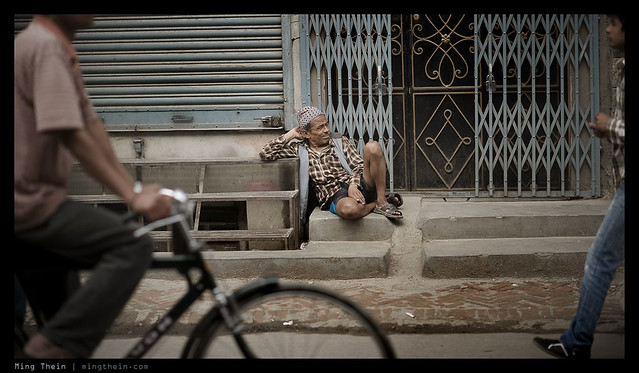
The final part of my ‘life in Kathmandu’ series. Shot in mid-2011 with a Nikon D700, 24/1.4 and 85/1.4 G. I think this set really epitomizes my ‘cinematic’ style of reportage. Enjoy! MT




reframing the world one picture at a time
The final part of my ‘life in Kathmandu’ series. Shot in mid-2011 with a Nikon D700, 24/1.4 and 85/1.4 G. I think this set really epitomizes my ‘cinematic’ style of reportage. Enjoy! MT
Was told by NPS this morning that an internal fix for the D800/ D800E asymmetric focusing issue has been issued. I’ll be sending my cameras in next week after a job; apparently it’s both hardware and software calibration. Fingers crossed…
I was interviewed recently on photography for BFM 89.9 – listen to or download the whole podcast here. Damn it’s weird hearing your own voice recorded. MT

Ion Orchard sunset. Leica S2, 70/2.5 Summarit-S
Here’s an interesting thought: sensor resolution is way past the point of far more than most people need – look at that recent Nokia 808 PureView and it’s 41MP sensor as an example. For most compact camera users, that’s just asking for trouble – file sizes, viewing, shooting technique…the list goes on.
What if we took a say 50MP compact 2/3″ sensor (not unfeasible) and just output no more than 5 MP from the sensor? You can zoom to your heart’s content before capture – either by taking a 1:1 crop or downsizing various portions of the frame; have a low light mode which uses pixel binning to reduce noise and/or improve dynamic range; and finally, make the whole thing speedy and lag-free by using a bright, fixed-focus wide angle lens. Or I suppose if you must have macro modes, make it AF. Finally, add some form of image stabilization to the mix, because that kind of pixel density is going to make most tripods look as though they have palsy. We’ve dropped the size, weight and cost of the zoom assembly; this makes for more compact, robust cameras. It also means that more engineering effort and perhaps even more money (though I wouldn’t put it past consumer electronics companies to want to hang on to every single extra penny and avoid R&D spending where possible) can be put into the lens, which should in theory improve optics.
The results probably wouldn’t be pretty at the pixel level, but the target audience is unlikely to care. And 5 good MP is more than enough for a clean 6×4″, or social media post, or email. Hell, it’d probably be enough for a decent A3 print if you use one of the pixel binning modes in good light. Think of it as digital zoom, but instead of getting degradation off the base pixel-level image quality, you get an improvement as you use more and more pixels.
However, I digress. As interesting as that idea is for the future of compacts – I wasn’t initially intending to suggest a new type of camera. What I wanted to explore are the building blocks of composition. Assuming everything is in focus, a scene – especially one shot from a wide angle perspective – can easily be decomposed into multiple elements, some of which contain the subject, some of which contain context, and some of which may turn context into a subject in its own right. All images are made up of these building blocks, and each can be treated as an image in itself. (Don’t try to compose this way in the real world, or you’re either going to go crazy or turn into a product photographer.) Examples may be – a face, a texture, a landmark.
Sometimes you don’t need more than a couple to create an arresting image – a portrait, for instance – sometimes you need as many as you can get to convey the chaos of the scene (crisis photojournalism comes to mind). What I notice in good photographers’ images is that all critical frames contain the elements required to tell the story, and usually in aesthetically pleasing relative placement, too. This is a learned skill; one can identify the critical elements required to tell a story, and then go out and look for a frame that contains them. I suppose the more control you have over the placement of the individual elements, and the more individual elements you can even identify in the first place, the stronger your image will be. Elements may break down into sub-elements – a wide shot may contain a portrait which can contain a face closeup; all of these things are building blocks.
This brings us full circle to the original starting point – how many images are there in an image? Let’s take the first image as an example:
This decomposes into what I think are five clear elements; the building and its relationship with the organic are the subjects.


What I find interesting is that each of these elements – or crops – could be an image on its own. And you can of course further subdivide these images down into their own building blocks. How many does one need to make up a strong overall image? One? Two? More? It’s hard to say; I think the answer is actually infinite. If you had infinite resolution, you could keep subdividing and cropping infinitely.
I know this is a fairly nebulous post, but stay with me here and you’ll start to see the genesis of an idea.
Let’s do the same, but in reverse. The frame below arguably works on its own as an image:

But then, if we include more context, so does this:

Or this:

And this.

We can keep pulling out…

…until we reach the initial (final?) frame.
 Welding. Nikon D800, AFS 28-300 VR
Each of these compositions on its own would have worked as a frame. Similarly, continuously pulling out adds more and more context, until you pass a threshold beyond which the context dominates the subject. I framed the final shot that way because that was the farthest I thought I could pull out to maximize context, but at the same time isolate the subjects in the frame. Anything more and the subjects would have been too small to identify cleanly. You’ve also got to consider the final viewing size: smaller would mean physically smaller subjects, which would encourage tighter framing. Similarly, images that appear flat and cluttered at smaller sizes frequently work well when enlarged due to the greater amount of detail we can physically appreciate.
I started this article postulating on whether increases in resolution would lead to a new generation of pixel-binning super-sensored compacts; the more I think about it, the more I think it might even apply to photography as a whole. We have long past the point of resolution sufficiency for most purposes; shrinking pixel pitches mean that lens maximum apertures and diffraction-impacted apertures are converging. Eventually you’re going to have to buy excellently designed and well-corrected fast lenses and shoot them wide open to absolutely maximize resolution from the sensor.
Perhaps this will give birth to a new style or form of photography – we capture everything first, and then decide what’s important to the frame afterwards. A little bit like Lytro, but for composition rather than focus. Of course, we can do the same today with the super high resolution DSLRs, but there are limits to how much we can crop, and the lack of suitable lenses to serve as a reproduction optic. Such a camera – let’s call it post-capture framing – would be responsive due to lack of focusing needs; hyper focal would probably suffice; offer decent low light performance due to the large maximum apertures required; and be reasonably compact – rangefinder sized, perhaps – due to an optical system designed and matched to the sensor. It’d probably be closer in proportions to a cube, actually – once the lens is taken into account.
The skill of the photographer at the moment of capture would then be reduced to timing and exposure; the latter would probably be mostly automated, leaving only timing; however, this doesn’t make things any easier. The bulk of the work would now be done in post-processing – not just the digital ‘development’ portion, but also the editing, framing and cropping. I’ve always thought of editing as one of the critical skills for a pro – one’s reputation is based as much on the photos you show against the ones you don’t; being able to see the frame ‘in the wild’ and capture the moment in time is not an easy thing to do. Post-capture framing would give you all the time in the world to do that, which would make things easier somewhat – but also offer more opportunities and flexibility for other compositions.
This would of course raise some interesting IP issues: if another ‘editor’ cropped the original photo to a much smaller, unrecognizable frame, whose photo is it? The person who pressed the button, and just aimed the camera in the right general direction, or the one who actually saw the composition in the master frame?
It’s a brave new world, and an exciting time to be a photographer. Personally, though, I’m one of those very anal people who seeks to maximize all of the image quality they can get out of the camera; which means I don’t crop unless it’s to a non-native aspect ratio. Understanding the use of ‘building blocks’ to create a final composition, plus knowing when you’ve got enough context (or too much context, overpowering the subject) is a very important skill to refine, regardless of the technology involved. MT
____________
Visit our Teaching Store to up your photographic game – including Photoshop Workflow DVDs and customized Email School of Photography; or go mobile with the Photography Compendium for iPad. You can also get your gear from B&H and Amazon. Prices are the same as normal, however a small portion of your purchase value is referred back to me. Thanks!
Don’t forget to like us on Facebook and join the reader Flickr group!

Images and content copyright Ming Thein | mingthein.com 2012 onwards. All rights reserved
High ISO performance and ‘general operation’ are listed as improvements; though I think the X2 is frankly the camera that requires the least firmware improvement in the line…still, it’ll make a good thing even better. MT
A continuation of my Streets of Kathmandu series – this time in color, and shot with a Fuji X100. Sadly, the camera with the firmware at the time was too slow for tracking street work – I resorted to either trap focusing or hyper focal. Superb colors, though. Enjoy! MT


____________
Visit our Teaching Store to up your photographic game – including Photoshop Workflow DVDs and customized Email School of Photography; or go mobile with the Photography Compendium for iPad. You can also get your gear from B&H and Amazon. Prices are the same as normal, however a small portion of your purchase value is referred back to me. Thanks!
Don’t forget to like us on Facebook and join the reader Flickr group!
Images and content copyright Ming Thein | mingthein.com 2012 onwards. All rights reserved
In the internet age, anybody who has an opinion is free to express it. They’re even free to promote it in whatever way they choose, to whoever they choose. And inevitably it’s the loudest people that get heard – though not necessarily are they the ones with the most valid or interesting things to say.
/rant on: Something has been bothering me, for the past few weeks. And I’ve just put my finger on it. Every time I post a camera or lens review, something odd happens. Traffic spikes, but so do the very polarized emails and comments: everything from outright praise that I find undeserved (though extremely flattering) to derision and people attempting to poke holes in every single portion of my methodology or opinions. I want to make several things clear, both for reviews going forwards and retroactively for things I’ve already written:
1. Everything is relative. If you don’t like my images, fine – nobody is forcing you to look at them. Same for my opinions. But one of the great things about the internet is that there’s so much free content out there that you’re at liberty to choose what you see and read. (What you believe is up to you). And even better, is that there’s always an opportunity to learn something because everybody has a different point of view. I strive to approach every comment and question with an open mind, because it’s entirely possible (in fact, likely) that somebody has thought of something I’ve overlooked. But at the same time, questions are fine, but if you’re going to be a critic, then at least have a clear logical support case for your argument.
2. I will never claim that X image is better than Y image on anything but a subjective, personal level. Remember, cinematographers like flare, but still photographers don’t. Same with certain soft lenses. Photography is subjective, and that subjectivity means that nobody is right or wrong for the most part.
3. For the other parts that are quantifiable – noise, resolution, color accuracy (but not ‘pleasingness’) etc – then scientific tests are always the best way to get a relative idea of whether A is better than B. But the observer must always remember that there are a lot of variables involved – some of which cannot be decoupled from the equation (like lens choice) and some of which are also not relevant to the question (lens choice does not affect noise performance!).
4. I run tests and reviews as practical exercises. The reviews and tests I write are basically a documentation of my own evaluation process to determine if a particular camera makes sense for me or not as a tool, and if so, what incremental advantage does it offer over what I’ve already got. It’s possible to always say ‘but you should have use the 50/1.4 Aspherical Super-Nonagon-Reproductar ED instead of the 50/2.8 XYZ Noname’ – yes, but that isn’t a real world choice for me. I don’t think about the equipment I don’t have, because I’m not going to make photos with it. And I’m certainly not going to go out and buy it solely for the sake of a test. It seems a lot of people get hung up over this and fail to realize that a) a huge amount of work is required to document these tests and b) I’m not paid for it. Worse still, it takes away from the time I have available to do work that does pay. If I compare two things it’s because it’s a real world choice I’ll have to face when looking into the equipment cabinet.
5. My conclusions are not drawn solely from the images you see. The images are there as examples and illustrations. There is no validity to base a conclusion off shrunken web-size jpegs that have both been compressed and color-converted down to 8bit SRGB. I don’t share full size raw files because a) they’re proprietary and b) it would be ridiculously impractical due to bandwidth and hosting considerations. I won’t write something unless I’ve seen it enough times to warrant mention – a single odd image could be down to any number of factors, including sample variation. If something however performs consistently better or worse than expected based on other pieces of equipment of similar specifications, then it’s worth noting. And I suspect that’s what makes a lot of people uncomfortable, because they may have put their money in the wrong camp.
6. Equipment is nothing but a tool. If one tool gives you more flexibility or capability than another, then use it; if it doesn’t, don’t. Grow up and stop wasting your time defending your equipment choices online as though they’re religious beliefs or life and death. If you like it, use it. If that makes you produce better images with camera A even though camera B has more resolution, then camera A is better for you. This is why we have literally hundreds of choices on the market – the camera companies are smart enough to realize that, and let the diehard fans fight to the death over it on the internet. Any publicity is good publicity, right? As a photographer, I only care about the usefulness of a tool. I will buy what works and be vocal about what doesn’t, because if we’re not, then nothing will improve or be fixed. Remember: by far the most important ingredient in a successful photograph is the photographer.
7. The litmus test is the image you get out of it. If the viewer spends most of their time looking for noise rather than at the subject, then I’ve failed as a photographer. Delivering a good image – something that pleases myself and my clients – is the end goal, not to produce an incredibly boring photography that’s technically perfect. That is not what I’m hired for.
8. Finally, my site is about photography, not equipment. If you are looking for community validation of your expensive purchases and expect to see results that show the most expensive is always the best by a clear margin, then criticize my testing methodology with no proof or credibility if I find otherwise, please go and find a suitable forum for that – there are plenty of them out there. But if you want to learn about how understanding the various elements of composition will make you a better photographer, or how human psychology influences our perception of color, then keep reading. /rant off. MT
____________
Visit our Teaching Store to up your photographic game – including Photoshop Workflow DVDs and customized Email School of Photography; or go mobile with the Photography Compendium for iPad. You can also get your gear from B&H and Amazon. Prices are the same as normal, however a small portion of your purchase value is referred back to me. Thanks!
Don’t forget to like us on Facebook and join the reader Flickr group!
Images and content copyright Ming Thein | mingthein.com 2012 onwards. All rights reserved

Starburst. Olympus E-PM1 Pen Mini, Panasonic 20/1.7
This has been another one of those tricky articles to write – mainly because a lot of self-reflection went into it, and as we all know, it’s very difficult to do that and remain objective. The essays is illustrated with images that are representative of experiments that worked – things I was inspired to try with various muses, and in turn learned something from.
What is a muse? In its purest form, a muse is perhaps best defined as something that triggers inspiration in an artistic or creative sense. It doesn’t have to be an inanimate object; most artists’ muses tend to be people; in fact, most artists tend to land up romantically involved with their muses. Creativity is impossible to separate from inspiration, and inspiration is a very close bedfellow of attachment – attachment to an idea. (I know this sounds like Inception, but bear with me here.*)
*On an unrelated note, that movie contains one of the most spectacular dining rooms I’ve ever seen – from a design and architectural point of view. And I suspect it would be pretty cool as both a photographic subject and backdrop, too.

Floating head. Olympus E-PM1 Pen Mini, 14-42 kit lens
This attachment can take many forms. From a specifically artistic point of view, the main one is to try and capture the essence of the subject in the artist’s work; in fact, an extremely challenging muse is probably the best thing an artist can have, because no matter how hard they try, they will never feel as though they’ve done the subject justice – and this is what drives the growth of creativity. It’s not so much attachment to the subject per se, as an obsession with the desire to capture the subject in a medium or object other than the subject itself – which is in itself doomed to failure, because the more one understands about a subject, the more one realizes that it’s impossible to reproduce it in another medium – especially if the subject is something live and changing, like a person.

Prague sunset. Leica M9-P, 28/2.8 ASPH
So in effect, muses are necessary stimulants to creativity. There are a few things that make a good muse: complexity and multidimensionality is one; ease of access is another (you never know when an idea might strike, and you just have to try something out); finally, some sort of flux or dynamism is another – which is why most muses tend to be things that offer infinitely variable possibilities – for instance, Ansel Adams and Yosemite – or a person.

Journey ending. Leica M9-P, 28/2.8 ASPH
Having a muse is also an admission of the artist to imperfection – at least in their own minds. If the artist was happy with their work, they’d finish one piece of art – take one photograph – feel like they’ve nailed the shot, and then never look at the subject again. By trying to photograph something repeatedly, it says both that there’s perhaps more to capture than is possible in a single frame, as well as all of the past frames being insufficient or incomplete in some way.

Vienna at Christmas. Leica M9-P, 50/1.4 ASPH
A person may have many muses. You might, for instance, be inspired by a particular place or location; an object, and a person. Most of mine fall into the latter two categories, though the objects tend to be somewhat short-lived. I’ll start with the easy one – objects. I tend to accumulate objects of design. I have a huge weakness for things which have unique (but functional) design elements; things made of unusual or highly tactile materials and textures; and things that just look good. Past random acquisitions include a miniature fountain pen with no clip; a vase with a hole so impractically small that you would be hard pressed to fit even a single flower stem in it, but an incredibly unique texture; and fifteen stuffed polar bears.** And of course there are the watches, too.
**You may have already seen these make cameo appearances in various camera tests. Their white fur is an excellent test subject for highlight tonality, microcontrast, and of course fine detail reproduction.

Bob. Nikon D700, Voigtlander 20/3.5
Most of these objects will be the subjects of several photo sessions, or until I’m happy with at least one or two of the images I’ve captured. After that, they don’t change, so they don’t really serve much of a challenge photographically; however they litter my apartment as monuments to my design curiosity. But by far the biggest guilty pleasure of mine are cameras and lenses; yes, they are technical tools used to capture an image. But different cameras also force you to shoot differently and think about composition in different ways; a great example is a compact, or a monochrome-only camera. The former removes the crutch of bokeh, and forces you to rely on subject differentiation solely via framing and light; the latter forces you to see luminance, texture and shadow, rather than contrasts in color. Both are refreshing, and mastery helps you improve overall as a photographer.

Red vase and erstwhile contents. Nikon D5100, 60/2.8 G Micro
Then there’s the difference between rangefinders and SLRs – viewing and focusing method aside, I find the biggest difference is that a rangefinder forces you to focus more on your subject – you can’t see what’s in focus and what isn’t; you can’t frame precisely. Shot properly, both of those things subconsciously make you concentrate more on ensuring that the subject itself is the most immediately obvious thing in the frame, and the primary composition is so strong that whatever might be in the edges or out of focus areas of the frame become secondary, and do not detract from the subject. A new camera makes you want to go out and shoot with it, too – and that motivation is often enough to make you get images you wouldn’t otherwise have managed if you’d either stayed at home or not bothered to experiment with.

A Parisian cliche. Leica M8, 21/1.4 ASPH. I don’t think I would even have attempted this with a big black DSLR.
Japan is also a source of endless inspiration for me – perhaps because the place is just so different from anywhere else in the world, especially the old world of Europe where I used to live, and the developing world of South-East Asia where I now live. I step off the plane and feel excited – those very differences that pervade every aspect of daily life force you to approach subjects with fresh eyes and curiosity; you take experimental risks and try things you normally wouldn’t at home or on a commercial shoot, where risk might equal loss of a client. I think every photographer needs these creative trips on a semi-regular basis as a way of forcing your eyes not to take things for granted, especially when back home. Seeing something done differently overseas tends to make you wonder what’s normal – it is of course all relative – but perhaps enough for you to find a worthwhile frame in the course of your daily life you might have otherwise ignored.

Waiting for the train, Sapporo. Nikon D700, Zeiss ZF.2 2/100 Makro-Planar
My biggest muse, by far, is my long-suffering wife. She is crash test dummy for new equipment and technique, a partner in crime for experimentation, and a handy anonymous body when an empty scene happens to need one to complete the frame. (She isn’t that patient, though, which also forces me to hone my instinctive composition and technical skills – the less one has to think about something, the faster one works.) And as a person, I find her endlessly fascinating*** – which means that there are always facets of her personality that I’m trying to capture; regardless of whether I do or not, I’ll always feel there’s something left over the next hill – and that motivates me to keep shooting.
***I suppose if this wasn’t the case, then I probably married the wrong person. Perhaps there’s a photographic metaphor in this – maybe in choice of camera or choice of subject – but that remains another topic for another day.

Medusa sleeps. Leica X1
Conversely, there are places I visit frequently with a camera – either as part of testing, or because I always have a camera of some sort on me – I will take some photos, but nothing in the location compels me to return. These I do not consider to be muses because they don’t inspire me; I just happen to be there and see something.

Bukit Bintang reflections. Apple iPhone 4
I highly recommend you find your own muse; it doesn’t have to be a person, or even a fellow photographer (my wife doesn’t really have any interest in taking pictures, and she is almost always surprised by the way the images turn out – despite having participated instrumentally in their creation). Rather, your muse is a reflection of you as a photographer – what is it that fascinates you? What inspires you? What makes you want to create? Finding and understanding that is a hugely important step to unlocking your creativity. MT
This post was brought to you by Ming Thein’s Email School of Photography – learn exactly what you want to learn, when you want to learn it. Muses not included, but I’m always happy to talk psychology to figure out what drives you. Don’t forget to like us on Facebook!

Despite being completely unpronounceable, this watch is just plain outright cool. The brainchild of Max Busser (MB&F) and Felix Baumgartner (URWERK), it is the first watch to use an eccentric planetary transmission system for the timekeeping mechanism – i.e. the same geometry as the Wankel engine. (Curiously, there’s only one ratio of inner to outer satellite that actually permits the three distinct chambers to be formed; any other ratio doesn’t seal at all). The minutes are read off the red tips of the upper ‘rotor’, with the hours on the level below. There is no seconds indication, but there is a power reserve on the back of the watch.
I believe these are the first photos outside the official press release, and I was told that the watch is a working production prototype – which means non-final parts and finishing, and some potential tool marks in places as befits an engineering experiment…
Many thanks to Ian Skellern at C3H5N3O9.
This series shot (hastily) with a Nikon D800E and AFS 60/2.8 G Micro. It wasn’t a commercial shoot, so please excuse me if I missed a spot or two. All images can be clicked on for larger versions.


A slot has opened up for my Tokyo, Japan workshop in October this year. It’ll be two days of shooting covering travel reportage, low light work, street photography, architecture and general Good Photographic Habits®, and a further day of post processing and photoshop around Tokyo, Japan.
More details here. Please send me a message if you’re interested. Thanks! MT
Behind the scenes videos




If you enjoyed the content, please consider  -ing or subscribing - thanks for your support!

