POTD: Hommage a Hiroshi Sugimoto

_PM08047bw copy
Seascape. Part of a full set coming up later. Olympus E-PM1 Pen Mini, 14-42 kit lens.

The sea is one of those odd subjects – like the sky – that’s seemingly full of infinite variation, but at the same time is instantly identifiable for what it is. I could take a thousand images of the sea, and none of them would be the same – but you’d know instantly that it was the sea. Even if the processing was the same, which I’d never do because it’d be boring.

What you don’t immediately notice here is that to achieve this perspective, the shot was taken at 14mm and just inches above the water, about 30m away from the beach and out to sea. (Interestingly, the EXIF data records the subject as being 4.3 billion meters away – I’d say that’s infinity, and in fact, further away than the moon.) Not exactly the least hazardous environment for photographic equipment! I suppose the only reason I even attempted this series was the relatively low cost of the equipment at risk; no way would I do it with an M9, for instance. I didn’t take anything heavier in the way of photographic equipment because it was meant to be a break. But at the same time, I don’t think I’d be able to truly relax unless I knew I had the ability to make the shot if the opportunity arose.

Sometimes we need time in a different physical location to reset our seeing process, if nothing else. MT

POTD: Retail party

_PM03166 copy
Retail party. Olympus E-PM1 Pen Mini, Panasonic 20/1.7

On assignment again this weekend – shooting watches for my upcoming exhibition at Starhill, Kuala Lumpur (from May 2nd, more details to come in a future post) with Jaeger Le-Coultre and Leica. This one’ll be an interesting challenge because the entire set will have to be shot with a Leica M… and I don’t scrimp when it comes to magnification. MT

POTD: Voyeur, reflected

_PM03125bw copy
Voyeur, reflected. Olympus E-PM1 Pen Mini, Panasonic 20/1.7

Sushi, and the philosophy of photography

_PM07501 copy
Seared Wagyu beef with momeji oroshii.

Sushi is a universe in itself – there are so few components that if you get any one of them slightly wrong, the taste will be horrible. But if you get every one of them right, the experience can be magical. Specifically, your fish must be fresh and in season; precisely the right amount of soy sauce should be brushed on to the top, with a little dab of wasabi hiding between the rice and the fish. The fish itself is cut slightly concave so it drapes perfectly over the rice, itself measured to precisely the right quantity to make a mouthful and shaped by hand, not too tightly packed and not too loose, either.

_PM07411 copy
Katsuo (bonito) with ginger.

And then there’s the seasoning that accompanies the rice – a mix of mirin and rice vinegar – which must offer the right degree of tartness and sweetness to provide a counterpoint to the fish and soy sauce, but not so much that it overpowers or tastes sour. And this is before we even talk about more complicated creations that involve multiple types of fish, or searing, or additional condiments and seasoning.

_PM07492 copy
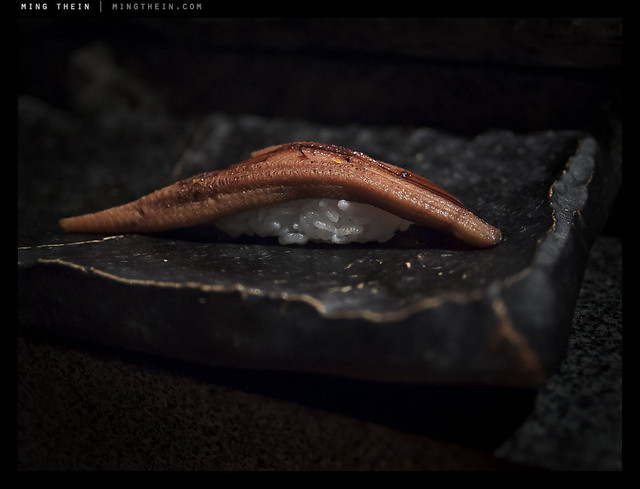
Broiled anago (freshwater conger eel).

There’s a parallel between sushi and photography (and sushi and many other things, actually) – aside from the obvious that it’s art, sushi making requires both technical skill and creativity. There are constraints, but you can work around them. It can be learned, it can be honed by experience, but there’s definitely an element of talent and intuition involved which all great sushi chefs possess. Photographs and sushi both come in small, bite-sized increments – they require little time to create if all the elements come together, and can be enjoyed in moments or contemplated for hours – I’ve eaten sushi dinners with 20+ different varieties served over many hours; I suppose that would be like going through the Magnum annual. Neither photography nor sushi is cheap, either; and mastery can take years.

_PM07485 copy
Torigai clam.

There’s even an anticipative element to it – the feeling of curiosity before you go to eat (wondering what is in season and came from Tsukiji today) is much like the feeling I get before a shoot; you’re all excited and ready to go. It’s also entirely possible that it’s just me.

_PM07471 copy
Seared katsuo

The best sushi I’ve ever eaten – so far – comes from a local chef in Kuala Lumpur at a restaurant called Hanare; Kenny Yew is an absolute genius when it comes to creating new things – for instance, seared wagyu with momeji oroshii chili – as a sushi. I need to go at least once a month or I get withdrawal symptoms and the DTs, because I just can’t eat sushi anywhere else now. The few lucky friends I’ve taken there feel the same way. It really is art – some of the pieces make me tingly and others nearly bring me to tears. I’ve eaten things there I never would have though edible, let alone ordered – and loved them. That’s much like how certain exhibitions, art or equipment inspire me to try photographic experiments that work out a lot better than expected.

_PM07446 copy
Seared hama-tai (sea bream)

And best of all, you can mix the two. The lighting conditions at that restaurant are pretty horrible, but they save me a seat at the counter which happens to have a halogen spot over it; I position my sushi carefully to be well-lit. This set might appear the same, but that’s because I wanted a consistent point of view; (and comparison)
they were also shot during the same meal. I discovered one other thing that night: the best color I’ve yet managed to achieve is delivered by a combination of Zeiss glass and Olympus cameras.

_PM07395 copy
Oo-toro. (Fatty yellowfin tuna belly)

I had the ZF.2 2/28 Distagon on the Pen Mini via an adaptor, and was utterly floored by the color when I opened up the raw files on my computer – the sushi literally looked like it had in real life. Every bit of the color, texture, iridescence and freshness was captured. I’m guessing it’s a combination of the fortuitous lighting, the great color and micro contrast of Zeiss lenses in general, and the pleasing color palette of Olympus cameras. Whatever it is, I think I’ve found my perfect sushi-camera.

_PM07426 copy
Red snapper.

My parting advice is that if you do get a chance to eat sushi made by a master, do as you would do at an exhibition of photographs by a great photographer: put away your preconceptions, go in with an open mind, and enjoy. You’ll probably be surprised. MT

_PM07424 copy
Kamburi (giant yellowtail).

POTD: Weekend worshippers at the temple of retail

_PM01826 copy
Weekend worshippers at the temple of retail.
Olympus E-PM1 Pen Mini, 45/1.8

Who says the economy is bad? Our (already high as a per capita basis) shopping malls are always packed to the gills on weekends, and still they open more. Note red shirted queue at top right – the malls are such crowd-pullers that Canon stages an annual one-day photography competition set solely in the mall itself. There were at least a thousand people running around with probably $1-2k of gear each – says quite a lot about the state of the photography industry, really. Never has it been so consumer-centric – which is a great thing for variety of equipment, but a disaster for working pros unless you’re well entrenched at the highest end of the spectrum. MT

Observing vs. participating: behind the camera

Today’s post is a follow-on spurred by the discussion following yesterday’s article on hiding behind the subject. Apologies to anybody if I lose you in the second paragraph, but I promise it will be worth it.

A camera can be many things.

A tool, to produce an image.

A bridge, to start a conversation.

An observer, to record an event, or bear witness to something.

A shield, to distance and separate the photographer from the scene he or she is attempting to capture.

There’s a big difference between being part of the action, and just being a witness to the action. Which do you think makes for stronger images? Unquestionably, the former. However, it’s not that simple: photojournalism is like quantum mechanics.

Let’s take a little detour. Quantum mechanics 101: under the quantum mechanical realm – i.e. the very small – an observable event has no distinct state, but rather a continuum of probability. This means that there’s the potential for any possible outcome to our observable event; however, until we observe it, we don’t know what the outcome will be. However, the very act of observing the event changes the outcome – because once the outcome has been observed, it can no longer be any of the other possible outcomes. This changes the probability continuum for the event, thus changing the event itself.

The best example of this is Erwin Schrodinger’s (the famous physicist) cat experiment. A box contains a live cat, whose lid triggers a mechanism that <em>might</em> kill the cat. So until you open the lid of the box, you don’t know if the cat is dead or alive; by observing the cat, you interfere with its state of being: namely, you might kill it by checking if it’s really alive or not.

_PM05775 copy
A demonstration of the link between quantum mechanics and photography. Behaviour of the person in the middle didn’t change until he saw me bring the camera up.
New year’s eve 2011-12, Kuala Lumpur. Olympus Pen Mini E-PM1, 12/2

Back to photography. As a photojournalist, if you are an observer, you do not generally interfere with the course of events – other than any secondary impact arising from people viewing your images, and possibly taking action or interfering with the course of history. However, if you are a participant rather than an observer – then by taking photographs, you are directly interfering with the event. From a photographic point of view, it means that the images you get may be more powerful, but not necessarily as genuine because the subjects are aware of the camera and will almost certainly change their behavior accordingly, which again changes the image and changes the course of events because the subjects change the way they act around the camera. As a stealth operative, you will capture the natural reactions of your subjects – but at the expense of involvement for the viewing audience.

_PM04759 copy
Active participation at a family event. Olympus Pen Mini E-PM1, 12/2

They’re very different types of images, and both have their advantages and disadvantages – to say nothing of the ethical dilemmas posed for a photojournalist when covering certain events, for instance wars and natural disasters. I can’t say whether one is better than the other, but I do know that it’s much more difficult to get powerful images if you are not a participant – simply because the focus of the subject is not the camera.

_7048120 copy
Passive observer. Epicure 2011. Nikon D700, 85/1.4G

I’ve always felt the best compromise is to be an observer, but an active one: anticipate and seek out your targets; study behavior and be ready for what comes next, so when that one fleeting moment of critical action – what HC-B memorably termed ‘the decisive moment’ – you are ready, and manage to capture it.

_N8_L1000374bw copy
The kiss, hommage a HC-B. London. Leica M8, Zeiss ZM2.8/21.

Required a lot of anticipation because a) the M8 is manual focus; b) you have to shoot wide open in the low light conditions of the Underground; c) here’s the kicker: they were on an escalator moving in the opposite direction to me, so there was really only one chance to get the shot.

There are times when you should not be a passive observer. In intimate social situations, for example – hiding behind your camera would just come across as awkward, antisocial and downright rude. Portraiture is another example. People naturally connect and express emotion more easily when there’s another human on the receiving end, rather than an enormous and intimidating piece of glass attached to a big black camera.

Perhaps this is why smaller cameras such as the compact system cameras and rangefinders are seeing a modern resurgence (aside from the obvious size and weight benefits) – they remove a layer between you and your subject in a couple of ways. Firstly, if you’re interacting with your subject, they can see your face; body language is the vast majority of communication, and your subject will take visual cues from you. If you’re not interacting with your subject, smaller cameras attract a lot less attention, and let you shoot without the subject being conscious of your presence. I have no problem shooting in very close quarters with a good point and shoot or mirrorless camera – the Ricoh GR-Digital III and Olympus Pen Mini are my favorites because of size and responsiveness – and to a lesser extent, the Leica M9-P. The full-sized Nikons are a no-no (especially anything with a battery grip or large aperture lens) unless you’re in a public situation where the expectation is a lot of people will have cameras and be taking photos.

_M8_L1022749bw copy
Never a problem finding a protest if you’re shooting a Leica. Just look like you’re a world-weary photojournalist and you’d be surprised how many ‘official’ lines you can get past. Leica M8, Voigtlander 50/1.1 Nokton

Speaking of expectations, this should be a good guide to what equipment and technique is best suited to get the best images: if you’re expected to look and play the part of a photographer – a fashion shoot, for instance – using a small camera so the model can see your face probably isn’t going to get you the results you desire. If you’re trying to be stealthy and cover an insurgent protest, then a point and shoot probably is a good idea to help you keep a low profile. Street photography is something else that’s best done with compacts, too. Bottom line: take your cue from your subjects.

One final word: if you are not comfortable, then it will show in your body language. Remember, most communication is nonverbal: this means you’re also going to make your subjects aware of your discomfort (and probably also make them feel uncomfortable with the situation). Most important tip: be confident, regardless of whatever your equipment choice, and however you chose to shoot. Photographers create images: appearing the part is a very important piece of the puzzle. MT

Long term review: The Olympus E-PM1 Pen Mini

(hereafter known as the Pen Mini for simplicity.)

First things first: I don’t do measurement style reviews; there are other sites that do that much better than I can. I write from a shooter’s perspective: is it a good tool? Do I enjoy using it? Are there any critical flaws potential purchasers should know about? If you’re fine with that, read on.

_7048900 copy
Olympus E-PM1 Pen Mini, taped up for stealth and wearing the excellent Zuiko Digital 12/2. I’ve since switched to using a small lanyard strap, because a strap this chunky is overkill for such a small camera – and I wanted to use it on my M9-P.

At the end of 2011, Olympus introduced an interesting trio of cameras. Although they were ostensibly positioned at different market segments, just a couple of hundred dollars covered the spread, and they all shared the same sensor and AF system. Two of them even almost had the same body (the E-PL3 and E-PM1 only differ by a mode dial, flip screen and another button or two). The E-P3 had sightly different firmware, better build, and a greatly increased number of manual controls.

_PM05660 copy
Prague river evenings. Olympus Pen Mini, 45/1.8

Let me be honest upfront: I was not a fan of the original E-P1, nor any of its descendants or sub-lines. They were slow to operate and focus, had frankly quite poor image quality, and were neither small nor light. They were also ergonomically pretty poor.

So what changed? Firstly, the ergonomics. The Pen Mini is tiny. As in compact camera tiny, without a lens attached; and not much larger than a LX5 if you use one of the pancake lenses. The main thing is operation speed. The latest generation are fast. Fast enough that you’re constantly impressed that it’s found focus, and done so accurately. And fast in every other way too – navigating menus, playback, zooming review images, shot-to-shot, etc. Curiously, the small-bodied E-PM1 and E-PM3 are both faster than the flagship E-P3; they’ll shoot at around 5fps with the stabilizer off, but the E-P3 is limited to 3fps. Apparently it’s a limitation of the older shutter or stabilizer design. (But that’s not as fast as it gets; the new E-M5 will do 9fps with AF locked, and focusing is supposed to be even faster – not that you’d really be able to tell the difference.) Bottom line: you’re not waiting for the camera, and it isn’t what’s stopping you from getting the shot. After trying one in a store – a friend bought the E-P3 – I instantly decided it was fast enough; if the image quality was okay, then we’d be in business.

_PM02954 copy
Rush hour storm. Olympus Pen Mini, Panasonic 20/1.7

Autofocus is very fast indeed for static subjects in good light; I can’t tell the difference between the Pen Mini fitted with the right lenses (the new Olympus ones) and my D700. In lower light, there’s a difference; in very low light, sometimes the camera will fail to find focus at all. Forget about moving subjects; although there’s notionally a tracking mode, it’s essentially useless. Fall back to prefocus, timing and the larger DOF afforded by the small sensor in such situations. There is one quirk with the Olympuses (Olympii?) that I haven’t seen with other contrast-detect AF systems: it gets confused by extreme contrast (for example, focusing on the sun or a point light source) and just hunts, or perhaps reports good focus after settling at an intermediate point. That’s odd, because something that high contrast should be a perfect focusing target, right? Maybe it’s the pixel overload – blown channels – that stops it from working properly.

_PM06607 copy
The assembly of modernist cuisine. Olympus Pen Mini, Panasonic 20/1.7

The headline spec isn’t that exciting – just 12MP, and seemingly the same sensor as the previous generation of cameras. What Olympus did was increase the sensor readout speed to 60Hz, which has the effect of doubling autofocus speed (slightly more, actually, when the new focusing algorithm is taken into account) and making the view smoother. A good 12MP is more than enough for almost all but the most demanding uses; I’ve been plenty happy with the output of my D700, and guess what, that has exactly the same resolution.

_PM02054bw copy
Afroman. Olympus Pen Mini, 45/1.8

A D700 it is not, however. The Pen Mini (and by extension, other cameras using the same sensor) produce detailed, sharp images when used with the right lens and within their optimum shooting envelope; in some ways the output reminds me of the Leica M9 at low ISO. The antialiasing filter is very weak, if there is one; single pixel detail is excellent, especially when paired with the right lenses – the Olympus 45/1.8 that accompanied the cameras at launch is a good example of that. I’d say the sensor provides clean output up to ISO 800; it’s useable at 1600, and perhaps 3200 in a pinch. What you see isn’t the increased luminance/ chroma noise (but maintained detail) of the M9; there’s definitely a gentle smeary noise reduction going on even for the RAW files which seems to kick in around ISO 1250. Fine detail structures are the first to go, followed by edge detail. It’s noticeably by ISO 1600, and annoying if you go any higher. More critical is the narrowing dynamic range as the sensitivity increases – by ISO 1600 you’re probably looking at no more than 6 good stops from a RAW file. Note the reduced dynamic range is also noticeable at base ISO – specifically, the highlight recovery slider in Adobe Camera Raw does very little if the image is overexposed, and what little it does is tinged with false color information. The shadow slider still shows that there’s a decent amount of information in the quarter tones, but at the expense of luminance and chroma noise.

_PM04833 copy
Arches, Vienna. ISO 1600 – looks good at this size, right? Visible edge erosion due to non-cancelable noise reduction at 100% though. Olympus Pen Mini, 45/1.8

You’d think this sounds pretty damning – it’s not. The files are punchy, and respond well to tweaking. However, the color palette is pleasing rather than accurate; something you need to take into account of if shooting objects, scenery or architecture. It excels at skin tones, however – in both RAW and JPEG. I’m a stickler for accurate color, especially after curve tweaking; it required quite a number of tries before I could accurately correct for the Olympus color palette (but still leave some residual camera signature in place).

Overall, image quality is right where you’d expect it to be for a sensor of this size: better than the 1/1.3″ compacts, but probably lagging a stop or so behind the best of the current APS-C cameras (Nikon D7000, for instance.)

_PM05594 copy
Cathedral reflections, Prague. Olympus Pen Mini, 45/1.8

Let’s talk about ergonomics. With a body that small, there’s no way you can fit a huge amount of external controls in. And they didn’t even bother trying. In fact, there are so few buttons on the back of the camera that you really HAVE to use the ‘super control panel’ screen to make settings changes – or suffer through the absolutely horrible menu system. I also find the camera quite slippery to hold because it has no thumb grip other than the movie record button and a vestigial rubber protrusion above the D-pad/dial combo; I fitted a spare ThumbsUp and haven’t looked back since. It doesn’t really fit properly, but it does the job well and hugely improves handling. I suspect one of those stick on front grips by Richard Franiec would also make a big difference. There’s only one programmable function button – the record button under your thumb. You’ll have to decide what your most frequently used function is from a rather short list. I’m using it for center AF point during shooting and instant delete during playback; you could also use it for the usual AF/AE functions and a few other things.

_PM00847 copy
Magritte strikes again. The camera really does quite lovely blues, especially sky tones. Olympus Pen Mini, 45/1.8

I have a love-hate affair with the menu. On one hand, the menu button brings up something that’s clearly aimed at a complete novice – you have a choice between scene modes, movies, PSAM, and a deeper-level settings menu. Curiously, the settings menu has two versions: the simple ‘idiot’ version with only basic options such as time, date, format etc – and a super-comprehensive version that makes the camera’s behavior more customizable than my D700. For instance, I can even adjust the LCD’s color temperature (!). The nice thing about this is you can set up the camera once to suit your shooting style, and not really touch it again after that. I shoot RAW, auto-ISO to 1600 with a lower limit of 1/60th (small cameras held at arms’ length mean higher propensity towards camera shake blur) and auto-WB. It’s in continuous high mode, with the stabilizer off, single point AF-C. The JPEG color settings do affect the RAW preview, so as usual I turn the saturation and contrast down, and crank up the sharpening so I can more easily tell whether what I’ve shot is in focus or not.

_PM05796 copy
New year’s eve rebel. Olympus Pen Mini, 12/2

You’re probably wondering why I don’t use the stabilizer: basically, it’s pretty much useless. I have much better results by shooting fast bursts and keeping the middle image. Turning the stabilizer on creates an odd double image effect that I suspect is an artifact of not being fully able to compensate for the shutter recoil. At higher shutter speeds, you shouldn’t be using stabilization at all on any camera, because it won’t react fast enough. And don’t even think about using the stabilizer for movie recording; it’s a digital effect and creates horrible rolling-shutter jello. That said, I tried shooting video once with the camera, and was horrified by the jellocam effect even with stabilizer off; sufficient to say, this isn’t a good choice for movie makers. This is rather odd, since the sensor can read out at at least 60fps; furthermore, the design of the cameras actually seems somewhat video-centric – why else would you fit a 16:9 LCD to a camera whose native aspect ratio is 4:3? That’s actually one of my pet peeves with the Pen Mini: you’ve got a lot of unused LCD space in normal shooting mode, so the 3″ LCD is effectively more like 2.5″. At least there are plenty of pixels, so the image is sharp and fluid.

_PM01718 copy
Architectural trees. This is about as bad as flare gets with the 45/1.8, with the sun in the frame – it’s not technically great, but it is very pleasing in a cinematic sort of way. Which suits my shooting style pretty well. Olympus Pen Mini, 45/1.8

Assuming you can figure out the menu and set up the camera to suit your style, the Pen Mini is actually a joy to shoot. I enjoy using it because it’s so small; it un-encumbers me and allows me to just be there with the option to shoot (without much compromise, if any) rather than consciously be shooting, as I would be if I was carrying a larger, bulkier camera. On a recent trip to Europe, I carried a Pen Mini and three lenses as my secondary/ backup system – all in the spare pockets of my jacket! I didn’t notice it was there until I needed a 90/1.8 equivalent, and out it came.

_PM06727 copy
Sushi. Seared isaki with momeji oroshii chili. Olympus Pen Mini and Panasonic 20/1.7

Ultimately, the make or break for any camera system is the available lenses; it’s why the NEX and Nikon 1 haven’t quite taken off with anything other than then beginner/ upgraded market, and it’s unlikely the Ricoh and Pentax systems will appeal to anything other than a very niche audience. Argueably, Micro Four Thirds is the most complete compact system; it certainly has the most lens options other than Leica M (and there are plenty of adaptors that allow you to use those lenses, too). I could find fast primes in the focal lengths I’d want to use, which is more than I can say of any of the other systems; better yet, I had a few choices. Fast and wide? No problem – there’s the excellent Olympus 12/2, or the compact Panasonic 14/2.5. And then there are a few zooms, too. I went with the 12/2, smitten by its clutched focusing ring (but finding later that it lacked sufficient resolution to be truly useful for zone focus, and wishing I’d bought the much smaller Panasonic instead). Midrange? Olympus 17/2.8 pancake, Panasonic 20/1.7, Panasonic-Leica 25/1.4, or the insane Voigtlander 25/0.95. All are good except for the 17, which is an utter dog. I went with the 20 for the size; it’s a fantastic and very versatile lens, except being an older model, focusing isn’t as fast as the newer lenses. The Voigtlander looks insanely cool and offers very close minimum focus, but is hugely impractical (magnified live view focus at arms’ length, anybody?) and expensive. The Leica is a nice option, but too bulky for my liking. I shoot usually 24/28 and a short tele pair; on the D700 for instance it’s the 24/1.4 or Zeiss 2/28 Distagon plus the Nikon 85/1.4 G. Olympus released a new 45/1.8 together with the trio of cameras; it’s probably the standout lens in their range. It’s light, cheap, fast to focus, has great bokeh, biting sharpness and a very pleasing overall rendition – what more can you ask for? Sure, metal build would be nice, but I’m happy saving that for the new 75/1.8 (150mm equivalent) exotic. I was considering a macro solution, but I have the D700 for that – and don’t think that will be changing anytime soon.

_PM02509 copy
Edible foam. Olympus Pen Mini, 14-42/3.5-5.6 IIR kit lens

I know in my mirrorless tips article I recommended using an external finder/ EVF for stability; I don’t with the Pen Mini for one simple reason: the stability I gain from bracing my face against the finder is negatively offset by the loss of stability caused by removing the ThumbsUp. Plus it makes the camera rather bulky, not pocketable, and fragile-feeling – I’d be constantly worried about snapping the finder off because it pivots through 90deg for waist level shooting, and doesn’t really lock in place all that securely.

_PM02066 copy
Graffiti. Olympus Pen Mini, 45/1.8

With all cameras, the ultimate litmus test for me is how much I use it: the cameras I like more tend to be workhorses or go-to cameras, either because I enjoy using them or they’re the best tool for the job. Anything that stays around for longer than around 2-3,000 exposures is a keeper for me; none of the other mirrorless systems I tried (NEX-5, X100, X1) lasted that long. The Olympus is rolling over 7,000 and going strong – which is nearly as much as I shot with the M9-P during the same period (since November last year). My D700 has seen just a couple of thousand frames, which is unusual.

_PM05602 copy
The embarrassment of having a pigeon crapping on your head. Olympus Pen Mini, 45/1.8

In conclusion, it’s a competent, fun camera. And at the current price of around $499 (I’ve seen it as low as $399 after rebates) in the US, it’s a no brainer. In fact, I’m thinking of picking up another one in electric pink to use as a spare or street photography camera; nobody is going to see me as a concern or take me seriously with one of those, which should make for some very interesting images. Micro Four Thirds has finally made good on its promise of smaller, just as good with this camera – its cheapest entry level option – not the flagship. I just hope the current corporate farce doesn’t kill the company, now that they’ve finally figured out how to produce a great product. MT

_PM04858 copy
Haunted house. Olympus Pen Mini, Panasonic 20/1.7

The never-ending quest for more magnification

The arrival of some new adaptors gave me an idea. Just how much further could I push the limits of macrophotography before I need to buy a microscope?

Quite far, it seems.

_M9P1_L1012055 copy

What you’re looking at in the image above is a mishmash of gear which could mostly be replaced by a single long tube with a mount at either end. From right to left: Zeiss ZM 2/50 Planar (I tried the Leica 35 FLE, but there wasn’t enough working distance) mounted on Leica Bellows II, mounted on Visoflex III, mounted on Leica M to Nikon F adaptor, mounted on 72mm of Nikon-fit extension tubes, mounted on Nikon F to M4/3 adaptor, with an Olympus Pen Mini hanging off the end.

The results? See for yourself below. The full frame is slightly less than 2x3mm in most of the photos with the 50mm, and 1.5x2mm with the 35mm. That’s 6:1 or 9:1 on Micro Four Thirds, but more like 12:1 or 18:1 equivalent on FX. I’ve marked on a larger photo of the watch exactly what you’re looking at, for readers intimately familiar with horological architecture. Note that the angle is slightly different in some of the images.

_7057451b copy

Does it make sense? No, because we’re clearly a) hitting diffraction limits; b) seeing resolution limits on the lenses used; c) seeing CA, distortions and other artifacts introduced by the sapphire crystal we have to shoot through on the watch and d) very low contrast. And for most watches, there won’t be this level of detail to capture in the first place. Curiously, lighting is actually pretty easy with the 50mm because it has a decent amount of working distance. For all practical purposes, I think 5:1 is pretty much the limit for watch photography. MT

_PM07810 copy

Balance rim rate/ inertia adjustment screw

_PM07830 copy

Escape wheel and bearing

_PM07852 copy

Barrel bearing

_PM07839 copy

Hairspring and carrier

_PM07827 copy

Third wheel jewel bearing and bridge end

_PM07814 copy

Balance stud attachment screw

_PM07807 copy

Barrel pivot and jewel bearing

_PM07806 copy

Minute hand tip