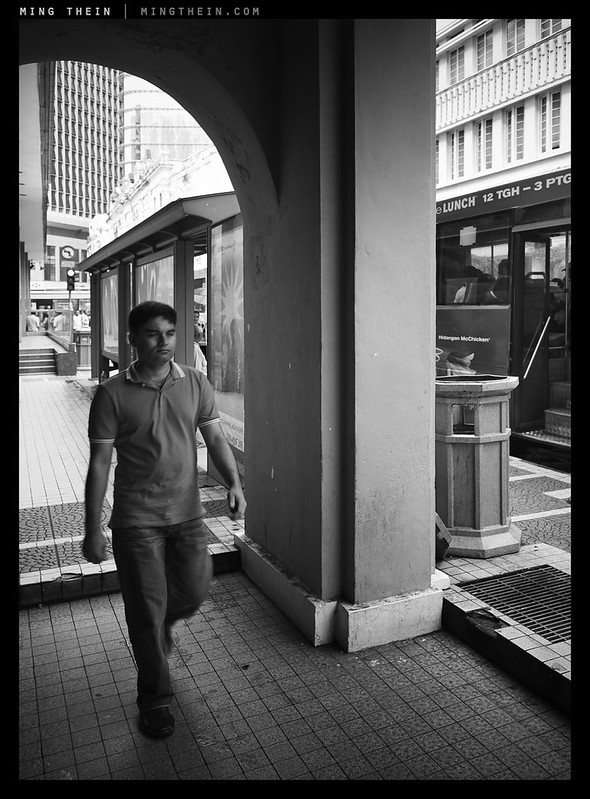
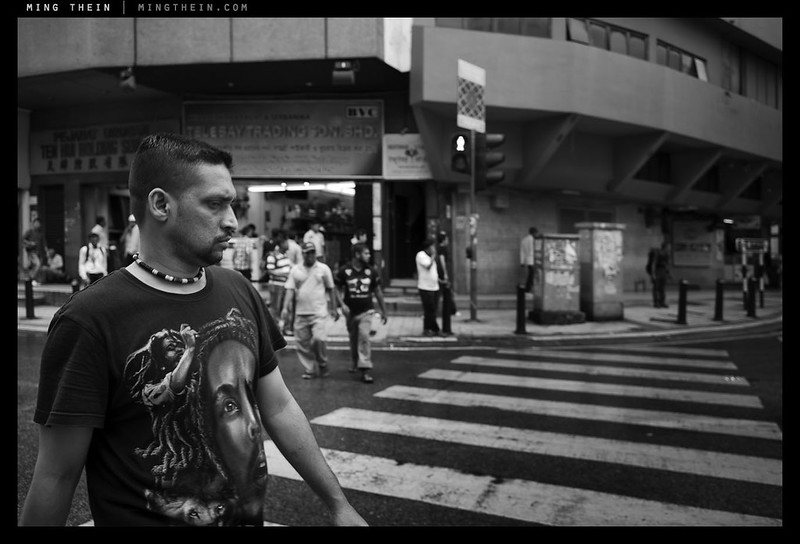
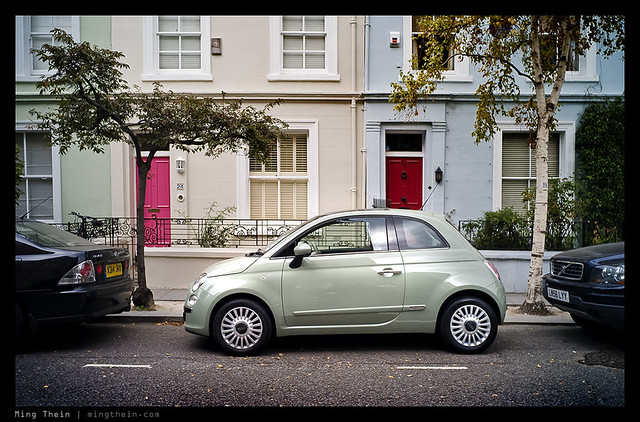
The 2013 Leica M Typ 240

_8027510 copy

Previously in October 2012, I had a chance to handle the M Typ 240 (I’m going to call it the M 240 from hereon in) back at the Kuala Lumpur launch event, and produce a quick preview (that can be found here). At that point, the camera was a very early functioning prototype – yet the improvement over the M9 was clear. There was of course no way to get images onto a PC for review; the SD card was glued in and the grip had no USB ports. Frustratingly, things appeared pretty good on the new (and larger) rear LCD. But we all know that such small and limited-gamut monitors are not a good way to determine image quality at all; I was thus itching to get my hands on a camera, or at very least, some good files to play around with. I’m not really a fan of long waits to availability – whilst it’s nice to know what’s in the works, I’d rather not have to wait six or more months before I can actually buy one. By then, the world might just have moved on.

[Read more…]

Quick shots from my ‘Diametric Opposites: East and West’ exhibition

MT-exhibition-leica-starhill-jan2013-020

For those who can’t make it to my exhibition for geographic or logistical reasons but would like to have a look anyway, I went back after the opening party (covered well by fellow Malaysian photographer Robin Wong here) to get a few images of the exhibition. There are a few thrown in from the evening, though I admit I was too busy talking to people to do much documenting. I have to say a huge thank you to Leica – especially George Wong and Johann Effendy for organizing things – and of course our host, the owner of the Leica Starhill store – Raymond from Keat Camera. I’m also touched by the support of everybody who turned up for the party – I think over 80 in the end, we were expecting 20-30…hope you all had a great evening, I know I certainly did – enjoy! MT

Coda: The images were shot over several years with a mix of M8/ M9-P, NOT the new M as the internet seems to be speculating. That would be impossible, seeing as Thaipusam 2013 hasn’t happened yet, and there was no new M in February 2012 when the most recent images were shot.

[Read more…]

Diametric opposites: my upcoming exhibition

Leica Starhill exhibition poster v1 jan13

I’m happy to present my upcoming exhibition sponsored by Leica and Keat Camera at their Starhill Gallery store in Kuala Lumpur – starting from this Friday 18th of January, and running for a month til 18 Feb. If you’re in town, you’re welcome to join the opening reception on Friday 18th at 7.30pm; I’ll be there giving personal tours. Thanks! MT

New: Photoshop Workflow DVD for the Leica M Monochrom!

m-monochrom photoshop opening

As the first batch of Leica M Monochroms begin to be delivered to their owners, I’ve received a surprisingly large number of questions and requests for info or  a DVD on how to handle the Monochrom files. More than enough to justify producing one. The DVD is in a similar format to the previous general Photoshop Workflow for Photographers but with 15 specific examples that consist of M-Monochrom files shot under various conditions, of various subjects.

The video takes you through my modified B&W workflow specifically for the Leica M-Monochrom, and is designed to be a useful starting place for photographers wanting to get that ‘pop’ out of their files. It’s 2h10min long, in low-compression Quicktime format at the native 1440x900px resolution of my screen to capture all of the subtle nuances. Building on feedback from the previous DVD, I’ve now got a before and after preview of the files processed as examples below, as well as further improved audio quality. I also address superscaling/ upsizing for making very large prints.

Feb 2013 Update: The Photoshop Workflow Video for the Leica M Monochrom is US$65 via paypal and digital delivery – please include the product you’re ordering and the email address you’d like the download link delivered to.

Checkout now via PayPal

Thank you again in advance for your support! MT

MM workflow examples 1

MM workflow examples 2

MM workflow examples 3

MM workflow examples 4

____________

Visit our Teaching Store to up your photographic game – including Photoshop Workflow DVDs and customized Email School of Photography; or go mobile with the Photography Compendium for iPad. You can also get your gear from B&H and Amazon. Prices are the same as normal, however a small portion of your purchase value is referred back to me. Thanks!

Don’t forget to like us on Facebook and join the reader Flickr group!

appstorebadge

Images and content copyright Ming Thein | mingthein.com 2012 onwards. All rights reserved

Review: The Panasonic Leica 45/2.8 Macro-Elmarit for Micro Four Thirds

_8015681 copy

One of the earliest lenses for the Micro Four Thirds system, the Panasonic Leica 45/2.8 Macro-Elmarit (hereafter known as just the 45 for the rest of the article) is also perhaps one of the most underrated. It acquired a reputation of being a slow focuser; that might have been as much due to the bodies available at the time as the lens mechanics. (The lens actually has a range limiter switch).

_8015687 copy
Square hoods are a very typically Leica thing – just look at the S lenses. Oddly, the hood for the 25/1.4 is much deeper than this one.

Something I’ve always wondered was whether this was a Panasonic design, a Leica design, or a mix of both. Turns out that the answer is that the optics are designed by Leica in Germany; they’re assembled at Panasonic’s factories in Japan, and QC’d by a Leica rep who’s based there. Regardless, the optics are pretty darn superb. The lens is very useable even wide open at f2.8; unsurprisingly, for a macro lens, every focus distance is sharp. Performance is slightly worse in the corners than the center, but even this slight degree of blurring is removed by stopping down to f4 or smaller.

_8015675 copy
The midsize lens balances well on the Olympus OM-D.

Don’t go any smaller than f11 though, because after this point there is clear diffraction softening visible on the OM-D’s sensor; fortunately due to the short real focal length, you’re unlikely to need to do so even if you require extended depth of field. f2.8-f8 is a good practical working range.

I’m pleased to report that the lens is also very low in chromatic aberrations of any kind; lateral CA is almost completely absent, and longitudinal CA (spherochromatism or ‘bokeh fringing’) is mild, and completely gone by f5.6. This suggests that the lens’ design is almost entirely tele centric, and definitely optimized for the M4/3 mount as we don’t see any evidence of purple fringing.

_5001658 copy
Study of a pepper, 1. OM-D and 45/2.8 Macro

Bokeh is a slightly different story. Whilst bokeh is superbly smooth and uniform with no ghosting or double images if you have enough distance between subject and out of focus area, there is a very odd transition zone immediately on either side of the focal plane that is both slightly nervous and displays bright edges on highlights. It’s worse at larger apertures and complex/ busy subjects. If you stop down to f5.6 or so, this property goes away.

_5004410 copy
Hublot Big Bang Ferrari Chronograph Magic Gold. OM-D and 45/2.8 Macro

Outside of macro work, in truth, a 45/2.8 as a multipurpose lens just isn’t that exciting because it’s a bit in no mans’ land. You have the equivalent FOV of 90mm, but none of the bokeh separation; it isn’t a sufficiently compressed perspective to be exciting or let you do something compositionally different with all-in-focus telephoto shots. In fact, it feels more like shooting with a 60-75mm lens in that regard. Yet you can’t be lazy with your shooting discipline, because it really needs about 1/100s for a consistently sharp image – providing you’ve got either one of the stabilizers off.

_5001346 copy
Maitres du Temps Chapter Two Tonneau. OM-D and 45/2.8 Macro

As with all of the Panasonic lenses on Olympus bodies, you have a choice of which stabilization system to use – either the moving-lens based system, controlled by a switch on the side of the lens, or the sensor-shift type built into the body. I did quite a lot of testing comparing the two systems – unfortunately there’s no real quantifiable way of doing this – and didn’t see any significant benefit of one over the other. As with all IS systems, you need to turn it off if the shutter speed is high enough otherwise you will actually land up with double images. The threshold is probably around 1/500s. I think this is because it can’t react fast enough to the high-frequency vibration caused by the shutter, but I’m sure there are others far more knowledgeable on this subject.

_5001978 copy
Doctor Zoidberg. OM-D and 45/2.8 Macro

There’s a second switch on the side of the barrel, and that’s to control the focus limiter. Like all M 4/3 lenses, manual focus is entirely fly-by-wire; I personally don’t like these systems because they don’t give you enough tactile feedback and lack hard infinity or near limit stops. Although I prefer to use manual focus when shooting close focus so I can set my magnification before focusing, this is one of the few lenses where I have no choice but to rely on autofocus.

_5004225bw copy
Street scene in Geneva. OM-D and 45/2.8 Macro

It will hunt a bit if you have the lens set to full range and aren’t focusing on a close subject; but for the most part, focusing is actually pretty swift if only small changes in focus distance are required. Switching on the limiter – near focus of 45cm – makes things much faster. (The full limit is 25cm, which gives 1:1 magnification and about 10cm or so of working distance from the front of the lens). I haven’t actually tried it on the E-PM1, but I don’t expect focusing performance to be much worse.

_5004606 copy
Hublot Ultra Thin. OM-D and 45/2.8 Macro, ambient light on location.

The 45 works much better as a dedicated macro lens, and will serve handily as a portrait lens in a pinch; however, my general purpose pick would be the Olympus 45/1.8. Image quality is superb; there’s a biting sharpness and fine microcontrast structure you’d expect from a lens with this price tag and implied heritage. It definitely renders in a very different way to the Olympus 45/1.8; I suppose the best way to describe it would be tight and controlled.

_5004169 copy
Geometry. OM-D and 45/2.8 Macro

It’s a midsize (for M 4/3, but about the same size as a 50/1.8 for any SLR mount) lens which balances well on an OM-D, with or without the optional grip. Sadly, the only metal parts in this lens appear to be the lens mount and screws; whilst the plastics are of high quality and the build quality and tolerances are tight, it just doesn’t have the feel of a precision instrument in the same way that say the Leica M or Zeiss ZF lenses do.

_5001673 copy
Study of a pepper, 2. The full size shot shows some nervousness of bokeh around the focus transition zone near the stem. OM-D and 45/2.8 Macro

I would personally prefer a bit more control over my depth of field in a macro lens. Having said that, the extended depth of field offered here can be useful for certain applications where you need to get a large amount of the subject in focus. Perhaps the forthcoming Olympus 60/2.8 macro will better suit my requirements. However, it does offer some advantages over my normal setup – at maximum magnification, it covers a 17x13mm frame, against 36x24mm for full frame, and without the need for any extension tubes and the accompanying degradation in quality*. I can also see some uses for it for macro video, though the fly-by-wire focus ring may prove to be a bit of a problem.

_5002024 copy
Grilled wagyu done right. OM-D and 45/2.8 Macro

*Extension tubes add another set of mount interfaces into the optical system; any slight deviations in planarity, or looseness, or give, will result in the optics being slightly off-axis. This is visible as softening, coma or astigmatism.

For now, though, the Panasonic Leica 45 retains a place in my bag, especially for use as part of my backup system on watch shoots. Don’t let the plastic exterior fool you: optically, this is a serious lens, and in the grand scheme of things it actually represents fairly good value for money despite being one of the more expensive lenses in the M 4/3 system. MT

The Panasonic Leica 45/2.8 is available from B&H and Amazon.

____________

Visit our Teaching Store to up your photographic game – including Photoshop Workflow DVDs and customized Email School of Photography; or go mobile with the Photography Compendium for iPad. You can also get your gear from B&H and Amazon. Prices are the same as normal, however a small portion of your purchase value is referred back to me. Thanks!

Don’t forget to like us on Facebook and join the reader Flickr group!

appstorebadge

Images and content copyright Ming Thein | mingthein.com 2012 onwards. All rights reserved

_5004452 copy
Hublot Diver’s Chronograph. OM-D and 45/2.8 Macro

Photoessay: The immigrants of Kuala Lumpur

Developing countries have just as much, or perhaps even more immigration going on than in developed ones. For starters, border controls are a lot more lax; as is visa enforcement. At a recent visa amnesty, the Malaysian government granted over 600,000 national identity cards – representing permanent residency or citizenship – to previously unregistered foreign workers or illegal immigrants. Put that in perspective for a moment: that’s nearly 2.5% of the people in the country who were previously operating under the radar. What do they all do? Well, mostly provide cheap labor or services for the jobs the locals don’t want to do; and as the immigrant community expands, many have started businesses providing a bit of home for their own people, too.

There’s one part of Kuala Lumpur that’s mostly home to the Bangladeshi, Burmese and Nepali immigrants of the city – it’s the area around Leboh Ampang and the older portion of the city. I took a walk around with a student a little while back, and this is a short series on the other side of Kuala Lumpur. Understandably, a lot of them are still nervous about being photographed, because I suspect some are not officially supposed to be here…MT

Shot with a Leica M9-P and Zeiss ZM 2.8/28 Distagon. Exif data is intact, click through to Flickr to view.

_M9P1_L1016307bw copy

_M9P1_L1016271bw copy

_M9P1_L1016214bw copy

_M9P1_L1016232bw copy

_M9P1_L1016198bw copy

_M9P1_L1016314bw copy

_M9P1_L1016303bw copy

_M9P1_L1016276bw copy

_M9P1_L1016249bw copy

_M9P1_L1016211bw copy

____________

Visit our Teaching Store to up your photographic game – including Photoshop Workflow DVDs and customized Email School of Photography; or go mobile with the Photography Compendium for iPad. You can also get your gear from B&H and Amazon. Prices are the same as normal, however a small portion of your purchase value is referred back to me. Thanks!

Don’t forget to like us on Facebook and join the reader Flickr group!

appstorebadge

Images and content copyright Ming Thein | mingthein.com 2012 onwards. All rights reserved

Photoessay: Kowloon in color

Shot on a particularly rainy night in Kowloon, post-typhoon with a Leica M9-P and Zeiss ZM 28/2.8. Surprisingly, both functioned fine despite the moisture and humidity. I must be one of the few strange photographers who actually like shooting in the rain – it’s not masochism, despite what it might appear as. Three simple reasons: one, there’s a lot more texture and color from the water, reflections and umbrellas; two, the light is a bit more diffuse; three, nobody pays you any attention – everybody is simply too busy trying to keep dry. And this makes street photography significantly easier. MT

_M9P2_L1000628 copy

_M9P2_L1000463 copy

_M9P2_L1000492 copy

_M9P2_L1000609 copy

_M9P2_L1000567 copy

_M9P2_L1000554 copy

_M9P2_L1000518 copy

_M9P2_L1000490 copy

_m9p2_l1000481 copy

_M9P2_L1000473 copy

____________

Enter the August 2012 competition: Compact Challenge – here!

If you enjoyed this post, please consider supporting the site via Paypal (mingthein2@gmail.com); Ming Thein’s Email School of Photography – learn exactly what you want to learn, when you want to learn it or learn how to achieve a similar look with our Photoshop workflow DVDs.  You can also get your gear from Amazon.com via this referral link.  Prices are the same as normal, however a small portion of your purchase value is referred back to me. Thanks!

Don’t forget to like us on Facebook and join the Flickr group!

Photoessay: portrait of a chef – Fergus Henderson

Perhaps best known for his use of offal, bones, tails and other normally discarded parts of the animal, chef Fergus Henderson is one of the innovators of modern cuisine. His dishes are derivatives of traditional British food, usually paired with French wines. However, perhaps the most impressive thing about him is that he’s actually an excellent trained architect (from no other institution than the AA) but one day decided he preferred food – and despite being awarded a Michelin star for St. John restaurant in 2009, he was entirely self taught as a chef and has never worked in anybody else’s kitchen.

Henderson was diagnosed with Parkinson’s in 1996, and has since undergone deep brain stimulation therapy which supposedly has increased his mobility in the kitchen – however, watching him work it’s clear that he wields most implements with difficulty (and in some cases, it’s just too dangerous) and relies on his deputy. However, when you talk to him, it’s clear that his disability has not diminished his ability, talent or passion for food – if anything, it’s enhanced it. He’s an animated, engaging speaker with a dry sense of humor and a disarming smile. I had the honor of running a food photography class with him once; it remains one of the most inspiring experiences of my photographic career to date.

All I can say is that I have enormous respect for the man, and his bone marrow and parsley salad (which he describes in strangely architectural terms) was quite excellent, too. MT

This series shot with a Leica M9-P, 35/1.4 ASPH FLE and Leica D-Lux 5 Titanium.

_DL52_L1000004 copy

_M9P1_L1015047 copy

_DL52_L1000029 copy

_M9P1_L1015029 copy

_M9P1_L1015066 copy

_M9P1_L1015054 copy

_M9P1_L1015056 copy

_DL52_L1000097 copy

_DL52_L1000091 copy

_M9P1_L1015089 copy

_M9P1_L1015088 copy

_DL52_L1000053 copy

____________

Enter the August 2012 competition: Compact Challenge – here!

If you enjoyed this post, please consider supporting the site via Paypal (mingthein2@gmail.com); Ming Thein’s Email School of Photography – learn exactly what you want to learn, when you want to learn it or our Photoshop workflow DVDs.  You can also get your gear from Amazon.com via this referral link.  Prices are the same as normal, however a small portion of your purchase value is referred back to me. Thanks!

Don’t forget to like us on Facebook and join the Flickr group!

Revisiting the Leica M8: a cheap entry into digital rangefinders?

_M8_L1024673bw copy
Latte Ninja. Leica M8, 21/1.4 ASPH

In the last few years, rangefinders (effectively only the Leica M system) have experienced something of a renaissance; I think partially due to the market being over saturated with DSLRs to fill every niche, and partially due to the full frame M9 which so many Leica shooters had been clamoring for. A frequently asked question is ‘why is DRF technology lagging so far behind its DSLR counterparts?’ After all, the innards are pretty much the same – sensor development and fabrication is so horribly expensive and complex that it can only be undertaken by a handful of either very large or very specialized companies; the electronics are largely FGPA-based (i.e. with reconfigurable chips) and there are plenty of good software coders out there – just look at the proliferation of Apple apps. Micro 4/3 has arguably pushed miniaturization of the electronic components even further – so it can’t be the body size that’s holding back DRF development.

_M8_L1022658bw copy
Yin Yang. Leica M8, Voigtlander 50/1.1

Aside from the M9 and its derivatives (full review of the Leica M9-P here, and the M-Monochrom here), the only other digital true range finders that have made their way to market in the past were the Epson RD1 and RD1s (both using the same 6MP Sony APS-C sensor) and of course the Leica M8. All of these cameras have been M-mount, a sensible choice because it’s the most versatile and open of the RF systems – and of course has the greatest selection of lenses, from second hand $200 Voigtlanders to $12,000 Noctiluxes.

_M8_L1025381bw copy
A Parisian cliche. Leica M8, Voigtlander 50/1.1

No, I suspect the reality is that what’s preventing us from seeing a DRF with competitive specifications isn’t technology, but the economics of market sizing: Leica sold about 30,000 M9s in the two-and-a-half years after launch; by comparison, Nikon makes about that many D800s every month. To invest such levels of R&D spending into a very niche product doesn’t make economic sense – even if you are charging three or four times what a comparable spec DSLR goes for.

_D90_DSC7260bw copy

Having said all that, you’re probably wondering about the title of the article: Leica M8? Is that a typo? No. Even with the technological, sensor and usability limitations (manual focus and built in frame lines for 28-90mm only, for instance) there are still good reasons why you might want a rangefinder. And even more reasons why you might consider technology that’s now realistically nearly seven years old – which is an entire geological epoch in the digital era.

_M8_L1021682bw copy
Contemplating the journey. Leica M8, Zeiss 21/2.8

For a start, rangefinders are far less intimidating to your subject than DSLRs. They’re also smaller. Yes, there’s Micro 4/3 and all of its different flavors: but which one of them gives you a proper optical finder? None*. If you want an optical finder, and a responsive focusing system, a rangefinder is the only way to go. The lenses are also smaller, because they don’t have to house AF components or retrofocus/ telecentric designs to clear an SLR’s mirror mechanism.

*I’m deliberately leaving out the Fuji X100 and X-Pro1 cameras here; I don’t consider them to be rangefinders, and they have their own entire set of issues – slower AF than manual focusing a rangefinder being the biggest of them.

_M8_L1025023bw copy
Cloister. Leica M8, 21/1.4 ASPH

Let’s assume for now that your priorities are to be inconspicuous, travel light, have an optical finder, and do documentary work in the 28-90mm range – let’s not bother with flash for now. That basically puts an M as your only option. You could buy a new M9 and lenses, but that’ll be painfully expensive; with three fast lenses (28/2, 35/1.4, 50/1.4 or 75/2) you’re already looking in the vicinity of US$30,000. And that might not even be your primary system, because if you want macro, precise framing for your ultra wide, or telephoto, you’re out of luck.

_N8_L1002520 copy
Compact. Leica M8, Zeiss 21/2.8

This is where a second hand M8 starts to make some sense: you can find clean, low-mileage examples in the US$2,000-2,500 range; pair that with some Zeiss ZM or Voigtlander glass, and you’re in business. Some of the Zeiss lenses like the 21/2.8 and 50/2 are outstanding in the own right, and the Voigtlanders offer unique options that aren’t available natively to Leica M (12mm and 15mm pancakes, or an affordable 50/1.1 anybody?). Let’s say we do the same system with equivalent fields of view (i.e. 28mm, 35mm, and 50 or 75mm) – I’d pick the Zeiss ZM 21/2.8 Biogon, the Zeiss ZM 35/2 Biogon and Zeiss 50/2 Planar or Voigtlander 50/1.1 Super Nokton. You could easily do that around the US$8,000 range, even if you buy all the lenses new. And if you decide for whatever reason that you don’t like the rangefinder experience, selling it on isn’t going to cost you very much, or be very difficult. Think of it as a rental.

_M8_L1026630bw copy
One of those moments. Leica M8, Voigtlander 50/1.1

But what about the sensor and electronics? It is, after all, seven year old technology. The reality is that the M8 was a bit on the noisy side even when it was new; that hasn’t changed. However, it was also capable of excellent images at that time – that also hasn’t changed. (All of the images in this article were shot with a Leica M8 and a variety of lenses.) So long as you understand the inherent limitations of rangefinders, and those of the camera itself, you’ll be fine. Even if you have to shoot in low light. The sensors of the M8 and M9 are CCDs. CCD technology delivers a rich tonal response in the shadows and highlights that is very difficult to achieve with a CMOS; the tradeoff is noise and color accuracy.

_N8_L1000327bw copy
Looking for information. Leica M8, Zeiss 21/2.8

Let’s talk a bit about the limitations of rangefinders in general, and the M8 specifically:
– Built-in frame lines for 24-90mm only, with a 1.3x crop factor – 32-120mm equivalent. Use an external finder if you need wider.
– 10MP CCD, ISO range of 160-2500, but I’d stick to 640 and lower for optimal image quality, and 1250 in a pinch. Either use fast lenses, or meter for the highlights.
– Realistically, it’s a single frame advance camera. The continuous modes are not worth talking about. Anticipate your shots!
– 6 DNG frames when the barrel is hot. Overshoot this and you’re going to run into card corruption and buffer dumping issues – which will require pulling the battery to unlock the camera.
– Inaccurate frame lines. They’re calibrated for 1m, instead of something that makes more sense like say 2m. The M8.2 had its frame lines updated to correspond to the view at 1.5m instead, which is an improvement, but no idea. Just frame with the outside of the frame lines. A little practice will help you to visualize what will be in-frame and what won’t.

_M8_L1026180bw copy
A very friendly Parisian. Leica M8, 21/1.4 ASPH

– Poor battery life. Carry a spare.
– Crappy LCD. No point chimping on this camera, because the LCD is so poor it’s impossible to tell what’s in focus and what isn’t – just save it for the PC. You’ll save a bit of battery life, too.
– Metering issues with strong point light sources. The M8’s center weighted meter gets easily confused by strong point light sources in the frame; it’s very important to keep an eye on the meter reading. If it looks too high to make sense, then you probably want to override manually by using the shutter speed dial directly.
– No easy exposure compensation. Move the camera a bit until you find the exposure you want, then half press until the little dot between the left numbers appears – this locks exposure.

_M8_L1024556bw copy
Turbine. Leica M8, 21/1.4 ASPH

– Manual focus. I’ve left the biggest issue for last. It isn’t manual focus per se that’s the issue, but focus calibration: if it’s out, it’s out, and you can kiss goodbye to sharp images. The rangefinder interacts with the lens through a series of very sensitive and precisely calibrated cams, and in my experience with several digital M bodies, they do drift – more so with frequent mounting and dismounting of lenses. It’s highly recommended that you get the body calibrated to the lenses you intend to use on the camera, and this goes for any digital M body.

_M8_L1023548 copy
Children. Leica M8, 35/2 ASPH

The M cameras tend to be extremely polarizing cameras. They’re either intensely refreshing, and offer a very different shooting experience, or they’re extremely frustrating due to their lack of flexibility. Rangefinders are cameras that force you to adapt to their way of working, not the other way around. If the way you see happens to fit this, then you’re in for a great experience. Unfortunately, the only way to find out is if you have a particularly generous friend who’ll loan you theirs, or by going down the used M8 route.

_M8_L1024904 copy
Canterbury Cathedral. Leica M8, 21/1.4 ASPH

I highly recommend sticking to one lens and getting to know it well; it will help in both keeping costs down as well as improving the quality of your images because it trains your eye to pre visualize. And there’s no harm in buying second hand Leica glass either; thanks to the recent trend of continual price increases, the lenses have been holding their value better than most blue chip equities. In fact, it’s probably the only class of photographic equipment that might even be considered an investment – certainly not the bodies, however. MT

____________

Visit our Teaching Store to up your photographic game – including Photoshop Workflow DVDs and customized Email School of Photography; or go mobile with the Photography Compendium for iPad. You can also get your gear from B&H and Amazon. Prices are the same as normal, however a small portion of your purchase value is referred back to me. Thanks!

Don’t forget to like us on Facebook and join the reader Flickr group!

appstorebadge

Images and content copyright Ming Thein | mingthein.com 2012 onwards. All rights reserved

_M8_L1024320 copy
Spiral. Leica M8, 21/1.4 ASPH

Photoessay: Master Baker Daniel Jorda at the World Gourmet Summit

Master Baker Daniel Jorda is from the small neighborhood of Trinitat in Barcelona, and a third generation chef. In addition to running his own bakery, he also works with Michelin-starred chefs to produce custom breads to complement their meals; having tried them personally, I have to say that his work has the perfect balance of softness, crustiness, and flavor. Most importantly, it never seems artificial or forced – the bread is always rustic, but somehow perfectly controlled.

This short photoessay covers the class he gave at the World Gourmet Summit in Singapore a few months back. Series shot with a Leica M9-P and 35/1.4 ASPH FLE. MT

_M9P1_L1015677bw copy

_M9P1_L1015670bw copy

_M9P1_L1015647bw copy

_M9P1_L1015603bw copy

_M9P1_L1015615bw copy

_M9P1_L1015703bw copy

_M9P1_L1015685bw copy

_M9P1_L1015649bw copy

_M9P1_L1015612bw copy

_M9P1_L1015609bw copy

_M9P1_L1015607bw copy

_M9P1_L1015598bw copy

____________

If you enjoyed this post, please consider supporting the site via Paypal (mingthein2@gmail.com) or via Ming Thein’s Email School of Photography – learn exactly what you want to learn, when you want to learn it.

You can also get your gear from Amazon.com clicking through this referral link. It doesn’t cost you any more, but a small portion of your purchase value is referred back to me. Thanks!

Don’t forget to like us on Facebook!