Some of my favorite lenses

I thought some of you might be curious about what I consider to be my staples. There are some lenses that I consider best-in-class, or best for a special purpose, but I don’t own because it’s impractical, expensive or I simply wouldn’t use often enough; there are others that are workhorses for me and happen to be excellent. Some I like simply because they have interesting quirks that make for unusual or unique image rendition.

Rule #1: Don’t compromise on glass. I can’t remember who told me this, or where I read it, but it’s true: the lens makes the image, and it makes the most obvious difference, too. If you know that lens X is the best for what you shoot, but you decide to save a few hundred dollars and buy lens Y which will do the job but isn’t as good, you’ll probably land up regretting it and buying lens X anyway. Best case – you manage to sell lens Y without too much of a loss, and land up paying more than had you just bought X in the first place; worst case, you land up having to pay for both.

With that in mind, let’s start at the wide end and move on from there.

_PM04496 copy
Mmm, lenses. Most of my current equipment, except the Leica 35/1.4 ASPH FLE is missing.

Superwide
This is not really a class of lens I use often, but if I did, my money would go to the Nikon AFS 14-24/2.8 G. It’s an incredibly impressive piece of glass that’s sharp in the corners wide open and almost entirely free of CA. It’s an achievement for a prime, let alone a fast aperture zoom. I did actually own one when I had a Nikon D3.

_3030433 copy
What was actually a very small restaurant. Somewhere near Nara, Japan. Nikon D3, 14-24/2.8

Wide
Wide and fast is an important combination for photojournalism, especially available light work; I like the Nikon AFS 24/1.4 G, Leica 21/1.4 Summilux-M ASPH, Zeiss ZM 2.8/21 Biogon and curiously, the 28/1.9 equivalent on the Ricoh GR-Digital III, but my all time favorite lens in this category is the Zeiss ZF.2 2/28 Distagon. This lens shares the same optical formula as the much vaunted ‘Hollywood’ in Contax mount; except it has a chip to meter on Nikon bodies. Bokeh is exceptional, it focuses very close, has biting sharpness at all apertures, and above all, a very unique rendition that emphasizes the subject because the plane of focus is curved in a spherical section, with the camera at the center. That means edge subjects are rendered oddly, but if you stick to the border zones you’ll be fine. And the micro contrast structure is beautifully detailed, which works well with the lens’ high native color transmission to deliver a very 3D image. Note: I haven’t included the Olympus 12/2 in this list, because whilst it’s technically pretty good, it’s frankly also characterless. Kinda like ordinary vanilla ice cream.

_7009593 copy
Film making. Nikon D700, Zeiss ZF.2 2/28 Distagon

Wide-normal
This range has usually been no-mans’ land for me; I tend to prefer a wider or longer perspective. However, I’m rediscovering the joys of a conventional view with the Leica M9-P; in my mind there is only one lens in this range – the Leica 35/1.4 Summilux-M ASPH FLE (Floating Lens Element – though technically it’s a group of elements). It’s about as close to a technically perfect lens as you can get; sure, we could ask for a closer minimum focus distance, but that isn’t really possible with a rangefinder due to parallax issues on framing. It even works incredibly well for super macro work with a bellows on the M9-P, or extension tubes and an adaptor on the D700. Who’d have thought? A distant second in this category would be the Panasonic 20/1.7 for Micro Four Thirds.

_M9P1_L1009886 copy
Inversion. Leica M9-P, 35/1.4 ASPH FLE

Normal
Again, another desert for me. I’ve owned a lot of lenses in this range – from Nikon alone, the 45/2.8 P, AF 50/1.8 D, AF 50/1.4 D, AFS 50/1.4 G (two of them, embarrassingly), pre-AI 55/1.2 SC, AF 60/2.8 D Micro and AF 60/2.8 G Micro. Except the macro lenses, somehow none of the standard lens offerings for SLRs have inspired me at all. They’re either characterless or surprisingly bad, considering the low demands; the only exception is the brief impression I got of the new Nikon AFS 50/1.8 G, which contains aspherical surfaces and has a bite to it that’s sorely lacking in the faster or older versions. However, I’d give the gong to the Leica 50/1.4 Summilux-M ASPH, which if you get a good copy, is absolutely incredible. It’s sharper wide open than most lenses ever get stopped down; the subject separation is amazing, and your frame is literally dissected into planes. I think it has to do with the transition from in-focus to out-of-focus being very abrupt; it shoots much more like a telephoto than a normal lens. Special mention should be given to the Leica 50/0.95 Noctilux-M ASPH, which is special because it delivers performance very close to the Summilux ASPH, but over one stop faster. It isn’t a practical lens though, due to size, weight, long focus throw, criticality of rangefinder alignment, minimum 1m focus distance, cost…I could go on. And the swirly bokeh (caused by uncorrected residual spherical aberration) of the old Noctilux is gone – I don’t miss it, to be honest. But I’ve been amazed by it every time I’ve used it, which is thankfully frequent due to my relationship with Leica. A commended award go to the Zeiss ZM 2/50 Planar; it doesn’t really have any character of its own, but it is a very competent, transparent lens.

_M9P1_L1007858 copy
Convergence. Shot out of the window of a moving train. Leica M9-P, 50/1.4 Summilux-M ASPH

_M9P1_L1001196 copy
Smoke fountain. Leica M9-P, 50/0.95 ASPH

Short telephoto
Tough call, actually. There are two contenders for this prize: the Nikon AFS 85/1.4 G, and the Zeiss ZF.2 85/1.4 Planar. If I could have both, I would; their rendering styles are quite different. The Nikon performs like modern aspherical glass – sharp, saturated, contrasty, creamy smooth bokeh, fast transition between in-and-out of focus, but a little clinical. The Zeiss is more lyrical and definitely less perfect; it does suffer from CA at high contrast edges, and edge sharpness isn’t as good as the Nikon (which somehow manages to maintain pin sharp corners even at f1.4). It’s bokeh can present as odd cats-eye shapes from light sources that aren’t centered. But oh boy, the tones! Especially for black and white work. It’s unbeatable. And the way it renders micro contrast is slightly more refined and textural than the Nikon. Since I have to choose, I’ll give it to the Nikon, by a hair; I can consistently get useable images with that, but the Zeiss isn’t so easy to nail focus with because it’s manual – even with my modified D700 (F6 micro prism screen, precise mirror alignment and screen shimming, DK-17M).

_7048556 copy
Levitation. Nikon D700, AFS 85/1.4 G

_7008086 copy
If This Looks Like It Was From A Commercial, That’s Because It Was. Nikon D700, Zeiss ZF 85/1.4 Planar

The difference in micro contrast rendition betweens the two lenses is pretty obvious even at this size – the Zeiss is just more refined, somehow. But there’s no question that the Nikon is punchier. Same camera, too – so it’s like to like.

Telephoto
I used to shoot telephoto a lot during my birding days – relying primarily on the Nikon AI 500/4 P (because it was cheap, light and optically excellent) and later on, the Nikon AFS 300/2.8 VR – which I still think is one of the best lenses ever made, if a little short. Tough to give an award here because I haven’t tried many of the available options, but from what I’ve seen, I’d still probably give it to the 300/2.8 VR.

_MT84782 copy.jpg
Scarlet ibis. Nikon D2H, AI 500/4 P

special purpose
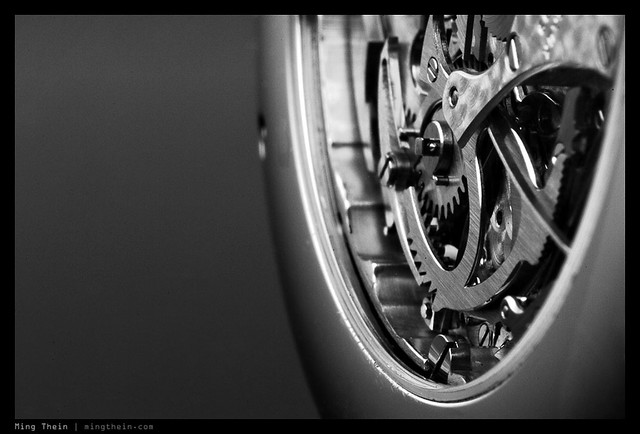
This category includes macro, tilt-shift, pinholes, toy lenses, and other weird and wonderful optics. I love the Nikon PC 85/2.8 tilt-shift macro; it offers both incredible sharpness and great control over your depth of field thanks to its built in movements. But sadly it only reaches 1:2, and doesn’t do so well with extension tubes – which makes it significantly less useful for my purposes, so I sold it. If they made a 1:1 version, I’d be all over it in a heartbeat. My current mainstay in this range is the Nikon AFS 60/2.8 G Micro; it’s excellent but again, a little characterless and suffers from longitudinal chromatic aberration (‘bokeh fringing’) which can be quite annoying on specular highlights, i.e. most watch cases. It does require special processing to remove, which can be tricky if you want to maintain the underlying color of the original object. I’d love to try the Coastal Optics 60/4 APO-UVIR Macro; except it’s in the same price range as a Noctilux. The output from that lens looks incredible – between the completely apochromatic behavior and high transmission throughout the spectral range, color accuracy should be superb.
_DSC0405bw copy
Extended depth of field control. Girard-Perregaux Opera Two. Nikon D2Hs, PC 85/2.8 Micro

There is one upcoming lens I’m looking forward to, also; chief of these is the new Olympus 75/1.8 for Micro Four Thirds – it should be a very cinematic lens, if the 45/1.8 is anything to go by. MT

____________

If you enjoyed this post, please consider supporting the site via Paypal ([email protected]) or via Ming Thein’s Email School of Photography – learn exactly what you want to learn, when you want to learn it.

You can also get your gear from Amazon.com clicking through this referral link. It doesn’t cost you any more, but a small portion of your purchase value is referred back to me. Thanks!

Don’t forget to like us on Facebook!

Incoming new gear: Nikon D800

Just spoke to my NPS rep today – my Nikon D800 will be arriving in the next week or two. Look out for my first impressions post, and a detailed long term review in a couple of months once I’ve had a chance to put it through its paces.

In the meantime, does anybody have any specific questions about the camera they’d like me to answer once I get it? Please leave a comment below.

And in case you’re wondering why I’m getting a regular D800 instead of the D800E, the answer is because I’ve long past the point of pixel sufficiency, however I do need a replacement workhorse camera ASAP as my current (very high mileage, I might add) D700 is throwing the occasional black frame at me. MT

Long term review: The Olympus E-PM1 Pen Mini

(hereafter known as the Pen Mini for simplicity.)

First things first: I don’t do measurement style reviews; there are other sites that do that much better than I can. I write from a shooter’s perspective: is it a good tool? Do I enjoy using it? Are there any critical flaws potential purchasers should know about? If you’re fine with that, read on.

_7048900 copy
Olympus E-PM1 Pen Mini, taped up for stealth and wearing the excellent Zuiko Digital 12/2. I’ve since switched to using a small lanyard strap, because a strap this chunky is overkill for such a small camera – and I wanted to use it on my M9-P.

At the end of 2011, Olympus introduced an interesting trio of cameras. Although they were ostensibly positioned at different market segments, just a couple of hundred dollars covered the spread, and they all shared the same sensor and AF system. Two of them even almost had the same body (the E-PL3 and E-PM1 only differ by a mode dial, flip screen and another button or two). The E-P3 had sightly different firmware, better build, and a greatly increased number of manual controls.

_PM05660 copy
Prague river evenings. Olympus Pen Mini, 45/1.8

Let me be honest upfront: I was not a fan of the original E-P1, nor any of its descendants or sub-lines. They were slow to operate and focus, had frankly quite poor image quality, and were neither small nor light. They were also ergonomically pretty poor.

So what changed? Firstly, the ergonomics. The Pen Mini is tiny. As in compact camera tiny, without a lens attached; and not much larger than a LX5 if you use one of the pancake lenses. The main thing is operation speed. The latest generation are fast. Fast enough that you’re constantly impressed that it’s found focus, and done so accurately. And fast in every other way too – navigating menus, playback, zooming review images, shot-to-shot, etc. Curiously, the small-bodied E-PM1 and E-PM3 are both faster than the flagship E-P3; they’ll shoot at around 5fps with the stabilizer off, but the E-P3 is limited to 3fps. Apparently it’s a limitation of the older shutter or stabilizer design. (But that’s not as fast as it gets; the new E-M5 will do 9fps with AF locked, and focusing is supposed to be even faster – not that you’d really be able to tell the difference.) Bottom line: you’re not waiting for the camera, and it isn’t what’s stopping you from getting the shot. After trying one in a store – a friend bought the E-P3 – I instantly decided it was fast enough; if the image quality was okay, then we’d be in business.

_PM02954 copy
Rush hour storm. Olympus Pen Mini, Panasonic 20/1.7

Autofocus is very fast indeed for static subjects in good light; I can’t tell the difference between the Pen Mini fitted with the right lenses (the new Olympus ones) and my D700. In lower light, there’s a difference; in very low light, sometimes the camera will fail to find focus at all. Forget about moving subjects; although there’s notionally a tracking mode, it’s essentially useless. Fall back to prefocus, timing and the larger DOF afforded by the small sensor in such situations. There is one quirk with the Olympuses (Olympii?) that I haven’t seen with other contrast-detect AF systems: it gets confused by extreme contrast (for example, focusing on the sun or a point light source) and just hunts, or perhaps reports good focus after settling at an intermediate point. That’s odd, because something that high contrast should be a perfect focusing target, right? Maybe it’s the pixel overload – blown channels – that stops it from working properly.

_PM06607 copy
The assembly of modernist cuisine. Olympus Pen Mini, Panasonic 20/1.7

The headline spec isn’t that exciting – just 12MP, and seemingly the same sensor as the previous generation of cameras. What Olympus did was increase the sensor readout speed to 60Hz, which has the effect of doubling autofocus speed (slightly more, actually, when the new focusing algorithm is taken into account) and making the view smoother. A good 12MP is more than enough for almost all but the most demanding uses; I’ve been plenty happy with the output of my D700, and guess what, that has exactly the same resolution.

_PM02054bw copy
Afroman. Olympus Pen Mini, 45/1.8

A D700 it is not, however. The Pen Mini (and by extension, other cameras using the same sensor) produce detailed, sharp images when used with the right lens and within their optimum shooting envelope; in some ways the output reminds me of the Leica M9 at low ISO. The antialiasing filter is very weak, if there is one; single pixel detail is excellent, especially when paired with the right lenses – the Olympus 45/1.8 that accompanied the cameras at launch is a good example of that. I’d say the sensor provides clean output up to ISO 800; it’s useable at 1600, and perhaps 3200 in a pinch. What you see isn’t the increased luminance/ chroma noise (but maintained detail) of the M9; there’s definitely a gentle smeary noise reduction going on even for the RAW files which seems to kick in around ISO 1250. Fine detail structures are the first to go, followed by edge detail. It’s noticeably by ISO 1600, and annoying if you go any higher. More critical is the narrowing dynamic range as the sensitivity increases – by ISO 1600 you’re probably looking at no more than 6 good stops from a RAW file. Note the reduced dynamic range is also noticeable at base ISO – specifically, the highlight recovery slider in Adobe Camera Raw does very little if the image is overexposed, and what little it does is tinged with false color information. The shadow slider still shows that there’s a decent amount of information in the quarter tones, but at the expense of luminance and chroma noise.

_PM04833 copy
Arches, Vienna. ISO 1600 – looks good at this size, right? Visible edge erosion due to non-cancelable noise reduction at 100% though. Olympus Pen Mini, 45/1.8

You’d think this sounds pretty damning – it’s not. The files are punchy, and respond well to tweaking. However, the color palette is pleasing rather than accurate; something you need to take into account of if shooting objects, scenery or architecture. It excels at skin tones, however – in both RAW and JPEG. I’m a stickler for accurate color, especially after curve tweaking; it required quite a number of tries before I could accurately correct for the Olympus color palette (but still leave some residual camera signature in place).

Overall, image quality is right where you’d expect it to be for a sensor of this size: better than the 1/1.3″ compacts, but probably lagging a stop or so behind the best of the current APS-C cameras (Nikon D7000, for instance.)

_PM05594 copy
Cathedral reflections, Prague. Olympus Pen Mini, 45/1.8

Let’s talk about ergonomics. With a body that small, there’s no way you can fit a huge amount of external controls in. And they didn’t even bother trying. In fact, there are so few buttons on the back of the camera that you really HAVE to use the ‘super control panel’ screen to make settings changes – or suffer through the absolutely horrible menu system. I also find the camera quite slippery to hold because it has no thumb grip other than the movie record button and a vestigial rubber protrusion above the D-pad/dial combo; I fitted a spare ThumbsUp and haven’t looked back since. It doesn’t really fit properly, but it does the job well and hugely improves handling. I suspect one of those stick on front grips by Richard Franiec would also make a big difference. There’s only one programmable function button – the record button under your thumb. You’ll have to decide what your most frequently used function is from a rather short list. I’m using it for center AF point during shooting and instant delete during playback; you could also use it for the usual AF/AE functions and a few other things.

_PM00847 copy
Magritte strikes again. The camera really does quite lovely blues, especially sky tones. Olympus Pen Mini, 45/1.8

I have a love-hate affair with the menu. On one hand, the menu button brings up something that’s clearly aimed at a complete novice – you have a choice between scene modes, movies, PSAM, and a deeper-level settings menu. Curiously, the settings menu has two versions: the simple ‘idiot’ version with only basic options such as time, date, format etc – and a super-comprehensive version that makes the camera’s behavior more customizable than my D700. For instance, I can even adjust the LCD’s color temperature (!). The nice thing about this is you can set up the camera once to suit your shooting style, and not really touch it again after that. I shoot RAW, auto-ISO to 1600 with a lower limit of 1/60th (small cameras held at arms’ length mean higher propensity towards camera shake blur) and auto-WB. It’s in continuous high mode, with the stabilizer off, single point AF-C. The JPEG color settings do affect the RAW preview, so as usual I turn the saturation and contrast down, and crank up the sharpening so I can more easily tell whether what I’ve shot is in focus or not.

_PM05796 copy
New year’s eve rebel. Olympus Pen Mini, 12/2

You’re probably wondering why I don’t use the stabilizer: basically, it’s pretty much useless. I have much better results by shooting fast bursts and keeping the middle image. Turning the stabilizer on creates an odd double image effect that I suspect is an artifact of not being fully able to compensate for the shutter recoil. At higher shutter speeds, you shouldn’t be using stabilization at all on any camera, because it won’t react fast enough. And don’t even think about using the stabilizer for movie recording; it’s a digital effect and creates horrible rolling-shutter jello. That said, I tried shooting video once with the camera, and was horrified by the jellocam effect even with stabilizer off; sufficient to say, this isn’t a good choice for movie makers. This is rather odd, since the sensor can read out at at least 60fps; furthermore, the design of the cameras actually seems somewhat video-centric – why else would you fit a 16:9 LCD to a camera whose native aspect ratio is 4:3? That’s actually one of my pet peeves with the Pen Mini: you’ve got a lot of unused LCD space in normal shooting mode, so the 3″ LCD is effectively more like 2.5″. At least there are plenty of pixels, so the image is sharp and fluid.

_PM01718 copy
Architectural trees. This is about as bad as flare gets with the 45/1.8, with the sun in the frame – it’s not technically great, but it is very pleasing in a cinematic sort of way. Which suits my shooting style pretty well. Olympus Pen Mini, 45/1.8

Assuming you can figure out the menu and set up the camera to suit your style, the Pen Mini is actually a joy to shoot. I enjoy using it because it’s so small; it un-encumbers me and allows me to just be there with the option to shoot (without much compromise, if any) rather than consciously be shooting, as I would be if I was carrying a larger, bulkier camera. On a recent trip to Europe, I carried a Pen Mini and three lenses as my secondary/ backup system – all in the spare pockets of my jacket! I didn’t notice it was there until I needed a 90/1.8 equivalent, and out it came.

_PM06727 copy
Sushi. Seared isaki with momeji oroshii chili. Olympus Pen Mini and Panasonic 20/1.7

Ultimately, the make or break for any camera system is the available lenses; it’s why the NEX and Nikon 1 haven’t quite taken off with anything other than then beginner/ upgraded market, and it’s unlikely the Ricoh and Pentax systems will appeal to anything other than a very niche audience. Argueably, Micro Four Thirds is the most complete compact system; it certainly has the most lens options other than Leica M (and there are plenty of adaptors that allow you to use those lenses, too). I could find fast primes in the focal lengths I’d want to use, which is more than I can say of any of the other systems; better yet, I had a few choices. Fast and wide? No problem – there’s the excellent Olympus 12/2, or the compact Panasonic 14/2.5. And then there are a few zooms, too. I went with the 12/2, smitten by its clutched focusing ring (but finding later that it lacked sufficient resolution to be truly useful for zone focus, and wishing I’d bought the much smaller Panasonic instead). Midrange? Olympus 17/2.8 pancake, Panasonic 20/1.7, Panasonic-Leica 25/1.4, or the insane Voigtlander 25/0.95. All are good except for the 17, which is an utter dog. I went with the 20 for the size; it’s a fantastic and very versatile lens, except being an older model, focusing isn’t as fast as the newer lenses. The Voigtlander looks insanely cool and offers very close minimum focus, but is hugely impractical (magnified live view focus at arms’ length, anybody?) and expensive. The Leica is a nice option, but too bulky for my liking. I shoot usually 24/28 and a short tele pair; on the D700 for instance it’s the 24/1.4 or Zeiss 2/28 Distagon plus the Nikon 85/1.4 G. Olympus released a new 45/1.8 together with the trio of cameras; it’s probably the standout lens in their range. It’s light, cheap, fast to focus, has great bokeh, biting sharpness and a very pleasing overall rendition – what more can you ask for? Sure, metal build would be nice, but I’m happy saving that for the new 75/1.8 (150mm equivalent) exotic. I was considering a macro solution, but I have the D700 for that – and don’t think that will be changing anytime soon.

_PM02509 copy
Edible foam. Olympus Pen Mini, 14-42/3.5-5.6 IIR kit lens

I know in my mirrorless tips article I recommended using an external finder/ EVF for stability; I don’t with the Pen Mini for one simple reason: the stability I gain from bracing my face against the finder is negatively offset by the loss of stability caused by removing the ThumbsUp. Plus it makes the camera rather bulky, not pocketable, and fragile-feeling – I’d be constantly worried about snapping the finder off because it pivots through 90deg for waist level shooting, and doesn’t really lock in place all that securely.

_PM02066 copy
Graffiti. Olympus Pen Mini, 45/1.8

With all cameras, the ultimate litmus test for me is how much I use it: the cameras I like more tend to be workhorses or go-to cameras, either because I enjoy using them or they’re the best tool for the job. Anything that stays around for longer than around 2-3,000 exposures is a keeper for me; none of the other mirrorless systems I tried (NEX-5, X100, X1) lasted that long. The Olympus is rolling over 7,000 and going strong – which is nearly as much as I shot with the M9-P during the same period (since November last year). My D700 has seen just a couple of thousand frames, which is unusual.

_PM05602 copy
The embarrassment of having a pigeon crapping on your head. Olympus Pen Mini, 45/1.8

In conclusion, it’s a competent, fun camera. And at the current price of around $499 (I’ve seen it as low as $399 after rebates) in the US, it’s a no brainer. In fact, I’m thinking of picking up another one in electric pink to use as a spare or street photography camera; nobody is going to see me as a concern or take me seriously with one of those, which should make for some very interesting images. Micro Four Thirds has finally made good on its promise of smaller, just as good with this camera – its cheapest entry level option – not the flagship. I just hope the current corporate farce doesn’t kill the company, now that they’ve finally figured out how to produce a great product. MT

_PM04858 copy
Haunted house. Olympus Pen Mini, Panasonic 20/1.7

Photography equipment is a circle…

…and not because the lenses and control dials are round.

[Tongue in cheek] The phases of equipment euphoria go something like this:

Absolute newbie: Buys the sexiest, smallest point and shoot they can find. Then gets frustrated that it’s slow or the pictures look horrible in low light.

Modern alternative: Cameraphone.

_D90_DSC4534bw copy
Canon IXUS SD780IS. It was the sexiest, smallest, point and shoot I could find at the time. But I had my reasons for buying it, as you’ll see later.

Beginning hobbyist: Upgrades to a prosumer thing, the more buttons and dials the better; a longer zoom is just a bonus, as is if it looks like a DSLR – take that Nikon thingy with the 24-1000mm lens, for instance. 1000mm!

_0012295bw copy
Leica D-Lux 5.

Amateur: A DSLR is a must. But why bother with the SLR bit if you’re going to hold it at arms’ length and use live view?

_D90_DSC0506bw copy
Nikon D40, swallowed by 400/2.8VR hood.

Serious amateur: A bigger, more serious DSLR. Maybe the same one as before, but with a battery grip and telephoto lens. Carries it around everywhere they go, complete with backpack containing 1001 other ‘essentials’ such as cleaning supplies, chargers, spare tripod heads, etc. Given a few years, will develop into an aspiring pro.

Semi-pro: An anomaly: may just use whatever midrange DSLR is given by their company, or use serious amateur gear.

P1070221 copy.jpg
Why choose between systems when you can have both?

Aspiring pro: Always has the latest and greatest; a pair of pro bodies, full set of f2.8 zooms and f1.4 primes, carbon fiber tripods, and…no work to pay for it all.

Pro: Only carries what they need; usually a matched pair of bodies for redundancy, with one lens each, and maybe a flash. No superfluous gear, because they know how much of a pain it is to carry. After several years, will develop a pronounced lean towards the shoulder that carries the spare body and a stoop from carrying 5kg around their necks.

_7048856bw copy
Going light. Olympus Pen Mini.

Old hand: May or may not have been a pro, but now forced to sell some or all of their gear to cover chiropractor bills and divorce settlement after wife got ignored on too many holidays in favor of sunsets and sunrises and magic hour reflections; still can’t quite let go of the photography bug, so they look for the lightest thing they can find that just manages to do the job, but at the same time not require eating ramen or baked beans for a year.

And guess what: we’re right back where we started.

Now, you’re probably wondering why I’ve got photos of all of this gear: at some point or other, I went through it. Read carefully, and seriously, learn from my costly mistakes before you have both a bad back and an empty wallet. You have been warned. MT

POTD/ Quick review: Details in the fabric/ Leica D-Lux 5

_DL5T_L1000026 copy
Details in the fabric. Traditional Japanese spring kimono. Leica D-Lux 5 Titanium

Now may also be a good time to share a few quick thoughts on the Leica D-Lux 5 Titanium – it arrived early last week for me to use as a backup/ pocket camera. In short,

The Good:
-Very flexible controls.
-Multi-aspect ratio switch – I’m using it a lot more than I would; it’s now easier to fit the frame to the subject.
-Image quality is excellent up to ISO 400; useable at ISO 800; I wouldn’t go any higher than that.
-It’s one sexy looking camera.
-Battery life seems to go on and on and on – first 200 frames shot, still showing full.
-Sharpness is good throughout the frame, and even at macro distances – cross-frame consistency close up isn’t usually a strong point of compact cameras. This was a big, pleasant surprise.
-Usefully large RAW buffer; i.e. you don’t notice any penalty for using RAW instead of JPEG (which I of course highly encourage).
-Mode dial is much stiffer than its predecessors, and can’t easily be knocked off position.
-Like all leaf-shutter compacts, the flash sync speed is all the way up to its maximum of 1/2000s! (*More on this later – I also shot a food job with it this weekend, which will be the subject of a future article.)
-Like all Panasonic-based cameras, an excellent optical image stabilizer – I can’t quantify this in any way, but I’ve always felt that their IS systems are on par with or even slightly better than the systems Nikon and Canon use on their SLR lenses.

_DL5T_L1000034 copy

The not so good:
-It is expensive for what it is – the standard D-Lux 5 represents fair value for money, because if you take out the cost of Lightroom (bundled) and the extended warranty, it’s not much more expensive than the Panasonic LX5 it’s based on, but arguably a better looking camera. The Titanium version, on the other hand, isn’t real titanium but commands a hefty premium over the standard one.
-The LCD is pretty poor; in fact it’s difficult to gauge the quality of a shot using it alone. The one on the V-Lux 3 is much better.
-Could be faster – startup feels decidedly leisurely and focusing isn’t as fast as the older Ricoh GR-Digital III. There was a time when these prosumer compacts were much faster than the mirrorless compact system cameras; my Pen Mini blows both of them out of the water.
-The included gray leather case looks cool, but is bulky and totally impractical. It stays at home for storage only.

_DL5T_L1000029 copy

I’ll be traveling for the rest of the week; depending on internet connection availability, frequency of posts may be reduced (don’t worry, I’ve got some great stuff prepared in advance and auto-scheduled in case I have no internet access at all). MT

_DL5T_L1000031 copy

Long term review: the Leica M9-P

First things first: this isn’t going to be a technical review, because there are sites that do it much better than I can; it’s going to be subjective because there are things I do in my processing workflow that might not necessarily be reflective of everybody else’s, but I am consistent in how I treat my cameras, which means that results are comparable between different cameras. Specifically – I shoot raw with auto-WB, expose slightly hot, adjust exposure and WB in Adobe Camera Raw, and take care of final sharpening, curves and color adjustments in Photoshop. What this review – and future equipment reviews – will be is a subjective but hopefully useful insight into how a piece of gear performs under professional use conditions, and whether there are any serious limitations to my style of shooting (and my subjects). With that out of the way, let’s move on.

_7052691 copy

I suppose it may be a little late in the product’s life-cycle to be doing a review now – given that the M9 was launched in September 2009 and is now 2.5 years old, which is ancient in the digital era. But let me explain. Firstly, I think it’s still a relevant product today – perhaps even more so, given the increased resurgence of late of compact ILCs and rangefinder-a-likes. The Leica M still remains the benchmark product that all strive to be judged better than, and it’s lens system is still the one everybody makes mount adaptors to fit. (Notice Fuji launching an in house M-mount adaptor with the X-Pro1). There are other reasons, too. The original M8 is still in circulation on the secondary market, where prices have stayed constant around the US$2,200-2,500 mark from the launch of the M9; this is extremely surprising behavior for a digital camera of any sort, let alone one that will be six years old this year, and one that has its fair share of flaws (don’t get me started; I owned two and shot with five examples in total; they all required UVIR filters for accurate color, had buffer overflow/ firmware stability issues, hot spots, banding, etc.). You can bet a D2x isn’t worth what it was three years ago. The sole reason this is the case is because they represent a relatively accessible entry point for rangefinder photography; you can buy second hand Zeiss and Voigtlander lenses and not spend much more on the whole system than if you bought a midrange DSLR. Sure, you might not get the high ISO performance or frame rates, but then again you also don’t have to live with the weight. This price may change with the widespread availability of the Fuji X-Pro, but I don’t expect it to – they’re completely different beasts, and the X-Pro has more in common with the mirrorless ILCs than digital rangefinders.

_M9P1_L1005460bw copy
A Hitchcock scene in Prague. Wide and hyperfocal is where rangefinders excel. Leica M9-P, 28/2.8 ASPH

In the same way, the M9 will remain a relevant product beyond its life cycle. All rumors point to a replacement sooner rather than later, though with Leica’s partner Kodak having sold off its sensor division, it’s anybody’s guess as to where the sensor is going to come from. What would make sense is a Sony sensor – perhaps a full frame version of the 16 or 24 MP APS-C models – but with a custom micro lens array to deal with RF optics. Would I want that many megapixels? No, but we’re digressing. More on the sensor issue later.

The final reason it’s taken me until 2.5 years after the release of the camera to write a review is quite simple: I haven’t had the chance to shoot with one extensively until November last year, after becoming an official partner of Leica. Whilst you can do RF photography on the cheap with a used M8, a new M9 kit and top flight lenses will set you back big, big money – the kind that could easily also buy a luxury automobile. I’ve used the M9-P with the 50/0.95 Noctilux-M ASPH, 35/1.4 Summilux-M ASPH FLE, 50/2.5 Summarit-M, 50/1.4 Summilux-M ASPH, 28/2.8 Elmarit-M ASPH and Zeiss ZM 2.8/28 Biogon and ZM 2/50 Planar.

_D90_DSC7248 copy
My previous rig, used for 90% of my shots. I was so practiced and familiar with this lens and camera that I could zone focus accurately at f1.4, and compose without seeing either finder. That’s what happens when you shoot >1000 frames per day with the same gear. Alas, I don’t shoot anywhere near that much, so I lost the ability. The M9-P is also a lot more sensitive to precise focus because of the pixel density.

A bit of background: I shot almost exclusively Leica in 2009-early 2010 with a pair of M8s, the Leica 35/2 ASPH, 21/1.4 ASPH (primary lens) and 50/1.4 ASPH. I also used the Voigtlander 15/4.5 and 50/1.1 and Zeiss ZM 21/2.8 extensively. Total count: nearly 70,000 frames – so I’m not new in the RF world by any means. I also had an M6TTL.

Did I have issues with the M8s? Yes. Specifically,
1. They’d lock up if you overshot the buffer; and you’d have to pull the battery and card to get the camera to restart, sometimes losing images on the card and definitely losing whatever was in the buffer at the time.
2. Banding, especially at high ISO or if underexposed.
3. A very sensitive meter; if there were any point light sources in the frame, you can be sure the camera would underexpose horribly.
4. No easy way of dialing in exposure compensation – the workaround for that was to meter on something else, AE lock with a half press of the shutter, and then focus on the subject
5. Very poor high ISO performance. I’d keep things below 640, 1250 in emergencies, and seeking out the fastest lenses possible – which with 28mm as my favorite focal length, turned out to be horribly expensive.
6. No idea how much battery life you really had left, and a very, very slow (5-6 hours!) charger.
7. I like to shoot at 28mm; it just feels natural to me. That’s 21mm equivalent due to the M8’s crop factor. But there’s only frame lines for 24mm (31mm equivalent) which isn’t wide enough, so I have to use an external finder. Oh, but you still require focusing precision with fast lenses especially; so you have to use the RF to focus and an external finder to frame. Pain. I eventually landed up shooting with two eyes open, focusing with the RF, guesstimating the frame with my open eye and ignoring the external finder unless I was shooting at hyper focal distances.
8. Very notchy-feeling shutter release – it’s difficult to release smoothly, even with a soft release installed. Why does it need three stages – can’t they just use a smooth two-stage like all of the other professional cameras? Even the film Leicas had much better feeling shutter button actions than this.

_M9P1_L1007182bw copy
The librarian, Strahov Cloister. Leica M9-P, 28/2.8 ASPH

Have any of these things been fixed?
1. It won’t lock up and require a battery-pull, but you still have the same small buffer. Seven shots or so while the barrel is hot; I liken it to shooting a revolver. Count your frames and you should be fine when it comes to sequences. It won’t do more than 2fps anyway, so you’re best off in single shot mode.
2. Banding is much improved – in fact, I haven’t seen it in any of the 12,000+ frames I’ve shot so far.
3. Nope, same meter.
4. You can dial in exposure compensation on the rear dial or menu, but it doesn’t really show in the finder except for a really small, difficult to see dot between the numbers. I found a better workaround – if I’m at base ISO (you know because your shutter speed is above the AUTO ISO threshold you set) then I’ll just choose a lower shutter speed, guesstimating whatever I think it should be. Lots of photography makes you have a pretty good internal meter. If I’m shooting at night, I’ll fix my ISO and go fully manual.
5. It’s better, but not that much better. Reality is that at the pixel level, I now find 1250 to be the limit, with 2500 for emergencies only. However, because there are many more pixels, you can print at the same size and gain roughly another 1/2-2/3 stop. It’s not in D700, let alone D3s territory by any means, but at least its much more useable than the M8 was. I can use f2.0 lenses without too much issue – which is great, because they’re both cheaper and tend to be better optically.
6. There’s now a very accurate percentage meter and a faster (2-3 hour) charger. Both things help your battery management greatly, though I still carry a spare battery especially for heavy shooting days. One battery will get me around 1,000 frames if I limit review time to the bare minimum.
7. The widest frame line is now 28mm, yay! Unfortunately, the eye relief is insufficient to see it with glasses. 35mm is the widest frame I can comfortably see unless I wear contact lenses – which I do for serious shooting.
8. Nope, not changed. But at least they made the power/self timer switch tighter, so you don’t accidentally select the timer and wonder why the camera isn’t taking the shot.

_M9P1_L1003662 copy
Evening tram. Leica M9-P, 50/1.4 ASPH

So, for the most part, things are better. The menu system is still simple and snappy; although there is a tendency to do odd things with some Sandisk cards – specifically lockups when browsing or protecting files in long series; I haven’t noticed this with other brands, though.

What else has changed? Surprisingly little. Why fix it if it isn’t broken? Frankly, if Leica could get hold of the D3s sensor and innards somehow, then they’d have a killer machine. I wouldn’t even need to shoot anything else. Oh yeah, there are some small cosmetic changes – the corner where the little round LCD was on the M8 is gone, and the finishes are now black paint or gray chrome for the regular M9, and silver chrome or black paint for the M9-P which omits the Leica dot in favor of top plate engraving and a sapphire LCD cover, but is otherwise the same camera. I was given a silver M9-P, which is my preference aesthetically too.

_M9P1_L1005830bw copy
The hidden gorilla. Leica M9-P, 28/2.8 ASPH

The things I like very much about the M system, and specifically the digital Ms, remain. The sensor is a CCD, not CMOS – in real terms, that means much more pleasing tonal and color response at the expense of base noise. There’s a color richness yet tonal transparency that’s difficult to describe; it reminds me of the old Nikon D2H and medium format cameras, which for the most part use CCD sensors. There is of course no anti-aliasing filter, which means that the resolving power is extreme. Is moire an issue? No, but I’m not a fashion photographer.

What is much more important than your filter pack is the alignment of your rangefinder. This affects resolving power hugely, especially if you’re shooting fast lenses wide open. The best practice is to send everything back to Leica for calibration, but since we can’t easily do that in the field, we must learn to calibrate our own rangefinders* (to be the subject of a future article.) – to the shallowest depth of field lens you’ve got, providing it doesn’t suffer from focus shift. If it does, calibrate to your most frequently used lens and remember to adjust for the focus shift when you’re shooting your fastest. A rangefinder with a well-calibrated rangefinder is one of the most accurate focusing mechanisms devised; much better than manual focusing most SLRs because their viewfinders won’t have been perfectly aligned or shimmed, either. Not quite as good as magnified live view on the LCD, but that isn’t practical for photojournalism work or anything without a tripod. Where rangefinders excel is focusing anything wide up to about 75mm; fast is no problem. In fact, with regular practice I find I can focus just as fast or faster on static subjects than with an autofocus camera. (The AF camera will report that it’s found focus, but you can’t always tell if it’s focused precisely on what you want it to.

_M9P1_L1004918bw copy
When you shoot a Leica, you inevitably find a protest in the most unlikely of locations. Demonstrators protesting Kabila’s reign in the Congo, Vienna. Leica M9-P, 28/2.8 ASPH

So, given a properly calibrated rangefinder, resolution and sharpness aren’t a problem. In fact, there’s more resolution in a good M9 file than anybody really needs, unless you’re making wall-sized prints that are to be inspected at nose distance. It’s more resolution than I can normally use, especially for photojournalism or street photography where everything is moving fast, light conditions are challenging, and your exposure is probably borderline for getting a critically sharp shot. I’m the limitation, not the camera. It’s great for shooting people, though; subjects tend to be more curious about the vintage looking camera than intimidated (as is usually the case if you point an enormous pro DSLR at them). You tend to get much more natural and open portraiture as a result.

_M9P1_L1001901 copy
I don’t quite know what she was demonstrating here either. Leica M9-P, 50/0.95 ASPH

I use the camera for architecture and urban landscapes too; it excels at that for the most part, but the nature of the viewfinder and it’s vague-ish frame lines mean that compositions aren’t always precise; I sometimes have to violate my personal rule of no-cropping to trim things I didn’t think were in the frame at the time of shooting. The frame lines are conservative.

The last thing I use the M9-P for is watch photography – this only of late, and it hasn’t fully replaced the D700 because I still haven’t got a complete setup. What it does excel at so far is extremely high magnification macros; we’re talking minimum 3:1 and usually up to 5:1 or even 6:1. This is where the Visoflex III and Bellows II (both vintage, probably 40-50 years old) come into their own in a surprisingly but very ungainly way. (For more info on macro with the M system, see this earlier post.

_M9P1_L1003384 copy
Shadows, Vienna. Leica M9-P, 28/2.8 ASPH

So am I happy with the M9-P?

For the most part, yes. The image quality, within its optimal range, is stunning – as good as the output of any 35mm/ FX camera I’ve seen to date (the D800E may be a different story when it arrives). It isn’t that great at high ISO, but you can usually get a workable and pleasing image in all but the darkest condition. My earlier On Assignment post about shooting the Thaipusam festival was a surprise to me – it performed far better than I expected, but it wasn’t easy to achieve those results because of the limitations of a rangefinder with moving subjects.

_M9P1_L1008733 copy
Master Sushi Chef Kenny Yew. Leica M9-P, Zeiss ZM 2/50 Planar

It’s relatively small, portable and easy to use; it doesn’t get in the way or require separate carrying solutions or bags. Most of the time I just go out of the house with the camera slung over one shoulder, suspended by a single lug since it’s easier to access and much more comfortable to shoot without a strap digging into the web between your index and third fingers. It is deceptively heavy, though, especially with the Noctilux 0.95; I think that rig weighs more than my D700 and 85/1.4. It also desperately needs a grip to hold securely, because there’s nowhere on the back of the camera for your thumb to find secure purchase. (The film Ms didn’t have this problem because you usually braced your thumb on the winder crank to be ready for the next shot anyway.) I’ve used ThumbsUp grips on all of my digital Ms and find them to be indispensable – they make a huge difference to the handling properties of the camera. This should be a built in ergonomic feature of future Ms, not an expensive aftermarket accessory. While we’re on ergonomics, did I mention that it’s far too easy for you to put your finger into one of the rangefinder windows? I find it immensely annoying when somebody does that after they request to have a look at your camera; you can’t see a damn thing or focus easily if there’s a fingerprint obscuring every window. I keep mine scrupulously clean and take care not to stick my fingers in. Having said that, I guess it’s a limitation of the RF design; a recessed window would be difficult to clean, and one that sticks out would probably get chipped or scratched more easily.

_M9P1_L1000955 copy
The paradox of clean energy. Leica M9-P, 50/0.95 Noctilux-M ASPH

There is one thing that the M9-P especially has that nothing else does (except perhaps an M8) – tactility. I don’t personally like the painted finishes; I do like the slightly rough chrome surface and the solid, cold, metal feeling of the control points; the rubber is nice but leather would be nicer (although impractical in the sweaty tropics – I suppose at least people would think twice about asking to use your camera). It’s just a beautiful design object and something that makes you want to handle, fondle and use it; this isn’t something that I can say of any of my other cameras, except oddly perhaps the Ricoh GR-Digital III. And that makes me shoot it more; which in turn makes me experiment and produce images that I probably wouldn’t otherwise have done without the camera. For all of its quirks and foibles, I just like using it.

_M9P1_L1007838bw copy
Self portrait, lucky timing with two opposing moving trains and a whole load of surprise with the ensuing gust of wind. Leica M9-P, 50/1.4 ASPH

I think the real verdict is that I’m now using the M9-P as my primary camera, even for things that it was not designed for, even when I have the choice to use something else. This is not at all what I expected going in; I suppose in that sense it succeeds beyond expectations.

_M9P1_L1003919bw copy
Fog, Schonbrunn Palace, Vienna. Leica M9-P, 28/2.8 ASPH

That doesn’t mean I don’t have a long list of things that could be improved for the next digital M; realistically, we’re going to see evolutionary rather than revolutionary changes, because after all, it is still a Leica M – if you want AF, buy the Fuji. With that, I leave you with the list:

1. Bigger buffer. I can count shots, but I’d rather not – 15-20 would be plenty. The new Nikon D4 reportedly has a 95-frame RAW buffer(!)
2. Live view. I think this is probably inevitable, given the capabilities of all of the current crop of sensors; I personally want it so I don’t have to use the clunky Visoflex for macro work.
3. More speed, especially with image processing – specifically review and magnification.
4. A better LCD. More pixels are useless if I can’t tell whether I’m using them all properly or not. I can see why the body will not accommodate a 3″ unit for design and aesthetic reasons, but a higher resolution 2.5″ unit with better color would make a huge difference.
5. A built in thumb grip on the back; a ThumbsUp built into the body would be perfect. They could even bring back the winder ala Epson to save battery power.
6. Softer, better-feeling shutter release button.
7. A little more information in the viewfinder; shutter speed in aperture priority and ISO is all I need.
8. A meter that doesn’t go crazy if there’s a point light source in the frame.
9. Improved high ISO, but it’s not actually that critical.
10. More robust firmware, and less sensitivity to particular brands of SD cards.
11. More eye relief in the finder – especially useful for photographers with glasses

Notice I haven’t asked for video, more pixels, AF, or 12fps, or LCD finder overlays; I think the fundamental concept is great, but it could use a few little tweaks to keep it relevant in today’s world of options – especially when historical trends point towards this camera being even more expensive than its predecessor. MT

*Disclaimer: I am not responsible if you damage your camera or void your warranty.

_M9P1_L1006378 copy
The police are everywhere. Leica M9-P, 28/2.8 ASPH

____________

If you enjoyed this post, please consider supporting the site via Paypal ([email protected]) or via Ming Thein’s Email School of Photography – learn exactly what you want to learn, when you want to learn it.

You can also get your gear from Amazon.com clicking through this referral link. It doesn’t cost you any more, but a small portion of your purchase value is referred back to me. Thanks!

Don’t forget to like us on Facebook!

Lens review: The Leica 50/0.95 Noctilux-M ASPH

Noctilux. Regardless of its generation – whether the pioneering (and very, very rare) f1.2 early version or the current super speed f0.95, it’s a bit of a legend amongst photographers, and with good reason. It was one of the first lenses I was loaned by Leica – replacing a 50/2.5 Summarit that was supplied with the M9-P initially. I asked for more speed, and it seems like I got everything they could give me.

_7052556 copy

The beast.

Let me start with my first impressions of the outgoing f1.0 lens: a big, huge, heavy, difficult to focus (thanks to a very long focus throw) beast with a near-useless short built in hood. I didn’t like that veiling softness caused at f1 due to a combination of flare and uncorrected spherical aberration; and I really found the ‘swirly bokeh’ distracting (another artifact of uncorrected spherical aberration) – something that most people loved as the signature of the Noctilux. I guess I’m in the minority. The first time I handled the f0.95, I was actually collecting my 21 Summilux; this was in 2009. I duly fondled, took some test shots, thought it was pretty good, and handed it back – I didn’t like the stiff focusing ring, and it was even bigger than the previous one. And somehow felt twice as heavy.

[Read more…]

The never-ending quest for more magnification

The arrival of some new adaptors gave me an idea. Just how much further could I push the limits of macrophotography before I need to buy a microscope?

Quite far, it seems.

_M9P1_L1012055 copy

What you’re looking at in the image above is a mishmash of gear which could mostly be replaced by a single long tube with a mount at either end. From right to left: Zeiss ZM 2/50 Planar (I tried the Leica 35 FLE, but there wasn’t enough working distance) mounted on Leica Bellows II, mounted on Visoflex III, mounted on Leica M to Nikon F adaptor, mounted on 72mm of Nikon-fit extension tubes, mounted on Nikon F to M4/3 adaptor, with an Olympus Pen Mini hanging off the end.

The results? See for yourself below. The full frame is slightly less than 2x3mm in most of the photos with the 50mm, and 1.5x2mm with the 35mm. That’s 6:1 or 9:1 on Micro Four Thirds, but more like 12:1 or 18:1 equivalent on FX. I’ve marked on a larger photo of the watch exactly what you’re looking at, for readers intimately familiar with horological architecture. Note that the angle is slightly different in some of the images.

_7057451b copy

Does it make sense? No, because we’re clearly a) hitting diffraction limits; b) seeing resolution limits on the lenses used; c) seeing CA, distortions and other artifacts introduced by the sapphire crystal we have to shoot through on the watch and d) very low contrast. And for most watches, there won’t be this level of detail to capture in the first place. Curiously, lighting is actually pretty easy with the 50mm because it has a decent amount of working distance. For all practical purposes, I think 5:1 is pretty much the limit for watch photography. MT

_PM07810 copy

Balance rim rate/ inertia adjustment screw

_PM07830 copy

Escape wheel and bearing

_PM07852 copy

Barrel bearing

_PM07839 copy

Hairspring and carrier

_PM07827 copy

Third wheel jewel bearing and bridge end

_PM07814 copy

Balance stud attachment screw

_PM07807 copy

Barrel pivot and jewel bearing

_PM07806 copy

Minute hand tip

The perils of lots of ideas, but not quite enough sleep

I couldn’t sleep last night (again) but as compensation I did wake up with an idea.

Put your favorite lens on your favorite camera.

Why hadn’t I thought of this before?

_VL31_L1000950 copy
Not this, but close. I have thought of this before, but it only works for macro, and not that well.

So I dug out the adaptor rings, to make another sacrilegious unholy matrimony between systems.

This guy (Zeiss ZF.2 2/28 Distagon):
_5100_DSC1424bw copy

Plus this guy (the M9-P. A lens-lens thing goes beyond wrong and into completely impractical territory.):
_7052556 copy

Yee har!

Except, there’s no RF coupling or live view.

Oops. *slaps forehead*

The very limited testing I did do (you didn’t think I’d just mount it and not try to take a picture, did you?) showed the combination definitely has promise. And f2 still requires some finesse to focus accurately on full frame, especially high resolution full frame. But there were no odd artifacts, and the lens is definitely capable of resolving more than the sensor. Curiously, I think it might even perform slightly better on the M9-P’s offset microlens-and-non-telecentric-wideangle-corner-optimized sensor than the D700’s uniform one. Too bad we’ll have to wait until Leica eventually brings live view functionality to an M body to find out.

In the meantime, I’m going to find out if Miyazaki-san of MS Optical (makers of those lens-cap triplet designs and noted lens surgeon) can make an RF-coupling, though I suspect it may be tough because the focusing ring rotates the wrong way, and the focus throw is much shorter than normal Leica M RF lenses. MT

CES 2012: Thoughts on the new cameras

This year seems to be yet another bonanza year of choice for photographers – and gearheads, especially. What follows is a few quick thoughts on the recent spate of introductions – specifically, those I find interesting or worth commenting on:

Nikon D800/D800E
50% more resolution – maybe as much as 75% on the E variant – and less than half the price of the D3x? It’s interesting to see just how far technology has come in the last few years. Not only is there more resolution, there’s more speed AND it’s 14 bit data off the sensor. I’m not worried about noise; downsize to say 15MP and you’ll find the files will be surprisingly clean, with very crisp detail at the single-pixel level. The resolution champion outside medium format? Easily. It’ll print well, too. I broke down and ordered a D800E via NPS. No comments on video specs, it’s just not something I do at the moment. Interestingly, it’s lighter, too. Minus points for the new battery system – what are legacy users going to do with their spares?

Warning to people who just want ‘more’: this camera is going to be punishing on both technique and lenses; poorer lenses may never get sharp at any aperture. And forget 1/focal length: you’re going to have to double that to be critically sharp at the 100% level. Sloppy photographers are probably better off sticking to more forgiving (and lower) resolutions. I know this definitely won’t be the camera I grab when I have to wear the photojournalist hat.

Nikon D4
It’s interesting to see that 16MP is considered enough for the flagship; that’s because it is. If you can’t print an enormous wall-sized enlargement that looks good from sensible viewing distances, you’re probably not doing something right. I remember the days when the D2H’s measly 4MP was sufficient for billboard work – and that was cropped down, too. Remember that as the print gets larger, you’re going to be further and further away. For fine art and pixel peepers, there may be reasons to have more resolution, but seriously – nobody was complaining when 12MP was state of the art. And these are much, much higher quality pixels than before. Again, minus points for the new battery system. Spares are expensive. I don’t see myself needing one of these – it’s too big and heavy, and has no built in flash to trigger slaves – but man those backlit buttons are cool.

Olympus OM-D E-M5, ZD 75/1.8 and ZD 60/2.8 Macro
I find myself going through phases with this one. I think the final verdict will boil down to size and sensor output quality. Not having seen either, it’s hard to make a call. It’s very difficult to tell from the product images – maybe the industry needs a standard sized hand or something. I like the idea of this camera – I really do – but frankly I think the design just isn’t that coherent. By the numbers it seems blazingly fast, though. Maybe this is what M4/3 should have been all along.

Much more interesting are the two lenses accompanying the announcement: 150/1.8 equivalent, anybody? Should make a killer portrait and fashion lens. The 60/2.8 macro is interesting to me because it a) goes to 1:1, which is really 2:1 equivalent on a full frame body; and b) it’s 120mm equivalent, which means a decent amount of working distance.

Pentax K-01
Firstly, it’s hideous. Secondly, it’s pretty intelligent: pancake lenses with most of the optics inside where the mirror box should be, keeping the size down; whilst retaining the original flange distance to allow use with legacy lenses. But sorry, the missing EVF is an unforgivable omission. I really have no idea who this camera is aimed at.

Fuji X-Pro1
Fuji is taking the success of the X100 and X10 and smacking Leica on the head with it. Then, just to make sure nobody missed their intentions, they displayed the camera with an M adaptor – which will also be released with the camera. Nobody doubts the image quality will be good. But my fear is that as with its siblings, the horrendously unstable and poorly implemented firmware is going to make or break this. I do like the initial lens choices though – the 28, 50, 90 macro combination feels like it was tailor made for me.

Canon G1X
Too little, too late. It’s bigger than competing mirrorless offerings, but lacks the interchangeable lens option; its only saving grace is going to be if the image quality is superb. I wouldn’t expect anything worse than the current crop of Canon APS-C cameras, which is to say pretty competent. But I just can’t see where it fits in for most photographers.

Final thoughts: Overall, too many of those damn confusing Xs in names. I think it’s time to get back to the photography, now.

Product images from press releases and DC.Watch.Impress