Review: A controversial lens: the Nikon AFS 28-300/3.5-5.6 VR G


Image from Nikon USA.

This lens is the full-frame equivalent of the very popular 18-200/3.5-5.6 DX VR; and like the DX equivalent, it’s an optic that seems to breed two kinds of people: blind fanboys who think it’s the one and only lens you need to own, and others who think it’s a horrible compromise that does nothing well, and is best avoided.

_7015068 copy
Dayabumi. The first marble-facaded skyscraper in Kuala Lumpur. Nikon D700, 28-300VR

I picked up this lens together with the new (at the time) AFS 85/1.4 G at the latter end of 2010; I never intended to use it as a one-size fits all, but rather as as more flexible replacement for the AFS 70-300/4.5-5.6 VR – itself which was great up to about 200mm, but required much smaller apertures to be useable at 300mm, and it never got as sharp as it was at shorter focal lengths – despite stopping down.

Bottom line: the 28-300VR does the job. My sample, at least, matches the 70-300VR optically in the 70-200mm range; neither one is really great at 300mm, but I’d give a slight edge to the 28-300VR. Never mind the fact that it isn’t 300mm all the time – I’ll talk more about this later.

_7039347 copy
Honda HSV-010 detail. Super Japan GT, Sepang International Circuit. Nikon D700, 28-300VR

Let’s start with the physical stuff. It isn’t a small lens – in fact, it’s similar in size and heft to the 24-70/2.8 without the hood – but it’s made entirely of textured polycarbonate. It also extends considerably when zoomed out, which shifts the weight in the hand quite noticeably. Fortunately, the extensions are quite robust. The lens is gasketed, and I’ve shot with it in light rain; I probably wouldn’t do this under more adverse weather conditions, because the water will naturally go inside the lens as you zoom in and out – you can see evidence of this as water streaks are left behind. There’s a narrow, very short-throw focus ring with rudimentary distance scale, no DOF markings, and very little feel. Clearly, this lens wasn’t mean to be manually focused – good luck doing it precisely. In front of that is a wide rubberized zoom ring. Zoom spacing is nice and linear, though a little stiff – you can feel the plastic-on-plastic action inside the lens. The remaining controls are switches for AF/MF, VR ON/OFF, and VR ACTIVE/ NORMAL mode. There’s also a lock switch to prevent the lens extending past 28mm – clearly Nikon learned something from the self-tromboning 18-200VR, though the zoom action is actually stiff enough not to require it.

_7039042 copy
GT500 at Sepang International Circuit. Nikon D700, 28-300VR

It’s a proper AF-S lens, which means that you have full time manual override. Focusing is midrange-fast, even at the long end of the zoom. It isn’t as fast as the pro lenses, obviously. Fast enough.

The stabilizer uses Nikon’s second generation technology – denoted by the gold VR plaque, rather than red as on the first versions. It’s quite effective – with good technique, critically sharp shots at 1/15s 300mm on FX or 1/50s 450mm equivalent on DX are possible. It has automatic panning detection, and an ACTIVE mode that cancels out all subject motion – i.e. panning off. However, you should be turning the stabilizer off if your shutter speed is above the safe speed required – the time required for the stabilizer to move into position can actually create a weird double-image effect if left on at very high shutter speeds. VR is much more effective if you give it a couple of seconds to ‘lock in’ before shooting. Curiously, it also works much better if the camera is held horizontal – extreme up or down shooting tends to render it mostly ineffective.

_7021180 copy
Polo. Cue panning mode. Nikon D700, 28-300VR

Let’s talk about optics: I strongly suspect with a lens this complex, there’s some sample variation going on. And this might well be the source of the strong polarization between user camps. Mine isn’t so hot at 28mm – in fact, it’s downright crappy (flare, aberrations, lack of sharpness and contrast) at 28mm until f5.6; curiously, you can manual focus it to a sharper image – however, using that AF-fine tune calibration throws out every other focal length. From 35mm to 200mm or so, this lens is right up there with the rest of them – it’s sharp, contrasty, and has plenty of bite. It’s lacking micro contrast though, which I suspect is a consequence of having a huge number of elements and air-glass interfaces: a little bit of contrast is lost at each one, no matter how good your coating is. Above 200mm, things soften to the point that 300mm isn’t that good wide open, and requires f8 to be useable.

_7049396bw copy
A swimmer’s portrait. Nikon D700, 28-300VR

That was for FX. Curiously, the lens seems a little sharper on DX (16MP D5100); this might be because it’s using only the central portion of the image, though that doesn’t explain the much improved results at the extreme ends of the range. Curiously, it works much better on the D800 than it did on the D700 – it could be my sample – in fact, it’s much the same as on the D5100 which has similar pixel density. On the 12MP FX cameras, I’d use it from 28-100 at f5.6, and 100-200 at f8 or lower. On the 36Mp D800, 28-300 at maximum aperture is useable but a little soft; improves greatly one stop down, and is actually pretty good by two stops down from maximum. There’s always vignetting, at pretty much every aperture; however it’s an easy fix in Photoshop. Weakest performance is actually at 28mm on all formats and sensors – on the high density sensors, it’s sharp but hazy; on the D700, it’s just hazy.

It seems that slightly better results may be obtained at 28mm on the D700 if live view is used, which points to an AF calibration error – however, if one calibrates for 28mm, every other point in the focal range becomes soft. I think this is very much a design or batch QC issue as all of the samples of the lens I’ve tested have exhibited the same issue.

_5100_DSC1853 copy
Rear fuselage. Every rivet is sharp in the full size version, despite being shot at 28mm. Nikon D5100, 28-300VR

Sharpness is about the only optical thing that the lens has going for it. It flares in a dramatic, cinematic way; distortion is horrible and complex; (as you’d expect from an optical design that has to correct for wide-angle and telephoto aberrations) and high contrast edges exhibit lateral chromatic aberration, though not as bad as you’d expect from a lens of this complexity. Bokeh is actually neutral to good.

_7018371 copy
Aeroplanescape. Nikon D700, 28-300VR

By far the worst thing about this lens is the focal length shortening. You didn’t think you were really going to get 300mm at the near limit of 0.45m, did you? If so, that would be one hell of a macro lens. The reality is that up close, it’s probably giving you no more than 135mm, no matter what the position of the zoom ring. This is an optical trick that allows for less movement of the focusing group to deliver the same minimum focus distance. Out to infinity, the lens delivers around 290mm.

_7028122 copy
Fountain. Nikon D700, 28-300VR

Curiously, Canon also makes a 28-300mm lens – but it’s a heavy duty, L-series weather sealed push-pull zoom monster, costing at least four times as much as the Nikon. I used one briefly with a 1D Mark III, which has similar pixel density to the D700 – the Nikon is much, much better. There’s a general softness and slight edge flare to the Canon that makes images feel ill-defined. I hear a replacement is in the works, however. There’s also a Tamron version, which I can’t comment on as I haven’t used it – other than it’s f6.3 on the long end. I think though then physical aperture of the Nikon or Tamron may be f5.6 or f6.3, the T stop is much, much lower – possibly as bad as f8 or higher.

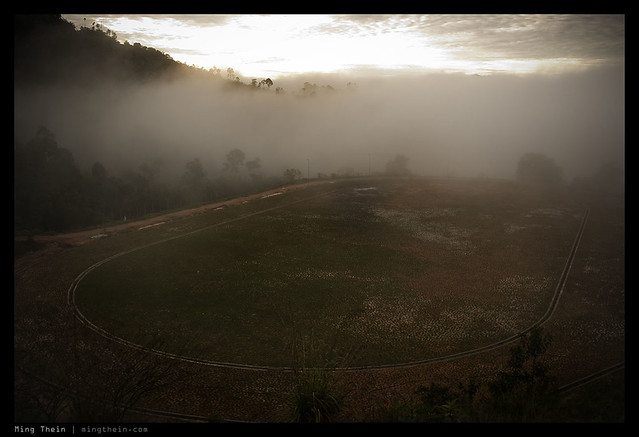
_7016463 copy
Morning mountains. Would have been better with a little more micro contrast; the original file was very, very felt indeed. Nikon D700, 28-300VR

Practically, what is this lens good for? What do I use it for? Basically, two things: it’s a Swiss army knife, for times when I know there’ll be plenty of light out, and I’m not aperture-limited; when I don’t know what I’m shooting or know that I’ll require a lot of perspectives; and finally, when I need telephoto reach. I shoot most of my work below 85mm, so this is a kind of emergency tool for when I need to go longer. It works, and having said all of the above, it is capable of delivering pretty good images – if you use it within its limitations. Just don’t try and shoot architecture in the dark hand-held with it. MT

_7018406 copy
Sky hole. Nikon D700, 28-300VR

The Nikon AFS 28-300/3.5-5.6 VR G is available here from B&H and Amazon.

____________

Visit our Teaching Store to up your photographic game – including Photoshop Workflow DVDs and customized Email School of Photography; or go mobile with the Photography Compendium for iPad. You can also get your gear from B&H and Amazon. Prices are the same as normal, however a small portion of your purchase value is referred back to me. Thanks!

Don’t forget to like us on Facebook and join the reader Flickr group!

appstorebadge

Images and content copyright Ming Thein | mingthein.com 2012 onwards. All rights reserved

On assignment and studio review: Watch photography with the Leica M9-P

We photographers are a strange lot: sometimes we make our lives difficult when there’s absolutely no need to. I recently shot a watch photography assignment using a Leica M9-P, of all things. (This setup has been the subject of another post, here)

You probably know that my usual rig for this is a Nikon with a whole bunch of extension tubes. Why did I do it, you might ask? See the end of the post for the answer.

Let’s start back-to-front, with a few highlights from the results:

_M9P1_L1013948 copy
Deep Sea Chronograph.

I would conservatively say that this was the most difficult shoot I’ve ever done, and the only one that required the services of an assistant – normally, I find they just get in the way and it’s much faster for me to do what needs to be done rather than have to explain it. Firstly, this rig is one which does not focus to infinity, is entirely manual, and is both heavy and unwieldy. Put one finger wrong and you’re liable to make a hole in the bellows, which being the better part of half a century old, is extremely fragile. (The mechanical parts are still in amazingly good condition though, and operate very smoothly.) You need to set magnification first – also restrictive, between about 2.5:1 to 1:2 only (with the Visoflex and 90/4 only) – then move the entire rig to frame – and because it’s unwieldy, you can’t do this handheld. I made a kind of gimbal head out of a Manfrotto 468RC0 Hydrostat head tilted at 90 degrees, to which was vertically mounted a Manfrotto geared focusing rail, with the rail on the Bellows II attached at right angles to that – which allowed me tilt and yaw motion, and precise front/back and up/down movements. Slow going – there were ten adjustment points on support system alone, to say nothing of photographic controls – but accurate.

_M9P1_L1013352 copy
Duometre a Quantieme Lunaire 40.5

Secondly, the Visoflex prism obviously blocks the M9-P’s hotshoe, ruling out the use of flashes – at least by any conventional means. With a custom-fabricated cable (read: a hotshoe cover with holes made in it to thread through speaker wire, which was then soldered to the contact points of a donor slave – in this case, a Nikon SB700), it was possible. The slave flash would fire at minimum power and trigger the other flashes in SU4 optical slave mode. Optical slave mode is a polite way of saying 100% manual – so it’s either light meter (which I don’t have) or experience (which I do have, from shooting the same thing with slide film). My assistant would run from flash to flash poking buttons and turning wheels in response to cryptic instructions like “top, up one; back, thirty-two and fifty millimeters, up ten degrees; kill the right one.”

[Translation: Top flash, increase power by one stop. Back flash, change power to 1/32 and zoom head to 50mm, tilt the head up ten degrees. Turn off the right flash.]

_M9P1_L1014200 copy
Amvox World Chronograph

It was a near thing. The entire job relied on a single critical part: that sync cable. At one point, there was an internal short somewhere which either kept the flash firing frequently enough to trigger epilepsy, or not firing at all. And to compound things, I suspect the trigger voltage of the hotshoe and flash didn’t agree, which would occasionally cause the M9-P to not fire its shutter at all. And then the Visoflex jammed…let’s just say the Victorinox earned its keep on that day.

_M9P1_L1013260 copy
Duometre a Quantieme Lunaire 40.5

It took me just over nine hours to make a final cut of 80 photographs – which is excruciatingly slow, considering I’ll normally do three times that number in two thirds of the time. Most of the delay was due to moving and setting the camera, or fine-tuning the flashes.

_M9P1_L1013409 copy
Duometre a Spherotourbillon

However, I think this conclusively proves that the Leica M system is a lot more versatile than most people think. Now, if only Leica would produce modern versions of these accessories – and perhaps something to trigger a flash. I don’t think most people have any idea how difficult it is to find a Bellows II-screwmount to Leica M adaptor until you look…

_M9P1_L1014513+28 copy
Master Ultra Thin Reserve de Marche

One quick comment on image quality: the 90/4 Macro-Elmar is a superbly sharp lens with great micro contrast, if you use it in the optimal range. At maximum aperture (f4), there is very visible chromatic aberration – both longitudinal and lateral. Stopped down between f5.6 and f11, it’s superb. At f16, diffraction suddenly kicks in – there’s a huge difference between f13 and f16, it’s as though somebody has run a Gaussian filter over the entire image. (I think at this magnification it’s probably closer to f32, though). I wouldn’t even go near f22. I had to pay careful attention to lighting with the M9, for the simple reason that its dynamic range is probably 2-2.5 stops less than the D800 at base ISO. All in all though, I think you’ll agree that the combination is capable of some spectacular results – even more impressive considering that it was never designed for this.

leicamacro01

Because we photographers have a particularly odd fascination with checking out other people’s equipment, I’m going to leave you with some gear shots. I will also say that if anybody is in the market for a tripod head, the Manfrotto Hydrostat series is truly excellent – it’s the only head I’ve ever used that doesn’t exhibit any ‘droop’ when locking down the head, no matter the weight or magnification of the camera and lens combination attached. It’s rock solid.

leicamacro02

leicamacro05

Yours truly at work. (You’ll notice I’m not using the tripod here; I put it aside for the further-away shots of whole watches.)

leicamacro06

My exhibition of fine art horology sponsored by Jaeger Le-Coultre and Leica will be on display at Starhill Gallery, Bukit Bintang, Kuala Lumpur from 3 May onwards – please drop by if you’re in town! If you let me know in advance, I’ll try to give you a personal tour. MT

____________

Visit our Teaching Store to up your photographic game – including Photoshop Workflow DVDs and customized Email School of Photography; or go mobile with the Photography Compendium for iPad. You can also get your gear from B&H and Amazon. Prices are the same as normal, however a small portion of your purchase value is referred back to me. Thanks!

Don’t forget to like us on Facebook and join the reader Flickr group!

appstorebadge

Images and content copyright Ming Thein | mingthein.com 2012 onwards. All rights reserved

Professional photography with compact cameras

_0011047 copy
Regent Square architecture, London. Ricoh GR-Digital III

The title of this article isn’t a contradiction: I did really just suggest shooting for clients, for money, with a compact camera. I’m not talking about compact system cameras or ILCs like Micro Four Thirds; those have recently come of age and are very, very competent indeed – in fact, for most purposes, they produce indistinguishable final results (think print, or web, rather than pixel-peeping at 400% on a perfectly calibrated monitor) from larger cameras if used within their limits.

_0012621 copy
GuB Marine Chronometer. Ricoh GR-Digital III

The reality is that while the big guns have been steadily improving, and have almost all surpassed the image quality level any professional photographer may require, there have been steady improvements in compact cameras (fixed lens, small sensor) too. It’s often not clear which arm of sensor development leads which: the desire for lower noise and improved photosite efficiency has undoubtedly helped improve dynamic range and noise properties of larger sensors. And vice versa, development of CMOS technology for larger sensors is slowly finding its way into point and shoots.

_0011852 copy
Gas Malaysia. Ricoh GR-Digital III

What does this mean? In the real world, my clients almost never have final uses for the images that require more than 12MP when properly shot and composed (i.e. not heavily cropped). We can delude ourselves into thinking more is better – all else equal, it usually is – but most of the time, it makes no difference. Even if you’re doing a billboard, you don’t need medium format – I’ve done a couple with the mere 4MP Nikon D2H – simply because the individual pixels are about the size of golf balls, but nobody notices because you never get any closer than 20 meters.

_0011137 copy
Selfridges, London. Ricoh GR-Digital III

I recently shot some wildlife images for the local Malaysian launch for the Leica V-LUX 3 (a full review is here on the official Leica Blog). The spec is ambitious: a fixed 24-600mm lens,12MP, and full resolution images to ISO 3200. Did I mention the sensor was just 1/2.33” in size? It doesn’t get much smaller in the compact realm; there’s 1/2.5”, 1/3”, and then you’re into cellphone sensors.

_VL31_L1000236 copy
Scarlet Ibis. Leica V-Lux 3

In any case, the images were printed to at least 20×30”, and in some cases, larger. I even used ISO 400 (base of 100) and very dodgy shutter speeds for some of them. Was the color odd? Did they look grainy and horrible? Not one single bit, even with your nose pressed up to the print. I shot raw and did zero noise reduction – zero. Would they pass for fine art, let alone commercial use? Absolutely. In fact, the results were on par with the Nikon D200 and it’s APSC sensor that I used for the same kind of thing about five or so years ago.

_VL31_L1000944 copy
Leica Visoflex III on M9-P. Leica V-Lux 3

I did some other testing with that camera, too: studio product work with flash. Here, the result was even more difficult to distinguish from a larger sensor camera – at base ISO, controlled lighting and optimal apertures, everything looks superb even to the pixel level. In fact, possibly better, because to achieve the same depth of field in the final image, I’d have to stop down so far on a full frame camera that I’d be incurring a softness penalty due to diffraction.

_0010773 copy
Tulip staircase, Queen’s House, Greenwich. Ricoh GR-Digital III

So what about putting my money where my mouth is? I have already. There are photos I submitted to Getty Images – which were shot with an iPhone 4 (5MP) – and accepted. I swear the file quality is fine for A3+ prints, so long as you’re shooting at base ISO and watch exposure carefully – I’ve tried. I recently shot another job (to be the subject of a future On Assignment article) with another compact – the Leica D-LUX 5. Yes, it has a slightly larger sensor, and I was using LED light panels, but the result was successful: the client (and I) would not have been any happier had I used a larger camera.

_0011302bw copy
KL Drift. Ricoh GR-Digital III

We all know Alex Majoli made his name shooting with compacts – famously half a dozen Olympuses C5060s – because of their silence, unobtrusiveness and low replacement cost, especially important in combat or hostile environments. (I’m told he uses an M9-P now, though.)

_1002177bw copy.jpg
Welders; Hommage a Majoli. Ricoh GR-Digital I

I should probably talk a bit about the situations in which a compact would be more useful than a larger DSLR or even ILC:

1. When size or weight is a priority. I haven’t done it (and probably never will) – but I wouldn’t want to climb Everest with a Nikon D4 and suitable lenses. There’s plenty of light, so I’d probably go with one of the more robust compacts.

_1002147bw copy.jpg
Shipyard inspection. Ricoh GR-Digital I

2. When you don’t want to stand out. Sensitive or covert photojournalism/ documentary photography immediately springs to mind. Nobody is going to pay you a second thought or glance if you’re ‘just shooting with your cellphone’ – everybody else is doing it, so you just blend in. Compacts are pretty much socially acceptable and transparent in most situations; if you’re not 100% sure of that, adopt the shooting pose of a complete photographic ignoramus and you’ll soon see what I mean.

_0010486bw copy
Nepalis protesting in London. Ricoh GR-Digital III

3. When there’s a lot of light. This sounds stupid: it’s not, because you’re going to have a to stop down a DSLR in the tropics if you’re shooting in bright sunlight; I’ve hit the 1/8000s limit even at f4 or f5.6 and base ISO before – especially with anything even slightly reflective, like water or glass. Short of using a grad ND so you can open up the aperture a bit more, you’re going to land up having to stop down anyway. And guess what: compositionally, there’s no longer any difference between the images cameras of a different sensor size produce. (Dynamic range is something else entirely).

_0010059 copy
Tea time. Ricoh GR-Digital III

4. When you need extended depth of field. There are compositions that only work with compact cameras precisely because everything is in focus – something which may be optically impossible with an SLR, especially if you need a telephoto perspective. You’re probably wondering why I don’t use one for macrophotography: simple, nobody makes something that delivers the right perspective, and since you can’t change lenses, there’s not a lot I can do to rectify that. Secondary optics and adaptors are an option, but then you’re going to be getting compromised image quality because you’re adding components to an optical system that’s optimized for something else.

_0011006bw copy
Trees. Ricoh GR-Digital III

5. When you want a different look. There are times when the harsher, higher contrast look that’s a property of smaller photosite sensors (specifically: lower dynamic range, because the electron wells are physically smaller and can’t collect as many photons before reaching full charge capacity and overflowing – i.e. blowing out or saturating). If you’re shooting in bright daylight, this could look like exposing for the shadows and completely losing the highlights to white; or exposing for the highlights and leaving the shadows dark (or even black). The latter produces some very arresting black and white work, actually. Or if you’re totally masochistic, perhaps you like the look of massive chroma and luminance noise.

_780_IMG_2630bw copy
Croissants a Poilane. Canon SD780 IS

The one final piece of advice I suggest is that you talk to your clients beforehand to make sure they’re okay with you using a small camera: very often, it’s about perception rather than reality; your client may not be aware that you can deliver the same image quality or unique images through your choice of equipment – it may negatively affect your reputation. Most importantly, make sure you have enough practice and confidence that you can actually deliver what you claim with your compact – don’t experiment on paid work, unless it’s B-roll. And as ever, always carry a backup. MT

____________

Visit our Teaching Store to up your photographic game – including Photoshop Workflow DVDs and customized Email School of Photography; or go mobile with the Photography Compendium for iPad. You can also get your gear from B&H and Amazon. Prices are the same as normal, however a small portion of your purchase value is referred back to me. Thanks!

Don’t forget to like us on Facebook and join the reader Flickr group!

appstorebadge

Images and content copyright Ming Thein | mingthein.com 2012 onwards. All rights reserved

The ideal camera

I’m going to disappoint you upfront: it doesn’t exist, at least not yet. But what if we did a hypothetical – yet realistic – exercise to see what a product like this would look like?

First disclaimer: I, and a group of partners, were very close to building this – but we were let down partway through by a key technology partner, and found funding challenging – despite the continuing growth of the photographic industry, especially at the advanced amateur and entry-professional segments. Alas, it never materialized. In any case, the idea has matured a bit since then, both through the benefit of time, and ideas gleaned from intervening new product releases.

Second disclaimer: This is what I would like as a photographer, and may not necessarily apply to everybody.

I’m not going to suggest a 100-megapixel, 25fps, point-and-shoot sized body with a full frame sensor, and built in 10-600/1.4 zoom. That’s stupid, and the preserve of equipment masturbators on camera forums who don’t actually use their equipment.

Right now, I use four systems: full frame Leica M digital, for photojournalism, reportage, portraiture and travel work; full frame Nikon FX for extreme low light, macro and controlled lighting work; Micro Four Thirds for personal work/ carry where photography isn’t the primary objective of the outing, and where anything larger might be obtrusive; and finally, a number of compacts for social documentary use. I’ve never been told by a client that I have insufficient resolution; and I’ve delivered images as small as 5MP before. Why? Because I’m a stickler for practicing shot discipline; that means even though I’m ‘only’ giving you 5MP, they’re 5 extremely clean MP at the pixel level, well exposed, perfectly focused, not posterized, and will print cleanly at A2. More MP – say 18 from the M9 – just means you can make larger prints before fine detail breaks down at close inspection distances. That’s all. I’ve only come up against the low light limits of the Nikon system once – and that was photographing a wedding in near darkness (only candles) in rural Nepal; but I was still able to get good quality images with ISO 12,800 and f1.4 glass. I don’t need ISO 512,000.

Let’s take the best parts of each system, and see what our bastard-camera would look like:

1. Sensor size: This is a tough one, actually. There are times when I want a smaller sensor for more DOF (think very compressed perspectives) – I will often use a compact for this. There are times I want a larger sensor for even shallower DOF for a given field of view – this is the main attraction of systems like the Leica S2. Let’s go with full frame, because we can always have a 2x crop factor (it’s easier to multiply out than 1.5x, and when you want a smaller sensor it’s generally because you need more reach or more DOF and more reach.)

2. Sensor spec: 48MP. Whoa, really? What happened to I don’t need huge MP, you’re wondering? Simple: pixel binning. 48 million photo sites – with RGB + Luminance values coming from individual photo sites, would mean amazing detail, fantastically accurate color, and low noise. Output file resolution of 12MP – but actual pixel detail of 12MP. With this technique and today’s sensor architecture, I don’t think it’d be a problem to get a clean ISO 12,800 file. And that’s enough for me. Add a Bayer algorithm mode to give a 12MP crop, and that takes care of my telephoto/ compressed perspective/ high DOF needs.

3. Speed: Doesn’t have to be fast – 5fps is plenty. I work just fine with the single-shot M9-P; most of the time bursts are for stability rather than action.

4. Video modes: I don’t use it, but I do like to experiment – so perhaps a 1080P/ variable frame rate mode would be nice, with full manual controls, of course. But no rolling shutter!

5. Autofocus: Let’s take the best there is now and match it: CAM3500FX in the Nikon D700 is eerily psychic at tracking moving subjects; however, it could use more frame coverage – expand the points to cover out to say 80% of the frame linearly, and we’re in business.

6. Firmware features: Lots of scope for customization: I don’t mind going through a lengthy setup process to ensure the camera does exactly what I want. I want to be able to hide things in menus and reassign all of my buttons, and have custom modes that set all camera behavior – including base exposure parameters – at once. And of course the ability to remember, save and transfer to another camera body.

7. Lenses: AF, fast aperture – at least f2, preferably f1.4. Useable wide open, of course. Physical aperture rings. I don’t need zooms, or extreme focal lengths; 18-24-28-35-50-85-200 and a short tele macro (maybe the 200 could double as a macro) will do me just fine. It could even be reduced to 24-50-85 in a pinch, so long as one of those was a 1:1 macro with capability to take a bellows or extension tubes.

8. Body: Robust, thick-gauge metal (tactility is important) and weather sealed; plenty of sensible physical controls; an optical viewfinder or excellent EVF – I think the new Sony OLED unit in the NEX-7 or 5N is about the minimum. But I much prefer the enormous, bright finder of say the Leica S2. I think M9-size is about perfect; big enough to have some heft and solidity, sufficient space to house all of those controls, and (yes, I’m shallow – or at least some clients are) impressively professional-looking. That would have to have an EVF to maintain the body thinness and accurate framing. If it’s an optical finder, we could probably make it small-SLR size – I don’t see why a full frame sensor won’t fit inside a D7000-sized body; the flange distance is FX-sized, and there were film SLRs of similar dimensions. Ergonomic comfort is very, very important – especially if you’re going to use it for 12 hours a day (or sometimes even more). Plenty of sticky rubber and thumb/ finger hooks, please. Buttons big enough to use with gloves, and wheels/ switches that don’t move unless you want them to – think locking buttons or very stiff detents.

9. Other considerations: File format: Compressed 16-bit DNG. It’s future proof, past-proof, and easy to handle and archive. Don’t bother with JPEG because I don’t use it. Live view would be nice, but not critical; it can be useful for awkward angles but is greatly enhanced by a swivel screen (which frankly I hate because they’re flimsy and compromise body integrity). A vertical grip is nice, but not necessary. What is necessary is a high magnification, high-eyepoint (I, and a lot of other photographers, are poorly sighted thanks to plenty of shooting into bright point light sources and so need to wear glasses) and with a nice big rubber eyecup. A high-resolution, color-accurate LCD is important for review. Most important is operating speed – menus and such – the camera should never feel laggy. This is the #1 reason why I’ve given up on a piece of equipment in the past.

Okay, so who’s going to make me one of these things? MT

And the Nikon D800 autofocus saga continues (with some comments on specific lens performance)

This post is a quick update to my D800 autofocus issues, as well as commentary on the specific performance on some of the more popular lenses people have been asking about. I don’t have time to post crops, but I think most of you would trust that I know what I’m doing.

I spent the morning at Nikon. Ostensibly, to collect my replacement D800, and a PC-E 85/2.8 Micro. However, it turns out the replacement D800 exhibits the SAME autofocus issue – namely, with wide angle lenses, the center and right side AF points yield in focus images, the left side bank is way out. This is especially obvious with the 24/1.4 G. We also tried their NPS loaner demo units and their D800E sample. The results were mostly the same – all of the D800s showed identical results. The D800E was a bit better, but still noticeably soft on one side. It gets worse: I’ve had a number of emails from people with cameras in the same serial number block – below 1000 – and the 24/1.4, who are finding the same thing. Apparently it is a serious issue, because my NPS rep told me that HQ has asked for updates and is looking into it on the production line.

Perhaps it was my 24/1.4 sample that was the issue – nope, because it works fine on a D3x, D4 and D700; we tried another 24/1.4 which showed consistent results – that rules out lens problems. I think we can also rule out sensor alignment problems as I don’t see any odd shifts in the focal plane when focusing using live view.

The upshot is that it will take them two days to diagnose the problem, and possibly longer to fix. Since it’s only an issue with wide angles, and not an issue with anything above about 50mm, I elected to keep this body for the time being – I’m only using it in the studio with the 60/2.8 G Micro, and now the 85/2.8 PCE. It looks like I will be reviewing both E and non-E after all – I’ve elected to take a D800E for the replacement unit.

There were more surprises in store, though – specifically, with lenses.

Summary of Nikkors tested so far on the D800:

AFS 14-24/2.8 G: Not good at 14mm; obvious corner sharpness issues. Displayed AF issues at 24mm. Center is sharp. T stop is probably closer to f4 than f2.8. Average to good performer.

AFS 24-70/2.8 G: Sharp everywhere in the range, at every aperture. No AF issues, even at 24mm. Excellent performer.

AFS 70-200/2.8 G VR II: Sharp everywhere in the range, at every aperture. 85mm setting better than the 85/1.4 G at f2.8, and comparable to the 85/1.8 G at f2.8 (yes, you read that right. The 85/1.8 G is better than the 85/1.4 G.). No AF issues either. Excellent performer.

AFS 24/1.4 G: Sharp everywhere except extreme corners at every aperture if you live view – remains an optically amazing lens, but now even more fiddly to use thanks to the AF issues. Three copies all displayed left-side softness on the D800, but not on other bodies. Cautiously, I’d say excellent performer, to be confirmed once I have a properly working body.

AFS 28-300/3.5-5.6 G VR II: Sharp everywhere if you close down the aperture on stop. Microcontrast not great, but serviceable. Overall global contrast is good. Color a bit odd. Good to very good performer. No AF issues, probably covered by depth of field and small apertures.

AFS 35/1.4 G: No good wide open. Center is okay, both sides are not good – even after AF fine tune. Not recommended. The 24-70 performs much better at 2.8 than the 35/1.4 does at the same aperture. Slight AF issue noticed, same as 24/1.4.

AFS 85/1.4 G: Inconsistent. Wide open displays LCA and LoCA at edges. Nowhere near as good as it was on the D700/ D3/ D3s. Stopped down to f2.8, it improves, but only to about the same level as the 70-200/2.8 II wide open. Note T stop is pretty high for this lens though – probably 2/3 stop more than the 70-200/2.8 II, and half a stop more than the 85/1.8 G for the same aperture. Good to very good stopped down. Honestly, I’m not liking this lens very much anymore.

AFS 85/1.8 G: Incredible. Sharp everywhere at every aperture, no LCA or LoCA. Bokeh is neutral, not quite as good as the 85/1.4 G. Surprising considering this lens has no ED glass, Nano coating or aspherical elements. It’s honestly an optical masterpiece, and very, very cheap. If you need an 85mm and don’t have the 85/1.4 G already, I’d suggest buying one of these. Performance at wide open at f1.8 is better than the 85/1.4 G at 2.8; it matches or slightly exceeds even the 60/2.8 G Micro at the same distances. You’re probably wonder what’s the catch: two things; T stop and build quality. T stop is half a stop down on the 85/1.4 G for the same aperture, and it’s light and plasticky. Still weather sealed, though. Excellent plus performance, no visible AF issues.

PC-E 85/2.8 Micro: This is the only lens of the group tested that could best the new 85/1.8 G, and by the slightest of margins (or maybe both lenses out resolved even the D800E sensor and we’d need something even higher density to see the difference). Global contrast is a little lower than the 85/1.8 G, but micro contrast has more bite and structure to it – reminds me of the Zeiss macros. Excellent plus performance. (I took this one home, after relieving my credit card of some of its available balance. Look out for a full review in the future once I get a chance to shoot it in the studio.)

PC-E 24/3.5: A truly excellent piece of glass. Matches the performance of the 85/2.8, but at 24mm. Shame about the small aperture, though. Handily focuses to about 20cm – which is about 3cm from the front element of the lens. I’d say sharpness performance of this and the 24/1.4 G at f4 are about the same, however the micro contrast structure of this lens is almost Zeiss-like in detail. Excellent plus performance again. And whoever said it won’t mount is wrong – it mounts and offers full movement just fine, but you must zero all of the movements before trying to mount it, and there are certain orientations that work better than others (big knobs vs small knobs near the prism etc.)

AFS 60/2.8 G Micro: Although this was my reference standard on the 12MP FX bodies, it’s performance clearly isn’t up to the D800’s demands: I’m seeing plenty of longitudinal CA (especially in the bokeh) that wasn’t there, or almost negligible, on the D700. It’s sharp already at f2, but not critically bitingly sharp til f4-5.6; your working aperture range is somewhat limited because diffraction kicks in noticeably by f16, and it’s unusably soft by f25. I’d say f22 is probably best reserved for emergencies. This is the main reason I got the 85/2.8 PCE: lack of depth of field control. I’d put it in the good-to-excellent range.

A word on the D800E: I didn’t have a lot of time with it, but from what I can see, there is a slight but noticeable difference in fine micro contrast, as well as sharpness and resolving power. It seems to offset diffraction to some extent. However, file sizes will be even bigger, and lens demands even higher. Recommendation: use with caution, requires controlled circumstances to get the most out of it (tripod or studio lights, low ISO).

Conclusion: If you plan on getting the most out of your D800/D800E, you’re going to have to rethink your lens lineup. What worked brilliantly for me on the D700 – as in I felt I couldn’t get any more image quality out – isn’t working on the D800. And there are a lot of surprises here; not all of them good – the 85/1.4 G and 24/1.4 G are good examples of this. It seems that one has to now choose for a lens set optimized for studio work (or slightly brighter light conditions) – 24-70, 70-200, 85/1.8G, 85/2.8 PCE – with the compromises that brings for available light work, especially now that you’re going to require more shutter speed to handhold and the sensor loses out a stop to the D700 at the pixel level – or run two sets of lenses. This obviously isn’t ideal, or cheap. I feel the latter route is likely the way I’ll have to go – probably with the 85/2.8 PCE for the majority of my studio work, and a Zeiss 21/2.8 or 24/3.5 PCE for architecture and interiors.

Am I happy with feeling like a bit of an expensive guinea pig? Not one single bit. I think this latest push in resolution has brought up manufacturing tolerance and QC issues that were never previously noticeable. But at least a) it works under a known range of conditions, and more importantly NPS here deserves credit for doing their best to rectify the situation, and at least provide me with a working solution in the intermediate period (D3x on extended loan for high-res WA work).

It’s not ideal, but when you get everything right, the D800 is capable of delivering pretty darn amazing image quality. The trouble is, once you’ve seen it, you really don’t want to give it up – even if it is a colossal pain to achieve. Of course, none of this will be news to seasoned medium or large format shooters – but for anybody expecting to go from a DX consumer body, or even 12MP FX, to D800 and get pixel-level crispness across the frame, there’s going to be something of a steep learning curve to climb. MT

Check back for more updates once my D800E replacement body (finally) arrives at the end of the month.

____________

Visit our Teaching Store to up your photographic game – including Photoshop Workflow DVDs and customized Email School of Photography; or go mobile with the Photography Compendium for iPad. You can also get your gear from B&H and Amazon. Prices are the same as normal, however a small portion of your purchase value is referred back to me. Thanks!

Don’t forget to like us on Facebook and join the reader Flickr group!

appstorebadge

Images and content copyright Ming Thein | mingthein.com 2012 onwards. All rights reserved

Mirrorless system lens compatibility recommendations

For those of you with legacy system lenses, compact system cameras seem to make sense, yes? You can use all of your old lenses on newer bodies via adaptors and you’ll not only get to use your favorite optics, but you’ll save money to boot. And the really short back flange distances of some of the lenses mean that just about everything from an SLR or RF mount will fit with the right adaptor.

Well, not quite: firstly, all the fields of view will be different unless you’re going between APSC and APSC. Then there’s also the issue of size: why buy a compact mirrorless systems with the intention of reducing weight when you then go stick an enormous lens on the front?

Bottom line: there are many disadvantages to using legacy glass on mirrorless systems; more so than advantages. I knew that going in, and only use my micro four thirds system with dedicated lenses; but I have got a whole drawer full of adaptors, mostly purchased out of sheer curiosity.

If you are hell bent on making unholy pairings, then read on.

Quick aside: ‘Good’ means lenses work well, and deliver excellent or outstanding optical results; better than the system’s native lenses. ‘OK’ means that they work about as well. ‘Bad’ means that you shouldn’t bother; most of the time this is due to non-telecentric wide angles not playing nice at the edges due to very short back flange distances and a lack of offset micro lenses on the sensor to counter sharp angles of incidence between image rays and sensor. This manifests as purple fringing, chromatic aberration, vignetting, and corner softness. It could also mean the lens just doesn’t have enough resolution to deal with a very high density sensor – for instance the 24MP Sony NEX-7. There are exceptions to this rule, and where I’ve found them, I’ve noted them. The Ricoh GXR M-module is an exception because it does have offset micro lenses and was specifically designed for RF glass.

Sony NEX
Good: Legacy Sony/ Minolta telephotos and normals; new Sony midrange and high end zooms; Leica M telephotos
OK: New Sony wides; Leica M normals
Bad: Older wides; Leica M wides; C-mount/ CCTV lenses (won’t even cover the image circle!)

Micro Four Thirds
Good: SLR high end telephotos, SLR normals, RF telephotos. Exception: Zeiss ZF/ZF.2 glass, Leica 35/1.4 ASPH FLE.
OK: SLR midrange telephotos; some of the slower RF normals
Bad: Leica M wides (pay attention to your adaptor: cheaper ones probably won’t be planar, and land up causing obvious astigmatism. They may not even focus to infinity, or minimum distance!). The Leica Noctilux 0.95 does not do well on micro four thirds; it displays a lot of CA and blooming. I suspect that it is only optimized with the focal plane precisely at 28mm from the flange. Most C-mount/ CCTV lenses – these lack the resolving power and flatness of field.

Nikon 1
Good: Any of the new Nikon lenses, say post-2009; almost all of these are telecentric and of sufficiently high resolving power. Any of the SLR high end telephotos, RF telephotos
OK: RF normals, all other cheap telephotos; older Nikon MF glass; RF normals
Bad: Cheap C-mount/ CCTV lenses – these lack resolving power; RF wides

Ricoh GXR
Good: Any Leica M

Nikon D800 quick update: Diffraction and studio work

One of the most frequent questions I’ve heard about the Nikon D800 is “where are the new diffraction limits?”

I spent the last two days using the camera for a studio product shoot – watches, of course – and now feel qualified to answer that question. Yes, my camera does have a misaligned AF module, but since you manual focus and stop down, it isn’t much of an issue for this kind of work. Low light wide-angle photojournalism, yes. But I digress.

Bottom line: with the 60/2.8 AFS Micro (which I think is the best of the macro lenses Nikon currently makes), everything is good up to f16, there are hints of it by f22, clear diffraction at f25, and I wouldn’t go past f29 even in emergencies – you’re probably back down to maybe 18MP of real resolution.

This is obviously a serious problem for the kind of photography I do. The solution? I just ordered the PC-E 85/2.8 Micro. MT

Addendum: I don’t know how many people this is going to matter to, but I notice the refresh rate of the built-in flash is slower – it matters to me because I’m an iTTL-CLS kinda guy, especially for my product and food photography work. What’s worse is that with the D700, if the camera wasn’t going to let the flash fire, you could cycle the power once and have a shot straight away. But with the D800, you’ve just got to wait, and wait, and wait for the capacitor to cool down and recycle. Cycling the power makes absolutely no difference whatsoever.

Update on Nikon D800 focusing issues

It seems that I’m going to have to redo all of my focus tracking and lens evaluation tests: my AF sensor module is misaligned. I’ve come to this conclusion after a) trying out a number of wide angle lenses, all of which exhibit a soft left side when the AF system or focus confirmation dot reports achieving focus; and b) sending it in to Nikon locally to diagnose. Curiously, the problem is only exhibited with wide angle lenses (telephotos are mostly fine), and live view confirms it’s an AF sensor issue not an imaging sensor issue.

The bad is that it’s serious enough to require a new camera because the calibration is a very high precision adjustment that takes time (and unclear if it can be done locally); the good news is that NPS Malaysia made the situation right: a couple of hours after reporting the problem, I met with a representative who informed me a new D800 will arrive next Wednesday, and I’ve been loaned a D3x until the replacement arrives – at which point it will just be swapped out. Kudos to NPS for handling the problem well though – that’s how professional service should work (though a new camera on the same day would be even better…)

Still, a bit of a shame, because I planned to use the D800 for its first commercial shoot this weekend – looks like I’ll only be using it for the stop-down telephoto shots. MT

Coda: It’s interesting just how sluggish the D3x feels when shooting in 14-bit raw mode – just 1.8fps, with what feels like a good 200ms or more of lag between hitting the button and the shutter firing. It’s very noticeable if you put the camera back into 12 bit mode, after which it feels responsive and snappy like it should. Even the menus feel a little laggy, like the camera’s processor is working very hard. The D800, by comparison, runs happily along at 5fps in 14-bit mode – 3x the frame rate with files that are 50% larger, for a total of 450% more data. You don’t feel any lag, and zoomed in images – even 14 bit raw – are very fast to navigate around. Faster than the D700, even. I don’t know how many other people have noticed this, but it’s pretty darn impressive, in my opinion.

____________

Visit our Teaching Store to up your photographic game – including Photoshop Workflow DVDs and customized Email School of Photography; or go mobile with the Photography Compendium for iPad. You can also get your gear from B&H and Amazon. Prices are the same as normal, however a small portion of your purchase value is referred back to me. Thanks!

Don’t forget to like us on Facebook and join the reader Flickr group!

appstorebadge

Images and content copyright Ming Thein | mingthein.com 2012 onwards. All rights reserved

Review: The Leica X1

_3100_DSC1318 copy

Why write about this camera now? The X1 may not be a new camera by any means, but curiously I think if anything it has become relevant again, now that large sensor compacts are all the rage (I can only hope for a digital full frame Ricoh GR1v or Olympus Mju II). I owned one of these for the second half of 2010 and into early 2011, before swapping it for the much-vaunted (and somewhat disappointing) Fuji X100 – to be the subject of another review.

What is interesting is that X1s are popping up used here and there at quite reasonable prices – though like most Leicas, they seem to resist extreme depreciation quite well. At the time, I couldn’t resist, and I was getting impatient waiting for the X100, so I traded in my Sony NEX-5 and bit the bullet.

_3100_DSC1400 copy

A little background: early attempts at mirrorless cameras seemed like a great idea to me – but also somewhat half-baked; here was a camera large enough to be inconvenient, but not large enough to do the job properly. And slow enough to make you want to tear your hair out. But yes, the image quality was definitely better than a small sensor compact. So I persevered. Early micro four thirds attempts weren’t just terrible, they were utterly dire. The Olympus E-P1 was so slow as to be unusable. And the control layout from the Panasonic G1 somehow just didn’t work well – despite being just fine on the LX3. Hmmm. The Sony NEX-5 was next; decently fast, getting smaller, but oh boy the interface was utterly horrible. And none of them had a good EVF, let alone a nice optical finder. Like every other equipment fanboy, the X100 seemed to be the perfect fix – EVF, OVF, manual controls, nice fast lens.

But the X1 got in the way.

_X1_L1000849 copy Hood reflections. Leica X1

First impressions: whoa, it’s light. There really isn’t that much inside the camera – although it’s metal, it gives the impression of being hollow rather than solidly packed like the Ms. It’s also nice and simple: the limited menu from the M8/9 made it over, keeping the important things and not adding anything superfluous. Shutter speed and aperture control dials are nicely obvious and pleasantly tactile, although they could perhaps be a bit stiffer to prevent accidental knocking. I’d ask for a lock button, but that isn’t part of the Leica gestalt. In fact, it looks and feels like nothing so much as a Barnack camera – especially if you put a compact finder on top. I like the Ricoh GV-2 28mm bright line – yes, it’s a 36mm equivalent lens, but if you use the insides of the 28mm bright line, it actually provides more accurate framing than a dedicated 35/36mm finder, which tends to be a bit too conservative for my liking. (I’m one of those people who composes their shots with the outside of their M’s frame lines.)

_X1_L1000782 copy
KLPAC. Leica X1

So, a digital Barnack – that’s a good thing, right? Well, yes and no. Let’s get the bad out of the way first: it’s slow; not in the control/ UI interface, but AF and MF were positively glacial. MF required too many turns of the little wheel to use accurately for zone focus; AF was just slow, period – even with the fastest ‘single point HI’ setting chosen. And it doesn’t focus closer than 30cm, though at times it seems even that’s a little generous. A firmware update improved things somewhat, but still doesn’t bring this camera into ‘this feels fast’ territory. I’m faster with an M9. And let’s not even talk about the Olympus Pen Mini. While I’m griping, I want to bring up two more issues: the battery life is abysmal – I mean I can exhaust a battery in an hour or two of shooting. Perhaps 300 frames and it’s flashing at me. Finally, in low light, the LCD doesn’t gain up enough; maybe it can’t without being grainy and unusable. It also doesn’t have enough pixels to manual focus easily. There are a few other niggles too – like peeling leatherette, which I was told is a tropical climate + glue compatibility issue and has been fixed on newer cameras; the flash sometimes not popping up…a bigger buffer would be nice, too.

_X1_L1001362 copy
Corporate sponsored roaring 40s party. Leica X1

With that done, let’s talk about the good things.

1. The sensor’s image quality is really excellent. For a 12MP camera using a last generation sensor. I understand it’s a derivative of the Sony sensor used in the Nikon D90, which was excellent but very much a first generation product for large sensor live view and video, and certainly without a fast enough refresh rate to be used for contrast detect autofocus – which is what the X1 does. ISO 3200 is definitely useable, and produces crisp results – with compromised dynamic range, of course; but the grain is nice and random, and mostly in the luminance channels. The tonal response of the sensor makes it excel at black and white work, even at higher ISOs. I believe the X1 also has a very weak (or possibly no) AA filter – and it shows.

_X1_L1001345bw copy
Shadow of the photographer. Leica X1

2. The lens’ image quality is also excellent. I was told that the optics are identical to the discontinued but highly regarded 24/2.8 Elmarit-M ASPH – except in a collapsible, autofocus version with an extended helicoid to allow focusing to 30cm instead of 70cm. It’s sharp corner to corner, and at every aperture. The lens clearly out resolves the sensor – aperture control is for depth of field control only, not improving optical performance. Microcontrast structure, flare resistance and chromatic aberration performance are all exemplary. Moreso when you remember that the lens is collapsible, with all of the various small potential alignment errors introduced by moving tubes and the like.

_X1_L1001184 copy
Redhead. Leica X1

3. The camera seemingly never fails to focus. Wait a minute, didn’t I say before that AF was terrible? I said slow: not inaccurate. It might take several seconds, but the camera will find focus. And that will be on the money. It doesn’t seem to get confused by point light sources, unlike most other compact system cameras I’ve used.

_X1_L1001273 copy
The mysterious oval in the mountains. Very, very low contrast – but no focusing problems. Leica X1

4. Flash sync speed is…1/2000s! Really? Yes, really. Say thank you to the leaf shutter. That means you can do a lot of creative work with it because you can sync at outdoor daylight speeds, as well as freeze motion very well. Oh, and there’s that handy built in flash: it’s quite useless for social work and as a primary, but as an optical slave trigger when manually set to minimum power, it’s great. One other benefit of the leaf shutter is that it’s an incredibly low-vibration camera – the release is just a smooth, quiet ‘snick’. I wish the Ms had a shutter like this – and the nice-feeling shutter button to go with it.

_X1_L1000998 copy
Hair flick. Leica X1, 1/2000s, Nikon SB900s in umbrellas.

Does it deliver the ‘Leica look’? Yes and no. These days, with enough processing, you can make a image shot from any camera look like it was shot using another one; however, there are some subtle differences like tonal accuracy and dynamic range that you can’t easily fake. The X1 feels to me like a half-Leica: the sensor is a CMOS, which by definition will have a very different – much more linear in the shadows and highlights – tonal response to a CCD, which is what is used in the M8/M9/S2 (and responds much more similarly to film, i.e. non-linearly). However, the lens definitely imparts some Leica DNA; you can see it in the way the images ‘pop’, but the color and palette might not be quite what you expect – that’s the sensor.

_X1_L1000466bw copy
Looking down. Leica X1

The bottom line is that this camera delivers what it’s supposed to: image quality. Ease of use is there, but speed could be seriously improved. And I’d like to see either a short zoom version (a 28-35-50 Tri-Elmar style lens arrangement could be interesting too) or a telephoto – say an 85/2 – which would be great for studio work.

_X1_L1000845 copy
More building color. Leica X1. I actually really liked this camera for architectural work; more than my Ms because of the precise framing afforded by the LCD. Wider would be nice, though.

I’m still trying to figure out who this camera is aimed at, though: it’s not automatic enough for a novice-who-wants-a-Leica to use and appreciate without feeling frustrated; you do need to know something about photography to get the most out of it by working around its limitations. (Hint: pre focusing is your friend). I think it’d make a good backup camera for an M user – if they sorted out manual focus; the wheel should be a bit more responsive, and it needs virtual DOF scales, I think – or an upgrade camera for a D-Lux 5 owner; but they might still want to keep the D-Lux around for the added focal length flexibility. It might also make the perfect weekend toy for the jaded SLR owner who wants to try something different.

_X1_L1001167 copy
Ferrari 430. Leica X1

One final word: as with all of the large sensor compacts I’ve used so far, don’t expect to shoot it the same way you shoot your SLR – it’s not designed for that. Instead, think of it more as an introduction to M-style photography – slower, more contemplative and more anticipative – and I believe the results will come. MT

_X1_L1001174bw copy
Lamborghini Gallardo. Leica X1

Popular Nikon D800 woes, problems, issues and solutions

There’s been a lot of brouhaha on the forums recently about the Nikon D800’s various ‘critical flaws’:

1. The camera stops down in live view, so you can’t see anything!

2. You can’t get a sharp magnified live view image, so it’s no good for critical focus.

3. LCD has a color cast.

Let’s deal with these one by one.

1. I don’t consider full time DOF preview to be a problem, actually. Besides, to achieve critical focus accuracy, you should be focusing with the lens at maximum aperture anyway. One of the advantages of live view is that you actually get to see what minimal DOF looks like, unlike with the viewfinder where the focusing screen limits DOF to somewhere around f4.

2. The live view preview image is heavily, HEAVILY dependent on your picture settings because it provides a PREVIEW. So, set accordingly. Note that picture controls don’t affect RAW images unless you’re converting in NX; the settings are stored as a tag in the metadata. I set my picture controls to maximum sharpening to gauge whether an image is in focus or not, the rest don’t matter. (I have a separate set for video.)

Specifically, see below:

Above with standard sharpening set; below with +9 set. Note the difference, specifically with the text. This is at or slightly beyond 100% view. Problem solved.

3. The color is definitely different to the D700/D3/D3s – if I had to say, I think it renders a little warmer. In the image below, both cameras were set to the same WB.

Regardless, you should not be judging color on the camera’s LCD anyway – all images will have to be processed via a computer anyway, and frankly if you’re spending this much on a camera, why would you want to be cheap on your image processing or computer monitor. It’s like buying a Ferrari but only putting 89 octane fuel in it and wondering why the car feels sluggish.

One final word: these are very minor issues. They aren’t deal breakers, and there are workarounds for all of them. Curiously, users of medium format digital have to endure much more – but we never hear them complain about their LCDs, or lack of live view – despite paying ten times as much. Go out and shoot and stop whining. Ultimately, your skill limits the quality of your image far more than the native color temperature of your LCD ever will. MT

____________

Visit our Teaching Store to up your photographic game – including Photoshop Workflow DVDs and customized Email School of Photography; or go mobile with the Photography Compendium for iPad. You can also get your gear from B&H and Amazon. Prices are the same as normal, however a small portion of your purchase value is referred back to me. Thanks!

Don’t forget to like us on Facebook and join the reader Flickr group!

appstorebadge

Images and content copyright Ming Thein | mingthein.com 2012 onwards. All rights reserved