The Sony Cyber-shot DSC-RX100 – a somewhat comparative review

_7065327 copy
All images in this review are clickable for larger versions, via the flickr host. The EXIF data is also intact. Apologies in advance for the lack of variety of sample images; the weather over the last few days just hasn’t been cooperative. No matter, I’ll continue to use this camera regularly as my pocket camera, and will be posting images both here and to my flickr page.

After receiving a number of emails asking if I’d review the Sony RX100, I decided to check one out for myself. Up to this point, I admit I hadn’t paid much attention to the latest round of compact camera offerings – I’ve got several excellent compacts, CSCs, SLRs – basically, all my bases are covered. Could I use something that might perhaps bring the next image quality notch closer to being pocketable? Sure.

Note: throughout this review, the product shots have had the logo taped over to prevent them being lifted and used without permission (which has happened before, often for dodgy internet merchants or ebay sellers). It seems image theft is a reality of the internet. Making a dime comes before any kind of ethics, which is rather sad.

_7065303 copy

My first encounter with the camera was in Hong Kong, oddly enough at a little store catering to second hand gear – yep, even before most of the world gets to have a camera in stock, there are people here already deciding that it’s time for the next best thing. I played with it for a bit, was hugely impressed by the focusing speed, and equally impressed by the low light capabilities of the camera. But I left to sleep on it overnight, and by the time I’d realized a few days later that the camera was constantly on the back of my mind, it was too late because it’d been sold.

_7065341 copy

No matter. I figured I could get one locally – wrong! In any case, a fellow photography friend in Hong Kong and Fedex came to the rescue; a day after asking him to hunt for one, it arrived on my doorstep.

Proper first impressions, in the cold light of day: it’s small. Very small. Especially considering it’s packing a 1″, 20.2MP sensor and 28-100mm lens; sure, it’s f4.9 on the long end, but that’s better than almost all kit zooms (I’m looking at you, Nikon 1, with your bulky 28-80/3.5-5.6 equivalent) and an extremely impressive f1.8 on the wide end. In effect, this camera makes the Nikon J1 look utterly pointless – it’s cheaper, has a better lens than both the kit zoom and the ‘fast’ pancake prime, and both better specified and more controllable. It’s actually nearly 1cm narrower and several mm shorter than the Ricoh GR-Digital III; and only 2mm thicker. The Leica D-Lux 5* I’ve got looks positively chubby by comparison. Of the three, only the Sony doesn’t have a hotshoe (and the Leica’s also doubles as an EVF port). Design-wise, it feels very much like Sony just duplicated the Canon S90/95/100 series of cameras, adding a prominent seam around the middle of the camera almost as an afterthought. Lineage-wise, however, it’s clearly a descendant of the V1 from 2003 and later the V3 from late 2004; both enthusiast compacts with bright Carl Zeiss lenses and plenty of manual controls. There’s also a bit of R1 DNA in there too, with its large sensor and fixed lens. However, the RX100 loses the various eye level finders of its predecessors. I don’t miss it too much; those little optical tunnel finders are nearly useless for precise composition anyway, and there’s no way to know what the camera has focused on, either.

*Comments also apply to the Panasonic LX5. The LX7 is going to be even larger; even though the lens gains a stop in speed, the sensor remains approximately the same size (1/1.7″ instead of 1/1.63″).

_7065342 copy

The body may be tiny, but the lens is by far the largest of the lot.

_7065350 copy

Of course, that isn’t the whole story; both Ricoh and Leica will focus down to 1cm at wideangle, where the Sony is limited to 5cm, and something much further at telephoto – nearly two feet. The Leica will go wider, and faster at f3.3 at the long end; the Ricoh of course has no long end, but it’s party piece is the excellent fast fixed 28/1.9. If this is starting to feel a bit like a comparison, it is; realistically, I’ve got these three serious compacts in my arsenal as options for when I need something truly pocketable. And taking two along would be utterly stupid (and defeat the point of a compact at all) – so there can only be one choice.

_RX100_DSC0319b copy
Urban painting in progress. Sony RX100

Sometimes, little quirks of handling can make or break a camera. The Ricoh excels here – it’s probably the best handling compact ever; two fully programmable control dials, a rocker switch, locking mode dial, and a wonderfully large pill-shaped shutter button that has both a well-defined half press, as well as a clean, soft break. Combine that with sticky rubber and rough magnesium, and it’s a handling dream. The Leica is a bit smooth for my liking; it’s slippery and easy to drop, and the rear control dial is stiff and difficult to press. But it does have an aspect ratio and focus mode switch, which gains it points in my book. However, the physical lens cap is definitely not a good thing – the Sony’s lens is much, much larger, and they’ve still managed to fit a retractable shutter in there.

_RX100_DSC0188b copy
Available light portrait – ISO 2500. Sony RX100

That said, I find the Sony’s controls both small and fiddly; ‘delicate’ is perhaps the best word to describe them. Firstly, the shutter button’s travel is far too shallow; the half press is stiff without much feedback or travel, and full press feels somewhat like half press on most compacts. Still, it’s very soft, which means it should be easy to activate without exciting too much camera shake. The camera does overall feel very responsive when shooting, and I suspect that shutter button feel has something to do with it. The rest of the buttons are small and similarly lack tactile feedback; the Ricoh meanwhile is exemplary in this regard. The RX100 actually has two control dials – one around the lens, which lacks any physical detents, and one around the four-way controller, which is used to control exposure parameters. I personally think the missing detents on the lens ring are a mistake; it makes it difficult to set exposure parameters (or any setting that has discrete increments) accurately. This limits its usefulness to only two things – zoom control and manual focus, which is a shame, really.

_RX100_DSC0259b copy
How the other half live. Sony RX100

There are a few other things I don’t like about this camera – let’s get these out of the way first, because they’re all relatively minor.
1. Charging in-camera – this makes it impossible to maintain two batteries; the camera needs it, because you’re definitely not going to make it through a whole day of shooting with only one. Battery life is about 300-400 shots per charge depending on how much chimping you do. Sony, at the price you’re charging for this thing, how difficult would it be to include a charger, or a battery-cap if you insist on just supplying a USB cable?
2. No shutter speed limits to auto ISO – I suppose it’s using 1/focal length, but there’s no way to be sure.
3. It’s slippery as hell and far too easy to drop. It would have been nice if the bottom portion (after the central groove) was wrapped in sticky rubber or something.
4. No raw support* (not really a Sony flaw, and I suppose it’s coming soon from Adobe)
5. No hotshoe – not really a big deal actually – I don’t think I’ve ever used the hotshoe on a camera like this, other than to hold an external optical finder – and if used at 28mm, this camera is just crying out for one. Sadly, there’s absolutely nowhere to put it.
6. The ‘?’ button isn’t reprogrammable – that makes it basically useless for advanced users when shooting, because it brings up a kind of ‘how to’ for beginners. That and it deletes images – which is bound to be supremely confusing for the novice, because instead of having his or her questions answered – their image will disappear!
7. While the camera is pretty fast to start up, it’s inexplicably very slow to turn off – and sometimes, won’t turn off at all if you suddenly move it. (Apparently this is the ‘drop sensor’ feature designed to freeze everything and prevent damage in case you do happen to drop it. It seems that somebody on the engineering team thought the design was too slippery…)
8. No manual included, print or CD – some settings are just not obvious (like manual WB for instance), and having to use the online HTML manual is a royal pain.
9. The meter tends to underexpose; I understand why this is useful to protect highlights especially for a sensor with small pixel pitch, but according to the histogram it’s by as much as two stops in cases.

*If you’re wondering why I didn’t use the supplied software, I did – but I stopped soon after starting, because frankly, like every other manufacturer-produced converter, it’s crap. Excruciatingly slow, doesn’t give you as much flexibility as ACR, and just doesn’t integrate into the rest of my workflow. It takes me less time to compensate for JPEG limitations than work around the raw converter, and in the end, the results are still better.

_RX100_DSC0245b copy
While waiting for the wife. Sony RX100

Still, at least we’re not restricted to only Memory Stick media, I suppose. There are a lot of things to like about the RX100. I’m going to ignore the trick multishot, face detect and scene modes (panorama, low light stacking etc) and just focus on the things that might be of interest to photographers. From a usability point of view, focus is both fast and accurate – even at the long end of the zoom, in lower light. I think it might be because there’s some form of continuous pre-AF always going on in the background; this definitely can’t be good for battery life. There is an AF assist lamp, but as with all ‘conveniences’ of this sort, it’s obnoxious. I turned it off. I keep being fooled into thinking it’s a small sensor compact because of its size; it isn’t, and you do have to watch your focus point – especially at nearer focusing distances, and with the lens wide open. As with all contrast detect AF cameras, continuous autofocus is best avoided, though the tracking mode works pretty well in static scenes – hit the center button to activate it, put the box over the thing you want to track, then hit it again to lock on. I can see this being useful for posed portraits, but little else. There’s also manual focus with peaking and magnification, though AF is so fast and flexible that I can’t see why you’d want to use it.

_RX100_DSC0326b copy
Construction break. Sony RX100

It’s worth saying something about the LCD, too – the ‘Whitemagic’ LCD has 1.2 million dots, but VGA resolution; there’s an extra white pixel in there to boost the brightness of the panel under daylight. The upshot is that this is one of the best LCDs in the business – it’s sharp and fluid, and you almost can’t see the pixels. It should be a little brighter, but it seems that you can’t gain up the auto-brightness setting – either manual or nothing. Sony deserves some praise for including a shooting mode where there aren’t any icons cluttering the framing portion of the display; instead, critical exposure settings are displayed in a black bar at the bottom of the screen, very reminiscent of an SLR finder. Without this, it would be impossible to compose – there are just too many darned icons littering the screen, taking up almost the entire left third of the display.

_RX100_DSC0351bw copy
Iron horse without a rider. Sony RX100

I do have one complaint about the LCD and metering system, though – it’s not consistent, or representative. Firstly, you can’t accurately judge exposure from the LCD like you can with some other cameras (the Nikon DSLRs and Olympus OM-D come to mind); secondly, matrix metering is rather unpredictable. Though it mostly tends to underexpose (presumably to protect highlights) – sometimes it does so hugely, by as much as two stops; yet there are other times when it does the exact opposite. I think this is Sony’s attempt at trying to replicate the actual scene as closely as possible, but it instead limits your dynamic range and increases noise – not to mention being a colossal pain given we have no proper RAW support at the moment, so post-capture adjustment latitude is limited. I’ve reverted to the centerweighted meter for any tricky lighting situations, because I simply have no certainty over how this camera’s matrix meter is going to respond.

_RX100_DSC0277b copy
Hood reflections. Sony RX100. This shot turned out VERY overexposed – far more than you’d expect for a scene of this type. Beware the meter.

This type of camera would probably benefit from a well-implemented touch panel to change settings or at very least select focus point; the economy of buttons doesn’t help when it comes to changing settings quickly. Having said that, the lens ring and Fn button functions are programmable; the latter holding seven customizable items. It also has three memory banks that remember all camera settings, and occupy the MR position on the mode dial. The one thing that really needs to be changeable isn’t – that’s the rear dial rotation. Somehow it just feels back to front to me, which results in a few fumbles before reaching the desired setting. Still, it lets you jump between zoomed-in images when in play mode, which is handy for comparing shots. (You can also power up the camera in playback mode without extending the lens by holding down the play button.) For the most part, camera functions – menus, navigation – are all snappy and occur without lag. The overall impression is of a very responsive camera indeed.

_RX100_DSC0344b copy
Man, chair and door. The extremely low prefocus shutter lag allowed me to position this man perfectly. It’s so fast the camera almost feels wired into your brain.

Adding to the feeling of speed is the 10fps continuous shooting mode, which works even in RAW+JPEG; there’s a small amount of lag between bursts as the files are written to the card (I’m using a 32GB UHS-1 Sandisk Extreme HD SDHC card), but there’s a seriously impressive amount of data being shunted around here. Somehow, the Sony engineers also found space to stuff in a couple of gyros too – there’s a level display, plus optical image stabilization. To be honest, the stabilizer feels a bit less effective than that in the Panasonics, and much less effective than the Olympus OM-D – surprising, because I believe it’s a lens-based system. It’s probably good for 1-1.5 stops.

_RX100_DSC0237bw copy
B&W portrait. I’m pleased with the tonality, despite being a) shot at ISO 3200 and 1/30s, so it was dark; b) being a JPEG; c) having most of the bottom halftones seemingly crushed into the shadows, and the highlight detail ‘stretched out’.

Image quality breaks down into two parts – the lens, and the sensor. Let’s talk abut the lens first.

Given the incredibly small pixel pitch, best working apertures are at below f5.6, and ideally around f4; this however is a bit of a problem as the lens only reaches f4.9 on the long end. Still, I don’t see much evidence of diffraction softening. For the most part, this is a reasonably good lens despite its ambitious specifications – the only place where it’s let down is close focusing distance (say under 20cm or so) and maximum aperture at the wide end. You’re going to have to be at f2.8 or preferably f4 to get critically sharp images when shooting close; before that point, there’s a lot of flare and coma going on that robs sharpness. At normal distances, it’s an decent performer. Mine’s does better in the corners at telephoto than wide; in fact, the corners are pretty soft at f1.8, which leads me to suspect a degree of field curvature. The top edge is also softer than the bottom edge of the frame – it’s difficult to build a retractable lens with consistently high resolving power cross-frame due to the required tolerances; not that this is any excuse. The lens also remembers your last used focal length when the camera was turned off – there doesn’t seem to be any way of disabling this though. There is a bit of bokeh available, though not much – but what you do see is relatively smooth an inoffensive (though I haven’t had any extremely harsh lighting conditions under which to shoot the camera yet).

_RX100_DSC0156b copy
Still life I. Sony RX100, uncorrected for vignetting.

Distortion and vignetting are minimal, and I didn’t see any evidence of CA, but since there’s no way to open the RAW files without the effects of Sony processing (I don’t count the supplied raw converter), it’s impossible to say how much of these optical limitations are being removed by the in-camera processing. I suppose we’ll just have to wait for an ACR update to find out. In the meantime, I’m making a ‘raw’ jpeg by turning off NR, reducing saturation and contrast to the minimum levels, and upping sharpening one notch (to preserve detail).

Does it have the Zeiss magic? Honestly, I’m not seeing it in the JPEGs – raw files might be a different story. It’s definitely a notch above the compact camera lenses I’ve used up to this point (with the exception of the GRDIII’s lens) but don’t expect it to have the same 3D pop as the ZF/ZE/ZM glass. It’s not a depth of field related thing either; the larger format glass pops even at hyper focal. (It could very well be a sensor limitation though).

_RX100_DSC0127bw copy
Still life II. Maybe there is a little of that Zeiss ‘pop’ and tonal richness after all – but it did require some post processing. Sony RX100.

The sensor is another story. Ostensibly, it’s a relative of the 10MP 1″ unit found in the Nikon 1 cameras; it’s a CMOS sensor with RGB filter array (curiously, not one of Sony’s four-color arrays). Pixel pitch is 2.4 microns compared to around 2 for the 10MP 1/1.7″ types, sub-2 for most normal compacts, 3.38 for the Nikon 1, 4.2 for the OM-D, and 4.88 for the D800E. Thus we’d expect slightly better performance than the current crop of prosumer compacts – perhaps a little more, given the generation gap. Not quite – it seems that this sensor is another generation ahead of the sensor in the Nikon 1, because it delivers similar noise levels, dynamic range and color accuracy despite having twice the number of photosites crammed in. In fact, from a noise point of view, it’s probably a bit better than the 12MP M4/3 sensor used in the E-P3 generation. Not quite what you expected huh? And all this from JPEG output. It seems Sony has upped their game there, too – unlike the oversaturated, over-contrasty, strange-hued JPEGs of the NEX-5, the RX100 generates remarkably natural looking files. Noise reduction – it cannot be completely turned off – when turned down, does a decent job of balancing texture/ detail and noise. My one complaint is that auto white balance is all over the place, and the camera doesn’t seem to like doing manual WB from a gray card – either it fails entirely, or delivers a very strange hue shift.

Sony RX100 noisetest
For a 100% version, click here

I feel there are only two areas in which the sensor’s smaller pixel pitch starts to show – that’s dynamic range, and edge acuity at higher ISOs. While dynamic range is a bit better than the prosumer compacts – perhaps 9.5-10 stops useable JPEG (and hopefully 11-11.5 in RAW) – the highlights and especially shadows clip quite abruptly (a lot of the tonal range seems bunched up in the bottom third of the histogram), so one must take care with exposure – not something easy to do when you have to contend with the camera’s erratic metering*. If you push the shadows too far in post, you start to get splotchy, low frequency (but random) yellow-blue pattern noise depending on the ambient lighting. There are also a few hot pixels thrown in for good measure, too. Edge acuity is another thing altogether – there’s visible erosion of fine detail structures beginning at ISO 1600, and getting more obvious as you go higher. Dynamic range doesn’t suffer quite as much as you’d expect, though. Overall, I’d put the high-ISO limit of this camera at 3200 – this is about the same as the Pen Mini, and a 1-1.5 stops more than the LX5, GRDIII et al. It’s going to be very interesting to see how this camera performs once we have a way to put the raw files on a level playing field…

*It’s also possible that I’ve been spoiled by the nice, linear RAW files from today’s CMOS-based DSLRs and CSCs. But then again, that’s unlikely, because the tonal response of the M-Monochrom’s CCD is quite similarly biased towards shadows and highlights and I didn’t have any problems processing those.

_RX100_DSC0350bw copy
Taxi drivers. Note the mark of JPEG: irretrievable highlight clipping. It was either this or lose the deep shadows. I suspect the image would have been saveable in RAW.

On the whole, two things left their mark on me during this review and while using the camera – firstly, I was constantly surprised by just how good the image quality was. I expected compact camera level, I was given constantly CSC-level, though not quite as good as the latest generation of M4/3 bodies like the OM-D. In many ways, it felt like an entry level DSLR crammed into a compact body. It’s incredibly fast and responsive, and shunts around large RAW files at 10fps without a hiccup. The lens is definitely an excellent performer, and a notch above the kit zooms; not to mention being faster at both ends and having a bit more reach. The second, less positive impression felt as though some useability had been sacrificed for size, usually unnecessarily – there’s no reason why we can’t have detents on the lens ring, an external charger, or even a printed manual (especially important given the complexity of the controls). There are ways to adjust things from both menu and shortcuts, but seemingly odd inflexibilities like the useless ‘?’ button and lack of an AF-point reset key (you have to move it back to the center with the D-pad). In some ways, the camera does feel like an experiment; which is surprising given the maturity of compact camera designs these days.

_RX100_DSC0070b copy
Untitled workers. Sony RX100

But on the whole, the RX100 gets it right – it is undoubtedly the best compact camera available today, especially from the point of view of image quality. And I still feel as though it hasn’t shown its full potential yet, hampered by the lack of RAW support. I’ll be taking this camera with me on holiday at the end of the month – and only this camera. (It’s a family trip, not a shooting one; I usually bring the GRDIII for occasions like this). It’ll be interesting to see how it performs, and if I feel like anything is missing – look out for an update early next month. Hopefully we’ll get ACR support by then too.

_RX100_DSC0143b copy
Still life III. Sony RX100

I didn’t think I’d have quite so much to say about quite so small a camera; the overwhelming feeling is that we’re very nearly at the point where there aren’t that many good reasons left for a larger sensor or even interchangeable lenses for most users – but perhaps that’s another generation out. What I do notice is that the improvement in smaller sensors has also had an effect on the way I compose – rather than seeking shallower depth of field, I’m looking for just enough to give the right amount of separation of subject from background; sometimes, a fast wide on a smaller 1″ sensor is enough; other times, you have no choice but to use 300mm on medium format because of the required perspective. One final point worth noting: this isn’t a cheap camera. In fact, it’s a good 50% over a Pen Mini kit, and comparable to a GX1 kit. It seems that you’re paying double taxes for minaturization and Zeiss optics; but the very few compromises mean that if you already have a large, fully-featured CSC or DSLR, then this is the ideal pocket companion for the times when you just don’t want all that weight. The RX100 isn’t a mature replacement for a larger camera, but the number of reasons to have one around definitely just got smaller. The limitations now rest squarely on the photographer; for most people, this is all the camera they’ll ever need. This is the king of the hill when it comes to compacts – I’ve not yet shot with anything else this size that has such great base ISO image quality and can handle ISO3200 with impunity and minimal consequences to image quality, whilst not holding you up with either focusing or continuous shooting speed. Highly recommended. MT

Coda: I’ve taken to putting some cloth tape on the front of my camera’s grip area for a more secure hold, because as handsome as the smooth anodized aluminium looks, it’s a slippery little bugger. Looks hideous, but I’d rather that than drop a very expensive point and shoot.

One reader also made a good comment on video: I’ve left it out. Yes, the camera can do 1080P 50/60, which is astounding considering its size; I tried it briefly and it looks fantastic, however I lack the expertise in this area to make any comments of weight other than to say that a) I don’t see much, if any, visible artefacting; b) you can zoom while recording, and it’s silent; c) the camera records stereo sound.

The Sony RX100 is available here from B&H and Amazon.

____________

Visit our Teaching Store to up your photographic game – including Photoshop Workflow DVDs and customized Email School of Photography; or go mobile with the Photography Compendium for iPad. You can also get your gear from B&H and Amazon. Prices are the same as normal, however a small portion of your purchase value is referred back to me. Thanks!

Don’t forget to like us on Facebook and join the reader Flickr group!

appstorebadge

Images and content copyright Ming Thein | mingthein.com 2012 onwards. All rights reserved

_RX100_DSC0292b copy
Still life IV. Sony RX100

Revisited and reviewed: The Zeiss ZF.2 2/100 Makro-Planar T*

_7065244 copy

I’ve actually owned two of these lenses. My first experience was in mid 2010, with the D700 and after discovering the joys of Zeiss microcontrast; I found it stonkingly sharp, very contrasty, yet capable of delivering images with a rich saturation and three-dimensional pop. In other words, very much in line with the rest of the Zeiss ZF lineup.

_8016610 copy
A study of apples, 1. Inspired by the lighting of the old Dutch Masters. Nikon D800E, Zeiss ZF2 2/100

This lens is my second one – now revisited because I feel the need to find lenses capable of making the most of the D800’s incredible resolving power. Between watches and food, I shoot a lot of macro work. This also means that I’ve got some specific requirements that can only be addressed by a mixture of several lenses; a tilt-shift for increasing depth of field in one plane, or moving the camera out of reflections; something short for use with extension tubes to produce high magnification; something longer to produce better separation/ isolation; and finally, something in a normal focal length that can focus a bit nearer if required.

_8016607 copy
A study of apples, 2. Nikon D800E, Zeiss ZF2 2/100

I’ve had everything in each category so far until the something longer. The Nikon 105/2.8 VR was my previous choice of all-round macro, but it did have some fairly annoying CA issues that wouldn’t be remedied until stopped down by quite a bit; and the working distance at high magnification was actually pretty short because the non-extending internal focus design necessitated shortening the focal length at nearer distances. I replaced it with the 60/2.8 AFS, which I’ve always felt was a little better optically.

_8016614 copy
Two-tone pears. Nikon D800E, Zeiss ZF2 2/100

Enter the Zeiss ZF.2 2/100 Makro-Planar T* (hereafter the 100MP). It’s a full stop faster than the Nikon at f2, which it impressively maintains throughout the focus range; it also doesn’t shorten the focal length as it focuses closer, which maintains working distance, as well as minimizes focus breathing (especially important for videographers). The downside, of course, is that a huge amount of extension is required to deliver only 1:2 magnification (extension for a given magnification is proportional to the focal length). 1:1 would have been nice, but I honestly don’t know where they’d pack that extra helicoid. Near focus limit is 44m at 1:2 magnification, with a clear 20+cm of working distance in front of the lens barrel (less if you choose to use the hood).

_7065251 copy
This is not a small lens when fully extended at maximum magnification with the hood on.

What does amaze me about the 100MP is its ability to cut an image into very clear planes; at every aperture there’s an abrupt transition between in focus and out of focus; in this regard, it reminds me a lot of the Leica 50/1.4 ASPH-M which has a similar ability. This impression is further reinforced by a complete lack of ghosting or fringing of any sort around the focal point, even at maximum aperture. The lens also produces excellent bokeh; out of focus areas are rendered as walls of blur, with no harsh edges or double imaging. The sole exception to this is the occasional cats’-eye-shaped highlight from very bright off-center sources. The iris is placed in the center of the lens’ optical elements, and made up of 9 blades with rounded edges. (The only perfect circle you get is at f2).

_7014686 copy
Bokeh. Note odd ellipses from off-center. Nikon D700, Zeiss ZF2 2/100

It’s a moderately complex 9/8 optical design, which doesn’t use any aspherical elements (as is traditional for Zeiss) – relying instead on different types of glass and the excellent T* coating to keep optical aberrations at bay.

_7011389 copy
Flames. Bokeh from the 100MP mostly looks like this. Nikon D700, Zeiss ZF2 2/100

Once again, the coating does its job admirably – flare is very minor, and in fact, almost nil when you use the supplied deep hood; contrast is always excellent, and the microcontrast rendition is superb – very much three dimensional and ‘like a Zeiss’. Color is warm and fully saturated; the lens’ spectral transmission matches that of its siblings, but will probably require some correction if you’re going to use it with those from another manufacturer. And needless to say, as a macro lens, it delivers an almost completely flat plane of focus.

_7013324 copy
Golf course dawn – shot into the sun. Note complete lack of flare. Nikon D700, Zeiss ZF2 2/100

However, there’s no such thing as a perfect lens – although some manufacturers might claim there is – but the 100MP comes pretty close, in my opinion. Its one sole flaw is longitudinal chromatic aberration caused by uncorrected spherochromatism – in plain text, it’s colored fringes on out of focus highlights (‘bokeh fringing’). It’s especially noticeable front-back on a high contrast subject. The only way to avoid it is by stopping down to f4 or smaller, or some handy Photoshop work with the sponge tool in post processing.

_7010940 copy
That fruit I can never pronounce. No bokeh fringing because of the relatively low contrast subject. Nikon D700, Zeiss ZF2 2/100

I just want to touch on one last optical property before talking about build quality and some general observations/ conclusions – and that’s diffraction. Although the primary driver of exactly when diffraction kicks in is down to the pixel density of the sensor, I can’t help but notice that there is also definitely some effect caused by the lens used – perhaps this is related to focal length shortening and effective apertures at different magnifications; I’m not absolutely sure. All I know is that if I compare this lens at f22 and the Nikon 60/2.8 G at an indicated f22, the Zeiss does seem a fraction softer – I’d continue the comparison at smaller apertures, but there aren’t any more on the Zeiss.

_7011153 copy
Sinn 756 S UTC. Nikon D700, Zeiss ZF2 2/100

Moving on to the physical qualities of the lens – like all the ZF/ZE optics, it’s a superb thing to use. The lens is all metal, with a buttery smooth focusing action, and incredibly solid feel. The felt-lined hood locks on to the end of the lens by means of a bayonet mount (in chrome). Let’s just say the lenses feel like instruments, rather than disposable plastic toys. Actually, I do have some criticisms to do with both the cosmetics and the construction, though. Firstly, the red distance markings for feet are too dark and nearly impossible to read unless it’s fairly bright; this holds true for all Zeiss lenses.

_8016759 copy
Hommage a Monet. Nikon D800E, Zeiss ZF2 2/100

The flocked hood is great at reducing stray light, but it’s also great at picking up lint, and the front edge is easily dentable – if only they would put a small rubber lip on it. I know it’s a macro lens, and the feel is superb, but the focus throw is just much too long – half a turn should be more than enough; the Nikons do this and get to 1:1; there’s no need to have a whole turn of rotation. It makes things slower to use than they have to be. Oh, and despite this huge distance turned…infinity to three meters is probably less than about 10 degrees of rotation.

_7014252 copy
Mount Yotei Dawn. Nikon D700, Zeiss ZF2 2/100

Finally, it’s a macro lens: for photographing objects, with the lens in close proximity, which may or may not be reflective. The chrome hood bayonet looks magnificent, but it’s also the cause of a huge hotspot (hot ring?) in many shiny objects. The hood helps to some degree, but you can still see the inside of it a little. And that brings me to the nameplate on the lens: white lettering on the black front rim – guess what, this reflects off your subjects too, and has to be retouched out. Again, it’s not as bad when the hood is used (and much, much worse on the 2/50 Makro Planar because of the even shorter working distance of that lens) – but it should be black, or put somewhere else. Better yet, include with the lens a plain matte black blanking ring that covers both the chrome hood bayonet and the nameplate ring when the lens is used specifically for macro work.

_7011976bw copy
Lips. Nikon D700, Zeiss ZF2 2/100

This is perhaps one of the easiest lens reviews I’ve written: the optics are stunningly good, and there are no complaints here. Within it’s optimal working range – it’s fantastic, and longitudinal chromatic aberration aside, can’t be beaten. That said, the LoCA we see here is no worse than any of the other 100/105mm lenses on the market. It’s not only a great macro lens, but it also does very well at longer distances too – I actually like to use it for landscapes, because its tonal rendition really makes scenes pop. You can use it for portraits, but your subjects had better have perfect skin…at least bokeh will be beautiful, though.

_7013712bw copy
Spot the mosquito (hint: click on the image, and look near the ear). Nikon D700, Zeiss ZF2 2/100

If you do any sort of macro work, or are an aficionado of great optics, I can’t recommend this lens enough. It’s one of the few lenses that can keep up with the resolution of the Nikon D800E even at maximum aperture, and versatile enough to serve both as a macro, a portrait lens, and a short telephoto. I’m now off to tape up the front of mine to go shoot some watches. MT

The Zeiss 2/100 Makro-Planar is available here from B&H and Amazon, in Nikon or Canon mounts.

____________

Visit our Teaching Store to up your photographic game – including Photoshop Workflow DVDs and customized Email School of Photography; or go mobile with the Photography Compendium for iPad. You can also get your gear from B&H and Amazon. Prices are the same as normal, however a small portion of your purchase value is referred back to me. Thanks!

Don’t forget to like us on Facebook and join the reader Flickr group!

appstorebadge

Images and content copyright Ming Thein | mingthein.com 2012 onwards. All rights reserved

_7013736 copy
Spring. Nikon D700, Zeiss ZF2 2/100

_8016636 copy
Home. Nikon D800E, Zeiss ZF2 2/100

_8016650 copy
The ZF2 2/100 and D800E produces wonderfully natural color….

_8016861 copy
…but can also be used as a very painterly tool thanks to its drawing style (D800E, ZF2 2/100).

_7012680bw copy
Waiting for the train in rural Japan. Nikon D700, Zeiss ZF2 2/100

Long term review: The Carl Zeiss ZF.2 2/28 Distagon T*

_5100_DSC1460 copy
A cinematic lens needs a cinematic product shot.

I’ve been lucky enough to own and use a lot of lenses in my time. And some of them pretty exceptional – off the top of my head, there’s the Nikon 200/2; the Leica 50/0.95 Noctilux-M ASPH; the Leica 21/1.4 Summilux-M ASPH; the Leica 35/1.4 ASPH FLE (you can probably see where this is going); the Leica 50/2 APO; the Nikon 85/1.4 G; the Zeiss ZF 2/100 Makro Planar; the Nikon 85/2.8 PCE…suffice to say, it would be difficult to pick one as an outright favorite. But I think if there ever was a contender, then it’d be the Zeiss ZF.2 2/28 Distagon T*.

_5100_DSC1424bw copy

Firstly, it’s not a technically perfect lens by any stretch of the imagination. In fact, it tends to score quite lowly on common testing metrics – especially in the corners – because its defining signature is highly pronounced field curvature. Imagine a ball around the camera; the plane of focus for this lens follows the surface of that sphere. It lends a very unique rendition to subjects shot with it because it has the property of emphasizing the out of focus areas by making them effectively further away from the camera. This, in turn, results in greater separation between the subject and background – it’s not always obvious, but if you shoot the same scene with a relatively flat-field lens like the Nikon 24/1.4, you can instantly see the difference.

_5100_DSC1558 copy
Proper DOF scales, but they’re too short.

This property makes for great bokeh and a very cinematic rendering. In fact, the earlier Contax/ Yashica mount version of the lens is known as the ‘Hollywood Distagon’ for its huge popularity amongst filmmakers for use in indoor scenes; I wouldn’t be surprised if the majority of these lenses landed up being converted to some cinema mount. As far as I can tell from their block diagrams, the ZF and ZF.2 versions are almost (if not exactly) identical optically, with some minor updates to coatings and the like – as well as a different mount, of course.

_7022462 copy
Dessert. Nikon D700, ZF2 2/28

On axis, there’s plenty of sharpness at every aperture. You cannot focus and recompose with this lens; use either live view or AF assist to focus edge subjects, else they will be out of focus. f4 seems to be the optimal aperture, but frankly there’s not a lot of difference from wide open. However, you’ll need at least f5.6 on full frame before your depth of field covers the effects of field curvature completely. Similarly, the lens vignettes noticeably at f2 – perhaps 1-1.5 stops in the corners – which almost disappears by f5.6. All of this adds to the flavor.

_7013522 copy
Fire. Nikon D700, ZF2 2/28

The one optical quality that isn’t so hot is a propensity for purple fringing on bright contrast edges, especially noticeable around in-focus backlit subjects; it goes away with stopping down. It doesn’t look like CA, which makes me suspect that it’s an odd interaction of the older lens design with digital sensors. For most subjects, it’s fairly easy to correct by masking out the affected area and desaturating the magenta channel. There is some slight CA in the corners, but it’s almost completely gone by f4. Thanks to the excellent coating, flare is almost entirely absent – point the lens into any light source you wish, just watch your eyes. It’s a great lens for shooting contra-jour; what little flare does show (if the angle is just right) is mild and cinematic.

_7023450 copy
That’s the most flare I’ve ever been able to get out of this lens. Nikon D700, ZF2 2/28

The ZF 28 has a rounded-polygon aperture with 9 blades; it isn’t perfectly circular, but I can’t complain about the bokeh – it’s absolutely beautiful, and renders even complex backgrounds in a pleasingly melted fashion. There are very slight highlight fringes on out of focus point sources, but the transition is fairly gentle so it’s not at all distracting.

_7004487 copy
All about the bokeh. Nikon D700, ZF2 2/28

I find that the Zeiss ZF lenses seem to fall into two camps – there’s those with a very ‘crisp’ rendition, like the 2.8/21 Distagon, the 2/50 Makro-Planar and the 2/100 Makro-Planar, and those with a softer rendition, like the 1.4/50 Planar and 1.5/85 Planar. The 2/28 seems to straddle those two camps – it has higher contrast than the latter group, but not quite as much punch as the former. I personally find it very pleasing.

_7004875bw copy
Waiting. The 28 Distagon’s excellent tonal separation makes for great B&W conversions, too. Nikon D700, ZF2 2/28

Like all Zeiss lenses, microcontrast is excellent thanks to the T* coating. Speaking of coatings, the first few elements of the lens actually seem to disappear when you look into the front – this speaks volumes about little light loss there is going on inside the optics. This translates into excellent light transmission – T2.1, in fact. (It’s the same lens optically as the Zeiss CP.2 T2.1/28, but with different focus gearing and a much smaller price tag.)

_7021599 copy
Kitchen portrait. Nikon D700, ZF2 2/28

Being a manual focus lens, you’re probably wondering how practical it is for regular photography – the answer is that it’s not too bad, but you’ll definitely see the benefit in having a split prism or similar screen installed. All modern DSLRs have focusing screens with a narrow scatter angle that are optimized for brightness with slow zooms rather than focusing snap; in fact, it’s a slow change that’s been ongoing since the beginnings of autofocus.

_3100_DSC0067 copy
Untitled, Nikon D3100, ZF2 2/28

You’ll probably find it nearly impossible to focus with an entry level APS-C DSLR; their focusing screens don’t have anywhere near enough magnification or ‘snap’ to make life easy. Although you can use the focusing aids – the green dot and arrows for Nikon users, or the beep for Canon shooters – depth of field with the 28 Distagon is shallow enough that you need to take care, because there’s a bit of range in the focus ring position for which the dot will stay lit or the beep will sound. And the extreme ends of that range will be clearly out of focus if the lens is shot wide open. You could stop down and use the DOF scales, of course, but the focus ring throw is a bit too short and the DOF scales too incomplete for that.

_7022547 copy
Coffee time. Nikon D700, ZF2 2/28

One nice feature is that the lens focuses very close indeed – 25cm from the sensor plane – for some interesting closeup angles. Optical performance remains consistently excellent even at this focusing distance.

You’ll notice I haven’t said much about construction – that’s a good thing. Use any of the ZF or ZE lenses (optics are of course the same) and you’re in for a treat. They’re solid, fully metal (anodized aluminum barrels, I believe) with chromed brass mounts and buttery smooth focus throws; just enough resistance not to move or be nudged, but with a really nice tactile feel that reminds me of a well-damped heavy piston moving through oil, or something similar. For want of a better analogy, the lenses feel like scientific instruments. On the ZF.2 versions, there’s an aperture ring that locks at f22 for electronic control on modern Nikons. The ZF version has ‘rabbit ears’ for coupling with earlier cameras’ metering pins. And the ZE version is fully electronic with no aperture ring at all.

_7024569 copy
Stair #173. Nikon D700, Zeiss ZF2 2/28

There are a few areas for improvement, though – while the hood bayonet mechanism is beautifully made and locks with a nice positive detent, the hood itself is easily dinged and scratched on the rim if bumped into something. A rubber lip would be nice. And the velvet flocking on the inside of the hood might be great at preventing stray light and flare, but it’s also very good at picking up dirt (especially light-colored dirt) and seems to peel off the metal quite easily. To be honest, I land up not using mine a lot of they time because I’m particular enough to like to keep my equipment pristine. Finally, the lens caps need help – there’s not enough thread on the edges to keep them securely gripping the filter ring; the springs aren’t strong enough to keep the caps from moving if bumped; and they’re impossible to remove if the hood is attached. I’ve replaced all of my Zeiss caps with Nikon ones.

_7013841 copy
Mt. Yotei wears a hat. Nikon D700, ZF2 2/28

If you think I’m gushing about this lens, it’s solely because of the pictorial results I get from it justify it. To my eyes, they have a special quality that I rarely see, and just makes images that pop – with saturated, slightly warm colors, great microcontrast separation, and a very three-dimensional rendering. And the enjoyable tactility of the thing as an object doesn’t do any harm, either. Frankly, if they did an M-mount version with thes same optical formula – size be damned – this would be permanently welded to my M9-P.

_7008766 copy
Perbadanan Putrajaya. (Vignetting added). Nikon D700, ZF2 2/28

How does it compare to the other 28s or 28 equivalents I’ve used? This is an interesting question, because the new Nikon AFS 28/1.8 G (which I recently reviewed here) seems to actually have a lot of the same optical properties as the Zeiss – field curvature, great central sharpness, smooth bokeh, high transmission – and most usefully, autofocus. Honestly, I think the Nikon comes very close; however, the one missing ingredient is microcontrast – it just doesn’t pop in the same way as the Zeiss. Color saturation is a little lower, too. I’ve come to the conclusion that if I’m running and gunning, I’ll take the Nikon, but if I’ve got time to craft the image, then it’s the Zeiss all the way. I don’t think any of the other Nikon mount 28s are in the running, even the legendary f1.4; admittedly, it’s been a long time since I’ve used one. Both lenses have some distortion, which would probably render them unsuitable for architectural work without correction; I think they make much better contextual documentary lenses anyway.

_7012699 copy
Train driver. Nikon D700, ZF2 2/28

I admit I’m a bit of a 28mm FOV junkie, so I’ve tried many lenses on different mounts and formats; in my mind, the two interesting competitors are the Leica 21/1.4 Summilux-M ASPH and Zeiss ZM 2.8/21 Biogon, both on the 1.3x crop Leica M8 rangefinder. The former is the only wide I’ve ever used that gives the same sort of subject separation as a telephoto; the latter has similar 3D qualities to the ZF 2/28, and in fact reminds me quite a bit of the ZF 2.8/21 Distagon, too. Unfortunately, I haven’t had a chance to evaluate the Leica 28/2 Summilux ASPH in any great detail, and the Leica 28/2.8 ASPH is very sharp, but a little characterless. The ZM 2.8/28 is a very competent lens, but missing that little something I can’t quite put my finger on.

_7009842 copy
Riding the big yellow snake. Nikon D700, ZF2 2/28

I don’t say this lightly, but despite its optical imperfections, the ZF.2 2/28 Distagon joins my personal pantheon of great lenses – if you’re a fan of cinematic rendering and the 28mm FOV, then this is the lens for you. It positively shines on full frame, but will do well on APS-C cameras too – if you can focus it reliably. Now, if only they’d make an autofocus version…MT

Note: some of you may be wondering why none of the images from this review were shot with the D800E; the honest answer is because I haven’t had a chance yet. However, my initial testing shows that the lens continues to perform as expected and without issue on the higher-resolution sensor.

Addendum: If you’re a Canon shooter, I actually recommend buying the Nikon (ZF/ZF.2) versions if you have a mirrorless cameras as well – you can then use this lens on the CSC with an adaptor, and retain full aperture control. This isn’t possible with the Canon version as the diaphragm is activated electronically.

Both versions of the lens are available here from B&H or Amazon.

____________

Visit our Teaching Store to up your photographic game – including Photoshop Workflow DVDs and customized Email School of Photography; or go mobile with the Photography Compendium for iPad. You can also get your gear from B&H and Amazon. Prices are the same as normal, however a small portion of your purchase value is referred back to me. Thanks!

Don’t forget to like us on Facebook and join the reader Flickr group!

appstorebadge

Images and content copyright Ming Thein | mingthein.com 2012 onwards. All rights reserved

_7004405bw copy

Roots. Nikon D700, ZF2 2/28

Sushi, and the philosophy of photography

_PM07501 copy
Seared Wagyu beef with momeji oroshii.

Sushi is a universe in itself – there are so few components that if you get any one of them slightly wrong, the taste will be horrible. But if you get every one of them right, the experience can be magical. Specifically, your fish must be fresh and in season; precisely the right amount of soy sauce should be brushed on to the top, with a little dab of wasabi hiding between the rice and the fish. The fish itself is cut slightly concave so it drapes perfectly over the rice, itself measured to precisely the right quantity to make a mouthful and shaped by hand, not too tightly packed and not too loose, either.

_PM07411 copy
Katsuo (bonito) with ginger.

And then there’s the seasoning that accompanies the rice – a mix of mirin and rice vinegar – which must offer the right degree of tartness and sweetness to provide a counterpoint to the fish and soy sauce, but not so much that it overpowers or tastes sour. And this is before we even talk about more complicated creations that involve multiple types of fish, or searing, or additional condiments and seasoning.

_PM07492 copy
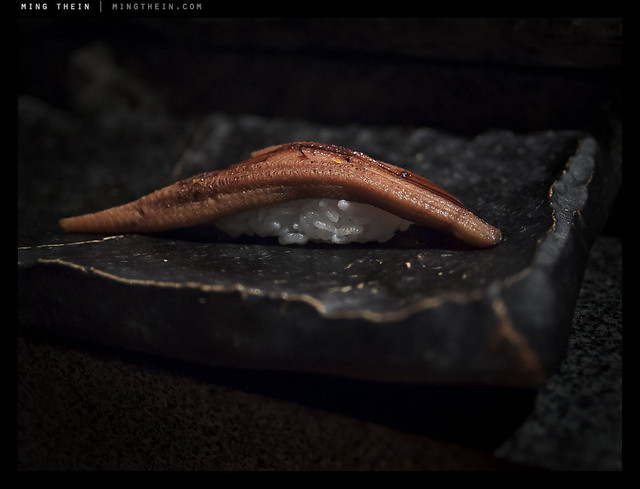
Broiled anago (freshwater conger eel).

There’s a parallel between sushi and photography (and sushi and many other things, actually) – aside from the obvious that it’s art, sushi making requires both technical skill and creativity. There are constraints, but you can work around them. It can be learned, it can be honed by experience, but there’s definitely an element of talent and intuition involved which all great sushi chefs possess. Photographs and sushi both come in small, bite-sized increments – they require little time to create if all the elements come together, and can be enjoyed in moments or contemplated for hours – I’ve eaten sushi dinners with 20+ different varieties served over many hours; I suppose that would be like going through the Magnum annual. Neither photography nor sushi is cheap, either; and mastery can take years.

_PM07485 copy
Torigai clam.

There’s even an anticipative element to it – the feeling of curiosity before you go to eat (wondering what is in season and came from Tsukiji today) is much like the feeling I get before a shoot; you’re all excited and ready to go. It’s also entirely possible that it’s just me.

_PM07471 copy
Seared katsuo

The best sushi I’ve ever eaten – so far – comes from a local chef in Kuala Lumpur at a restaurant called Hanare; Kenny Yew is an absolute genius when it comes to creating new things – for instance, seared wagyu with momeji oroshii chili – as a sushi. I need to go at least once a month or I get withdrawal symptoms and the DTs, because I just can’t eat sushi anywhere else now. The few lucky friends I’ve taken there feel the same way. It really is art – some of the pieces make me tingly and others nearly bring me to tears. I’ve eaten things there I never would have though edible, let alone ordered – and loved them. That’s much like how certain exhibitions, art or equipment inspire me to try photographic experiments that work out a lot better than expected.

_PM07446 copy
Seared hama-tai (sea bream)

And best of all, you can mix the two. The lighting conditions at that restaurant are pretty horrible, but they save me a seat at the counter which happens to have a halogen spot over it; I position my sushi carefully to be well-lit. This set might appear the same, but that’s because I wanted a consistent point of view; (and comparison)
they were also shot during the same meal. I discovered one other thing that night: the best color I’ve yet managed to achieve is delivered by a combination of Zeiss glass and Olympus cameras.

_PM07395 copy
Oo-toro. (Fatty yellowfin tuna belly)

I had the ZF.2 2/28 Distagon on the Pen Mini via an adaptor, and was utterly floored by the color when I opened up the raw files on my computer – the sushi literally looked like it had in real life. Every bit of the color, texture, iridescence and freshness was captured. I’m guessing it’s a combination of the fortuitous lighting, the great color and micro contrast of Zeiss lenses in general, and the pleasing color palette of Olympus cameras. Whatever it is, I think I’ve found my perfect sushi-camera.

_PM07426 copy
Red snapper.

My parting advice is that if you do get a chance to eat sushi made by a master, do as you would do at an exhibition of photographs by a great photographer: put away your preconceptions, go in with an open mind, and enjoy. You’ll probably be surprised. MT

_PM07424 copy
Kamburi (giant yellowtail).

POTD: Three men and a mirror

_M9P1_L1012268 copy
Three men and a mirror. Old Kuala Lumpur coffeeshop. Leica M9-P, Zeiss ZM 2/50 Planar

I do enjoy street photography. But it’s more of a social documentary and practice arena to hone my skills in other areas. The one big difference between photojournalism and street is your internal sense of purpose: with the former, you know you’re there on assignment, and looking for particular images. This means two things: confidence, and focus. That’s why I find photojournalism a lot easier than street – it’s all about confidence. MT

The perils of lots of ideas, but not quite enough sleep

I couldn’t sleep last night (again) but as compensation I did wake up with an idea.

Put your favorite lens on your favorite camera.

Why hadn’t I thought of this before?

_VL31_L1000950 copy
Not this, but close. I have thought of this before, but it only works for macro, and not that well.

So I dug out the adaptor rings, to make another sacrilegious unholy matrimony between systems.

This guy (Zeiss ZF.2 2/28 Distagon):
_5100_DSC1424bw copy

Plus this guy (the M9-P. A lens-lens thing goes beyond wrong and into completely impractical territory.):
_7052556 copy

Yee har!

Except, there’s no RF coupling or live view.

Oops. *slaps forehead*

The very limited testing I did do (you didn’t think I’d just mount it and not try to take a picture, did you?) showed the combination definitely has promise. And f2 still requires some finesse to focus accurately on full frame, especially high resolution full frame. But there were no odd artifacts, and the lens is definitely capable of resolving more than the sensor. Curiously, I think it might even perform slightly better on the M9-P’s offset microlens-and-non-telecentric-wideangle-corner-optimized sensor than the D700’s uniform one. Too bad we’ll have to wait until Leica eventually brings live view functionality to an M body to find out.

In the meantime, I’m going to find out if Miyazaki-san of MS Optical (makers of those lens-cap triplet designs and noted lens surgeon) can make an RF-coupling, though I suspect it may be tough because the focusing ring rotates the wrong way, and the focus throw is much shorter than normal Leica M RF lenses. MT