For your holiday viewing pleasure…I’m pleased to offer up the next two instalments in the workshop video series: How To See Ep2: Tokyo, and Street Photography Ep1.
Photoessay: Tokyo reflections
December 12, 2012 by
One more from the Tokyo series. It never ceases to amaze me how clean everything is – combine that with strong, directional light, and you’ve got the making of images with instant depth. Reflections are wonderful things; they’re visual metaphors for something that might or might not be there in reality. Shot with a Sony RX100. Enjoy! MT


____________
Visit our Teaching Store to up your photographic game – including Photoshop Workflow DVDs and customized Email School of Photography; or go mobile with the Photography Compendium for iPad. You can also get your gear from B&H and Amazon. Prices are the same as normal, however a small portion of your purchase value is referred back to me. Thanks!
Don’t forget to like us on Facebook and join the reader Flickr group!

Images and content copyright Ming Thein | mingthein.com 2012 onwards. All rights reserved
Photoessay: Tokyo nights
November 30, 2012 by
I love shooting at night in Japan for many reasons – firstly, the city never sleeps so there’s always something interesting to photograph; secondly, the quality and layout of the light itself is interesting – their designers obviously pay a lot of attention to this; finally, it’s easy to achieve high image quality. There’s simply so much light it’s rarely necessary to venture into the higher ISO regions, so you can actually get some tonally very rich images covering a large dynamic range with little noise and reasonable shutter speeds. It was better in the pre-Fukushima days when electricity was abundant in Japan; I remember being surprised that in late 2008 I could seriously shoot ISO 200 at night, handheld.
Needless to say, on my last trip, I did plenty of roaming the streets after dark. Here is a collection of my favourite images in that theme. Enjoy! MT
This set was shot with an Olympus OM-D with the 12/2 and 45/1.8 lenses, and a Sony RX100.


____________
If you enjoyed this post, please consider supporting me via Paypal (mingthein2@gmail.com). Visit our Teaching Store to up your photographic game – including Photoshop Workflow DVDs and customized Email School of Photography; or go mobile with the Photography Compendium for iPad. You can also get your gear from Amazon.comhere.
Don’t forget to like us on Facebook and join the reader Flickr group!
Images and content copyright Ming Thein | mingthein.com 2012 onwards. All rights reserved
Photoessay: Tokyo architecture
November 12, 2012 by
Tokyo must be one of the best places in the world to shoot modern architecture – between the crazy ideas, traditional influences and availability of money to spend on buildings beyond the merely functional. I suppose the incredibly small plot sizes also force architects to make the best use of available space, but at the same time also stand out from their neighbours. One interesting thing I’ve noticed is that all buildings are separated by a small – about 6″ – gap; presumably this has something to do with allowing slip in the event of an earthquake. Still, it does look a little odd at times.
Being personally and professionally interested in architecture, I had a field day walking around the city; a couple were shot with the Olympus OM-D and 12/2 is surprisingly good for this combination, though at times I did wish I had something a little wider – perhaps an equivalent for the Zeiss 2.8/21 Distagon which is my current mainstay for architectural work. The Sony RX100 covered everything else. Enjoy! MT

Slices

Tower

Chaos

Order

Tradition

I always think of this building as a bean in a hurry.

Ginza lamppost

Continuation of sky

Curvature is not an illusion

Facades I

Facades II

Who says windows have to follow floors?

Mirrored shard
____________
If you enjoyed this post, please consider supporting the site via Paypal (mingthein2@gmail.com); Ming Thein’s Email School of Photography – learn exactly what you want to learn, when you want to learn it or learn how to achieve a similar look with our Photoshop workflow DVDs. You can also get your gear from Amazon.com via this referral link.
Don’t forget to like us on Facebook and join the Flickr group!
Images and content copyright Ming Thein | mingthein.com 2012 onwards. All rights reserved
Experiments with street photography and motion
November 9, 2012 by

This series of images was captured around dusk in Shinjuku, Tokyo during my last workshop. While my students were off completing their final assignment, I decided to challenge myself to capture the feel and essence of the place in a different way to what I would have normally done. (After all, it wouldn’t be fair for me to put my students outside their comfort zone by insisting on the importance of having a central idea or theme in their images for their assignment if I couldn’t delivery myself, would it?)

At the same time, I’d felt as though I’d been reaching a little creative stagnation of late, and wanted to force myself to do something different anyway. Having your own style is good, but at the same time, that style has to evolve and grow in order not to get stale or boring. One of the things I’d been doing a lot of lately is jacking my shutter speeds up very high to ensure I was getting every last pixel of resolution out of the new cameras; whilst this made for great definition under the majority of circumstances, this crispness of capture doesn’t always suit the theme you’re trying to shoot to.

The idea I decided to follow for this series was flow – people as water, life as transient, a moment being more than a moment and altogether insufficient to capture the sheer volume of activity of what was going on around me. It’s a very strong impression I got simply by standing in place and watching life moving around me – people simply didn’t stop, torpedoing from location to location with some objective in mind, dispatching that objective, then moving on to the next one. (I’m guilty of this at times too; it’s a consequence of running your own business. Perhaps this experiment was as close to my subconscious was going to get to forcing me to slow down and smell the roses.)

The only two ways I could see of communicating this idea were either to have a huge number of people lining streets and thoroughfares to appear as a continuous mass (there were a lot of people, but not that many, and moreover there was no way or achieving that vantage point) or through the use of motion blur – not a little bit, of the kind that appears at 1/30s and with people walking, but something altogether a bit more abstract. In hindsight, this would have been very easy to accomplish with a tripod, but without it, I didn’t have the foresight to pack one in – much less bring one on the day. Even a mini-pod or a Gorillapod would have been useful.
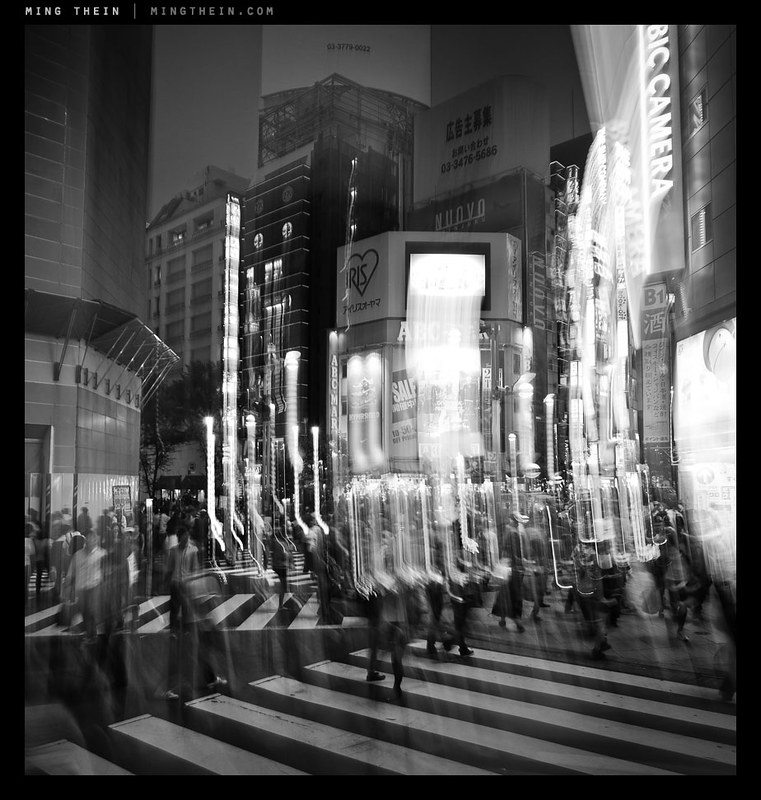
Instead, I was forced to test the stabilizer of the OM-D to its limits – even with something to brace against (And sometimes not), I’d be needing shutter speeds in the 1/2s-1/5s range to achieve the effects I was looking for. Needless to say, you can only do this when the sun is going down. To give me a higher chance of success, I used the 12/2 for most of these shots, and shot in continuous high burst mode – not for the frame rate, but because I’d be able to keep my finger on the shutter button to minimize camera shake, and have only short intervals between frames. When I had to shoot using the LCD instead of the EVF, I would pull the neck strap tight to tension the camera somewhat against my neck and hopefully reduce shake – this technique is actually surprisingly effective. In hindsight, I should have used the self timer + burst function to completely eliminate finger-induced shake.

One of the things with this kind of photography is that you really don’t know exactly what you’re going to get until you get it; there may not be enough motion, or too much, or you might have streaks in the wrong part of the frame; all you can do is do a lot of takes until you get the right one.
Compositionally, the most important thing to remember when involving motion in your shot is that there must always be some clearly static and sharp object in the frame to serve as a visual anchor for your composition; if this is missing, the photograph just appears to be blurred or out of focus without the same directionality and focus that is implied by motion blur. In fact, having a large number of people moving through the frame is somewhat reminiscent of the energy of strong, dynamic brush strokes in a painting. I like the idea of abstracting out the people from the scene, and the contrast between the animate and inanimate. For these images, I chose the visual anchor first, then followed it by imagining where I’d want my flows of people to go; needless to say, there were a lot that didn’t work out because I didn’t have enough people moving close to the camera – a foreground is of course a necessity of using a wide-angle lens.

I did use the 45/1.8 for some of the images, but this proved to be extremely challenging as the lower practical limit for handholding a 90mm equivalent was somewhere in the 1/10s range on the OM-D, which is fractionally higher than what I needed for the desired effect. Still, I did manage to get lucky a couple of times with both very stable shots and convenient things to lean against. I also tried some more and less conventional techniques – panning blur, and combining staticness with abrupt motion of the entire camera to impose an impression of chaos whilst maintaining some semblance of a visual anchor. Overall, I’m pretty happy with the results though. Notes for a future experiment: I’d love to try this with a tripod and a longer lens. MT
____________
Visit our Teaching Store to up your photographic game – including Photoshop Workflow DVDs and customized Email School of Photography; or go mobile with the Photography Compendium for iPad. You can also get your gear from B&H and Amazon. Prices are the same as normal, however a small portion of your purchase value is referred back to me. Thanks!
Don’t forget to like us on Facebook and join the reader Flickr group!
Images and content copyright Ming Thein | mingthein.com 2012 onwards. All rights reserved


Photoessay: The people of Tokyo
November 3, 2012 by
Another one of the continuing series from my last Tokyo trip – this time focusing on is inhabitants. Enjoy! MT
This set was shot with an Olympus OM-D and the ZD 45/1.8. As usual, click on any image to go to its Flickr landing page; EXIF data is intact on the right hand side link.

Plenty to spare, Ginza

Geisha in training, Asukusa

Maid for hire, Akihabara

Only in Tokyo would this be considered normal. Shibuya

Putting up a wager, Asakusa

Untitled. Senso-Ji temple grounds, Asakusa

Coffee break, Shibuya

A considered proposition. Somewhere along the Yamanote line

Reading the fine print, Akihabara

What happens after closing time. Asakusa

Elegant shopping. Ginza

Public opinion, Shibuya

A Japanese cliche, Shibuya

Even the chauffeur gets lost sometimes. Ginza
____________
If you enjoyed this post, please consider supporting the site via Paypal (mingthein2@gmail.com); Ming Thein’s Email School of Photography – learn exactly what you want to learn, when you want to learn it or learn how to achieve a similar look with our Photoshop workflow DVDs. You can also get your gear from Amazon.com via this referral link.
Don’t forget to like us on Facebook and join the Flickr group!
Images and content copyright Ming Thein | mingthein.com 2012 onwards. All rights reserved
Photoessay: Tokyo monochromes
November 1, 2012 by
This set is a whole bunch of little snippets of life from around Tokyo – mostly Shibuya, Shinjuku and Ginza. I’ve tried to get into the Japanese style of street photography/ reportage a little; the intentional chaos is somewhat unnerving to my perfectionist nature and definitely not so easy to replicate. Still, I think I got just enough of an influence in there to get something different to my normal work. MT
This set was shot with an Olympus OM-D, ZD 12/2, 45/1.8 and Sony RX100. As usual, click on any image to go to its Flickr landing page; EXIF data is intact on the right hand side link.

Shadow of a head

Look before you leap

Untitled

Diagonal
Trapped

Meditation nap

Lines I

Lines II

Overpackaged

Ginza reflections

Confidence

Bad boy I

Bad boy II

Just another afternoon in Shibuya
____________
If you enjoyed this post, please consider supporting the site via Paypal (mingthein2@gmail.com); Ming Thein’s Email School of Photography – learn exactly what you want to learn, when you want to learn it or learn how to achieve a similar look with our Photoshop workflow DVDs. You can also get your gear from Amazon.com via this referral link.
Don’t forget to like us on Facebook and join the Flickr group!
Images and content copyright Ming Thein | mingthein.com 2012 onwards. All rights reserved
Photoessay: A slice of green in Tokyo
October 30, 2012 by

During my last trip to Tokyo – the workshop and the couple of spare days I had – one of the things I’d always wanted to do is find a bit of urban oasis in the concrete jungle of the city. It seems that the Japanese apply the same sort of perfection to their landscaping as they do to just about everything else – even though it seems at times that some parts of the composition may be chaotic, it’s probably intentional. On a more practical note, the gardens were used to provide easy perspective practice for that portion of the workshop. We visited Koishikawa garden near Iidabashi station – a little mini-enclave with several distinctively different areas to provide some variety.

Personally, I was just happy to enjoy the flawless green grass of the Imperial Palace East Garden – open to the public, and supposedly with regular lunchtime concerts (though I was there at the appointed place and time, I guess it must have been the wrong day). One of the photographic ideas I continued to explore here (and you may have seen some evidence of this in my past work already) was layering and the use of projected surrealism – spot the Monet-a-like, and homages to Chinese painting in the fish. Though I like this for my personal work, I’ve yet to see any commercial potential here…
Thoughts and comments welcome as always; you can click the images to view larger versions via the flickr landing page, plus EXIF data if you click on the right column (‘The photo taken with an XXX’).
This series shot with an Olympus OM-D, 12/2 and Sony RX100.


____________
If you enjoyed this post, please consider supporting the site via Paypal (mingthein2@gmail.com); Ming Thein’s Email School of Photography – learn exactly what you want to learn, when you want to learn it or learn how to achieve a similar look with our Photoshop workflow DVDs. You can also get your gear from Amazon.com via this referral link.
Don’t forget to like us on Facebook and join the Flickr group!
Images and content copyright Ming Thein | mingthein.com 2012 onwards. All rights reserved
Tokyo Oct 2012 workshop report
October 25, 2012 by

I arrived in Tokyo a couple of days early – partially because of the flight schedules, partially because Tokyo is one of my favorite cities in the world for photography and I hadn’t had a chance to shoot here in nearly four years – it was high time I rectified that. I have to say that a large part of what made Tokyo so darn attractive was the fact that it felt so different from the moment you stepped off the plane; I don’t know if it’s familiarity or something else, but I didn’t really get that hit this time around.

That aside, I spent a good two days just walking around, looking and shooting anything that took my fancy. I travelled very light – in the end bringing only the OM-D, 12/2 and 45/1.8 lenses, plus a Sony RX100 for backup (the links are to my reviews); not having a bag – hell, not even having to use the pockets of my shooting jacket most of the time – was positively liberating, not just because Tokyo appeared to be going through a warm ~25C spell.

Plenty of opportunities to shoot distracted commuters during the many train rides.
The first day of the workshop started off with a briefing to explain the critical components of what goes into making a good image; followed by a period of just walking around Ginza, observing, with me pointing out compositions and the participants not distracted by the technical aspects of taking a photograph; by the end of the half hour, I was starting to see a lot of sneaked shots.

We proceeded to a rather nice garden for a gentle introduction to the workshop, and easing the participants in by practicing proper perspective use and framing of edges – the best way to do this is always to focus on one topic alone and remove all other distractions; gardens are great for this because they’re quiet, tranquil and static objects are of course very friendly to do-overs until you get things perfect…

Not part of the museum’s exhibits, but I’d like to think the style is very Japanese and it’d have at least made it into the amateur category.
One of my favorite places in Tokyo is the Tokyo Metropolitan Museum of Photography at Ebisu; they always have some interesting exhibitions running, and it was here where I first encountered Salgado’s work – in the form of original prints, no less. There were two exhibitions running – one of a competition from a local photography club, and one of a number of classical photographers considered to be masters. We spent some time assessing both – looking at what worked in the images, what didn’t, and deconstructing them for the participants to understand what elements they specifically liked, and how we would go about replicating them – first for the amateur images, and then the classical ones. Needless to say – there were a lot more hits in the classical images, but still a surprising number of misses or difficult to understand images in both.


The afternoon and early evening was spent at Asakusa and the old market around Senso-ji temple; here we practiced the use of stages and waiting for a subject; timing, and making cinematic. There was also an unfortunate hangyoku (Tokyo apprentice geisha) who got pursued around for a few blocks…


Dinner was at Akihabara, but not until the participants had a chance to practice some of the techniques from the Asakusa session again in a more lively environment, plus add in one more tool: the correct use of spot metering for the subject.


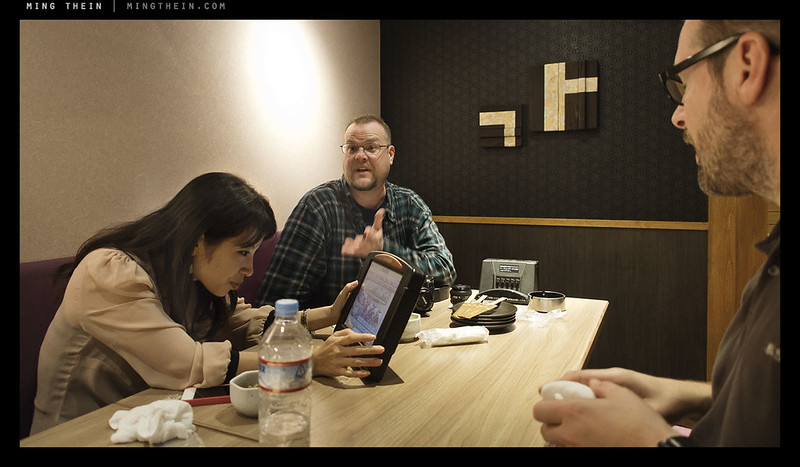

Doyle was still raring to go after the rest of us were footsore and too full of yakitori; he kept shooting.
Day two dawned bright and clear again – the light was fantastic with nary a cloud to be seen; in the mornings, the tall canyons of buildings and their glass sides serves as very strong light guides and secondary sources; we spent it wandering around Ginza looking for light, and making the most of the naturally interesting sources both for street photography and architectural abstracts.


Following another look-for-compositions-only walk to the Otemachi district near Tokyo Central (which was mostly observed, though it broke down somewhat at the end), we dealt with the use of reflections and layering to give images added context and depth, before calling a halt at noon once the light became non-conducive for this.


We started out with all the cameras in a bag. By the end I don’t think anything could have forced the participants not to have them in hand all the time.
The group headed to Shibuya for the final instructional portion: shooting through people and acting calm, and working a single scene for a set amount of time to force yourself to work harder to see compositions rather than just abandoning and moving on. Both of these techniques require a huge amount of people, and Shibuya crossing on Saturday afternoon didn’t fail to oblige!


Our last shooting session happened around dusk, at Shinjuku on the threshold of the seedy (and even busier than Shibuya) Kabukicho district. Here, the participants were given free reign to employ all of the techniques they’d learned in the previous sessions to capture whatever felt natural and instinctive to them; we regrouped for a review and feedback to figure out how to strengthen the idea, then went out for a final session before calling it a day for sushi.

One of my experiments with motion – handheld. To be the subject of a future article.


Another battle in the never-ending RF vs DSLR debate

One of those scenes filled with randomness that happens from time to time in a place like Tokyo.
The final day was spent completing the workflow: yes, introducing the basics of Photoshop! Probably just as well, as the weather was miserable and raining. Up til this point, I didn’t think there was physically enough space for that many Macs in one room anywhere in Japan outside perhaps the Apple Store and rural Hokkaido.

A gray, postprocessed shot for a gray, postprocessing day
You may be wondering why we didn’t visit the tuna auctions at Tsukiji: simple, because in recent years, access has gotten prohibitively restrictive to the point that now you have to queue from 5am to get a ticket for 5.30am that only allows you access to the auction portion for half an hour, and nowhere else. If you want to shoot the rest of the market, you can only come after 9.30am – long after all of the action is over. There simply wasn’t any point.
Images from the trip are slowly making their way into our reader Flickr pool by Khair Mahfar, lemonice photos, ekindangen, doyleshafer and dcmer. I’ll be uploading mine over the coming days and weeks, and most will come here as themed photoessays, too.
And yes, don’t worry if you missed this one – there will be more workshops planned for next year; provisionally, San Francisco, New York and possibly Boston in April; Munich, Barcelona and maybe London in September. I’ve also got a couple of spots left for Melaka on 3/4 November this year, as well as the last of the Zeiss Food Photography Masterclasses. Send me an email too book a place or if you’d like more details. Thanks! MT
____________
Visit our Teaching Store to up your photographic game – including Photoshop Workflow DVDs and customized Email School of Photography; or go mobile with the Photography Compendium for iPad. You can also get your gear from B&H and Amazon. Prices are the same as normal, however a small portion of your purchase value is referred back to me. Thanks!
Don’t forget to like us on Facebook and join the reader Flickr group!
Images and content copyright Ming Thein | mingthein.com 2012 onwards. All rights reserved
October 2012 Tokyo Workshop
May 16, 2012 by

Fear of straying off the beaten path. Nikon D3, 24-70/2.8
I’m in the early planning stages of a small (3-5 participant) private workshop in Tokyo this October (2012). Dates aren’t fixed yet, that’ll depend on the participants’ schedules. Details as follows:
– 3 days, based in Tokyo (but I’m not ruling out quick side trips to appreciate the autumn foliage)
– Two days of shooting – covering whatever specific topics the participants would like to learn, but I have some ideas (travel, landscape, photojournalism and making sequences of images into stories, learning composition fundamentals with compacts, night photography etc.)
– One day of editing/ selecting images and photoshop post-processing
Depending on the number of participants, costs will range from US$1,300 to US$2,200; this is for tuition only and assumes you live in Tokyo, or can easily get there. Would be ideal for Asian residents, as it’s just a short commute.
Please drop me an email or leave a comment below if you’re interested.
Thanks! MT





 Ming Thein | Photographer