If you haven’t started shooting, now’s the time to do so. Remember, the more people who enter, the larger the pot…
A gentle reminder: three weeks to go until the first Mingthein.com photography contest closes!
July 11, 2012 by
Photoessay: Some Hublots (and, how to shoot watches on location with available light…)
July 11, 2012 by

I was recently at a Hublot event – both covering the new Basel 2012 watches for fratellowatches.com as well as meeting the CEO and marketing people (it never hurts to network in this industry). I didn’t want to bring the lighting equipment, and the photos were for a blog – not commercial use – so I figured that I could get away with a lightweight rig. I used the Olympus OM-D and Panasonic Leica 45/2.8 Macro, and available light. Most of the images were shot at ISO 1600 or above; even at larger sizes, they hold up pretty well. Needless to say, for web use, they’re fine.
But I digress – all I had was whatever lights were set into the roof of the showroom, and a dark watch display tray for use as a background. By tilting the tray and camera to look for the right lighting angles – sometimes to avoid reflections, sometimes to enhance them – I managed to produce a set I was pretty happy with, but yet manages to have a very different feel to what I normally produce in the studio. (They also have zero dust retouching, which you fortunately can’t see at this size – cleaning cloths are your friend!) Enjoy! MT


____________
The inaugural mingthein.com photography contest closes 31 July 2012 – the more people entering, the larger the cash prize! Enter here
If you enjoyed this post, please consider supporting the site via Paypal ([email protected]) or via Ming Thein’s Email School of Photography – learn exactly what you want to learn, when you want to learn it. You can also get your gear from Amazon.com via this referral link. 
Don’t forget to like us on Facebook!
For the curious, a dissertation of opinions on my current equipment choices
July 10, 2012 by
This is a little preview of something I’ve been working on for some time and have gone through many packets of ginseng-garcinia cambogia to keep energized for – a concise database of quick reviews/ opinions on every single piece of equipment I’ve ever used. Think of it as a reference for a quick opinion instead of having to send an email – look out for it soon, the magnum opus is nearly complete and will weigh in at nearly 20,000 words…
Cameras

Apple iPhone 4** – The first phone whose image quality I actually liked. Crisp, detailed files; limited dynamic range – as expected from this kind of sensor – some kind of rudimentary spot metering. Color accuracy is horrible in anything other than bright sunshine, and way off indoors. Doesn’t seem to have the range of shutter speeds to cope with very dark or very bright conditions. Also, noisy. Needs a physical two-stage shutter button. Nevertheless, it’s produced images that went into the Getty library, so no complaints. Oh, and I can make calls and blog off it, too.

Leica D-Lux 5/ D-Lux 5 Titanium** – Actually won a regular one in a competition; wasn’t impressed and sold it fairly quickly thereafter. However, extended time with the camera has made me change my mind. Not only is the image quality excellent, the pixels are surprisingly robust and stand up to a decent amount of post processing. Excellent macro mode that makes it a good food camera. Also, great stabilizer. Color output needs a lot of work though, and I see that customary Panasonic cyan tinge. Still, makes a great backup/ pocket/ M-companion camera.

Leica M9/ M9-P** (May 2012) – The M9-P is one of those cameras that just feels right. Tactility and the ‘want to use it’ factor are high. Image quality is superb, so long as ISO is kept below 800; 1250 is still okay (about a one stop improvement on the M8) but still nowhere near the other FF DSLRs. The lack of an AA filter gives images tremendous bite – just watch your rangefinder calibration. It’s very easy to shoot fast lenses and then wonder why they’re soft, when in fact it’s probably due to a misaligned rangefinder. Most of the woes with the M8 are gone (lockups etc) but you have to be very careful with what cards you use; faster ones can cause corruption and crashes.

Nikon D700** (May 2012) – My workhorse since late 2009, and the end of the First Leica Period. Shares the incredibly versatile sensor and AF system from the D3, and delivers identical image quality and performance for almost all purposes. Capable of hitting 8fps with the battery grip and suitable power source, too. I can’t think of a better value camera today – there isn’t anything that delivers the same image quality, same usability, customizability and durability for the price. Along with the D3, the first camera where I felt that I was now the limitation in the imaging chain, and would have to progress substantially to change that. Mine has done over 70,000 actuations and remains in my arsenal for available light reportage work, and as a backup body to the D800E. Smart move by Nikon to keep in production (at least for a few months) and on sale; I would actually recommend this over the D800 if you don’t intend to print enormous (D700 files still look great at 40×60″) or require video. Save the difference in price and go buy some glass instead – and enjoy the wider choices, because the larger pixel pitch is very forgiving indeed.
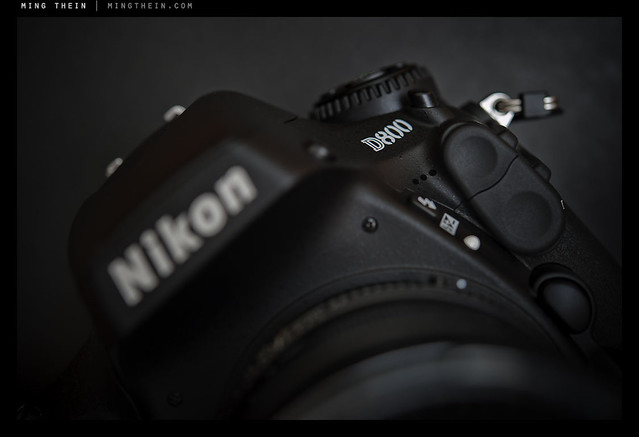
Nikon D800 (Apr 2012) – Best dynamic range of any 35mm format DSLR at the moment; incredibly accurate color, and shunts around those enormous files like it’s nothing. Video quality catches up to Canon 5DIII, and offers headphone monitoring, adjustable audio input and uncompressed full HDMI out feeds. This camera has moved the bar for 35mm DSLRs. In fact, it’s so good that most lenses can’t keep up with the sensor – every optical flaw is revealed. The lenses that work well on the camera are just as surprising as the ones that don’t (compared to the 12MP FX cameras); the 85/1.8 G for instance is better than the 85/1.4 G, and the 28-300VR becomes pretty good. Pixel-level noise performance is probably a stop behind the D700, but you’re actually going to lose a bit more than that because of the shutter speeds required to negate camera shake at these pixel densities. A non-issue if you downsize, but then why would you do that after having to suffer huge file sizes? Highly recommended to spend some time calibrating your lenses using the AF fine tune function. Watch out for AF issues with side focus points.

Nikon D800E** (May 2012) – The comments that apply to the D800 also apply to the D800E, if not more so; it’s even more demanding on lenses, and shows up CA more than the regular D800; it will moire, but you’re saved by the high resolution which means moire doesn’t kick in until much finer structures are resolved. This camera takes the Oscar for Best Image Quality in 35mm Format at the moment – by a long, long stretch. It makes the D3x feel like positively old, slow technology by comparison (even though the images it produces are of course still the same as the day it was released). It just makes achieving results like this so effortless and accessible, than you forget how many pixels you’re actually packing. And did I mention that the battery life is better than my D3 ever was?

Olympus OM-D E-M5** (May 2012) – The most impressive new camera I’ve used so far in 2012. Not because of any one of its features, but because of its combination of features. It’s a game changer in its ability to combine excellent image quality – I’d say very close to the D7000 in every way, including high-ISO performance and dynamic range – to a very compact body, which also happens to be weather sealed and able to shoot at 9fps. EVF is finally good enough to use, though has limited dynamic range and of course can’t replace a good optical finder. In the tradition of Olympus cameras, it’s highly customizable, too. The only thing that lets it down is AF – yes, it’s blazingly fast, but not always accurate especially at longer distances with fast wides. And continuous AF is nearly worthless – good thing single AF is so fast. Also available with a two-part battery grip that makes quite a big difference to the handling and overall usability of the camera – but it’s still positively tiny. No built in flash, but they give you a little weather-sealed one that can also double as a wireless commander for other flashes. Olympus still hasn’t learned that putting the strap eyelet in the middle of your palm is uncomfortable. Sigh.

Olympus E-PM1 Pen Mini** (May 2012) – The best value M4/3 camera out there today. Decent image quality; great color and acceptable noise at ISO 1600. Very responsive and lighting fast focusing – same system as in its more expensive siblings. Incredibly compact body means you can slap a pancake on it, chuck it in your pocket and call it a day. And not notice it’s there until you need it. Surprisingly customizable once you find the hidden custom function menu – I can’t think of any other cameras of this size (or even professional DSLRs) which let you change the color temperature of the LCD. Great battery life, too – easily a thousand shots before you need to swap out packs. Design *looks* great but could use refinements – why on earth would you fit a 16:9 LCD to a camera whose native aspect ratio is 4:3? Most of the LCD is black and unused; the strap lugs are still idiotically positioned (this seems to be an Olympus design hallmark) and the ring on the back is fiddly. Other than that, I really do love this camera. It’s largely taken over from my Ricoh GRD-III.

Ricoh GR-Digital III** (May 2012) – Round three. This iteration of the ultimate pocket PJ camera increased lens speed to f1.9, brought the sensor from the LX3 and G9, and more speed. Still remains hugely customizable. You could now shoot DNGs like JPEGs and not pay any usability penalty; focusing got faster; ISO 800 was now useable, and 1600 OK for emergencies. However, the lens’ notional f1.9 speed brought more improvement than expected – I rarely have to go over ISO 400 indoors, which makes me think the lens design and coatings are truly excellent. Files are surprisingly good for such a small camera, and up to A3 indistinguishable from larger sensors; plenty of latitude for processing and capable of both excellent B&W conversions and color tones. My favorite point and shoot, at this moment in time. No impulse to buy the GRD IV because I don’t see anything that camera would give me over the GRD III. If I had to take only one camera with me for a trip, this would probably be it – and was, on several occasions.
Zoom lenses
Nikon AFS 28-300/3.5-5.6 VR II** (May 2012) – The FX equivalent of the 18-200VR, and the replacement for the original 28-200 Swiss Army Knife. Delivers acceptable quality between 35 and 200mm on the 12MP FX bodies; 300mm is soft even at f8, and 28mm is both haloed and soft until f5.6 – it almost seems that there’s a slight focusing issue only at 28mm. Strangely, delivers sharp results everywhere in the range on the 16MP DX bodies; it’s actually very, very good on the D800, and excellent by f8. Who would have guessed? If you travel, and want to go light but maintain resolution, buy this and a D800. Note that it has a very slow T stop thanks to the 20+ elements inside it, so don’t expect it to be a low light lens. VR is quite effective but you’ve got to give it a second or two to ‘lock down’ before shooting, and turn it off above about 1/500s or it will just cause a double image. It’s not on Nikon’s recommended list of lenses for the D800, but they bundle them as a kit in Japan – I can see why. Notice I haven’t talked about D800E: that’s because on this camera, somehow the same lens performs like it did on the D700 – hazy wide open, and not pretty at all at 28mm. However, stopping down by one stop improves things dramatically, and we’re nearly back to the same level of resolution it produces on the D800. Odd.
Olympus ZD 12-50/3.5-6.3 EZ** (July 2012) – A multitalented Swiss army knife of a kit lens that feels a lot more complicated than it needs to be – motor zoom, 1:3 ‘macro’ mode locked at 43mm, weather sealing, fly by wire focusing…sadly, the optics aren’t really up to par for the OM-D it’s bundled with. It will do fine if there’s enough light, but you’re going to need a lot of light to make the f6.3 end work well. The plus side is that it focuses very quickly indeed.
Olympus ZD 14-42/3.5-5.6 IIR** (June 2012) – The standard kit lens for the Pen cameras – it’s actually pretty good, with decent sharpness over the entire field even wide open. I much prefer this to the 12-50. It has very…er…lightweight construction, which means plastic mounts, thin plastic sections on the barrel, and generally you want to be careful because I don’t think it’ll take that much abuse. Good optics though, even if (as rumored) none of them are actually glass. Focuses fast.
Panasonic Lumix G 100-300/4-5.6** (June 2012) – 200-600mm equivalent zoom for M4/3, topping out at a very useable f5.6 at the long end – what’s not to like? Sharpness is very good to excellent everywhere in the range, with the 300mm end being (predictably) the weakest. Optical stabilizer works well. Focusing is reasonably fast, but not as fast as the Olympus MSC lenses. (Actually, it feels about the same speed as the Nikon 70-300VR). Best used with an EVF camera for stability; you can’t really mount it on a tripod because of the lack of a collar and resulting imbalance (which is a shame).
Prime lenses

Nikon AFS 28/1.8 G (June 2012)** – A very light, relatively small lens. Focuses fast. Weather sealed, but doesn’t have any metal in it apart from the mount and some screws. It’s sharp in the center at all apertures on the D800E, but isn’t flat field; you’ll have to take care for edge subjects – it can be sharp if you get the focus plane right. Doesn’t have the 3D microcontrast of the Zeiss 28/2 Distagon, but surprisingly offers better transmission f-stop for f-stop. Neutral bokeh and color. Now if only they’d make an f1.4 version.
Nikon AI 45/2.8 P** (May 2012) – Currently on my second copy. I had one of the much rarer black versions with my FM3A back in 2004; stupidly, I sold it. I’m rediscovering the joys of the simple Tessar optical formula with the D800 – the center zone is always bitingly sharp, and progressive ‘rings’ of sharpness open up as you stop down; by 5.6 it’s great everywhere across the frame. I suspect this is actually field curvature rather than softness, because you can focus on an edge subject, recompose and the edge subject will be perfectly sharp. I have a feeling I’ll find this to be one of those lenses with personality, like the similarly field-curvy Zeiss 28/2 Distagon. Color transmission is neutral, there’s a tiny hint of longitudinal CA, and bokeh is very nice indeed. Unfortunately it won’t make sunstars, though. Oddly the edge focusing points seem to work inconsistently for focus confirmation on this lens; the center point works much better and focus holds if you do the center-focus-and-recompose thing. Now if only there was an AF f2 version! Pentax was on to something with its Limited series of pancake lenses.
Nikon AFS 60/2.8 G Micro** (May 2012) – This lens is one of my two studio workhorses, the other being the 85/2.8 PCE. This one gives me the convenience of AF, 1:1 and higher potential magnification with extension tubes. I switched to this lens from the 105/2.8 VR due to the huge amount of lateral chromatic aberration (bokeh fringing) present in the latter; not great for product shots as it required some often very tricky retouching to remove the color casts without affecting the color of the underlying subject. I feel it’s also a touch sharper, too. The 40/2.8 and 85/3.5 VR macro lenses do not make any sense to me; the latter is not much cheaper, and the working distance of the former is terrible. Bokeh-wise, it’s neutral to good; color wise, it’s neutral; all in all, it’s a very transparent lens that does its job and avoids imprinting its personality onto the picture, which is great. Note that it doesn’t change length with magnification, but it does shorten focal length a little, so working distance at maximum magnification isn’t more than about 5cm. Not suitable for photographing biting insects.
Nikon AFS 85/1.8 G** (June 2012) – An impressively sharp optic on every body I’ve tested it on, including the D800 and D800E; no CA, edge to edge perfection even at f1.8. Sharp and contrasty all over, probably thanks to the small number of internal elements. I have no idea how they do it – the optical design is incredibly simple, and has no aspherical elements, no ED glass, no IF/ RF groups and no fancy coatings. The T stop is about half a stop down on the 85/1.4 G for the same aperture, though – must be the effect of the Nano Crystal Coating on the 85/1.4 G’s elements. I think this may be the best general purpose/ fast 85mm out there at the moment, and I don’t say that lightly. Beats the 85/1.4G and Zeiss ZF.2 85/1.4 handily for sharpness. Highly recommended if you don’t already have the 85/1.4 G, and recommended for D800 users even if you do.
Nikon PCE 85/2.8 Micro** (May 2012) – One of Nikon’s sharpest lenses. Full movements, and a macro to boot! Nothing to complain about optically, at any aperture. However, the tilt and shift axes should be parallel; the way they are installed from the factory not only does not permit easy rotation like the old version, but there’s also a PCB and ribbon cable that has to be changed at the cost of US$300 or so – for something that shouldn’t have been design that way in the first place. My other issue is that the focusing ring on all of the samples I’ve tried is extremely stiff; no amount of working it in or lubrication helps that. I dismantled part of my lens to find that there are a few friction rings between the top keeper that stops the focus ring from slipping off, and the ring itself; the problem is when the focusing ring is moved, it naturally exerts force on the friction ring and keeper because of the focusing cams. It’s actually so stiff that it requires less force to rotate the lens about its movements axis, which means you’ve got to be careful when using it. It isn’t a fluid or easy lens to use, but produces excellent results. PCE version means an electromagnetic diaphragm that stops down with a button instead of a lever; unfortunately it also means you can’t use it on a non-electronic body or bellows, other than wide open.

Olympus ZD 12/2** (May 2012) – The best of the wide angles for M4/3 at the moment; it’s fast, sharp, and doesn’t have any obvious optical deficiencies other than slightly nervous bokeh (but chances are you’re not going to see bokeh with this spec anyway). It does distort a bit, so it probably isn’t that suitable for architectural photography. I don’t think the T stop is quite f2 – feels like it needs a higher shutter speed than you’d expect for a given lighting condition. The lens does have this interesting focusing ring which can be either fly by wire or mechanically linked manual; the latter has distance and depth of field scales and everything! However, it may not be fully mechanically coupled as it seems there are only five or six distinct focus ‘zones’ you can select, which means hyper focal use isn’t quite as easy as you’d think. I tried it a few times and was disappointed by the inexplicably out of focus results I got at times until I discovered the previous fact. Use it in autofocus mode and be happy (it’s one of the newer, fast MSC designs anyway).
Olympus ZD 45/1.8** (May 2012) – Probably my favorite lens for M4/3 at the moment. Optically, it’s superb. Sharp, moderate contrast, excellent color, neutral, smooth bokeh, and a great microcontrast structure the helps to generate that 3D look and feel to images. Sharp already wide open, but improves to peak at around f2.8-4; don’t go past f8 on M4/3 bodies because you will run into obvious diffraction effects. The price is spectacularly good for what you’re getting, but the compromise is a plastic, somewhat flimsy-feeling outer shell, no lens hood, and an easily-lost blanking ring at one end to cover the hood bayonet.
Panasonic Lumix 20/1.7 G** (May 2012) – One of the must-haves for M4/3 because of its small size and reasonably high optical quality. It isn’t the sharpest or fastest-focusing lens out there (in fact, it’s one of the original lenses that was launched with the system) but it does seem to hold up well on the newer 16MP cameras. My only complaint is that it’s a bit too contrasty, and the micro contrast structure lacks the same refinement of say the Olympus 45/1.8. Not expensive and worth having around; makes a good two-lens kit to pair with a zoom for travel.
Panasonic Leica Lumix 45/2.8 Macro-Elmarit OIS** (May 2012) – The only real macro choice for M4/3 at the time of writing this; good thing it’s an excellent lens. Reaches 1:1 on the M4/3 sensor size, which means close to 2:1 equivalent magnification on full frame. I’ve not done any serious shooting with this yet, but my early watch tests and casual shots suggest that it’s one of those rare ‘transparent’ lenses that just does a great job at faithfully reproducing the subject. A cautious favorite, so far. The OIS system also seems more effective than the in-body stabilization on the OM-D – and no, don’t use them together because there’s some weird interference going on.
Zeiss ZF 21/2.8 Distagon** (Jun 2012) – Possibly the ultimate wide angle lens, period. Sharpness is excellent across the entire frame even wide open on the D800E; there’s noticeable vignetting, but it goes away completely by f5.6. More importantly, the lens has a rich, 3D saturation and microcontrast structure that makes fine textures (e.g. landscapes) pop. This is how all lenses should be constructed – focus throw and weighting is utterly perfect, with just enough resistance, plenty of smoothness and no backlash. The only thing I don’t like is the enormous filter size – the front element is much, much smaller than the filter ring; why on earth did they have to use 82mm? It makes the lens very difficult to pack because it’s almost conical.

Zeiss ZF 28/2 Distagon** (May 2012) – This is one of my favorite lenses of all time; has the same optical formula as the legendary C/Y ‘Hollywood’ so beloved of filmmakers (hence the nickname). I know I keep going on about Zeiss microcontrast; this has it in spades. I’m convinced it’s all in the coatings. You know the transmission of a lens has to be good when you can’t see the first few elements – that’s a sure sign that there isn’t any light being reflected back out of the lens (or worse still, around inside the lens, causing internal flare). Color transmission is on the warm side, but very rich and saturated throughout the spectrum. It’s worth noting that this is not the best lens for reproduction or architectural work; not only does it distort, it also has highly pronounced field curvature (concave with edges closer towards the camera). It is this field curvature that both gives the lens its unique character – exaggerated subject separation from the background, as the background is effectively more out of focus than if the lens were flat-field – as well as its horrible test charts.
Zeiss ZF 50/2 Makro-Planar** (Jun 2012) – The fastest short macro lens currently available, but only goes to 1:2 reproduction; 1:1 would have been nice. Working distance is a little short, and there’s some spherochromatism/ longitudinal CA wide open on high contrast subjects. Optically, it delivers nice separation and ‘bite’ at all distances. Has a very long focus throw, with far distances a bit too bunched up. My problem with it is that the white front lettering and silver ring are very obviously reflected in shiny subjects…

Zeiss ZF 100/2 Makro-Planar** (July 2012) – Reputed to be one of Zeiss’s highest resolving lenses for F mount; I can believe it. Switched to this from the Nikon 105/2.8 VR in the hopes of lower longitudinal chromatic aberration; sadly, it was not to be. Interestingly, there’s no lateral CA, though. However, the lens doesn’t shorten its focal length when focusing close, which means framing stays the same on focusing. It’s also constant f2 throughout the magnification range, which makes for some spectacular separation. Reaches 1:2 on its own; 1:1 would have been nice. Only downside is that once again like the 50/2 Makro Planar, the further distances on the focusing ring are very close together, which makes precise focusing a little tough. I acquired a second one of these recently to give me something with longer working distance for the D800E – and it’s utterly superb. The lens is capable of outresolving the sensor everywhere in the frame wide open. I may have an exceptional copy, though I doubt it because my previous one was similarly spectacular. Highly recommended.
Zeiss ZM 28/2.8 Biogon** (May 2012) – Although sharp, the lens somehow doesn’t have the optical magic of its 21mm brother; there’s some slight internal flare that reduces crispness wide open. Great by f4 and excellent by f5.6, however. I bought this lens to use as my go-to 28mm on the M9-P, thinking it would replicate the 21 Biogon’s signature, but it has hardly seen any use since the arrival of the 35 ASPH FLE.
Zeiss ZM 50/2 Planar** (May 2012) – Optically, a much better lens than the 50/1.5 Sonnar; it’s bitingly sharp wide open out to the borders; the edges and extreme corners come into line at f2.8. Neutral bokeh and pleasing (slightly warm) color rendition; has that Zeiss ‘pop’ in the microcontrast. No complaints overall – just one of those transparent lenses that doesn’t get in the way of your picture-taking, or impose a signature of its own.
Accessories
Apple Macbook Air 11” Late 2010** (May 2012) – What I use when I’m on the road. I have the 1.4 C2D, 2GB, 128GB SSD configuration. It’s more than fast enough for everything except the most heavy duty video or image editing tasks; in fact, it’s the first computer which doesn’t make me feel like I’m carrying a computer. Also, it looks cool. Much preferred to an iPad because I can actually do work on it. However, I don’t do editing on this machine for one big reason: the screen. It’s both too small and too inaccurate (even after calibration) to do critical color work. Battery life is excellent – I can actually hit 5h with moderate brightness and wifi on; more if I turn it off and dim the monitor.
Apple Macbook Pro 15″ Mid 2010** (May 2010) – My primary editing machine. I have the 2.66 i7, 8GB/ 512MB and 500GB/4GB SSD hybrid HDD configuration. I use it with CS5.5 and Snow Leopard; upgrading to Lion would be too painful to patch all of the little add-ons etc that I use. Handles 12MP 16bit raw files just fine; in fact, I can open about 20 in Photoshop before noticing any slow down. Curiously though, I can’t open seven 36MP files at the same speed; there’s definitely some nonlinear effects going on here. Four is about the max before things start to hit traffic. Could well be the way Photoshop is allocating resources, however. Battery life is okay – 3-4 hours for web browsing etc, probably closer to 2 if running processor heavy tasks like Photoshop (which also uses the discrete GPU).

Fotodiox AV1000PRO LED panels** (Jul 2012) – Enormous 1.5-foot square LED panels with a high CRI and reasonable amount of brightness; runs off wall power with an optional battery pack. Great for food work as the temperature doesn’t affect what you’re shooting.

Gitzo GT1542 Carbon 6x Traveller** (Jul 2012) – My new travel tripod – it’s so unbelievably light, yet sturdy thanks to the leg locking mechanism. Unlike Gitzos of old, you no longer have to undo the locks one by one – you can undo all of them, extend/ retract, then tighten. Much faster. I think it’ll easily hold more than its rated weight capacity. Legs fold up to reduce overall size. The only downside I can see is that there are only two leg positions – flat, and 30deg. An intermediate position would have been nice. Makes an excellent pairing with the GH1780QR ball head.
Gitzo GH1780QR ball head** (Jul 2012) – A compact, low-profile ball head that pairs well with the GT1542 Traveller. Holds a D800E, 85 PCE and focusing rail sturdily with no play; doesn’t quite lock down as decisively as the Manfrotto Hydrostat, but it’s more than good enough. Slightly fiddly quick release locking system with tension adjustment, but in practice works well, and most importantly, prevents camera from reaching the floor in the event of an accidental bump. Has now replaced my Hydrostat for travel, because as good as the Hydrostat is, it weighs more than the GT1542 tripod…
Gitzo GT5562LTS Carbon 6x** Systematic Geant (Jul 2012) – My new studio tripod – even though it has six sections, it feels completely rigid because the largest section is about 2″ in diameter. I can even use it as a makeshift stool without too much trouble (sans head and column, of course). Easily the most sturdy, yet compact and portable, support system I’ve ever used. Weighs about 3kg or thereabouts. I imagine it’d be pretty useful for birders, too.
Kenko Pro DG extension tubes** (May 2012) – A critical part of my watch photography kit. So critical and heavily used that I actually wore out the contacts on my first set after about six years; it wouldn’t communicate the aperture properly to the lens (or AF for that matter) – a new set joined the arsenal earlier this year. Now if only Nikon would make a bellows with electrical contacts and a tripod mount…
Manfrotto 444 Carbon One tripod** (May 2012) – one of Manfrotto’s first carbon fiber numbers; it’s strong, but not particularly light. Extends to just below head height with the column down. Capable of holding a 400/2.8 without breaking a sweat. I pair it with the 468 RC0 Hydrostat head. One complaint – the column doesn’t lock down very well; the friction clamp doesn’t have enough friction to stop the column from rotating if you apply torque to the camera, but have locked down the head. Not a big issue for most uses, but can get annoying at times.
Manfrotto 468 MG RC0 Hydrostat ball head** (May 2012) – I firmly believe the Hydrostats are probably the best ballheads currently made. They use a vacuum system to lock down the ball, which is Teflon coated aluminum (I think; it could also be ceramic). The body of the head itself is cast magnesium. This is the only head I’ve used which doesn’t droop when you lock it down – it’s binary; either the head is locked or it isn’t. This is especially important for high magnification macro work as predictable fine positioning is critical. Has a separate pan lock and tension adjustment for the main ball. Not at all lightweight (about a kilo, I think) – but is rated to 16kg; I know it can hold far more than that as I’ve used it and the tripod as a stool on occasion (with another rail on the head to make it less pointy, of course).
Manfrotto 1052 BAC light stand** (May 2012) – I use these to hold my flashes and LED light panels. Lightweight and made of aluminum, but able to reach up to 7ft whilst carrying moderate (probably not over 2kg or a couple of speedlights) loads. Tubes fit together very precisely, and have some sort of gasket that prevents the loaded section from falling uncontrolled into the base, but instead uses the air trapped inside the bottom tube as a pneumatic cushion. Neat. Also folds flat to stack together multiple stands with ease.
Manfrotto 5001B compact light stand** (Jun 2012) – They’re light and compact (about 45cm long when folded) but not capable of supporting much more than a flash – good for travel. The leg extension mechanism isn’t as smooth as the 1052s because they have to fold out through 90deg rather than just extending downwards. Still, to the best of my knowledge, there aren’t any alternatives.
Manfrotto Super Clamp** (Jun 2012) – Does what its says on the box – it’s a standard lighting mount with a clamp on one end, and a ballhead with cold shoe on the other. Useful for holding flashes in position in awkward places, or for holding things on stands which don’t have standard mounts.
Michael Tapes Design Whibal cards** (Jun 2012) – A little piece of gray plastic that happens to be perfectly gray, and invaluable for ensuring perfect color (or as near as you can get to it given current sensor technology). Use either with your lights to set a manual WB, or add a frame with the card in it to eyedropper and sync WB off afterwards in post. Highly recommended.
Michael Tapes Design LensAlign** (Jun 2012) – A graduated tool to calibrate focus for lenses and AF systems – shows you exactly how much front or back focus you have, and how to make adjustments accordingly. Has come in very, very useful now that the D800/ D800E is far more demanding on lenses and its focusing system…
Nikon DK17M** (May 2012) – 1.2x magnifier for threaded Nikon professional camera eyepieces; will fit the D700, D800, D2 series, D3 series and D4 series cameras. Makes precise framing and focusing a lot easier, but note that it reduces eyepoint, so if you wear glasses, you may no longer be able to see the corners of the frame easily anymore. Works well with the DK-3 eyecup (which is rare, out of production, and has been superseded by the less snug fitting DK19).
Nikon ME-1** (May 2012) – Stereo shotgun microphone for video-capable Nikon DSLRs. Mounts to the hotshoe and is powered via the microphone jack. Sound quality is definitely better than the built in mic, but nothing to write home about. There’s a wind cut switch, rubber isolation mount for the mic portion, and a small foam dead cat. If sound is absolutely critical you’re probably better off using collar mics or a dedicated audio recorder.
Nikon SB700** (May 2012) – Best value flash for Nikon users at the moment; serves as a good primary, and works well as a CLS commander. Physical switches for modes make it faster to use than digging through the softkeys and menus of the SB900. Has one annoying trait; the lock button on the power/ mode switch is difficult to press and rotate simultaneously – similar design to the SB900, but somehow it doesn’t have this problem. I’d rather have two of these than one SB910; functionality is almost the same and the price isn’t that different, either. Note that TTL only (not TTL BL) mode is gone from this flash – I don’t know why. Has one of the most stupidly designed cases ever – looks like a washbag – Unlike the SB900’s case, it isn’t a holster you can put on your belt; when you open it up, the contents all fall out because it isn’t rigid and the opening is huge. Good for storage but nothing else.
Nikon SB900** (May 2012) – I’m slowly acquiring a small collection of these as people dump them in favor of the SB910s; I’ve never had overheating problems despite fast, hard use in the studio. Recycle time is a lot faster than the SB800 even with the extra battery pack. Unfortunately it’s physically larger than the SB800, which makes it a bit challenging to pack; you get a bit more power and a much larger zoom head range, which means you can do interesting things like spotlight effects with the head set at 200mm (and your lens presumably much wider). Allows you to control the beam pattern (not that it seems to make a lot of difference) and communicates color temperature to the camera via the hotshoe pins. Also uses some sort of optical filter to recognize what color gel or accessory you have clipped over the head to alter output accordingly.
Nikon SC31-IR** (May 2012) – Most of you probably have never heard of this little gadget, let alone seen one; it’s a little IR-only transmission panel that mounts on the hotshoe and flips down in front of the built-in flash to prevent seeing the built-in flash in the exposure if you’re using CLS commander mode. A very specific tool, but for people like me who use the built-in for exactly that, it’s a godsend and beats having to put your hand in front of the flash all the time.
Sandisk Extreme Pro SDHC UHS** (May 2012) – Fast and reliable, I use these in all of my SD-based cameras except the M9; this card is on the watchlist and is apparently ‘too fast’ for the camera.
Sandisk Extreme Pro CF UDMA** (May 2012) – I use these in my D700.
Sanyo Eneloop AA** (May 2012) – The best rechargeable batteries ever; has the best of both worlds of lithium and NiMH – it’s rechargeable, can support high discharge rates, but at the same time doesn’t self-discharge and has no memory effect. Perfect for flashguns, especially if you don’t use them that often. I’ll get around 700-800 shots on an SB900 per fully charged set of four.
Transcend Class 10 SDHC** (May 2012) – Currently using this in my M9-P, to avoid card corruption issues – it seems that the fast Sandisk cards still aren’t fully reliable.
Wacom Intuos 4 M** (May 2012) – Upgraded to this in early 2010; I was seduced by the OLED shortcut display and the promise of more sensitivity levels. The former has turned out to be pretty useless because of muscle memory, and the latter is true, but it’s more about ease of control than actual additional pressure levels. I feel that the build quality on this version isn’t quite as good as the previous one – the button feel is not as positive, and the actual surface itself is very easily marked by the pen tip. To make things worse, the pen tips seem to wear faster on this surface; I used perhaps two in the four years I had the Intuos 3, but in two years with the 4, I’ve already gone through six. And no, I don’t think I’m doing any more retouching than before – but all the same, the active area of my tablet is mirror-reflective in places. In fact, you can probably figure out the layout of my Photoshop palettes by looking at the tablet surface alone. Still, highly recommended – an invaluable tool for any photographer that has to do serious retouching.
____________
Visit our Teaching Store to up your photographic game – including Photoshop Workflow DVDs and customized Email School of Photography; or go mobile with the Photography Compendium for iPad. You can also get your gear from B&H and Amazon. Prices are the same as normal, however a small portion of your purchase value is referred back to me. Thanks!
Don’t forget to like us on Facebook and join the reader Flickr group!

Images and content copyright Ming Thein | mingthein.com 2012 onwards. All rights reserved
Extended photoessay: A visit to manufacture Jaeger-LeCoultre
July 9, 2012 by
For most horological afficionados, visiting their favorite manufacture is a necessary pilgrimage along the path. I’ve had the privilege to visit a few in my time, however living halfway around the world makes this a bit more of an expedition than is convenient. However, on my last assignment to Switzerland, I happened to have a free day, and the folks at Jaeger LeCoultre were extremely accommodating…
Enjoy the photoessay – it’s more of a story of how a watch is made, and a slight deviation from normal programming, but I think you’ll find it interesting all the same.
Images shot with an Olympus OM-D and Panasonic 20/1.7 and 45/2.8 macro lenses. Each image can be clicked on for a larger version.

I was given this and a lab coat, presumably to keep out street dust (or perhaps add to the authenticity of the experience for some). Sadly, they didn’t issue me with any tools – perhaps for my own good.
That pass, gets you into here:


Once past the obligatory heavy Eastern Europeans (presumably there to ensure you don’t leave with any watches you didn’t come in with), one is greeted by this sculpture a little further down the hall; signed by all of the thousand employees who work at the Manufacture.


The old Manufacture, now the reception area and offices.


Views from this place are incredible. It’s like working in a postcard.
Life of a watch starts in the prototype and R&D department; for understandable reasons, I wasn’t allowed to take photos in here – or even go in, for that matter. From a production standpoint, things begin here – in the parts fabrication department, where things are cut, stamped, shaped, machined, CNC’d, bent…


The output of which can be seen here – Reverso case blanks, thousands upon thousands of tiny, perfect blued screws, and a whole bunch of spare gears (I believe these are offcuts that didn’t pass QC).


Those cases marked in red (along with other parts) are then sent to the QC department, where a laser alignment rig checks that the parts are within extremely fine (think micron level) tolerances. You can see that rig at work here:

Next up is finishing – parts are polished, grinded, striped, anglaged, perlaged, engraved, plated, and generally prettied up in yet another department. Two things surprised me: stripes and perlage are surprisingly fast to apply; polishing a Reverso case is not – in fact, it takes a lot longer than I would have imagined.


Anglage.

Rotor engraving.


Setting microscopically small jewels; that pile of what looks like dust off to the top right is actually a pile of unset ruby bearing stones. Needless to say, it takes a microscope and hands of stone.

Anchor setting room.

Up some stairs, with a quick pause (note scenery) and through an attic doorway…


…takes us to the haute horologie department.

Don’t forget your protection. And those wrapped things at bottom left aren’t sweets, they’re earplugs.

On a tray for visitors to enjoy as you enter. Sadly, no ‘Please Take One’ sign was to be seen anywhere.


This part of the workshop is an incredibly quiet, calm environment; you get the feeling you’re in a high precision lab rather than a manufactory – which I suppose is pretty much what it is. You’ll notice that most of the employees are plugged into their iPods; the music and isolation help concentration.


Assembling a Spherotourbillon.

Ta-da! Look what I made earlier. This is possibly the only photograph to date with five of them in one place…


Beginning to case up inside a negative pressure cabinet, so dust gets sucked out.

Moving over to another bench, we find:
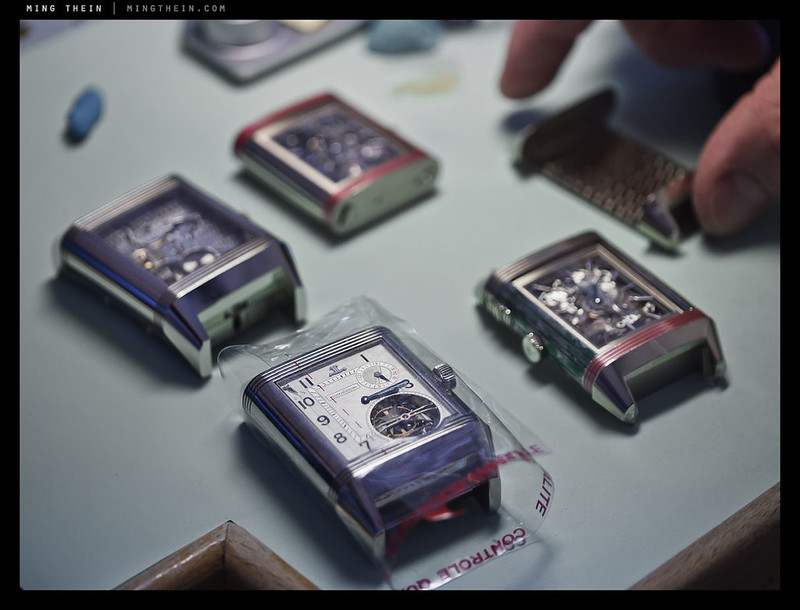

The red and blue plastic is a protective layer to prevent scratches as the watches are cased, assembled, and final adjustments made.

There’s also a Repetition Minutes a Rideau present – but not just any one, a blue one!


It sounded great. I suspect the double case (the movement is actually based on the earlier limited edition series of 500 in pink gold) improves the tonal qualities of the chime significantly. It also looks absolutely stunning, though I’d gladly forgo the outer slide mechanism and just have the inner watch – apparently the inner case is about the same size as a regular Reverso GT, which isn’t very big at all.

On the way out, we pass a Gyrotourbillon in final stages of regulation. The dial on the left (which actually looks complete) is a work dial, used for adjustment only. I’m told that it takes one watchmaker between 1.5 and 3 months to assemble one of these; the huge time difference is if after assembly, it doesn’t run to spec, then the whole thing has to be taken apart and the cage re-balance and re-adjusted.

The gemsetting atelier is next.


I’m not a huge fan of gem set pieces (they showed me bracelet links for a Master Tourbillon, which when completed, would retail for around one million Euros – the entire thing was covered in diamonds, including the dial); however, this particular piece was pretty intriguing – it’s called a ‘chaotic’ setting, and you actually can’t see where the setting ends and the stones begin. They use around 200-240 diamonds of various sizes to cover a ladies’ Reverso case.


We appear to have found the Atmos division.

I actually found this portion quite fascinating, as you seldom see so many of these in one place – and more interestingly, so many vintages; there were clocks here dating from easily fifty years go. I suppose it’s one of the few products whose fundamental parts have changed very little over time. Interestingly, they still cure the balance suspension wire; except these days, it’s done with weights and electric current rather than horse urine and time.

Oh look, a Klimt! In all seriousness, this was an incredibly stunning piece which I think few have been lucky enough to see in person.

View from the employee canteen.
I did also visit the museum, but wasn’t allowed to take any photos. Suffice to say there are some incredibly rare and very interesting pieces in there. And while all the Atmoses are running, charmingly none of them show the exactly same time 🙂 MT
I would like to say a personal thank you to Marina Shvedova, Janek Deleskiewicz, Cecile Tichant, Alexis Delaporte, Reena Tan, and all the patient employees whom patiently answered my endless barrage of questions.
____________
Visit our Teaching Store to up your photographic game – including Photoshop Workflow DVDs and customized Email School of Photography; or go mobile with the Photography Compendium for iPad. You can also get your gear from B&H and Amazon. Prices are the same as normal, however a small portion of your purchase value is referred back to me. Thanks!
Don’t forget to like us on Facebook and join the reader Flickr group!
Images and content copyright Ming Thein | mingthein.com 2012 onwards. All rights reserved
Lens review: The Olympus M.Zuiko Digital 12-50/3.5-6.3 EZ for Micro Four Thirds
July 8, 2012 by

Waiting.
Olympus’ latest zoom covers a useful 24-100mm equivalent range (12-50mm actual) and is the kit lens accompaniment to the OM-D in most parts of the world. (I’ve also seen a variant that includes the 14-42 IIR instead.) It’s a bit of a Swiss army knife – the lens has a power zoom feature for video, which can be decoupled to provide a mechanical zoom ring (more on this later) plus a fixed focal length macro mode, at 43mm. It’s also got a programmable function button on the lens barrel. Like all M4/3 lenses except the 12/2, the lens is focus-by-wire only and has a continuously turning focusing ring that has no DOF markings.


Lens and optical formula. The various colored elements represent different types of glass. Image from Olympus Malaysia
Construction is all plastic, except for the metal mount. It’s pretty solid, though the plastics used feel a notch below those in comparable Nikon kit zooms; still, the lens is weather sealed and is the first of the Olympus lenses to feature a rear gasket. It’s not a small lens, by M4/3 standards – it’s about the same physical size as the Voigtlander 25/0.95, but nowhere near as heavy or well built. The best comparison I can give is to one of those miniature cans of mixers they give you on an airplane to go with your shot of whiskey. Like all Olympus lenses, it doesn’t include a hood or pouch (shame on you, Olympus).

This lens is not meant for low light. This shot – 1s at ISO 800 – says more about the IS capabilities of the OM-D than anything else.
All images in this article shot with an Olympus OM-D E-M5, and the 12-50/3.5-6.3 EZ lens. Clicking on any image will bring you to the flickr landing page, where you and see larger versions.
Optically, the lens uses a 10/9 construction with several exotic elements; with aspherical elements, ED elements, HR elements, and one mysterious DSA element – I think it’s a double aspherical, but it could also be a Japanese government agency. Zooming and focusing is all internal. A quick note on the former: zooming can be accomplished by servo – in the intermediate position, the zoom ring turns into a rocker switch, with one speed in either direction – or mechanically, by pulling it backwards.

Just your average youth on Saturday
The mechanical zoom is my preference, except in this case it has no real clear stops at either end – so when you turn the camera on, it’s very difficult to tell in advance where you are exactly in the zoom range. The complete lack of external cues doesn’t help, either – there are no focal length markings, and the lens doesn’t change length. I find this very disconcerting, not to mention costing valuable seconds when trying to get a shot.

Swirl.
The good news is that focus speed is excellent – just as fast as any of the other Olympus ‘MSC’ lenses; I’m told that the system uses some form of magnetic solenoids and a single moving element to keep things silent and fast. Whatever technology used, it’s fast and precise, and has no problem moving in small increments to match small changes in subject distance.

Untitled
A bonus feature is a 1:3 macro mode – this covers a 36x48mm frame area at a near focus distance of 20cm (normal minimum focus is 35cm), which actually makes it pretty handy at a pinch. Optically, performance is surprisingly good too in this range – completely at odds with one’s expectations for a zoom-with-macro. The macro mode is accessed by holding down a mechanical interlock button on the side of the lens and sliding the zoom ring all the way forwards, which locks the focal length at 43mm.

Urban geometry
You’ll notice I haven’t said much about optical performance up to this point. That’s because it’s honestly quite a mixed bag. It can be good – if you stop down a little (though not past f8, because diffraction starts to rob you of resolution by that point) – but not in the corners. The 12mm end comes close to the 12/2 in the center, but is very soft in the corners; actually, soft is not the right term, the resolution is there, but there’s very clear CA causing apparent softness due to the separation of the blue and red components in the image. It’s a similar story at the 50mm end, though not as pronounced in the corners. There’s some internal flare that creates slight haloes around contrast edges, and it lacks the crispness of the 45mm. In fact, the 45mm at f1.8 is sharper than the 12-50 ever gets.

Waves overhead.
Personally, I find the biggest problem to be not the lack of sharpness, or resolution, or CA – but the poor microcontrast. Textures are not very well defined at all; there’s a decent amount of macro contrast, but overall, the images produced just feel blocky – things seem to fall into either highlights or shadows, and nothing much in the middle.

The Canyon
All that said, it does pretty well for a kit lens – though personally, I actually think the 14-42 IIR actually performs a little better overall; it just feels like it’s got more ‘bite’ than the 12-50. I could of course have a bad copy. Finally, you’ve also got to watch out for the small maximum aperture; f6.3 on the long end is not bright at all. However, thanks to the relatively small number of elements, the lens’ T stop seems to be fairly close to its f stop.

Night crossing.
I struggle a little with the conclusion on this one. It’s a lens that is convenient, and does so many things; but at the same time, I don’t feel like the optics do the OM-D’s sensor justice at all. However, if you’re out in the sunshine, and only want to carry one lens, it’s a good option.

Balance
I purchased the lens as part of a bundled kit with my second OM-D; the price difference was quite small compared to body-only; certainly much less than the cost of the bare lens alone. This in my mind made it a worthwhile experiment; however, I don’t think I’ll be using it much, unless I happen to go to the beach or skiing or some other bright environment where I’d rather not be changing lenses. So, if you’d like the convenience, or can’t find a body-only OM-D, it’s not a bad buy; but if you’re expecting it to come close to the resolution of the M4/3 system’s primes, you’re going to be disappointed. MT

A lens like an umbrella: take it just in case.
The 12-50 is available here from B&H in black or silver.
____________
Visit our Teaching Store to up your photographic game – including Photoshop Workflow DVDs and customized Email School of Photography; or go mobile with the Photography Compendium for iPad. You can also get your gear from B&H and Amazon. Prices are the same as normal, however a small portion of your purchase value is referred back to me. Thanks!
Don’t forget to like us on Facebook and join the reader Flickr group!
Images and content copyright Ming Thein | mingthein.com 2012 onwards. All rights reserved
Calling for entries: The inaugural Mingthein.com photography contest!
July 7, 2012 by

I’m happy to announce a new and (hopefully long-term) feature for the site; something that’ll foster more active participation, buy me time to add more content, and of course, give back more to the readers: I’m going to run a photography contest.
The basic principles:
– It will be 100% merit based. I will be judging.
– There will be a cash award for the winner and runner up!
– The prizes will be supported by a small entry fee of US$5 – the more people who enter, the bigger the award pot becomes. So share it with your friends!
– You will learn something: the final 10 images will be given a detailed critique on the site.
– Unlike just about every other competition out there, I won’t keep the rights to your images; all you need to agree to is allow me to publish the image here if you win, or if you make the final 10.
– There are no restrictions on equipment or date the picture was shot.
– You do of course need to have shot the photo, and own the rights to the image.
– Images must be in the theme of the competition.
This is designed to be a competition by photographers, for photographers.
First theme: The Human Element
Judging criteria: The winning photo must be compositionally strong, have an obvious subject, be technically well executed in a manner that supports the subject, and above all, it must generate an emotional response in the viewer. There’s got to be a person in there somewhere. Color or black and white are both equally acceptable, as are posed and candid images. It doesn’t matter if you’re an amateur or professional, I’m only looking at the quality of your image.
Closing date: Midnight GMT, 31 July, 2012.
How to enter:
– Each participant is allowed to enter one image.
– Images must be in jpeg format, 1500 pixels wide on the long side.
– Watermarks are fine but must not obscure the subject (obviously)!
– Send an email with “July 2012” [space] plus your name in the subject line to mingthein2(at)gmail.com. The body of the email should contain your paypal address (payment is required for participation), name, your image and its title.
– Send your entry fee of US$5 via Paypal gift to [email protected]
– I will confirm receipt of both to the email address the image came from.
– Judging will take place in the first week of August, with results to come thereafter.
– Multiple entries are not allowed.
The fine print:
– First place takes 50% of the total entry fees received.
– The runner up takes 20% of the total entry fees received.
– The balance of 30% will go towards running and supporting this site.
– You must own the rights to the image submitted.
– Rights for all images submitted remain property of the photographer, but in order to be eligible to win, the photographer must grant mingthein.com the rights to publish the image either as part of the final 10 critique, or as the winner.
– The judges’ decision is final.
– Photoshop allowed, but digital editing is limited to adjustments to color/ contrast/ dodge & burn/ sharpening/ minor retouching including spot removal etc. Changes of substantial portions of the image in order to alter the overall impression of the photograph are not allowed, and if detected are subject to disqualification.
– Your email address and other personal data will remain confidential and not be shared with any third party.
– Entries are welcome from any country, it’s an international competition!
Remember: the prize grows directly proportional to number of entries, so share this with your other photography friends and on Facebook!
Good luck, and may the best image win! Looking forward to seeing all of your entries. MT
Second Singapore reader meetup
July 7, 2012 by

A quick competition. More details to follow…
Just wanted to say a big thank you to the readers who attended the Singapore meetup yesterday – great to see familiar faces and new ones; a shame several of you couldn’t make it, but there’s always next time.
And by the way, the collage of images/ iPhones above is something I’m going to run at all future meet ups – I’ll pick a subject, everybody finds an image to enter, puts $5 or $10 in the pot, I’ll do a critique, then the best image takes all. Think of it as an opportunity to learn something, and possibly a free lunch 🙂
See you all next time! MT
Book review: Workers, by Sebastiao Salgado
July 6, 2012 by

One of my favorite photography books of all time is Sebastiao Salgado’s Workers, published by Phaidon. There are various printings around – some hard cover, some soft; the one I have is soft cover with a dust jacket. I actually find these easier to read, but I do worry about the long term durability of the bindings. Groups of pages are stitched together then held in a glued matrix at the spine – this kind of binding has given me some issues in the past, if the quality of the glue isn’t up to par.
But I digress. The book is about the photographs, and to a lesser extent, the printing; not the binding.
Brazillian-born Salgado is a photojournalist who needs no introduction – his long and distinguished career has included a stint at Magnum before founding his own agency, Amazonas Images; he’s also a UNICEF ambassador and has worked with the UN, WHO and other NGOs. He’s one of the few people who’s even had a special edition Leica set produced for him, which I believe was eventually auctioned off for charity. (As of late, he also seems to be a Canon brand ambassador.)

Salgado has a preference for megaprojects – photographic assignments that last for years, or decades, rather than mere days or weeks; his latest and final project, Genesis, begun in 2004 and supposedly nearing completion. Workers was shot on medium format and Leicas; he has recently switched to a digital capture workflow, however, physical negatives are made from the select files and printed the old-fashioned way – which undoubtedly contributes to how his images have such a unique look.
That look – best described as tonally rich, with well-executed dodge and burn in the highlight and shadow quarter tones – is extremely distinctive, and highly textural. You can usually tell at a glance if an image is a Salgado. What elevates Salgado into the great photographic pantheon is his ability to combine perfect presentation with perfect framing, dynamically strong lighting and emotionally arresting subjects – each image provokes an emotional reaction in the viewer – anger, hope, pity, awe, fear – sometimes all at once, even.

The content of Workers is very much encapsulated in the title – it’s a look at the people who keep the great economic machine turning over; curiously, there’s very little seen of the ‘managers’ and clerks; you get the impression that he either doesn’t think they’re worth bothering with because they do little to no real work. The reality is probably a mix of that, and the fact that piles of paper and meeting tables in faceless offices don’t typically make arresting photographic subjects. What you do get is a very intimate view into the spectrum of physical labor – from sulfur mining with bare hands to the construction of the Channel Tunnel. Nothing is clean and industrialized, perhaps with the exception of an auto production line; Salgado’s images portray reality: dirty, oily, textured and visually stunning.
The book itself contains several hundred images in black and white – I don’t think Salgado has ever tried working in color – there’s very slight bronzing to the printing, but I personally feel it adds to the overall look and feel of the images. I’ve had the privilege to see original prints at the Tokyo Metropolitan Museum of Photography, and feel these are very authentic indeed. The density of printing is also excellent, with blacks being extremely deep and the rich tonal variations faithfully reproduced. There are also numerous foldout pages for larger subjects.

If you have a single photojournalistic bone in you, Workers and his other books are highly, highly recommended – it’s a book I go to for both compositional and tonal inspiration. Even if you have no interest in photojournalism, it’s difficult not to be awed by Salgado’s images; they show us a side of the world that few get to see, but for some people forms their entire reality. And hopefully, that incremental understanding and tolerance we take away from seeing into the lives of others goes beyond the enjoyment of the images. MT
____________
If you enjoyed this post, please consider supporting the site via Paypal ([email protected]) or via Ming Thein’s Email School of Photography – learn exactly what you want to learn, when you want to learn it.
You can also get your gear from Amazon.com clicking through this referral link.
Don’t forget to like us on Facebook!
Quick poll: Photoshop workflow video tutorial
July 5, 2012 by
I’ve had a number of emails about my Photoshop workflow already, but they’re difficult to answer because a lot of this stuff is demonstration-based. I could make a video, but that’s very time consuming and means I can’t do other stuff. However, for a tutorial of this sort to be useful and meaningful, it will have to be properly recorded and edited, supplied in HD on DVD, and will take some time to do. The tradeoff is always blogging vs commercial work – realistically it’ll probably cost a little something in order to justify producing.
So, before I go off and spend a couple of days producing one – I’d like to get an idea of how you all feel about it via the two quick questions below. Thanks! MT
Singapore reader meetup details
July 5, 2012 by
Hi everybody,
Just to confirm the reader meetup tomorrow – we’ll do it at The National Museum of Singapore; looks like I’m going to be holed up there all day with various other meetings/ events.
Venue: meet at the front entrance, the National Museum of Singapore – we’ll go find a place for food/ drinks after that; Novus is quite nice from memory.
Time: 1-3pm
Feel free to bring any other friends who might be interested. Free and easy like the last one, and perhaps we’ll run an impromptu photo contest, so bring your smartphones/ tablets etc…
In case you decide to come last minute, are running late, or get lost, my phone number is +60 17 387 6700.
See you all tomorrow! MT






