Photokina 2012 commentary and opinions

The rush of product announcements is over, the collective giddy fanboy-like enthusiasm has died down somewhat, and presumably some serious business is being discussed in the back meeting rooms and dingy service hallways of the exhibition hall in Cologne, or over giant pretzels at the local bierhaus. It’s about the right time for a bit of serious reflection and commentary on some of the more interesting announcements from the last week.

The beginning of full frame for the masses.
The Nikon D600 and Canon 6D are squarely aimed at the space which the Nikon D70 and Canon 300D battled over nearly eight years ago; enthusiast-level cameras with serious image quality and a reasonably good feature set. Granted, the price point is a bit higher, but then again, inflation has moved things along somewhat, too. I actually think both of these cameras are far more capable than the average user needs, but people will buy them anyway. Commendably, Nikon actually had cameras in stock, and for sale at dealers on the day that was announced; this seems to be a rare exception in days of ‘pre-announcements’ months ahead of actual availability. And there weren’t any shortages, either – my dealer (admittedly one of the largest in Malaysia) got 60 bodies, compared to two(!) D800s. The D600 is an extremely refined camera that has no major issues anywhere – and I’m pleased to see that QC is much better this time, too; even though the camera comes from Nikon’s Thailand plant instead of Sendai. I’ll be doing a full review the D600 in the coming days, so stay tuned.

Breaking away from the traditional fixed limitations to camera software.
Nikon’s S800C is the first attempt by a large, traditionally-camera (I don’t count Samsung) manufacturer at doing quasi-open firmware; I think its success will depend on two things – the ecosystem around apps, and the level of integration with normal photographic functions. I don’t think it makes sense to have a camera that’s touch-screen only, which requires you to navigate some menus before you can even take a picture; instead, perhaps the ‘camera app’ could be loaded and running over the base OS by default, with other functional configurations loaded as required. They’ll need to retain buttons, too. And I have no idea how Android handles image processing, especially for very large files.

Wireless, wireless, wireless
Nikon, Canon and Olympus have gone big on wireless file transfer this year, each taking slightly different approaches. Nikon’s is dongle based, and allows ftp of files to any server, which is great for working professionals; Canon’s is built into camera (why aren’t they all like this?) – I haven’t used one, so I can’t comment on functionality. Olympus is card-based and requires an app on a tablet or smartphone to work, but is very well integrated with social media. I think the strategies actually represent their respective companies quite well; Nikon is still conservative and photographic-focused; Canon is a bit gadgety, and Olympus’ target market is very much the blogger and casual user. I hope that at some point the wireless standards will be sufficiently fast and well-defined enough to allow transfer of any file to any other device, or direct upload from the camera itself; Olympus’ implementation seems to work the best of the lot (as far as speed and multiple users go) – unfortunately there’s no way of having it send anything other than a jpeg to a tablet.

More mirrorless
There were a slew of offerings here: the Fuji X-E1, Panasonic GH3, Sony NEX-6/ NEX-5R, Olympus E-PL5 and E-PM2. It’s clear that smaller sensors are here to stay – remember sufficiency for the masses – and viewfinders are becoming an increasingly rare spec. The X-E1 is probably what the X-Pro should have been in the first place; I honestly found the hybrid finder in the X100 gimmicky after a while, and landed up using the EVF most of the time for more precise framing. If AF is improved as much as they claim, Leica will have competition on its hands, but then again, they probably won’t mind because they’ll just sell more lenses. The GH3 now occupies top spot in the M4/3 pyramid, and appears to be a notch above the OM-D in both spec and price. The asking money – $1299 – isn’t cheap at all. Fortunately, sensor quality in the new M4/3 cameras more than justifies it. Sony is more of the same – a cheaper NEX-7, and an evolution of the NEX-5. The hybrid AF technology with phase detect points in the imaging sensor itself was surprisingly low-key; I would have thought that something this useful would be deserving of more fanfare. Olympus’s lower-end cameras have been updated with the innards of the OM-D (though not the 5-axis gyro stabilizer). The E-P3 remains in the lineup for now, though I don’t see why anybody would buy one given the price and older sensor. I’ve got an E-PL5 here for testing, and it’s a pretty impressive camera – this is what the original E-P1 should have been. It’s fast, responsive, very nicely built, and pocketable with the body cap lens; I’ll have a full review up in the coming days.

Sony A99
Sony’s different approach to mirrorless has meant some unique value propositions at the low and mid range, and a slightly odd product at the high end – the A99 shares a base sensor with the D600, but is positioned at the price point of the D800E. At that level, you get higher fps than either camera, an excellent EVF, but a slightly odd control layout and user interface. General operation is fast enough, but I have no idea whether tracking AF is up to speed with conventional DSLRs or not; this has traditionally been a weak point of Sony cameras. I don’t think the package is compelling enough to attract new photographers to the brand, but videographers might be convinced by the quality of the output; the RX100 is seriously impressive, and that sensor is a fraction of the size of the A99’s. I still don’t think EVF’s are anywhere near good enough for critical applications, though; it’s not so much about resolution as dynamic range. I previously had a hands-on preview here.

Carl Zeiss
It seems that they’ve come back with a vengeance: first the 2/135 APO, and then the 55/1.4 Distagon, not to mention AF lenses for the X-Pro and E mount – a 12/2.8, 32/1.8 and 50/2.8 macro. It seems odd that they would skip over the much larger M4/3 market at first, though the relationship with Sony might have something to do with it. On the SLR front, although most of the lenses are capable of excellent results on even the D800E, the 50/1.4 Planar and 85/1.4 Planar have left much to be desired. It’s interesting to see that the 55/1.4 adopts their wide-angle Distagon formula; I suspect this is going to be an outstandingly good lens – it had better be, given the size (82mm filter!) and likely price. It’s apparently the first in a range of very high resolution DSLR lenses that will sit above the current ZF.2/ ZE line.

More M4/3 lenses
Olympus 60/2.8 Macro, 15/8 body cap lens and 17/1.8 announcement; Schneider’s 14, 30 and 60mm primes and Panasonic’s 35-100/2.8 were all announced. Serious glass is a good sign for system maturity. Whilst I won’t be buying the 17, Schneider 30/ 60 or Panasonic 35-100, the Olympus 60/2.8 macro has proven to be one of, if not the best lens I’ve used on M4/3, and one of the best macro lenses ever, period. I’ve acquired one for myself, along with the 15/8 body cap – it’s a fun toy, makes my E-PM1 an interesting pocket option, and is a very good street shooter thanks to huge DOF and a mechanical focus lever. Being a 28mm lover, the Schneider 14mm is definitely on my list, though the expected price tag is eye-watering. I think they will have to lower prices for this range of optics to be a success; I simply can’t see any quantity of people willing to pay this much for lenses relative to the cost of the rest of the system.

Enthusiast compacts with small sensors are still going strong
There were several announcements in this category: the Olympus XZ-2, Canon S110/ G15, Nikon P7700, Panasonic LX7, and Fuji XF1. All were evolutionary rather than revolutionary; the most exciting thing was the mechanical lens on the rather compact (and surprisingly large 2/3″ sensored) XF1. I think for this category of camera to survive, they’re going to have to get smaller and more versatile with lenses, or cheaper; Sony’s RX100 makes for stiff competition given its much larger sensor and reasonably fast lens – and it’s compact. I see the Canon S110 and Fuji XF1 doing reasonably well because of their size; the LX7 has that f1.4 lens; the rest are probably going to wither.

Leica
Aside from the new, confusing naming, Leica did what we expected them to do (and probably should have done quite some time ago) – brought live view to the M, along with a much improved LCD. Although I’m sure they’ll sell in droves anyway, what will make or break this camera as a professional tool won’t be price – rather, the quality of the sensor from the new Belgian supplier, as well as the reliability of the electronics and other parts. At least we don’t have to worry so much about rangefinder alignment; however the EVF makes things somewhat ungainly and also impossible to use flash or a thumb grip (not that that will work anyway, with the ergonomic modification and extra control dial). The M also loses one of its windows – frame lines are now LED illuminated, which is a big deal because it means much easier viewing under difficult light conditions. The M-E is a stripped down M9; I suppose there were a lot of leftover components to use up. I’m curious about the color, but that’s about it. The S has received a supposedly new sensor, though the pixel count remains the same; let us hope image quality is improved, then.

The wildcards: Sony RX1 and ‘that Hasselblad’
Perhaps this section should have been called ‘the good, the bad and the ugly’; or ‘beauty and the beast’. The RX1 appears to be a masterpiece of innovation, even though the camera isn’t as small as it appears to be, and the price is rather high. I think it’s now only a matter of time before we see great compact full frame cameras in the vein of the older Ricoh GR1v and Olympus Mju II. That can only be a good thing for those of us who don’t always want or need to carry around a D600. The Hasselblad Lunar, on the other hand, is either a masterpiece of capitalistic genius which will make them a boatload of money from the taste-challenged Middle Eastern and Chinese markets, or the beginning of the end for the brand. I suppose this is what happens when a bunch of financiers who don’t understand photography take over a camera company; for shame. Granted, Leica is doing the same thing with its rebranded Panasonics, but at least they look better than the original versions. The Lunar is so hideously ugly that it appears to have been designed by a five-year-old, rendered by a fifth form graphics design student, and then posted on April 1st. Except, it wasn’t, and it seems that nobody within Hasselblad can see that the emperor’s new clothes are missing. Having said that, a technology partnership with Sony makes perfect sense: look at the technical prowess required to create the RX100 and RX1. If anything, they could breathe new life into medium format. However, rebranding the company’s existing cameras is definitely NOT the way to go.

A note on marketing strategy
For whatever reason, companies seem to choose to announce all of their products at the same time – this is stupid. As a result, none of the products individually get the attention they could otherwise have managed if the announcements were spread throughout the year; Photokina should be an industry show where things are on display and the reps are there to answer questions and do business. I’d consider myself a fairly avid follower of the industry in general, and yet I keep finding things that I simply overlooked in the deluge of announcements – the Nikon P7700 was something I wasn’t even aware of until today, for instance. And the Zeiss and Schneider announcements got lost against the noise against the Hasselblad Lunar. Fifteen minutes of fame, yes – it just doesn’t make sense to fight with your competitors for the same fifteen minutes so that everybody at best gets five seconds each. Leica did it right with their May 10 event; I suspect the impact was much stronger than at Photokina, and they certainly got more attention in the blogosphere.

Overall, the theme for this year has been evolution and lenses; there are a lot of solidly interesting products out there, some of which I’ll review, some of those in turn which I’ll buy – but the list isn’t that long, probably just the Schneider 14/2, Zeiss 1.4/55 Distagon and 2/135 APO. I don’t see anything dramatically different or improved over what we’re currently using, but better lenses are always worth lusting after. MT

____________

Visit our Teaching Store to up your photographic game – including Photoshop Workflow DVDs and customized Email School of Photography; or go mobile with the Photography Compendium for iPad. You can also get your gear from B&H and Amazon. Prices are the same as normal, however a small portion of your purchase value is referred back to me. Thanks!

Don’t forget to like us on Facebook and join the reader Flickr group!

appstorebadge

Images and content copyright Ming Thein | mingthein.com 2012 onwards. All rights reserved

Macro shootout on Micro Four Thirds: four lenses, one winner

_5009894 copy

Today’s post is a continuation of yesterday’s review of the new Olympus M.Zuiko Digital 60mm f2.8 Macro; aimed at answering two questions: what is the best macro lens for Micro Four Thirds, and just how much better are the system-specific lens designs? Firstly, a bit of background logic. I’ve selected lenses around the same focal length range – 50mm+/- – in mounts that can easily be adapted to fit M4/3; this pretty much means native lenses and Nikon; Canon and Sony do not have mechanical aperture control, and thus no way of stopping down; besides, Zeiss makes the same lens in multiple mounts. I haven’t used conventional lenses with extension tubes* as these are not real macro lenses; their optics have not been designed with optimization for close range performance in mind. Exotic optics and things that aren’t easily available such as the Coastal Optics 60/4 APO-UV-VIS-IR were also excluded for obvious reasons.

*With one exception, explained later

This left us with four practical contenders: the Panasonic Leica 45/2.8 Macro-Elmarit (PL45), the Carl Zeiss ZF.2 2/50 Makro-Planar, the Nikon AFS 60/2.8 G Micro, and of course the Olympus M.Zuiko Digital 60/2.8 Macro (ZD60). Some are going to cry foul at not having the older Zuiko Digital 50/2 Macro present, but there’s a good reason for that – I didn’t have one handy, and the newer lens has a much higher MTF. Basically, we have here the best short focal length macros available for the respective systems – I might have missed one, but the test would be meaningless unless repeated with all lenses at the same time.

These tests would be useless without consistent methodology – so a quick note on that is necessary to provide some background context to the tests. The camera used was an Olympus OM-D, the highest resolution camera available for Micro Four Thirds, and with a pixel pitch equivalent to a 64MP full-frame sensor; this was shot RAW, converted in ACR with identical settings and zero sharpening. I used a Manfrotto 468MGRCO Hydrostat head and Gitzo GT 5562 GTS legs with no center column; this combination is rock-solid and rated to far higher loads than I can even physically carry. To completely rule out camera shake, the test subjects were illuminated with flash – in this case, a pair of Olympus FL-600Rs, triggered wirelessly using the supplied flash for the OM-D. The lens was defocused serveral times for each shot and the best image selected.

Focusing was performed with either AF and checked with 10x live view, or manually with 10x live view, at the intended point of comparison. A G-compatible adaptor was used to mount the Nikon and Zeiss lenses; the aperture on the 60mm was set to the same approximate size (as viewed from the front, object side) as the Zeiss when stopped down. The magnification of each scene was matched between the different lenses by moving the tripod.

The test scenes were artificial constructs to investigate specific properties: resolution at center, border and corner wide open; bokeh, longitudinal and lateral chromatic aberrations and distortion. The lenses were tested in the range they would be typically used – moderately close distances down to the 1:1-1:2 magnification range. All use floating elements, and infinity performance is excellent across the board – it isn’t difficult to design a normal lens that performs well at infinity.

With regards to the commentary, please go off what I say and not what you see: even though these are low-compression jpegs of screen shots of 100% crops, there will inevitably be some differences in color and resolution compared to the actual files which I’ve viewed on a calibrated monitor, at full resolution. Clicking on the ‘full resolution’ links takes you to the original screen shot file.

1. Center resolution at mid distance, f2.8

_5009081 copy
Full frame

ZD60 comparison center mid distance
Click here for the full resolution 100% screen crop.

Wide open, the ZD60 has both the best resolution and microcontrast here, taking the crown from the PL45 by a hair; there seems to be just a tiny bit of CA or bleed on the edge of the lettering of the PL45 that’s robbing the lens of crispness. You can also see that the lens doesn’t seem to be resolving on as fine a level as the ZD60  – note the fiber in the right hand center edge black portion. Neither the Nikon nor the Zeiss are anywhere near in the running here; both have internal veiling flare that clearly lower contrast and resolution, especially in the texture of the label. The Zeiss is a bit better than the Nikon, but then again it should be; it’s the only lens in this group that’s been stopped down by a stop. The legacy lenses are a little disappointing but not entirely surprising; even on the larger pixel pitch D800E they require some stopping down to reach optimum resolution.

2. Bokeh and longitudinal CA, f2.8

ZD60 comparison loca-bokeh
Full resolution. From the previous frame. A set of keys was lit directly with another flash to provide a bright, contrasty and reflective background subject.

Bokeh is pretty good in all of these, but not perfect in any of them. If I had to choose one, I’d say my vote is betweens the Nikon and the Olympus; the Nikon appears the smoothest of the bunch, but also suffers from significant longitudinal chromatic aberration. The Olympus has almost no longitudinal CA, but it does have some texture in the OOF highlight area, as well as a bright edge to the same area. The PL45 is clearly the worst of the bunch, with uneven highlights, bright edges, and longitudinal CA to top things off; it seems that it might also be prone to double imaging with certain out of focus subjects. The Zeiss falls somewhere in the middle for smoothness, but has the worst longitudinal CA. Remember that the relative merits of bokeh are very subjective – what might be to my taste may not be to yours. CA, however, is CA, and can require significant postprocessing work to fix if present in the OOF areas.

3. Corner resolution at approx. 1:3 magnification, f2.8

_5009115 copy
Full frame

ZD60 comparison corner
Full resolution

As with the initial center crop, it’s a very close race between the PL45 and the ZD60; both appear to have contrast, but the ZD60 has slightly higher resolving power and microcontrast. I see a small amount of CA on the PL45 image too; the top edge of the white line has a slight green fringe. The Nikon lags behind both for resolution, and has some visible CA; note the top edge of the white line. The Zeiss is the worst here – there’s visible CA, a tiny bit of coma, low contrast, some flare, and markedly lower resolution than the others. It also has the warmest rendition of the lot (WB was manually set to the same Kelvin temperature for all images).

4. Center resolution at 1:2 magnification, f2.8

_5009132 copy
Full frame

ZD60 comparison center 1-2mag
Full resolution

Things haven’t changed much in the center and at closer distances; the two legacy lenses are closer in resolving power to the native M4/3 lenses, but both still lack microcontrast. In overall resolution, there’s little to choose between the Nikon and Zeiss, the PL45 is only a bit better. It’s actually surprising how much crisper the ZD60 appears here.

5. Border resolution at 1:1.2 magnification and distortion, f5.6

_5009170 copy
Full frame; a 20mm extension tube was required for the Zeiss ZF.2 2/50 MP to achieve this magnification as it’s normally limited to 1:2.

ZD60 comparison edge 1-1
Full resolution

A more practical application – for me, at any rate. None of the lenses had any noticeably distortion, so I didn’t bother to include full crops from them. For all intents and purposes, it’s a non-issue. The focus point of this image was the center pinion of the second hand of the watch (the round thing), not the 60 text. Note that the hand is very dark blue, and the left-edge blue highlight is the color of the hand. The color fringing visible on the high contrast edge of the steel pinion itself, on the other hand, is chromatic aberration. On stopping down a little, the Zeiss has caught up with the PL45 and ZD60 in both resolution and microcontrast; there’s very, very little to choose between the three. The PL45 appears to have the most contrast overall, followed by the Zeiss; the ZD60 still seems to be resolving slightly more than the other two (note micro-machining marks in the highlights of the silver guilloche pattern) but with lower contrast; perhaps its coatings cannot deal with the reflections from the silvered pattern as well as the Zeiss T* or Leica coatings. The Nikon is clearly struggling to deliver the same macro- and microcontrast, though resolution appears to be only a hair behind the other three. I think the PL45 looks the best here, with the Zeiss and Olympus tied for second, but it is very, very close indeed.

Conclusions

Given that you’ll have to shoot all of these lenses at relatively large apertures (for a macro lens) to avoid diffraction, wide open performance and close to it are both very important. Although both the Zeiss and Nikon are relatively modern designs, it’s clear that the legacy mount lenses simply don’t do as well as the dedicated designs, which isn’t surprising. As a practical option, although image quality is more than acceptable – we are very much into the realm of pixel peeping here – the dedicated M4/3 lenses are simply much easier to use thanks to autofocus; it’s nearly impossible to nail critical manual focus wide open and handheld, though quite doable on a tripod. If resolution is your priority, then your choice should be either the ZD60 or PL45; however, if it’s bokeh, you might want to think about an adaptor. Bottom line: if you have these lenses around, and work in a controlled environment, you could quite happily make do with an adaptor.

All of these lenses are capable of producing stellar images technically; the artistic content is of course very much down to the photographer. I don’t think it’s difficult to pick a winner here; although the PL45 and ZD60 are both excellent lenses, the ZD60 simply has far fewer optical shortcomings than the PL45, and a transparency about it that makes it look as though the other lenses have a veil or film or something pulled over them. I own all of these lenses, and have extensive experience with them. The Nikon has been my mainstay lens for watch photography since its release several years ago; the Zeiss I use for food, and the PL45 has increasingly been my lens for both product and food shoots because of the extended depth of field available with an 45mm real focal length and the M4/3 system. I’ve generally avoided shooting wide open with the Nikon and Zeiss at close distances, though. However, this test (and the preceding review of the Olympus ZD60) is seriously making me reconsider the position of the former two lenses; the Olympus is so much better on M4/3 than the other two even on the Nikons, let alone adapted to M4/3.

I think you don’t need me to tell which lens is the clear winner here…MT

The various lenses tested are available here from Amazon: Olympus ZD 60/2.8 Macro, Panasonic-Leica 45/2.8 Macro-Elmarit, Nikon AFS 60/2.8 G Micro, Zeiss ZF.2 2/50 Makro-Planar.

____________

Visit our Teaching Store to up your photographic game – including Photoshop Workflow DVDs and customized Email School of Photography; or go mobile with the Photography Compendium for iPad. You can also get your gear from B&H and Amazon. Prices are the same as normal, however a small portion of your purchase value is referred back to me. Thanks!

Don’t forget to like us on Facebook and join the reader Flickr group!

appstorebadge

Images and content copyright Ming Thein | mingthein.com 2012 onwards. All rights reserved

Review: The Olympus ZD 60mm f2.8 Macro and FL-600R wireless flash system

_5009896 copy

Although ‘development announced’ (i.e. officially leaked) several months ago together with the 75/1.8, Olympus’ newest macro lens – the M.Zuiko Digital 60mm f2.8 (hereafter known as the ZD60) was formerly announced at Photokina 2012, and should be available sometime in October 2012 at a price of around RM2,000. It’s also only the second macro lens available natively with a Micro Four Thirds mount (and autofocus), the other one being the Panasonic-Leica 45/2.8 Macro-Elmarit, which I reviewed earlier here. Being an OM-D shooter, and heavily product-photography oriented, I was invited by Olympus Malaysia to review the ZD60 together with the new PEN Lite E-PL5 (review coming in the next week or so). The macro work I do almost always involves flash, so I had them loan me a set of their most recent flashes – the FL-600R. This review will therefore be approached from the point of view I’m most familiar with: photographing watches with speedlights, in a pretty much identical manner to how I do it with my main Nikon system. There will be comparative notes throughout, and no pictures of flowers, cats, eyes, coins, trinkets or other typical macro subjects. Let us begin.

_5009907 copy

All images in this review were shot with an Olympus OM-D and FL-600R wireless flashes; the images are all from the ZD60, except the images of the ZD60, which were shot with the PL 45/2.8.

Let’s talk about the lens first: it offers 1:1 reproduction ratio at a minimum distance of 19cm from the sensor plane, which translates into a healthy 7-8cm of working distance at maximum magnification. This is great news for people who want tight frame coverage; by comparison, if I try to get the same subject coverage (i.e. 2:1 on full frame) with my D800E and Nikon 60 macro, I’m down to around 4 of working distance, which makes even lighting control much more difficult. The optical design has 13 elements in 10 groups, with one ED element, two HR elements and one E-HR element (I presume these are different types of optical glass).

Optical design and MTF chart. From Olympus Malaysia

Three of the groups float and perform focusing functions. This is not a simple optical design! There are traces of a double-Gauss base design in there, but it looks as though heavy modifications and extra elements were added to optimize resolution and close range performance. By comparison, the excellent Nikon AFS 60/2.8 G Micro – which has been my mainstay lens up til now – has one less element and one less group.

_5009904 copy

Size-wise, it’s similar to the 12-50 kit lens for the OM-D; build quality is definitely better, but still plastic and nowhere near as nice as the 12/2 and 75/1.8 lenses. The plastic used is matte, feels reasonably robust, but curiously has visible moulding lines in several places – I’ve not noticed this on any of the polycarbonate-shelled Nikon or Canon lenses before, but it may be because those tend to have a spatter-finish paint that hides the seams better. It’s also weather sealed, with ‘SPLASH PROOF’ in big letters on the bottom of the lens barrel. The lens is made in China.

_5009558 copy

Omega Speedmaster 9300.

_5009558 crop
100% crop of the above.

Two small points of interest on the ergonomics of the lens itself – firstly, although the (optional, shame on you, Olympus) hood is a bayonet fit, it telescopes in and out; neat, but I found it annoying after a while as if you support the lens by the hood and put too much pressure on it, the hood will easily shift or start to collapse back in. Second is the little rotary knob to control the focus range, accompanied by a pointer scale showing the subject distance and corresponding magnification level. The switch has several settings – full range, 0.4m to infinity, 0.19m to 0.4m, and a sprung detent to take the lens to 1:1. It sounds clunky but is actually very practical in use – selecting the right range keeps focusing fast and positive, and the 1:1 position is very helpful in traversing the focusing range when you don’t have a full-time mechanically coupled focusing ring. Overall, ergonomics are excellent.

_5009726 copy

_5009726 crop
100% crop of the above.

Once in a while, (though increasingly frequently with today’s computer-designed optics) you come across a lens that is truly outstanding – the last two that come to mind were the Olympus ZD 75/1.8 and Leica 50/2 APO-Summicron-M ASPH. I’ve used a number of competent, but imperfect, lenses in the meantime, none of which were that memorable for their optics. Fortunately, the ZD60 is another one of those lenses that falls into the ‘truly outstanding’ category – I’ve tried hard under many varied test conditions to find fault with the optics, and come up with an extremely short list. If you want the short answer, you can skip the next few paragraphs: this lens offers excellent optical performance at every aperture and focus distance.

_5009610 copy

The lens has an even more impressive MTF chart than its highly-regarded predecessor, the ZD 50/2 macro for Four Thirds; granted, both designs only have to cover the small Four Thirds frame, and they used a lot of elements to do it, but still: it clearly outresolves the OM-D’s sensor, even wide open. On my copy, I simply didn’t see any improvement in stopping down – you get increased depth of field, and sharpness stays constant (i.e. outstanding) at every part of the frame. There’s diffraction beyond f8, and that’s about it. The plane of focus is also flat, as far as I can make out, and there’s almost zero distortion present. Let’s just say that the ZD60’s resolving power is not going to be the reason for any soft images. Like most of the extremely sharp lenses, the ZD60 also has very high microcontrast – these characteristics are related because high resolving power is required to differentiate between subtle tonal differences in the subject. In fact, it’s amongst the best lenses I’ve ever seen; deserving of the superlative classification (for lenses, at any rate) – of transparent.

_5009812 copy

For reference, the screws on the right are about 1.5mm across.

Although overall resolution would support a much higher-density sensor, it wouldn’t be practical in use: on the OM-D’s 16MP sensor, you already have minor diffraction from f8, and visible diffraction at f11 and up (even though the lens can stop down to f22, I really wouldn’t recommend it; you might as well use a pinhole at that point). I suppose it would have been nice if it had tilt control too, but I think given the target market for Micro Four Thirds, that option might be a long time coming. I believe Novoflex has a T/S bellows system, which might be worthy of investigation at some point in the future.

_5009392 copy

Jaeger-LeCoultre Reverso Latitude.

As for the other optical qualities of the lens – bokeh, chromatic aberration, color rendition and transmission – there are very few flaws. The only one I could find was some slight texture in the bokeh, and even then only in a couple of frames with circular out of focus highlights at a certain brightness level – one of the signatures of a moulded hybrid aspherical element somewhere in the construction. To keep things in perspective, even the Panasonic Leica 45/2.8 Macro exhibits this trait, and more obviously. Aside from that, bokeh is smooth and pleasant, with very minimal bright edges on defocused highlights. Chromatic aberration was nonexistent laterally, and more commendably, almost completely absent longitudinally, too, even wide open. I have not seen this level of CA performance in any macro lens I’ve used to date, even the Leica 120/2.5 APO-Summarit-S. Color rendition is neutral and pleasingly saturated, and taken in tandem actually quite reminiscent of the Zeiss lenses. Olympus uses their new ZERO coating on the lens, which keeps transmission high – I would estimate the lens to be around T3.0.

The ZD60 uses Olympus’ MSC system, which has the elements moving linearly on a rail; it’s not as fast as the 12/2 or 45/1.8, but with the limiter in the 0.4m-infinity position, it’s similar in speed to the 75/1.8, and definitely faster than the Panasonic-Leica 45/2.8.

_5010037 copy

FL-600R compared to the Nikon SB900. One would fit in your pocket; pocket the other and you’d probably be arrested on a public indecency charge.

Next up, we have the FL-600R flash; it has a guide number of 50m at ISO 200, or 36m at ISO 100, running off four AA batteries, with a wide panel and zoom head covering from 16 to 85mm. Full-power cycle time is claimed to be 2.0s with NiMH batteries; it didn’t feel any slower than my Nikon SB900s or SB700s, which I find to be pretty fast. In addition to the usual TTL and manual modes, the flash can also act as both wireless commander and slave using Olympus RC system. It’s also got a bright single LED in the base portion – ostensibly for video use, but I actually found it to be a useful modelling light for macro work, making focusing and composition quite a bit easier. If only it was in the head itself and even brighter…

_5009382 copy

In use, the flashes are fairly simple to operate, though the very low number of external controls means that a lot of button presses are required, and you have to remember what does what – I much prefer the softkey and physical switches approach of the SB900 and SB700. That said, the units are physically much smaller than even the SB700 and SB600, and positively dwarfed by the SB900 – this leaves very little real estate on the back for the LCD and controls.

_5009485 copy

Overall, I found TTL flash exposure to be mostly good; wireless TTL on the other hand, was a bit hit and miss. There were certain situations – specifically when one flash was firing at the background, and the other at the subject – where the subject exposure was a bit inconsistent. Not much of an issue, I just dialled in manual power. The limited external controls and display space also mean that adjusting settings for remote flashes with the FL-600R as master isn’t so easy, and requires far more button presses than I would like. Fortunately, even with the FL-600R on the hotshoe, the camera itself can be used to set the remotes; the hot shoe contacts then transmit the data to the flash. Coupled with the OM-D’s touchscreen, it’s a fast and easy experience – in this respect, better than the Nikon system. And you can control all three groups of flashes from the camera, regardless of which flash is attached to the hotshoe – which is one more than the Nikon system. There are also three available channels so other users’ flashes aren’t triggered by yours and vice-versa if there are a few of you. I can see this being useful if you shoot Nikon or Canon, but to be honest, I’ve never encountered an Olympus flash shooter…

_5009342 copy

The only major issue I have with the wireless flash system is triggering – the sensor on the flash unit itself seems to be very small, aimed forwards and somewhat recessed – this makes no sense whatsoever, seeing as the flash is likely to be facing the subject, which means that the sensor will be away from the camera. Even the Nikons – with side and front mounted sensors – still have problems picking up the optical trigger signal at times. With the FL-600Rs in orientations where the sensor wasn’t almost facing the camera directly, triggering was somewhat hit and miss, especially with the small flash supplied with the OM-D. Use of one of the FL-600R units as a master improved this somewhat, but camera companies really need to start making flashes with multiple optical sensors, or better yet, built in radio triggers for both camera and flash. I know some of you might suggest external radio triggers, but has anybody tried looking for a TTL PocketWizard for Olympus lately? It just doesn’t exist.

_5009513 copy

To date, when using the OM-D for macro work, I’ve either been using my large LED panels (and hence continuous lighting) or the SU-4 optical slave mode on my SB900s and the supplied small flash set to 1/64 power, which works well, but lacks the convenience of being able to set the power output from the flashes either via TTL metering or directly from the camera, let alone both. This can be inconvenient at the best of times – worse still if your flashes aren’t easily accessible. I’ve wanted to try the Olympus wireless flashes for some time now; my thoughts are that so long as you can spare one unit to use as a master trigger, they’re a viable alternative to the Nikon system; the problem is that I’d have to buy another five flashes to get the same flexibility as I have now, which seems somewhat silly.

_5009319 copy

That said, the Olympus system – and Micro Four Thirds – for macro work has a lot going for it; firstly, a truly outstanding lens which is almost completely CA-free; flashes that aren’t that expensive, and very, very small – like the rest of the system. I could fit an equivalent system to what I use now in a bag half the size. Although on the face of things, the Nikon system has a huge resolution advantage – you lose something in diffraction (despite the D800E not having an AA filter), and the OM-D files are clean enough to upsize well to 25MP or so. The difference is much less than you might think. I think I’d have a very difficult time deciding what to buy if I was starting over again with the same objectives. As it is, I won’t be returning the ZD60 to Olympus; it’s unquestionably earned a place in my arsenal, edging out the 45/2.8 (it’s also nice that I no longer have a focal length overlap with the faster 45/1.8). As far as I’m concerned, this is the new reference lens for Micro Four Thirds. It’s that good. MT

The Olympus M.Zuiko Digital 60/2.8 Macro is available here from B&H and Amazon.

The FL600R flash is also available here from B&H and Amazon.

Come back again tomorrow for part two: a four way shootout between the M.Zuiko Digital 60/2.8 macro, Panasonic Leica 45/2.8 Macro-Elmarit, Zeiss ZF.2 2/50 Makro-Planar and Nikon AFS 60/2.8 G Micro!

____________

Visit our Teaching Store to up your photographic game – including Photoshop Workflow DVDs and customized Email School of Photography; or go mobile with the Photography Compendium for iPad. You can also get your gear from B&H and Amazon. Prices are the same as normal, however a small portion of your purchase value is referred back to me. Thanks!

Don’t forget to like us on Facebook and join the reader Flickr group!

appstorebadge

Images and content copyright Ming Thein | mingthein.com 2012 onwards. All rights reserved

_5009375 crop
Parting shot – another 100% crop.

Points of sufficiency: do you really know how much is enough?

The never-ending photographic arms race got me thinking recently about sufficiency: how many pixels, fps, AF points, ISO settings, etc. are enough? The troubling thing is that I thought I used to know the answer: I’m no longer sure it’s quite as clear cut. See, the thing is that if you’re viewing images online, in theory, anything close to your screen resolution (leaving space for UI elements, text, menus etc.) should be sufficient – 1000px wide is more than enough for most purposes. The images on this site are mostly 800px wide, for reference. In theory, that should mean an iPhone is overkill. Yes and no; just because resolution sufficient, it doesn’t mean that we’re going to have enough dynamic range, or color depth (or accuracy).

This raises a hypothetical question: suppose we could have say a ‘perfect’ 3MP – in a compact camera, with a reasonably good zoom lens; if we put those 3MP into a 2/3″ or 1/1.7″ sized sensor, we could probably get a fast-sh 24-120mm f2-4 equivalent into something that would be reasonably pocketable. The relatively low pixel density would mean several things – good acuity, low noise, good color accuracy, and much higher forgiveness of the lens quality. With today’s technology, I don’t see why you couldn’t get a clean ISO 6400 and useable ISO 12800. Even with a lens of moderate speed, that’s a more than sufficient shooting envelope for most photographic purposes. Add a good optical stabilizer, fast AF, 14 bit RAW, responsive buffering and controls, and most people would be set. And with raw files that small, you could probably get 10,000 of them onto a 32GB card.

But, nobody would buy it and it would be a commercial failure. Only 3MP? Really?

That’s the kicker. If you’ve ever had a really high quality, but small-ish file, then you’ll know that you can actually do quite a lot with it; I remember seeing some images from the 2005 Wildlife Photographer of the Year competition – prints, at 40×60″ or so – which were shot with a Nikon D1H: that’s right, all of 2.7MP. Did they sing? You bet. Did they look grainy, or pixellated? Not especially so, but I’m sure you’d see the difference if you shot the exact same scene with a D800E. The shot that won would no doubt still be a great capture even twenty years from now. A hundred years from now. Does the equipment matter? Insofar as it didn’t get in the way of the capture, no.

In a more realistic scenario, a proper 300dpi print (actual pixels, not printer ink dots) looks extremely sharp. 200dpi is still acceptable; do you know what most computer screens are? Closer to 110. Sharp images still look sharp, don’t they? And the reason things appear pixellated is because the pixel mask of the screen gives each pixel a hard edge. If the edges of each dot were just a tiny bit fuzzy and overlapped the next dot, like in a print, then things would look just fine. The reality is that short of sticking yourself a few inches away from the display, you’re not really going to see the individual pixels. I have to be honest; the Macbook Pro’s 220dpi ‘retina’ display doesn’t look all that different to my 15″ non-retina from healthy viewing distances. But it requires four times the amount of graphics power to run, because guess what: every graphical element requires four times the pixels.

Most people print no larger than 6×4″, or perhaps out to 8×12″ for special images; survey a group of enthusiasts on the largest print they’ve made, and you’ll probably find 13×19″ a good end point. There are two reasons why: cost, and lack of display space. Enormous prints are great, but you’d also better have enormous walls to hold them.

So what does a 1500×2000 pixel, 3MP file get you? At 110dpi, 13.6×18.2″ – lo and behold, that’s pretty darn close to 13×19″! The one problem with this scenario is that it assumes that all photographers using the ‘sufficient’ camera have the shot discipline to get things perfect at the pixel level, and that they’re really getting the full resolution of the sensor. Sigma/ Foveon shooters will know what I mean by this – the files may be small, but the real resolving power is pretty darned high. Higher than the sensor’s pixel count would lead you to believe (but not as high as Sigma’s marketing department would like you to believe).

Even for use on a next generation ‘retina’ display, you could still get a 7×9″ image out – comfortably fitting the display size. You could probably interpolate it a little too, and not see too much degradation in quality.

Let’s put this all into context. The recently-released Sony RX100 (reviewed here) has 20MP effective – that’s a whopping 5500×3600 or so pixels, or enough for a 50×33″ print – I don’t have enough space in my house to hang more than one or two of those, and at that size, I’d struggle to think what image I wouldn’t mind looking at for hours on end. Yet there are still people crying ‘not enough resolution!’. At that sensor size, pixel density is so high that critical focusing and shooting discipline become very important; I notice that the stabilizer seems a lot less effective than lower-pixel count cameras, but I’m now starting to suspect it’s because it’s got to work quite a lot harder to maintain perfection at the pixel level.

Take the argument a notch further: okay, so there are still reasons to have something with interchangeable lenses. And those things always come with bigger sensors (okay, so not the Nikon 1 cameras, but they haven’t exactly been a commercial success – expensive, small sensor, low pixel count; even if the pixel quality is reasonably high and the cameras are extremely responsive). Bigger sensors mean more expected resolution. I’m going to bypass M4/3 and APS-C for the time being, because they all top out at reasonably similar resolutions; there isn’t that much difference between 16 and 24MP – remember, area scales with the square of length. Let’s go to full frame DSLRs – one of the most common questions I’ve received via email in the last few months is ‘I have a D700. Should I upgrade to the D800/ D800E?’ The fact that that question is even being asked signals that the marketing department has done a good job. They’ve sold you on the lure of the enormous number of pixels; you haven’t bothered to do a bit more reading to find out that a) you’re going to need much better lenses; b) shot discipline once again becomes critical; c) stability is a hot topic; d) your AF system might not be quite as accurate as you thought – especially if you’re using auto-area and letting the camera do the thinking for you.

The answer to this question is simple: how big do you print, and do you need video? If the answer to the latter is yes, go ahead and buy it; video isn’t something the D700 can do. The former is a bit more subtle: if you can’t get a good 45×30″ or so print out of the D700, then your shooting technique needs work. I’ve had images shot under ideal conditions printed to 40×60″ for exhibitions – they still looked great. Granted, the subjects weren’t crammed with fine detail like leaves and grass, but they weren’t high-bokeh content portraits, either. So, if you’re not making say 20×30″ landscapes on a regular basis – do you really need the heartache that comes from having to revaluate all of your lenses, and shunt around 50MB RAW files? Probably not. But, the bragging rights are a different matter altogether.

One of the reasons why the photographic industry is still growing despite passing saturation point some time ago is because of the photographers themselves: they don’t know when to stop. Canon will happily sell you a 50/1.2 for three or four times the price of the 50/1.4, which itself is three times the price of the 50/1.8 – simply because there are people who will pay for that extra half a stop. (And it may be an extra half a stop of aperture, but it’s almost certainly less than half a stop of transmission.) Let’s be realistic: the camera’s metering doesn’t gauge scenes that accurately; I routinely make adjustments of +/- 1 stop, and that’s with Nikon’s super-accurate matrix meter in the D700 or Olympus OM-D (I consider both to be more reliable than the D800, which has a tendency to put too much weight to the active focus area). The Sony RX100 is out by so much that I have to constantly use exposure compensation or risk an unsalvageable image. With the degree of adjustment latitude our modern sensors give us, whole stops changes are what you have to be making before you see any appreciable differences in image quality.

Here’s another curious thing: equipment with more conservative specifications often performs better than more extreme gear, even though the extreme gear frequently costs several times more. This is because we’re dealing with known technology, with greater tolerance for error: this is why there are many superb 50/2s or 50/2.8s that perform excellently wide open, but few 50/1.4s and faster that do. It’s also why lenses with higher resolving power – take the macros for instance – have modest apertures. It’s easier to correct for smaller apertures. Same thing with sensors – it’s easier to get good dynamic range and a high signal-to-noise ratio out of a sensor with a larger pixel pitch; the supporting electronics for each photosite has to be of a certain size, and if there isn’t much area to go around in the first place, that circuitry starts to make a significant and noticeable difference to the light-collecting ability of the sensor.

The bottom line is very Socratic: Know thyself. Specifically, think carefully about which pictorial limitations are due to the photographer, and which are because of the camera. Low light performance? It’s probably your gear. Poor composition? More pixels isn’t going to help you. Blurry images? More pixels definitely aren’t going to help you; examine your technique first.

The recent series on inspirations from older cameras was posted specifically to illustrate this point: just because a camera is old, it doesn’t mean that it’s no longer capable of producing good images. If somebody could use it to get the shot when they had no other choice, it means that you can still do that. The important thing to remember is that most of the time, the limitation is in the user, not the equipment. So next time, before buying more gear, think about spending money on improving your skill level first. I guarantee that you’ll see a much bigger improvement in your images. MT

____________

Visit our Teaching Store to up your photographic game – including Photoshop Workflow DVDs and customized Email School of Photography; or go mobile with the Photography Compendium for iPad. You can also get your gear from B&H and Amazon. Prices are the same as normal, however a small portion of your purchase value is referred back to me. Thanks!

Don’t forget to like us on Facebook and join the reader Flickr group!

appstorebadge

Images and content copyright Ming Thein | mingthein.com 2012 onwards. All rights reserved

Review: The Carl Zeiss ZF.2 2.8/21 Distagon T*

_8015935 copy

One of the legendary wideangles for SLR users, the Carl Zeiss ZF.2 2.8/21 Distagon T* (referred to simply as the ’21’ after this) is a fairly complex – by Zeiss standards, anyway – telecentric design with 16 elements in 13 groups and a floating rear group for close range correction. As with most of the modern Zeiss lenses, it’s based on a derivative of the older Contax/ Yashica 2.8/21 Distagon (however, that was a 15/13 design). It’s currently available in Canon (ZE, fully electronic) and Nikon (ZF and ZF.2, the latter of which is fully electronic) mounts.

_8015829 copy

Like all Zeiss lenses, this is a piece of glass that is extremely solid, moderately heavy (~620g) and very well built all-round – it’s like an old-fashioned scientific instrument, in a good way. There is no plastic on this lens; except perhaps some of the baffling at the front and rear. The barrel is black-anodized aluminium, with chrome front bayonet for the hood, and chromed brass rear mount. My two minor complaints about build quality relate to the hood lining and mount – like all Zeiss lenses, the mount seems to wear very quickly, showing brassing after just a dozen or so lens changes. The hood is metal, solid, and locks into place on the front bayonet thread with a reassuring click – and doesn’t move thereafter. However, it also has very crisp edges that are prone to denting, and the felt lining can easily start peeling around the front edge if you get it caught on something. A thin rubber bumper lip around the front edge would solve both problems handily (and if I’m not mistaken, the hoods for some of the Sony Alpha Zeiss lenses have this).

_8015938 copy

One curious design quirk is the front portion – it reminds me very much of a martini glass. Although the glass itself appears to be able to fit within a similarly-sized housing as the 2/28 Distagon, the front filter thread is a whopping 82mm. I presume this is so one can stack filters without worry for vignetting, but it could also be because some parts such as the hood and bayonet are shared with the similarly martini-like 4/18 Distagon. Unfortuantely, this makes the lens rather cumbersome to pack as it occupies virtually cube-like dimensions.

_8013437 copy
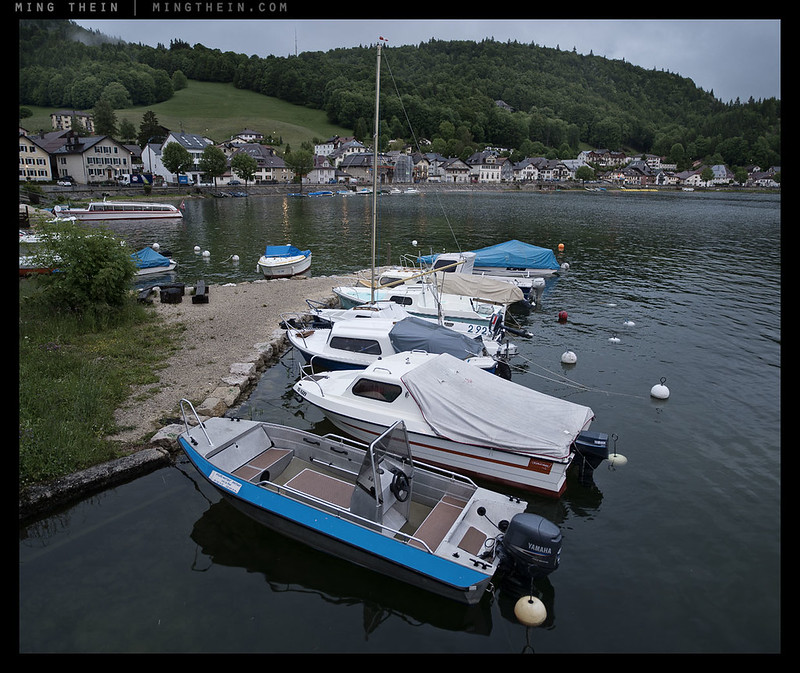
Boats, stored. Le Sentier, Switzerland. Nikon D800E, Zeiss ZF.2 2.8/21 Distagon

This is, of course, a manual focus lens – apparently the tale goes that all of the autofocus patents are held by the Japanese, except for Hasselblad, who bought technology from Minolta. Needless to say, these patents are being kept very closely guarded; I honestly can’t think of a reason to buy a large portion of Nikon and Canon’s lenses if I could get autofocus with Zeiss. Industry politics aside, the manual focus ring is perfect – spinning freely enough to change focus distance quickly, but not so loose that you can’t set the distance precisely. The amount of damping is perfect. Why Zeiss can’t make all of its other lenses feel like this is beyond me – they’re mostly a bit too heavy in feel for my tastes, especially in a fast moving reportage scenario.

_8017807 copy
Spiral. Sasana Kijang, Kuala Lumpur. Nikon D800E, Zeiss ZF.2 2.8/21 Distagon

The near focus limit is just 22cm, which makes for some very dramatic closeups indeed; however don’t be expecting fantastic magnification because it is, after all, a 21mm lens – which means you’re looking at 1:5 or so. More importantly, however, is that optical performance across the frame is maintained even at this focusing distance; undoubtedly thanks to the floating rear group that compensates for near aberrations. I personally can’t think why I’d use it at this range, though it might make an interesting lens for food photography on the OM-D – being a 42mm equivalent.

_8018467-8 copy
Boutique interior. Nikon D800E, Zeiss ZF.2 2.8/21 Distagon

Sharpness and resolving power are excellent; this is one of the few wides that really does the D800E sensor justice – even into the edges. The center is already extremely sharp from wide open, and the extreme corners catch up at around f5.6 or so. There are very mild traces of lateral CA wide open in the corners with high contrast subjects and the D800E; they’re not visible at all on the D700 and DX bodies. And there’s no odd color smearing, either – everything resolves in the same spatial location, which can’t always be said of wide angles (the Sigma and Voigtlander 20mms come to mind). Interestingly, this lens has an extremely impressive MTF chart* – almost flat by f5.6 – made even more impressive by the fact that Zeiss MTF charts are measured averages not theoretical maximums.

*The interpretation of which will be the subject of a future article.

_8014874 copy
Dreaming of the high seas. Nikon D800E, Zeiss ZF.2 2.8/21 Distagon

What of the other optical properties? Well, there’s some vignetting; around 1-1.5 stops in the corners at f2.8, but it’s almost entirely gone by f4. There’s distortion, too; up to 2% taking an odd moustache or sombrero-shaped pattern that isn’t so easy to correct manually, but can be taken care of easily by ACR’s built in profile for the lens. Bokeh is neutral and pleasant, with no hard edges; that is, when you can get enough subject separation to see any bokeh in the first place. You’re pretty much going to be at hyperfocal from 2m if you set f5.6.

_8017918 copy
Gallery. Nikon D800E, Zeiss ZF.2 2.8/21 Distagon

Finally, a quick word on that famous Zeiss microcontrast – it’s present as expected. Microcontrast is the visible result of several optical properties: high resolution; even and high spectral transmission, and as little chromatic aberration as possible. The 21 has all of these things. Resolution and chromatic aberration are functions of the optical design; transmission dependant on the glass types and coatings used. As with all Zeiss lenses, the transmission of this lens is very high thanks to the excellent coatings – note how in the images above, the front few elements mostly disappear; this is due to the surface coatings not allowing reflected light. It’s especially important for maintaining contrast; good coatings manifest themselves in a deep, saturated look that I like to think of as ‘tonal richness’. But I digress: the T stop of the 21 is 2.9, which is just 0.1 stop down from the physical aperture of 2.8. It means that you’re pretty much going to get as much light as you can out of the optical design.

_8013417 copy
Boats, in use. Lac de Joux, Switzerland. Nikon D800E, Zeiss ZF.2 2.8/21 Distagon

All of these technical qualities are useless if the lens doesn’t produce great images; it does. The 21 somehow manages to be an excellent balance of technical competence and personality; it’s not entirely a transparent lens, but its personality definitely lends a positive influence to any images shot with it. And despite the distortion, you can use it for architectural work uncorrected if you don’t put any straight edges too close to the frame border – in practice, it’s not that noticeable; far more obvious will be whether your camera is level or not. For critical applications, correct the distortion with ACR/ Photoshop. The drawing style of the 21 falls somewhere between the 2/28 Distagon and the 2/50 Makro-Planar; both resolve at very high levels, have excellent microcontrast and transmission, but the difference in ‘personality’ here seems to be related to the amount of field curvature and distortion; the 21 is not perfectly flat field, but it’s pretty close – which is a surprise for an ultrawide.

_8018601 copy
MRI machine. Nikon D800E, Zeiss ZF.2 2.8/21 Distagon with flash

One of the things I like very much about the way this lens renders – and perhaps more generally about the 21mm field of view – is that it’s about as wide as one can go without the perspective starting to render subjects unnaturally, so long as you carefully place the foreground in your images. It’s wide enough to convey space – especially in tight interior quarters – but not so wide as to appear unnatural, which is a problem I’ve always found with ultrawides. It’s simply impossible to achieve anything approaching a natural-looking perspective with anything wider because of the configuration of our own eyes: 21mm is roughly equivalent to your peripheral vision. Psychologically, our brains just aren’t conditioned to interpreting anything wider on a regular basis.

_8017924 copy
Solidity and transparency. Sometimes perspective distortion is actually useful to add a bit of abstraction to an image. Sasana Kijang. Nikon D800E, Zeiss ZF.2 2.8/21 Distagon.

I want to add a quick note on compatibility: thanks to it being a telecentric design, the lens actually works very well on smaller formats – Micro Four Thirds, for instance. Carrying say a Nikon FX body, a M4/3 body and the 21 and 100mm lenses gives you an optically excellent and reasonably light landscape kit covering 21, 42, 100 and 200mm – a nice spacing of perspectives. I did this for several early-morning walks in Switzerland whilst on my last assignment, except I had the 1.4/85 Planar instead of the 2/100 Makro-Planar.

_5003575 copy
One of those falling trees in the forest that nobody ever hears about. Olympus OM-D, Zeiss ZF.2 2.8/21 Distagon

Up until fairly recently, I’d done my wide architectural work with either a Voigtlander 20/3.5, whose low contrast and lack of bite I didn’t like very much; or the Nikon AFS 24/1.4G, which didn’t have the same microcontrast as the Zeiss. All I can say is that I have no idea why I didn’t get the 21 sooner; it’s another one of those truly outstanding lenses that is a must if you’re a wideangle shooter. It isn’t the most discreet lens for documentary work, but the pictorial results are excellent; but it is an absolute no-brainer if you’re an architectural or landscape photographer. Highly recommended! MT

Get your Zeiss 2.8/21 Distagon is available here from B&H and Amazon

____________

Visit our Teaching Store to up your photographic game – including Photoshop Workflow DVDs and customized Email School of Photography; or go mobile with the Photography Compendium for iPad. You can also get your gear from B&H and Amazon. Prices are the same as normal, however a small portion of your purchase value is referred back to me. Thanks!

Don’t forget to like us on Facebook and join the reader Flickr group!

appstorebadge

Images and content copyright Ming Thein | mingthein.com 2012 onwards. All rights reserved

_5003560 copy
Old factory reflections. Olympus OM-D, Zeiss ZF.2 2.8/21 Distagon

Stability, tripods, and reviews: The Gitzo GT5562LTS 6x Systematic and GT1542 Traveller

_7065208 copy

I admit upfront that I’m not a big fan of tripods: they’re cumbersome, heavy, and slow to use (compared to shooting handheld). But it’s undeniable that the added support helps hugely when it comes to maximizing your image quality, especially when shooting very high pixel density cameras*.

*It’s not so much absolute resolution as pixel density that affects things – the higher the pixel density, the smaller an angular movement is needed to produce a perceived level of blur greater than one pixel.

It’s also entirely possible that up til this point, I’d never had a really good tripod system. I’ve been using a first-generation carbon fiber thing until now – the Manfrotto 444 Carbon One – and whilst it was much better than the aluminum PRO190B I had beforehand, it still left a bit to be desired in terms of vibration damping and rigidity. The thing with a tripod is that you want to it be rigid enough not to move, but compliant enough to damp any vibrations coming from your camera’s shutter/ mirror mechanism, or the ground – if you say happen to be working next to a piling site, or an active volcano (don’t laugh, I’ve done the former on architectural jobs and know of people who do the latter).

Usually, the former is taken care of by the head and spider (top portion holding the legs) and the latter, the leg tubes themselves. Aluminum or steel is not the ideal material for legs because it’s both heavy and directionally uniform; you can’t machine it so that it damps vibrations in one direction but allows some compliance in another. Wood, on the other hand, is an excellent material for this; it’s one of the reason those old-school Berlebach tripods are so popular (that, and the fact that they can be stained to match the particular hue of your view camera). The modern alternative is carbon fiber – the weave direction can be aligned and laid such that the tubes are stiff longitudinally and laterally, but can still absorb minor vibrations without transmitting them to the camera.

Let’s rule out the head from this review for the moment – I use the same head on the 444 and both Gitzos. I know it seems odd to assess an entire support system this way, but bear with me – I use a Manfrotto 468MG RC0 Hydrostat head, which uses a vacuum chamber and hydraulic lock to keep the teflon-coated ball in position. It’s the only ball head of any size I’ve used that doesn’t ‘droop’ after you lock it down (especially noticeable at high magnifications when I do macro work). It also has a tension/ friction adjustment, and a separate pan lock. Let’s just say it’s an outstanding ball head that I still think has no competitor.

_5001916 copy

The Gitzo GT1542T Carbon 6X Traveller

I’m going to refer to it as the 1542, instead of its mouthful of a name. The 1542 is a series 1 (second smallest tube diameter, first digit), four section (third digit), second version (fourth digit) tripod that has one neat party trick: the legs fold up instead of down, to surround the rapid column and head and make the overall collapsed length much shorter for transport and storage. That’s how a 42cm (closed) tripod can reach 149cm extended. Maximum load capacity is 8kg. The tripod itself is incredibly light – a skeletonized magnesium spider (with a beautiful gray hammertone finish) and carbon legs contribute to its 1kg weight. It’s the only tripod that I haven’t felt pained to carry, and that includes some pretty light horrible aluminum things with sections about the same thickness as a soda can.

_5001906 copy
Note skeletonized spider

Unlike earlier versions, the 1542 has G-Lock which is an anti-rotation system applied to the tube ends to allow you to unlock all of the leg collars, extend to the desired height, then lock them back individually. (You used to have to screw and unscrew them in order to prevent infinite rotation).

_5001910 copy

Interestingly, the little 1542 is much more rigid than my previous Manfrotto 444; this despite also being about half the weight, and with thinner leg sections. I suppose it’s down to the locking system and the weave of the carbon fiber. I’ve used this while traveling on assignment (actually, I specifically acquired it for this purpose) for watch photography – which demands the utmost stability due to the magnifications involved – and it performed flawlessly, even with a much lighter duty head – I replaced the very heavy Hydrostat with a Gitzo GH1780QR head for travel. In fact, I liked it enough to bother carrying it while doing landscapes, which says a lot as this has never happened before…

If there’s one disadvantage, is that the legs only lock at one angle.

_7065199 copy

The Gitzo GT5562LTS 6x Systematic

Playing Obelix to the 1542’s Asterix, the 5562 is a Series 5 (maximum tube diameter and thickness), 6-section, second generation studio tripod with carbon legs, and a massive 40kg load rating. I have no idea what camera system would weigh that much – a telescope, perhaps – but it’s reassuring to know that I have the support should the fancy ever take me. I’ve even removed the head and used its enormous ~15cm diameter platform as the world’s most expensive stool at particularly tedious shoots.

_7065228 copy

The supplied platform has a 3/8″ screw for standard ball heads, and a locking screw in the base to keep them in position; it’s also removable to allow attachment of a Systematic ballhead directly into the leg frame itself, or a rapid column, or a geared column. There’s also a rather neat bubble level inset directly into the platform. Ostensibly, it’s serious overkill for my requirements – I put perhaps 4kg on it at most, and that includes the head, positioning rail, camera, lens, and a flash.

_7065190 copy
This should give you an idea of just how massive the leg sections are.

All the same, I’ve developed an irrational affection for it; it’s nicknamed ‘the Stubby’ because it also happens to fold down to just 50cm in length, but can shoot at ground height thanks to three locking angles for the legs. It reaches 148cm without a column, though; I’ve got a geared column on order for added precision, but it seems that in summer, the whole of Italy goes on holiday and nothing comes out of the factory.

You’ll notice that I haven’t talked at all about the Stubby’s stability: that’s because there’s no question it is the most rigid, solid tripod I’ve ever used. In fact, it’s more rigid than some tables; a rock would probably be of comparable stability. Needless to say, this is easily my favorite tripod; if I had more weight allowance on my international trips, you can bet this is what’d I’d be carrying.

_7065215 copy

Negative points? Well, the feel of the extension/ retraction of the legs could be better. I had a Benro (pretty much a Chinese Gitzo knockoff) monopod that had a washer inside the leg tubes that gave them a damped feel when extending and retracting; not to mention an extremely cool swooshing sound. But then I noticed that despite having about the same maximum tube diameter as the Series 5 Gitzos, it was far less rigid than even the 1542 – let alone Mr. Stubby. And worse still, the damn thing is no longer straight after using it for birding with large lenses for a couple of years…

_7065212 copy

Still, I can’t think of a better tripod for people whose studio has to be mobile, or who require absolute solidity for use with long lenses – birders come to mind.

Every photographer needs to have at least one good tripod and head. You’ll be surprised just how much of a difference it makes to both a bad one and not using one at all; the only downside of Gitzo tripods is that they’re not cheap, but I have a strong suspicion that this is the kind of equipment one buys once and owns for life – I certainly can’t see why I’d need to replace the Stubby. MT

The Gitzo Traveller is available here from B&H, as is the 5562.

____________

Visit our Teaching Store to up your photographic game – including Photoshop Workflow DVDs and customized Email School of Photography; or go mobile with the Photography Compendium for iPad. You can also get your gear from B&H and Amazon. Prices are the same as normal, however a small portion of your purchase value is referred back to me. Thanks!

Don’t forget to like us on Facebook and join the reader Flickr group!

appstorebadge

Images and content copyright Ming Thein | mingthein.com 2012 onwards. All rights reserved

Revisited and reviewed: The Zeiss ZF.2 2/100 Makro-Planar T*

_7065244 copy

I’ve actually owned two of these lenses. My first experience was in mid 2010, with the D700 and after discovering the joys of Zeiss microcontrast; I found it stonkingly sharp, very contrasty, yet capable of delivering images with a rich saturation and three-dimensional pop. In other words, very much in line with the rest of the Zeiss ZF lineup.

_8016610 copy
A study of apples, 1. Inspired by the lighting of the old Dutch Masters. Nikon D800E, Zeiss ZF2 2/100

This lens is my second one – now revisited because I feel the need to find lenses capable of making the most of the D800’s incredible resolving power. Between watches and food, I shoot a lot of macro work. This also means that I’ve got some specific requirements that can only be addressed by a mixture of several lenses; a tilt-shift for increasing depth of field in one plane, or moving the camera out of reflections; something short for use with extension tubes to produce high magnification; something longer to produce better separation/ isolation; and finally, something in a normal focal length that can focus a bit nearer if required.

_8016607 copy
A study of apples, 2. Nikon D800E, Zeiss ZF2 2/100

I’ve had everything in each category so far until the something longer. The Nikon 105/2.8 VR was my previous choice of all-round macro, but it did have some fairly annoying CA issues that wouldn’t be remedied until stopped down by quite a bit; and the working distance at high magnification was actually pretty short because the non-extending internal focus design necessitated shortening the focal length at nearer distances. I replaced it with the 60/2.8 AFS, which I’ve always felt was a little better optically.

_8016614 copy
Two-tone pears. Nikon D800E, Zeiss ZF2 2/100

Enter the Zeiss ZF.2 2/100 Makro-Planar T* (hereafter the 100MP). It’s a full stop faster than the Nikon at f2, which it impressively maintains throughout the focus range; it also doesn’t shorten the focal length as it focuses closer, which maintains working distance, as well as minimizes focus breathing (especially important for videographers). The downside, of course, is that a huge amount of extension is required to deliver only 1:2 magnification (extension for a given magnification is proportional to the focal length). 1:1 would have been nice, but I honestly don’t know where they’d pack that extra helicoid. Near focus limit is 44m at 1:2 magnification, with a clear 20+cm of working distance in front of the lens barrel (less if you choose to use the hood).

_7065251 copy
This is not a small lens when fully extended at maximum magnification with the hood on.

What does amaze me about the 100MP is its ability to cut an image into very clear planes; at every aperture there’s an abrupt transition between in focus and out of focus; in this regard, it reminds me a lot of the Leica 50/1.4 ASPH-M which has a similar ability. This impression is further reinforced by a complete lack of ghosting or fringing of any sort around the focal point, even at maximum aperture. The lens also produces excellent bokeh; out of focus areas are rendered as walls of blur, with no harsh edges or double imaging. The sole exception to this is the occasional cats’-eye-shaped highlight from very bright off-center sources. The iris is placed in the center of the lens’ optical elements, and made up of 9 blades with rounded edges. (The only perfect circle you get is at f2).

_7014686 copy
Bokeh. Note odd ellipses from off-center. Nikon D700, Zeiss ZF2 2/100

It’s a moderately complex 9/8 optical design, which doesn’t use any aspherical elements (as is traditional for Zeiss) – relying instead on different types of glass and the excellent T* coating to keep optical aberrations at bay.

_7011389 copy
Flames. Bokeh from the 100MP mostly looks like this. Nikon D700, Zeiss ZF2 2/100

Once again, the coating does its job admirably – flare is very minor, and in fact, almost nil when you use the supplied deep hood; contrast is always excellent, and the microcontrast rendition is superb – very much three dimensional and ‘like a Zeiss’. Color is warm and fully saturated; the lens’ spectral transmission matches that of its siblings, but will probably require some correction if you’re going to use it with those from another manufacturer. And needless to say, as a macro lens, it delivers an almost completely flat plane of focus.

_7013324 copy
Golf course dawn – shot into the sun. Note complete lack of flare. Nikon D700, Zeiss ZF2 2/100

However, there’s no such thing as a perfect lens – although some manufacturers might claim there is – but the 100MP comes pretty close, in my opinion. Its one sole flaw is longitudinal chromatic aberration caused by uncorrected spherochromatism – in plain text, it’s colored fringes on out of focus highlights (‘bokeh fringing’). It’s especially noticeable front-back on a high contrast subject. The only way to avoid it is by stopping down to f4 or smaller, or some handy Photoshop work with the sponge tool in post processing.

_7010940 copy
That fruit I can never pronounce. No bokeh fringing because of the relatively low contrast subject. Nikon D700, Zeiss ZF2 2/100

I just want to touch on one last optical property before talking about build quality and some general observations/ conclusions – and that’s diffraction. Although the primary driver of exactly when diffraction kicks in is down to the pixel density of the sensor, I can’t help but notice that there is also definitely some effect caused by the lens used – perhaps this is related to focal length shortening and effective apertures at different magnifications; I’m not absolutely sure. All I know is that if I compare this lens at f22 and the Nikon 60/2.8 G at an indicated f22, the Zeiss does seem a fraction softer – I’d continue the comparison at smaller apertures, but there aren’t any more on the Zeiss.

_7011153 copy
Sinn 756 S UTC. Nikon D700, Zeiss ZF2 2/100

Moving on to the physical qualities of the lens – like all the ZF/ZE optics, it’s a superb thing to use. The lens is all metal, with a buttery smooth focusing action, and incredibly solid feel. The felt-lined hood locks on to the end of the lens by means of a bayonet mount (in chrome). Let’s just say the lenses feel like instruments, rather than disposable plastic toys. Actually, I do have some criticisms to do with both the cosmetics and the construction, though. Firstly, the red distance markings for feet are too dark and nearly impossible to read unless it’s fairly bright; this holds true for all Zeiss lenses.

_8016759 copy
Hommage a Monet. Nikon D800E, Zeiss ZF2 2/100

The flocked hood is great at reducing stray light, but it’s also great at picking up lint, and the front edge is easily dentable – if only they would put a small rubber lip on it. I know it’s a macro lens, and the feel is superb, but the focus throw is just much too long – half a turn should be more than enough; the Nikons do this and get to 1:1; there’s no need to have a whole turn of rotation. It makes things slower to use than they have to be. Oh, and despite this huge distance turned…infinity to three meters is probably less than about 10 degrees of rotation.

_7014252 copy
Mount Yotei Dawn. Nikon D700, Zeiss ZF2 2/100

Finally, it’s a macro lens: for photographing objects, with the lens in close proximity, which may or may not be reflective. The chrome hood bayonet looks magnificent, but it’s also the cause of a huge hotspot (hot ring?) in many shiny objects. The hood helps to some degree, but you can still see the inside of it a little. And that brings me to the nameplate on the lens: white lettering on the black front rim – guess what, this reflects off your subjects too, and has to be retouched out. Again, it’s not as bad when the hood is used (and much, much worse on the 2/50 Makro Planar because of the even shorter working distance of that lens) – but it should be black, or put somewhere else. Better yet, include with the lens a plain matte black blanking ring that covers both the chrome hood bayonet and the nameplate ring when the lens is used specifically for macro work.

_7011976bw copy
Lips. Nikon D700, Zeiss ZF2 2/100

This is perhaps one of the easiest lens reviews I’ve written: the optics are stunningly good, and there are no complaints here. Within it’s optimal working range – it’s fantastic, and longitudinal chromatic aberration aside, can’t be beaten. That said, the LoCA we see here is no worse than any of the other 100/105mm lenses on the market. It’s not only a great macro lens, but it also does very well at longer distances too – I actually like to use it for landscapes, because its tonal rendition really makes scenes pop. You can use it for portraits, but your subjects had better have perfect skin…at least bokeh will be beautiful, though.

_7013712bw copy
Spot the mosquito (hint: click on the image, and look near the ear). Nikon D700, Zeiss ZF2 2/100

If you do any sort of macro work, or are an aficionado of great optics, I can’t recommend this lens enough. It’s one of the few lenses that can keep up with the resolution of the Nikon D800E even at maximum aperture, and versatile enough to serve both as a macro, a portrait lens, and a short telephoto. I’m now off to tape up the front of mine to go shoot some watches. MT

The Zeiss 2/100 Makro-Planar is available here from B&H and Amazon, in Nikon or Canon mounts.

____________

Visit our Teaching Store to up your photographic game – including Photoshop Workflow DVDs and customized Email School of Photography; or go mobile with the Photography Compendium for iPad. You can also get your gear from B&H and Amazon. Prices are the same as normal, however a small portion of your purchase value is referred back to me. Thanks!

Don’t forget to like us on Facebook and join the reader Flickr group!

appstorebadge

Images and content copyright Ming Thein | mingthein.com 2012 onwards. All rights reserved

_7013736 copy
Spring. Nikon D700, Zeiss ZF2 2/100

_8016636 copy
Home. Nikon D800E, Zeiss ZF2 2/100

_8016650 copy
The ZF2 2/100 and D800E produces wonderfully natural color….

_8016861 copy
…but can also be used as a very painterly tool thanks to its drawing style (D800E, ZF2 2/100).

_7012680bw copy
Waiting for the train in rural Japan. Nikon D700, Zeiss ZF2 2/100

For the curious, a dissertation of opinions on my current equipment choices

This is a little preview of something I’ve been working on for some time and have gone through many  packets of ginseng-garcinia cambogia to keep energized for – a concise database of quick reviews/ opinions on every single piece of equipment I’ve ever used. Think of it as a reference for a quick opinion instead of having to send an email – look out for it soon, the magnum opus is nearly complete and will weigh in at nearly 20,000 words…

Cameras

_0012308bw copy

Apple iPhone 4** – The first phone whose image quality I actually liked. Crisp, detailed files; limited dynamic range – as expected from this kind of sensor – some kind of rudimentary spot metering. Color accuracy is horrible in anything other than bright sunshine, and way off indoors. Doesn’t seem to have the range of shutter speeds to cope with very dark or very bright conditions. Also, noisy. Needs a physical two-stage shutter button. Nevertheless, it’s produced images that went into the Getty library, so no complaints. Oh, and I can make calls and blog off it, too.

_S21_L1008270 copy

Leica D-Lux 5/ D-Lux 5 Titanium** – Actually won a regular one in a competition; wasn’t impressed and sold it fairly quickly thereafter. However, extended time with the camera has made me change my mind. Not only is the image quality excellent, the pixels are surprisingly robust and stand up to a decent amount of post processing. Excellent macro mode that makes it a good food camera. Also, great stabilizer. Color output needs a lot of work though, and I see that customary Panasonic cyan tinge. Still, makes a great backup/ pocket/ M-companion camera.

_7052691 copy

Leica M9/ M9-P** (May 2012) – The M9-P is one of those cameras that just feels right. Tactility and the ‘want to use it’ factor are high. Image quality is superb, so long as ISO is kept below 800; 1250 is still okay (about a one stop improvement on the M8) but still nowhere near the other FF DSLRs. The lack of an AA filter gives images tremendous bite – just watch your rangefinder calibration. It’s very easy to shoot fast lenses and then wonder why they’re soft, when in fact it’s probably due to a misaligned rangefinder. Most of the woes with the M8 are gone (lockups etc) but you have to be very careful with what cards you use; faster ones can cause corruption and crashes.

_1KD_MG_0084 copy

Nikon D700** (May 2012) – My workhorse since late 2009, and the end of the First Leica Period. Shares the incredibly versatile sensor and AF system from the D3, and delivers identical image quality and performance for almost all purposes. Capable of hitting 8fps with the battery grip and suitable power source, too. I can’t think of a better value camera today – there isn’t anything that delivers the same image quality, same usability, customizability and durability for the price. Along with the D3, the first camera where I felt that I was now the limitation in the imaging chain, and would have to progress substantially to change that. Mine has done over 70,000 actuations and remains in my arsenal for available light reportage work, and as a backup body to the D800E. Smart move by Nikon to keep in production (at least for a few months) and on sale; I would actually recommend this over the D800 if you don’t intend to print enormous (D700 files still look great at 40×60″) or require video. Save the difference in price and go buy some glass instead – and enjoy the wider choices, because the larger pixel pitch is very forgiving indeed.

_7062045 copy

Nikon D800 (Apr 2012) – Best dynamic range of any 35mm format DSLR at the moment; incredibly accurate color, and shunts around those enormous files like it’s nothing. Video quality catches up to Canon 5DIII, and offers headphone monitoring, adjustable audio input and uncompressed full HDMI out feeds. This camera has moved the bar for 35mm DSLRs. In fact, it’s so good that most lenses can’t keep up with the sensor – every optical flaw is revealed. The lenses that work well on the camera are just as surprising as the ones that don’t (compared to the 12MP FX cameras); the 85/1.8 G for instance is better than the 85/1.4 G, and the 28-300VR becomes pretty good. Pixel-level noise performance is probably a stop behind the D700, but you’re actually going to lose a bit more than that because of the shutter speeds required to negate camera shake at these pixel densities. A non-issue if you downsize, but then why would you do that after having to suffer huge file sizes? Highly recommended to spend some time calibrating your lenses using the AF fine tune function. Watch out for AF issues with side focus points.

_DL5T_L1000927bw copy

Nikon D800E** (May 2012) – The comments that apply to the D800 also apply to the D800E, if not more so; it’s even more demanding on lenses, and shows up CA more than the regular D800; it will moire, but you’re saved by the high resolution which means moire doesn’t kick in until much finer structures are resolved. This camera takes the Oscar for Best Image Quality in 35mm Format at the moment – by a long, long stretch. It makes the D3x feel like positively old, slow technology by comparison (even though the images it produces are of course still the same as the day it was released). It just makes achieving results like this so effortless and accessible, than you forget how many pixels you’re actually packing. And did I mention that the battery life is better than my D3 ever was?

_8012328 copy

Olympus OM-D E-M5** (May 2012) – The most impressive new camera I’ve used so far in 2012. Not because of any one of its features, but because of its combination of features. It’s a game changer in its ability to combine excellent image quality – I’d say very close to the D7000 in every way, including high-ISO performance and dynamic range – to a very compact body, which also happens to be weather sealed and able to shoot at 9fps. EVF is finally good enough to use, though has limited dynamic range and of course can’t replace a good optical finder. In the tradition of Olympus cameras, it’s highly customizable, too. The only thing that lets it down is AF – yes, it’s blazingly fast, but not always accurate especially at longer distances with fast wides. And continuous AF is nearly worthless – good thing single AF is so fast. Also available with a two-part battery grip that makes quite a big difference to the handling and overall usability of the camera – but it’s still positively tiny. No built in flash, but they give you a little weather-sealed one that can also double as a wireless commander for other flashes. Olympus still hasn’t learned that putting the strap eyelet in the middle of your palm is uncomfortable. Sigh.

_7048929 copy

Olympus E-PM1 Pen Mini** (May 2012) – The best value M4/3 camera out there today. Decent image quality; great color and acceptable noise at ISO 1600. Very responsive and lighting fast focusing – same system as in its more expensive siblings. Incredibly compact body means you can slap a pancake on it, chuck it in your pocket and call it a day. And not notice it’s there until you need it. Surprisingly customizable once you find the hidden custom function menu – I can’t think of any other cameras of this size (or even professional DSLRs) which let you change the color temperature of the LCD. Great battery life, too – easily a thousand shots before you need to swap out packs. Design *looks* great but could use refinements – why on earth would you fit a 16:9 LCD to a camera whose native aspect ratio is 4:3? Most of the LCD is black and unused; the strap lugs are still idiotically positioned (this seems to be an Olympus design hallmark) and the ring on the back is fiddly. Other than that, I really do love this camera. It’s largely taken over from my Ricoh GRD-III.

_DL5L1000074bw copy

Ricoh GR-Digital III** (May 2012) – Round three. This iteration of the ultimate pocket PJ camera increased lens speed to f1.9, brought the sensor from the LX3 and G9, and more speed. Still remains hugely customizable. You could now shoot DNGs like JPEGs and not pay any usability penalty; focusing got faster; ISO 800 was now useable, and 1600 OK for emergencies. However, the lens’ notional f1.9 speed brought more improvement than expected – I rarely have to go over ISO 400 indoors, which makes me think the lens design and coatings are truly excellent. Files are surprisingly good for such a small camera, and up to A3 indistinguishable from larger sensors; plenty of latitude for processing and capable of both excellent B&W conversions and color tones. My favorite point and shoot, at this moment in time. No impulse to buy the GRD IV because I don’t see anything that camera would give me over the GRD III. If I had to take only one camera with me for a trip, this would probably be it – and was, on several occasions.

Zoom lenses

Nikon AFS 28-300/3.5-5.6 VR II** (May 2012) – The FX equivalent of the 18-200VR, and the replacement for the original 28-200 Swiss Army Knife. Delivers acceptable quality between 35 and 200mm on the 12MP FX bodies; 300mm is soft even at f8, and 28mm is both haloed and soft until f5.6 – it almost seems that there’s a slight focusing issue only at 28mm. Strangely, delivers sharp results everywhere in the range on the 16MP DX bodies; it’s actually very, very good on the D800, and excellent by f8. Who would have guessed? If you travel, and want to go light but maintain resolution, buy this and a D800. Note that it has a very slow T stop thanks to the 20+ elements inside it, so don’t expect it to be a low light lens. VR is quite effective but you’ve got to give it a second or two to ‘lock down’ before shooting, and turn it off above about 1/500s or it will just cause a double image. It’s not on Nikon’s recommended list of lenses for the D800, but they bundle them as a kit in Japan – I can see why. Notice I haven’t talked about D800E: that’s because on this camera, somehow the same lens performs like it did on the D700 – hazy wide open, and not pretty at all at 28mm. However, stopping down by one stop improves things dramatically, and we’re nearly back to the same level of resolution it produces on the D800. Odd.

Olympus ZD 12-50/3.5-6.3 EZ** (July 2012) – A multitalented Swiss army knife of a kit lens that feels a lot more complicated than it needs to be – motor zoom, 1:3 ‘macro’ mode locked at 43mm, weather sealing, fly by wire focusing…sadly, the optics aren’t really up to par for the OM-D it’s bundled with. It will do fine if there’s enough light, but you’re going to need a lot of light to make the f6.3 end work well. The plus side is that it focuses very quickly indeed.

Olympus ZD 14-42/3.5-5.6 IIR** (June 2012) – The standard kit lens for the Pen cameras – it’s actually pretty good, with decent sharpness over the entire field even wide open. I much prefer this to the 12-50. It has very…er…lightweight construction, which means plastic mounts, thin plastic sections on the barrel, and generally you want to be careful because I don’t think it’ll take that much abuse. Good optics though, even if (as rumored) none of them are actually glass. Focuses fast.

Panasonic Lumix G 100-300/4-5.6** (June 2012) – 200-600mm equivalent zoom for M4/3, topping out at a very useable f5.6 at the long end – what’s not to like? Sharpness is very good to excellent everywhere in the range, with the 300mm end being (predictably) the weakest. Optical stabilizer works well. Focusing is reasonably fast, but not as fast as the Olympus MSC lenses. (Actually, it feels about the same speed as the Nikon 70-300VR). Best used with an EVF camera for stability; you can’t really mount it on a tripod because of the lack of a collar and resulting imbalance (which is a shame).

Prime lenses

_8015800 copy

Nikon AFS 28/1.8 G (June 2012)** – A very light, relatively small lens. Focuses fast. Weather sealed, but doesn’t have any metal in it apart from the mount and some screws. It’s sharp in the center at all apertures on the D800E, but isn’t flat field; you’ll have to take care for edge subjects – it can be sharp if you get the focus plane right. Doesn’t have the 3D microcontrast of the Zeiss 28/2 Distagon, but surprisingly offers better transmission f-stop for f-stop. Neutral bokeh and color. Now if only they’d make an f1.4 version.

Nikon AI 45/2.8 P** (May 2012) – Currently on my second copy. I had one of the much rarer black versions with my FM3A back in 2004; stupidly, I sold it. I’m rediscovering the joys of the simple Tessar optical formula with the D800 – the center zone is always bitingly sharp, and progressive ‘rings’ of sharpness open up as you stop down; by 5.6 it’s great everywhere across the frame. I suspect this is actually field curvature rather than softness, because you can focus on an edge subject, recompose and the edge subject will be perfectly sharp. I have a feeling I’ll find this to be one of those lenses with personality, like the similarly field-curvy Zeiss 28/2 Distagon. Color transmission is neutral, there’s a tiny hint of longitudinal CA, and bokeh is very nice indeed. Unfortunately it won’t make sunstars, though. Oddly the edge focusing points seem to work inconsistently for focus confirmation on this lens; the center point works much better and focus holds if you do the center-focus-and-recompose thing. Now if only there was an AF f2 version! Pentax was on to something with its Limited series of pancake lenses.

Nikon AFS 60/2.8 G Micro** (May 2012) – This lens is one of my two studio workhorses, the other being the 85/2.8 PCE. This one gives me the convenience of AF, 1:1 and higher potential magnification with extension tubes. I switched to this lens from the 105/2.8 VR due to the huge amount of lateral chromatic aberration (bokeh fringing) present in the latter; not great for product shots as it required some often very tricky retouching to remove the color casts without affecting the color of the underlying subject. I feel it’s also a touch sharper, too. The 40/2.8 and 85/3.5 VR macro lenses do not make any sense to me; the latter is not much cheaper, and the working distance of the former is terrible. Bokeh-wise, it’s neutral to good; color wise, it’s neutral; all in all, it’s a very transparent lens that does its job and avoids imprinting its personality onto the picture, which is great. Note that it doesn’t change length with magnification, but it does shorten focal length a little, so working distance at maximum magnification isn’t more than about 5cm. Not suitable for photographing biting insects.

Nikon AFS 85/1.8 G** (June 2012) – An impressively sharp optic on every body I’ve tested it on, including the D800 and D800E; no CA, edge to edge perfection even at f1.8. Sharp and contrasty all over, probably thanks to the small number of internal elements. I have no idea how they do it – the optical design is incredibly simple, and has no aspherical elements, no ED glass, no IF/ RF groups and no fancy coatings. The T stop is about half a stop down on the 85/1.4 G for the same aperture, though – must be the effect of the Nano Crystal Coating on the 85/1.4 G’s elements. I think this may be the best general purpose/ fast 85mm out there at the moment, and I don’t say that lightly. Beats the 85/1.4G and Zeiss ZF.2 85/1.4 handily for sharpness. Highly recommended if you don’t already have the 85/1.4 G, and recommended for D800 users even if you do.

Nikon PCE 85/2.8 Micro** (May 2012) – One of Nikon’s sharpest lenses. Full movements, and a macro to boot! Nothing to complain about optically, at any aperture. However, the tilt and shift axes should be parallel; the way they are installed from the factory not only does not permit easy rotation like the old version, but there’s also a PCB and ribbon cable that has to be changed at the cost of US$300 or so – for something that shouldn’t have been design that way in the first place. My other issue is that the focusing ring on all of the samples I’ve tried is extremely stiff; no amount of working it in or lubrication helps that. I dismantled part of my lens to find that there are a few friction rings between the top keeper that stops the focus ring from slipping off, and the ring itself; the problem is when the focusing ring is moved, it naturally exerts force on the friction ring and keeper because of the focusing cams. It’s actually so stiff that it requires less force to rotate the lens about its movements axis, which means you’ve got to be careful when using it. It isn’t a fluid or easy lens to use, but produces excellent results. PCE version means an electromagnetic diaphragm that stops down with a button instead of a lever; unfortunately it also means you can’t use it on a non-electronic body or bellows, other than wide open.

_7048849 copy

Olympus ZD 12/2** (May 2012) – The best of the wide angles for M4/3 at the moment; it’s fast, sharp, and doesn’t have any obvious optical deficiencies other than slightly nervous bokeh (but chances are you’re not going to see bokeh with this spec anyway). It does distort a bit, so it probably isn’t that suitable for architectural photography. I don’t think the T stop is quite f2 – feels like it needs a higher shutter speed than you’d expect for a given lighting condition. The lens does have this interesting focusing ring which can be either fly by wire or mechanically linked manual; the latter has distance and depth of field scales and everything! However, it may not be fully mechanically coupled as it seems there are only five or six distinct focus ‘zones’ you can select, which means hyper focal use isn’t quite as easy as you’d think. I tried it a few times and was disappointed by the inexplicably out of focus results I got at times until I discovered the previous fact. Use it in autofocus mode and be happy (it’s one of the newer, fast MSC designs anyway).

Olympus ZD 45/1.8** (May 2012) – Probably my favorite lens for M4/3 at the moment. Optically, it’s superb. Sharp, moderate contrast, excellent color, neutral, smooth bokeh, and a great microcontrast structure the helps to generate that 3D look and feel to images. Sharp already wide open, but improves to peak at around f2.8-4; don’t go past f8 on M4/3 bodies because you will run into obvious diffraction effects. The price is spectacularly good for what you’re getting, but the compromise is a plastic, somewhat flimsy-feeling outer shell, no lens hood, and an easily-lost blanking ring at one end to cover the hood bayonet.

Panasonic Lumix 20/1.7 G** (May 2012) – One of the must-haves for M4/3 because of its small size and reasonably high optical quality. It isn’t the sharpest or fastest-focusing lens out there (in fact, it’s one of the original lenses that was launched with the system) but it does seem to hold up well on the newer 16MP cameras. My only complaint is that it’s a bit too contrasty, and the micro contrast structure lacks the same refinement of say the Olympus 45/1.8. Not expensive and worth having around; makes a good two-lens kit to pair with a zoom for travel.

Panasonic Leica Lumix 45/2.8 Macro-Elmarit OIS** (May 2012) – The only real macro choice for M4/3 at the time of writing this; good thing it’s an excellent lens. Reaches 1:1 on the M4/3 sensor size, which means close to 2:1 equivalent magnification on full frame. I’ve not done any serious shooting with this yet, but my early watch tests and casual shots suggest that it’s one of those rare ‘transparent’ lenses that just does a great job at faithfully reproducing the subject. A cautious favorite, so far. The OIS system also seems more effective than the in-body stabilization on the OM-D – and no, don’t use them together because there’s some weird interference going on.

Zeiss ZF 21/2.8 Distagon** (Jun 2012) – Possibly the ultimate wide angle lens, period. Sharpness is excellent across the entire frame even wide open on the D800E; there’s noticeable vignetting, but it goes away completely by f5.6. More importantly, the lens has a rich, 3D saturation and microcontrast structure that makes fine textures (e.g. landscapes) pop. This is how all lenses should be constructed – focus throw and weighting is utterly perfect, with just enough resistance, plenty of smoothness and no backlash. The only thing I don’t like is the enormous filter size – the front element is much, much smaller than the filter ring; why on earth did they have to use 82mm? It makes the lens very difficult to pack because it’s almost conical.

_3100_DSC1295 copy

Zeiss ZF 28/2 Distagon** (May 2012) – This is one of my favorite lenses of all time; has the same optical formula as the legendary C/Y ‘Hollywood’ so beloved of filmmakers (hence the nickname). I know I keep going on about Zeiss microcontrast; this has it in spades. I’m convinced it’s all in the coatings. You know the transmission of a lens has to be good when you can’t see the first few elements – that’s a sure sign that there isn’t any light being reflected back out of the lens (or worse still, around inside the lens, causing internal flare). Color transmission is on the warm side, but very rich and saturated throughout the spectrum. It’s worth noting that this is not the best lens for reproduction or architectural work; not only does it distort, it also has highly pronounced field curvature (concave with edges closer towards the camera). It is this field curvature that both gives the lens its unique character – exaggerated subject separation from the background, as the background is effectively more out of focus than if the lens were flat-field – as well as its horrible test charts.

Zeiss ZF 50/2 Makro-Planar** (Jun 2012) – The fastest short macro lens currently available, but only goes to 1:2 reproduction; 1:1 would have been nice. Working distance is a little short, and there’s some spherochromatism/ longitudinal CA wide open on high contrast subjects. Optically, it delivers nice separation and ‘bite’ at all distances. Has a very long focus throw, with far distances a bit too bunched up. My problem with it is that the white front lettering and silver ring are very obviously reflected in shiny subjects…

_7011131bw copy

Zeiss ZF 100/2 Makro-Planar** (July 2012) – Reputed to be one of Zeiss’s highest resolving lenses for F mount; I can believe it. Switched to this from the Nikon 105/2.8 VR in the hopes of lower longitudinal chromatic aberration; sadly, it was not to be. Interestingly, there’s no lateral CA, though. However, the lens doesn’t shorten its focal length when focusing close, which means framing stays the same on focusing. It’s also constant f2 throughout the magnification range, which makes for some spectacular separation. Reaches 1:2 on its own; 1:1 would have been nice. Only downside is that once again like the 50/2 Makro Planar, the further distances on the focusing ring are very close together, which makes precise focusing a little tough. I acquired a second one of these recently to give me something with longer working distance for the D800E – and it’s utterly superb. The lens is capable of outresolving the sensor everywhere in the frame wide open. I may have an exceptional copy, though I doubt it because my previous one was similarly spectacular. Highly recommended.

Zeiss ZM 28/2.8 Biogon** (May 2012) – Although sharp, the lens somehow doesn’t have the optical magic of its 21mm brother; there’s some slight internal flare that reduces crispness wide open. Great by f4 and excellent by f5.6, however. I bought this lens to use as my go-to 28mm on the M9-P, thinking it would replicate the 21 Biogon’s signature, but it has hardly seen any use since the arrival of the 35 ASPH FLE.

Zeiss ZM 50/2 Planar** (May 2012) – Optically, a much better lens than the 50/1.5 Sonnar; it’s bitingly sharp wide open out to the borders; the edges and extreme corners come into line at f2.8. Neutral bokeh and pleasing (slightly warm) color rendition; has that Zeiss ‘pop’ in the microcontrast. No complaints overall – just one of those transparent lenses that doesn’t get in the way of your picture-taking, or impose a signature of its own.

Accessories

Apple Macbook Air 11” Late 2010** (May 2012) – What I use when I’m on the road. I have the 1.4 C2D, 2GB, 128GB SSD configuration. It’s more than fast enough for everything except the most heavy duty video or image editing tasks; in fact, it’s the first computer which doesn’t make me feel like I’m carrying a computer. Also, it looks cool. Much preferred to an iPad because I can actually do work on it. However, I don’t do editing on this machine for one big reason: the screen. It’s both too small and too inaccurate (even after calibration) to do critical color work. Battery life is excellent – I can actually hit 5h with moderate brightness and wifi on; more if I turn it off and dim the monitor.

Apple Macbook Pro 15″ Mid 2010** (May 2010) – My primary editing machine. I have the 2.66 i7, 8GB/ 512MB and 500GB/4GB SSD hybrid HDD configuration. I use it with CS5.5 and Snow Leopard; upgrading to Lion would be too painful to patch all of the little add-ons etc that I use. Handles 12MP 16bit raw files just fine; in fact, I can open about 20 in Photoshop before noticing any slow down. Curiously though, I can’t open seven 36MP files at the same speed; there’s definitely some nonlinear effects going on here. Four is about the max before things start to hit traffic. Could well be the way Photoshop is allocating resources, however. Battery life is okay – 3-4 hours for web browsing etc, probably closer to 2 if running processor heavy tasks like Photoshop (which also uses the discrete GPU).

_5001012bw copy

Fotodiox AV1000PRO LED panels** (Jul 2012) – Enormous 1.5-foot square LED panels with a high CRI and reasonable amount of brightness; runs off wall power with an optional battery pack. Great for food work as the temperature doesn’t affect what you’re shooting.

_5001910 copy

Gitzo GT1542 Carbon 6x Traveller** (Jul 2012) – My new travel tripod – it’s so unbelievably light, yet sturdy thanks to the leg locking mechanism. Unlike Gitzos of old, you no longer have to undo the locks one by one – you can undo all of them, extend/ retract, then tighten. Much faster. I think it’ll easily hold more than its rated weight capacity. Legs fold up to reduce overall size. The only downside I can see is that there are only two leg positions – flat, and 30deg. An intermediate position would have been nice. Makes an excellent pairing with the GH1780QR ball head.

Gitzo GH1780QR ball head** (Jul 2012) – A compact, low-profile ball head that pairs well with the GT1542 Traveller. Holds a D800E, 85 PCE and focusing rail sturdily with no play; doesn’t quite lock down as decisively as the Manfrotto Hydrostat, but it’s more than good enough. Slightly fiddly quick release locking system with tension adjustment, but in practice works well, and most importantly, prevents camera from reaching the floor in the event of an accidental bump. Has now replaced my Hydrostat for travel, because as good as the Hydrostat is, it weighs more than the GT1542 tripod…

Gitzo GT5562LTS Carbon 6x** Systematic Geant (Jul 2012) – My new studio tripod – even though it has six sections, it feels completely rigid because the largest section is about 2″ in diameter. I can even use it as a makeshift stool without too much trouble (sans head and column, of course). Easily the most sturdy, yet compact and portable, support system I’ve ever used. Weighs about 3kg or thereabouts. I imagine it’d be pretty useful for birders, too.

Kenko Pro DG extension tubes** (May 2012) – A critical part of my watch photography kit. So critical and heavily used that I actually wore out the contacts on my first set after about six years; it wouldn’t communicate the aperture properly to the lens (or AF for that matter) – a new set joined the arsenal earlier this year. Now if only Nikon would make a bellows with electrical contacts and a tripod mount…

Manfrotto 444 Carbon One tripod** (May 2012) – one of Manfrotto’s first carbon fiber numbers; it’s strong, but not particularly light. Extends to just below head height with the column down. Capable of holding a 400/2.8 without breaking a sweat. I pair it with the 468 RC0 Hydrostat head. One complaint – the column doesn’t lock down very well; the friction clamp doesn’t have enough friction to stop the column from rotating if you apply torque to the camera, but have locked down the head. Not a big issue for most uses, but can get annoying at times.

Manfrotto 468 MG RC0 Hydrostat ball head** (May 2012) – I firmly believe the Hydrostats are probably the best ballheads currently made. They use a vacuum system to lock down the ball, which is Teflon coated aluminum (I think; it could also be ceramic). The body of the head itself is cast magnesium. This is the only head I’ve used which doesn’t droop when you lock it down – it’s binary; either the head is locked or it isn’t. This is especially important for high magnification macro work as predictable fine positioning is critical. Has a separate pan lock and tension adjustment for the main ball. Not at all lightweight (about a kilo, I think) – but is rated to 16kg; I know it can hold far more than that as I’ve used it and the tripod as a stool on occasion (with another rail on the head to make it less pointy, of course).

Manfrotto 1052 BAC light stand** (May 2012) – I use these to hold my flashes and LED light panels. Lightweight and made of aluminum, but able to reach up to 7ft whilst carrying moderate (probably not over 2kg or a couple of speedlights) loads. Tubes fit together very precisely, and have some sort of gasket that prevents the loaded section from falling uncontrolled into the base, but instead uses the air trapped inside the bottom tube as a pneumatic cushion. Neat. Also folds flat to stack together multiple stands with ease.

Manfrotto 5001B compact light stand** (Jun 2012) – They’re light and compact (about 45cm long when folded) but not capable of supporting much more than a flash – good for travel. The leg extension mechanism isn’t as smooth as the 1052s because they have to fold out through 90deg rather than just extending downwards. Still, to the best of my knowledge, there aren’t any alternatives.

Manfrotto Super Clamp** (Jun 2012) – Does what its says on the box – it’s a standard lighting mount with a clamp on one end, and a ballhead with cold shoe on the other. Useful for holding flashes in position in awkward places, or for holding things on stands which don’t have standard mounts.

Michael Tapes Design Whibal cards** (Jun 2012) – A little piece of gray plastic that happens to be perfectly gray, and invaluable for ensuring perfect color (or as near as you can get to it given current sensor technology). Use either with your lights to set a manual WB, or add  a frame with the card in it to eyedropper and sync WB off afterwards in post. Highly recommended.

Michael Tapes Design LensAlign** (Jun 2012) – A graduated tool to calibrate focus for lenses and AF systems – shows you exactly how much front or back focus you have, and how to make adjustments accordingly. Has come in very, very useful now that the D800/ D800E is far more demanding on lenses and its focusing system…

Nikon DK17M** (May 2012) – 1.2x magnifier for threaded Nikon professional camera eyepieces; will fit the D700, D800, D2 series, D3 series and D4 series cameras. Makes precise framing and focusing a lot easier, but note that it reduces eyepoint, so if you wear glasses, you may no longer be able to see the corners of the frame easily anymore. Works well with the DK-3 eyecup (which is rare, out of production, and has been superseded by the less snug fitting DK19).

Nikon ME-1** (May 2012) – Stereo shotgun microphone for video-capable Nikon DSLRs. Mounts to the hotshoe and is powered via the microphone jack. Sound quality is definitely better than the built in mic, but nothing to write home about. There’s a wind cut switch, rubber isolation mount for the mic portion, and a small foam dead cat. If sound is absolutely critical you’re probably better off using collar mics or a dedicated audio recorder.

Nikon SB700** (May 2012) – Best value flash for Nikon users at the moment; serves as a good primary, and works well as a CLS commander. Physical switches for modes make it faster to use than digging through the softkeys and menus of the SB900. Has one annoying trait; the lock button on the power/ mode switch is difficult to press and rotate simultaneously – similar design to the SB900, but somehow it doesn’t have this problem. I’d rather have two of these than one SB910; functionality is almost the same and the price isn’t that different, either. Note that TTL only (not TTL BL) mode is gone from this flash – I don’t know why. Has one of the most stupidly designed cases ever – looks like a washbag – Unlike the SB900’s case, it isn’t a holster you can put on your belt; when you open it up, the contents all fall out because it isn’t rigid and the opening is huge. Good for storage but nothing else.

Nikon SB900** (May 2012) – I’m slowly acquiring a small collection of these as people dump them in favor of the SB910s; I’ve never had overheating problems despite fast, hard use in the studio. Recycle time is a lot faster than the SB800 even with the extra battery pack. Unfortunately it’s physically larger than the SB800, which makes it a bit challenging to pack; you get a bit more power and a much larger zoom head range, which means you can do interesting things like spotlight effects with the head set at 200mm (and your lens presumably much wider). Allows you to control the beam pattern (not that it seems to make a lot of difference) and communicates color temperature to the camera via the hotshoe pins. Also uses some sort of optical filter to recognize what color gel or accessory you have clipped over the head to alter output accordingly.

Nikon SC31-IR** (May 2012) – Most of you probably have never heard of this little gadget, let alone seen one; it’s a little IR-only transmission panel that mounts on the hotshoe and flips down in front of the built-in flash to prevent seeing the built-in flash in the exposure if you’re using CLS commander mode. A very specific tool, but for people like me who use the built-in for exactly that, it’s a godsend and beats having to put your hand in front of the flash all the time.

Sandisk Extreme Pro SDHC UHS** (May 2012) – Fast and reliable, I use these in all of my SD-based cameras except the M9; this card is on the watchlist and is apparently ‘too fast’ for the camera.

Sandisk Extreme Pro CF UDMA** (May 2012) – I use these in my D700.

Sanyo Eneloop AA** (May 2012) – The best rechargeable batteries ever; has the best of both worlds of lithium and NiMH – it’s rechargeable, can support high discharge rates, but at the same time doesn’t self-discharge and has no memory effect. Perfect for flashguns, especially if you don’t use them that often. I’ll get around 700-800 shots on an SB900 per fully charged set of four.

Transcend Class 10 SDHC** (May 2012) – Currently using this in my M9-P, to avoid card corruption issues – it seems that the fast Sandisk cards still aren’t fully reliable.

Wacom Intuos 4 M** (May 2012) – Upgraded to this in early 2010; I was seduced by the OLED shortcut display and the promise of more sensitivity levels. The former has turned out to be pretty useless because of muscle memory, and the latter is true, but it’s more about ease of control than actual additional pressure levels. I feel that the build quality on this version isn’t quite as good as the previous one – the button feel is not as positive, and the actual surface itself is very easily marked by the pen tip. To make things worse, the pen tips seem to wear faster on this surface; I used perhaps two in the four years I had the Intuos 3, but in two years with the 4, I’ve already gone through six. And no, I don’t think I’m doing any more retouching than before – but all the same, the active area of my tablet is mirror-reflective in places. In fact, you can probably figure out the layout of my Photoshop palettes by looking at the tablet surface alone. Still, highly recommended – an invaluable tool for any photographer that has to do serious retouching.

____________

Visit our Teaching Store to up your photographic game – including Photoshop Workflow DVDs and customized Email School of Photography; or go mobile with the Photography Compendium for iPad. You can also get your gear from B&H and Amazon. Prices are the same as normal, however a small portion of your purchase value is referred back to me. Thanks!

Don’t forget to like us on Facebook and join the reader Flickr group!

appstorebadge

Images and content copyright Ming Thein | mingthein.com 2012 onwards. All rights reserved

Some thoughts on digital camera lifespan

_PM04496 copy
Some of my 2012 gear. Missing is the D800E, PCE 85/2.8 Micro, AI 45/2.8P, 35/1.4 ASPH FLE, Pen Mini, OM-D, Panasonic 20/1.7, Panasonic Leica 45/2.8, D-Lux 5 Titanium,a couple more SB900s, light panels…

This small mountain of gear leads to two very frightening thoughts. Firstly, there’s no ending in sight; one keeps accumulating more and more equipment in order to keep pushing the edge of what’s possible both from a compositional and artistic standpoint, as well as from an image quality standpoint. You’ve either got to have a great day job and very deep pockets, or some good recurring clients.

The second thought is around obsolescence. In the film days, the camera body and lenses lasted a long time; you invested in glass, got a decent body – one that fulfilled your personal needs as a photographer – and then picked the right film for the job. In that sense, image quality differences between brands were down to the lenses and the photographer. This is to say that if you put the same film in every camera, the difference in sharpness or acuity or color or whatever would be down to the lens only. If you wanted more image quality, you went for a bigger format – and thus a larger sensor. The digital equivalent to this would be having only one photo site design of a fixed pixel pitch; say around 4.9 microns, which would get you 16MP at APS-C, 36MP at FX, about 60MP on 645, and something silly on large format. For an equivalent size print, the larger format would definitely outdo the smaller format by an amount proportional to the difference in resolution.

_M8_L1025381bw copy
A Parisian cliche. 2006 vintage Leica M8, Voigtlander 50/1.1

Except, that’s not quite the case, because there are technological tricks employed on some sensors that land up yielding image quality that isn’t quite where you’d expect along the size-quality curve. Bottom line: the camera body now plays a much more critical role in the imaging chain because it also contains the ‘film’, and this isn’t something you can change when the equivalent of a new emulsion is released.

Cameras from the 1950s and 1960s are still alive and well today – and in some cases, quite plentiful. Yes, some may have sticky shutters or mechanical issues due to neglect or lack of servicing, but the reality is that they were a) built to last and b) will continue to do a fine job so long as one can find film for them. The chemical process for film processing hasn’t changed much in the last forty or so years. Negatives can (probably) last hundreds of years with proper archival and storage conditions – how long, exactly, is anybody’s guess.

_DSC0299bw copy
Minute repeater works. 2005 vintage Nikon D2Hs, 85/2.8 PC Micro

However, we’re facing some very real issues with digital, and ones that matter to all digital photographers. Let’s examine these individually.

Camera life. In the film days, shutters may have been rated to 50,000 or so exposures for a professional body – the reality is that nobody but a professional would shoot this many frames; film always has a per-shot cost and effort cost associated with it. You think a bit harder before letting off a frame, and this generally results in fewer frames but more keepers. Since digital is free, photographers experiment a lot more (and learn a lot faster) – but this means that you’re probably going to wear out a shutter if you are a dedicated shooter and keep a camera more than a few years. Even the professional grade cameras have shutters rated to around 300,000 or so exposures; I know of many sport photographers whose cameras are well over the million-frame mark. I’ve had to replace shutters a couple of times on my own cameras. This in itself isn’t a big deal, so long as parts are available. However, if something goes wrong with the electronics, your camera becomes a brick the minute the manufacturer runs out of spare circuit boards – the chips are not something you can repair with an experienced hand, unlike mechanical shutters for instance.

P1030543bw copy.jpg
Shipyard worker. 2007 vintage Panasonic TZ3

Lenses. Even modern lenses are not immune to this – yes, they all still use glass and helicoids, but they also rely on a lot of electronics to control autofocus and aperture functions. Let’s not even talk about those with magnetically-activated gyroscopes for stabilization. Even the coreless ring-shaped motors used to achieve fast focusing aren’t infallible; early Nikon AFS lenses are notorious for requiring that expensive repair once the lenses start making squeaking noises. Again: you’re up one of those brown creeks with no paddle if something electronic gives way. The sole exception to this is the entirely mechanical glass by Leica and Zeiss; those will probably survive the apocalypse.

Batteries and cables. Anybody who’s got an older camera that uses Ni-MH or Ni-Cd cells is going to relate to this one instantly: once the batteries are no longer available, you’ve got a brick. And the inherent nature of the chemistry means that this can be as short as five years, or perhaps ten if you’re lucky. I’m glad I don’t have any that fall into this category, but I do have some lithium cells that were so heavily used that they’re pretty much useless now; I’d be worried about not being able to get replacements for these in the future. (Fortunately, I’m paranoid about spare batteries, so I have at least two for each camera I use.) Once supplies dry up off ebay, that’s probably the end of the line – and who even knows how old or new those stockpiles are. One thing I really hate about some cameras is the necessity to use proprietary connectors for things like video out or even USB – if you lose or damage that little adaptor or cable that came in the box with the camera, you’re probably out of luck getting a replacement unless there’s a huge ecosystem for the camera – but so far, no camera connector has reached that kind of popularity. At least some makers see sense and use standard mini-USB cables or 3.5mm minijacks. And putting the two together, the same of course goes for battery chargers…

_MT18438bw copy.jpg
A quiet moment. 2004 vintage D2H, with a 1960s vintage 55/1.2 SC pre-AI converted Nikkor

Storage media. This one concerns me quite a lot: we’ve already seen big shifts from one type of digital media to another, with almost zero support once a type of card or drive or storage goes out of fashion. Self-burned CDs from just a few years ago seem to be hit and miss when it comes to readability; early DVDs are a tossup because of the format used; and has anybody tried to mount an old drive recently? They don’t always work. I’ve found the best way to keep your files and backups accessible is to use external hard drives, limit the amount of uptime they have (if you’re not using them, don’t turn them on) and change them every couple of years. This serves several purposes: firstly, maximizing forward compatibility; secondly, giving you more space; thirdly, hopefully more reliability as technology matures; and finally, the old drives can be kept somewhere as an incremental backup. And drives fail, too – you might want to take a look at my article on storage and backups.

Online. If you’re storing files online, make sure you have an offline backup. I’m sure Kodakgallery had a lot of users at one point – at least until they shut down this month. I dread to think what’s going to happen to their servers when everybody’s aunt and uncle suddenly realize that all of their photos are there and must be downloaded immediately, or worse still, forgets completely they’re there at all. The problematic thing is that there is usually no automated backup for these things – you have to download the images one by one. If say Flickr went down, I’d lose the 13,800 or so images I’ve got there – at least the small, web-sized archives – and that wouldn’t be so critical, except that all of the images from this site are hosted there. Still, it would be recoverable – but not great. And problematically, there’s no way of executing a backup to this, either.

File compatibility. Of all the future proofing problems faced by us digital users, this is by far the biggest. I’m no so worried about JPEGs, because it seems that as a format it’s here to stay; even the improved JPEG 2000 format introduced by the same group that created JPEG compression originally didn’t really make much of a dent in the photography world. What worries me more is the ability to open all of those RAW files in future; so far, Adobe Camera Raw is doing a great job of maintaining full compatibility with older cameras (which explains why the update files are now enormous), but I wonder what will happen if that platform shifts in future. We can only hope the size of the demand for such support is large enough to support a continuing market for such products. A second set of DNG files may be an option for increased future proofing. However, it’s well-known that ACR isn’t the best converter for all files, and better image quality can be obtained via other converters for specific cameras – so I’d be concerned about what information isn’t being fully captured and transferred over. I don’t have a solution for this other than keeping a full set of uncompressed TIFF files, whose encoding is relatively simple and shouldn’t be too difficult to retain support for in future.

P1060920bw copy.jpg
End of the line. 2007 vintage Panasonic TZ3

There’s one final issue I’d like to touch on in this article, and that’s the ecosystem. I’m not about to go greenpeace; I’m referring specifically to the support tech that’s required to maintain a full digital workflow; this includes everything from the memory cards to cables to batteries to the computer involved. Image quality competitiveness aside (more on sufficiency in another article), I think you’re going to have to think about a full upgrade cycle for your support gear every three to five years. It’s no longer your camera body you’ve got to cost in, but also a new computer to handle the larger files, Photoshop upgrades to get the most out of those RAW files, bigger memory cards and hard drives to store everything on, maybe even a higher resolution, more accurate monitor. And all of this of course costs money.

There are two ways of dealing with this – as a hobbyist, I’d recommend buying one complete (and compatible) set, then using it until one critical component dies or absolutely has to be replaced. This should get you at least five years of use, probably more. The upside is lower money out, but also close to zero residual value. As a professional, you probably have to consider the other extreme – upgrade as soon as an improvement is available. Your used gear still has resale value, and this can be used to offset the upgrade costs. Incremental upgrades to the supporting equipment can be made with relatively small spending. (I don’t like to use the word ‘investment’ when it comes to equipment, because it is really a losing proposition.) It also keeps you competitive. I’m a masochistic early adopter, so I’ve always taken the latter route. I think it’s very important to pick one approach and stick to it (or buy film, then consider owning only one camera and lens for the rest of your life) – otherwise you’re going to be stuck in the expensive no-mans’ land inn the middle. MT

____________

Visit our Teaching Store to up your photographic game – including Photoshop Workflow DVDs and customized Email School of Photography; or go mobile with the Photography Compendium for iPad. You can also get your gear from B&H and Amazon. Prices are the same as normal, however a small portion of your purchase value is referred back to me. Thanks!

Don’t forget to like us on Facebook and join the reader Flickr group!

appstorebadge

Images and content copyright Ming Thein | mingthein.com 2012 onwards. All rights reserved

2012 Equipment picks for travel photography

This is an article that will probably go out of currency about six months after it’s published, but no matter; just because new cameras are released, it doesn’t reduce the usefulness or image-making ability of older ones. Travel is something I do for both work and pleasure; in my previous corporate life I used to travel heavily (think anywhere up to 100+ sectors per year) for work. My love for photography inevitably led me to carry a camera of some sort wherever i went – both to document my experiences as well as for use as stress release during my limited free time. Shooting is cathartic to me – I’m probably the only person I know who relaxes after a day of commercial shooting by taking pictures.

Traveling for meetings and other corporate reasons really takes most of the fun out of it; the TSA and other forms of airport security and administration do the rest. Much to my wife’s consternation, it’s taking me a little while to start enjoying it again.

The thought of going on a trip actually presents me with much anxiety: what the hell do I bring in the way of equipment? Early on in my photographic career, the choice was simple: everything that would fit into the bag, which at that point, was pretty much everything. Later, I’d take just new gear, or once again, if undecided, pretty much everything. However, my first trip with a significant other – Paris – showed me that hefting around all of that gear was both pointless when the primary purpose of your trip isn’t photography, as well as that it’s a sure way of annoying the hell out of your partner.

This considered, equipment choices changed from ‘how do I use X piece of gear?’ to ‘what is the minimum I can get away with and not feel like I’m missing anything?’ (My article on minimalism deals with this handily).

As a general rule of thumb, I don’t like to bring untried or untested gear with me unless I have absolutely no choice (my Vienna/ Prague trip at the end of 2011 was to get some images for Leica; that was the first time I was shooting the M9-P and 28/2.8 ASPH properly, and I paid for it occasionally with missed shots and questionable focus); there’s too much at stake if it breaks or doesn’t perform as expected. You’re probably not going to be able to repeat that trip to the Himalayas, so it’s probably a good idea to bring both a spare camera and a primary that you know can handle a bit of abuse.

What I do like a lot at the moment are both the raw shooting compacts – think the Ricoh GR-Digital III/ IV, Leica D-Lux 5/ Panasonic LX5; and the most compact of the system cameras. My current choice for travel is the Olympus OM-D, because of its image quality, huge responsiveness, small size – and more importantly, small system size – and ability to work well with longer lenses.

The Leica M9-P ranks pretty high up that list too – however, using anything over 50mm isn’t so easy without a magnifier, and if you’ve got one of those on, then you can kiss goodbye to your 28mm. It also isn’t so flexible when it comes to shooting food, for instance – another thing I enjoy. I do admit, it looks and feels nicer, though – but I’m shallow that way. (Why not travel in style if you can?) However, the biggest gotcha with the Leica is the liability – I don’t know how it is in other parts of the world, but to get insurance for cameras in Malaysia is near impossible, especially if you’re going to be taking them out of the country. And the premiums to fully cover an M system would probably cost a goodly portion of the trip itself.

I like to go with a two-lens kit these days – 24/28 and 85/90. This gives me two distinct perspectives, prime lens quality, fast apertures (with the low light ability and depth of field control that also implies) and (mostly) reduced size. This means the 24/1.4 AFS and 85/1.4 AFS on the D700; the Olympus 12/2 and 45/1.8 on the OM-D and Pen Mini; or some mixture of the Zeiss 28/2.8 Biogon, 50/2 Planar, Leica 28/2.8 ASPH and 50/1.4 ASPH on the M9 (anything longer being impractical). Where possible, I’ll generally also bring a spare body in the same mount, and perhaps also a highly capable compact – the Pen Mini and 20/1.7 pancake or Ricoh GR-Digital III usually fill this niche. I also like the Leica D-Lux 5, because its lens conveniently happens to go from 24 to 90mm…

The one hypothetical situation – which so far has not yet happened – where I’d make an unconventional equipment choice would be if I went skiing. The landscape opportunities are fantastic, but one generally needs more millimeters to make it work; however, there’s a lot of light, so they don’t have to be fast millimeters. I’d probably use the D800E and 28-300VR in a chest pouch, with a 45/2.8 P pancake in the front pocket for when the light gets low and I want something smaller for social evening activities.

If I’m going to an advanced country where spares are easily available, I’ll probably go with just one body; Japan would be a good example of this (though for some odd reason, I’ve always had two bodies whenever I’ve been there). This reduces weight drastically, and I know that I can still use my Nikon lenses if I have to pick up a used D700 or something to replace it. The other nice thing is worldwide support via NPS, which I’ve had to use in the past when the lens release button on my D3 fell off on the second day of my trip(!).

There are reasons for having two bodies, however – instant readiness is one of them – but it’s also important to consider how much of the trip you plan to spend shooting, and how much you plan to spend enjoying and experiencing being in a different place. It would be a shame to miss out on or have an incomplete experience because you’re too busy trying to get the shot. (I’m one of those strange people who experiences things by shooting them, so you may not necessarily want to follow exactly what I do here, either.)

So, distilling all that into a paragraph, my current camera choice would be the Olympus OM-D, 12/2 and 45/1.8 lenses. Either with a second OM-D body, or a Pen Mini as backup.

What about other equipment?

Well, batteries and chargers are a no-brainer. Figure out what you need for a full day of shooting, and bring one more so you can be charging and shooting at the same time. This number should be at least two. Ideally, you’d want your cameras to share batteries and chargers to improve backup, but this isn’t always possible. It seems that all camera makers want us to buy their horribly overpriced accessories all over again every time a new camera is released. Shame on you.

Spare cards are also a no-brainer. I generally bring three to four times what I think I’ll need; these days it’s usually 32 GB cards in the cameras, another two spares each, and some older 16GB spares.

Depending on how long you’re going to be on the road, you might want to consider bringing some sort of editing device or at least something to give you web access; I like the 11″ Apple MacBook Air because it’s both a proper computer, and light enough that you don’t notice you’ve got it. I don’t do any processing on it because of screen color accuracy issues, but I could if I had to. In fact, almost all of this blog is written from that machine. It also gives me somewhere to backup my files to at the end of the day. (Although I won’t do any photoshop work, I can do some light editing after seeing what works on a larger screen and what doesn’t.) After a two week trip, the last thing you want is for one of your cards to get corrupted and take all of your images with it. Backups are important: I’ve learned that the hard way in the past. Fitted into the USB ports are a pair of 32GB Sandisk Cruzer Fit USB drives, which are extremely small – they stick out about 5mm – but add another 64GB of solid state storage, which works as another backup. I’ve also got one of my portable drives with me, which holds a complete backup of my work at home – just in case something happens while I’m not there.

A comfortable bag is a must for moving from location to location, but when you’re there and shooting, you might want to consider a waist pouch or shooting jacket instead (depending of course on the climate). If I’m going with two bodies, I’d put a lens on each, spare cards and batteries in a cargo pants pocket, and off we go. It’s much, much more pleasant to shoot unencumbered without any bags or things that you might have to watch out for or remember to zip up and guard against thieves; you’ll be surprised how much of a difference it makes to your travel photography experience. I went with a shooting jacket last time, a couple of lenses in my pockets and one camera around my neck, and it was a hugely liberating experience.

Other things that are useful, but people seldom think of:
– Chewing gum.
– A permanent CD marker.
– Business cards, if you’re a pro photographer.
– Press passes – you’d be surprised how many times this has gotten me into places to get shots where the public wouldn’t normally be allowed.
– Duct tape, and cloth tape – it’s the magical stuff that holds the universe together. Both of them together, wrapped around that original particle, could probably have prevent the big bang from happening. Good thing they were inside the particle.
– Plastic ziploc bags, big enough to hold your cameras. This is my emergency rain cover, in case it gets really bad; however, you can take care of this to some extent by having a weather sealed camera. The lightest, smallest one in this class is the OM-D.
– A small flash, if you haven’t got one built into the camera; fill at night is useful.
– A tabletop tripod for long exposures; you can also rotate it through 90 degrees and brace it up against a window. I like the Manfrotto 345 set, which comes with some incredibly sturdy cast magnesium legs, a small ballhead, and an aluminum extension (which can be useful for small cameras, but absolutely too weak for larger ones).
– If you’re going to a hostile environment like the sea, then UV filters to fit all lenses.
– Spare lens caps and back caps**.
– Lens hoods. They’re good bumpers against impact protection.
– A small multitool. You might have to check this one in. Those little screwdrivers are extremely handy; actually, make sure you check your mount screws for tightness before leaving home – they have a curious proclivity to work themselves loose over time.
– Copies of your critical travel documents on a USB memory stick or memory card.
– Memory card reader; the compact direct-plug-in USB types are the most handy.
– A local sim card and cheap phone to put it in might be useful for extended trips.

**I usually tape two together, back-to-back, to make lens changing easier. Take the lens off the camera, put it onto your double-ended special, then take the other lens off and put it onto the camera. No fumbling with caps or leaving things unnecessarily uncovered. The alternative – aside from having two bodies – is to use a waist pouch or drop-in and forgo the caps entirely. Just make sure there isn’t anything else inside the pouch that could damage your lenses.

One last thing: don’t forget to have fun. It’s infinitely better to go with less gear and get creative to make do with what you did bring, rather than carry 30kg with you because you’re worried about the security of your hotel room and can’t bring yourself to leave anything behind, but at the same time don’t really want to walk around all day with it either. MT

Update, August 2012: I want to add the Sony RX100 to the list of recommended cameras. If you’re traveling in a group or with a partner, or doing any sort of travel at all where photography is not your primary objective, then consider taking along the RX100 instead of something larger. It’s barely noticeable until you need to get the shot, then it does it with a minimum of fuss and hides until it’s called upon again. It’s the very definition of the concept of photographic sufficiency.

____________

If you enjoyed this post, please consider supporting the site via Paypal (mingthein2@gmail.com); Ming Thein’s Email School of Photography – learn exactly what you want to learn, when you want to learn it or learn how to achieve a similar look with our Photoshop workflow DVDs.  You can also get your gear from Amazon.com via this referral link.  Prices are the same as normal, however a small portion of your purchase value is referred back to me. Thanks!



Don’t forget to like us on Facebook and join the Flickr group!