The confusion between T-stops and f-stops

f-stop – we all know what that is, right? The size of the hole in the lens that lets light through. The faster the better, and the faster the more expensive. The faster it is, the easier it is to shoot in low light. An f0.95 Leica Noctilux is easily ten times more expensive than an f2.5 Leica Summarit, yet it’s only three stops faster.

That’s all. Right?

Not quite.

_5100_DSC1518 copy
Zeiss ZF.2 2/28 Distagon. Notice how the front few elements almost disappear – that’s because they’re not reflecting anything. This despite a huge diffuse light source – it’s the mark of excellent coatings, and promises a T-stop close to the f-stop.

f-stop is the relationship between the physical aperture of the lens – the effective optical diameter, usually limited by the diaphragm – and the focal length. Specifically, focal length over physical aperture equals f-stop. So a 50mm f2.0 will have an effective physical aperture of 25mm. This affects one property, and one property only of the lens: the minimum depth of field. All f1.4 lenses of a given focal length will have the same depth of field. However, they may appear to have different depths of field because the speed of transition between in focus and out of focus differs depending on the optical formula of the lens. As does the quality of the bokeh. (See my other article ‘A word (or ten) on bokeh’ for more information).

_7052666 copy
The legendary Leica Noctilux.

T-stop (curiously, always written with a capital T) is a number measuring the effective transmission aperture of the lens – in other words, the physical aperture might be f2.0, but how well does the light actually transfer light to the image plane? Why would it even differ from the f-stop in the first place? Lenses are actually black holes: they absorb or reflect or refract light in directions other than the imaging plane. It could be due to poor coatings, or internal polished elements, or simply having many elements – at every air/glass or glass/glass interface, 100% transmission is impossible. There will always be some reflections which decrease the effective transmission factor of a lens.

_5100_DSC1488 copy
The famous Zeiss T* coating.

Modern coatings go a very long way towards ensuring that all light entering the lens makes it to the image plane, with flare reduction and increased contrast as a bonus. However, as lens design gets more complex – take those 18-270mm super zooms for instance – the number of elements required to correct aberrations across all focal lengths covered increases, and so does the complexity of the lens design. Remember, more surfaces means less light transmission.

_D90_DSC7216 copy
Leica 21/1.4 Summilux-M ASPH. Again, note how the front few elements disappear thanks to the coating. Interestingly, this is a very complex design for a Leica lens – 10 elements in 8 groups.

Practically, this means that prime lenses will generally give you a higher shutter speed for a set aperture; it might be a small difference, or a noticeable one. Your f5.6 super zooms probably have a T-stop closer to f8 or f10. Conversely, a good prime lens with few elements and excellent coatings will give a T-stop very close to the actual f-stop.

Example 1: the older Nikon 85/1.4 D has a T stop closer to T-2; the Zeiss ZF 85/1.4 Planar yields almost double the shutter speed for the same exposure, with all other variables constant. The T-stop is around T1.47.

_1KD_MG_0064 copy
Old Nikon 85/1.4 D – note visible reflections off every single element. That’s light that isn’t going to reach the sensor anymore.

Example 2: ignoring the minor difference in focal length, consider the Nikon 105/2.8 VR macro and the Leica 90/4 Elmarit-M macro. The Leica has only four elements. The Nikon, 14 elements in 12 groups. What do you think their T stops are? Unsurprisingly, not very different.

Not all lenses are made equal. And don’t think because there are fewer elements, the lens design isn’t as good. It’s very difficult to design a well-corrected lens with few elements – designs such as the Cooke Triplet and Double Gauss are pretty much as simple as they get. MT

____________

Visit our Teaching Store to up your photographic game – including Photoshop Workflow DVDs and customized Email School of Photography; or go mobile with the Photography Compendium for iPad. You can also get your gear from B&H and Amazon. Prices are the same as normal, however a small portion of your purchase value is referred back to me. Thanks!

Don’t forget to like us on Facebook and join the reader Flickr group!

appstorebadge

Images and content copyright Ming Thein | mingthein.com 2012 onwards. All rights reserved

Observing vs. participating: behind the camera

Today’s post is a follow-on spurred by the discussion following yesterday’s article on hiding behind the subject. Apologies to anybody if I lose you in the second paragraph, but I promise it will be worth it.

A camera can be many things.

A tool, to produce an image.

A bridge, to start a conversation.

An observer, to record an event, or bear witness to something.

A shield, to distance and separate the photographer from the scene he or she is attempting to capture.

There’s a big difference between being part of the action, and just being a witness to the action. Which do you think makes for stronger images? Unquestionably, the former. However, it’s not that simple: photojournalism is like quantum mechanics.

Let’s take a little detour. Quantum mechanics 101: under the quantum mechanical realm – i.e. the very small – an observable event has no distinct state, but rather a continuum of probability. This means that there’s the potential for any possible outcome to our observable event; however, until we observe it, we don’t know what the outcome will be. However, the very act of observing the event changes the outcome – because once the outcome has been observed, it can no longer be any of the other possible outcomes. This changes the probability continuum for the event, thus changing the event itself.

The best example of this is Erwin Schrodinger’s (the famous physicist) cat experiment. A box contains a live cat, whose lid triggers a mechanism that <em>might</em> kill the cat. So until you open the lid of the box, you don’t know if the cat is dead or alive; by observing the cat, you interfere with its state of being: namely, you might kill it by checking if it’s really alive or not.

_PM05775 copy
A demonstration of the link between quantum mechanics and photography. Behaviour of the person in the middle didn’t change until he saw me bring the camera up.
New year’s eve 2011-12, Kuala Lumpur. Olympus Pen Mini E-PM1, 12/2

Back to photography. As a photojournalist, if you are an observer, you do not generally interfere with the course of events – other than any secondary impact arising from people viewing your images, and possibly taking action or interfering with the course of history. However, if you are a participant rather than an observer – then by taking photographs, you are directly interfering with the event. From a photographic point of view, it means that the images you get may be more powerful, but not necessarily as genuine because the subjects are aware of the camera and will almost certainly change their behavior accordingly, which again changes the image and changes the course of events because the subjects change the way they act around the camera. As a stealth operative, you will capture the natural reactions of your subjects – but at the expense of involvement for the viewing audience.

_PM04759 copy
Active participation at a family event. Olympus Pen Mini E-PM1, 12/2

They’re very different types of images, and both have their advantages and disadvantages – to say nothing of the ethical dilemmas posed for a photojournalist when covering certain events, for instance wars and natural disasters. I can’t say whether one is better than the other, but I do know that it’s much more difficult to get powerful images if you are not a participant – simply because the focus of the subject is not the camera.

_7048120 copy
Passive observer. Epicure 2011. Nikon D700, 85/1.4G

I’ve always felt the best compromise is to be an observer, but an active one: anticipate and seek out your targets; study behavior and be ready for what comes next, so when that one fleeting moment of critical action – what HC-B memorably termed ‘the decisive moment’ – you are ready, and manage to capture it.

_N8_L1000374bw copy
The kiss, hommage a HC-B. London. Leica M8, Zeiss ZM2.8/21.

Required a lot of anticipation because a) the M8 is manual focus; b) you have to shoot wide open in the low light conditions of the Underground; c) here’s the kicker: they were on an escalator moving in the opposite direction to me, so there was really only one chance to get the shot.

There are times when you should not be a passive observer. In intimate social situations, for example – hiding behind your camera would just come across as awkward, antisocial and downright rude. Portraiture is another example. People naturally connect and express emotion more easily when there’s another human on the receiving end, rather than an enormous and intimidating piece of glass attached to a big black camera.

Perhaps this is why smaller cameras such as the compact system cameras and rangefinders are seeing a modern resurgence (aside from the obvious size and weight benefits) – they remove a layer between you and your subject in a couple of ways. Firstly, if you’re interacting with your subject, they can see your face; body language is the vast majority of communication, and your subject will take visual cues from you. If you’re not interacting with your subject, smaller cameras attract a lot less attention, and let you shoot without the subject being conscious of your presence. I have no problem shooting in very close quarters with a good point and shoot or mirrorless camera – the Ricoh GR-Digital III and Olympus Pen Mini are my favorites because of size and responsiveness – and to a lesser extent, the Leica M9-P. The full-sized Nikons are a no-no (especially anything with a battery grip or large aperture lens) unless you’re in a public situation where the expectation is a lot of people will have cameras and be taking photos.

_M8_L1022749bw copy
Never a problem finding a protest if you’re shooting a Leica. Just look like you’re a world-weary photojournalist and you’d be surprised how many ‘official’ lines you can get past. Leica M8, Voigtlander 50/1.1 Nokton

Speaking of expectations, this should be a good guide to what equipment and technique is best suited to get the best images: if you’re expected to look and play the part of a photographer – a fashion shoot, for instance – using a small camera so the model can see your face probably isn’t going to get you the results you desire. If you’re trying to be stealthy and cover an insurgent protest, then a point and shoot probably is a good idea to help you keep a low profile. Street photography is something else that’s best done with compacts, too. Bottom line: take your cue from your subjects.

One final word: if you are not comfortable, then it will show in your body language. Remember, most communication is nonverbal: this means you’re also going to make your subjects aware of your discomfort (and probably also make them feel uncomfortable with the situation). Most important tip: be confident, regardless of whatever your equipment choice, and however you chose to shoot. Photographers create images: appearing the part is a very important piece of the puzzle. MT

Hiding behind the subject

Photographers normally hide behind the camera (though we shouldn’t, because it distances us from what we’re shooting and makes us observers rather than participant-observers, but that’s another story for another time) right? So what’s with hiding behind the subject?

A friend once said this to me about a watch: I’m expecting exceptional photos because it’s an extraordinary subject. I didn’t quite understand what he meant at first, but I do now. How many images are famous because of the content – maybe the rarity of the subject, the famousness of the person, the momentousness of the situation – rather than because the photograph itself is exceptional? Look carefully. For instance, imagine the photo wasn’t of say Obama, but instead an ordinary man. Would it still be a special photograph? Probably not. The examples go on. Some of these images are truly special for their composition etc – but a lot are also well known solely because the photographer happened to be in the right place at the right time.

I’m not saying that news photographers can’t shoot, but there is a continuum. I often wonder whether I’d be able to produce images as good or better than other people if I was in one of those once-in-a-lifetime situations. The honest answer is, I don’t know.

But I digress; back to the watch.

Supposing you make what is perceived as an ordinary photo of an ordinary subject; that is probably par for the course. If you can make an exceptional photo of an ordinary subject, then the talent lies with you as the photographer rather than the subject for being special. However, if you fail to make a ‘wow’ photo with a very special subject – I dunno, say a Bugatti Veryron for instance – then you’ve both failed to capture the essence of the subject in the photograph, and failed to apply your nascent talent as a photographer.

I bore this in mind as I photographed the watch – a Lange & Sohne Datograph.

The image on the manufacturer’s site looks like this (slightly different to the actual watch shot because this is an updated model):

It’s technically competent, but a very flat, very boring shot that fails to capture any of the magic of the piece. I can’t say I was happy with my first, second or even third try; I too made an ordinary photo out of an exceptional subject (you’ll see why, shortly) or at best, a good photo. Which still didn’t do the subject justice, in my mind.

_7051575 copy
Early attempt. Nikon D700, 60/2.8 G

_7051614 copy
Later attempt, which you’ve probably seen in another article; I use this for illustration purposes. Yes, it’s compositionally and technically much stronger, but also fails in many ways to capture the essence of the subject. Nikon D700, 60/2.8 G

_PM03763 copy
Here’s an interesting attempt to capture the idea of cool precision. I think by throwing out conventional notions of how I’d shoot a watch, I was definitely making progress. I didn’t even use my usual D700 and 60 macro combination with flashes; this was shot with the Olympus Pen Mini, Panasonic 20/1.7 and continuous LED lights.

_7052948 copy
Final attempt. I like this idea because it subtly represents the ‘best of Germany’-teutonic-aesthetic, yet it’s still a little bit imperfect (like anything handmade, especially the subjects) and a bit surreal. The watch was actually resting on the same surface as the lens, but the laws of optics reverse the projection (and in turn required mirror-imaging in photoshop to make the orientation look correct). Nikon D700, 60/2.8 G and a Leica Noctilux 0.95 ASPH.

This philosophy is something I now keep in the back of my mind when I shoot: don’t hide behind your subject. At very least, do it justice. If you can, then make an extraordinary photo. If you can’t, then try, or at least know when it doesn’t come up to scratch. It isn’t easy to do, but I think just one more way to raise your game. MT

What influences your photography?

A random thought struck me while driving today (it seems to happen often, but then again with Malaysian traffic, I do spend a lot of time in the car): what are my conscious and unconscious photographic influences, and how do they affect my images look?

I think this is a topic worth exploring because it’s useful to analyze how you think as a photographer, because it will both consciously help you to identify potential shots sooner, as well as tap into other sources of influence you might not have previously considered. As sacrificial guinea pig, I’ll go first.

_7016973 copy
Hanoi. Nikon D700, 85/1.4G

1. Cinema.
I love dramatic lighting, shots with huge expanses and a small bit of human context, tight crops, 16:9 and wider aspect ratios, creamy smooth foreground (contextual?) and background bokeh, spectacular lens flare, and facial emotion. And let’s not forget the influence of color tone, too. It’s all about setting a mood or feeling for the image, rather than conveying a specific story. But it’s easy to get too carried away; a close shot of a facial expression might work in cinema because you’ve got the establishing shots before and after to give context; there’s a flow of events that requires that one detail element to be complete. If you don’t have enough background context, a standalone still is rather weak and hard to place. Where I find the cinematic style does work very well is when you’ve got a series or sequence of images.

_M8_L1023466bw copy
Surprise at goodbye, London. Leica M8, 35/2 ASPH

_N8_L1001358bw copy
Loiterers, London. Leica M8, Zeiss ZM 21/2.8

2. Classical photojournalism.
There’s power in emotion here; criticality of timing; and frequently, only monochromatic, moody images because technology of the time couldn’t do better. You exposed for the subject and let the rest of the tonal range fall wherever it might. I’m avoiding the look because I prefer the cinematic feeling, but not the critical principles.

_M8_L1017820 copy
You’ve probably seen this shot before – it’s one of my all time favorites, and my interpretation of a Salgado.
The scavenger, Canacona Beach, Goa, India. Leica M8, 50/1.4 ASPH

3. Sebastiao Salgado.
Salgado’s work is characterized by emotion, location, and wonderful tonal processing; in some ways he showed the world what HDR was by dodging and burning away in the darkroom long before digital. And not to mention, he didn’t overdo it or make it unnatural. If only he’d used color once or twice.

_N8_L1001161bw copy
Perhaps what Ansel might have shot today, if he were still alive. City Hall, London. Leica M8, Zeiss ZM 21/2.8

4. Ansel Adams.
If you’re looking for technical perfection in an image, Ansel comes pretty darn close. Large formats. Tripods. Super fine grained films, and optimal developers; platinum and selenium toning. It’s the equivalent of shooting raw with a medium format digital camera at optimal apertures and individually adjusting each image in the RAW converter before printing it off a RIP-optimized 16 bit TIFF from a printer with, oh, I don’t know, say 16 different ink tanks. But it looks spectacular.

P1030452b copy.jpg
In Rothko we Rust (complete with signature). Jaya Shipyard, Singapore. Panasonic TZ3

5. Rothko.
The modernist abstract painter isn’t somebody I’ve consciously followed; I’ve seen his paintings here and there, but it’s the simple geometry of color and strength of line that makes his compositions compelling. Lately I’ve been shooting quite a lot of architectural abstracts where this dominates; it’s not a style that works all the time though, because it’s heavily subject-driven.

_VL31_L1010016 copy
I have a huge white soft spot for clouds. Leica V-Lux 3

6. Rene Magritte.
It’s the low-angled evening light and the clouds. They get me every time. There’s nothing more to say, really.

_1002147bw copy.jpg
Inspection tour, Jaya Shipyard, Singapore. Ricoh GR-Digital I

7. Alex Majoli.
Early on, Majoli was noted for using only a brace of compact cameras to document and nothing else – his style is dark and moody; perhaps a reflection of his personality, or more likely a way of overcoming the limitations of the equipment by exposing only for the highlights (first ensuring the subject is in the highlight zone, of course) then disregarding the rest. He taught me two things: firstly, there are workarounds to every equipment limitation that might actually yield very interesting results; secondly, if the composition is strong enough, you don’t need to rely on extreme perspective or bokeh as a crutch.

_7014252 copy
Mount Yotei wears a hat, Hokkaido, Japan. Nikon D700, Zeiss 2/100 Makro-Planar

8. Hiroshige.
He makes me see things in layers – and not in the photoshop kind of way.

9. Dr. House.
A character from a TV series? Yes. My wife often tells me I’m very much like him: morose, intense, slightly damaged, and very, very focused on getting it right – usually at the expense of other things. I don’t think that’s a bad thing. When I’m shooting, I go into the zone and everything else becomes peripheral; you notice a lot of small details that normally pass you by. I think pushing yourself, pushing your creativity, trying new things, and seeking tangential inspiration are precisely what keeps things moving. The problem, unfortunately, is convincing your clients.

_7045226 copy
I believe it’s called a chocolate dial. Jaeger Le-Coultre Master Ultra Thin 1833. Nikon D700, 60/2.8 G Micro.

10. My subject.
As obvious as this seems, I think it’s either second nature or ignored. If you’re conscious of your subject, you’re probably going to try and present it in a natural looking way. Or maybe an unnatural contextual juxtaposition, if discordant photography is your style. I think either is fine – and I do both. The former when I’m trying to encapsulate a story in a moment; I try to look for all of the elements to put into the same frame. The latter when I’m trying to be ironic, or when the story itself is in the juxtaposition.

IMG_1091b copy
I can’t figure out why, but shots like this seem to be acceptable with an iPhone – maybe it’s a property of the medium. Also, I smell a little Magritte on the wind here.

11. My equipment.
I’m not afraid to admit that different gear makes me shoot differently: there are some things you can do with certain cameras that you can’t with others. I’ll never attempt all-in-focus compressed perspectives with an SLR, because I know you just can’t do it without running out of DOF (or shutter speed as a consequence of stopping down for more DOF). But you can very easily do it with a compact superzoom, because 300mm equivalent is really something like 50mm and at f5.6 and nearly infinity, it’s all going to be in focus anyway. Or, the opposite – shallow DOF cinematic wide-angle work with a compact. Different tools for different things – and I’ll pick my tool depending on both what I anticipate shooting, and the style I want to try out on the day. I’ve shot an entire job for a shipyard client on the compact Panasonic TZ3; they thought I was using the D2H and 70-200/2.8 slung over my shoulder. In reality, I managed to produce work that I never could have done with the SLR – and they were very happy with the result.

Have you figured out what influences the way you shoot? MT

The importance of shot discipline

I’m going to start by defining shot discipline. There are two aspects: timing and technique.

_7035186 copy
Miss it, and the moment is gone. Procession, Nepal. Nikon D700, 24/1.4

Part one: Timing

Imagine having a revolver, and say four enemies that are going to come towards you in a short space of time – too short for you to reload. You’ve got six shots. If you’re good, you’ll only need four; if you miss three times, you’re screwed. How is this relevant to photography? What part of the workflow is limited to just a few shots? Your buffer, especially during fast paced action. (Why do you think pro cameras have huge buffers? Insurance.) Anticipation and waiting for the critical moment – that peak in action when everything comes together – is very important; more so if your camera doesn’t have a motor drive or a huge buffer.

The revolver analogy is a good one. I’d compare a D3/D4 class camera to a machine gun with a telescopic sight: it’s complicated, but you can spray and pray indefinitely and probably get something good – even if you have no skill or experience whatsoever, simply by the sheer weight of statistics. (If you take a thousand photographs, one or two will probably be okay – similarly, aim in the right general direction and you’ll probably hit the target once or twice). In experienced hands, it’s impossible NOT to get the shot.

Honestly, I found shooting with the D3 too easy. Same goes for the D700. The M9-P, on the other hand, is a completely different beast. It’s like a Magnum .44 or a Desert Eagle 50 Cal; utterly useless to a beginner, but a fantastic tool if you know how to use it. But, you pretty much only get six RAW shots when the barrel is hot. See why timing is important while shooting action?

Do I find it limiting? Yes, but only if I’m not paying attention. And guess what: that was the simple part to shot discipline.

_7037390 copy
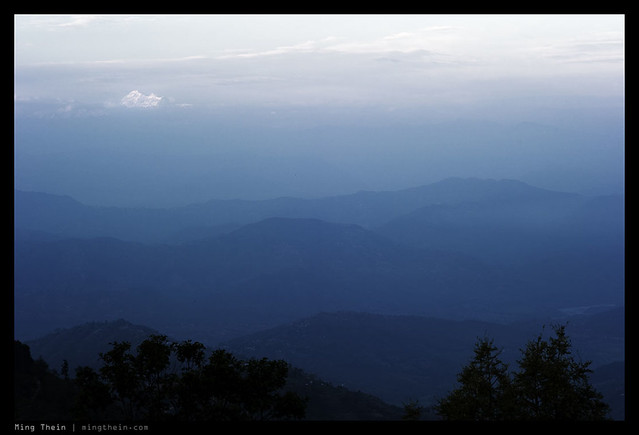
Spot the Himalayas. Would more resolution be better? Actually no, it wouldn’t have made a difference. The scene itself was resolution-limited by atmospheric mist. Nikon D700, 85/1.4 G

Part two: Technique

The higher the pixel density of your camera, the more technique matters. For a fixed sensor size, small movement on a low-resolution camera matters less than on a high resolution one. Let’s say camera A has 4MP, and camera B has 16MP – that’s double the resolution, not quadruple (2x in each linear axis). If you move by a factor of half a pixel on camera A, the image is still pretty much aligned with the original pixel it was focused on; your edges might be a bit blur, but you could probably use unsharp masking to fix the perceived acuity. If you move by the same factor on camera B, you’re going to be out by a whole pixel. And that’s not fixable by unsharp masking. Increase the resolution further, and the effect is compounded. Those original 2.7MP APSC cameras were pretty forgiving, actually. The 24MP APSC ones will not be.

Technique actually covers several things.

1. Stability. This is the biggest one. If you don’t move, then your edges will stay where you focused them on the sensor plane. All will be sharp. So how do we achieve this? Several ways – the easiest is a sturdy tripod. Good shutter tripping technique – roll gently, don’t jab. And the last way is to reduce apparent movement by maintaining a high shutter speed, either by cranking the ISO, using faster lenses, or using a flash.

_D90_DSC3428 copy
mmm, lenses.

2. Lenses. Good lenses have better resolving power, right? Yes, but these days, the difference is mostly visible only when shot at maximum aperture. By f8 or f11, most lenses are capable of resolving identically to near as enough makes no difference at the sensor plane. And certainly not enough to be noticed in a moderately-sized print. Having said that, test your lenses carefully to determine what the optimal aperture is, and by what point resolution is ‘acceptable’. Look at the corners. It’s pretty important to do this before buying too, to avoid any issues or inconvenience later on. Just one of the reasons I’m still happy to go to a real retail store to buy stuff; I want to make sure the lens I’m going to use is going to perform the way I expect it.

_7055995 copy
Speake-Marin Immortal Dragon. The eternal fight between more DoF and diffraction limits. I cheated a little by using a wider focal length, which has more DOF for a given aperture. Nikon D700, Zeiss ZM 2.8/28 Biogon

3. Watch out for diffraction. Although all lenses have an optimal aperture, the smaller the pixels, the closer the diffraction limit will be to wide open. Most compact cameras – especially the 1/2.33″ kind – will resolve optimally wide open, and be noticeably softer if set to f5.6 or f8. (This is one reason most manufacturers use a switchable ND filter rather than a real aperture; also on a sensor that small, everything is in focus all the time.) For instance: I can use f45 to shoot macros on the 4.1MP D2H without noticing any diffraction softening; however, by f27 on the D700, I’m seeing a noticeable reduction in acuity. That limit becomes f16 on the 16MP APS-C cameras, and I suspect as low as f11 on 24MP APS-C. F8 is as far as I’d go with any lens on Micro Four Thirds.

_7008297bw copy
Missed focus in either direction would turn this from a keeper into junk. Nikon D700, Zeiss ZF 1.4/85 Planar – manual focus

4. Focusing. If you’re shooting a rangefinder, make sure the RF is properly calibrated for the lenses you normally use. Be aware of focus shift with aperture stop down. If you’re shooting an SLR, make sure your AF system is properly calibrated, especially for wide open lenses; use the AF fine tune function if you’ve got one. Shoot live view, wide open, manual focus and magnified to determine what the absolute best result you can obtain is, and then adjust your AF system until you achieve that consistently. AF accuracy matters most when shooting wide open – sadly these days SLR focus screens are optimized for brightness rather than focusing snap, which means it’s much harder to see when something is in focus or not. (Camera makers want to sell you the latest AF lenses, so they discourage you from focusing yourself.) It isn’t helped either by tiny viewfinders. If you’re going to use your SLR manual-focus, it’s worth adjusting your mirror zero position and focus screen shimming to ensure that what you see in the finder does in fact match what the sensor sees. And a coarser matte split prism or micro prism screen helps immensely, too. Don’t try to do this yourself, however – it’s difficult and there are a lot of fragile, easily scratched components inside the finder which can be irreparably damaged if you don’t know what you’re doing.

5. Maintenance. This also covers several things: make sure your lenses and mounts are clean, for one. Clean lenses are obvious. Clean mounts, less so: a little bit of misalignment between the lens/ mount/ sensor combination can cause noticeable softness on one side of the image. It mattered less in the days of film because the ‘sensor’ plane had some thickness to it; you could be off by a bit and the image would still be focused on the emulsion. A digital sensor is a perfectly flat single plane, with no forgiveness in the front-back direction.

_M8_L1026119bw copy
A good example of condition-induced limits. Paris. Leica M8, 21/1.4 ASPH

Bottom line: if you don’t think you can handle that many pixels, shoot in a binned and downsized raw mode, or get a camera with fewer pixels. You’ll save yourself the hassle of handling enormous files, too. I know that under certain conditions – photojournalism and street, for example – it’s extremely unlikely that I’ll be able to fully achieve more than 12MP of resolution on a full frame camera. This isn’t because I’ve got poor technique, but simply because there are restrictions put on you by the shooting conditions – for instance, being jostled by people; having to shoot in extremely dark environments at high ISO; using a MF rangefinder with wide open shallow-DOF lenses on a moving subject. The list of excuses goes on. Bottom line: I know I’m the weak link in the imaging process here; I’ll try to improve, but I also recognize my limits and won’t fall into the trap of thinking more MP will make for a better image. It won’t. In the studio however, that’s a totally different matter. MT