The final part of my ‘life in Kathmandu’ series. Shot in mid-2011 with a Nikon D700, 24/1.4 and 85/1.4 G. I think this set really epitomizes my ‘cinematic’ style of reportage. Enjoy! MT




reframing the world one picture at a time
The final part of my ‘life in Kathmandu’ series. Shot in mid-2011 with a Nikon D700, 24/1.4 and 85/1.4 G. I think this set really epitomizes my ‘cinematic’ style of reportage. Enjoy! MT
I was interviewed recently on photography for BFM 89.9 – listen to or download the whole podcast here. Damn it’s weird hearing your own voice recorded. MT

Ion Orchard sunset. Leica S2, 70/2.5 Summarit-S
Here’s an interesting thought: sensor resolution is way past the point of far more than most people need – look at that recent Nokia 808 PureView and it’s 41MP sensor as an example. For most compact camera users, that’s just asking for trouble – file sizes, viewing, shooting technique…the list goes on.
What if we took a say 50MP compact 2/3″ sensor (not unfeasible) and just output no more than 5 MP from the sensor? You can zoom to your heart’s content before capture – either by taking a 1:1 crop or downsizing various portions of the frame; have a low light mode which uses pixel binning to reduce noise and/or improve dynamic range; and finally, make the whole thing speedy and lag-free by using a bright, fixed-focus wide angle lens. Or I suppose if you must have macro modes, make it AF. Finally, add some form of image stabilization to the mix, because that kind of pixel density is going to make most tripods look as though they have palsy. We’ve dropped the size, weight and cost of the zoom assembly; this makes for more compact, robust cameras. It also means that more engineering effort and perhaps even more money (though I wouldn’t put it past consumer electronics companies to want to hang on to every single extra penny and avoid R&D spending where possible) can be put into the lens, which should in theory improve optics.
The results probably wouldn’t be pretty at the pixel level, but the target audience is unlikely to care. And 5 good MP is more than enough for a clean 6×4″, or social media post, or email. Hell, it’d probably be enough for a decent A3 print if you use one of the pixel binning modes in good light. Think of it as digital zoom, but instead of getting degradation off the base pixel-level image quality, you get an improvement as you use more and more pixels.
However, I digress. As interesting as that idea is for the future of compacts – I wasn’t initially intending to suggest a new type of camera. What I wanted to explore are the building blocks of composition. Assuming everything is in focus, a scene – especially one shot from a wide angle perspective – can easily be decomposed into multiple elements, some of which contain the subject, some of which contain context, and some of which may turn context into a subject in its own right. All images are made up of these building blocks, and each can be treated as an image in itself. (Don’t try to compose this way in the real world, or you’re either going to go crazy or turn into a product photographer.) Examples may be – a face, a texture, a landmark.
Sometimes you don’t need more than a couple to create an arresting image – a portrait, for instance – sometimes you need as many as you can get to convey the chaos of the scene (crisis photojournalism comes to mind). What I notice in good photographers’ images is that all critical frames contain the elements required to tell the story, and usually in aesthetically pleasing relative placement, too. This is a learned skill; one can identify the critical elements required to tell a story, and then go out and look for a frame that contains them. I suppose the more control you have over the placement of the individual elements, and the more individual elements you can even identify in the first place, the stronger your image will be. Elements may break down into sub-elements – a wide shot may contain a portrait which can contain a face closeup; all of these things are building blocks.
This brings us full circle to the original starting point – how many images are there in an image? Let’s take the first image as an example:
This decomposes into what I think are five clear elements; the building and its relationship with the organic are the subjects.


What I find interesting is that each of these elements – or crops – could be an image on its own. And you can of course further subdivide these images down into their own building blocks. How many does one need to make up a strong overall image? One? Two? More? It’s hard to say; I think the answer is actually infinite. If you had infinite resolution, you could keep subdividing and cropping infinitely.
I know this is a fairly nebulous post, but stay with me here and you’ll start to see the genesis of an idea.
Let’s do the same, but in reverse. The frame below arguably works on its own as an image:

But then, if we include more context, so does this:

Or this:

And this.

We can keep pulling out…

…until we reach the initial (final?) frame.
 Welding. Nikon D800, AFS 28-300 VR
Each of these compositions on its own would have worked as a frame. Similarly, continuously pulling out adds more and more context, until you pass a threshold beyond which the context dominates the subject. I framed the final shot that way because that was the farthest I thought I could pull out to maximize context, but at the same time isolate the subjects in the frame. Anything more and the subjects would have been too small to identify cleanly. You’ve also got to consider the final viewing size: smaller would mean physically smaller subjects, which would encourage tighter framing. Similarly, images that appear flat and cluttered at smaller sizes frequently work well when enlarged due to the greater amount of detail we can physically appreciate.
I started this article postulating on whether increases in resolution would lead to a new generation of pixel-binning super-sensored compacts; the more I think about it, the more I think it might even apply to photography as a whole. We have long past the point of resolution sufficiency for most purposes; shrinking pixel pitches mean that lens maximum apertures and diffraction-impacted apertures are converging. Eventually you’re going to have to buy excellently designed and well-corrected fast lenses and shoot them wide open to absolutely maximize resolution from the sensor.
Perhaps this will give birth to a new style or form of photography – we capture everything first, and then decide what’s important to the frame afterwards. A little bit like Lytro, but for composition rather than focus. Of course, we can do the same today with the super high resolution DSLRs, but there are limits to how much we can crop, and the lack of suitable lenses to serve as a reproduction optic. Such a camera – let’s call it post-capture framing – would be responsive due to lack of focusing needs; hyper focal would probably suffice; offer decent low light performance due to the large maximum apertures required; and be reasonably compact – rangefinder sized, perhaps – due to an optical system designed and matched to the sensor. It’d probably be closer in proportions to a cube, actually – once the lens is taken into account.
The skill of the photographer at the moment of capture would then be reduced to timing and exposure; the latter would probably be mostly automated, leaving only timing; however, this doesn’t make things any easier. The bulk of the work would now be done in post-processing – not just the digital ‘development’ portion, but also the editing, framing and cropping. I’ve always thought of editing as one of the critical skills for a pro – one’s reputation is based as much on the photos you show against the ones you don’t; being able to see the frame ‘in the wild’ and capture the moment in time is not an easy thing to do. Post-capture framing would give you all the time in the world to do that, which would make things easier somewhat – but also offer more opportunities and flexibility for other compositions.
This would of course raise some interesting IP issues: if another ‘editor’ cropped the original photo to a much smaller, unrecognizable frame, whose photo is it? The person who pressed the button, and just aimed the camera in the right general direction, or the one who actually saw the composition in the master frame?
It’s a brave new world, and an exciting time to be a photographer. Personally, though, I’m one of those very anal people who seeks to maximize all of the image quality they can get out of the camera; which means I don’t crop unless it’s to a non-native aspect ratio. Understanding the use of ‘building blocks’ to create a final composition, plus knowing when you’ve got enough context (or too much context, overpowering the subject) is a very important skill to refine, regardless of the technology involved. MT
____________
Visit our Teaching Store to up your photographic game – including Photoshop Workflow DVDs and customized Email School of Photography; or go mobile with the Photography Compendium for iPad. You can also get your gear from B&H and Amazon. Prices are the same as normal, however a small portion of your purchase value is referred back to me. Thanks!
Don’t forget to like us on Facebook and join the reader Flickr group!

Images and content copyright Ming Thein | mingthein.com 2012 onwards. All rights reserved
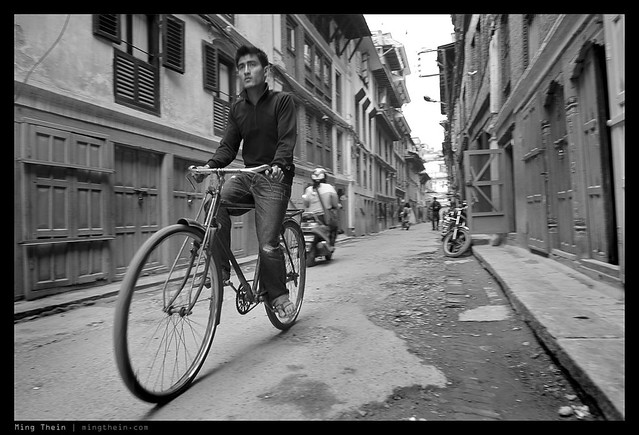
A continuation of my Streets of Kathmandu series – this time in color, and shot with a Fuji X100. Sadly, the camera with the firmware at the time was too slow for tracking street work – I resorted to either trap focusing or hyper focal. Superb colors, though. Enjoy! MT


____________
Visit our Teaching Store to up your photographic game – including Photoshop Workflow DVDs and customized Email School of Photography; or go mobile with the Photography Compendium for iPad. You can also get your gear from B&H and Amazon. Prices are the same as normal, however a small portion of your purchase value is referred back to me. Thanks!
Don’t forget to like us on Facebook and join the reader Flickr group!
Images and content copyright Ming Thein | mingthein.com 2012 onwards. All rights reserved
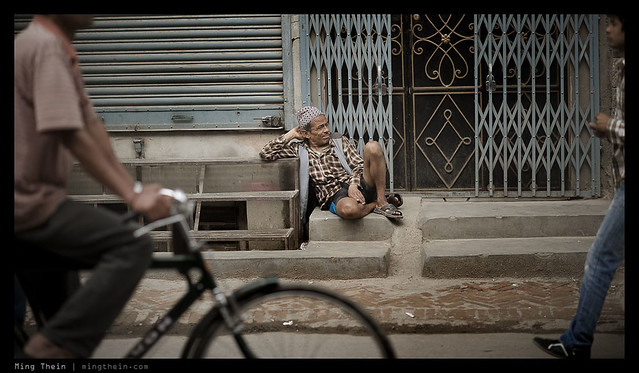
The first part of an ongoing series of the streets and people of Kathmandu, Nepal. Shot in mid-2011 with a Nikon D700, 24/1.4 G and 85/1.4 G lenses.


Starburst. Olympus E-PM1 Pen Mini, Panasonic 20/1.7
This has been another one of those tricky articles to write – mainly because a lot of self-reflection went into it, and as we all know, it’s very difficult to do that and remain objective. The essays is illustrated with images that are representative of experiments that worked – things I was inspired to try with various muses, and in turn learned something from.
What is a muse? In its purest form, a muse is perhaps best defined as something that triggers inspiration in an artistic or creative sense. It doesn’t have to be an inanimate object; most artists’ muses tend to be people; in fact, most artists tend to land up romantically involved with their muses. Creativity is impossible to separate from inspiration, and inspiration is a very close bedfellow of attachment – attachment to an idea. (I know this sounds like Inception, but bear with me here.*)
*On an unrelated note, that movie contains one of the most spectacular dining rooms I’ve ever seen – from a design and architectural point of view. And I suspect it would be pretty cool as both a photographic subject and backdrop, too.

Floating head. Olympus E-PM1 Pen Mini, 14-42 kit lens
This attachment can take many forms. From a specifically artistic point of view, the main one is to try and capture the essence of the subject in the artist’s work; in fact, an extremely challenging muse is probably the best thing an artist can have, because no matter how hard they try, they will never feel as though they’ve done the subject justice – and this is what drives the growth of creativity. It’s not so much attachment to the subject per se, as an obsession with the desire to capture the subject in a medium or object other than the subject itself – which is in itself doomed to failure, because the more one understands about a subject, the more one realizes that it’s impossible to reproduce it in another medium – especially if the subject is something live and changing, like a person.

Prague sunset. Leica M9-P, 28/2.8 ASPH
So in effect, muses are necessary stimulants to creativity. There are a few things that make a good muse: complexity and multidimensionality is one; ease of access is another (you never know when an idea might strike, and you just have to try something out); finally, some sort of flux or dynamism is another – which is why most muses tend to be things that offer infinitely variable possibilities – for instance, Ansel Adams and Yosemite – or a person.

Journey ending. Leica M9-P, 28/2.8 ASPH
Having a muse is also an admission of the artist to imperfection – at least in their own minds. If the artist was happy with their work, they’d finish one piece of art – take one photograph – feel like they’ve nailed the shot, and then never look at the subject again. By trying to photograph something repeatedly, it says both that there’s perhaps more to capture than is possible in a single frame, as well as all of the past frames being insufficient or incomplete in some way.

Vienna at Christmas. Leica M9-P, 50/1.4 ASPH
A person may have many muses. You might, for instance, be inspired by a particular place or location; an object, and a person. Most of mine fall into the latter two categories, though the objects tend to be somewhat short-lived. I’ll start with the easy one – objects. I tend to accumulate objects of design. I have a huge weakness for things which have unique (but functional) design elements; things made of unusual or highly tactile materials and textures; and things that just look good. Past random acquisitions include a miniature fountain pen with no clip; a vase with a hole so impractically small that you would be hard pressed to fit even a single flower stem in it, but an incredibly unique texture; and fifteen stuffed polar bears.** And of course there are the watches, too.
**You may have already seen these make cameo appearances in various camera tests. Their white fur is an excellent test subject for highlight tonality, microcontrast, and of course fine detail reproduction.

Bob. Nikon D700, Voigtlander 20/3.5
Most of these objects will be the subjects of several photo sessions, or until I’m happy with at least one or two of the images I’ve captured. After that, they don’t change, so they don’t really serve much of a challenge photographically; however they litter my apartment as monuments to my design curiosity. But by far the biggest guilty pleasure of mine are cameras and lenses; yes, they are technical tools used to capture an image. But different cameras also force you to shoot differently and think about composition in different ways; a great example is a compact, or a monochrome-only camera. The former removes the crutch of bokeh, and forces you to rely on subject differentiation solely via framing and light; the latter forces you to see luminance, texture and shadow, rather than contrasts in color. Both are refreshing, and mastery helps you improve overall as a photographer.

Red vase and erstwhile contents. Nikon D5100, 60/2.8 G Micro
Then there’s the difference between rangefinders and SLRs – viewing and focusing method aside, I find the biggest difference is that a rangefinder forces you to focus more on your subject – you can’t see what’s in focus and what isn’t; you can’t frame precisely. Shot properly, both of those things subconsciously make you concentrate more on ensuring that the subject itself is the most immediately obvious thing in the frame, and the primary composition is so strong that whatever might be in the edges or out of focus areas of the frame become secondary, and do not detract from the subject. A new camera makes you want to go out and shoot with it, too – and that motivation is often enough to make you get images you wouldn’t otherwise have managed if you’d either stayed at home or not bothered to experiment with.

A Parisian cliche. Leica M8, 21/1.4 ASPH. I don’t think I would even have attempted this with a big black DSLR.
Japan is also a source of endless inspiration for me – perhaps because the place is just so different from anywhere else in the world, especially the old world of Europe where I used to live, and the developing world of South-East Asia where I now live. I step off the plane and feel excited – those very differences that pervade every aspect of daily life force you to approach subjects with fresh eyes and curiosity; you take experimental risks and try things you normally wouldn’t at home or on a commercial shoot, where risk might equal loss of a client. I think every photographer needs these creative trips on a semi-regular basis as a way of forcing your eyes not to take things for granted, especially when back home. Seeing something done differently overseas tends to make you wonder what’s normal – it is of course all relative – but perhaps enough for you to find a worthwhile frame in the course of your daily life you might have otherwise ignored.

Waiting for the train, Sapporo. Nikon D700, Zeiss ZF.2 2/100 Makro-Planar
My biggest muse, by far, is my long-suffering wife. She is crash test dummy for new equipment and technique, a partner in crime for experimentation, and a handy anonymous body when an empty scene happens to need one to complete the frame. (She isn’t that patient, though, which also forces me to hone my instinctive composition and technical skills – the less one has to think about something, the faster one works.) And as a person, I find her endlessly fascinating*** – which means that there are always facets of her personality that I’m trying to capture; regardless of whether I do or not, I’ll always feel there’s something left over the next hill – and that motivates me to keep shooting.
***I suppose if this wasn’t the case, then I probably married the wrong person. Perhaps there’s a photographic metaphor in this – maybe in choice of camera or choice of subject – but that remains another topic for another day.

Medusa sleeps. Leica X1
Conversely, there are places I visit frequently with a camera – either as part of testing, or because I always have a camera of some sort on me – I will take some photos, but nothing in the location compels me to return. These I do not consider to be muses because they don’t inspire me; I just happen to be there and see something.

Bukit Bintang reflections. Apple iPhone 4
I highly recommend you find your own muse; it doesn’t have to be a person, or even a fellow photographer (my wife doesn’t really have any interest in taking pictures, and she is almost always surprised by the way the images turn out – despite having participated instrumentally in their creation). Rather, your muse is a reflection of you as a photographer – what is it that fascinates you? What inspires you? What makes you want to create? Finding and understanding that is a hugely important step to unlocking your creativity. MT
This post was brought to you by Ming Thein’s Email School of Photography – learn exactly what you want to learn, when you want to learn it. Muses not included, but I’m always happy to talk psychology to figure out what drives you. Don’t forget to like us on Facebook!

Some of my 2012 gear. Missing is the D800E, PCE 85/2.8 Micro, AI 45/2.8P, 35/1.4 ASPH FLE, Pen Mini, OM-D, Panasonic 20/1.7, Panasonic Leica 45/2.8, D-Lux 5 Titanium,a couple more SB900s, light panels…
This small mountain of gear leads to two very frightening thoughts. Firstly, there’s no ending in sight; one keeps accumulating more and more equipment in order to keep pushing the edge of what’s possible both from a compositional and artistic standpoint, as well as from an image quality standpoint. You’ve either got to have a great day job and very deep pockets, or some good recurring clients.
The second thought is around obsolescence. In the film days, the camera body and lenses lasted a long time; you invested in glass, got a decent body – one that fulfilled your personal needs as a photographer – and then picked the right film for the job. In that sense, image quality differences between brands were down to the lenses and the photographer. This is to say that if you put the same film in every camera, the difference in sharpness or acuity or color or whatever would be down to the lens only. If you wanted more image quality, you went for a bigger format – and thus a larger sensor. The digital equivalent to this would be having only one photo site design of a fixed pixel pitch; say around 4.9 microns, which would get you 16MP at APS-C, 36MP at FX, about 60MP on 645, and something silly on large format. For an equivalent size print, the larger format would definitely outdo the smaller format by an amount proportional to the difference in resolution.

A Parisian cliche. 2006 vintage Leica M8, Voigtlander 50/1.1
Except, that’s not quite the case, because there are technological tricks employed on some sensors that land up yielding image quality that isn’t quite where you’d expect along the size-quality curve. Bottom line: the camera body now plays a much more critical role in the imaging chain because it also contains the ‘film’, and this isn’t something you can change when the equivalent of a new emulsion is released.
Cameras from the 1950s and 1960s are still alive and well today – and in some cases, quite plentiful. Yes, some may have sticky shutters or mechanical issues due to neglect or lack of servicing, but the reality is that they were a) built to last and b) will continue to do a fine job so long as one can find film for them. The chemical process for film processing hasn’t changed much in the last forty or so years. Negatives can (probably) last hundreds of years with proper archival and storage conditions – how long, exactly, is anybody’s guess.

Minute repeater works. 2005 vintage Nikon D2Hs, 85/2.8 PC Micro
However, we’re facing some very real issues with digital, and ones that matter to all digital photographers. Let’s examine these individually.
Camera life. In the film days, shutters may have been rated to 50,000 or so exposures for a professional body – the reality is that nobody but a professional would shoot this many frames; film always has a per-shot cost and effort cost associated with it. You think a bit harder before letting off a frame, and this generally results in fewer frames but more keepers. Since digital is free, photographers experiment a lot more (and learn a lot faster) – but this means that you’re probably going to wear out a shutter if you are a dedicated shooter and keep a camera more than a few years. Even the professional grade cameras have shutters rated to around 300,000 or so exposures; I know of many sport photographers whose cameras are well over the million-frame mark. I’ve had to replace shutters a couple of times on my own cameras. This in itself isn’t a big deal, so long as parts are available. However, if something goes wrong with the electronics, your camera becomes a brick the minute the manufacturer runs out of spare circuit boards – the chips are not something you can repair with an experienced hand, unlike mechanical shutters for instance.

Shipyard worker. 2007 vintage Panasonic TZ3
Lenses. Even modern lenses are not immune to this – yes, they all still use glass and helicoids, but they also rely on a lot of electronics to control autofocus and aperture functions. Let’s not even talk about those with magnetically-activated gyroscopes for stabilization. Even the coreless ring-shaped motors used to achieve fast focusing aren’t infallible; early Nikon AFS lenses are notorious for requiring that expensive repair once the lenses start making squeaking noises. Again: you’re up one of those brown creeks with no paddle if something electronic gives way. The sole exception to this is the entirely mechanical glass by Leica and Zeiss; those will probably survive the apocalypse.
Batteries and cables. Anybody who’s got an older camera that uses Ni-MH or Ni-Cd cells is going to relate to this one instantly: once the batteries are no longer available, you’ve got a brick. And the inherent nature of the chemistry means that this can be as short as five years, or perhaps ten if you’re lucky. I’m glad I don’t have any that fall into this category, but I do have some lithium cells that were so heavily used that they’re pretty much useless now; I’d be worried about not being able to get replacements for these in the future. (Fortunately, I’m paranoid about spare batteries, so I have at least two for each camera I use.) Once supplies dry up off ebay, that’s probably the end of the line – and who even knows how old or new those stockpiles are. One thing I really hate about some cameras is the necessity to use proprietary connectors for things like video out or even USB – if you lose or damage that little adaptor or cable that came in the box with the camera, you’re probably out of luck getting a replacement unless there’s a huge ecosystem for the camera – but so far, no camera connector has reached that kind of popularity. At least some makers see sense and use standard mini-USB cables or 3.5mm minijacks. And putting the two together, the same of course goes for battery chargers…

A quiet moment. 2004 vintage D2H, with a 1960s vintage 55/1.2 SC pre-AI converted Nikkor
Storage media. This one concerns me quite a lot: we’ve already seen big shifts from one type of digital media to another, with almost zero support once a type of card or drive or storage goes out of fashion. Self-burned CDs from just a few years ago seem to be hit and miss when it comes to readability; early DVDs are a tossup because of the format used; and has anybody tried to mount an old drive recently? They don’t always work. I’ve found the best way to keep your files and backups accessible is to use external hard drives, limit the amount of uptime they have (if you’re not using them, don’t turn them on) and change them every couple of years. This serves several purposes: firstly, maximizing forward compatibility; secondly, giving you more space; thirdly, hopefully more reliability as technology matures; and finally, the old drives can be kept somewhere as an incremental backup. And drives fail, too – you might want to take a look at my article on storage and backups.
Online. If you’re storing files online, make sure you have an offline backup. I’m sure Kodakgallery had a lot of users at one point – at least until they shut down this month. I dread to think what’s going to happen to their servers when everybody’s aunt and uncle suddenly realize that all of their photos are there and must be downloaded immediately, or worse still, forgets completely they’re there at all. The problematic thing is that there is usually no automated backup for these things – you have to download the images one by one. If say Flickr went down, I’d lose the 13,800 or so images I’ve got there – at least the small, web-sized archives – and that wouldn’t be so critical, except that all of the images from this site are hosted there. Still, it would be recoverable – but not great. And problematically, there’s no way of executing a backup to this, either.
File compatibility. Of all the future proofing problems faced by us digital users, this is by far the biggest. I’m no so worried about JPEGs, because it seems that as a format it’s here to stay; even the improved JPEG 2000 format introduced by the same group that created JPEG compression originally didn’t really make much of a dent in the photography world. What worries me more is the ability to open all of those RAW files in future; so far, Adobe Camera Raw is doing a great job of maintaining full compatibility with older cameras (which explains why the update files are now enormous), but I wonder what will happen if that platform shifts in future. We can only hope the size of the demand for such support is large enough to support a continuing market for such products. A second set of DNG files may be an option for increased future proofing. However, it’s well-known that ACR isn’t the best converter for all files, and better image quality can be obtained via other converters for specific cameras – so I’d be concerned about what information isn’t being fully captured and transferred over. I don’t have a solution for this other than keeping a full set of uncompressed TIFF files, whose encoding is relatively simple and shouldn’t be too difficult to retain support for in future.

End of the line. 2007 vintage Panasonic TZ3
There’s one final issue I’d like to touch on in this article, and that’s the ecosystem. I’m not about to go greenpeace; I’m referring specifically to the support tech that’s required to maintain a full digital workflow; this includes everything from the memory cards to cables to batteries to the computer involved. Image quality competitiveness aside (more on sufficiency in another article), I think you’re going to have to think about a full upgrade cycle for your support gear every three to five years. It’s no longer your camera body you’ve got to cost in, but also a new computer to handle the larger files, Photoshop upgrades to get the most out of those RAW files, bigger memory cards and hard drives to store everything on, maybe even a higher resolution, more accurate monitor. And all of this of course costs money.
There are two ways of dealing with this – as a hobbyist, I’d recommend buying one complete (and compatible) set, then using it until one critical component dies or absolutely has to be replaced. This should get you at least five years of use, probably more. The upside is lower money out, but also close to zero residual value. As a professional, you probably have to consider the other extreme – upgrade as soon as an improvement is available. Your used gear still has resale value, and this can be used to offset the upgrade costs. Incremental upgrades to the supporting equipment can be made with relatively small spending. (I don’t like to use the word ‘investment’ when it comes to equipment, because it is really a losing proposition.) It also keeps you competitive. I’m a masochistic early adopter, so I’ve always taken the latter route. I think it’s very important to pick one approach and stick to it (or buy film, then consider owning only one camera and lens for the rest of your life) – otherwise you’re going to be stuck in the expensive no-mans’ land inn the middle. MT
____________
Visit our Teaching Store to up your photographic game – including Photoshop Workflow DVDs and customized Email School of Photography; or go mobile with the Photography Compendium for iPad. You can also get your gear from B&H and Amazon. Prices are the same as normal, however a small portion of your purchase value is referred back to me. Thanks!
Don’t forget to like us on Facebook and join the reader Flickr group!
Images and content copyright Ming Thein | mingthein.com 2012 onwards. All rights reserved
This is an article that will probably go out of currency about six months after it’s published, but no matter; just because new cameras are released, it doesn’t reduce the usefulness or image-making ability of older ones. Travel is something I do for both work and pleasure; in my previous corporate life I used to travel heavily (think anywhere up to 100+ sectors per year) for work. My love for photography inevitably led me to carry a camera of some sort wherever i went – both to document my experiences as well as for use as stress release during my limited free time. Shooting is cathartic to me – I’m probably the only person I know who relaxes after a day of commercial shooting by taking pictures.
Traveling for meetings and other corporate reasons really takes most of the fun out of it; the TSA and other forms of airport security and administration do the rest. Much to my wife’s consternation, it’s taking me a little while to start enjoying it again.
The thought of going on a trip actually presents me with much anxiety: what the hell do I bring in the way of equipment? Early on in my photographic career, the choice was simple: everything that would fit into the bag, which at that point, was pretty much everything. Later, I’d take just new gear, or once again, if undecided, pretty much everything. However, my first trip with a significant other – Paris – showed me that hefting around all of that gear was both pointless when the primary purpose of your trip isn’t photography, as well as that it’s a sure way of annoying the hell out of your partner.
This considered, equipment choices changed from ‘how do I use X piece of gear?’ to ‘what is the minimum I can get away with and not feel like I’m missing anything?’ (My article on minimalism deals with this handily).
As a general rule of thumb, I don’t like to bring untried or untested gear with me unless I have absolutely no choice (my Vienna/ Prague trip at the end of 2011 was to get some images for Leica; that was the first time I was shooting the M9-P and 28/2.8 ASPH properly, and I paid for it occasionally with missed shots and questionable focus); there’s too much at stake if it breaks or doesn’t perform as expected. You’re probably not going to be able to repeat that trip to the Himalayas, so it’s probably a good idea to bring both a spare camera and a primary that you know can handle a bit of abuse.
What I do like a lot at the moment are both the raw shooting compacts – think the Ricoh GR-Digital III/ IV, Leica D-Lux 5/ Panasonic LX5; and the most compact of the system cameras. My current choice for travel is the Olympus OM-D, because of its image quality, huge responsiveness, small size – and more importantly, small system size – and ability to work well with longer lenses.
The Leica M9-P ranks pretty high up that list too – however, using anything over 50mm isn’t so easy without a magnifier, and if you’ve got one of those on, then you can kiss goodbye to your 28mm. It also isn’t so flexible when it comes to shooting food, for instance – another thing I enjoy. I do admit, it looks and feels nicer, though – but I’m shallow that way. (Why not travel in style if you can?) However, the biggest gotcha with the Leica is the liability – I don’t know how it is in other parts of the world, but to get insurance for cameras in Malaysia is near impossible, especially if you’re going to be taking them out of the country. And the premiums to fully cover an M system would probably cost a goodly portion of the trip itself.
I like to go with a two-lens kit these days – 24/28 and 85/90. This gives me two distinct perspectives, prime lens quality, fast apertures (with the low light ability and depth of field control that also implies) and (mostly) reduced size. This means the 24/1.4 AFS and 85/1.4 AFS on the D700; the Olympus 12/2 and 45/1.8 on the OM-D and Pen Mini; or some mixture of the Zeiss 28/2.8 Biogon, 50/2 Planar, Leica 28/2.8 ASPH and 50/1.4 ASPH on the M9 (anything longer being impractical). Where possible, I’ll generally also bring a spare body in the same mount, and perhaps also a highly capable compact – the Pen Mini and 20/1.7 pancake or Ricoh GR-Digital III usually fill this niche. I also like the Leica D-Lux 5, because its lens conveniently happens to go from 24 to 90mm…
The one hypothetical situation – which so far has not yet happened – where I’d make an unconventional equipment choice would be if I went skiing. The landscape opportunities are fantastic, but one generally needs more millimeters to make it work; however, there’s a lot of light, so they don’t have to be fast millimeters. I’d probably use the D800E and 28-300VR in a chest pouch, with a 45/2.8 P pancake in the front pocket for when the light gets low and I want something smaller for social evening activities.
If I’m going to an advanced country where spares are easily available, I’ll probably go with just one body; Japan would be a good example of this (though for some odd reason, I’ve always had two bodies whenever I’ve been there). This reduces weight drastically, and I know that I can still use my Nikon lenses if I have to pick up a used D700 or something to replace it. The other nice thing is worldwide support via NPS, which I’ve had to use in the past when the lens release button on my D3 fell off on the second day of my trip(!).
There are reasons for having two bodies, however – instant readiness is one of them – but it’s also important to consider how much of the trip you plan to spend shooting, and how much you plan to spend enjoying and experiencing being in a different place. It would be a shame to miss out on or have an incomplete experience because you’re too busy trying to get the shot. (I’m one of those strange people who experiences things by shooting them, so you may not necessarily want to follow exactly what I do here, either.)
So, distilling all that into a paragraph, my current camera choice would be the Olympus OM-D, 12/2 and 45/1.8 lenses. Either with a second OM-D body, or a Pen Mini as backup.
What about other equipment?
Well, batteries and chargers are a no-brainer. Figure out what you need for a full day of shooting, and bring one more so you can be charging and shooting at the same time. This number should be at least two. Ideally, you’d want your cameras to share batteries and chargers to improve backup, but this isn’t always possible. It seems that all camera makers want us to buy their horribly overpriced accessories all over again every time a new camera is released. Shame on you.
Spare cards are also a no-brainer. I generally bring three to four times what I think I’ll need; these days it’s usually 32 GB cards in the cameras, another two spares each, and some older 16GB spares.
Depending on how long you’re going to be on the road, you might want to consider bringing some sort of editing device or at least something to give you web access; I like the 11″ Apple MacBook Air because it’s both a proper computer, and light enough that you don’t notice you’ve got it. I don’t do any processing on it because of screen color accuracy issues, but I could if I had to. In fact, almost all of this blog is written from that machine. It also gives me somewhere to backup my files to at the end of the day. (Although I won’t do any photoshop work, I can do some light editing after seeing what works on a larger screen and what doesn’t.) After a two week trip, the last thing you want is for one of your cards to get corrupted and take all of your images with it. Backups are important: I’ve learned that the hard way in the past. Fitted into the USB ports are a pair of 32GB Sandisk Cruzer Fit USB drives, which are extremely small – they stick out about 5mm – but add another 64GB of solid state storage, which works as another backup. I’ve also got one of my portable drives with me, which holds a complete backup of my work at home – just in case something happens while I’m not there.
A comfortable bag is a must for moving from location to location, but when you’re there and shooting, you might want to consider a waist pouch or shooting jacket instead (depending of course on the climate). If I’m going with two bodies, I’d put a lens on each, spare cards and batteries in a cargo pants pocket, and off we go. It’s much, much more pleasant to shoot unencumbered without any bags or things that you might have to watch out for or remember to zip up and guard against thieves; you’ll be surprised how much of a difference it makes to your travel photography experience. I went with a shooting jacket last time, a couple of lenses in my pockets and one camera around my neck, and it was a hugely liberating experience.
Other things that are useful, but people seldom think of:
– Chewing gum.
– A permanent CD marker.
– Business cards, if you’re a pro photographer.
– Press passes – you’d be surprised how many times this has gotten me into places to get shots where the public wouldn’t normally be allowed.
– Duct tape, and cloth tape – it’s the magical stuff that holds the universe together. Both of them together, wrapped around that original particle, could probably have prevent the big bang from happening. Good thing they were inside the particle.
– Plastic ziploc bags, big enough to hold your cameras. This is my emergency rain cover, in case it gets really bad; however, you can take care of this to some extent by having a weather sealed camera. The lightest, smallest one in this class is the OM-D.
– A small flash, if you haven’t got one built into the camera; fill at night is useful.
– A tabletop tripod for long exposures; you can also rotate it through 90 degrees and brace it up against a window. I like the Manfrotto 345 set, which comes with some incredibly sturdy cast magnesium legs, a small ballhead, and an aluminum extension (which can be useful for small cameras, but absolutely too weak for larger ones).
– If you’re going to a hostile environment like the sea, then UV filters to fit all lenses.
– Spare lens caps and back caps**.
– Lens hoods. They’re good bumpers against impact protection.
– A small multitool. You might have to check this one in. Those little screwdrivers are extremely handy; actually, make sure you check your mount screws for tightness before leaving home – they have a curious proclivity to work themselves loose over time.
– Copies of your critical travel documents on a USB memory stick or memory card.
– Memory card reader; the compact direct-plug-in USB types are the most handy.
– A local sim card and cheap phone to put it in might be useful for extended trips.
**I usually tape two together, back-to-back, to make lens changing easier. Take the lens off the camera, put it onto your double-ended special, then take the other lens off and put it onto the camera. No fumbling with caps or leaving things unnecessarily uncovered. The alternative – aside from having two bodies – is to use a waist pouch or drop-in and forgo the caps entirely. Just make sure there isn’t anything else inside the pouch that could damage your lenses.
One last thing: don’t forget to have fun. It’s infinitely better to go with less gear and get creative to make do with what you did bring, rather than carry 30kg with you because you’re worried about the security of your hotel room and can’t bring yourself to leave anything behind, but at the same time don’t really want to walk around all day with it either. MT
Update, August 2012: I want to add the Sony RX100 to the list of recommended cameras. If you’re traveling in a group or with a partner, or doing any sort of travel at all where photography is not your primary objective, then consider taking along the RX100 instead of something larger. It’s barely noticeable until you need to get the shot, then it does it with a minimum of fuss and hides until it’s called upon again. It’s the very definition of the concept of photographic sufficiency.
____________
If you enjoyed this post, please consider supporting the site via Paypal ([email protected]); Ming Thein’s Email School of Photography – learn exactly what you want to learn, when you want to learn it or learn how to achieve a similar look with our Photoshop workflow DVDs. You can also get your gear from Amazon.com via this referral link. 
Don’t forget to like us on Facebook and join the Flickr group!
From the horological files. MT
Set shot with a Nikon D800E, several SB900s, the AFS 60/2.8 G Micro, and one shot with a Leica 35/1.4 ASPH FLE via adaptor – see if you can spot which one!


____________
Visit our Teaching Store to up your photographic game – including Photoshop Workflow DVDs and customized Email School of Photography; or go mobile with the Photography Compendium for iPad. You can also get your gear from B&H and Amazon. Prices are the same as normal, however a small portion of your purchase value is referred back to me. Thanks!
Don’t forget to like us on Facebook and join the reader Flickr group!
Images and content copyright Ming Thein | mingthein.com 2012 onwards. All rights reserved

Image from Amazon.
Suppose you only ever photographed one subject in your life – hell, you’re not even a photographer by training or trade – what would your images look like? Supercell is the answer. Kevin Erskine is a farmer living in the American midwest, who also happens to be a storm enthusiast (storm chaser? I have no idea what these types of people are called).
What’s unique about this book is that Erskine photographs nothing but clouds and storms – he might well be great at portraits too, but it seems unlikely judging from the text. I must admit that a huge part of the appeal of this book for me stems from the subject – granted, the images are technically competent and nicely printed, but I want to look at the clouds, not the photograph. It’s one of those collections whose images speak for themselves – it’s rare, but you can actually look through the image, through the ink, through the page, through the book, and into the scene itself – nothing more, and nothing less.

Image from Amazon
And you know what, I really, really like it. To be honest, this book isn’t for everybody. Many viewers will find it extremely boring; page after page after page of nothing but clouds, tornadoes, rain, and myriad other forms of atmospheric precipitation. But to a huge Magritte fan like myself, who lives in the tropics and sees nothing but perhaps two or three common varieties of cumulus (and if you’re lucky, the occasional cirrocumulus) – it’s like looking at pornography. I can only imagine how much more interesting my cityscapes would be against a backdrop of enormous dramatic clouds; the interplay of light and shadow off the glass facades of modern architecture. Alas, Erskine’s problem is perhaps the opposite of mine: he has no end of clouds to play with, but nary any more construction than a grain silo or barn – the equivalent to our local clouds.

Image from Amazon
Almost all of the images in the book were shot with a wide angle, large-format camera; there really is no other way to capture the scale and majesty of the formations otherwise. I’m curious though, with such a slow method of working, how on earth does he get out of the way of the weather in time? It must be a pretty near thing in some of the images.

Image from Amazon
If you’ve ever wondered what it’s like to live in the great empty plains, or wanted to, then this is the book for you. It’s as much about the infinite fractal variety in nature as it is about the powerful beauty of clouds. And if you don’t like clouds, or prefer to live in the city, then it would at least make a great present for your meteorologist. MT
Behind the scenes videos




If you enjoyed the content, please consider  -ing or subscribing - thanks for your support!

