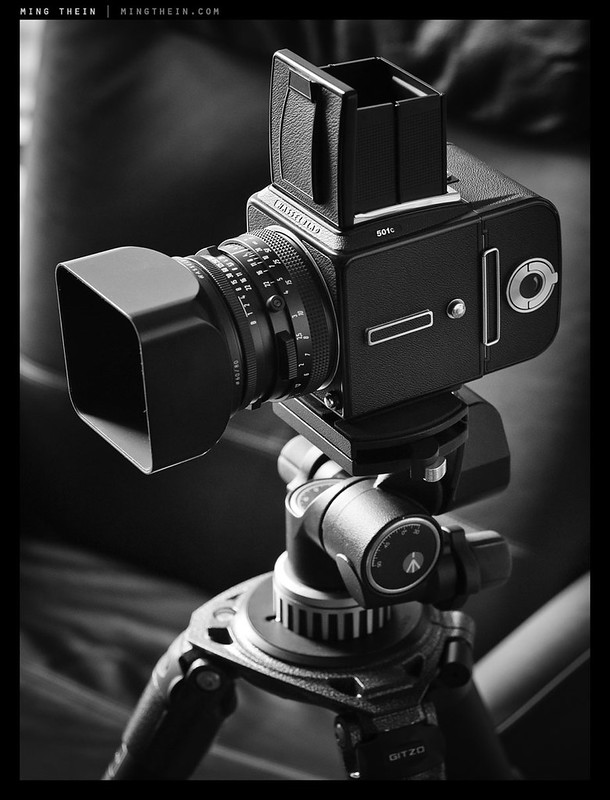
Following on from the previous post on my recent acquisition of a medium format digital system, I thought it’d be appropriate to share some of the results from the first serious shoot I used it for a little while back. I found that the system was much more sensitive to camera shake than expected; mirror lockup was an absolute necessity, though the Gitzo GT1542 carbon traveller and Arca-Swiss P0 head both performed very well and offered more than sufficient rigidity. (In hindsight, I should probably have bought the cup feet for the tripod to prevent it sinking into the mud though.) Though you can’t see it at this size, the frames with mirror lockup are distinctly crisper at the pixel level than those without.
How I landed up going medium format digital…
Earlier in the year, many of you saw me post the image of the Hasselblad 501CM hanging off a tripod at 90 degrees near the surf line. Several asked why on earth would I need to turn a square format camera sideways; apart from the obvious answer of ‘to shoot vertically!’ there’s definitely more than meets the eye. Firstly, Hasselblad did actually produce an A16 645 format magazine for the V-series bodies; they’re relatively rare nowadays and must obviously be used with the correct focusing screen to ensure accurate composition. In addition to being better suited to the typical print rectangles, you also get 33% more images per roll of 120 (16 instead of 12, as the name suggests). I was using something a little more exotic; though like the A16, it isn’t rotatable and so requires you to turn the camera through 90 to shoot verticals. It’s not very convenient, to say the least.
Workers of heavy metal – a combined On Assignment Film Diaries Photoessay, part two
The second portion of this photoessay concludes (part one is here) with a plenty of images and couple of final thoughts: firstly, another huge thank you to the client for giving me this opportunity – he’s a reader of this site too – very rarely do professional and personal creative goals mesh with such rewarding results. Secondly, I think there are a couple of things I need to look for in future assignments: it’s a bit abstract, but basically one needs to have a subject with potential and a client who’ll trust you enough to let you run with it – without either, the ensuing images will always be a compromise. MT
Workers of heavy metal – a combined On Assignment Film Diaries Photoessay, part one
If ever I had a dream assignment, this has got to have been one of them. (And the job isn’t quite finished yet; there are a few other outstanding items that need to be taken care of.) Imagine being presented with a scene of near-infinite photographic opportunity by a client who says ‘I hired you because I like your work, and I don’t want to restrict your artistic vision – so go ahead and shoot as you see fit.’ Then throw in the ability to shoot with the system(s) of your choice – including film – and a couple of good lunches to boot. And a chauffeured 7-series to and from the location. I swear a) I’m not joking, and b) this doesn’t happen often, but hey: if it did, we certainly wouldn’t be able to appreciate it.
FD Shooting with the legends: The Hasselblad 903 SWC
All of Hasselblad’s SWC (originally ‘Supreme Wide Angle, then Super Wide Angle, then abbreviated from ‘Super Wide Camera’) cameras are slightly odd beasts: they’re tiny for medium format, but large for anything else; they look very much like stunted miniature versions of the regular V series bodies. It’s as though somebody chopped the middle section out, taking the winding crank and waist-level finder out along with it. In place, the camera has grown a large megaphone-like viewfinder, and the shutter release has migrated to the top of the body.
FD Shooting with the legends: The Hasselblad 501CM
There are two cameras that are synonymous with 6×6 medium format film: the Rolleiflex TLR, and the Hasselblad V series. (I may well do a piece on the former in the future). Today’s subject, however, is one of the final incarnations of the V line – the 501CM. I suppose you could think of it as the distilled essence of the V series – unlike the 503s, it lacks TTL flash metering; unlike the 200-series, it still relies on a lens-based leaf shutter and remains completely mechanical. But at the same time, the camera has interchangeable focusing screens and the gliding mirror geometry of the 503CW to prevent vignetting with longer lenses. (I have a brief intro to the Hasselblad V series here.) It’s my pick of the bunch because a) I have no intention of using it with TTL flash, and b) I’d rather not have to rely on electronics in any way – there are modern digitals for that…
Film diaries: Watches and a Hasselblad

Digital contact sheet of the negs.
I’ll admit that deep down, from the day I decided to buy the Hasselblad, I’d harboured a deep, masochistic desire to do this. During previous evaluations of medium format for my main commercial subjects, it didn’t really fit the bill: too difficult to achieve the degree of magnification required for watches, and digital medium format wouldn’t give me the width I needed for architectural work. It’d also be overkill for food photography in this country, given the current state of affairs*.
*I recently had a large corporate client ask for a portfolio and quote, then turn around and give the job to another photographer who quoted less and said ‘here, copy’. The results were crude because of harsh lighting and repetitively boring subject placement, but I suppose if they can’t tell the difference…perhaps I’m the one who’s got unrealistic expectations?
But hey, on film, for fun and in the spirit of creative experimentation, why not?
Film diaries: A quick introduction to Hasselblad V-series cameras
Since acquiring and shooting with my 501C, a lot of my readers, students and photography friends have been asking for more information about these beauties. I certainly don’t claim to have the depth of knowledge of some of the longer-lived collectors or photographers, but what follows is a (hopefully) handy collation of what I do know, from the point of view of the practical photographer.
The Hasselblad V series is a system camera: that’s to say that lenses, bodies, finders, backs and other general accessories are interchangeable. The body contains the reflex mirror, film winding mechanism and secondary shutter only, plus a way of triggering and rewinding the leaf shutter in the lens, of course. Lenses of various vintages can be used on all bodies, with varying degrees of functionality. Flash sync terminals – PC sync – are in the lens, since this is triggered mechanically by the leaf shutter. Several types of backs are available, including digital and polaroid (rare) options; the same goes for finders. The ‘classic’ configuration is an 80/2.8 lens, collapsible waist level finder and A12 film back.
Bodies
Generally, for a shooter, you want to look at buy the 500-series (also known as the V series; includes 500, 500C, 500C/M, 501, 501C, 501C/M, 503CW, 503CX etc). The C means that it uses C-mount lenses which have built in leaf shutters (first Synchro-Compur and later Prontor); anything with /M means upgraded/ modified. The bodies contain the mirror, winding mechanism, and a secondary shutter to prevent light leaks. A nice user is better than a safe queen that’s never been exercised, because you must remember the whole thing is mechanical. Later versions have TTL flash metering and electronic coupling. I would go for either a 501CM or 503 of some description; the 500s are older. Mine is a 501C and dates to 1995; I also have a 1999 501CM. The 501CM and 503CW have upgraded mirror geometry that doesn’t black out at the top portion when used with longer lenses or extension tubes. The electronic 553 and 555 bodies have built in motor drives, but are bulky and eat batteries for breakfast. I think fully mechanical is the way to go; partially because of long-term reliability (gears can be fixed; small-volume electronics is often unrepairable without spares). There are also tilt shift bodies (ArcBody and FlexBody), and a super wide viewfinder camera – the 900 series (903 SWC, 905 SWC and earlier SWC and SWC/M), which has a fixed 38/4.5 Biogon but takes standard backs. Finally, we have the 200-series bodies – these have a built in focal plane curtain shutter that requires batteries to run, but permits much higher (1/2000s) shutter speeds and faster (generally by a stop) lenses; they share the same mount as the regular V series, and V series lenses can be used if the shutter speed is locked to the F position, but not the other way around – the V series require a shutter in the lens to operate, which the 200-series lenses lack.
When testing a body, the winding action should have some springy resistance, and the shutter action should be snappy – the mirror should get out of the way fast, and stay there; same goes for the secondary shutter curtains at the rear of the body. Note that the mirror doesn’t come down again until the camera is rewound. You can check mirror alignment by turning the lens all the way to infinity: find a suitably distant subject and check that it is indeed in focus with the magnifier. (The lenses have hard infinity stops.) Needless to say, there should be no loose or rattling parts inside. Check also that the lens drive shaft on the mount turns when you release the shutter and wind the crank, and that the vertical gear on the right also winds with the crank – this advances the film. Finally, the little lever that protrudes from the body on the bottom right where the back mounts should also be sharp and not worn – this advances the film status indicator.
Related bodies
The ArcBody and FlexBody are two V-mount bodies that also take the same A-series backs and accessories (but not finders); these have bellows or bags in the middle that permit some technical camera movements; noticeably shifts and tilts. In some ways, they’re miniature view cameras. The ArcBody is primarily geared towards shifts; it has its own accompanying set of Rodenstock lenses and is ideal for architectural work. The FlexBody is mainly for tilts, and DOF control/ product photography or landscape. Personally, if I do move over to medium format for my work, I’d be looking at one of these – they also accept digital backs. Note that both are relatively uncommon and seriously expensive.
Lenses
The type you want to go with the V series are C T*, CF T*, CFE T* or CFI T* lenses. The earlier C (non T*, i.e. no fancy coating) lenses work too; they’re cheap but low contrast and relatively high flare. The T* lenses denote optics with the Zeiss T* coating – their rendition and performance is much like the modern ZF.2 series. They all also have long back focus distances, so you can mount them on your SLRs too – though the resolving power may not be as high as the latest 35mm optics.
CF lenses are the best bang for the buck. They have coupled aperture/shutter speed rings (with the exception of the 80/2.8 CF T*) and upgraded shutter mechanisms; CFE and CFI lenses are later models with electronic coupling and are several times more expensive than CF, often for no particularly good reason. The bodies almost always come with the standard 80mm – it has a similar diagonal FOV as a 50mm on 35mm, but you have to remember it’s a little bit different because you’re comparing square to 3:2 aspect ratios. The good lenses – all CF or higher – are the 40/4 Distagon FLE, the 50/4 Distagon FLE, the 80/2.8 Planar, 120/4 Makro-Planar, 150/4 Sonnar and 180/4 Sonnar. These are roughly 24, 28, 45-50, 85, 100 and 120 equivalents. The FLE lenses have a separate correction ring for optimising close-range performance.
Note that the tip of one of the shutter blades may appear bent in the lens; this is a design feature to prevent catching at high shutter speeds. The shutter action of a lens should be snappy and crisp; the slower speeds tend to be where there are problems, so it can be beneficial to test the 1/2 and 1 second speeds with a stopwatch to get an idea if they’re roughly within spec. A slightly metallic noise when changing shutter speeds is normal, especially if you are traversing large ranges of shutter speeds – this is just the internal springs changing tension. Be very, very vigilant for broken drive shafts – these cost a fortune to fix!
One final note on lenses: they require bayonet filter adaptors (designated B-something) which allow you to mount standard screw-in filters. I suppose this is for ease of changing in case the threads get munched up, but it can be a pain if you’ve lost the bayonet ring. Fortunately, they take mostly standard sizes – except for the 4/40 Distagon, which requires an enormous 93mm (!!) filter.
Backs
Three main kinds: A12, A16 and A24. There’s also an A70 bulk rolling back – it has a 200-shot capacity. The number denotes # of shots; A12 and A16 work with 120 film, and A24 works with thinner 220 film; it has no paper backing for twice the number of shots. Note however you can’t buy 220 film here anymore (update: I did see fresh Provia 100 in 220 at Yodobashi in Tokyo in November 2013), so it’s kinda useless – don’t buy an A24. You can load 120 film into an A24, but the difference in length means that it won’t wind or count frames properly. Just avoid it. The A12 is the standard back and gives 12 6×6 shots on a 120 roll. The A16 is a 645 back that gives 16 shots per 120 roll, but requires a separate viewfinder mask to show only the 645 film area – this should be included if you plan to buy an A16. Note that it’s not very practical because shooting a waist level finder in portrait orientation is nearly impossible. Backs should come with dark slides – the little piece of metal that goes between body and back – if you don’t have this, you can’t detach the back. It’s to prevent light leaks when interchanging backs – the ability to do this mid-roll is one of the huge strengths of the system. Buy multiple backs to make the most of this. Note: some sellers will note ‘matching numbers’ which means the roller mechanism inside’s serial # matches the housing – it doesn’t make any functional difference, but it does seems to affect prices quite a bit. If you’re going to use it and not collect it, it doesn’t matter.
You might see something called a ‘Lindahl dark slide holder’ mentioned – this is a clip on that goes on the back of the back (really) that holds your dark slide while you’re shooting. It’s functionally useful, but I personally think it looks ugly because it spoils the lines of the camera. A better solution is just to tuck the dark slide into your wallet.
There are also many digital options, both from Hasselblad (the CFV series backs) and other manufacturers. Note that none of them make a true 6×6 back; there’s always some crop factor involved. The earlier CFV and Phase backs did have square sensors, but these were 1.5x crop, 37x37mm affairs that were much like using FX lenses on a DX body. The newer backs – CFV-39 and CFV-50 – use 645 aspect ratio sensors in a 1.1x horizontal crop, and a 1.5x square crop. They are accompanied by viewfinder masks that I personally find very confusing – much like trying to compose with an overlaid tennis court. Note that some backs have sync issues with purely mechanical triggering, especially if your shutter mechanism is a bit worn. The solution is to use the PC sync cable off the lens to synchronise it with the back, but this can result in issues like worn terminals from frequent lens changes, and lack of anywhere to hook up your flash.
Finders
There are two kinds: prism and waist level. Waist level is the collapsible, left-right reversed type with a built in magnifier. It’s the standard finder. Prism finders come in metered (PME-x) flavours and unmetered flavours (PM3, PM5). It’s basically an enormous SLR finder, but in 45 degree and 90 degree (the later PME-90) flavours. They’re all interchangeable, once you take the back off. Note that the prisms are meters only, and do not transfer the settings to the camera – you still have to do that manually.
Metering
Unless you have a metered finder, the cameras are fully manual and unmetered. This means using a trained eyeball, or getting a meter prism; otherwise, the simplest solution is to use a compact camera in aperture priority mode with spot meter set. Match apertures and ISO, then transfer the shutter speed reading to the lens. Important note: if you’re using a compact, I’ve found that the Hasselblad requires half a stop to a stop less shutter speed than the compact for the same exposure (i.e. if the compact reads 1/100s, the ‘blad will use 1/150-1/200s). This is partially due to the tonal response characteristics of film, and partially due to the transmission properties of the lens: T* coated V lenses have a T stop very close to their physical F stop, whereas compacts usually don’t because of inferior coatings or complex designs with large numbers of elements.
Pricing
This is perhaps the most sensitive/ subjective topic here, but to give you an idea – a solid user condition 500CM, waist level finder, 80/2.8 CF T* or C T* and A12 back should run under a US$1,000. Price varies depending on variant and condition, of course. Later models like the 503 series will of course cost more – sometimes considerably so. That said, I still find it pretty amazing that you can buy a camera of this quality at little more than the price of a consumer DSLR kit – and you can be sure that the ‘Blad will outlast you, and probably your children. I don’t know what happened to the millions of 300D Digital Rebels they made, but I suspect that most bit the dust a long time ago.
Important notes:
- The shutter should be stored in a cocked state, i.e. wind the back after every shot.
- VERY IMPORTANT: DO NOT MOUNT OR UNMOUNT THE LENS IF THE SHUTTER IS NOT COCKED. The drive shaft for the lens (to cock the leaf shutter in the lens) can break if it is not in the correct orientation.
- The dark slide needs to be inserted before removing the back
- The dark slide needs to be removed before shooting (shutter button is blocked)
- When you shoot, hold down the shutter button – do not release it immediately after pressing. The secondary curtains in the body only stay open as long as the button is held down.
- Don’t lose or bend your dark slides; you won’t be able to insert them, and without the dark slide in, you can’t remove the back, and there’s nothing to block the shutter from firing accidentally in a bag. Get spares, if you can.
- Always wind the camera before attaching a back – if not, when you wind it, you’ll lose a frame. The right procedure for assembling a camera is 1. wind body; 2. attach lens (check that the little slot in the lens’ mount lines up with the dot, if it doesn’t, use a coin or screwdriver to turn it in the direction of the arrow – this is to cock the lens shutter); 3. slide in finder of choice; 4. load and attach back – this is a whole separate section on its own.
I’m now wondering how many of you are going to give it a try…MT
The best place to find vintage gear is on the secondary market in Japan – send an email to Bellamy Hunt of Japan Camera Hunter; he can source to spec and budget. I get a good chunk of my stuff from him and can’t recommend him highly enough. Send him an email and tell him Ming sent you!
____________
Enter the January 2012 black and white challenge – win a multispectral Sony NEX-5 B&W machine modified by yours truly!
If you enjoyed this post, please consider supporting me via Paypal (mingthein2@gmail.com). Visit our Teaching Store to up your photographic game – including Photoshop Workflow DVDs and customized Email School of Photography; or go mobile with the Photography Compendium for iPad. You can also get your gear from Amazon.comhere. Prices are the same as normal, however a small portion of your purchase value is referred back to me. Thanks!
Don’t forget to like us on Facebook and join the reader Flickr group!
Images and content copyright Ming Thein | mingthein.com 2012 onwards. All rights reserved
Film diaries: medium format revisited, with the Hasselblad 501C
Many of you might remember my earlier serious revaluation of medium format photography (article here) – and the conclusion I reached from a couple of months ago, which was that whilst there was a slight but noticeable gain in image quality, it simply didn’t work for me – not only would the solution for my regular commercial subjects be rather clunky and impractical. For my personal work, it didn’t feel different enough from shooting FX digital to force me to think different; in fact, the slow AF and generally sluggish UI made me frustrated. You’ll probably also recall that I very briefly evaluated the CF-V 39 back for the V series and quickly abandoned it because somehow it just left me confused – “…somewhere between the combination of the multiple crop lines, the left0-right inversion and everything else that was different, my brain shut down. I just couldn’t see anything other than what should have fit into the square 6×6 frame…”. Logically, this shouldn’t have been the case, given that rangefinders have far more confusing framelines, and any DSLR has a maze of AF boxes and grids and the rest inside the finder. But it did, and I summarily ruled out shooting with any of the V-series cameras.
This actually wasn’t my first experience with the V-series. Many, many years ago, one of my students acquired a 503 and CFV-16; I played with it briefly and found that to be equally frustrating and counterintuitive. (I also remember the back just shutting down and refusing to cooperate at one point, too.) It didn’t leave much of an impression, and certainly not a positive one.
Yet somehow despite all of this, I seem to have performed an abrupt 180 degree turn in the last couple of months. I acquired a rather nice 501C, which according to its serial number, is around 17 years old. For some irrational reason – and that’s the only thing I can put it down to – I am taking to this camera in a way that I certainly didn’t with the others. It doesn’t feel counterintuitive. It doesn’t feel finnicky or fragile. And it certainly isn’t confusing. Unlike the others, it makes me want to go out and shoot; it’s also got me seeing square compositions, which I certainly didn’t do before. In fact, I like working with it so much – and of course the results it produces – that I’ve also ordered a second back and 50/4 Distagon FLE, and the 120/4 Makro-Planar to complete the kit.
The obvious question is of course, what changed?
I’m not entirely sure myself. Other than that perhaps the shooting experience is different enough to give me the kick I was looking for; the basic controls are all still there, in a logical layout, without so many quirks that you go mad trying to remember them. Don’t get me wrong: using a V-series Hasselblad is still very much an exercise in masochism; your finder is reversed, the focus throw is extremely long, you only get 12 shots per roll (24 if you can find an A24 back and 220 film) and your shutter speed tops out at just 1/500s. Not to mention little quirks like having to remember to cock the shutter before mounting or unmounting lenses to avoid breaking the leaf shutter drive shaft, or putting the dark slide in before changing backs/ taking it out before shooting, the oddly positioned shutter release etc. And let’s not even talk about how fiddly it is to load the backs in the first place*. Somehow, the experience works for me.
*That said, unlike my first film Leica M, I managed to load it properly and not get a blank roll at the other end. I think I was just more careful this time.
It also helps that the experience is a pleasantly tactile one. ‘Serious’ cameras from the film era were built like the proverbial brick outhouse; the choice of materials and attention to detail made them objects to last, and objects that were enjoyable to use and handle. If you’re holding your camera for hours on end every day, believe me, this matters; that little, rattly, cheap-feeling plastic switch can drive you nuts after a while. The 501C, on the other hand, is every gram a real camera with a feel that is unmatched by just about every modern piece of gear, excepting perhaps the Leicas and Zeiss lenses – certainly not anything from a mass manufacturer. Historically, the cost of these things was non-trivial, and it certainly shows. What I do find amazing is that a very, very good condition complete outfit can be acquired for around the same cost as a midrange prosumer DSLR – yet I still get comments from people fawning over it as though it’s a Bugatti.
I suspect the latter may be as much to do with the perceived (historical) costs of entry, as much as the masochism required to pilot one well which results in quite a large psychological barrier overall. I personally have no issue with meterless cameras, or manual focus; I’m training my eyes to be a light meter, and for the most part, I’m within about a stop of the intended exposure. For commercial flash work, it’s usually manual through a mix of experience and quick guide number calculations. It’s actually quite liberating to be in full control of the outcome and not have to second-guess whether the camera is going to give you what you want or not.
There are also some very clever things I like about the V system: firstly, the ability to change backs mid-roll means that you can carry a high ISO back and a low ISO back, and not waste film or miss shots. The lenses are calibrated so that turning both shutter and aperture rings in the same direction by the same number of stops maintains a certain EV exposure; most of the CF lenses even have a coupling button to lock the rings together. Not letting you take out the back without a dark slide in place (and blocking the shutter if it is in place) makes sense too, if you think about it: you don’t want to accidentally waste a frame. You can also easily interchange finders and focusing screens; later cameras also take winder grips and motor drives.
With film, the shooting experience is only half the story. To control the output completely, you also have to develop and scan your own (assuming your output is digital rather than print). I’m still refining my process for both, so I’ll refrain from commenting too much on that for now; suffice to say that the grain is a bit large for my taste, probably because tap water here is 27 C and far too warm for slow development. As for the scanning process – I’m using a single-shot capture from a D800E and Zeiss 2/50 Makro-Planar, duplicating the negatives sandwiched between glass for flatness. The tonality and conversion process definitely needs some refinement, too.
It seems like a lot of work – and it is – but I am enjoying the process. And all up, I don’t think I’m spending much (if any) more time than I would with a digital workflow – I have fewer, but better, images to work on; the conversion process after scanning is largely written up as a macro, so I don’t have to do anything other than load my files, crop, dust spot and press a button; there is no curve or dodge and burn work involved anywhere. If I wanted that level of control and cleanliness, I’d use the D800E. That said, if they did ever offer a ‘full 6×6’ (or close to it) digital back, I’d probably mortgage a kidney and buy one. I could see myself using this thing commercially if throughput and control were faster and more consistent.
In short: so far, so good. I’d highly, highly recommend the experience if you have any interest in shooting film, or trying something different – the best thing about it is that if you don’t like it, you can resell the camera for pretty much what you paid for it. If you do like it – I did the economics – I’d have to shoot 25,000 frames with my complete (two lenses, two backs, two finders, including film and chemical cost) 501C setup to equal the cost of a new H4D-40. And there’s no way I’d be shooting in such quantity with either camera – I have other workhorses for that. More thoughts to come soon. MT
____________
Visit our Teaching Store to up your photographic game – including Photoshop Workflow DVDs and customized Email School of Photography; or go mobile with the Photography Compendium for iPad. You can also get your gear from B&H and Amazon. Prices are the same as normal, however a small portion of your purchase value is referred back to me. Thanks!
Don’t forget to like us on Facebook and join the reader Flickr group!
Images and content copyright Ming Thein | mingthein.com 2012 onwards. All rights reserved
Quick thoughts/ hands on: The Hasselblad Lunar
I’ll admit that I was one of the Lunar’s early detractors. There is no doubt that this is a polarizing camera; it won’t be everybody’s cup of tea. Many were left questioning Hasselblad’s decision to effectively rebody a Sony NEX-7 – in itself a competent camera – but it was likely the price and design direction that really created a bit of a tempest. There’s no question that the Leica-reshelled Panasonics do look better; the design is cleaner and less fussy. And the premium is partially explained by the extended warranty and inclusion of Lightroom with your purchase. This isn’t the case with the Lunar/NEX-7 – the price difference is several multiples, almost certainly due to the choice of materials.
Yesterday I met with the MD of Hasselblad’s Asia Pacific distributors, Egon Heldner of Shriro. He had with him a Lunar prototype; at some point during the conversation – initially about Zeiss – the camera magically appeared in his hands. I got to play with it a little (but not make test shots) and have a conversation to try to understand exactly what they were thinking when they decided to push the collective go button on the project. Please note that this camera is an engineering prototype, which means that electronics, fit and finish (and even some aspects of design) are not final. It was working, however, and felt remarkably well put-together for a prototype – though unfinished in some areas.
Firstly, the Lunar is not just limited to the NEX-7. As has been reported elsewhere, there will be other variants based on existing Sony cameras; to what extent the cameras are modified beyond external appearance is still not disclosed, but it’s possible – even likely – that they will have some customized processing algorithms to bring in some of the DNA from the firm’s medium format cameras. (I presume this means things like tonal response and color palette etc.)
Secondly, none of the photos or press images I’ve seen do the camera justice. In the metal, I won’t say it’s minimalist beautiful in the way a Leica M is, but it certainly isn’t ugly. The odd orthogonal projection for the original drawings didn’t have any sense of perspective and overemphasized the size of the grip (I do consciously think about these things, because I am a product photographer). The big surprise for me was the way it felt in the hand – it has an ergonomic ‘rightness’ to it that most cameras lack, including the original NEX-7. The grip shape is surprisingly very comfortable, and for the most part, the choice of materials is excellent. I still think the rubies are utterly pointless, and I’m undecided about the carbon fiber front plate, but the titanium top deck is utterly gorgeous. And I don’t mind the wood either, to be quite honest. As much as I like the idea of blue leather, I suspect that it’s going to be utterly impractical; I live in the tropics and cameras getting wet from rain or sweat is inevitable. Hasselblad’s designer got one thing absolutely spot on: the tactility of the object. If you spend a large number of hours every day with camera in hand, you don’t take these things for granted; the weight (yes, something can be too light); the way the controls feel in terms of dial/ button resistance etc.; the grip shape, etc. are all very, very important. It’s one of the reasons why I’m not bonding with the D600: it’s not the image quality or functionality, it’s the angular feel of the grip that just doesn’t make you want to hold it for very long. As a result, I don’t use it.
Again: it’s not for everybody; a lot of people think it’s a) ugly and b) pointlessly overpriced. Yet some will buy it because it’s a ‘Blad/ status symbol. I wouldn’t not buy it because it’s a rebodied Sony; the original could definitely use some improvements in the tactility department. But I’ll say two things: firstly, I strongly encourage people to pick one up and feel it before making a judgement. Secondly, it’s not going to be as expensive as expected.
Here’s an interesting thought about publicity – they say any form of it is good – at the release of most modern DSLRs/ enthusiast compacts, on forums you’ll get a whole bunch of people saying ‘I’ve preordered’, a number saying ‘if only it had XYZ’, and others saying it’s pointless. Let’s ignore the usual silent majority. With the Lunar, I think there were 500+ comments on the DPReview announcement page within a day; about 70-80% were negative. Yet there were 20% who liked the camera – given that something of this price is an emotional purchase, generally buyers tend to fall into one of two camps: you either like it, or you don’t. Sadly, most of their buyers won’t be pros or serious photographers – though that doesn’t stop them from making it a serious photographic tool. I don’t think Hasselblad will sell many of these as body-only outfits; most buyers won’t have lenses, and the obvious choice for bundling would be the new Zeiss AF series.
And even if Hasselblad sells 100 of these things off the mark, that will represent a significant chunk of change. I’m sure the actual number is much higher – there are apparently quite a number of pre-orders in Malaysia already – given that their target clientele generally don’t frequent forums. The difference here is whilst a lot of people on forums will coo over a D4 or 1Dx, most will not buy one for various reasons. At the other end of the market – and I know this from being involved in the high end watch business – a very different dynamic is at play.
As much as this camera is really a NEX-7 rebodied, it could be much more. Sony have already confirmed that the E mount is large enough to accept a full frame sensor; what if Hasselblad were to put a D800E sensor in it, default to DX mode when using the regular E mount/ lenses, and then include an F-E adaptor to allow the use of ZF.2 lenses? That would certainly be a very interesting option, and would at a stroke solve the shutter vibration issue. I’d definitely like to see a conventional hotshoe, though. Again, there’s a watchmaking analogy here: a lot of very high end watches use pedestrian base movements; whilst some of them really don’t do anything with a $200 movement other than put it in a case, slap a brand on it, then add a couple of zeroes at the end, there are others who consciously select the pedestrian tractor as a base to develop off because it is a) reliable and proven; b) easy to service; c) has the properties required to support complications; and c) frees up limited development funds that would otherwise have been spent on the base movement to be used in other parts of the watch. I’m sure you can see the parallel here.
Here’s the thought that’s been nagging at me all of this time: if you ignore the design, price etc – the positive vibe about the NEX-7 at launch was incredible. If that had been launched at the same time with a series of AF Zeiss lenses and supplied in sufficient quantity, I think Sony could have well gotten the jump on M4/3 – at least in the high end market. We have that happening now with the Lunar – yet just because it’s been rebodied doesn’t make it any less capable a photographic tool than the original camera was. Is it four, five times better like the price suggests it should be? No, but then again neither are any of the $5,000 cameras (except perhaps the D800E). Take a D4 or M9-P for example: with the former, you gain speed, high ISO capability, ergonomics and AF, but less resolution and considerably greater bulk. It’s not five times faster, nor does it shoot ISO6400 like the NEX-7’s 1600. With the latter, resolution is probably about the same given the lack of an AA filter, but it’s much, much slower, a poorer performer at high ISO, and nowhere near as reliable. Yet it doesn’t stop Leica selling in impressive numbers.
Yes, it’s not everybody’s cup of tea, but the more I think about it, the more I think the Lunar gets a surprising number of things right and actually hits a part of the market most forums don’t see – right or wrong – whether those things are important to you or not are a different matter. Taste is relative, personal and subjective. I think I now understand why this camera exists – and it’s not entirely because of marketing. Before you think I’ve gone completely crazy, I encourage you to hold one in your hands for a little while. MT
I’d be curious to hear your thoughts and open this up to a general discussion – please leave a comment below. Thanks!
____________
Visit our Teaching Store to up your photographic game – including Photoshop Workflow DVDs and customized Email School of Photography; or go mobile with the Photography Compendium for iPad. You can also get your gear from B&H and Amazon. Prices are the same as normal, however a small portion of your purchase value is referred back to me. Thanks!
Don’t forget to like us on Facebook and join the reader Flickr group!
Images and content copyright Ming Thein | mingthein.com 2012 onwards. All rights reserved