Photoessay: Kathmandu with the Fuji X100

A continuation of my Streets of Kathmandu series – this time in color, and shot with a Fuji X100. Sadly, the camera with the firmware at the time was too slow for tracking street work – I resorted to either trap focusing or hyper focal. Superb colors, though. Enjoy! MT

_DSF1553 copy

_DSF1421 copy

_DSF1409 copy

_DSF1454 copy

_DSF1558 copy

_DSF1443 copy

_DSF1538 copy

_DSF1402 copy

_DSF1516 copy

_DSF1463 copy

_DSF1453 copy

_DSF1405 copy

_DSF1551 copy

____________

Visit our Teaching Store to up your photographic game – including Photoshop Workflow DVDs and customized Email School of Photography; or go mobile with the Photography Compendium for iPad. You can also get your gear from B&H and Amazon. Prices are the same as normal, however a small portion of your purchase value is referred back to me. Thanks!

Don’t forget to like us on Facebook and join the reader Flickr group!

appstorebadge

Images and content copyright Ming Thein | mingthein.com 2012 onwards. All rights reserved
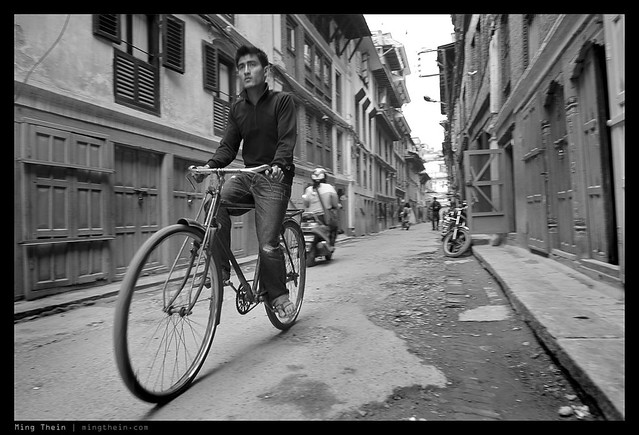
Photoessay: Monochromatic life in Kathmandu

The first part of an ongoing series of the streets and people of Kathmandu, Nepal. Shot in mid-2011 with a Nikon D700, 24/1.4 G and 85/1.4 G lenses.

_7032151bw copy

_7030456bw copy

_7030368bw copy

_7030506bw copy

_7031005bw copy

_7030468bw copy

_7031230bw copy

_7031292bw copy

_7031371bw copy

_7031404bw copy

_7031538bw copy

_7031965bw copy

_7032127bw copy

2012 Equipment picks for travel photography

This is an article that will probably go out of currency about six months after it’s published, but no matter; just because new cameras are released, it doesn’t reduce the usefulness or image-making ability of older ones. Travel is something I do for both work and pleasure; in my previous corporate life I used to travel heavily (think anywhere up to 100+ sectors per year) for work. My love for photography inevitably led me to carry a camera of some sort wherever i went – both to document my experiences as well as for use as stress release during my limited free time. Shooting is cathartic to me – I’m probably the only person I know who relaxes after a day of commercial shooting by taking pictures.

Traveling for meetings and other corporate reasons really takes most of the fun out of it; the TSA and other forms of airport security and administration do the rest. Much to my wife’s consternation, it’s taking me a little while to start enjoying it again.

The thought of going on a trip actually presents me with much anxiety: what the hell do I bring in the way of equipment? Early on in my photographic career, the choice was simple: everything that would fit into the bag, which at that point, was pretty much everything. Later, I’d take just new gear, or once again, if undecided, pretty much everything. However, my first trip with a significant other – Paris – showed me that hefting around all of that gear was both pointless when the primary purpose of your trip isn’t photography, as well as that it’s a sure way of annoying the hell out of your partner.

This considered, equipment choices changed from ‘how do I use X piece of gear?’ to ‘what is the minimum I can get away with and not feel like I’m missing anything?’ (My article on minimalism deals with this handily).

As a general rule of thumb, I don’t like to bring untried or untested gear with me unless I have absolutely no choice (my Vienna/ Prague trip at the end of 2011 was to get some images for Leica; that was the first time I was shooting the M9-P and 28/2.8 ASPH properly, and I paid for it occasionally with missed shots and questionable focus); there’s too much at stake if it breaks or doesn’t perform as expected. You’re probably not going to be able to repeat that trip to the Himalayas, so it’s probably a good idea to bring both a spare camera and a primary that you know can handle a bit of abuse.

What I do like a lot at the moment are both the raw shooting compacts – think the Ricoh GR-Digital III/ IV, Leica D-Lux 5/ Panasonic LX5; and the most compact of the system cameras. My current choice for travel is the Olympus OM-D, because of its image quality, huge responsiveness, small size – and more importantly, small system size – and ability to work well with longer lenses.

The Leica M9-P ranks pretty high up that list too – however, using anything over 50mm isn’t so easy without a magnifier, and if you’ve got one of those on, then you can kiss goodbye to your 28mm. It also isn’t so flexible when it comes to shooting food, for instance – another thing I enjoy. I do admit, it looks and feels nicer, though – but I’m shallow that way. (Why not travel in style if you can?) However, the biggest gotcha with the Leica is the liability – I don’t know how it is in other parts of the world, but to get insurance for cameras in Malaysia is near impossible, especially if you’re going to be taking them out of the country. And the premiums to fully cover an M system would probably cost a goodly portion of the trip itself.

I like to go with a two-lens kit these days – 24/28 and 85/90. This gives me two distinct perspectives, prime lens quality, fast apertures (with the low light ability and depth of field control that also implies) and (mostly) reduced size. This means the 24/1.4 AFS and 85/1.4 AFS on the D700; the Olympus 12/2 and 45/1.8 on the OM-D and Pen Mini; or some mixture of the Zeiss 28/2.8 Biogon, 50/2 Planar, Leica 28/2.8 ASPH and 50/1.4 ASPH on the M9 (anything longer being impractical). Where possible, I’ll generally also bring a spare body in the same mount, and perhaps also a highly capable compact – the Pen Mini and 20/1.7 pancake or Ricoh GR-Digital III usually fill this niche. I also like the Leica D-Lux 5, because its lens conveniently happens to go from 24 to 90mm…

The one hypothetical situation – which so far has not yet happened – where I’d make an unconventional equipment choice would be if I went skiing. The landscape opportunities are fantastic, but one generally needs more millimeters to make it work; however, there’s a lot of light, so they don’t have to be fast millimeters. I’d probably use the D800E and 28-300VR in a chest pouch, with a 45/2.8 P pancake in the front pocket for when the light gets low and I want something smaller for social evening activities.

If I’m going to an advanced country where spares are easily available, I’ll probably go with just one body; Japan would be a good example of this (though for some odd reason, I’ve always had two bodies whenever I’ve been there). This reduces weight drastically, and I know that I can still use my Nikon lenses if I have to pick up a used D700 or something to replace it. The other nice thing is worldwide support via NPS, which I’ve had to use in the past when the lens release button on my D3 fell off on the second day of my trip(!).

There are reasons for having two bodies, however – instant readiness is one of them – but it’s also important to consider how much of the trip you plan to spend shooting, and how much you plan to spend enjoying and experiencing being in a different place. It would be a shame to miss out on or have an incomplete experience because you’re too busy trying to get the shot. (I’m one of those strange people who experiences things by shooting them, so you may not necessarily want to follow exactly what I do here, either.)

So, distilling all that into a paragraph, my current camera choice would be the Olympus OM-D, 12/2 and 45/1.8 lenses. Either with a second OM-D body, or a Pen Mini as backup.

What about other equipment?

Well, batteries and chargers are a no-brainer. Figure out what you need for a full day of shooting, and bring one more so you can be charging and shooting at the same time. This number should be at least two. Ideally, you’d want your cameras to share batteries and chargers to improve backup, but this isn’t always possible. It seems that all camera makers want us to buy their horribly overpriced accessories all over again every time a new camera is released. Shame on you.

Spare cards are also a no-brainer. I generally bring three to four times what I think I’ll need; these days it’s usually 32 GB cards in the cameras, another two spares each, and some older 16GB spares.

Depending on how long you’re going to be on the road, you might want to consider bringing some sort of editing device or at least something to give you web access; I like the 11″ Apple MacBook Air because it’s both a proper computer, and light enough that you don’t notice you’ve got it. I don’t do any processing on it because of screen color accuracy issues, but I could if I had to. In fact, almost all of this blog is written from that machine. It also gives me somewhere to backup my files to at the end of the day. (Although I won’t do any photoshop work, I can do some light editing after seeing what works on a larger screen and what doesn’t.) After a two week trip, the last thing you want is for one of your cards to get corrupted and take all of your images with it. Backups are important: I’ve learned that the hard way in the past. Fitted into the USB ports are a pair of 32GB Sandisk Cruzer Fit USB drives, which are extremely small – they stick out about 5mm – but add another 64GB of solid state storage, which works as another backup. I’ve also got one of my portable drives with me, which holds a complete backup of my work at home – just in case something happens while I’m not there.

A comfortable bag is a must for moving from location to location, but when you’re there and shooting, you might want to consider a waist pouch or shooting jacket instead (depending of course on the climate). If I’m going with two bodies, I’d put a lens on each, spare cards and batteries in a cargo pants pocket, and off we go. It’s much, much more pleasant to shoot unencumbered without any bags or things that you might have to watch out for or remember to zip up and guard against thieves; you’ll be surprised how much of a difference it makes to your travel photography experience. I went with a shooting jacket last time, a couple of lenses in my pockets and one camera around my neck, and it was a hugely liberating experience.

Other things that are useful, but people seldom think of:
– Chewing gum.
– A permanent CD marker.
– Business cards, if you’re a pro photographer.
– Press passes – you’d be surprised how many times this has gotten me into places to get shots where the public wouldn’t normally be allowed.
– Duct tape, and cloth tape – it’s the magical stuff that holds the universe together. Both of them together, wrapped around that original particle, could probably have prevent the big bang from happening. Good thing they were inside the particle.
– Plastic ziploc bags, big enough to hold your cameras. This is my emergency rain cover, in case it gets really bad; however, you can take care of this to some extent by having a weather sealed camera. The lightest, smallest one in this class is the OM-D.
– A small flash, if you haven’t got one built into the camera; fill at night is useful.
– A tabletop tripod for long exposures; you can also rotate it through 90 degrees and brace it up against a window. I like the Manfrotto 345 set, which comes with some incredibly sturdy cast magnesium legs, a small ballhead, and an aluminum extension (which can be useful for small cameras, but absolutely too weak for larger ones).
– If you’re going to a hostile environment like the sea, then UV filters to fit all lenses.
– Spare lens caps and back caps**.
– Lens hoods. They’re good bumpers against impact protection.
– A small multitool. You might have to check this one in. Those little screwdrivers are extremely handy; actually, make sure you check your mount screws for tightness before leaving home – they have a curious proclivity to work themselves loose over time.
– Copies of your critical travel documents on a USB memory stick or memory card.
– Memory card reader; the compact direct-plug-in USB types are the most handy.
– A local sim card and cheap phone to put it in might be useful for extended trips.

**I usually tape two together, back-to-back, to make lens changing easier. Take the lens off the camera, put it onto your double-ended special, then take the other lens off and put it onto the camera. No fumbling with caps or leaving things unnecessarily uncovered. The alternative – aside from having two bodies – is to use a waist pouch or drop-in and forgo the caps entirely. Just make sure there isn’t anything else inside the pouch that could damage your lenses.

One last thing: don’t forget to have fun. It’s infinitely better to go with less gear and get creative to make do with what you did bring, rather than carry 30kg with you because you’re worried about the security of your hotel room and can’t bring yourself to leave anything behind, but at the same time don’t really want to walk around all day with it either. MT

Update, August 2012: I want to add the Sony RX100 to the list of recommended cameras. If you’re traveling in a group or with a partner, or doing any sort of travel at all where photography is not your primary objective, then consider taking along the RX100 instead of something larger. It’s barely noticeable until you need to get the shot, then it does it with a minimum of fuss and hides until it’s called upon again. It’s the very definition of the concept of photographic sufficiency.

____________

If you enjoyed this post, please consider supporting the site via Paypal (mingthein2@gmail.com); Ming Thein’s Email School of Photography – learn exactly what you want to learn, when you want to learn it or learn how to achieve a similar look with our Photoshop workflow DVDs.  You can also get your gear from Amazon.com via this referral link.  Prices are the same as normal, however a small portion of your purchase value is referred back to me. Thanks!

Don’t forget to like us on Facebook and join the Flickr group!

Travel minimalism: one lens to go

_M8_L1025017 copy
Canterbury in autumn. Leica M8, 21/1.4 ASPH

Every time I travel for personal purposes, I’m always torn between experiencing the place, and photographing the place. Photography is such a part of me that sometimes I feel that I experience and understand things more through trying to capture the essence of them. Or perhaps it’s because doing so forces you into conscientious observer mode, and this in turn makes one’s mind more receptive to things, and more willing to question what you see and find juxtapositions or contrasts.

_M8_L1024931bw copy
Canterbury Cathedral crypt. Leica M8, 21/1.4 ASPH

That aside one of the things which inevitably keeps me up the night before departure is trying to figure out what to bring equipment-wise. If it’s on assignment, then I bring everything I might possibly need, plus spares – to hell with overweight baggage, if you don’t have it, it could mean a lost job – on the other hand, if I’m traveling for myself, I’d rather carry as little gear as possible. Well, little enough that I don’t notice it after walking around for hours on end, but with sufficient coverage that I don’t get frustrated and feel like I missed a rare photographic opportunity because I didn’t bring along a wide angle. Or something along those lines.

_M8_L1026056bw copy
A Parisian in her natural habitat. Leica M8, 21/1.4 ASPH

My last personal vacation saw me bringing an Olympus Pen Mini, the 14-42 kit lens and a Panasonic 20/1.7 pancake. We went to the beach. Frankly this made the choice easy as I didn’t really want to expose any of the more expensive gear to moisture, salt and sand; the M9-P definitely would not have been suitable, and the D800 might have produced great landscapes, but it would also have worked fine as a boat anchor.

_M8_L1026132bw copy
Three conversations, Paris. Leica M8, 21/1.4 ASPH

I’ve been trying to fine-tune this over the years. I’ve been on trips where I did carry coverage from 14-450mm and a spare body; whilst I got some great images, I also had a sore back, and landed up leaving everything but one body and the 24-70 zoom in the hotel room for the last week. More crucially, I felt the images produced from that trip lacked focus; I brought everything, so subconsciously I was actually trying to capture everything. The upshot is a set of images that isn’t as strong as it could have been, and worse still, experiencing that slightly chaotic panicky feeling that you just might have missed a shot opportunity somewhere.

_0011006bw copy
Tate Modern yard, London. Ricoh GR Digital III

My preferred travel kit is a moderate wide, and a moderate telephoto – both fast – and one body. I might carry a spare compact or something similar as a backup, just in case. I’ve gone with the D700, 24/1.4 and 85/1.4 – this is an absolutely fantastic and hugely flexible combination – plus a spare compact, either the Fuji X100, Leica D-Lux 5, or my favorite, the Ricoh GR-Digital III. Most recently, I spent two weeks in Europe with an M9-P, 28 and 50mm lenses, plus the Pen Mini and 45/1.8 (giving me 90mm in a pocket). This was also an excellent combination, and in some ways better than the Nikon based setup due to weight and instant availability of the telephoto. However, it lagged hugely in low light performance. I think the next trip I take will probably be Micro 4/3 based; an OM-D and Pen Mini with 12, 20 and 45mm lenses will cover the vast majority of situations handily. And not weigh very much, either.

_0011022 copy
Piccadilly Circus, London. Ricoh GR Digital III

So what’s all of this talk about a single lens?** Or single camera? There are advantages to this approach: firstly, you’re unencumbered and free to enjoy the atmosphere, people and culture without feeling like a packhorse; a small camera around your neck is probably much easier to manage than an entire backpack full of lenses. Also, you don’t have to worry as much about security – frankly, carrying several Leica f1.4 Summiluxes and a Noctilux around even safe Singapore made me pretty nervous.

**Let me clarify: I don’t mean going with a 28-300, though I suppose this might be a viable option for some situations. That lens has more compromises than strengths, and if you don’t know how to manage your perspectives properly, then you’ll land up with weak images too, because you’ll always be trying to ‘zoom in’.

_0011001bw copy
The Shard, under construction. Ricoh GR Digital III

The main advantage, however, is that it frees up your mind from having to think about what perspective to take for a scene. Do you find the essence in the details, or do you go for something wider and more encompassing, with context? Trouble is, there is often no right answer – and from experience, I know that inevitably you’ll land up trying to make both work and being satisfied with neither. On the other hand, if you’ve got just one focal length, then you can pre visualize what your frame will look like; with sufficient experience, your eye naturally looks for compositions that fit within the perspective and angle of view of the lens you’ve got. Thus: instead of wondering what perspective to use, you’re free to spent that mental capacity on fine-tuning the elements inside the frame of the only perspective you have. It can be liberating – providing you’re thinking about the photograph, and not about the equipment you left at home. There’s also the side benefit of not having to change lenses, and thus always being ready.

_7017234bw copy
The doorway, Hanoi. Nikon D700, 85/1.4 G

I actually did this on several occasions. At the end of 2009, I made short trips to Oxford, Canterbury and Paris; for these I brought two lenses (21 and 50mm for the M8) but only used the 21. I did it again in 2010; the first trip saw me bringing a D700 and several lenses, plus the Ricoh GR-Digital III; I only used the Ricoh and its fixed 28mm because it was both much more convenient, as well as matching the way my eye was tuned at the time after my first Leica-M experience. I got wiser on the second trip and left everything behind except the GR-Digital III. Hanoi later that year saw me using only the D700 and 85/1.4 G.

_7017494 copy
A Vietnamese stereotype. Hanoi. Nikon D700, 85/1.4 G

If you are going to try this exercise, I’d recommend going for a wide normal rather than an ultra wide or a tele; for the simple reason that these are the most flexible focal lengths to use. 35-50mm can appear wide or moderately telephoto depending on how you choose to use the foreground elements in your scene. And at some point, chances are you’ll probably want to take a photo of yourself or your traveling companion (or both of you, or your family…you get the point) – and it’s generally much easier with something wide or normal than say a 300mm.

_M9P1_L1005025 copy
Prague castle and stars. Leica M9-P, 28/2.8 ASPH

Some people may find a telephoto easier to use in these kinds of situations because they can snipe from a distance; I’d personally advise against it because it’s very difficult to make images with context; and that’s one of the cornerstones of travel photography. The bokeh may be great, but if the background gives you no clue as to where the subject is, then the image could well have been shot anywhere – and that somewhat defeats the point of travel photography.

_M9P1_L1004062 copy
A Viennese moment. Leica M9-P, 28/2.8 ASPH

Personally, if I had to pick, I’d go with either a 28mm, or a 35mm – depending on whether my images would likely be more people-biased (longer), or more location-biased (wider). And it’d have to be fast, too; I’d be using the lens at night, and anything slower than 2.8 wouldn’t cut it. Frankly, in some situations, even f2.8 may be a little borderline. Finally, it’d have to go on something small, light and unobtrusive; responsiveness is important because your ability to anticipate things will be a little bit diminished thanks to the foreign environment. Right now, my choice is probably between the Olympus OM-D and Panasonic 20/1.7, the Ricoh GR-Digital III/ IV, or the Leica M9-P and a 35/1.4 ASPH FLE.

Give it a try. On your next trip, just use a 35 or 50 prime for at least a day or two; if it makes you feel better, bring along your zooms too, but don’t use them until you absolutely feel that you’re missing shots. MT

_M9P1_L1013074 copy
Wat Arun and Boat, Bangkok. Leica M9-P, 35/1.4 ASPH FLE

____________

Visit our Teaching Store to up your photographic game – including Photoshop Workflow DVDs and customized Email School of Photography; or go mobile with the Photography Compendium for iPad. You can also get your gear from B&H and Amazon. Prices are the same as normal, however a small portion of your purchase value is referred back to me. Thanks!

Don’t forget to like us on Facebook and join the reader Flickr group!

appstorebadge

Images and content copyright Ming Thein | mingthein.com 2012 onwards. All rights reserved

Photoessay: Piccadilly Circus by night

If this isn’t one of the most recognizable urban spaces on the planet, I’m not sure what is. Piccadilly Circus, London, is a gathering point for both locals and tourists, and all levels of the social stratum. The upscale thoroughfares of Regent Street, St. James and Piccadilly flow into a public square-cum-tube-station-cum-bus-stop-cum-traffic-junction, and mingle with the Theatre District and Chinatown in Shaftesbury Avenue, and the movie hub of Leicester Square.

I didn’t intend to shoot on this trip; I was based in Kuala Lumpur at the time and visiting London for work – to get some very confidential prospectuses securely printed, of all things – and only had a compact camera on me. Still, there are some places where you are compelled to break out a camera – of any sort – and shoot; this is one of them. And having a compact is not a bad thing in security-paranoid London; it just makes you like another tourist. Even better if it’s dusk, and your camera is black and nondescript. Not so good with the small sensor, but hey, there are compromises everywhere. MT

Series shot with a Ricoh GR-Digital III

_0011022 copy

_0011141 copy

_0011016 copy

_0011073 copy

_0011069bw copy

_0011148bw copy

_0011029bw copy