Photoessay: just outside the city…

_8B12780 copy

…Small slices of tranquility can be had. Even within city limits, for that matter. The Japanese are quite particular about their nature; like everything else, you get a sense of ordered chaos as an outsider – within defined boundaries, the wilds are allowed to run free. Go a bit further afield, and you might find something that’s actually a little more untamed. Still, there’s a different kind of compositional challenge to be had: see if you can eliminate any signs of man from an environment that might well be entirely artificial; regardless, autumn in Japan is quite a special time of the year because of the enormous variety of colours. It’s too bad timing such a trip is tricky and highly weather-depedant; we lucked out in 2013 when filming How To See Ep.2: Tokyo, but came a bit late last year. Today’s landscape images are a continuation of the unconventional landscapes from a couple of months ago from a slightly more conventional perspective. Half of them were shot in the Tokyo Botanical Gardens; the other half, on the side of a hillside and a river near Mt. Mitake, about an hour outside of Tokyo by train. I’m going to end with one comment on the last seven matched images really need to be viewed as large Ultraprints; hung sequentially the impact is like looking out of a window onto a garden in the full throes of fall. Any image from this series is available as an Ultraprint on request – just
shoot me an email
. Enjoy! MT

This series was shot with a Nikon D810, 24/3.5 PCE, AI 45/2.8 P, Zeiss 1.4/85 Otus and Voigtlander 180/4 APO-Lanthar lenses. Some images are stitched, all were processed withs PS Workflow II. You can also travel to Japan vicariously here, with How To See Ep.2: Tokyo…
[Read more…]

Daily meditations on photography, or, the purpose of instagram

IG

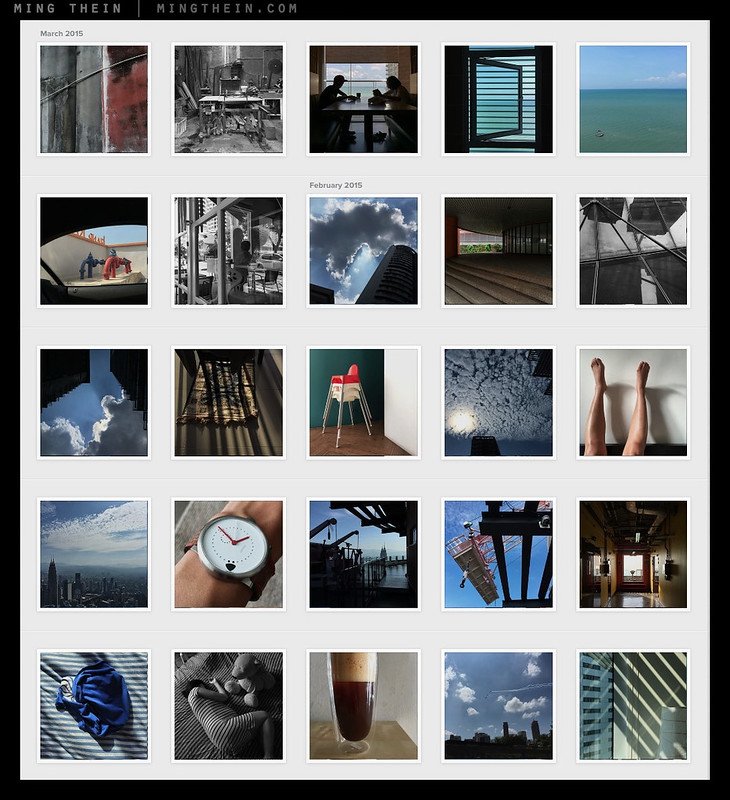
For a very, very long time, I was against instagram simply because of the mediocrity it perpetuated: run any crap image of a cat through one of our filters and make a masterpiece! Slowly, things changed. You could upload images you didn’t shoot with your phone. You didn’t have to filter them, even if they still had to be square. They actually introduced an editor with control closer to Photoshop than a cookie cutter (vertical and horizontal keystone correction, anybody?). I caved, and as previously announced, have been using it for some time – more than a year, in fact. (You can find me here.) Whilst the purpose for the majority of users is clear – it’s a visual social network, of course – my own rationale for using it has been far less clear until recently.

[Read more…]

The abstraction of an idea

_8B14086 copy
After all the people have gone home

In a previous post, I tackled the general concept of an abstract photograph. I think it can be refined down something of the following: an image which is balanced equally across the entire frame such at that no one area attracts your attention more than any other area; the eye wanders, takes in the details, and never really lingers. By this definition, there is no subject since no one area or element of the photograph stands out more than any other; however, you could probably also argue that the entire frame is really the subject. Semantics is a funny thing, though, and this isn’t quite the definition of the term: we must think in terms of essences and summaries instead. An ‘abstract’ of a paper or article is really the core idea distilled down to the simplest possible terms; the objective elevator pitch rather than the marketing tagline. Today’s article tackles the visual equivalent of that: how do we take an idea and translate that into something visual?

[Read more…]

Photoessay: From the streets of KL, #72

_RX103_DSC0106 copy
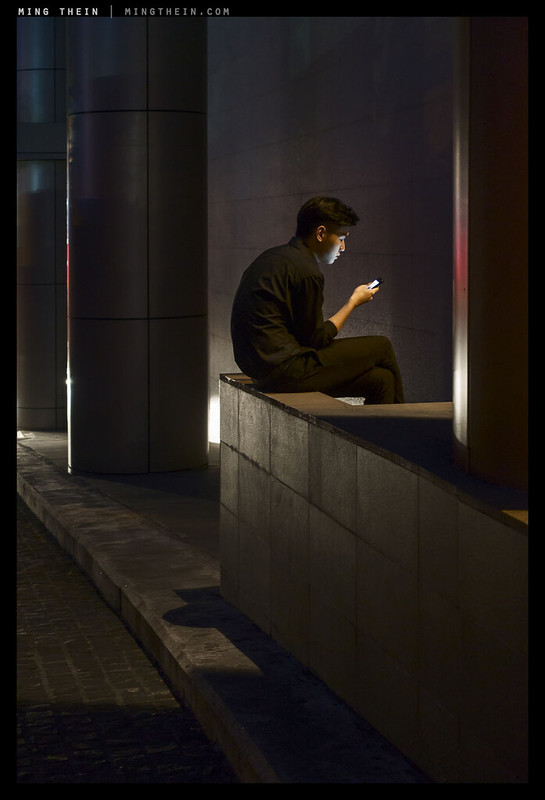
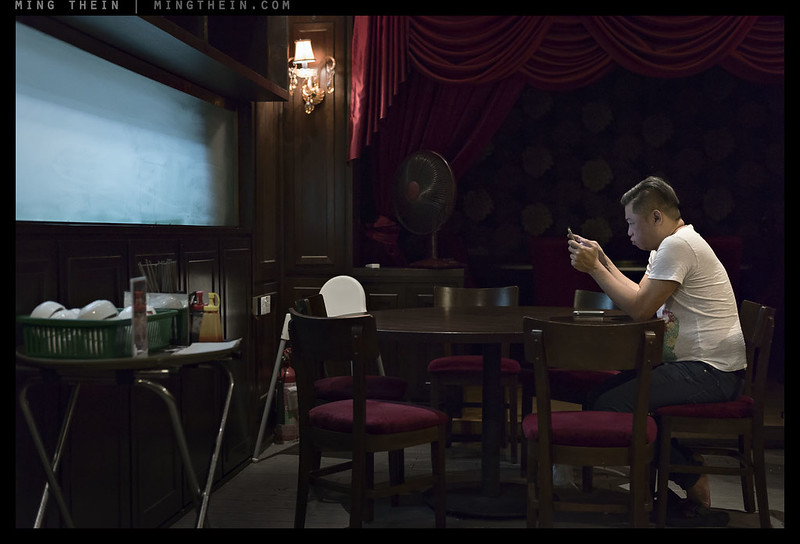
Connected isolation

It’s been a little while since I’ve posted any of the more conventional street photography with identifiable individuals. I suppose that’s a consequence of a change of creative direction towards images that are perhaps less literal and more everyman; photographs that can ask a question and make you have cause to contemplate them for a long time without really having an answer. Images that stick tend to be ones that are graphically shocking (could be positive or negative) or those that require some further digestion. Nevertheless, I still do make these images but instead curate them even more heavily than usual; today’s set perhaps more so because they’re made in what is a very familiar environment to me. What’s interesting is that many of these still come from a very small radius of places I’ve covered literally hundreds of times – I suppose that continual change is one of the joys of photography. This set spans some time, and as a result, quite some equipment too – from a first-generation RX100 to the CFV digital back to the D810. Postprocessing was mostly with PS Workflow II. Enjoy! MT

[Read more…]

Differences between eye and camera: practical implications

_G008000 copy
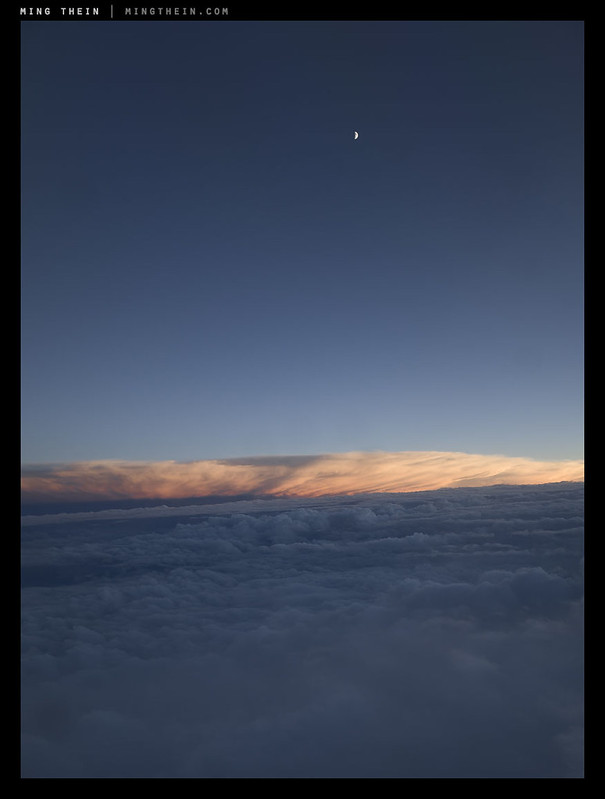
Why is it so difficult to get sunsets to appear ‘right’? Read on for the answer.

Many photographs do not work. Subsequently, we find out they do not work because there is a difference between what you saw and what your audience sees in the image. Sometimes this comes down to lack of skill in translating an idea, but often it’s more subtle than that: the camera doesn’t see what we see, and we need to be both highly aware of that and how to compensate for it. Yesterday’s photoessay is a good example: it’s no big deal to make a monochrome image, but our eyes only perceive a lack of color under very exceptional circumstances. Yet it’s these differences that make some images stand out, and others not really ‘work’.

[Read more…]

Photoessay: a different kind of KL cityscape

_8B24540 copy
Ordered cubism

I personally find one of the most challenging things to do is make compelling and different images in a situation that is a familiar one: your home city, your usual equipment with nothing particularly special or capable of making a distinctive look (or another way of looking at it is a general purpose tool with a very versatile shooting envelope), challenging weather, and to top it off, conditions that are not ideally conducive for creativity*. These were shot during a private workshop as examples; I have to simultaneously apologise to and thank my student at the time: firstly, I felt I could have made better images with a bit more sleep, but the conditions pushed me to really look for something different. In the end, I think this set fit the bill: I am happy because these are images that I have not only not produced in some form or other before, but images that I never conceptualised because I was not looking in those places either – even though it wasn’t my first time there. Enjoy! MT

*Prolonged lack of sleep from a newborn and a small apartment full of relatives.

This series was shot with a Nikon D810 and 24-120/4 VR, which is probably about as flexible as you can get.

[Read more…]

Avoidable photographic errors

_7503412 copy
Gratuitous header image.

Rule number one: there are no rules. A ‘mistake’ may not necessarily be a mistake if it helps convey the message or story or feeling intended by the photographer. I can easily think of multiple examples that go against every scenario described below. That said, for the most part, I’ve found these ‘mistakes’ to hold true. And if you want to achieve something very specific, then you either won’t be reading this article in the first place, or you’ll know when to bend the rules. The general viewing public probably has some preformed opinions of what is right/good, but these are born out of as much ignorance as conditioning by companies trying to sell more software or lenses or something else. There are rational reasons why these opinions may not necessarily be right in the context of fulfilling creative intention.

[Read more…]

Photoessay: Tokyo cityscapes

_8B11327 copy
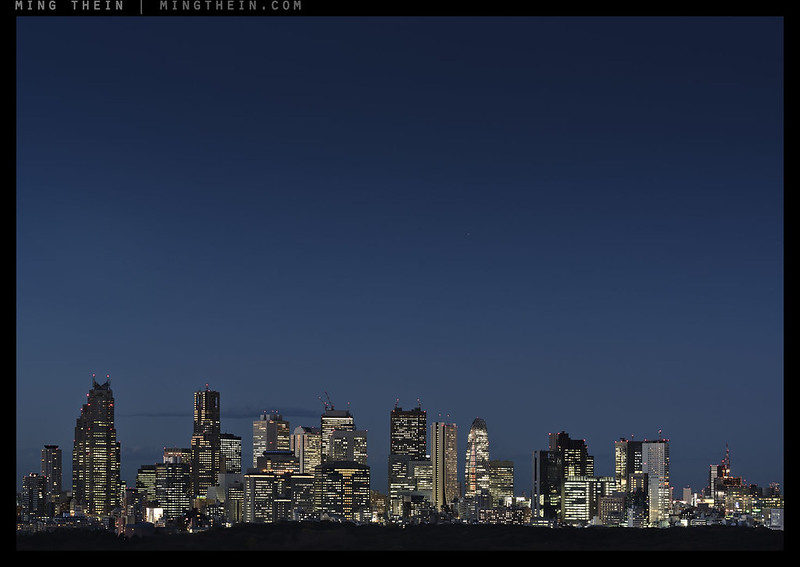
Skyline

We’re nearing the end of the images from the last trip to Tokyo. Today’s images are a continued evolution of the urban theme into something a bit more widespread; an attempt to capture the combined endless scale and whimsy of Tokyo. There are bits you might find surprising and challenging to your preconceptions of Japan – anything with space or trees or emptiness, for instance – but that’s the whole point, isn’t it? It is me giving in to my endless fascination for man-made light, texture and reflection in complementary colours. Enjoy! MT

This series was shot with a Nikon D810, D750, 24/3.5 PCE, 45/2.8P, Zeiss 1.4/85 Otus and Voigtlander 180/4 APO-Lanthar and processed with PS Workflow II; you can also travel vicariously to Japan with How To See Ep.2: Tokyo.

[Read more…]

WCSC Photography Competition 2015

WCSC competition

Just a little heads up for the Malaysian urban and architectural photographers in the audience today: I’ve been asked by a friend of mine to judge a photography competition run by the World Class Sustainable Cities conference for 2015. The theme is ‘Urban Regeneration Through Smart Partnerships’. There are two categories for >18 years and here, and information on previous conferences here. Good luck! MT

[Read more…]

On Assignment Photoessay: Abstraction in the machine

_8B00857 copy

Today’s photoessay is something a little different: the curated results from an assignment last year where I had an open creative brief; I was to document and photograph everything and anything at the given locations. The client was a heavy engineering/ construction company with everything going on from schools to subways to airports; it was both one of the most interesting assignments I’ve undertaken as well as one of the most satisfying – and simultaneously challenging.

Some of these images will be part of the larger exhibition in Hong Kong in June, so if you’re around, please come and say hello.

[Read more…]