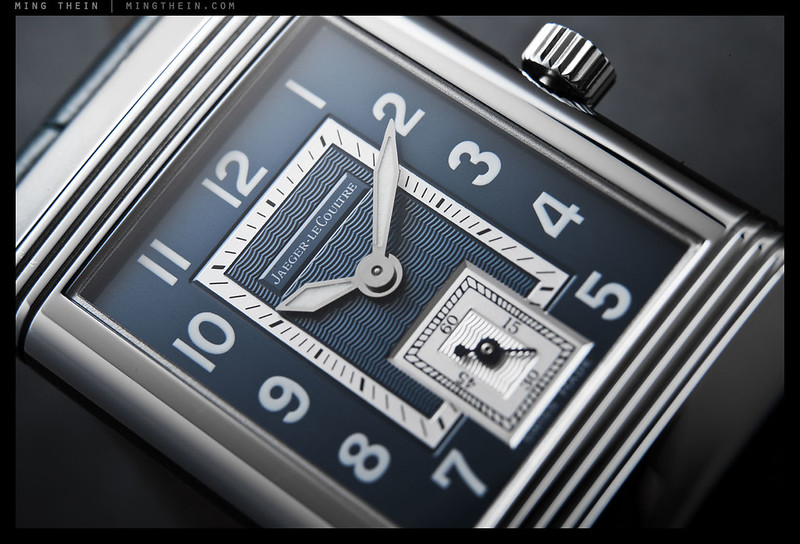
Photoessay: The Jaeger-LeCoultre Reverso Latitude

Not a commercial job, but one of those watches I’d personally encountered once, a long time ago in 2003, but was unable to afford at the time. Nevertheless, it left an impression on me, and from the time I did have the money to spare, I’ve been hunting one down. The problem is that they were very rare to begin with – I believe just 150 pieces were made – and with a very unique and beautiful dial; consequently, they’re rarer than hen’s teeth, and I’ve only ever seen one offered for sale new, and a grand total of zero on the secondary market. On my last trip to the factory, I did ask on the off chance that there was an unsold piece or two in the stockroom; there wasn’t.

On the way back to Kuala Lumpur, I passed by the watch shop in the airport without a second thought; after all, I was late for my flight at that point and had to run. Something compelled me to take a quick look; in a display case hiding behind a pillar was the very watch I’d been searching out for years. Some hasty negotiation ensued – it was obviously a new old stock piece bearing the marks of rough handling, but still sold as new with warranty – they were nice enough to give me a hefty discount and an additional strap. My wallet was suitably lightened, and I just managed to make my flight.

It’s a small watch by today’s standards, but is very thin (and of course mechanical) and pairs perfectly with a suit. The original Reversos were double sided with a blank metal case back, ostensibly to protect the watch while its wearer played polo; these days they’re either used as a second dial for complications, or a canvas for an engraving or art piece. I’m thinking of getting a Hokusai wave enameled on the back, but I’m in no hurry; these things are like tattoos; once it’s on, it’s for life.

If this story isn’t an example of fate and patience, I’m not sure what is. It seems that good things do come to those who wait. MT

This series shot with a Nikon D800E, SB900s, AFS 60/2.8 Micro and Zeiss ZF.2 2/50 Makro-Planar.

_8016093 copy

_8016078 copy

_8016036 copy

_8015995 copy

_8016086 copy

_8016060 copy

_8016089 copy

_8016014 copy

_8015972 copy

_8015953 copy

____________

Visit our Teaching Store to up your photographic game – including Photoshop Workflow DVDs and customized Email School of Photography; or go mobile with the Photography Compendium for iPad. You can also get your gear from B&H and Amazon. Prices are the same as normal, however a small portion of your purchase value is referred back to me. Thanks!

Don’t forget to like us on Facebook and join the reader Flickr group!

appstorebadge

Images and content copyright Ming Thein | mingthein.com 2012 onwards. All rights reserved

On Assignment: Time factors and big magnets

_8018601 copy
MRI machines are a lot thicker than they look on TV. Nikon D800E, Zeiss ZF.2 2.8/21 Distagon

I’ve shot for hospitals before, though not under these conditions. The day – well, night – before the shoot, I didn’t know I was going to be shooting the next day. Turns out that the hospital ordered a new MRI machine, at a cost of just RM13,000,000 – making it by far the most expensive object I’ve ever photographed. Here’s a bit of background on MRI machines: they’re so heavy that the room has to be purpose built to accommodate it, and the machine settled in then the rest of the place completed around the outside. (The control booth wasn’t operational or in place when I went there.) Apparently the magnet has to be cycled when it’s new to run in; during breaks in the cycling when the magnetic field strength dropped to zero was the only time we could go in to shoot it – they never fully turn the thing off. The upshot of all of this was that I had about half an hour to complete the shoot before they had to gas the MRI machine up with helium and start the cycling process again.

_8018659 copy
Inside the donut. Nikon D800E, Zeiss ZF.2 2.8/21 Distagon. Single SB900 with an umbrella outside to illuminate the patient and room. I don’t know why, but I kept thinking of Star Wars whilst I was inside here shooting.

There were about ten shots to complete inside the room – several of the room and machine itself, a few with a patient in it, and a couple with doctor-patient interaction. Needless to say, everything required lights to be brought in; not because ambient wasn’t bright enough, but because even, flat light is great for soothing patients but utterly crappy for providing definition on white objects. I used two SB900 speedlights for this shoot, triggered by the built in on my Nikon D800E. One was the main key light on a stand using an umbrella, and the other was placed to provide background fill. Whilst they work fine with line of sight, I do find myself wanting to hide them in ever more creative places; the inside of the MRI’s donut hole being one. I think I must be one of the few people to ever stick a flash inside an MRI machine. Perhaps I’ll pick up a set of Pocket Wizards at some point.

Half an hour and one haematoma on my finger later (I clipped it between the leg joins of my Gitzo while rushing to pack up) – good thing I was at a hospital – we were done. Possibly the most rushed shoot I’ve ever done, but also rather fun.

_8018592 copy
The Mammomat. Has a rather neat carbon fiber um…rack tray, too. Nikon D800E, Zeiss ZF.2 2/50 Makro-Planar. SB900 with umbrella from top right. The bluish color is actually a big glass panel that’s part of the machine; it changes color which supposedly helps keep patients calm.

The session actually started off here, in Mammography – it’s challenging to make a room that’s designed to have some separation between the x-ray source and the operator booth look cosy and inviting. And even more challenging was to show the process with a model patient in a way that didn’t reveal any skin.

The trick with lighting here was to balance the mid-warm ambient fluorescent with flash to provide definition and shadows; I shot manual for all of the exposures at about 0.5-1.5 stops under ambient. A SB900 with umbrella behind and above the subject provided face definition, with a second naked one on the floor provided room fill.

_8018569 copy
Showing everything while showing nothing. Nikon D800E, Zeiss ZF.2 2/50 Makro-Planar

____________

Enter our August 2012 competition – Compact Challenge – here!

If you enjoyed this post, please consider supporting the site via Paypal (mingthein2@gmail.com); Ming Thein’s Email School of Photography – learn exactly what you want to learn, when you want to learn it or learn how to achieve a similar look with our Photoshop workflow DVDs.  You can also get your gear from Amazon.com via this referral link.  Prices are the same as normal, however a small portion of your purchase value is referred back to me. Thanks!

Don’t forget to like us on Facebook and join the Flickr group!

Images and content copyright Ming Thein | mingthein.com 2012 onwards. All rights reserved

Inspirations from older cameras: the Nikon D3, part two

Part two of of this series. Part one was here.

_D3T1959 copy.jpg
Exclamation mark. D3, 300/2.8 VR

_3009420bw copy
Untitled. D3, 24-70

_3004568 copy.jpg
Rest. D3, 105VR

_3016416bw copy
Satay man. D3, 14-24

_3002491bw copy.jpg
Suggestions of a watch. D3, 105VR

_3035041 copy
Tour de Langkawi 2009. D3, 24-70

_3009669bw copy
The ‘hollywood’ shot. D3, 24-70

_3033285 copy
Virtual buildings. D3, 24-70

_3030120 copy
Blending in with nature. D3, 24-70

_3013397 copy
The proverbial rose. D3, 24-70

_3030678 copy
It can only be Fuji. D3, 24-70

_3035694 copy
Sunset. D3, 50/1.4 AFS

_3015669 copy
Children, Bangkok. D3, 14-24.

_3009001bw copy
Live retouching. D3, 24-70.

____________

Visit our Teaching Store to up your photographic game – including Photoshop Workflow DVDs and customized Email School of Photography; or go mobile with the Photography Compendium for iPad. You can also get your gear from B&H and Amazon. Prices are the same as normal, however a small portion of your purchase value is referred back to me. Thanks!

Don’t forget to like us on Facebook and join the reader Flickr group!

appstorebadge

Images and content copyright Ming Thein | mingthein.com 2012 onwards. All rights reserved

Inspirations from older cameras: the Nikon D3, part one

For me, the Nikon D3 is one of the cameras that revolutionized the way I shot – no longer was the camera the limitation in any way. It almost made things too easy; it forced me to rethink the way I shoot and stop trying to capture ‘everything’ in hyperreal detail and light (that was the previous challenge) and start moving myself to a more selective way of seeing. This was further reinforced by the Leica M8 that followed…

The D3 and D700 share the same sensor and much of their innards; the latter camera is still in service with me today, and used for things where I either don’t need the resolution or have to shoot under more demanding conditions than would be convenient with the D800E. And for anybody thinking of upgrading from an older DX camera, do it – you’re in for a treat.

Part one of the reinspiration is here. MT

_3031741 copy

Fushima-inarii, Kyoto. D3, 24-70

_3011285 copy

Hoan Kiem, Hanoi. D3, 70-300VR

_3036042bw copy

Rain. Kuala Lumpur. D3, 70-300VR

_3020442 copy

Scarlet ibis. D3, 70-300VR

_3014772 copy

Joy. D3, 24-70

_3009512bw copy

Detective in the city. D3, 24-70

_3004527 copy.jpg

Stamens. D3, 105VR

_3028702 copy

Imperial Palace moat, Tokyo. D3, 24-70.

_3028712bw copy

Shadows, Tokyo. D3, 24-70

_D3T0913 copy.jpg

Omega Dynamic. D3, 105VR

_3032473 copy

Daibutsu, Nara. D3, 24-70

____________

If you enjoyed this post, please consider supporting the site via Paypal (mingthein2@gmail.com) or via Ming Thein’s Email School of Photography – learn exactly what you want to learn, when you want to learn itYou can also get your gear from Amazon.com via this referral link.  Prices are the same as normal, however a small portion of your purchase value is referred back to me. Thanks!

Don’t forget to like us on Facebook!

Inspirations from older cameras: the Nikon D200, part two

Part two of the Nikon D200 inspirations. Part one was here. MT

_N213335 copy.jpg
Bluetit

_M212668bw copy.jpg
Under the arch

_M201785 copy.jpg
Traffic flow

_N212539 copy.jpg
Hanging

_M227348 copy.jpg
Kinkakuji in summer

_N215298 copy.jpg
Town crier

_M217573bw copy.jpg
Suggestions of life

_M216645 copy.jpg
Observing the observatory

_M229484 copy.jpg
Pea soup

_N205510 copy.jpg
Echoes

_N211097 copy.jpg
The underside of a ladybug

_M222758 copy.jpg
Fingers

_N206589 copy.jpg
Distorted reality, II

_N206051bw copy.jpg
In a hurry

____________

The inaugural mingthein.com photography contest closes 31 July 2012 – the more people entering, the larger the cash prize! Enter here

If you enjoyed this post, please consider supporting the site via Paypal (mingthein2@gmail.com) or via Ming Thein’s Email School of Photography – learn exactly what you want to learn, when you want to learn itYou can also get your gear from Amazon.com via this referral link.  Prices are the same as normal, however a small portion of your purchase value is referred back to me. Thanks!

Don’t forget to like us on Facebook!

Inspirations from older cameras: the Nikon D200, part one

A pair of D200s replaced my D2H as my workhorses – I shot extensively with these cameras from around mid 2006 to early 2008, until I got a D3. They managed to improve on the low light performance of the D2H, while increasing resolution by a considerable amount; popularly thought of as ‘D2x lite’. The only issue was mediocre AF, and at best average battery performance – I’d have to carry five or six to feed the pair of monsters on a heavy day of shooting. MT

_N213150bw copy.jpg
The end of all things

_N215552bw copy.jpg
Movement

_N210302 copy.jpg
Morning fog

_M228918bw copy.jpg
Animals with personality

_N201289 copy.jpg
Fighting, passing on a message, embracing…only they know.

_M200464b copy.jpg
Lange 1815.

_M224254 copy.jpg
Mosaic

_M230553 copy.jpg
A Parisian in London

_M225091 copy.jpg
Alone

_N211182 copy.jpg
Time for a rest

_M226879 copy.jpg
Japan in a lantern

_N205015bw copy.jpg
Traffic

____________

The inaugural mingthein.com photography contest closes 31 July 2012 – the more people entering, the larger the cash prize! Enter here

If you enjoyed this post, please consider supporting the site via Paypal (mingthein2@gmail.com) or via Ming Thein’s Email School of Photography – learn exactly what you want to learn, when you want to learn itYou can also get your gear from Amazon.com via this referral link.  Prices are the same as normal, however a small portion of your purchase value is referred back to me. Thanks!

Don’t forget to like us on Facebook!

Inspirations from older cameras: the Nikon D2H, part 2

The second part of the inspirations series in tribute to the Nikon D2H…part one was here. MT

_MT70034bw copy.jpg
The ballet

_MT87548 copy.jpg
Out of place and time

_M103023 copy.jpg
Snowy echoes

_MT52800bw copy.jpg
Column wheel chronograph

_M101532bw copy.jpg
Fur

_MT76744 copy.jpg
Cattle egret

_MT25431bw copy.jpg
Something’s going on in the square

_MT98674bw copy.jpg
Wondering where to put it

_MT87306 copy.jpg
Temple spires

_MT90350 copy.jpg
A bird portrait

_MT68786 copy.jpg
Dragonflies

_MT51257bw copy.jpg
London through the gap

____________

The inaugural mingthein.com photography contest closes 31 July 2012 – the more people entering, the larger the cash prize! Enter here

If you enjoyed this post, please consider supporting the site via Paypal (mingthein2@gmail.com) or via Ming Thein’s Email School of Photography – learn exactly what you want to learn, when you want to learn itYou can also get your gear from Amazon.com via this referral link.  Prices are the same as normal, however a small portion of your purchase value is referred back to me. Thanks!

Don’t forget to like us on Facebook!

Long term review: The Carl Zeiss ZF.2 2/28 Distagon T*

_5100_DSC1460 copy
A cinematic lens needs a cinematic product shot.

I’ve been lucky enough to own and use a lot of lenses in my time. And some of them pretty exceptional – off the top of my head, there’s the Nikon 200/2; the Leica 50/0.95 Noctilux-M ASPH; the Leica 21/1.4 Summilux-M ASPH; the Leica 35/1.4 ASPH FLE (you can probably see where this is going); the Leica 50/2 APO; the Nikon 85/1.4 G; the Zeiss ZF 2/100 Makro Planar; the Nikon 85/2.8 PCE…suffice to say, it would be difficult to pick one as an outright favorite. But I think if there ever was a contender, then it’d be the Zeiss ZF.2 2/28 Distagon T*.

_5100_DSC1424bw copy

Firstly, it’s not a technically perfect lens by any stretch of the imagination. In fact, it tends to score quite lowly on common testing metrics – especially in the corners – because its defining signature is highly pronounced field curvature. Imagine a ball around the camera; the plane of focus for this lens follows the surface of that sphere. It lends a very unique rendition to subjects shot with it because it has the property of emphasizing the out of focus areas by making them effectively further away from the camera. This, in turn, results in greater separation between the subject and background – it’s not always obvious, but if you shoot the same scene with a relatively flat-field lens like the Nikon 24/1.4, you can instantly see the difference.

_5100_DSC1558 copy
Proper DOF scales, but they’re too short.

This property makes for great bokeh and a very cinematic rendering. In fact, the earlier Contax/ Yashica mount version of the lens is known as the ‘Hollywood Distagon’ for its huge popularity amongst filmmakers for use in indoor scenes; I wouldn’t be surprised if the majority of these lenses landed up being converted to some cinema mount. As far as I can tell from their block diagrams, the ZF and ZF.2 versions are almost (if not exactly) identical optically, with some minor updates to coatings and the like – as well as a different mount, of course.

_7022462 copy
Dessert. Nikon D700, ZF2 2/28

On axis, there’s plenty of sharpness at every aperture. You cannot focus and recompose with this lens; use either live view or AF assist to focus edge subjects, else they will be out of focus. f4 seems to be the optimal aperture, but frankly there’s not a lot of difference from wide open. However, you’ll need at least f5.6 on full frame before your depth of field covers the effects of field curvature completely. Similarly, the lens vignettes noticeably at f2 – perhaps 1-1.5 stops in the corners – which almost disappears by f5.6. All of this adds to the flavor.

_7013522 copy
Fire. Nikon D700, ZF2 2/28

The one optical quality that isn’t so hot is a propensity for purple fringing on bright contrast edges, especially noticeable around in-focus backlit subjects; it goes away with stopping down. It doesn’t look like CA, which makes me suspect that it’s an odd interaction of the older lens design with digital sensors. For most subjects, it’s fairly easy to correct by masking out the affected area and desaturating the magenta channel. There is some slight CA in the corners, but it’s almost completely gone by f4. Thanks to the excellent coating, flare is almost entirely absent – point the lens into any light source you wish, just watch your eyes. It’s a great lens for shooting contra-jour; what little flare does show (if the angle is just right) is mild and cinematic.

_7023450 copy
That’s the most flare I’ve ever been able to get out of this lens. Nikon D700, ZF2 2/28

The ZF 28 has a rounded-polygon aperture with 9 blades; it isn’t perfectly circular, but I can’t complain about the bokeh – it’s absolutely beautiful, and renders even complex backgrounds in a pleasingly melted fashion. There are very slight highlight fringes on out of focus point sources, but the transition is fairly gentle so it’s not at all distracting.

_7004487 copy
All about the bokeh. Nikon D700, ZF2 2/28

I find that the Zeiss ZF lenses seem to fall into two camps – there’s those with a very ‘crisp’ rendition, like the 2.8/21 Distagon, the 2/50 Makro-Planar and the 2/100 Makro-Planar, and those with a softer rendition, like the 1.4/50 Planar and 1.5/85 Planar. The 2/28 seems to straddle those two camps – it has higher contrast than the latter group, but not quite as much punch as the former. I personally find it very pleasing.

_7004875bw copy
Waiting. The 28 Distagon’s excellent tonal separation makes for great B&W conversions, too. Nikon D700, ZF2 2/28

Like all Zeiss lenses, microcontrast is excellent thanks to the T* coating. Speaking of coatings, the first few elements of the lens actually seem to disappear when you look into the front – this speaks volumes about little light loss there is going on inside the optics. This translates into excellent light transmission – T2.1, in fact. (It’s the same lens optically as the Zeiss CP.2 T2.1/28, but with different focus gearing and a much smaller price tag.)

_7021599 copy
Kitchen portrait. Nikon D700, ZF2 2/28

Being a manual focus lens, you’re probably wondering how practical it is for regular photography – the answer is that it’s not too bad, but you’ll definitely see the benefit in having a split prism or similar screen installed. All modern DSLRs have focusing screens with a narrow scatter angle that are optimized for brightness with slow zooms rather than focusing snap; in fact, it’s a slow change that’s been ongoing since the beginnings of autofocus.

_3100_DSC0067 copy
Untitled, Nikon D3100, ZF2 2/28

You’ll probably find it nearly impossible to focus with an entry level APS-C DSLR; their focusing screens don’t have anywhere near enough magnification or ‘snap’ to make life easy. Although you can use the focusing aids – the green dot and arrows for Nikon users, or the beep for Canon shooters – depth of field with the 28 Distagon is shallow enough that you need to take care, because there’s a bit of range in the focus ring position for which the dot will stay lit or the beep will sound. And the extreme ends of that range will be clearly out of focus if the lens is shot wide open. You could stop down and use the DOF scales, of course, but the focus ring throw is a bit too short and the DOF scales too incomplete for that.

_7022547 copy
Coffee time. Nikon D700, ZF2 2/28

One nice feature is that the lens focuses very close indeed – 25cm from the sensor plane – for some interesting closeup angles. Optical performance remains consistently excellent even at this focusing distance.

You’ll notice I haven’t said much about construction – that’s a good thing. Use any of the ZF or ZE lenses (optics are of course the same) and you’re in for a treat. They’re solid, fully metal (anodized aluminum barrels, I believe) with chromed brass mounts and buttery smooth focus throws; just enough resistance not to move or be nudged, but with a really nice tactile feel that reminds me of a well-damped heavy piston moving through oil, or something similar. For want of a better analogy, the lenses feel like scientific instruments. On the ZF.2 versions, there’s an aperture ring that locks at f22 for electronic control on modern Nikons. The ZF version has ‘rabbit ears’ for coupling with earlier cameras’ metering pins. And the ZE version is fully electronic with no aperture ring at all.

_7024569 copy
Stair #173. Nikon D700, Zeiss ZF2 2/28

There are a few areas for improvement, though – while the hood bayonet mechanism is beautifully made and locks with a nice positive detent, the hood itself is easily dinged and scratched on the rim if bumped into something. A rubber lip would be nice. And the velvet flocking on the inside of the hood might be great at preventing stray light and flare, but it’s also very good at picking up dirt (especially light-colored dirt) and seems to peel off the metal quite easily. To be honest, I land up not using mine a lot of they time because I’m particular enough to like to keep my equipment pristine. Finally, the lens caps need help – there’s not enough thread on the edges to keep them securely gripping the filter ring; the springs aren’t strong enough to keep the caps from moving if bumped; and they’re impossible to remove if the hood is attached. I’ve replaced all of my Zeiss caps with Nikon ones.

_7013841 copy
Mt. Yotei wears a hat. Nikon D700, ZF2 2/28

If you think I’m gushing about this lens, it’s solely because of the pictorial results I get from it justify it. To my eyes, they have a special quality that I rarely see, and just makes images that pop – with saturated, slightly warm colors, great microcontrast separation, and a very three-dimensional rendering. And the enjoyable tactility of the thing as an object doesn’t do any harm, either. Frankly, if they did an M-mount version with thes same optical formula – size be damned – this would be permanently welded to my M9-P.

_7008766 copy
Perbadanan Putrajaya. (Vignetting added). Nikon D700, ZF2 2/28

How does it compare to the other 28s or 28 equivalents I’ve used? This is an interesting question, because the new Nikon AFS 28/1.8 G (which I recently reviewed here) seems to actually have a lot of the same optical properties as the Zeiss – field curvature, great central sharpness, smooth bokeh, high transmission – and most usefully, autofocus. Honestly, I think the Nikon comes very close; however, the one missing ingredient is microcontrast – it just doesn’t pop in the same way as the Zeiss. Color saturation is a little lower, too. I’ve come to the conclusion that if I’m running and gunning, I’ll take the Nikon, but if I’ve got time to craft the image, then it’s the Zeiss all the way. I don’t think any of the other Nikon mount 28s are in the running, even the legendary f1.4; admittedly, it’s been a long time since I’ve used one. Both lenses have some distortion, which would probably render them unsuitable for architectural work without correction; I think they make much better contextual documentary lenses anyway.

_7012699 copy
Train driver. Nikon D700, ZF2 2/28

I admit I’m a bit of a 28mm FOV junkie, so I’ve tried many lenses on different mounts and formats; in my mind, the two interesting competitors are the Leica 21/1.4 Summilux-M ASPH and Zeiss ZM 2.8/21 Biogon, both on the 1.3x crop Leica M8 rangefinder. The former is the only wide I’ve ever used that gives the same sort of subject separation as a telephoto; the latter has similar 3D qualities to the ZF 2/28, and in fact reminds me quite a bit of the ZF 2.8/21 Distagon, too. Unfortunately, I haven’t had a chance to evaluate the Leica 28/2 Summilux ASPH in any great detail, and the Leica 28/2.8 ASPH is very sharp, but a little characterless. The ZM 2.8/28 is a very competent lens, but missing that little something I can’t quite put my finger on.

_7009842 copy
Riding the big yellow snake. Nikon D700, ZF2 2/28

I don’t say this lightly, but despite its optical imperfections, the ZF.2 2/28 Distagon joins my personal pantheon of great lenses – if you’re a fan of cinematic rendering and the 28mm FOV, then this is the lens for you. It positively shines on full frame, but will do well on APS-C cameras too – if you can focus it reliably. Now, if only they’d make an autofocus version…MT

Note: some of you may be wondering why none of the images from this review were shot with the D800E; the honest answer is because I haven’t had a chance yet. However, my initial testing shows that the lens continues to perform as expected and without issue on the higher-resolution sensor.

Addendum: If you’re a Canon shooter, I actually recommend buying the Nikon (ZF/ZF.2) versions if you have a mirrorless cameras as well – you can then use this lens on the CSC with an adaptor, and retain full aperture control. This isn’t possible with the Canon version as the diaphragm is activated electronically.

Both versions of the lens are available here from B&H or Amazon.

____________

Visit our Teaching Store to up your photographic game – including Photoshop Workflow DVDs and customized Email School of Photography; or go mobile with the Photography Compendium for iPad. You can also get your gear from B&H and Amazon. Prices are the same as normal, however a small portion of your purchase value is referred back to me. Thanks!

Don’t forget to like us on Facebook and join the reader Flickr group!

appstorebadge

Images and content copyright Ming Thein | mingthein.com 2012 onwards. All rights reserved

_7004405bw copy

Roots. Nikon D700, ZF2 2/28

Inspirations from older cameras: the Nikon D2H, part 1

Possibly one of the most unpopular Nikons ever, and certainly the most derided professional DSLR – the D2H had a mere 4.2MP (the 0.2 mattered, when you only had 4.2 in total) when launched in 2004; its direct competition, the Canon 1D Mark II, had double that at 8MP. Worse still, Nikon’s much feted low noise JFET LBCAST sensor was in fact extremely noisy and pretty much unusable at ISO 1600 and above; an updated version – the D2Hs – actually had very good high ISO performance, but by then, the damage was done.

What the camera did do well was be insanely responsive – from the lighting-fast AF system, to 40ms shutter lag and hair trigger buttons, to 8fps shooting, it just felt alive. It was also a great teaching tool, precisely because it was so unforgiving of exposure or WB errors that you just had to learn to get it right, or not get a useable shot at all. When you did get it right, the D2H punched way above its pixel class – it resolved about the same amount of detail as my 6MP D70, and had very clean, high-acuity pixels; the unique sensor architecture also made for a beautiful tonal response, which doesn’t seem to exist in any camera today – the closest we get is the Leica M8 and M9.

I shot nearly two hundred thousand frames with this camera – picking the best few is going to be tough, so we’ll do this in a few parts. Part one is here, and part two follows. Enjoy! MT

_M102965 copy.jpg
Blue mountains

_MT52393 copy.jpg
Early watch work

_MT84782 copy.jpg
Scarlet ibis

_MT40136 copy.jpg
I wish it were real

_MT87546 copy.jpg
Umbrellas in Bangkok

_MT18359bw copy.jpg
Rush hour in London

_MT42076bw copy.jpg
It’s suspicious because the book is upside down

_MT98459 copy.jpg
Swords

_MT15600 copy.jpg
Inside the Arc de Triomphe

_MT77109 copy.jpg
Crowned pigeon

____________

The inaugural mingthein.com photography contest closes 31 July 2012 – the more people entering, the larger the cash prize! Enter here

If you enjoyed this post, please consider supporting the site via Paypal (mingthein2@gmail.com) or via Ming Thein’s Email School of Photography – learn exactly what you want to learn, when you want to learn itYou can also get your gear from Amazon.com via this referral link.  Prices are the same as normal, however a small portion of your purchase value is referred back to me. Thanks!

Don’t forget to like us on Facebook!

Nikon D800/ D800E left focus problem update: fixed successfully!

Just got my D800E back from NPS. Apparently, the cause of the focusing problem in all cases is some inaccurate calibration data entered during the alignment/ calibration process. I was told it’s basically a case of hooking the camera up to the laser calibration jig, and letting a piece of software run a calibration routine point by point – there are no physical or mechanical adjustments made to the camera. The software then writes this somewhere in the camera’s ROM for future use. All testing is done with the 50/1.4, and the instrumentation is apparently sensitive enough to detect minor focus errors – they’re also present even on teles, but less obvious, is what I was told.

Also asked about the new firmware that’s appearing in some cameras – apparently it’s legitimate, but not officially downloadable yet. No news on when that might be. My camera still has the same firmware it went in with – A 1.00, B 1.01, L 1.006.

The good news is that all of the wides I tried the camera with now focus consistently between AF and live view, i.e. there’s no difference between the results from either AF system. I repeated the test a number of times, each time with the camera locked down on a Manfrotto Hydrostat head on top of a Gitzo 5-series systematic tripod, using flash. (Let’s just say that camera shake is a non-issue.) However, it’s also revealed that lenses are a lot less perfect and symmetrical than we would like them to be…the D800E has one seriously demanding sensor.

D800E-af test-post-fix

This example set shot with the 28/1.8G at f1.8. The original size is visible here, which is a screen shot of 100% crops.

Conclusion: problem solved. If you do have the left side AF issue, then send it in and insist they look at it – because there exists a fix, and it works. Barring any further AF oddities (it’s night time here and I haven’t had a chance to test AF tracking or 51-point 3D yet), I’m considering this issue solved. Thanks to the folks at Nikon Malaysia for turning around the camera so fast!

I’m off to break out the LensAlign to run AF fine tune on the rest of my lenses again. MT

____________

Visit our Teaching Store to up your photographic game – including Photoshop Workflow DVDs and customized Email School of Photography; or go mobile with the Photography Compendium for iPad. You can also get your gear from B&H and Amazon. Prices are the same as normal, however a small portion of your purchase value is referred back to me. Thanks!

Don’t forget to like us on Facebook and join the reader Flickr group!

appstorebadge

Images and content copyright Ming Thein | mingthein.com 2012 onwards. All rights reserved